Mike James “Generations Apart: Two Poets on One Theme”

.

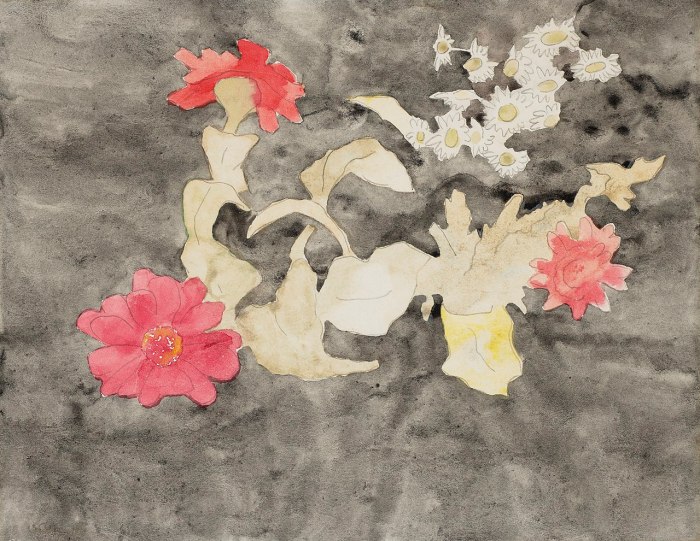
Charles_demuth_zinnias093342)

.

Generations Apart: Two Poets on One Theme

A Review of Once Upon a Twin, by Raymond Luczak

and New York Diary, by Tim Dlugos

.

Here are two books (one poetry, one prose) which cover similar material in different ways. The approaches are informed as much by generational shifts in attitude and sense of self as they are by genre.

Tim Dlugos is one of the many poets, artists, and musicians who died from AIDS. (The list is too long for one article, but Jack Smith, Jim Brodey, Karl Tierney, and Klaus Nomi are among the not-often-mentioned-enough.)

Dlugos was in the generation right after Ted Berrigan’s and his work often has a similar chatty, try-anything feel. David Trinidad, who edited New York Diary, also edited A Fast Life: The Collected Poems of Tim Dlugos. That book is a must-have for anyone who loves poetry or for anyone interested in that era. (Beautiful Aliens: A Steve Abbott Reader is another key and recent text.)

New York Diary serves as a sort of appendix to A Fast Life. The diary chronicles the summer and fall of 1976 when the twenty-something Dlugos moves to New York City. He’s appearing in magazines. He’s already published one small collection. He’s helping with readings and presses. Most importantly (to the diary and to a lesser extent the poems), he’s living. He’s flirting with the famous and the near famous and having anonymous sex with the unknown.

There are two audiences for New York Diary. The first is Dlugos completest. His fans are not legion, but they are devoted and passionate. This book will not disappoint them because it shows Dlugos working on his poems of “spontaneous goofs, flights, body motions” while also tracking his day-to-day.

It would be wrong to state that New York Diary should be read only by scholars and devoted fans. The book is enjoyable for any fan of poetry gossip because Dlugos is such a wonderful line-by-line writer. His entries can be notational, but he sketches out the ambience of his time in quick, jagged, and jazzy lines. Here are a few entries which can be read without context:

“Reminds me of a nun, without the saving gutsiness.” “In middle of a dance-floor sound bombardment, I discovered S&M component of disco.” “Clean, salt-water taste of his body.” “So much time still taken up w/ indecision.” “Phone booth has been put up outside front door. I haven’t sunbathed in a week.”

As much in his diary as in his so-necessary poetry, Dlugos is joyfully quotable. Within ten lines he can be graceful, funny, sad, and catty. On rare occasions he can be all at once.

Raymond Luczak is from the generation after Dlugos. He is a queer, deaf poet who is very much alive. He is as concerned with recording his life in his poetry as Dlugos was with recording it in his Diary. Maybe more so, since Luczak never seems to draw a line in regards to what he is willing to share with his readers. The only adjustments he makes are the adjustments of craft. Luczak is a skilled craftsman and this collection shows him operating within a variety of syntactical styles. The poems are all autobiographical, but he speaks in many voices.

It’s often dangerous to suppose that a poet’s work is autobiographical. Rimbaud and ten thousand poets since have made it clear that “I is another.” Luczak, however, confirms the autobiographical nature of these poems in a brief and interesting afterward. Instead of muddying the poems with explanations, he provides context for the catalysts behind his writing life.

Luczak’s skill is shown throughout, but he especially excels in small, subtle touches. The longest title in the collection has the fewest words. It’s a list poem called, “the easiest words to lipread in a school yard (even if you’re not deaf.)” Here are the last five words to the poem: “sicko / showoff / stupid / you girlie.” The additional word in the last line surprises the reader and frames the collection. The poet is not only deaf. He is queer. And he is Catholic. And then he is a foster child. His life unfolds and the hits keep coming.

He weaves his themes together throughout in poems where “anything forbidden / becomes even more desired.” The collection shows his growth from being a timid and clumsy child into a “serpent tongue of hiss” with a “catalog of grievances.” All the while, Once Upon a Twin may or may not be a false narrative. The memories are real, but stories and the lens they are viewed through change over time.

One of the many striking things about this collection, as well as Luczak’s poetry in general, is the immediacy and directness. He is not a poet who hints. He is a poet who reports. In Once Upon a Twin he has submerged a diving bell into his memory. He makes his readers grateful for the inventory he brings back.

.

Books Reviewed:

Once Upon a Twin, by Raymond Luczak
Gallaudet University Press, 2021
Poetry, $15.95

New York Diary by Tim Dlugos
Edited by David Trinidad
Sibling Rivalry Press, 2021
Prose, $15.95

.

.

About the Author: Mike James makes his home outside Nashville, Tennessee. He has published in numerous magazines, large and small, throughout the country. His 18 poetry collections include: Leftover Distances (Luchador), Parades (Alien Buddha), Jumping Drawbridges in Technicolor (Blue Horse), and Crows in the Jukebox (Bottom Dog), He has received multiple Pushcart and Best of the Net nominations.

.

More Reviews by Mike James:

Mike James reviews Mingo Town & Memories by Larry Smith

Mike James reviews “Dead Letter Office: Selected Poems” By Marko Pogacar

Mike James reviews Beautiful Aliens: A Steve Abbott Reader and Have You Seen This Man? The Castro Poems of Karl Tierney

.

Image Credit: Charles Demuth “Zinnias” (1915) Public Domain
Mike James Reviews Wave If You Can See Me By Susan Ludvigson

.

91UqNQ1MB-L

.

Mike James Reviews

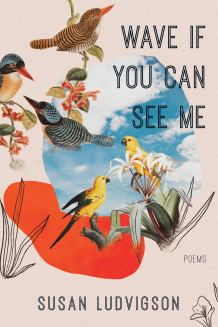
Wave If You Can See Me

By Susan Ludvigson

.

In “How It Can Happen,” one of the first poems in this fine new collection, the narrator imagines death as Shakespeare’s “other country.”  She writes, “I go with you, / but not all the way to your destination. / I wait in a dark house while you are taken / to a secret location. / We knew this could happen.”

The last line is instructive because it hints at a foreshadowing which haunts so many of these poems. In poem-after-poem the narrator is never sure of what’s across the river, but she’s certain it’s bad. A bridge will suddenly give way. Flood waters will rise too quickly. The villagers at the next exit won’t be friendly.

The dread is natural since so many of the poems are concerned with the death of the poet’s spouse, novelist Scott Ely. Many are not elegies as much as they are re-imaginings of an old life and dream-like restructurings of the current one. In the wonderfully titled “You Could Be Drinking Faulkner’s Bourbon,” she pictures what her husband might be doing in that other country. The poem moves from image to image, then concludes with a leap of transcendence: “we tell ourselves we’d like to know / but knowing / puts a period on speculation / and we are opposed / even in esoteric theory / to endings.”

From a technical standpoint, the addition of the four words “even in esoteric theory” deepens the poem. If good writing is about surprising the reader, those words surprise by their placement. “Esoteric theory” may not be the most sonically pleasing phrase, but it serves well to play off the narrator’s “speculations” and to strengthen the poem’s conclusion. The narrator is not just opposed to death and all the sorrows death brings. The narrator is opposed to all finality, even of the most far flung variety.

For Ludvigson, mourning is not relentless. Death is to be accepted. If Ludvigson never imagines death as gentlemen caller the way Emily Dickinson did, neither does she shy away from placing a spot at the table for him to sit. The narrator in “Too Late” tries to take in both her dream life and her new life as she travels without fear. “In the new country, / I try to ask directions, tell someone / how far we are from home. / The man behind the counter nods / as if he understands.”

Throughout the collection, over many roads and many nights, an understanding is always sought. Some poems end with an epiphany. Other poems end with an image like a cocked gun.

Though the subjects are often wrenching, there’s a steadiness throughout this collection which is appealing. The poems are tough and sensuous, subtle and clear. And the book is structured so that each poem adds resonance to the one before it.

This is Ludvigson’s first collection in 14 years. That’s a long time for a poet who has published many books, with most appearing in three to four year intervals. What has she done during her long silence? Well, she has continued to appear in magazines like Poetry, Atlantic Monthly, and Georgia Review. She has taught and judged book contests and taken up painting after a lifetime of watching. And she has said goodbye to friends and to her husband all while taking note of, “stars / burning through the debris of history / like love burning through the dark of loss.”

Wave If You Can See Me, by Susan Ludvigson
Red Hen Press, 2020
Poetry, $15.95

.

About the Author: Mike James makes his home outside Nashville, Tennessee. He has published in numerous magazines, large and small, throughout the country. His 18 poetry collections include: Leftover Distances (Luchador), Parades (Alien Buddha), Jumping Drawbridges in Technicolor (Blue Horse), and Crows in the Jukebox (Bottom Dog), He has received multiple Pushcart and Best of the Net nominations.

.

More Reviews by Mike James:

Mike James reviews Mingo Town & Memories by Larry Smith

Mike James reviews “Dead Letter Office: Selected Poems” By Marko Pogacar

Mike James reviews Beautiful Aliens: A Steve Abbott Reader and Have You Seen This Man? The Castro Poems of Karl Tierney

Poetry Soundbite: An Interview and Reading with Mike James


Welcome to AIOTB Magazine’s first Poetry Soundbite, an on-going series of poetry readings and interviews. For our inaugural Poetry Soundbite, we welcome Mike James, author of over a dozen books of poetry, including the soon to be released Leftover Distances, from Luchador Press. Below the video, you can find the text of the poems from James’ reading.


.

.


.


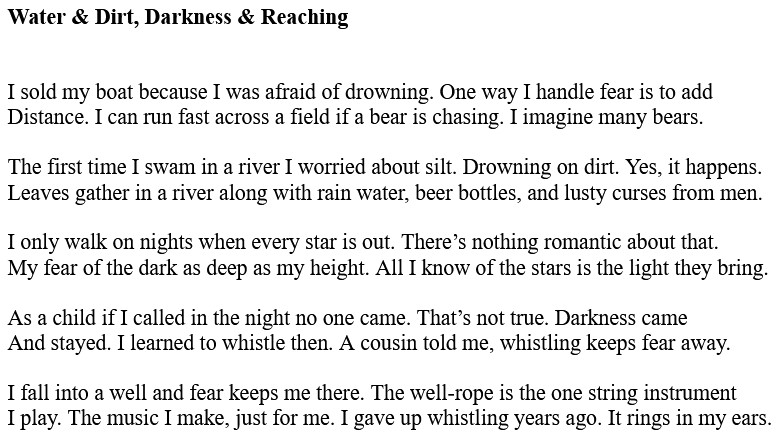
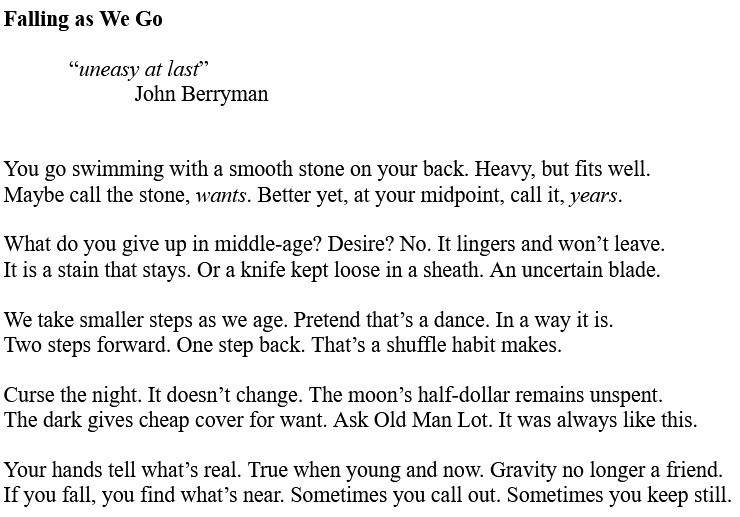
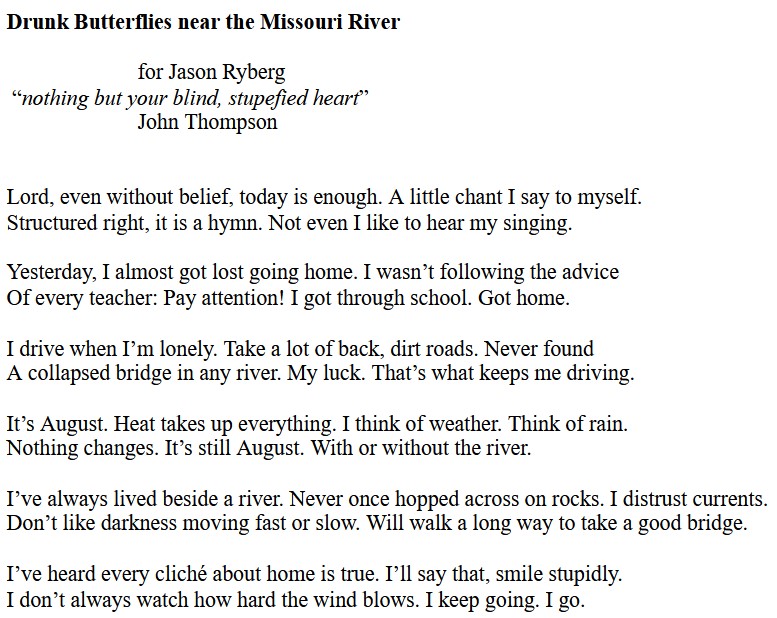
“Falling as We Go” and “Drunk Butterflies near the Missouri River” previously appeared in The Rye Whiskey Review.


About the Author: Mike James has published widely in places such as Plainsongs, Laurel Poetry Review, Birmingham Poetry Review, Gargoyle, and Tar River Poetry. His poetry collections include: Parades (Alien Buddha), Jumping Drawbridges in Technicolor (Blue Horse), Crows in the Jukebox (Bottom Dog), and My Favorite Houseguest (FutureCycle.) He has served as an associate editor of The Kentucky Review, of Autumn House Press, and of The Good Works Review, as well as the publisher of the now defunct Yellow Pepper Press. He currently serves as an associate editor of the prose poem journal Unbroken. His 18th collection, Leftover Distances, is forthcoming from Luchador Press. A multiple Pushcart nominee, Mike has read and lectured at festivals and universities throughout the country He is strong supporter of cats, literacy, coffee, white wine, top hats, crows, and free range poetics. He is an opponent of plaid, rigidity, salads, and quiet parakeets. He currently makes his home right outside Nashville.

Revisiting 2020: Our 50 Most Popular Posts of the Year


Dear As It Ought To Be Readers,


Despite everything 2020 threw at us, AIOTB Magazine was fortunate to receive so many brilliant poems, essays, interviews, and book reviews from writers around the world. Below, I have assembled the 50 most popular posts of the year based on the amount of hits they received. I know that few people will look back at 2020 with fondness, but maybe reviewing these posts from the year is a reminder of the resilience people have to continue to create in a crisis, and to channel the anxiety of the world into writing that connects us.

AIOTB Magazine was perhaps the only constant I had in 2020 that began and ended the year exactly the same, and completely intact. I have all of you contributors and readers to thank for that. Thanks for keeping me sane and connected to a community of writers when I most needed stability, creativity, and human connection in my life.

I have no idea what 2021 will look like, but if you keep reading and supporting each other’s work, you’ll at least have three new pieces a week on AIOTB Magazine to count on.


-Chase Dimock
Managing Editor


Poetry

Omobolanle Alashe:

Jason Baldinger:

Rusty Barnes:

Jean Biegun:

Victor Clevenger:

John Dorsey:

Ajah Henry Ekene:

Loisa Fenichell:

Jeff Hardin:

John Haugh:

Mike James:

Jennifer R. Lloyd:

John Macker:

Tessah Melamed:

THE NU PROFIT$ OF P/O/E/T/I/C DI$CHORD:

Hilary Otto:

Dan Overgaard:

Rob Plath:

Daniel Romo:

Diana Rosen:

Damian Rucci:

Leslie M. Rupracht:

Anna Saunders:

Sheila Saunders:

Alan Semerdjian:

Delora Sales Simbajon:

Nathanael Stolte:

Timothy Tarkelly

William Taylor Jr.:

Bunkong Tuon:

Peggy Turnbull:

Brian Chander Wiora:


Reviews

Chase Dimock:

Mike James:

Arthur Hoyle:


Interviews

Chase Dimock:


Nonfiction

Brian Connor:

Cody Sexton:


Micro Fiction

Meg Pokrass:

Announcing AIOTB Magazine’s Pushcart Nominees


As It Ought To Be Magazine is proud to announce our nominees for this year’s Pushcart Prize


Mike James: “Saint Jayne Mansfield”

Hilary Otto: “Show Don’t Tell”

Diana Rosen: “Hollywood Freeway”

Ronnie Sirmans: “Sloughing Words”

Bunkong Tuon: “Lisel Mueller Died at 96”

Agnes Vojta: “Everybody Loves the Person Who Brings Muffins”


Congratulations to our nominees and a big thanks to all the writers who shared their work with AIOTB Magazine this year!


-Chase Dimock
Managing Editor


Image Credit: Chase Dimock “Grover Beach Sunset” (2020)

A Review of Larry Smith’s Mingo Town & Memories by Mike James


A Review of Larry Smith’s

Mingo Town & Memories

By Mike James


Larry Smith knows what a penny tastes like. I kept thinking that while reading his fine new collection of poems, not because he says that but because his poems are so concerned with the absence of money.

Neither Eugene Debs nor Sherwood Anderson are mentioned in any poem, but any reader might notice them at the book’s periphery. Like Debs, Smith is concerned with the underclass and with how class can go a long way towards shaping destiny. And, like Debs, he has an almost mystical faith in the goodness of collective humanity.  Like Anderson, Smith is focused on day-to-day, small town, Ohio life. Also, just like Anderson, Smith is concerned with language spoken in diners and factories. There’s nothing ornamental in these poems. They are as sturdy and as practical as Amish furniture. His characters don’t always do right, but they seem to always recognize when they’ve done wrong.

Smith is an Ohio writer who has been publishing widely since the 1970’s. His books include poetry, novels, translations, biography, and non-fiction.  For his many readers, this new collection will arrive like an old friend. The things he’s always done well he continues to shine with.

Here’s a sample to illustrate what Smith is really good at, from his poem, “Wages.”


When I break a plate, Mom cries,
“Oh shit. Look what you’ve done.”
You can hear the sound of wind.
Then Mom hands Dad a fist full of bills,
and we kids go off to our rooms.
Tomorrow will mean our old clothes again
and the counting of our coins. 


Now poetry is about structuring language as much as it is about anything. Look at what Smith does with the endings of those lines. Only one word (again) is more than one syllable. Smith not only sticks to the vernacular here, but he also uses monosyllables to emphasize harshness and what it’s like to just get by. At the same time he allows the lines to play upon one another with off rhymes of wind/again and rooms/coins. This is an artful way to not draw attention away from the scene. Smith does a fine job of saying just enough in his poems.

These poems are often about the moments of just enough. Smith’s characters do a lot of waiting. Factory workers wait around to see if they will stay employed. Boys wait along the river. Old couples wait to talk. They are ordinary people killing time. Now and then a couple of his characters get together and are like, “two boats mooring along the shore.”


Mingo Town & Memories by Larry Smith
Bird Dog Publishing, 2020
Poetry, $15


About the Authors:

Mike James makes his home outside Nashville, Tennessee. He has published in numerous magazines throughout the country in such places as Plainsongs, Gargoyle, Birmingham Poetry Review, and Chiron Review. His fifteen poetry collections include: Journeyman’s Suitcase (Luchador), Parades (Alien Buddha), Jumping Drawbridges in Technicolor (Blue Horse), First-Hand Accounts from Made-Up Places (Stubborn Mule), Crows in the Jukebox (Bottom Dog), My Favorite Houseguest (FutureCycle), and Peddler’s Blues (Main Street Rag.) He served as an associate editor of The Kentucky Review and currently serves as an associate editor of Unbroken.

Larry Smith is the editor-publisher of Bottom Dog Press in Ohio, also the author of 6 books of fiction and 8 books of poems, most recently The Pears: Poems. A retired professor of humanities, he lives and works along the shores of Lake Erie in Huron, Ohio.


More Reviews by Mike James:

Mike James reviews “Dead Letter Office: Selected Poems” By Marko Pogacar

Mike James reviews Beautiful Aliens: A Steve Abbott Reader and Have You Seen This Man? The Castro Poems of Karl Tierney

Mike James: “Almost Autumn and Time to Go”


About the Author: Mike James makes his home outside Nashville, Tennessee. He has published in numerous magazines throughout the country in such places as Plainsongs, Gargoyle, Birmingham Poetry Review, and Chiron Review. His fifteen poetry collections include: Journeyman’s Suitcase (Luchador), Parades (Alien Buddha), Jumping Drawbridges in Technicolor (Blue Horse), First-Hand Accounts from Made-Up Places (Stubborn Mule), Crows in the Jukebox (Bottom Dog), My Favorite Houseguest (FutureCycle), and Peddler’s Blues (Main Street Rag.) He served as an associate editor of The Kentucky Review and currently serves as an associate editor of Unbroken.


More By Mike James:

Grace

Paul Lynde

Oh Daddy, Give Me A Quarter For The Time Machine


Image Credit: Carol M. Highsmith “Although this photograph of Ingalls Pond, near Hiram in western Maine, was taken a few days before the fall equinox, autumn colors have already made an appearance” (2017) The Library of Congress

Mike James Reviews “Dead Letter Office: Selected Poems” By Marko Pogacar


Mike James Reviews

Dead Letter Office: Selected Poems

By Marko Pogacar


Translated poetry is notoriously difficult to critique. Are we judging the work of the poet or the translator or the right combination of both? Even the best translation is a bit like listening to music playing in the apartment next door: we notice some of the beauty, but miss much of the subtlety. 

Ezra Pound famously said he wanted to know, “what could not be lost in translation.” One of the items more difficult to lose is imagery. The power of rhetoric may increase or decrease depending on the translator, but a clear, unusual image is harder to erase. 

Marko Pogacar is a poet well known in his native Croatia; however, this is his first volume translated into American English. Thankfully, for him and the reader, his translator is the supremely gifted Andrea Jurjevic, whose own poetry ranges across a similar landscape of stunning imagery and heart wrenching epiphany. 

Before diving into the poems, there’s a preface which calls out both Pogacar’s age (he’s in his mid-30’s) and the wars which shaped his early years. A good translator’s preface should address the work of the author being translated, as well as provide context on his life, while also addressing the nature of translation. Jurjevic does all of that. 

Her preface does a fine job of setting expectations for the reader. She writes, “There’s no idling in these poems. They’re noisy, mercurial, authentic. Their movement resembles a beehive; it is unpredictable and usually turned inward. The sound offers both a sword and a shield.” 

The last line is telling because much of the imagery throughout the collection is tied equally to violence and protection. Pogacar writes that “death fits into the three dots / at the end of an incomplete sentence,” but, despite that, “beautiful obstacles are everywhere.”  

Pogacar’s world is logic free and completely relatable. His poems exist within a dreamscape of surrealism and black humor. This is illustrated with the collection’s very first poem, the wonderfully titled, “Man Dines In His Father’s Slippers.” The poem begins as a type of love poem with the line, “What used to be borders, is now you.” The narrator then moves to a description of the environment and then back to observations on his internal life. The poem is structured as a jagged, uneven see-saw. Ultimately, it all evens out as the narrator tells us, “not love, stupidity, stupidity is the heart of the world– / and now in those slippers I eat and cry, / only eat and cry in the house.”

If a collection of poems is to be judged not just by the number of successful poems within it, but also by the number of exotically memorable lines, then Dead Letter Office succeeds on every level. Pogacar can take a reader into “a cage for the dreamless owl of the heart” and allow her to live there among “an archive of errors.”


Dead Letter Office: Selected Poems by Marko Pogacar
Translated by Andrea Jurjevic
The Word Works, 2020
Poetry/Translation, $21


About the Author: Mike James makes his home outside Nashville, Tennessee. He has published in numerous magazines throughout the country in such places as Plainsongs, Gargoyle, Birmingham Poetry Review, and Chiron Review. His fifteen poetry collections include: Journeyman’s Suitcase (Luchador), Parades (Alien Buddha), Jumping Drawbridges in Technicolor (Blue Horse), First-Hand Accounts from Made-Up Places (Stubborn Mule), Crows in the Jukebox (Bottom Dog), My Favorite Houseguest (FutureCycle)and Peddler’s Blues (Main Street Rag.) He served as an associate editor of The Kentucky Review and currently serves as an associate editor of Unbroken.


More By Mike James:

Grace

Paul Lynde

Oh Daddy, Give Me A Quarter For The Time Machine


Image Credit: “Chief Post Office Mail Room, Wellington 1920” Archives New Zealand Creative Commons 2.0

Mike James: “Saint Jayne Mansfield”

(click the image for a bigger size)


About the Author: Mike James makes his home outside Nashville, Tennessee. He has published in numerous magazines throughout the country in such places as Plainsongs, Gargoyle, Birmingham Poetry Review, and Chiron Review. His fifteen poetry collections include: Journeyman’s Suitcase (Luchador), Parades (Alien Buddha), Jumping Drawbridges in Technicolor (Blue Horse), First-Hand Accounts from Made-Up Places (Stubborn Mule), Crows in the Jukebox (Bottom Dog), My Favorite Houseguest (FutureCycle), and Peddler’s Blues (Main Street Rag.) He served as an associate editor of The Kentucky Review and currently serves as an associate editor of Unbroken.


More By Mike James:

Grace

Paul Lynde

Oh Daddy, Give Me A Quarter For The Time Machine


Image Credit: Digital Photo Art of a public domain photo of Jayne Mansfield by Chase Dimock

“Early Exits: New Books from Two Poets Lost to AIDS” By Mike James


Early Exits: New Books from Two Poets Lost to AIDS

By Mike James


Beautiful Aliens: A Steve Abbott Reader
Edited by Jamie Townsend
Nightboat Books, 2019
$19.95

Have You Seen This Man? The Castro Poems of Karl Tierney
Edited by Jim Cory
Sibling Rivalry Press, 2019 
$18.00


One of the reasons Steve Abbott is so refreshing is because he takes his lusts the same way he might drink orange juice: straight up. There are poems and essays about queerness and AIDS (his ultimate killer), but also ones about transcendence, poverty, and fatherhood. This collection pulls together essays (including a stunning piece on Bob Kaufman), fiction, poetry, cartoons, letters, and memoirs across a wide range of styles. His work reads like a mind never at rest.  

Abbott was part of the generation of queer poets who came of age in the 1970’s. This generation, which included Tim Dlugos, Kevin Killian, Steve Carey, and Jim Brodey, did not hide their sexuality even if some did not make it the center of their work. (A freedom taken for granted by heterosexual poets.) Prior to the 1970’s, most queer poets who took sex as a subject were either outliers (Harold Norse and John Weiners) or artfully oblique (Hart Crane and W.H. Auden.) 

Abbott’s work has a freedom and casualness not found in many poets prior to his generation. He’s able to toss off lines like, “The sky is so full / you hear footsteps on the roof” or drop in a line like, “So far as I know / Chairman Mao never wore a dress.”  It’s his knack for not taking the world too seriously which makes Abbott such an endearing writer. His work is casual, but never sloppy. He’s always precise. Check out how he starts this poem. 

It’s A Strange Day Alysia Says, A Green

“It’s a strange day,” Alysia says, “a green
bug in my room & now this mushroom growing in the car.”

She’s right. Under damp newspapers & cigarette
butts, from the floor, protrudes a slimy brown thing. 

Maybe I should get a new car or at least
clean it up, fix the window like the kids say. 

But how can I do this & still talk to angels?

Poets get absorbed in strange quests,
question not the creative regimen of poverty. 

I wanted to meditate on this but before I could
a hitchhiker we pick up crushes…

The poem continues in side-chat fashion, but this gives an idea of his voice. Tucked between the cigarettes, the ampersands, and the hitchhiker, this poem belongs to the 1970’s as surely as shag carpet, disco balls, and Pontiac Firebirds. And just like those well-remembered items, it’s tactile and timeless. The poet records a conversation between his self and soul about parenting, poverty, and poetry and lets the reader eavesdrop along the way.  

Because of Alysia Abbott’s fine and tender memoir, Fairyland, Steve Abbott is better known as a subject than as a writer. Beautiful Aliens should start to correct that oversight. 

Despite some obvious similarities (queer and San Francisco based) Karl Tierney was a different sort of poet than Steve Abbott. The new collection, Have You Seen This Man? illustrates that point. 

First, it must be noted, this collection was a love labor from Jim Cory, Tierney’s friend and literary executor. Tierney committed suicide in 1995 after an AIDS diagnosis. Cory spent the next 20 plus years submitting Tierney’s poetry to magazines and trying to gain interest from publishers for a collection. Cory, a wonderful and heart wrenching poet in his own right, kept the focus on Tierney rather than himself. This collection is a testament to Tierney’s talent as a poet and to Cory’s skill as an editor. Cory’s insightful introduction is worth the price of the book. 

But poets have to be judged by the quality of their work, not by the sadness of their lives. So, what kind of poet was Tierney? In a word: lustful. As Cory correctly notes, Tierney seems to channel the Roman poet Catullus in both his direct, almost comedic, style as well as in his subject matter. Like Catullus, Tierney writes like a man on a mission. The mission is getting either a or b or both into bed and the best poems (there are numerous gems) concern fleshly wants or their aftermaths. 

Here’s are a few lines from a typical piece to shows what he does well. 

Part-Time Whores In Doorways

Some of them are handsome, 
even if two sheets to the wind 

shaking skin and bones. 
Little meat upon them 

except between the legs 
meticulously exposed when rising

towards tweaks, Johns, or numbers. 
There is no need for pity. 

They milk even the bosom of Mary 
and display…

The poems continues and catalogs Tierney’s world of wants, fulfilled and unfulfilled. His characters go to every party and hate to go home alone. Tierney’s characters, are like so many party hungry, lonely people. As a poet though, he is unique. His poems are postcards of fanciful directness, finally delivered after so many years.


About the Author: Mike James makes his home outside Nashville, Tennessee. He has been published in numerous magazines throughout the country in such places as Plainsongs, Laurel Poetry Review, Birmingham Poetry Review, and Tar River Poetry. His fourteen poetry collections include: Parades (Alien Buddha), Jumping Drawbridges in Technicolor (Blue Horse), First-Hand Accounts from Made-Up Places (Stubborn Mule), Crows in the Jukebox (Bottom Dog), My Favorite Houseguest (FutureCycle), and Peddler’s Blues (Main Street Rag.) He has served as an associate editor of The Kentucky Review and as publisher of the now defunct Yellow Pepper Press. More information about him can be found on his website, mikejamespoetry.com.


More By Mike James:

Grace

Paul Lynde

Two Prose Poems


Image Credit: World AIDS Day Ribbon. Public Domain