
Kelli Austin and Rick Christiansen: “Word Gets Around”
James Duncan: “Terminal Moraine”
Howie Good: “Insomnia”
Paul Koniecki: “(Misfits) Camping in the round”
Lenore Rosenberg: “This story”
Moudi Sbeity: “Home”
Robin Wright: “Mamma Bird”
Magazine
Kelli Austin and Rick Christiansen: “Word Gets Around”
James Duncan: “Terminal Moraine”
Howie Good: “Insomnia”
Paul Koniecki: “(Misfits) Camping in the round”
Lenore Rosenberg: “This story”
Moudi Sbeity: “Home”
Robin Wright: “Mamma Bird”

As It Ought To Be is proud to announce our nominees for the 2027 Best of the Net Anthology.
Susan Cossette: “Bad Marguerite”
Dolo Diaz: “Environmental Collapse”
Joseph Geskey: “STEM As Part of a Flower”
Jade Kleiner: “Blood Draw at MGH”
Anna Saunders: “One whistle to go after”
Alicia Wright: “She doesn’t wish me dead”

Susan Cossette: “Orpheus Leaves Me His Lyre”
Holly Day: “Float”
John Dorsey: “A Full Head of Hair”
David Anson Lee: “The Waiting Room Aquarium”
Kelly Murashige: “Hakamairi”
Tim Peeler: “Pedagogue”
Aaron D. Wiegert: “Psalms of the Wisconsin Dells”

KB Ballentine: “Shatter the Blue”
James Benger: “Focus”
Celeste Budwit-Hunter: “There’s a Plan”
Geoffrey Heptonstall: “A Close Watch of the Cat”
DS Maolalai: “Upstairs bedrooms”
Ken Moon: “Baseball Grass”
Samuel Prestridge: “Tradition Said…”
Cheryl Snell: “Gesundheit”

Donna Dallas: “Arlington”
James Croal Jackson: “Abattoir”
Marc Janssen: “When the Sky is Distant”
Meg Pokrass: “Ode to Childhood Summers”
Jason Ryberg: “A Tiny Drop of Truth”
Michael T. Smith: “Pre-school Film Noir”
Agnes Vojta: “Twilight”
Sterling Warner: “Low Bar Priorities”
.
Chase Dimock reviews
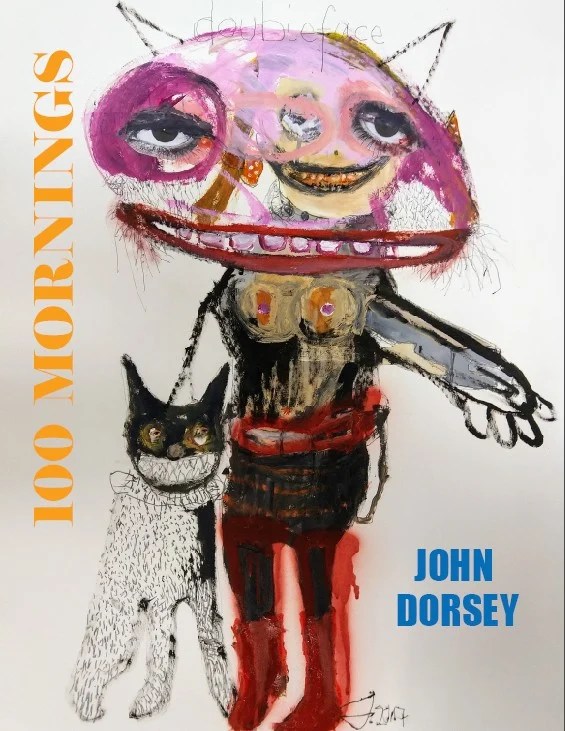
100 Mornings
By John Dorsey
As It Ought To Be has had the privilege of featuring over a dozen of John Dorsey’s poems in the past decade, and every time I see a submission from him, it’s like receiving a postcard in the mail from a friend. His trademark style relies on an economy of words, short stanzas, and minimal punctuation that deepen the effects of his imagery and description without superfluous flourishes or navel gazing meanderings. Instead, you feel like you’re receiving the very core of what matters in his poem, just as the few lines afforded by a postcard concentrates a correspondence with a friend down to only the most meaningful details.
His poems are a shot of moonshine or a single ice cube dropped down your shirt on a hot day: immediately impactful and efficiently potent.
Dorsey’s new book 100 Mornings (published by Sacred Parasite) is very much like a collection of postcards. The pages are about the size of a postcard and the short poems are accompanied by a series of paintings by Juliane Hundertmark whose images of fantastical creatures bring to mind what it would look like if Jean-Michel Basquiat was hired to design the muppets for Fraggle Rock. While I don’t endorse defacing a book of poetry, one could conceivably send pages from 100 Mornings as postcards themselves.
Just like a message written on a postcard, many of the poems in 100 Mornings read like a brief update on Dorsey’s life in the present, combining reflections on his health and mortality with his ever present empathy for the struggles of his friends and family. These themes tie together with the final poem of the collection, “Midlife Crisis Sutra.”
i wake up on a borrowed couch at 48
with pain in my right shoulder
that could be a pinched nerve
or signs of a stroke
the air tastes like old books
i think about
all the kids
i started out with
some dead
most with better lives
none of them
bothering with poems
Dorsey’s physical health is a constant presence in his work as he’s endured coping with disability, cancer treatments, and most recently, the loss of an eye. And yet, Dorsey uses his pain not to wallow or milk sympathy, but to understand the pain of others through the connective tissue of poetry. The symptoms of a stroke transition to the smell of books and the memories of friends he made through poetry by instinct. Dorsey performs a similar maneuver addressing the loss of his eye in “On Being Compared to Jim Harrison”
you could do far worse
but there are a lot of men
with one eye
& a fondness for rivers
who have trouble
sleeping through the night
men who gave up shaving ages ago
to write love poems
whispered sweetly into the ears of barn owls
& the faded girls of memory on dirt roads
Receiving the compliment of a comparison to the legendary Jim Harrison would inflate most egos, but for Dorsey, the similarity inspires him to weave connections with others who share the experience of disability and bittersweet memories of long lost acquaintances preserved in poetry.
Last year, As It Ought To Be published “Poem for Wookie,” the first piece I read of Dorsey’s in which he directly engages with the loss of his eye and how it influences his relationships with others.
you chase leaves
in the warm morning air
before coming over
to place one in my hand
& ask about my eye
who took it
where did it go
will it grow back
like a freshly planted tree
What initially struck me about this poem was how he directly, yet lightly presented the loss of his eye through Wookie’s innocent inquisitiveness. Such questions could feel invasive, but Dorsey understands they come naturally without the intention of a burdensome weight like the falling of leaves. Dorsey further narrates:
for every question
another leaf
seemingly out of nowhere
like a piece of your soul
all sound gone in this moment
my mouth dry
beyond explanation
i dance around the question
just another leaf.
Dorsey doesn’t hide his discomfort, and his dry mouth beyond explanation presents the rare possibility of lacking the words to express both his feelings and the biological facts of his condition. And yet, in just three words at the end, the explanation comes: “just another leaf.” Afterall, it is Wookie who connects the fallen leaf with the lost eye, and with his ability to see the best of intentions in others, embraces Wookie’s leaf as the answer itself.
100 Mornings is another unique leaf in Dorsey’s bibliography of well over a hundred books spanning more than three decades of writing. He has measured his life in zines, chapbooks, broadsides, anthologies, full-length books, collected works, and many other genres–thousands of leaves of poetry too voluminous for any single person to rake into a neat pile. And still with my ever growing shelf of John Dorsey books, I always look forward to his next poetry postcard in the mail.
About the Author: Chase Dimock is the Editor in Chief of As It Ought To Be. He holds a PhD in Comparative Literature from The University of Illinois and teaches literature and writing in Los Angeles. His poetry has appeared in dozens of magazines and his debut book Sentinel Species was published in 2020. Chasedimock.com

Sue Blaustein: “Philosophy”
Dolo Diaz: “Environmental Collapse”
Salvatore Difalco: “What You See at the End of a Lion”
John Grey: “In The Shadow of the Bridge”
Paul Ilechko: “Impossible Blue”
Amy Smyth Miller: “Estranged”
Craig Phillips: “Lost Balloonist”
..
Nights of Ecstasy:
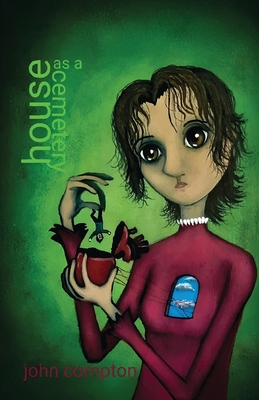
A review of john compton’s house as a cemetery
by Peter Mladinic
house as a cemetery is a poetic journey. Part iii begins with the lines: “reader, both of us are learning / through the connection of words.” The poet’s connection with self is followed by a connection with family, friends, strangers, lovers, a spouse, and poetic predecessors: Allen Ginsberg, John Ashbery, Anne Sexton, and Emily Dickinson. His homage to Dickinson begins “on my face— / etched—my name / & two dates.” In this startling metaphor, face as headstone, Compton’s reader sees their face reflected in the eye of the poet. Throughout the journey, the poet’s grandmother appears in the middle, in part iii as a nurturer offering her grandson a bowl of chili, and in iv with her spouse: “they fuck & call it a manifestation of church.” Although her second presence is in stark contrast with the first, the poet’s strongest bond is with his grandmother.
The poet’s mental/emotional landscape was formed between the ages of five and seven, and his grandmother is at the center of it. In the first poem in the book he says that words have “forced me to realize/ lineage/ between embalming fluid/ & origin.” In part i, a chrysalis of dreams and memories, birth and death are linked. People, things, and places appear bigger to a child than to an adult. “the enormous room” begins, “i was a cancer that his side of the family / could never cure. i was the blame / for his death.” Farther along, “how could their son ever love a man?” Then, “i was elated to see his mother.” Then the poem goes into her life, and she could be the grandmother, though that is not explicitly stated. A lonely widow, an introvert, “no visitors, she/ made that very clear,” she is like one of the “corner pieces” in the room. “i would have tried to mend her tears / but instead i let her dry skin / soak them.” The poet’s elation turns to disappointment and regret, but his bond to this person is very clear in how he talks about her. “the father who understood” involves a father holding his infant son, a union devoid of tenderness. The father “swaddled this broken boy…/ each / piece of him/ unable to be collected.” The poem concludes “urine warms his arms, dripping.” “funeral arrangements in a crawlspace” is the last poem in part iii. The son is a house, and he sees “a mother / on hands & knees / clawing the boards…/ trying to dig open / her son.” Childhood, the formative years, is emphasized in “i’ve only been here all my life.” In it, there’s a barn in the middle of a cornfield, an empty bible, and the poet wondering “why am I, to them, not able to make sense?”
i close my eyes hard,
tight enough that tears come between the lids.
when i open them, will i be saved?
will you hold my hand
& kiss me like i’m god?

so many prayers have come back soundless.
no proof of life beyond these walls.
somewhere i will find you;
but right now i continue to write you
into existence.
“You” is none other than the poet himself, in a place, and his grandmother is at the center of it. To get the full picture, a reader must consider “winter coat & a half glimpse of the world:”
fingers crackle like a frigid bough.
an ice blossom sprouts.
summer is my grandmother’s voice
asking if i’d like a bowl of chili.
The poet’s grandmother is part of his growth from childhood to adolescence, his awakening and becoming an individual. A harsh awakening. Consider the beginning of “transphobia;” “you were raped / yet too young to cum—they stuck objects / inside you to remind you you were a girl / & not a boy like them. The horrific waking nightmare of that experience is followed by condemnation from the religious in “after realizing my name means gift from god:” “you belong in hell. In the poet’s emergence of identity there is affirmation. “i am gay for the dead I was blamed for.” Lineage is sustained in one poem with the mention of the birth of the poet’s great nephew, and identity is developed in his encounter with strangers in a Greyhound bus depot. Water is symbolic of life and death in this book, and in “my mental breakdown at a greyhound station” he and the strangers are depicted as fish, and the depot itself is “a polluted aquarium.” Encounters with lovers are encapsulated in a poem with a title reminiscent of Walt Whitman: “i find your midnight in my pocket.” In the middle the poet says “now / all I have / is your darkness. And perhaps the love he felt as a child from his nurturing grandmother is manifested in “love poem for my husband:”
if you ever die,
i shall never wake:

the world, a blur
& boring—
Lastly, the early bond the poet formed with his grandmother is integral to his identity as a gay poet. She was nurturing (a plus) and religious (a minus). Consider this passage from part iv. blacked out borderland from an exponential crisis:
with no remorse using homophobia as their anchor they said: all your poems are queers i replied: no all my poems are gay they love you even though you’re homophobic they are yet to understand hate they haven’t grown in his world they are still innocent give them time they’ll cut your throat
In “my love letter to pride” he says “i will seize your city,/ plant words / in every inhabited region/ & let a forest / with my gay poems / breed into a colossal library.” It would be “off the mark” to say the poet is first and foremost his grandmother’s grandson, though that is undeniable. More apropos, John Compton is, and is a gay poet.
And his book house as a cemetery is unsettling and invigorating. In it, there are poems about the loneliness and happiness of marriage (to David), poems about their pets, and poems that pay homage to writers aforementioned, and to W.C. Williams and Virginia Woolf. As a gay poet, Compton is—this is fair to say—combative against forces trying to eradicate gay people, erode individuality, and undermine freedom; in short, forces that are trying to conquer, enslave, and destroy …in the name of god. So there are numerous war images. One poem ‘the turbulence of living” comes shortly after Compton’s homage to Emily Dickinson; its battle imagery gives an impression of civil war between north and south. It begins: “they took to the sun / like mushrooms: / corpses lay swollen.” The reader conjures a clearing in a wood and smoke from cannon fire. It’s just one of many flourishes in a book filled with poems that had to be written and deserve to be read, and read again. Bravo, John Compton. We need you!
house as a cemetery
by john compton.
QUEERMOJO a Rebel Satori Imprint
New Orleans, LA.
2026.
$16.95 paper.
About the Author: Peter Mladinic’s most recent book of poems, The Whitestone Bridge, is available from Anxiety Press. An animal rights advocate, he lives in Hobbs, New Mexico.

Ruth Bavetta: “Litany”
David A. Goodrum: “Keeping Things No One Else Wants”
Candice M. Kelsey: “pop rocks”
Lindsay McLeod: “Once I Believed But”
Jim Murdoch: “Beliefs (Three Kinds)”
Sreeja Naskar: “If This Turns Out To Be Another Love Song”
Kenneth Pobo: “What An Exhausting Night!
Robin Wright: “Expiration Date”

Barbara Berg: “To change the shape of wood, you must understand its properties”
Susan Cossette: “The Agreement”
Ken Gierke: “Dulcet Tones Do Not Lessen the Impact”
Bill Griffin: “Spoonfuls”
Rocío Iglesias McKenzie: “Immigrant’s Lullaby”
Daniel Edward Moore: “When All Else Fails”
Alan Perry: “Lift”
Donald Sellitti: “Why do souls just seem to linger?”

