SATURDAY POETRY SERIES PRESENTS: RESURRECTION PARTY

resurrection_cover


From RESURRECTION PARTY
By Michalle Gould:


SELF-PORTRAIT AS A SERIES OF PREPARATORY STUDIES FOR A NUDE BY MATISSE

The breasts hang low like fruit hoping
to be picked yet still on the branch,
While the body largely reclines, a letter K
lain on its side and slightly bent,
or in a less common pose, my back faces the viewer
so I resemble a pushed in O, my arms and legs drawn in,
like a turtle withdrawing far into its shell
to escape some predator that has come to suck;
We are become a rock. Our hearts lie hidden far
Below its skin. The artist scrapes my flesh onto his brush
but cannot touch what lies beneath, whatever he thinks—
nor can you, my dear, even as you read me.


SELF-PORTRAIT AS THE MAIDEN OF ATHENS

That day, I went forth to kill the Minotaur.
Since Theseus, they sent us all naked;
I had no ball of string; I had no sword.
For tools, instead, I had only the instruments
of my body: my nails for daggers, my hair for thread.
I had heard of his legendary cruelty;
I had heard how he killed without a word.
Then I came to the center and saw him.
His strong arms beckoned—and I cut the cord.


SELF-PORTRAIT AS A PAIR OF LOVEBIRDS

Opening their beaks, they thrust
their tongues out for one last kiss
before the long journey south—
like worms they each intend to drop
into the other’s hungry waiting mouth.


Today’s poems are from Resurrection Party, published by Silver Birch Press, copyright © 2014 by Michalle Gould, and appear here today with permission from the poet.


RESURRECTION PARTY concerns itself, almost to the point of obsession, with the question of how the imagination grapples with the fear of death. The collection intertwines religious and mythical subjects and themes with more fleshly concerns about the body and decay, presence and absence. It has been described as containing poems of “almost exquisite refinement, illuminated by the taut glow of sensuous prosody and imagery” and as “a deeply meditative collection at once intelligent, tender, and utterly human.” (From the Silver Birch Press website.)


Michalle Gould has been working on the poems that constitute Resurrection Party for almost 15 years. In that time, her poems and short stories have appeared in Slate, New England Review, Poetry, American Literary Review, The Texas Observer, and other journals. She currently lives in Los Angeles, where she works as a librarian, and is in the process of researching and writing a novel set in the North of England during the 1930s.


Editor’s Note: Michalle Gould has a deep and fearless understanding of the self. In her quest to write poems that grapple with life’s big questions—life and death, self-awareness, relationships—she is bold and unafraid. She views her own body as honestly as an artist would. Yet she understands truths about the self that no other can reveal: “The artist scrapes my flesh onto his brush / but cannot touch what lies beneath, whatever he thinks— / nor can you, my dear, even as you read me.”

In “Self Portrait as the Maiden of Athens” the poet re-examines the Greek myth of the minotaur from a female perspective. Here she notes that, unlike the male hero in the story, when the maiden faces the beast, “I had no sword. / For tools, instead, I had only the instruments / of my body: my nails for daggers, my hair for thread.” This concept translates into the larger role of women in the world, and the question of what few tools and resources we have traditionally been allowed.

SPS-beloved poet Louise Mathias writes that the terrain of Resurrection Party “is somewhere between body and spirit, life and death, intimacy and solitude, elegance and intuition. Possessing a sly humor coupled with a laser sharp awareness and assertion of how all is ephemeral, Resurrection Party accomplishes the rare: it makes even the big questions fresh.”


Want to see more from Michalle Gould?
Michalle Gould Official Website
Buy Resurrection Party from Amazon
Resurrection Party on Goodreads
More Excerpts from Resurrection Party

SATURDAY POETRY SERIES PRESENTS: JEN CAMPBELL

Jen Campbell


Vaginaland
By Jen Campbell


Screen Shot 2014-09-19 at 10.59.02 PM
Screen Shot 2014-09-19 at 10.59.16 PM
Screen Shot 2014-09-19 at 11.00.21 PM


“Vaginaland” was previously published in English Pen “Poems for Pussy Riot” and appears here today with permission from the poet.


Jen Campbell is an award-winning poet and short story writer. She’s also the author of the bestselling Weird Things Customers Say in Bookshops Series. Her poetry collection, The Hungry Ghost Festival, is published by The Rialto and her latest book, The Bookshop Book, will be published in October by Little, Brown.


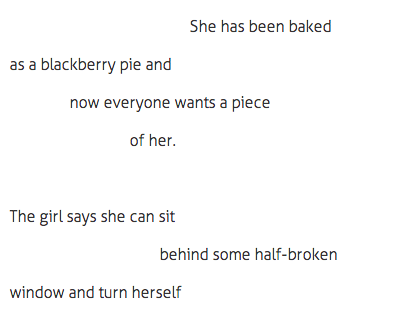
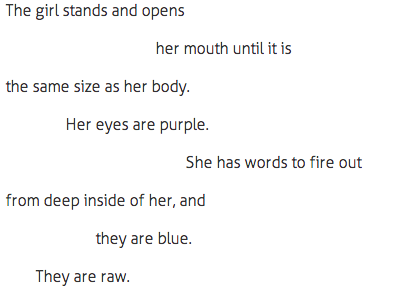
Editor’s Note: What is a girl? What is her mouth, her body, her words? Who is that girl when the world tries to hold her down and shut her up? When “She has been baked / as a blackberry pie and / now everyone wants a piece / of her”?

“Vaginaland” was originally published by English PEN as a political act. In an act of solidarity. In support of three members of the Russian punk band Pussy Riot, who were then in prison for their outspoken feminism, LGBT advocacy, and opposition to the policies of Russian President Vladimir Putin.

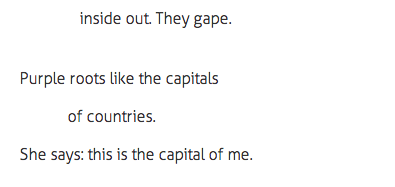
Who — and what — does a girl become when she stands up, breaks free, and fires out the words that are deep inside of her? When those words are political? When her voice is political? When “She says: this is the capital of me”?


Want to read more by Jen Campbell?
Jen Campbell Official Website
The Hungry Ghost Festival
The Prose-Poem Project
Jane Martin Poetry Prize 2013
The Plough Prize

SATURDAY POETRY SERIES PRESENTS: GLOSSOLALIA

GLOSSOLALIACOVER


from GLOSSOLALIA
By Marita Dachsel:


PATTY BARTLETT SESSIONS

I

I was 17, newly married
when I first put a woman to bed,
her new babe in arms.

Awaiting death, I’ve tallied,
attended 3977 births. Midwife,
my eminent title.

Pride is a sin,
but I think I will be forgiven
for the surge I feel
when I consider my record.


II

47 did not feel old,
but looked ancient to him.
A month after my daughter,
me. Sexless, righteous.
Virtuous. Finished.


III

I became a Mother in Israel,
coaxing young women
into the new covenant.

We were Sarah & Hagar. Rachel & Leah.

But I was wrong about polygamy.

Lust, envy & wrath are sins,
& I know I will never be forgiven
for being the zealous handmaiden
to this difficult life.


IV

I have lost four children. Heartache
is my chronic companion,
chafing the every day.

But my dear husband David
took a second wife
& I will tell you
what the others won’t admit:

There is no other earthly pain,
constant, raw & rending,
like sharing your man
with a younger wife.


V

I am a practical woman:
I can heal with herbs & my hands,
I brew my own beer, sew, knit,
& speak in tongues.

After birth, I would show
the mother the slick placenta,
raised up, a stretched orb.
An offering.

It carries the tree of life.
Rough, ropey. Red,
the colour of strawberry jam
boiling low on the stove.


VI

Being the first hand
to touch a life
is a powerful thing.

I have wondered
what imprint
I have left

& what has been
left on me.


AFTER THE MARTYRDOM

The men, they surged
from their homes,
from their women,
a confluence
in search of
their Galilee.

They shuffled, they scuffed
dirt across the land,
a hand of a crone.

The men, they fished.
Eyes skimmed the shore
for a stranger they would know.
Hope bobbed in their throats.
Loss, a lure, caught
shredding what they once knew true.

The women, they were left
with the children,
the dead.
The scriptures gave no guide
for wives at a time like this.


Today’s poems are from Glossolalia, published by Anvil Press, copyright © 2013 by Marita Dachsel, and appear here today with permission from the poet.


GLOSSOLALIA is an unflinching exploration of sisterhood, motherhood, and sexuality as told in a series of poetic monologues spoken by the thirty-four polygamous wives of Joseph Smith, founder of The Church of Jesus Christ of Latter-day Saints. In Marita Dachsel’s second full-length collection, the self-avowed agnostic feminist uses mid-nineteenth century Mormon America as a microcosm for the universal emotions of love, jealousy, loneliness, pride, despair, and passion. Glossolalia is an extraordinary, often funny, and deeply human examination of what it means to be a wife and a woman through the lens of religion and history. (From the Anvil Press website.)


Marita Dachsel is the author of Glossolalia, Eliza Roxcy Snow, and All Things Said & Done. Her poetry has been shortlisted for the Robert Kroetsch Award for Innovative Poetry and the ReLit Prize and has appeared in many literary journals and anthologies. Her play Initiation Trilogy was produced by Electric Company Theatre, was featured at the 2012 Vancouver International Writers Fest, and was nominated for the Jessie Richardson Award for Outstanding New Script. She is the 2013/2014 Artist in Residence at UVic’s Centre for Studies in Religion and Society.


Editor’s Note: In this collection Marita Dachsel has taken on no small task. By seeking to reclaim women’s stories from the polygamous world of Joseph Smith, the poet gives voice to the voiceless, the unknown, the lost and forgotten. Their stories come to life, their lives become known history. In “Patty Bartlett Sessions,” polygamous wife Patty Bartlett converts other women to the Mormon faith, “coaxing young women / into the new covenant.” But when she realizes the insurmountable trials of polygamy, she knows she “will never be forgiven / for being the zealous handmaiden / to this difficult life.” Instead she finds inspiration and fulfillment in her work as a midwife, for “Being the first hand / to touch a life / is a powerful thing.” In “After the Marytrdom” Dachsel speaks for a chorus of wives left by husbands seeking a divine experience, noting ruefully that “The scriptures gave no guide / for wives at a time like this.”


Want to see more from Marita Dachsel?
All Things Said & Done – Marita Dachsel’s Official Blog
Canadian Poetries
The Rusty Toque
The Barnstormer
Youtube: Too True: The poetry of four acclaimed BC poets

SATURDAY POETRY SERIES PRESENTS: JACKIE TREIBER

Jackie Trieber


from ‘A DANCER’
By Jackie Treiber


And from eternal life found in the eyes came the truth: she was one witch. She was from Atzlan. Of Avar, wore the bridal relic, sat at the heels of mother fire. Mary A. of Massachusetts, little unclear Mary. Celine of Normandy, sick on milk. Joan of Arc. Strega. Lost in the woods in her red shoes. Caught in the rain at the base of a mountain. No survivor of death, survivor of transcendence. Torched, entombed, excised. Acrid climate, cupidity, war, drought. In lieu of an oral lineage, in lieu of explanations, there came the gift of death to her. When death was collective, she was anonymous. When death became individual, she died with little handfuls of dirt on her chest, thrown with purpose and care. Her conclusion was more than physical death now, and her body nothing more than a reed carved to sing its masterful song. This is why she stood resolute—she had known a thousand floods of death. This, out of all of them, was nothing.


Today’s excerpt appears here with permission from the author.


Jackie Treiber writes, reads and edits in Portland, Oregon. She is drawn to conflicted and damaged characters. Dualities such as profane/magical, masculine/feminine and stability/chaos thrill and inspire her. Her poems will be published in an anthology of Kansas City poets in Spring 2015 (UnHoly Day Press). Her most recent work was featured in Smalldoggies Reading Series Chapbook (2011).

Editor’s Note: Today’s excerpt is part of a larger work of fiction, though it stands on its own as a poem, blurring the line between prose and prose poetry. From within its almost choral narration (despite its third person narrative perspective) emerges one woman who is also every woman. She is a witch, a bride, Joan of Arc. She is our collective suffering, our recurring death. And yet her story is epiphanous. Because she has suffered, she knows that she can rise above. She has lived—and died—often enough to know that death is nothing more than metamorphosis.

Want to read more by Jackie Treiber?
Work poems
How Do We Look?
#23
#11 Socially Acceptable Cannibalism
We burned John Wayne’s favorite yacht

SATURDAY POETRY SERIES PRESENTS: ALLIE MORENO

photo (1)

TOO MUCH OF A GOOD THING
By Allie Moreno

I have been stretched like
skin to dry in the sun
I am a blanket
I’m a tightrope
a staircase
a palace of forgotten
photographs
a sandcastle exposed in the wind
I love and
cover you

I have filled all the glasses
on the table
I have eaten what is
left on every plate
to be free of it

I have swallowed your
skeletons on cue
I should probably apologize
for complaining
but I’m the parade and the rain


“Too Much of a Good Thing” appears here today with permission from the poet.


Allie Moreno spends her daytime hours writing for a large tech company in the San Diego area. She received an MFA in Writing from UC San Diego and sometimes writes poetry from the confines of her cubicle. Allie tends to write about identity, belonging, and her experience as a trans-racial adoptee.

Editor’s Note: Simple, straightforward, and full of evocative imagery, today’s poem takes us inside the world of one who has lived for another. Stretched tight, walked upon, now disappearing grain by grain, “a sandcastle exposed in the wind.” To give love is not enough, when in so doing we give too much of ourselves. In end end we are almost left with a woman’s tendency to apologize for herself, but instead we are left with a counterweight. A provocative image slightly obscured. What is a woman when she is “the parade and the rain”?

Want to read more by Allie Moreno?
Allie Moreno’s Blog
Interview: Allie Moreno’s Adoption Experience

SATURDAY POETRY SERIES PRESENTS: RACHEL MENNIES

alisonsteve02327c

By Rachel Mennies:


AMIDAH FOR TEENAGE GIRLS

We said it Friday nights in unison: blessed
is Abraham, Isaac, patriarchs whose weight
we felt against our chests, Jacob, whose brother

filled his mouth with the sand of hate,
who split sisters with his body
of patience. The God of History, reads

the Siddur, nothing more dangerous
than this sort of God. Any good girl
will tell you so: ask Leah, who watched

as her betrothed tilled fields in agony,
rutted at her nightly, his pious bride, as he dreamed
for seven years of younger Rachel’s face. God,

our brute teacher. God, whom we thank
and thank for these big men. You are mighty forever,
my Lord. You resurrect the dead. My Lord, open

my lips, that my mouth may declare
Your praise.
Imagine the shock, that first boy
or man inside us for mere seconds, the tremor

of realization — some smaller God at our clavicle
thrumming in awareness. The creator of all things. And so
when I lie with him, my body already knows what to do

while he shifts his weight, moves his hips. You cause
the wind to blow and the rain to fall.
The hard ram’s horn,
the arms thrust high, parting a sea of salt. The open mouth

of incantation. O King, helper, savior and shield. And what of our
pleasure, that quiet subtext, that patient search against
our partners’ sweaty brows, near to finished? We already

know the phrase: bestow, bestow.


BUMPER CROP

Wet pink shock of a sliced-open
peach, pit hard between our teeth,
reached in a liquid, honest hurry.
Peach in the fingers of a certain lover’s hand.
Peach juice sliding down the wrist of a man
with assertive hungers. Peach, bringer
of rapture: the climax, but not
the fall. Peach sky rising up and up, free
of consequence. Impossible, but for
our chase of it. Peach in the crisper drawer,
softening. We hear stories of the pastor
and his book, so certain of fire, his biblical
calculus. Peach hot, sugared in an oven.
The mouth of red around the brain-
shaped, dumbstruck stone. Peach the very taste
of sin. Peach that sends the crows circling,
rapture here and gone. Peach God, rapt for carrion,
turning above us in the heavens, waiting for
us, ripening, to satisfy ourselves;
come to him pitted, come to him
finished, made rotten by
your sweet time in his sun.


“Amidah for Teenage Girls” was originally published in Witness, and “Bumper” was originally published in Linebreak. These poems appear in the collection The Glad Hand of God Points Backwards (Texas Tech University Press 2014) and appear here today with permission from the poet.


Rachel Mennies is the author of The Glad Hand of God Points Backwards, winner of the Walt McDonald First-Book Prize in Poetry (Texas Tech University Press, 2014), and the chapbook No Silence in the Fields (Blue Hour Press, 2012). Her poems have appeared in Hayden’s Ferry Review, Poet Lore, The Journal, and elsewhere, and have been reprinted at Poetry Daily. She teaches in the First-Year Writing Program at Carnegie Mellon University.

Editor’s Note: I really love today’s poems. Discretely and in conjunction. For the ways they press against the same themes, and for the ways they diverge. “Amidah for Teenage Girls” had me at “patriarchs whose weight / we felt against our chests,” and held me there, exalting, with “Jacob, whose brother // filled his mouth with the sand of hate, / who split sisters with his body / of patience.” Yes. Yes and yes. I could write pages about the first two stanzas of this poem alone. Instead, I urge you to read and reread it, to savor what stews and what simmers.

When I think of peaches and poems, I think of Li-Young Lee. And while “Bumper Crops” and “From Blossoms” each make their own unique contribution to the poetic landscape, I think Li-Young Lee would meditate along with Rachel Mennies on God and humanity, and that he would relish the poem’s sweet sensuality. As, I believe, would Anya Silver and Rabbi Rachel Barenblat, whose “French Toast” and “Sufganiyot” would, along with Mennies’ peaches, make up a picnic that would give Fifty Shades of Grey a good blush.

Want to read more by Rachel Mennies?
Rachel Mennies – Official Website
Buy The Glad Hand of God Points Backwards from Texas Tech University Press
Buy The Glad Hand of God Points Backwards from Amazon
Poetry Daily
Sixth Finch

SATURDAY POETRY SERIES PRESENTS: LAURA E. DAVIS

LEDavis-2014

By Laura E. Davis:


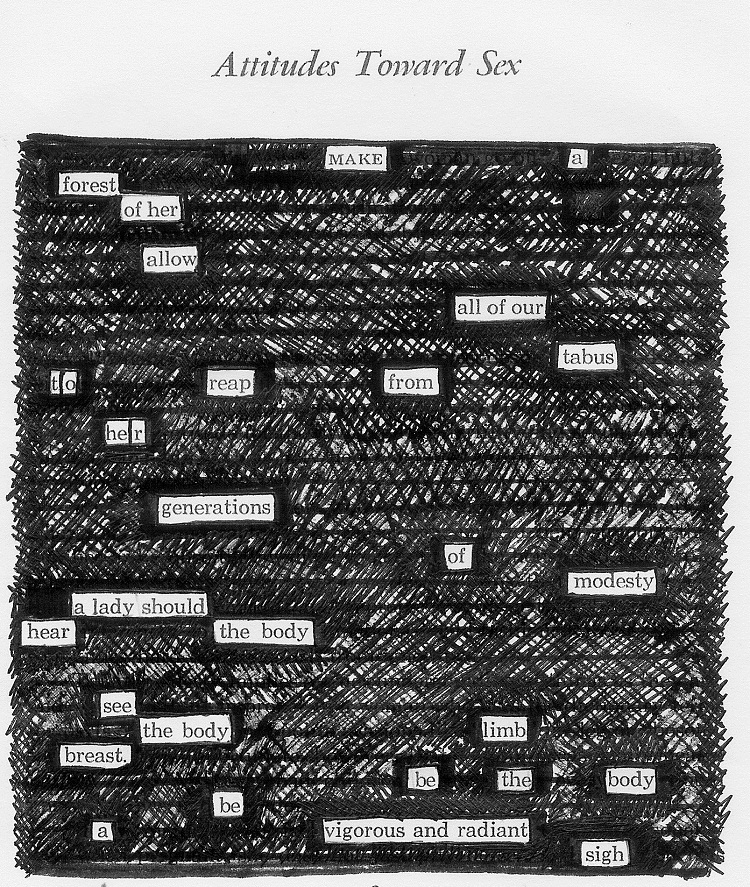
ATTITUDES TOWARD SEX

attitudestowardsex.small


THE BOYS ARE ALWAYS TALKING

about their cocks, naming
names—Rebecca, Elizabeth,
Ashley—we see these girls
all lined up, waiting to admire

the boys’ cocks. And the boys
talk about size of their cocks,
seven inches becomes ten, then
thirteen. They tell us how

they measured their cocks
after their first wet dream: they
woke up sweaty, quick-covered,
got their cocks hard again, pulled

out the ruler. Boys and cocks
everywhere. A boy shows his
cock to a girl on the playground.
Another boy watches girls from

a parked car while he touches
his cock. On the subway, boys
unzip their pants, put cocks
on display. Baby boys discover

their tiny cocks during every
diaper change. I didn’t see
my own clit was until I was
twenty-three. I had to hold

a mirror just to see it rise
like slow-motion stalagmite.
Had to hold back my own skin
just to show it to myself.


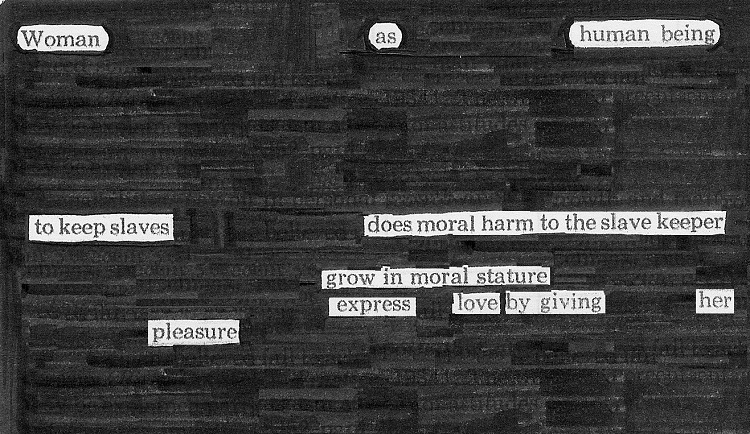
WOMAN AS HUMAN BEING

woman as human being.smaller


“Attitudes Toward Sex” was originally published in iARTistas. “The Boys Are Always Talking” was originally published in Muzzle. “Woman as Human Being” was originally published in Toad Journal. These poems appear here today with permission from the poet.


Laura E. Davis is the author of Braiding the Storm (Finishing Line, 2012), founding editor of Weave Magazine, and founder of Submission Bombers. Her poems are featured or forthcoming in Toad, Stirring, Corium Magazine, So to Speak, Muzzle, and others. Laura teaches for Poetry Inside Out, a K-12 a bilingual poetry program in San Francisco, where she lives with her partner, Sal.

Editor’s Note: This week I had the honor of working with an artist to create an artistic response to the Hobby Lobby Supreme Court decision. I have already written an editorial response to the ruling, but I wanted to speak out against this injustice in many ways, through many voices.

Today’s poems speak for womankind. They speak for our bodies, for our vantage point within a man’s world. When read together today, they are meant to be a shout from the rooftops. That no one exercises control over our bodies but ourselves. That we are human beings whose rights are superior to the rights of corporations. Yes, that we are human beings. Beautiful, complex, powerful human beings who are as capable of a battle cry as we are of “a vigorous and radiant sigh.”

Want to read more by Laura E. Davis?
Dear Outer Space – Laura E. Davis’ Blog
“Quiet Lightning” on Youtube
Buy Braiding the Storm from Finishing Line Press
“Relics” in Sundress
“Vessels” and “Red Storm” in The Doctor T. J. Eckleburg Review

SATURDAY POETRY SERIES PRESENTS: ONLY RIDE

OnlyRide-Front

from ONLY RIDE
By Megan Volpert:


Screen Shot 2014-04-04 at 3.16.20 PM

Screen Shot 2014-04-04 at 3.18.58 PM


Screen Shot 2014-04-04 at 3.20.28 PM

Screen Shot 2014-04-04 at 3.29.11 PM


Picture 1

Picture 3


Today’s poems are from Only Ride, published by Sibling Rivalry Press, copyright © 2014 by Megan Volpert. “You are suspended” was first published in This assignment is so gay, edited by Megan Volpert and published by Sibling Rivalry Press. These poems appear here today with permission from the poet.


Only Ride: If Denis Johnson had written Tuesdays with Morrie, it’d feel like Megan Volpert’s book of prose poems. Clawing its way out through this minimalist checklist of suburban malaise is an emphatically optimistic approach to growing up. These tiny essays carefully detail how to avoid becoming one’s parents, how to manage a body addled by disease, and how to keep having the best possible time in life. After all: this is the only ride there is, and we can only ride it. Volpert’s is a story of Springsteenian proportions, a gentleman’s guide to rebellion complete with iron horses and the church of rock & roll.

Megan Volpert is the author of five books on communication and popular culture, most notably about Andy Warhol. She has been teaching high school English in Atlanta for the better part of a decade, and is currently serving as her school’s Teacher of the Year. She edited the American Library Association-honored anthology This assignment is so gay: LGBTIQ Poets on the Art of Teaching, which is currently a Lambda Literary Award finalist. Predictably, www.meganvolpert.com is her website.

Editor’s Note: Megan Volpert’s Only Ride is a no-holds-barred journey through personal history, with sage wisdom bursting from its rough-and-tumble seams. The book is less Zen and the Art of Motorcycle Maintenance and more Get a Grip and Ride Like it’s Your Only Ride. This is a book about how to live life. Suck it up and move past the childhood issues that scarred you. Don’t just cope with illness, thrive in the face of it. Live life full throttle no matter what it throws at you, because life is short and living demands fierce courage.

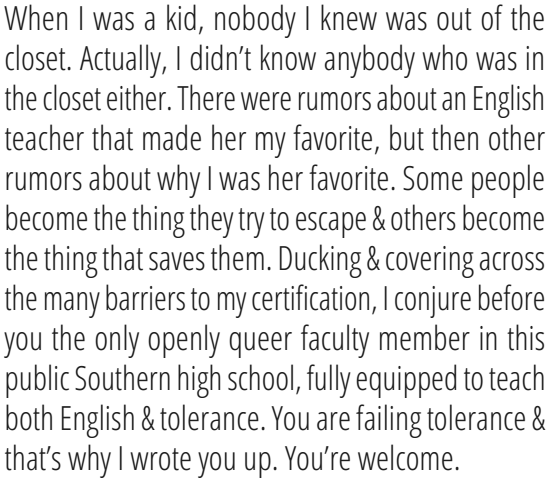
Throughout her journey Volpert takes personal and political stands, inspiring her readers to do the same. Sometimes you’ve just gotta smash things, because “a deep frustration that hurls pottery against the concrete floor… is not the thing to bottle up in shame.” Sometimes a teacher has a responsibility to teach more than just standard curriculum. As “the only openly queer faculty member in [a] public Southern high school,” Volpert is “fully equipped to teach both English & tolerance,” and she’ll write a student up for failing the latter.

Brimming with humor and hubris and wicked wit, the greatest gift of this book is the life lessons it relays. Stand up for what you believe in. Move past life’s bullshit and face adversity with a battle cry. Let go of the small stuff. “Many things annoy me,” Volpert confides, “but I seldom get really angry because now I just feel so lucky to be alive.” And we all should, the implication echoes. In a world where “[d]eath knocks twice: once for introductions & once to take you away,” why waste your precious life letting things get your goat? Having faced death, the poet gave her goat away; she has no goat to give. And we would all be well served to follow her example. “After all: this is the only ride there is, and we can only ride it.”

Want to see more from Megan Volpert?
Official Website
This assignment is so gay
Sibling Rivalry Press
FRONTIER PSYCHIATRIST

SATURDAY POETRY SERIES PRESENTS: LAURA YES YES

1970703_10152671596109251_151820833_n
By Laura Yes Yes:

SALEM 1994
(With touring partner Kim Johnson)

Courtesy of Jason Flynn’s youtube channel.


COLLEGE TRANSCRIPT

Courtesy of West Side School for the Desperate’s youtube channel.


Laura Swearingen-Steadwell (AKA Laura Yes Yes) has competed in slams nationwide, notably as a finalist in 2010’s Women of the World Poetry Slam. She tours and leads workshops as part of the queer female duo Shadowboxers Anonymous. Laura’s first book, How to Seduce a White Boy in Ten Easy Steps, was nominated for a National Book Award. She is currently an MFA candidate at Warren Wilson College.

Editor’s Note: I had the pleasure of seeing Laura Swearingen-Steadwell perform at louderARTS this week. louderARTS is home to a longstanding open mic, reading series, slam forum, and workshop series. Monday nights in Manhattan’s Bar 13 have been turning out the likes of Roger Bonair-Agard, Ocean Vuong, Elana Bell, Sabrina Hayeem-Ladani, John Paul Davis, Regie Cabico, and countless other rising stars and champions of the written and spoken word for years. The tradition continues every week. Show up at 6:00, like I did, and be treated to a FREE writing workshop with louderARTS members and visiting workshop leaders. I was lucky enough to kick off my evening with a workshop lead by today’s featured poet.

When Laura Swearingen-Steadwell opened up “Salem 1994” by inviting us all to join in a Kumbaya-esque rendition of Alanis Morissette’s “You Oughta Know,” I was all in. When the performance morphed into a feminist celebration of the songstresses who have been writing and performing the soundtrack of my life since I was fourteen years old, the poet officially had a new fan. When she performed “College Transcript” we were all invited to call out “brain,” “cunt,” “liver,” “fist” to accompany each of the poet’s hand gestures. It was fun. It was interactive. It was engaging. And it was truth, spoken from the poet’s own honest experience to resonate with our own. This is a poet who speaks her mind, who speaks her heart, who tells it like it is, unafraid, claiming the world for herself and for us all.

Want to see more by Laura Yes Yes?
“Habitat”
“Octopussy: The Playboy Interview”

SATURDAY POETRY SERIES PRESENTS: THE MOONS OF AUGUST

Lameris Cover-1


FROM THE MOONS OF AUGUST
By Danusha Laméris


EVE, AFTER

Did she know
there was more to life
than lions licking the furred
ears of lambs,
fruit trees dropping
their fat bounty,
the years droning on
without argument?

Too much quiet
is never a good sign.
Isn’t there always
something itching
beneath the surface?

But what could she say?
The larder was full
and they were beautiful,
their bodies new
as the day they were made.

Each morning the same
flowers broke through
the rich soil, the birds sang,
again, in perfect pitch.

It was only at night
when they lay together in the dark
that it was almost palpable—
the vague sadness, unnamed.

Foolishness, betrayal,
—call it what you will. What a relief
to feel the weight
fall into her palm. And after,
not to pretend anymore
that the terrible calm
was Paradise.


LONE WOLF

On December 8, 2011, the first wolf in nearly a hundred years was seen
crossing the border of the Sierra Nevada from Oregon to California.

A male, probably looking for a mate
in this high wilderness
along the cusp of Mount Shasta.
Already there are ranchers waiting, armed.
True, it’s only one wolf.
Except that a wolf is never just a wolf.
We say “wolf” but mean our own hunger,
walking around outside our bodies.
The thief desire is. the part of wanting
we want to forget but can’t. Not
with the wolf loose in the woods
carrying the thick fur
of our longing. Not with it taking
in its mouth the flocks we keep
penned behind barbed wire.
If only we didn’t have to hear it
out in the dark, howling.


THE BALANCE

She was at a friend’s apartment,
my mother, a third floor walk-up.
It was summer. Why she slipped
into the back room, she can’t recall.
Was there something she wanted
fro her purse…lipstick?
a phone number?
Fumbling through the pile
on the bed she looked up and saw—
was this possible?—outside,
on the thin concrete ledge
a child, a girl, no more than two or three.
She was crouched down
eyeing an object with great interest.
A pebble, or a bright coin.
What happened next
must have happened very slowly.
My mother, who was young then,
leaned out the window, smiled.
Would you like to see
what’s in my purse?
she asked.
Below, traffic rushed
down the wide street, horns blaring.
Students ambled home
under the weight of their backpacks.
From the next room,
strains of laughter.
The child smiled back, toddled along
the ledge. What do we know
of fate or chance, the threads
that hold us in the balance?
My mother did not imagine
one day she would
lose her own son, helpless
to stop the bullet
he aimed at his heart.
She reached out to the girl,
grabbed her in both arms,
held her to her chest.


Today’s poems are from The Moons of August, published by Autumn House Press, copyright © 2014 by Danusha Laméris, and appear here today with permission from the poet.


The Moons of August: “Danusha Laméris writes with definitive, savoring power—in perfectly well-weighted lines and scenes. Her poems strike deeply, balancing profound loss and new finding, employing a clear eye, a way of being richly alive with appetite and gusto, and a gift of distilling experience to find its shining core. Don’t miss this stunning first book.” —Naomi Shihab Nye

“This book of motherhood, memory, and elegiac urgency crosses borders, cultures, and languages to bring us the good news of being alive. With language clear as water and rich as blood, The Moons of August offers a human communion we can all believe in. Reckoning with and grieving for the past as they claim the future, these poems are wise, direct, and fearless. “What’s gone / is not quite gone, but lingers,” Laméris reminds us. “Not the language, but the bones / of the language. Not the beloved, / but the dark bed the beloved makes / inside our bodies.” —Dorianne Laux


Danusha Laméris’s work has been published in Alaska Quarterly Review, Poetry Northwest, Rattle, The Sun and Crab Orchard Review as well as in a variety of other journals. Her poems have also appeared in the anthologies In a Fine Frenzy: Poets Respond to Shakespeare, A Bird Black as the Sun: California Poets on Crows and Ravens, and Intimate Kisses. She was a finalist for the 2010 and 2012 New Letters Prize in poetry and has been nominated for a Pushcart Prize. Her poem, “Riding Bareback,” won the 2013 Morton Marcus Memorial prize in poetry, selected by Gary Young and her first book, The Moons of August, was chosen by Naomi Shihab Nye as the winner of the Autumn House Press poetry contest. She lives in Santa Cruz, California and teaches an ongoing poetry workshop.


Editor’s Note: I first discovered Danusha Laméris when I featured her stunning poem “Arabic” in the fall of 2013. When I read that her first book was forthcoming this year—and chosen by Naomi Shihab Nye as the winner of the Autumn House Press poetry contest, no less—I begged the poet remember me when the book was released. When it arrived I read, devoured, re-read, explored, breathed, bled, and grew whole once more within the boundless confines of its pages.

Through Laméris’ words I was the first woman born; I knew the burden—and relief—of being Eve. I was as old as time and as all-encompassing as nature. I was as helpless and as grieved as a mother, and as powerful. The Moons of August is small and light and fits effortlessly in my hands. Yet it reaches far back to human origins and delves deep into the human experience and the complex soul of (wo)man. “With,” as Dorianne Laux so aptly states, “language clear as water and rich as blood,” this is a book to read when you want to feel alive, from the very atoms that comprise you to the farthest reaches of your white light.


Want to see more by Danusha Laméris?
Author’s Official Website