SATURDAY POETRY SERIES PRESENTS: STEPHANIE WELLEN LEVINE

unnamed

HOPE, TRUTH, FEAR, AND MY SPIRITUAL QUEST. YES!
By Stephanie Wellen Levine


Yes, I’m on a quest for truth, but only IF.
IF there’s a story behind the stories I see, I want to know.
A line of meaning running behind them.
A beam of concern.
Something.

The man in the grimy wheelchair begging for money by the Harvard Square subway
Pushing himself right up to people with his one leg, as if to ask:
Could YOU hold a job if you had a sawed-off leg
And eyes that watered from the slightest hint of sun?

The woman staring at her cappuccino at Crema Café
Laughing at the creamy heart added by the barista.
She touches the heart with her pinky
So lightly, making sure she doesn’t ruin it
And then takes out a book called On Losing a Child.

Even the little girl in the T-shirt covered with clowns
On the first warm day of the season
Running through the sprinkler in front of her house
Again and again
Happy at first, screaming: “This is so fun!”
Each time the water sprays her face.
And then looking around
Scanning her yard, then the street
As if to ask: “Isn’t there more?”

Well, isn’t there?
That’s my question —
Hokey, grandiose, absurd, and unanswerable.
Or maybe answerable.
But do I want the answer?

Um, wow. I swear I’m not making this up.
I just saved this document and the title shocked me.
I didn’t choose it; I was being careless.
The title is yes.
Just plain yes.
Not the first several words of line one
Like it usually is when I’m careless about saving.
Just yes, no “if.”
No “but only.”

A happier, simpler person might rejoice now.
Isn’t there more?
Yes. Yes!
I got my answer, the one I wanted
In the guise of a word processing glitch.

Before this happened, I was going to say
That “yes” is the only answer I can handle.
The only one I seek.

“Yes” carries many possibilities.
God, like in the Torah.
Or an organizing energy uncapturable by any existing religion.
Or the dazzling power of individual and collective consciousness
Creating the world as we know it
Like some physicists believe
And some New Age types.

Or all of the above
Or something else entirely.
Or, or, or.

On one level, the details don’t matter
As long as “yes” is unmistakable.
As long as there’s something beyond the people in the street
Hurrying to their destinations while checking their phones
Not thinking, not once, that one day they won’t be well enough to hurry
And another day, later on, no one in any street, anywhere,
Will remember them
Or care whether they reached their appointments on time
Or even that someone cried after reading their poem.

Now, let me add a caveat, since I’m self-centered like that.
The details of “yes” don’t matter
As long as they include immortality for my consciousness
And the consciousness of everyone I love.
(And I love everyone who isn’t mean.)
I’m just not a “self pales in the face of the all” kind of soul.

But what if the true answer is “no”
Like many of the most brilliant minds insist?
No, there’s nothing mystical, or magical, or godlike, or transcendently loving.
Nothing beyond what we ourselves can do for each other, and for the earth.
The beauty of one soul reaching out to another
Doing their work, growing their passions
And then their time is up
And it’s time for a new generation.

No, there’s nothing “beyond”
No side door in the sky
No world hiding within the air
No time beyond the clock’s harsh tick
No heart beyond our smashed and battered hearts.

What if all my diligent searching brought me there
To “no”?
Would I want to realize that?
To remove all doubt?
If the actual, capital “T” truth is “no,”
Do I want to know?

NO.
No, no, no.
Some would say: Yes! Yes, of course!
Let me seize every moment with the fullness of infinity.
If that’s all I have, let me know, and savor all I can, now.
Because now is the prize, and that’s OK.
Now is good.

For me, now is only good if it carries at least a hope of then, or after.
Something else, something beyond.
Just plain now is horrifying.
It’s the man in the café rubbing his face until it bleeds
Because he’s nervous.
Because now is everything and nothing.

So why do I search?
What is my quest
If I want no part of a real possibility?

Why am I not one of those who leap and sing
At every piece of evidence,
Who embrace all those pride-filled spiritual leaders
High-fiving them and joining their circles?
Why am I the one who sits in the corner
Stewing, questioning, finding holes in all their answers
Alienating myself from all the peaceful souls?

I want the truth that I want
But I want it to actually be the truth.
I want to cross-examine and put it through a million paces
And then I want to smile. And know.

I’ll take the “yes” I received today as a hint.
Not proof. That would be crazy.
But a hint. A piece of hope.
It’s not the first I’ve received.
All those slices of hope add up to something.
Not proof, not peace, not joy
But a real thing
As real as, say, your memory of the wind against your face
On a warm night, at a barbecue, while your aunt told you tales
Of her first year at college.

Was the wind actually cool like you remember it?
Was your aunt really eating a chicken thigh and laughing about her roommate
While you battled a bee that came dangerously close to your plate?
Maybe. Maybe not.
Regardless, there’s truth in the overall flavor your mind creates
As it conjures the scene.

Hope is like that.
It carries a kind of truth.
Not provable. Not logical.
But sane and even precious.

Hope is the wind that carries my dreams
Even in the harshest weather.


Today’s poem previously appeared in Hevria, and appears here today with permission from the poet.


Stephanie Wellen Levine is the author of Mystics, Mavericks, And Merrymakers: An Intimate Journey Among Hasidic Girls: winner of the Moment Magazine Emerging Writer Book Award. She contributes regularly to the online magazines Hevria and The Wisdom Daily. Stephanie brings lifelong passion to her current book project, which explores her spiritual quest. She teaches at Tufts University and lives in Cambridge, MA, but she misses NYC more and more.

Editor’s Note: Today’s poem is an honest inquisition, probing into the depths of existence while admitting there is only so much we are willing to know, to learn, to hear. I am particularly taken in by the vignette stanzas early in the poem, the vivid little moments that so clearly illustrate how human it is to wonder, in life, whether there is more than this. The poet’s inquiry is urgent, insistent; “Isn’t there more?”

Want more Stephanie Wellen Levine?
Buy Mystics, Mavericks, and Merrymakers: An Intimate Journey among Hasidic Girls from Amazon
Hevria
The Wisdom Daily
Facebook

A Review of Agustin Aguilar’s Leonora Come Down

 leonora come down cover

A Review of Agustin Aguilar’s Leonora Come Down

By Nate Ragolia

Where lies the line between myth, falsehood, and reality? That is one of the central questions buried amid, gorgeous, poetic prose in Agustin Aguilar’s novella Leonora Comes Down, recently published by We Heard You Like Books. This work of fiction, elegant and lush in its descriptions, its mythos, and the world it creates revolving around small town  Wiskatchekwa is a challenging yet intimate read. Focusing on a boy named Arturo who one day finds and befriends a pyramid that is simultaneously his shadow, a chalice of lore and history, and a living entity (perhaps a goddess), Leonora Come Down invites readers to observe, absorb, and untangle an otherworldly puzzle.

Aguilar’s writing style finds a comfortable footing somewhere between William Faulkner, Margaret Atwood, and Harper Lee. His xenophobic, conservative hamlet of Wiskatchekwa is as fully imagined and populated by quirky characters as Maycomb or the small, gossipy town from “A Rose for Emily.” The novella requires intense reading, which may not work for everyone, but those who choose to will find the long, river-like sentences to be short poems themselves:

Sand was a fearful thing, like bobbleheads of the high school’s mascot, Red the Warrior, but they felt secure, they could sleep over a shapeless ghost of the past–though townspeople did not go in for flowery comparisons–because it wasn’t as if Wiskatchekwa were waves of drift, they also had silt and clay, great ingredients for growth, and the restrictive feature wasn’t far below.

Such sentences are frequent in Leonora Come Down and they typify the novella’s pleasures and pains. Though short, parsing through the many details in a single sentence may be challenging.

When I asked Agustin Aguilar about his influences, he replied, “The writer most on my mind when I began this story was Leonora Carrington, who of course lends her name. She is somewhat of a spiritual presence, a companion, in all of this. I’d count her novel, The Hearing Trumpet, as a particular influence. Stylistically, the influences vary. I wanted the language, at the line level, to read sort of effortlessly (though I realize some might take more than a little effort!). To be fairly simple, in terms of the imagery, the sentiment, the action. This is the fairy and folklore influence. And yet many sentences have a run-on quality, this sense of uncertainty and unnerving forward momentum. So there is tension in the narrative voice. This is also due to the task of weaving extraordinary events into a seemingly mundane setting–it was important that I keep the story rooted in a semi-recognizable place.”

Aguilar’s story deals primarily in the ways people doubt the new, fear change, but eventually come together. The town, Wiskatchekwa, wishes to remain small, fears the South and the people of the nearby lake. It is a world couched in revisionist history and superstition. Wiskatchekwa is less a setting than a character itself–reminiscent of Harper Lee or William Faulkner’s places. Aguilar’s fictional berg is a lively, opinionated, and occasionally antagonistic place. Wiskatchekwa resists change, while making revisions to its own history. Wiskatchekwa is pan-optic in the way small towns are: nothing escapes its gaze and no issue goes on without comment. The book’s main characters, Arturo and Leonora, are scrutinized, labeled, and qualified by the town’s magical collective consciousness. Wiskatchekwa is a character ripped from time, misplaced, but also stone-set, serving as both lens and parrot for common and universal fears and superstitions. Arturo’s worldview is motivated and limited by what the town and townspeople think. The town’s perception is a primary source of conflict.

Magical realism is also prominent in Aguilar’s world. Only Arturo remains consistent, serving as an innocent but knowing proxy for the reader; he takes the world at its face. Arturo is a vessel, willing to learn, repeating the prejudices and fears of the other townsfolk as a conveyance for sharing them with us.

Leonora Comes Down is about humanity and community, about what we choose to believe and the things we choose to deny. Aguilar’s novella is an exploration of truth, pondering the impacts of gossip, misinformation, and xenophobia. Readers will explore the ways we build our egos–and the egos of our communities–on believable, repeatable fictions, and the way that we often blindly trust whatever culture is handed down to us from generations prior.

Leonora Comes Down is also a self-reflexive study of myth and storytelling. The novella often focuses on the ways that we use stories to control each other, to change reality, and even to improve this world. Much of culture comprises the ways we look at the world and the stories we tell ourselves to try and understand it.

Suffice to say, Leonora Come Down is a brilliant work of magical realism, poetic prose, pseudo-Gothic fiction, and epistemological philosophy. The journey from page one to its satisfying and poignant ending will leave the reader with much to think about. Aguilar’s work is stunning, beautiful, with its own elaborate and believable mythos. His is a story of stories and storytellers, and despite its intricate, challenging form, one of the most rewarding books you may ever read.

Agustin Aguilar, Leonora Come Down. We Heard You Like Books, 2016: $12.95

***

Nate Ragolia is the author of the novella, There You Feel Free; Creator of the Illiterate Badger and Lark & Robin webcomics; and occasional chatterer on music, film, &c on Medium. He is also editor-in-chief of Boned: a collection of skeletal fiction, poetry, essays, and more.

SATURDAY POETRY SERIES PRESENTS: JANET R. KIRCHHEIMER

Janet

THE NATURE OF THINGS
By Janet R. Kirchheimer


I was eleven the spring my father singed his eyebrows off
while burning down pear trees.

Anne Carson says dirt is a minor thing.
This is not true.

Perhaps she has not seen a string bean pushing
its way up through the dirt.

The Rabbis say that Adam gave names to all the animals,
but do not say who named the trees.

These are some of the plant names I love:
Joseph’s coat, Persian shield, Silver shrub, African mallow.

Once in January, my father woke me at four o’clock in the morning
to help cover the parsley in our garden with blankets.

Frost was on the ground.
Stars, so bright at that time of the year, lit the garden.

In June, I call home to ask my father about the gladiolas.
He says some are coming, some are going.

The Talmud says occasionally rain falls because of the merit
of one man, the merit of one blade of grass, of one field.


Today’s poem was was previously published by the Institute for Jewish Ideas and Ideals, and appears here today with permission from the poet.


Janet R. Kirchheimer is the author of How to Spot One of Us. She is currently producing a documentary, “After,” about poetry of the Holocaust then and now, and is a teaching fellow at Clal-The National Jewish Center for Learning and Leadership.

Editor’s Note: Unearth the humble offerings of today’s poem and discover what grows from its rich soil. What love, what relationship, what sage advice about life. This is a poem as intimate as tending one’s own garden, and as universal as studying scripture. How wise, how simple, how sage. How lovely today’s poem, with all its offerings.

Want to read more by and about Janet R. Kirchheimer?
Buy How to Spot One of Us on Amazon
Writing Without Paper
Best American Poetry
CLAL
Collegeville Institute

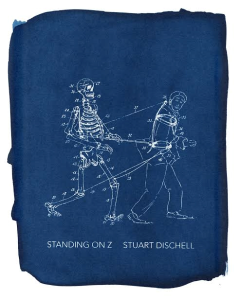
Standing on Z: An Interview with and Three Poems by Stuart Dischell

z

Okla Elliott: I notice that several poems in Standing on Z make use of repetition and that the repetition is often of a word that is generally considered negative—e.g., “forget” in “Questions for the Mariner” and “dead” in “Threnody.” Would you mind speaking to the repetition of these particular (types of) words and repetition in poetry more generally?

Stuart Dischell: Repetition is at the heart of poetry. It is its heartbeat. I’m talking about sound the repetition of sound and syntax–whether the metrics of formal verse or the breath-lines of free verse. The obvious difficulty in working with repetition is that it can be repetitious in the sense of boring, in the sense of a parent saying the same things in the same way over and over again or a child banging a spoon on the table. In a good poem that employs repetitions, the words, lines, or phrases take on nuanced meanings and repercussions. I have never been one to write villanelles or sestinas—those obsessive forms of which there are few really fine examples—but lately I find myself working with the pantoum and triolet. Repetition is memory. Or maybe I am just getting older and find myself repeating myself. What?

OE: Authors are often asked to give advice to beginning writers, which makes a lot of sense, but I want to take a different approach. What advice would you give to an early-career writer with, say, one book out and a decent first job? Which sorts of problems do you think are peculiar to writers at that point on the writing path?
.
SD: To start, I would say, “congratulations.” Publishing a book of poems is not easy nor is getting a decent job. That said, I would advise keeping to first principles, the things that “bid you to write poetry” as Rilke wrote in Letters to a Young Poet. Keep your totemic books around you, the writers that first got you going, and newer books too. Stay curious. Remember there is the imagination. Don’t understand your own poems so well. Don’t get too cozy with only poets of your generation. Remember there is always the imagination. Be playful but never forget that the writing of poetry is not a game. People have died for it.

OE: If you could change one thing in the literary/publishing world today, what would it be? I mean a-genie-just-gave-you-a-wish kind of scenario. Anything goes.

SD: Gee whiz, Genie, I don’t know what I would change. Poetry appears to be published everywhere online and in print. Although there may be perceived centers of power (mostly perceived by those dwelling in those centers) American poetry has become the most democratic of the arts. Journals and presses represent every perspective, aesthetic, and region—many within the same publications. Poems in “start-up” online journals are frequently read more than work in established literary journals. Gorgeous books are being printed by small presses, and as poetry becomes more frequently read online, there seems to be greater interest in the artisanal.

***

Standing on Z

The end of the jetty is like the end of our language.
Nothing is ahead but the open sea.

Who said there should not be more letters in the alphabet?
The jetty would be longer if we spoke Chinese—

But our characters are not as pretty and it takes
Perspective to see how the m in man and the w in woman

Suggest the graphics of their respective anatomies.
(Yet in my handwriting one looks like the other).

I am thinking of the romance of m and w by the sea.

What do you think they said in the hot sand of creation?
What would their last words be?

***

After a Late Show

A gob on the sidewalk
Refracts the lights
Of cars and bar signs
And theatre marquees.

The locked hands
Of couples pass over it,
A dog sniffs, and a child
Running in pink shoes

Ahead of her folks
After a late show
Calls it a jellyfish
And squashes it.

***

The Passages

Some brightly decorated passages
Lively and fluorescent until dawn
Like stars are hidden in the daylight—
No signs, no numbers, no names.

Mostly, we live indoors.

I have a favorite pair of shoes
Manufactured in Argentina.
There is nowhere I wish to walk
In them but down those passages.

***

Stuart Dischell was born in Atlantic City, NJ. He is the author of Good Hope Road, a National Poetry Series Selection, Evenings & Avenues, Dig Safe, Backwards Days, and the chapbooks Animate Earth and Touch Monkey. Dischell’s poems have been published in The Atlantic, Agni, The New Republic, Slate, Kenyon Review, Ploughshares, and anthologies including Essential Poems, Hammer and Blaze, Pushcart Prize, and Garrison Keillor’s Good Poems. A recipient of awards from the nea, the North Carolina Arts Council, and the John Simon Guggenheim Foundation. He teaches in the MFA Program in Creative Writing at the University of North Carolina Greensboro.

Killing Time

killing time

Killing Time

by

Jonathan K. Rice

I watch the traffic
reduced from four lanes to two.
The far lanes are scraped and rough
lined with orange cones
splattered with tar.

A work crew in hard hats
and fluorescent yellow vests
sweat in the heat, repaving the road,
driving pint-sized bulldozers and rollers,
shoveling, raking, sweeping,
waving cars through red lights
where the cross streets are blocked.

Two guys wait for the tattoo parlor to open.
John’s Kitchen is busy with breakfast.
It’s the only place I know that serves brains
and chitlins in this neighborhood.

A girl primps in the pawn shop window.
My coffee gets cold too fast but that’s okay.
It’s hot as hell and I’m waiting to meet
somebody down the block.

I sold my trumpet there.
The pawn shop guy with the gun on his hip
actually gave me what I paid for it
because I asked way too much.
I put gas in my car.

Now I’m looking to sell something else
but not my guitar
and never my dignity.

***

Jonathan Kevin Rice is a poet and visual artist living in North Carolina. This poem is reprinted by the author’s permission.

God: Both Source and River

KarenHeadBlue

God: Both Source and River

 by

Karen Craigo


If you’ve ever sat in a quiet room—if you’ve closed your eyes, stilled your breath, and thought you heard the rush of your own blood coursing through your frame—I think it could be fairly said that you’ve encountered God, or something close.

After a lifetime of thinking about God and the spirit, I’ve arrived at a construction that feels true to me. I flatly reject almost everything I’ve been told about the deity. God’s not male; God is not high above us; God does not direct and God does not judge. God is greater than that, and yet also closer and more intimate than that.

Let me back up. I have a friend who prays for trivial things—that she won’t be pulled over when speeding, or that she’ll get a good parking space when she arrives. This is literally true; she routinely asks God for a place to put her car, and this is on any normal day. It’s not a life-saving parking space; it’s just a good spot at the office, which she needs because she waited too long to leave for work.

I wonder how my friend squares her idea of God with the God of every other person circling the lot a few minutes before 8 a.m. Is it the same God? Does the winner of the spot just have a better relationship with the deity? And if God refuses to yield 60 square feet of ground, what does that say? Is God unfair, or is my friend too miserable of a sinner to merit a boon?

And praying for a place to park is far from the end of it. A lot of people I know pray for a team to win, or, more specifically, for a touchdown or a run or a goal, as if an all-knowing, all-seeing, all-loving force has one team’s colors in some cosmic closet.

It’s possible their God does, and it’s completely likely that I’m all wet when it comes to my idea of the universe’s creative and sustaining force. My ideas certainly go against my Baptist upbringing—those years of Sundays when my mother dropped me off at the First Baptist Church in Gallipolis, Ohio, because she thought kids needed church (although she herself seemingly had no interest in hanging out with a bunch of Baptists—people who, at least in the 1970s, decried pants for women).

I feel certain about God, although I’d never argue for my understanding of the deity over the understanding of some devout person who believes differently. For some, the God-stakes are very high, and a spiritual life is about heaven-winning and hell-avoidance. I see no profit in complicating that struggle, so I leave them to it and wish them well, hoping they get what they’re after.

But it’s a blessing not to believe in heaven or hell. They’re very childish notions to me. On one hand, there is this hot, buggy place where bad people go (as if we don’t all have bad in us; even Jesus is said to have cursed a fig tree, seemingly out of sheer crankiness). Or there is this stultifyingly dull cloudscape where the good end up, and live in mansions, and wear crowns (as if we’re not all miraculous reflections of our creator and source, more glorious in our bodies than any metal or jewel).

Here’s some good news, as I see it—here’s “gospel” with a small G. We’re in heaven right now, and we’re constantly reaping an eternal reward, the love we offer always multiplying and rolling through this world and beyond in wave after wave of grace.

There is also some bad news. I’m afraid I don’t know a word that can serve as the opposite of “gospel,” unless we go back to Old English and coin one, like “baedspel” or “baspel.” But the baspel is that we’re also in hell, and paying attention to that hell is more the point of the exercise of living. All around us we find suffering and need—chaos, uncertainty, grief—and I think our role is to change that, to sow peace that passes understanding, and to break our backs every single day to make things better.

I heard it once, unexpectedly, from a beloved minister in a Lutheran church, and her words stuck with me: All the heaven we’re ever going to have, and all the hell we’ll ever know, are right here. We’re in them. And our job is to weight the balance toward heaven—to share the heaven of plenty and ameliorate the hell of hunger; to share the heaven of compassion and shatter the hell of isolation.

I’m as well read as any lapsed Baptist about the Bible. Thanks to Sunday after Sunday after Sunday of Bible drills, I can find 1 John 4:8 in nothing flat. (Boom! He that loveth not knoweth not God; for God is love, just as God whispered into the precious Fibonacci swirl of the ear of King James.) But what I know—and I mean exactly that word, know—about the spirit does not come from a printed text; it comes from my boundless imagination and my bold, reasoning mind—“texts” that God is constantly writing and amending and revising.

I am a poet, and I have to say, it’s very hard for someone who writes and studies literature to accept as the infallible word of God a translated text of mixed and sometimes uncertain origin—and even of political censorship, with kings stepping in to say what can and can’t be included. Language is just too nuanced; its usage is both idiosyncratic to individuals and regionally or even very locally determined. I grew up on southeastern Ohio, for instance, where we went not downtown or uptown but “overtown,” and a “toboggan” was something we wore on our head in the winter. The Bible is read throughout the world, in 531 languages, Google tells me, and I have to believe that somewhere, someone is seeing “toboggan” and not visualizing “hat.

My life as a poet has something to do with my understanding of God. What I’ve found in my years of writing is that I can work pretty hard and come up with respectable poems (or stories or essays, on occasion). But sometimes I look at the page and I see something much more intricate than what I had planned. I’ll see a system of imagery running through it and know that I didn’t put it there deliberately, or I’ll see a secondary meaning that just sort of wove itself. It happens routinely, and when it does, I recognize it as a gift, or more appropriately, an artifact of a deeper conversation.

One of my most vital spiritual sources is the work of Carl Jung, who coined the term “collective unconscious” to describe an aspect of my understanding of God. God to me is divine intelligence, a river of thought and sense that runs through all of us and allows us to have a shared language of symbol and feeling. Inspiration, to me, is what happens when we dip our net into this unconscious and haul it in, wriggling. (Don’t worry; in this metaphor, it’s strictly a catch-and-release arrangement, and what fish show up do so voluntarily.)

Better writers probably offer their thesis up front, but this writer is a coward, and I know that my ideas about God are deeply offensive to some Christians and potentially very troubling to others. My strategy, then, has been to say a bunch of blah-de-blah for 1,250 words or so, and then offer my key point at the end, where only the hardiest readers (and the non-fish-lovers) are found. So here goes.

God is a river of intelligence that runs through everything and holds all of our consciousness. Unlike Jung’s construction of the collective unconscious, I think even animals, and perhaps even some objects, contribute to this intelligence. This river is ageless and timeless. It flows beyond Earth. It’s where we are before we’re born and where we go when we die, and we’re even in it now, or we can at least stick a toe in when we’re brave enough to try to connect.

The river is why death has no power over us; it’s why we can experience empathy; it explains the things we know without having reason to, and it is where inspiration comes from. It’s the source of life and art and love. It’s the most powerful force there is.

I am a Christian, a follower of Christ’s example, but I’m not at all traditional in my path; where traditional Christians see a God who is omniscient, I see the river. The same goes for the omnipotent, omnipresent, and omnibenevolent God. I am a small contributing source to what God is, and God, that river, flows all through me. God is in my body and God is deeply present in my spirit and brain. When I close my eyes, I can hear God rushing through.

***

Karen Craigo is the author of the poetry collection No More Milk (Sundress, 2016) and the forthcoming collection Passing Through Humansville (ELJ, 2017). She maintains Better View of the Moon, a daily blog on writing, editing, and creativity, and she teaches writing in Springfield, Missouri. She is the nonfiction editor and former editor-in-chief of Mid-American Review, the reviews editor of SmokeLong Quarterly, an editor of Gingko Tree Review, and the managing editor of ELJ Publications.

SATURDAY POETRY SERIES PRESENTS: THE HEART OF A WOMAN

We_Can_Do_It!
THE HEART OF A WOMAN
By Georgia Douglas Johnson

The heart of a woman goes forth with the dawn,
As a lone bird, soft winging, so restlessly on,
Afar o’er life’s turrets and vales does it roam
In the wake of those echoes the heart calls home.

The heart of a woman falls back with the night,
And enters some alien cage in its plight,
And tries to forget it has dreamed of the stars
While it breaks, breaks, breaks on the sheltering bars.


(Today’s poem is in the public domain, belongs to the masses, and appears here today accordingly.)


Editor’s Note: No matter who you voted for in the primaries nor who you plan to vote for come November, there is no denying that this was an historic week in American history.

In this vein, I dedicate today’s poem–written by a black woman in a white age–to Michelle Obama, a black woman running the White House who reminded us this week that: “I wake up every morning in a house that was built by slaves. And I watch my daughters, two beautiful, intelligent black young women, playing with their dogs on the White House lawn.” And I dedicate this poem to the fact that, for the first time in American history, a woman has been nominated by a major party to run for President of the United States of America.

Any (reasonable) reservations you (or I) may have about Hillary Clinton and our two-party system aside, this is a moment to pause and marvel, to appreciate what we have accomplished and to believe that this can–and should–be just the beginning of progressive progress. This is a moment to celebrate that the heart of a woman need not try “to forget it has dreamed of the stars,” for it need not break, break, break “on the sheltering bars.”

Georgia Douglas Johnson: A member of the Harlem Renaissance, Georgia Douglas Johnson wrote plays, a syndicated newspaper column, and four collections of poetry: The Heart of a Woman (1918), Bronze (1922), An Autumn Love Cycle (1928), and Share My World (1962). (Annotated biography courtesy of The Poetry Foundation.)

The Storms in Philadelphia

dnc
photo by Robert MacCready

The Storms in Philadelphia

by

Okla Elliott


The first day of the DNC convention was plagued with storms. The literal storm that hit Philadelphia was serious, with flash floods in some streets and power outages in various neighborhoods around the city. The political storms, however, were mostly tempests in teapots. Mostly.

As everybody knows by now, Debbie Wasserman Schultz was forced to resign her position as DNC chair on Monday and was taken off the speaking schedule at the convention due to leaked emails that proved collusion with the press on the DNC’s part to undermine the presidential campaign of Bernie Sanders, as well as offering coveted political positions to high-dollar donors. This was probably the only political storm of noteworthy size. But ultimately, since anyone with even the tiniest bit of intellectual honesty and observational abilities knew that the DNC was doing all it could ensure Clinton won the nomination and since we all know politics is corrupted by money every day, this wasn’t as big as some have made it out to be. My only hope is that Debbie Wasserman Schultz has been sufficiently disgraced that Bernie-backed progressive Tim Canova will be able to win his primary race against her and end up in the US Congress, where we desperately need more true progressives (which DWS most certainly is not).

The true tempest in a teapot was the booing and heckling by some Bernie Sanders supporters when he spoke to them early in the day and during his primetime speech on the convention’s main stage, particularly when he strongly endorsed Clinton for president of the United States. These people represent a tiny fraction of the convention goers and their voices were only barely heard—though they do deserve to be heard, but at precisely the volume they were. And that low volume level should be compared to the three-minute ecstatic standing ovation, replete with dozens of delegates crying, Sanders received when he stepped out on stage. He was and remains the beloved leader of millions of progressives in this country, and I imagine he’ll continue to be such a leader for years to come—though he’ll have even more influence than he previously did, due to his various political organizations he has announced he plans to start and due to his (likely) increased power in the US Senate, to say nothing of his massive public stature that will allow him to continue to bend the national political discourse to the left.

By any objective measure, the speeches given on Monday night were rousing and galvanizing. My social media feeds were a blur of statements like “Cory Booker is killing it!” or “I love you, Michelle!” or “Bernie is my hero!” and so forth, and having talked a few dozen friends and colleagues, they report the same.

When I was at the RNC convention, I reported back to The Citizens’ Voice, a newspaper out of Wilkes-Barre, PA, that I predicted a bump in the polls for Trump and a slight improvement in his negatives. I likewise predicted the same for Clinton then, but after seeing the first night’s speeches and feeling the mood here in Philadelphia the day after, I predict an even larger bump for Clinton/Kaine than Trump/Pence enjoyed after last week.

Five Scenes from the RNC Convention: Dispatch #2

IMG_6027

Five Scenes from the RNC Convention: Dispatch #2

(text and photos by Okla Elliott)

1.

We were driving around downtown Cleveland, navigating the blocked-off roads and foot traffic, when Robert’s police scanner app informed us that a major disruption was underway and police reinforcements were requested. Robert and I  jumped out of the car and began gathering camera equipment, as Turner ran around the car and got in the driver’s seat. Turner drove off in search of a parking spot. As Robert and I ran, he was assembling his video camera — mounting it and attaching the mic, the lens, and so forth — with some difficulty. (You try running through a crowded downtown while assembling a video camera set-up sometime.) Despite fear of missing important footage, we stopped to allow Robert time to properly assemble his gear. All of this, from the jumping out of the car to assembling the camera, was a bumbled action sequence from a Hollywood movie.

[Side note: One of several things I have learned covering the convention is that nothing ever — and I mean ever — works as smoothly as you imagine it will, and certainly not as smoothly as it does in the Hollywood imagination.]

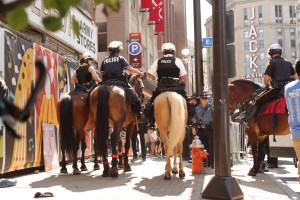
IMG_5902When we had finally made it across Public Square and down a small side street to where the commotion was, it turned out that members of the Revolutionary Communists had set an American flag on fire and were now surrounded by mounted police. We were therefore presented with a wall of horse-flesh and piles of horse manure scattered about. You’ll have to wait for the video dispatch, but Robert got some good footage of the arrest, as he ended up accidentally shuffled behind the horse-wall (which is now a word to me) by the IMG_5908police. I got a few photos of the horses and police, from where I ended up.
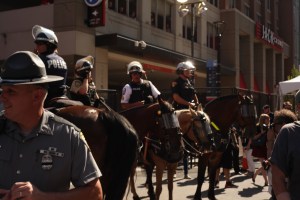
[Side note: One thing that happens to you a lot at these sorts of crowded protest-laden events is that you get moved around a lot, either with a gentle yet firm force by the police or just by the random flow of the crowd. Robert and I got utterly separated within seconds of arriving at the disruption and wouldn’t find each other again for nearly an hour.]

2.

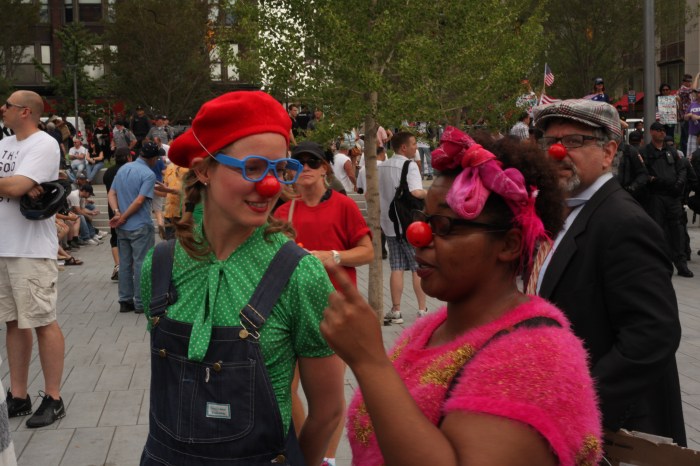
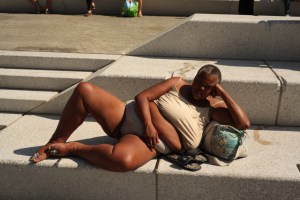
There were protesters of great variety present, though perhaps my favorite was a woman who merely lounged on the steps of the Public Square, proudly flaunting her lushly overweight body. When I asked permission to take her photo, I also asked her what she was protesting or supporting here. Here answer: “I’m not interested in protesting or IMG_5887supporting. I’m just enjoying this sun here in this open space.” It was therefore not so much a direct protest of any policy or party, but rather a positive message of body positivity and enjoyment she was promoting.
And this is another point worth making about the protesters at the convention: only a small number were directly protesting the RNC, around a fourth, I’d say. The rest just wanted attention for their cause or, in the more cynical cases, for themselves and were using this massive public event as a platform.

3.

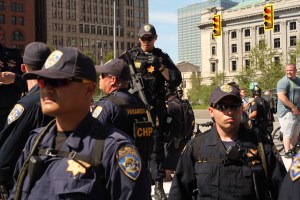
Perhaps the worst instance of protesters merely using the occasion to further their own IMG_5868agenda was when a group of rightwing Christians — think Westboro Baptist church types — set up a demonstration simply to yell about how gays were going to hell and how AIDS was righteous punishment from God.
Interestingly this demonstration had by far the greatest amount of police protection of any I saw in my three days in Cleveland. It also received the greatest resistance from the crowd.

[Side note: Something you should know about how demonstrations worked at the convention is that each group had to apply for permits to demonstrate at a particular location and for a specific time slot. Given the limited space provided, you got a turn

4.

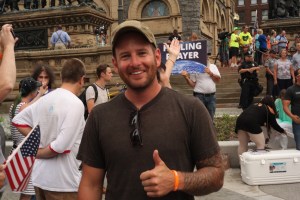
But if there is one rule of protests, it’s that for every protest group, there is an equal and opposite protest group. On the opposite side of the square was another Christian group, Healing Prayer, making a demonstration, but this time of love not hate. They played acoustic guitar and sang happy songs; they offered to pray for people in need; they hugged passersby freely. IMG_6018When I walked up to get a few photos, a man named Kevin (pictured to the right here) approached me and asked if he could pray for me.
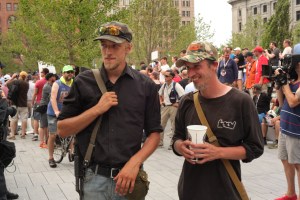
“Anything you need, anything you want me to pray with you for. What would you like me to pray for you for?” he asked.

“Maybe my health,” I said.

“What’s wrong?”

“I recently learned I have diabetes.”

And Kevin put his hand on my chest and gave a thoughtful and heartfelt prayer. And either he is the best actor in the world, or he was sincerely tearing up near the end of it. (I lean toward the latter.)

I’m sure whether one group cancels out the other or if some political/theological balance was restored to the universe by both groups being present, but I do know that rarely can you find such diversity in one location and rarely can see how a religious belief can be so starkly different in its enactment.

As Kevin said before I moved on, “Don’t you feel something different standing here with us? You feel love, right? Jesus loves you. Hell may be real, but I know this love right here is real. I can feel it. Do you?”

Yes, Kevin, I did.

5.

Okay, so every time I mentioned to a friend or family member that I was covering the RNC IMG_6009convention, the first, third, and seventh thing they said to me was, “Be careful there.” The media played up the potential violence, with armed protesters and armed supporters reported to be present. Even I was worried before I arrived. As it turned out, the New Black Panther Party didn’t show up en masse and armed, as promised, and the open-carry people present were really just photo ops for people like me. They spent almost the entire time posing for photos and offering platitudes about freedom and the found fathers.


Violence was nearly nonexistent at the convention and among the protesters, in fact, something that truly heartens me. I am happy to have been wrong, and I hope (though doubt) that the media will admit it was wrong to play up the possibility of violence, or at least acknowledge that the convention was remarkably civilized. The closest thing to incivility I saw was a group of grandstanding protesters on the final night yelling in the faces of cops in an attempt to create a spectacle and garner attention for themselves.

[Side note: It worked in a way. There was practically no immediate audience for their antics, but about a dozen people were filming and photographing the self-aggrandizing charade — Robert and myself included — so I imagine they’ll be able to get the attention they so obviously craved, even if only after the fact.]

All This Mayhem: Dispatch #1

rnc1

All This Mayhem: Dispatch #1

by

Okla Elliott (with photos and video by Robert MacCready)

I arrived at the Cleveland Amtrak station at 3:00am. It was darkened to the point of seeming abandoned; two cops stood by the entrance smoking cigarettes and eyeing everyone who came in or out with weary suspicion — though at that hour, this meant only me and maybe three or four others.

Cleveland was deathly quiet, a calm between two storms, yet the tension and tiredness emanating from the two police officers as I walked by them was unsettling. I felt sorry for them, for the unending task this week has already been and will continue to be in their lives. I also worried what that tension and tiredness might lead to as the week ground on.

But I’ve gotten ahead of myself. Aside from the obvious, why was I in Cleveland to cover and comment on the RNC convention? One of my best friends, Robert MacCready, called me on my birthday and after a few perfunctory seconds of well-wishing, he immediately launched into a scheme he said was perfect for us, something we absolutely had to do.

“You live near Philadelphia, right?”

“Yeah.”

“Let’s cover the DNC convention,” he said, not really a suggestion so much as a revelation of unalloyed necessity.

Long story made short: we decided to do our best Hunter S. Thompson and Norman Mailer impressions and do both the RNC and DNC conventions; a few weeks of frantic calling and emailing protest organizations, political candidates, and public officials ensued; Free Press Houston agreed to be our primary sponsor with several other news venues expressing interest in coverage as well. And it was, as they say, on.

rnc_flyerOkay…now that you’re mostly caught up, back to my arrival in Cleveland…
Bob picked me up at the station in a rental car and we went back to where we’ll be staying. We reviewed footage Bob had shot during the day before I arrived and discussed angles of entry for the stories we wanted to bring out all this mayhem. We did a minimum of reminiscing, slipping neatly into our new roles as journalistic/anthropologist collaborators. We finally got to sleep around 5:00am.

As I write this, Bob is editing footage for our first video dispatch. This is what our friendship was always meant to be: sitting across from each other at a table working together. Bob was right when he said, “Man, we have to do this.”

This first dispatch has been largely personal, but I’ll give you three interesting facts about the convention itself:

  1. The only arrests on day-one were for nonviolent offenses.

    vermin
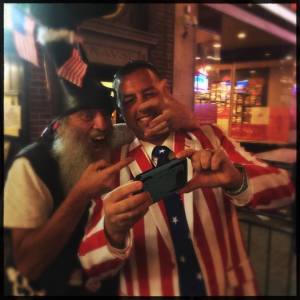
    Vermin Supreme with a new constituent
  2. The Bikers for Trump group had asked for a demonstration permit to accommodate tens of thousands, yet only approximately 1000 showed up, showing either a lack of support or courage on their part.
  3. Vermin Supreme was on the scene, offering Dadaist campaign promises such as a pony for every American, but an identification pony you would have to have with you everywhere to identify yourself as an American citizen.

We’ll be sending video and writerly dispatches as we can, and future dispatches will of course focus more on the convention itself. I will also be on various radio programs and writing for a few newspapers in addition to my in-the-moment dispatches here at As It Ought to Be. Links for all will be forthcoming. For now, enjoy the promo video for our adventures: