SATURDAY POETRY SERIES PRESENTS: THE HEART OF A WOMAN

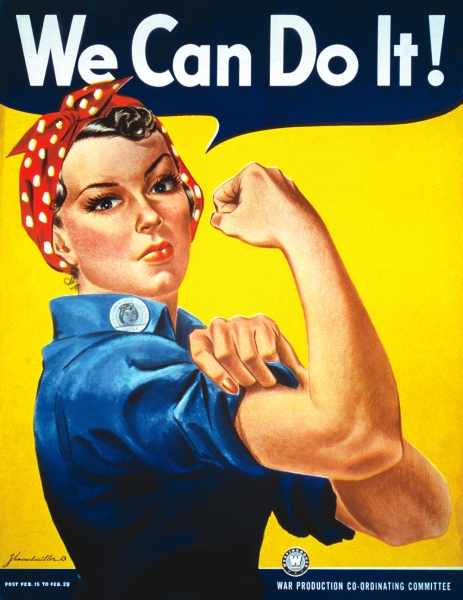
We_Can_Do_It!
THE HEART OF A WOMAN
By Georgia Douglas Johnson

The heart of a woman goes forth with the dawn,
As a lone bird, soft winging, so restlessly on,
Afar o’er life’s turrets and vales does it roam
In the wake of those echoes the heart calls home.

The heart of a woman falls back with the night,
And enters some alien cage in its plight,
And tries to forget it has dreamed of the stars
While it breaks, breaks, breaks on the sheltering bars.


(Today’s poem is in the public domain, belongs to the masses, and appears here today accordingly.)


Editor’s Note: No matter who you voted for in the primaries nor who you plan to vote for come November, there is no denying that this was an historic week in American history.

In this vein, I dedicate today’s poem–written by a black woman in a white age–to Michelle Obama, a black woman running the White House who reminded us this week that: “I wake up every morning in a house that was built by slaves. And I watch my daughters, two beautiful, intelligent black young women, playing with their dogs on the White House lawn.” And I dedicate this poem to the fact that, for the first time in American history, a woman has been nominated by a major party to run for President of the United States of America.

Any (reasonable) reservations you (or I) may have about Hillary Clinton and our two-party system aside, this is a moment to pause and marvel, to appreciate what we have accomplished and to believe that this can–and should–be just the beginning of progressive progress. This is a moment to celebrate that the heart of a woman need not try “to forget it has dreamed of the stars,” for it need not break, break, break “on the sheltering bars.”

Georgia Douglas Johnson: A member of the Harlem Renaissance, Georgia Douglas Johnson wrote plays, a syndicated newspaper column, and four collections of poetry: The Heart of a Woman (1918), Bronze (1922), An Autumn Love Cycle (1928), and Share My World (1962). (Annotated biography courtesy of The Poetry Foundation.)

The Storms in Philadelphia

dnc
photo by Robert MacCready

The Storms in Philadelphia

by

Okla Elliott


The first day of the DNC convention was plagued with storms. The literal storm that hit Philadelphia was serious, with flash floods in some streets and power outages in various neighborhoods around the city. The political storms, however, were mostly tempests in teapots. Mostly.

As everybody knows by now, Debbie Wasserman Schultz was forced to resign her position as DNC chair on Monday and was taken off the speaking schedule at the convention due to leaked emails that proved collusion with the press on the DNC’s part to undermine the presidential campaign of Bernie Sanders, as well as offering coveted political positions to high-dollar donors. This was probably the only political storm of noteworthy size. But ultimately, since anyone with even the tiniest bit of intellectual honesty and observational abilities knew that the DNC was doing all it could ensure Clinton won the nomination and since we all know politics is corrupted by money every day, this wasn’t as big as some have made it out to be. My only hope is that Debbie Wasserman Schultz has been sufficiently disgraced that Bernie-backed progressive Tim Canova will be able to win his primary race against her and end up in the US Congress, where we desperately need more true progressives (which DWS most certainly is not).

The true tempest in a teapot was the booing and heckling by some Bernie Sanders supporters when he spoke to them early in the day and during his primetime speech on the convention’s main stage, particularly when he strongly endorsed Clinton for president of the United States. These people represent a tiny fraction of the convention goers and their voices were only barely heard—though they do deserve to be heard, but at precisely the volume they were. And that low volume level should be compared to the three-minute ecstatic standing ovation, replete with dozens of delegates crying, Sanders received when he stepped out on stage. He was and remains the beloved leader of millions of progressives in this country, and I imagine he’ll continue to be such a leader for years to come—though he’ll have even more influence than he previously did, due to his various political organizations he has announced he plans to start and due to his (likely) increased power in the US Senate, to say nothing of his massive public stature that will allow him to continue to bend the national political discourse to the left.

By any objective measure, the speeches given on Monday night were rousing and galvanizing. My social media feeds were a blur of statements like “Cory Booker is killing it!” or “I love you, Michelle!” or “Bernie is my hero!” and so forth, and having talked a few dozen friends and colleagues, they report the same.

When I was at the RNC convention, I reported back to The Citizens’ Voice, a newspaper out of Wilkes-Barre, PA, that I predicted a bump in the polls for Trump and a slight improvement in his negatives. I likewise predicted the same for Clinton then, but after seeing the first night’s speeches and feeling the mood here in Philadelphia the day after, I predict an even larger bump for Clinton/Kaine than Trump/Pence enjoyed after last week.

Five Scenes from the RNC Convention: Dispatch #2

IMG_6027

Five Scenes from the RNC Convention: Dispatch #2

(text and photos by Okla Elliott)

1.

We were driving around downtown Cleveland, navigating the blocked-off roads and foot traffic, when Robert’s police scanner app informed us that a major disruption was underway and police reinforcements were requested. Robert and I  jumped out of the car and began gathering camera equipment, as Turner ran around the car and got in the driver’s seat. Turner drove off in search of a parking spot. As Robert and I ran, he was assembling his video camera — mounting it and attaching the mic, the lens, and so forth — with some difficulty. (You try running through a crowded downtown while assembling a video camera set-up sometime.) Despite fear of missing important footage, we stopped to allow Robert time to properly assemble his gear. All of this, from the jumping out of the car to assembling the camera, was a bumbled action sequence from a Hollywood movie.

[Side note: One of several things I have learned covering the convention is that nothing ever — and I mean ever — works as smoothly as you imagine it will, and certainly not as smoothly as it does in the Hollywood imagination.]

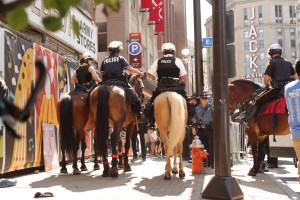
IMG_5902When we had finally made it across Public Square and down a small side street to where the commotion was, it turned out that members of the Revolutionary Communists had set an American flag on fire and were now surrounded by mounted police. We were therefore presented with a wall of horse-flesh and piles of horse manure scattered about. You’ll have to wait for the video dispatch, but Robert got some good footage of the arrest, as he ended up accidentally shuffled behind the horse-wall (which is now a word to me) by the IMG_5908police. I got a few photos of the horses and police, from where I ended up.
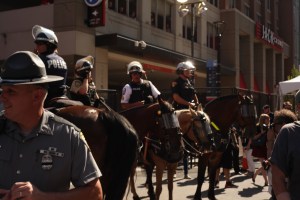

[Side note: One thing that happens to you a lot at these sorts of crowded protest-laden events is that you get moved around a lot, either with a gentle yet firm force by the police or just by the random flow of the crowd. Robert and I got utterly separated within seconds of arriving at the disruption and wouldn’t find each other again for nearly an hour.]

2.

There were protesters of great variety present, though perhaps my favorite was a woman who merely lounged on the steps of the Public Square, proudly flaunting her lushly overweight body. When I asked permission to take her photo, I also asked her what she was protesting or supporting here. Here answer: “I’m not interested in protesting or IMG_5887supporting. I’m just enjoying this sun here in this open space.” It was therefore not so much a direct protest of any policy or party, but rather a positive message of body positivity and enjoyment she was promoting.
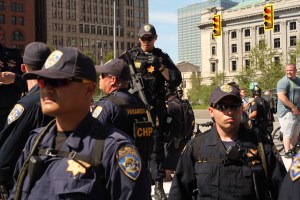
And this is another point worth making about the protesters at the convention: only a small number were directly protesting the RNC, around a fourth, I’d say. The rest just wanted attention for their cause or, in the more cynical cases, for themselves and were using this massive public event as a platform.

3.

Perhaps the worst instance of protesters merely using the occasion to further their own IMG_5868agenda was when a group of rightwing Christians — think Westboro Baptist church types — set up a demonstration simply to yell about how gays were going to hell and how AIDS was righteous punishment from God.
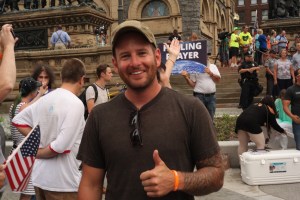
Interestingly this demonstration had by far the greatest amount of police protection of any I saw in my three days in Cleveland. It also received the greatest resistance from the crowd.

[Side note: Something you should know about how demonstrations worked at the convention is that each group had to apply for permits to demonstrate at a particular location and for a specific time slot. Given the limited space provided, you got a turn

4.

But if there is one rule of protests, it’s that for every protest group, there is an equal and opposite protest group. On the opposite side of the square was another Christian group, Healing Prayer, making a demonstration, but this time of love not hate. They played acoustic guitar and sang happy songs; they offered to pray for people in need; they hugged passersby freely. IMG_6018When I walked up to get a few photos, a man named Kevin (pictured to the right here) approached me and asked if he could pray for me.
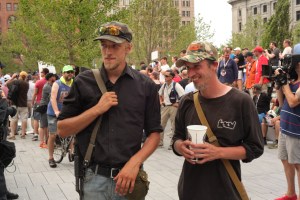
“Anything you need, anything you want me to pray with you for. What would you like me to pray for you for?” he asked.

“Maybe my health,” I said.

“What’s wrong?”

“I recently learned I have diabetes.”

And Kevin put his hand on my chest and gave a thoughtful and heartfelt prayer. And either he is the best actor in the world, or he was sincerely tearing up near the end of it. (I lean toward the latter.)

I’m sure whether one group cancels out the other or if some political/theological balance was restored to the universe by both groups being present, but I do know that rarely can you find such diversity in one location and rarely can see how a religious belief can be so starkly different in its enactment.

As Kevin said before I moved on, “Don’t you feel something different standing here with us? You feel love, right? Jesus loves you. Hell may be real, but I know this love right here is real. I can feel it. Do you?”

Yes, Kevin, I did.

5.

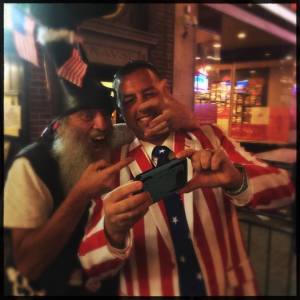
Okay, so every time I mentioned to a friend or family member that I was covering the RNC IMG_6009convention, the first, third, and seventh thing they said to me was, “Be careful there.” The media played up the potential violence, with armed protesters and armed supporters reported to be present. Even I was worried before I arrived. As it turned out, the New Black Panther Party didn’t show up en masse and armed, as promised, and the open-carry people present were really just photo ops for people like me. They spent almost the entire time posing for photos and offering platitudes about freedom and the found fathers.

Violence was nearly nonexistent at the convention and among the protesters, in fact, something that truly heartens me. I am happy to have been wrong, and I hope (though doubt) that the media will admit it was wrong to play up the possibility of violence, or at least acknowledge that the convention was remarkably civilized. The closest thing to incivility I saw was a group of grandstanding protesters on the final night yelling in the faces of cops in an attempt to create a spectacle and garner attention for themselves.

[Side note: It worked in a way. There was practically no immediate audience for their antics, but about a dozen people were filming and photographing the self-aggrandizing charade — Robert and myself included — so I imagine they’ll be able to get the attention they so obviously craved, even if only after the fact.]

All This Mayhem: Dispatch #1

rnc1

All This Mayhem: Dispatch #1

by

Okla Elliott (with photos and video by Robert MacCready)

I arrived at the Cleveland Amtrak station at 3:00am. It was darkened to the point of seeming abandoned; two cops stood by the entrance smoking cigarettes and eyeing everyone who came in or out with weary suspicion — though at that hour, this meant only me and maybe three or four others.

Cleveland was deathly quiet, a calm between two storms, yet the tension and tiredness emanating from the two police officers as I walked by them was unsettling. I felt sorry for them, for the unending task this week has already been and will continue to be in their lives. I also worried what that tension and tiredness might lead to as the week ground on.

But I’ve gotten ahead of myself. Aside from the obvious, why was I in Cleveland to cover and comment on the RNC convention? One of my best friends, Robert MacCready, called me on my birthday and after a few perfunctory seconds of well-wishing, he immediately launched into a scheme he said was perfect for us, something we absolutely had to do.

“You live near Philadelphia, right?”

“Yeah.”

“Let’s cover the DNC convention,” he said, not really a suggestion so much as a revelation of unalloyed necessity.

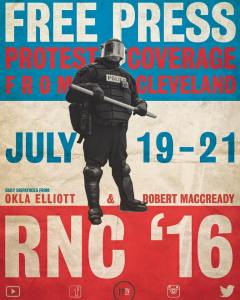
Long story made short: we decided to do our best Hunter S. Thompson and Norman Mailer impressions and do both the RNC and DNC conventions; a few weeks of frantic calling and emailing protest organizations, political candidates, and public officials ensued; Free Press Houston agreed to be our primary sponsor with several other news venues expressing interest in coverage as well. And it was, as they say, on.

rnc_flyerOkay…now that you’re mostly caught up, back to my arrival in Cleveland…
Bob picked me up at the station in a rental car and we went back to where we’ll be staying. We reviewed footage Bob had shot during the day before I arrived and discussed angles of entry for the stories we wanted to bring out all this mayhem. We did a minimum of reminiscing, slipping neatly into our new roles as journalistic/anthropologist collaborators. We finally got to sleep around 5:00am.

As I write this, Bob is editing footage for our first video dispatch. This is what our friendship was always meant to be: sitting across from each other at a table working together. Bob was right when he said, “Man, we have to do this.”

This first dispatch has been largely personal, but I’ll give you three interesting facts about the convention itself:

  1. The only arrests on day-one were for nonviolent offenses.

    vermin
    Vermin Supreme with a new constituent
  2. The Bikers for Trump group had asked for a demonstration permit to accommodate tens of thousands, yet only approximately 1000 showed up, showing either a lack of support or courage on their part.
  3. Vermin Supreme was on the scene, offering Dadaist campaign promises such as a pony for every American, but an identification pony you would have to have with you everywhere to identify yourself as an American citizen.

We’ll be sending video and writerly dispatches as we can, and future dispatches will of course focus more on the convention itself. I will also be on various radio programs and writing for a few newspapers in addition to my in-the-moment dispatches here at As It Ought to Be. Links for all will be forthcoming. For now, enjoy the promo video for our adventures:

Here, Now


 Here, Now

by

Paul Crenshaw


Before he was pulled over, Philando Castile worked in the cafeteria of an elementary school. Imagine with me all manner of child: their voices ringing off the tile floors, chewing with their mouths open, small shoes shuffling along in the line where the workers stand behind slanted glass. Imagine small cartons of milk. Plastic trays with square compartments for circular food. Small hands hold the corners of the trays. Some of the kids are scared and nervous this first day of school so a man at the end of the line gives them graham crackers and little goldfish. By all accounts I could find he was a fine man. In a few hours he will be shot in a car and all of us will see what happens next, but for now let us imagine him smiling and hugging the small children, saying “Here now, kids, eat all your food, so you can grow up to be big and strong.


***

Paul Crenshaw teaches literature and creative writing at Elon University. His work has appeared in Best American Essays, Best American Nonrequired Reading, North American Review, Prairie Schooner, Pushcart, Quarterly West, and elsewhere.

SATURDAY POETRY SERIES PRESENTS: BLACK LIVES MATTER POETRY


“It is not necessary that you believe that the officer who choked Eric Garner set out that day to destroy a body. All you need to understand is that the officer carries with him the power of the American state and the weight of an American legacy, and they necessitate that of the bodies destroyed every year, some wild and disproportionate number of them will be black.” ― Ta-Nehisi Coates


Editor’s Note: Every word I have attempted to write here has been wholly inadequate. I can only offer you poetry written by those who have lived an experience that I have only witnessed from the sidelines, in abject horror.


BLACK LIVES MATTER POETRY:

“Standing In Courage” by Jacinta V. White

“The All Black Penguin Speaks” by Roger Bonair-Agard

“Black Woman” by Georgia Douglas Johnson

#BlackPoetsSpeakOut

Black Lives Matter: A Roundup of Worthy Reads – The Poetry Foundaton

10 Artists of the Black Lives Matter Movement – Sojourners

Poets for Ferguson

Black Lives Matter – Renee Mitchell Speaks

‘Black Lives Matter’: A Poem by Nikkita Oliver

Anthony McPherson – “All Lives Matter: 1800s Edition”

Black Lives Matter/Freddie Gray Poem


SATURDAY POETRY SERIES PRESENTS: TWO MERMAID POEMS


792px-Elisabeth_Jerichau_Baumann_havfruen


Editor’s Note: In response to last week’s feature, Saturday Poetry Series favorites Erin Lyndal Martin and Elana Bell introduced me to two more fabulous mermaid poems. These poems have been swimming through my mind all week, and are too fantastic not to share. Get a taste here, then follow the links below to read each of these stunning poems in full.


from FABLE OF THE MERMAID AND THE DRUNKS
By Pablo Neruda, Translated by Paul Weinfield

But having come from the river, she understood nothing
She was a mermaid and was lost
Their insults flowed down her perfect, smooth flesh
Their filth enveloped her golden breasts
But not knowing tears, she did not weep tears


(Read the complete poem as translated by Paul Weinfield.)


from LATE SUNDAY MORNING
By Elana Bell

I kiss

the puckered lips, taste
ocean breath and remember

myself, slippery and long
under sun-slanted depths, swaying

to the whine of boats overhead.
I did not need you then, my scales

shining in their pristine sea.


(Read the entire poem in Winter Tangerine.)


Want to read more?
“Sunday Morning” in Winter Tangerine
“Fable of the Mermaid and the Drunks” as translated by Paul Weinfeild
“Fable of the Mermaid and the Drunks” in English and Spanish via Susan’s Place
“Fable of the Mermaid and the Drunks” on youtube, as read by Ethan Hawke


Today’s selections appear via Fair Use.

Three Poems by Shelley Puhak

puhak-headshot-199x300

Stalin, alone

At the Tbilisi seminary, suspended
for reading Victor Hugo, he wrote
as all seventeen-year-olds do, of violets,
icy peaks and blue firmament, wrote
a poem to the moon:
          .With outstretched arms, I shall revere
          .The spreader of light upon the earth.
At Kuntsevo, in the conservatory, moonlit
geometries on cold tile are cut by the black
of his boots, as pipe smoke ribbons rise
past glossy green leaves, fruit gone silver—
Lemons. He loved them.
Grew them until the end.
Now moonlight trails him when he steps
from his bath, bare feet on marble.
The moon dissects him, his body the same
as anyone’s: silver white rind
of skin, dimpled, oily, thin
and the bitter fruit within.

***

Why Old Women Cry at Weddings

His hand, big and pink, crushes the satin
on the small of her back.
………………………………The old women
mist up, but they are not just nostalgic,
already tasting the mud in their mouths,
remembering themselves queasy with champagne,
hair lacquered stiff, itchy lace cuffs,
their groom in his dress blues, not shipping out
until next week. And it’s not
that they forget things.
……………………………We all do.
They cry because we want
them to, or because it’s a wedding,
because there will be so many others
we will attend, one after another,
until all faces smear into years
pressed against frosted glass,
a year unfolds in an hour
spent fumbling
with a linen napkin
shaped like a swan.

***

Lancelot, after Being Caught Downloading Porn

Look. When the arborist called—the old oak
in the yard was too far along—

I sobbed in the Target parking lot, recalling
the birch of your body and the oak

of my own desire, pyramidal in youth,
thinning in autumn. And the day after

the machinery came, the cat
had to be put down. O! the simplicity

of a needle after so many tools with teeth:
saws, chippers, grinders. I’d think the cat

imperative and the oak incidental
to our story, had the arborist not said

deciduous over and over, explaining how
this oak, startled as a sapling, had always

been hollow. And now even its stump
gone. Easy, too easy, to let the cat

crumple. Someone came with the needle, someone
hummed among the last fingers of leaf.

Look. A hollow tree stands only on the new
wood it urges up. I’m only hunting

for a bit of bark to peel back, the surprise
of the pale just beneath, the dappled

birch of any body. Put away your quivering lip,
my dear. We were always deciduous.

***

Shelley Puhak is the author of two poetry collections, the more recent of which, Guinevere in Baltimore (Waywiser 2013), was selected by Charles Simic for the Anthony Hecht Poetry Prize. Her first collection, Stalin in Aruba (Black Lawrence 2009) was awarded the Towson Prize for Literature. Puhak’s poems have appeared in Kenyon Review Online, North American Review, and Verse Daily, her essays have appeared in Black Warrior Review, Creative Nonfiction, and Columbia. Puhak teaches at Notre Dame of Maryland University, where she is the Eichner Professor of Creative Writing. She lives in Baltimore with her husband and son.

[The above poems are reprinted with permission of the author.]

To Turn with Joy and Hope: A Conversation Between Okla Elliott and Sonya Huber

 sonya

SH: So, Okla, you recently wrote Bernie Sanders: The Essential Guide, and are now working on a similar short book for Squint Books on Pope Francis. In the Bernie book, you manage to work in cool departures into sci-fi and the appeal of dystopian literature. Are you planning stuff like that with the Pope book? And is the Pope Francis book more difficult because he’s such a global figure?

OE: I have a chapter that is a theoretical interlude, as I did in the Bernie book, but this one appropriates certain aspects of Hegelian philosophy to describe a version of God that is different than the standard one. One of my main goals as a writer is to make really difficult philosophy accessible to a generally educated reader, and I do my best to take Hegel, who is famously dense and confusing, and make him comprehensible on the subject of the nature of God. I depart a bit from Hegel’s views, but I think I follow them to their logical conclusion despite disagreeing with his own final conclusions on the subject.

There is another connection between the Bernie book and the Pope Francis book—namely,heartre I place both figures into the larger global and historical context out of which they emerged and in which they are active forces. I think this is, broadly speaking, a loosely defined reaction to neoconservative and neoliberal policies that have jeopardized the environment, financial stability, human rights, and world peace. I get into greater detail in the book of course, but that’s the broad stage on which I place Pope Francis.

SH: That sounds awesome. Or, I mean, terribly necessary and therefore awesome. I tried to do the same thing with The Evolution of Hillary Rodham Clinton and also to make something like neoliberalism accessible as a concept. As an aside—do you think that neoliberalism itself is enough of a framework for activists for understanding what is going on with the world and how to oppose those structures? I think the idea of neoliberalism is so pervasive and vague and global (and such a confluence of capital and nation-state) that it’s difficult to turn it around into action targets. One of the immediate goals suggested by the analysis of neoliberalism is greater scrutiny on international trade and debt agreements. (On that note, I highly recommend Sunil Yapa’s new novel, Your Heart is a Muscle the Size of a Fist, about the Seattle protests against the WTO in 1999). Hillary has played both sides of the fence but is probably at heart in favor of these agreements and the general opening of markets. But ultimately, stopping these agreements is a reactive battle. What do you see as a way for movements to gain momentum against neoliberalism?

OE: I think you’re right to see fighting trade agreements after the fact as a reactionary battle we are destined to lose. We need to somehow preemptively strike in such a way as to prevent further trade agreements like the ones that have decimated the American middle class while ruining the environment and workers’ rights in third-world countries. The only real way to do this is elect politicians who aren’t beholden the corporate class over the majority of Americans and human rights around the world. The question of course is: how do we do that?

Speaking of politicians who support every trade deal that’s ever come across their desks (to use her own words), I would like to hear more about your Clinton book. I know you have both positive and negative thoughts about her as a candidate and public figure. Could you outline the area of greatest ambivalence for you?

hillarySH: Yes, definitely! First, she came of age within the New Democrat mindset and is married to its key architect. So the major question for me is the extent to which she sees compromise with right-wing agendas (both domestic and international) as a kind of unavoidable expediency. In the past she has said that she believes that the market and the American model need to be spread around the world, which is as neocolonial as it gets. As I talk about in the book, international trade deals (often made in secret) are one area I think she is unreliable on. Also, I wish she had a clearly reform-minded agenda on a key domestic point (like Sanders has with education). She has both a good track record for child advocacy AND a history of supporting neo-liberal domestic programs (like stricter work requirements for welfare recipients and standardized testing in schools. Other major concerns include the big unknown of her foreign policy, especially her desire to confront ISIL, with all of the unknown effects that might bring. And I go into a huge list of other reservations in the book.

Despite my reservations, however, I’m not worried about having her as president. In reference to your point about change, I think local politicians and campaigns do important work, but I also see how many social movements throughout history have made gains by pressing from the outside. An electoral campaign is great and can galvanize people who hadn’t previously considered themselves active, which might lead them into a more sustained social movement. I don’t think Hillary Clinton is immune to social pressure. In fact, I think her record is quite the opposite; she’s flexible and social movements have an opportunity with her. If she’s the president, her power would be as limited as Obama’s has been, and as any president’s would be.

My next question for you—with your view of both the domestic fire behind Bernie Sanders and the internal firebrand of Pope Francis—is whether this overlap represents some kind of a new era or new opportunity for change? (Impossible question, but I want to see what you think.)

OE: As I argue in my Bernie book, there is a general planet-wide unrest with neoliberal policies, whether we’re talking about austerity programs in Greece or neocolonial corporate activities in Latin America or domestic policies here in the United States like the berniebookones you mentioned. And for whatever reason, for such general unrest to form into effective movements, humans tend to need leaders to coalesce around. Not always, but as a rule. Right now, figures such as Jeremy Corbyn, Pope Francis, Evo Morales, Justin Trudeau, Bernie Sanders, and Elizabeth Warren are spearheading what I see as a loosely connected global progressive movement. And, yes, I definitely see this as a huge opportunity for change here and abroad. We just need to keep the momentum going on all fronts all at once and not let up. My fear is that a Bernie Sanders loss in the primaries could make many of his followers crestfallen to the point of just giving up on effecting political change. It’s the job of people like you and me to make sure that doesn’t happen. So, no pressure or anything…

Since you brought up hope and/or potential for progressive change, what do you think a Clinton presidency can offer us in those regards, and what do you think it will offer in the opposite direction?

SH: The scenario of a Clinton presidency is interesting as a counterpoint to the Obama years. In 2008, I think many progressives and liberals saw his election as a win and were therefore slightly less motivated to get out and organize. This time around, I think the extremism in Trump’s platform combined with the full-on yardsale of the Democratic primaries means that people are a lot more educated about the ways in which we might ask for—and demand—more from our leaders and why it is particularly urgent to do so now, along with knowing a lot about key domestic and international issues. I hope skillful organizers connected to the Sanders infrastructure will channel the energy into a movement.

The hard thing is that an election has such a clear short-term endpoint, whereas so many social justice causes do not, so these skillful organizers will hopefully be able to frame issues in terms of intermediate steps and winnable goals without diluting the raw and ferocious passion for change (I guess that’s going to be my new band name, RAFP4C). Those organizers will also have to share theories with their supporters about how change happens beyond as well as within electoral politics.

On the issue of a Clinton presidency: I agree that there’s a danger of Bernie supporters falling into cynicism. Folks will also naturally be watching Clinton, ready to say “I told you so,” and this vigilance is necessary for sanity and for holding the administration accountable. On the other hand, that focus doesn’t necessarily build movements. I think it is up to Bernie supporters like us to turn with as much joy and hope toward the next future, to say that another world is possible, that electing a socialist president was a massively wild goal and that in coming close, we have shown ourselves that other massively wild things are possible. Now we need to go get them.

This is kind of weird question, but since you’re both in touch with Bernie supporters and are doing work on Pope Francis, is there an overlap? Do you feel like that voice coming from the Vatican, which has been pretty conservative since Vatican II, will add some oomph to progressive movements from a different direction of our population? Does the Pope have cred?

OE: All I have is anecdotal evidence to support the following answer, but I have tons of anecdotal evidence, so it feels like it is valid on some level. Nearly all of the people I see sharing Sanders memes on social media also share Pope Francis memes on social media. And what’s really interesting is how broad this pope’s appeal is. Many non-Catholics love him, and even atheist social media pages quote him. I think he is in a unique position to bring together different religious and political groups and move them in a more progressive direction. Basically, if we could get the Dalai Lama, Pope Francis, and Elizabeth Warren to do a world speaking tour, my life would be complete. (I’m only half-joking there.)

So, my final question for you: How do you see us moving forward, mixing moderate and progressive elements to form a sustainable and equitable future? And where does writing fit into all of this (a question I ask myself constantly without ever quite being able to concoct an answer I’m willing to settle on)?

SH: I am a mix of optimism and dread. Dread is my natural state, but I’m optimistic because the current debates have brought so many former “unquestionables” up for debate, from gender and sexuality to capitalism—even within moderate circles. With my public political writing, I sometimes set out to prove or argue a certain point, but lately I’m finding myself wanting to integrate more of the questioning and multivocal impulse of the essay into political topics, trying to take a stand while undercutting the traditional modes of argumentation. I tried to see Hillary Clinton from multiple angles in the book. I aim to provide some sort of a bridge between what occurs in political movements and outside of them. When I was very active in the labor movement, I felt like my creative writing was a guilty pleasure I couldn’t let go of but couldn’t talk about. These days especially with the range of outlets available, I’m getting more comfortable with allowing my political beliefs to infuse into my creative writing and vice versa. How about you on that same question?

OE: I recently wrote an essay titled “The New Era of Engaged Literature” in which I argue that American writers are finally getting serious about politics in a way we haven’t very often in the past. The majority of this focus is on identity politics here, which is important, but I hope more people will get into the nitty-gritty economics and law of politics as well. I think writers have massive powers of persuasion and education, which is why dictators always kill us first. If we can continue to write aesthetically interesting work that also has philosophical and/or political elements, I am optimistic that we can change the cultural discourse for the better in a lot of ways. And I think we need to take a multi-pronged approach here in terms of issues and literary genres to allow for the widest reach and maximum effect.

It’s been great chatting with you about these topics, by the way. We should do it again sometime.

SH: Definitely. On the interest of engaged literature, I am sure that the coming months are going to provide so many opportunities for it!

***

Okla Elliott is an assistant professor at Misericordia University in northeast Pennsylvania. He holds a PhD in comparative literature from the University of Illinois, an MFA in creative writing from Ohio State University, and a certificate in legal studies from Purdue University. His work has appeared in Cincinnati Review, Indiana Review, The Literary Review, New Ohio Review, Prairie Schooner, A Public Space, Subtropics, and elsewhere, as well as being included as a “notable essay” in Best American Essays 2015. His books include From the Crooked Timber (short fiction), The Cartographer’s Ink (poetry), The Doors You Mark Are Your Own (a novel), Blackbirds in September: Selected Shorter Poems of Jürgen Becker (translation), Bernie Sanders: The Essential Guide (nonfiction), and Pope Francis: The Essential Guide (nonfiction, forthcoming). More at www.oklaelliott.net.


Sonya Huber is the author of three books of creative nonfiction, Opa Nobody (2008) and Cover Me: A Health Insurance Memoir (2010), and the essay collection Pain Woman Takes Your Keys: Essays on Pain and Imagination (forthcoming in 2017). Her other books include The Evolution of Hillary Rodham Clinton (2016) and a textbook, The Backwards Research Guide for Writers (2011). Her work has appeared in The New York Times, Creative Nonfiction, Brevity, Fourth Genre, and other journals. She teaches at Fairfield University and directs Fairfield’s Low-Residency MFA Program. More at www.sonyahuber.com.

SATURDAY POETRY SERIES PRESENTS: TWO SUMMER POEMS

"England - English Summer Woods" courtesy of Jacopo Werther via Creative Commons: http://bit.ly/1qRZ81t
“England – English Summer Woods” courtesy of Jacopo Werther via Creative Commons: http://bit.ly/1qRZ81t


LILY-BELL AND THISTLEDOWN SONG
By Louisa May Alcott

Awake! Awake! for the earliest gleam 

Of golden sunlight shines 

On the rippling waves, that brightly flow 

Beneath the flowering vines. 

Awake! Awake! for the low, sweet chant 

Of the wild-birds’ morning hymn
Comes floating by on the fragrant air, 

Through the forest cool and dim; 

Then spread each wing, 

And work, and sing, 

Through the long, bright sunny hours; 

O’er the pleasant earth 

We journey forth, 

For a day among the flowers.

Awake! Awake! for the summer wind 

Hath bidden the blossoms unclose, 

Hath opened the violet’s soft blue eye, 

And awakened the sleeping rose. 

And lightly they wave on their slender stems 

Fragrant, and fresh, and fair, 

Waiting for us, as we singing come 

To gather our honey-dew there. 

Then spread each wing, 

And work, and sing, 

Through the long, bright sunny hours; 

O’er the pleasant earth 

We journey forth, 

For a day among the flowers.


SUMMER RAIN
By Fannie Isabel Sherrick

Oh, what is so pure as the glad summer rain,
That falls on the grass where the sunlight has lain?
And what is so fair as the flowers that lie
All bathed in the tears of the soft summer sky?

The blue of the heavens is dimmed by the rain
That wears away sorrow and washes out pain;
But we know that the flowers we cherish would die
Were it not for the tears of the cloud-laden sky.

The rose is the sweeter when kissed by the rain,
And hearts are the dearer where sorrow has lain;
The sky is the fairer that rain-clouds have swept,
And no eyes are so bright as the eyes that have wept.

Oh, they are so happy, these flowers that die,
They laugh in the sunshine, oh, why cannot I?
They droop in the shadow, they smile in the sun,
Yet they die in the winter when summer is done.

The lily is lovely, and fragrant her breath,
But the beauty she wears is the emblem of death;
The rain is so fair as it falls on the flowers,
But the clouds are the shadows of sunnier hours.

Why laugh in the sunshine, why smile in the rain?
The world is a shadow and life is a pain;
Why live in the summer, why dream in the sun,
To die in the winter, when summer is done?

Oh, there is the truth that each life underlies,
That baffles the poets and sages so wise;
Ah! there is the bitter that lies in the sweet
As we gather the roses that bloom at our feet.

Oh, flowers forgive me, I’m willful to-day,
Oh, take back the lesson you gave me I pray;
For I slept in the sunshine, I woke in the rain
And it banished forever my sorrow and pain.


(Today’s poems are in the public domain, belong to the masses, and appear here today accordingly.)


Louisa May Alcott: (1832-1888) was an American novelist and poet best known as the author of the novel Little Women (1868). Raised by her transcendentalist parents, Abigail May and Amos Bronson Alcott in New England, she grew up among many of the well-known intellectuals of her day. (Annotated biography of Louisa May Alcott courtesy of Wikipedia, with edits.)

Fannie Isabel Sherrick: (Lived circa mid-to-late 19th c.) was a native of St. Louis. Much of her early life was spent in California and Colorado, where many of her best productions in verse were written. Her collected poems were published in 1888, in a volume entitled Star Dust. Poor health caused her–at least temporarily–to give up literary endeavors. (Annotated biography of Fannie Isabel Sherrick courtesy of Evenings with Colorado Poets: an Anthology of Colorado Verse, with edits.)

Editor’s Note: Technically summer is not for another month yet, but here in New York the sun is shining, and Memorial Day weekend is the official start of our summer season, so “O’er the pleasant earth 
/ We journey forth, 
/ For a day among the flowers.” And, while summer rain was not a common occurrence in California–from whence I came–here in New York the sky opens up to quench the grasses, the flowers, the rivers and streams, all summer long: “Oh, what is so pure as the glad summer rain, / That falls on the grass where the sunlight has lain? / And what is so fair as the flowers that lie / All bathed in the tears of the soft summer sky?”

Want to read more summer poetry?
The Poetry Foundation