Plotting Against Plot

czyz

Plotting Against Plot

by

Vincent Czyz

Last fall, the sky October overcast, I walked to a field half a block from my apartment in South Jersey. Trees were beginning to catch fire with fall color, the air was cold enough to feel through a padded suede jacket, and the light was a feeble gray. Just as my sneakers made the transition from asphalt to grass, a flock of sparrows maybe fifty yards distant rose from the field I was entering. Wheeling, the flock flattened into a cloud, rapidly thinning and elongating, then contracted again until it bulged weightlessly in the middle. There was an astonishing ripple effect as one bird after another perceived an abrupt shift in direction and aligned itself with the new axis of movement more gracefully than any pattern of falling dominoes.

After this performance, which suggested a unified whole rather than anything that could be called a group effort, it occurred to me that the novels that have stayed with me—the stories and novellas, too, that have had the greatest half-life—have startled like the unexpected flight of that flock. At least that’s one of the things they’ve done. On another level, the works I most admire have, metaphorically speaking, made visible the physics of motion. Diagramming the gift of overcoming gravity with vector arrows and overlapping arabesques, they’ve sketched a cartography of flight. Most of all, the best fiction seems to have something in common with one of those incomparable things Whitman said incomparably well:

Logic and sermons never convince,
The damp of the night drives deeper into my soul.

In order to believe in the winged purposes of those sparrows, you have to let the flock sink past retina and optic nerve, you have to move beyond the equations that describe ratios of weight to force, the rate of wing-beats and the lift generated. In order to feel the spirit of Zen articulated by Alexander Pope (who presumably had never heard of Zen)—“whatever is, is right”—you have to find in yourself something that corresponds to the synchronized maneuvers of those birds.

In other words, the way I’m divvying things up, the best fiction speaks to the senses, to the intellect, and to our subjectivity—quaintly dubbed “soul” or “heart” depending on the spin you prefer. Not necessarily in that order.

The result of this seems to be that I gravitate toward work that’s been praised for its strong language and striking imagery while generally being chided for its weak storyline. But why should poets have exclusive rights to make insight and observation the strength of their pieces?

While most literati will probably agree readily enough in theory that there’s nothing wrong with a plotless novel (“Plot is old hat, of course, went out with frock coats and whalebone corsets…”), in practiceeditors and agents still get fidgety when a manuscript without sufficient narrative momentum comes across their desks. University presses generally take on these riskier propositions, while the larger reviewing bodies—if they bother with them at all—bury a column or two of commentary in the back of the publication. By and large, American readers, unlike their European counterparts, still seem to think a novel without a goose-bump-raising storyline for a backbone is like a screwdriver in which you can’t taste the vodka. A few years agoa literary agent, acknowledging the need to pay attention to market demands, told me, “Ulysses simply wouldn’t be published today.” And then there’s the former colleague of mine who maintains that “story isall that matters because that’s all you remember after you’ve read a book.”

The agent is probably right; I like to think my colleague is wrong. When I think of Moby-Dick, for example, the first thing that comes to mind has nothing to do with the narrative; the first thing that comes to mind is the tone of the novel, the mood Melville created. The book returns in fragments. I remember the tenor if not the actual words of Ahab’s one-sided conversation with the severed head of a sperm whale although, yes, a few lines do put in verbatim appearances (Of all divers, thou has dived the deepest. Tell us that secret thing that is in thee.). I remember Melville’s poetic meditation on the whiteness of the whale (herein you’ll find the rudiments of Jung’s theory of a collective unconscious). I remember the cook’s speech to the sharks, in which he theorizes that an angel is nothing but a shark well-governed; I remember Ahab categorizing all visible objects as mere pasteboard masks and swearing his men to abet him in his hunt for Moby-Dick (recalling Milton’s arch-rebel, exiled to darkness visible, exhorting his fellow angels to take revenge on heaven). If you say, “Yeah, but what happened?” sure, I can give you a reasonable outline of what happens. But if you ask me whether or not you should read the book, I wouldn’t try to sell you on an aging, peg-legged sea captain chasing around a white whale so he can get in the last lick. What happens isn’t nearly so much the point as how it happens and how we, as well as Melville, interpret not only events but their contexts.

A novel that hits all three areas—physical, intellectual, and subjective—Moby-Dick doesn’t have much plot to speak of; in 500plus pages, the action can be reduced to a one- or two-page synopsis without leaving out anything vital. Melville’s descriptions of New England and the sea are more than adequate to satisfy the reader’s sensory appetite. While discussions of cetology and whaling are the most obvious examples of discourse aimed more at the intellect than at the viscera, there are far more subtle instances: noting a series of odd coincidences in the early chapters, Ishmael senses more than mere chance at work and, beating Jung to the punch again, suggests a concept of synchronicity. The book as a whole is aimed at some “ungraspable phantom of life,” is obsessed with the inscrutable depths of the seasurely an allusion to the mysteries of the soul or psyche (choose your spin)—with the inexplicable lure of the color white, with the undefinable symbol of the whale, “be he agent or principle.” And then there’s the friendship between Queequeg and Ishmael to infuse Melville’s metaphysics with something warm-blooded, an emotional handhold for the reader.

No, plot doesn’t figure in as one of the things that make this book memorable. Rather it provides a loose framework for the things that make the book hard to forget.

If I’ve overemphasized Melville, let me hasten to add there are numerous other books that give plot short shrift but have lingered with me long after the last page was turned.: Joseph Conrad’s Heart of Darkness has even less of a storyline than Moby-Dick; it’s nothing but a travelogue in which a map of the interior darkness (eventually popularized as “the unconscious”) overlays a continent that is home to practices both disturbingly familiar and frighteningly alien to European trespassers. We can also add, I think, Virginia Woolf’s To the Lighthouse, William Gass’s The Tunnel, Milan Kundera’s The Unbearable Lightness of Being, Rainer Maria Rilke’s The Notebooks of Malte Laurids Brigge, Paul West’s The Place in Flowers Where Pollen Rests, Haldor Laxness’s Under the Glacier, Robert Musil’s The Man Without Qualities, Henry Miller’s Sexus, Samuel R. Delany’s Dhalgren, and Julio Cortazar’s Hopscotch, to name just a handful.

What I want, I suppose, is a prose body with a poetic soul. Of course, there’s absolutely nothing wrong with telling a stirring tale or weaving an intricate plot—quite the contrary, a good story is an undeniable asset. Nonetheless, plot alone will not carry the day. Indeed, plot, even in a novel, seems to me very much secondary. If a novel doesn’t open more than one door of perception, if it doesn’t speak to us the way music does, bypassing the mind’s “reducing valve,” if it doesn’t resonate in the nebulous region that gives rise to dreams, it’s a heap of feathers fit for stuffing a pillow, it’s not a bird in flight.


***

Vincent Czyz is the author of Adrift in a Vanishing City, a collection of short fiction. The recipient of the Faulkner Prize for Short Fiction, he has also won fellowships from the New Jersey Council on the Arts. His fiction has appeared in Shenandoah, The Massachusetts Review, Louisiana Literature, and Camera Obscura. His essays have appeared in Boston Review and Logos. He was the 2011 Truman Capote Fellow in Fiction at Rutgers-Newark. (“Plotting Against Plot” originally appeared in AGNI and is reprinted here with permission of the author.)

SATURDAY POETRY SERIES PRESENTS: JENNA LE

Jenna Le photo

By Jenna Le:


MOM’S COCKS

Mom grew up beside the Perfume River in Vietnam,
in a brick house overrun by chickens.
Those horny-footed fowl were always
rubbing their feather-padded genitals
against sofa legs and children’s shoes
as if they were fit to burst. Mom laughs

as she tells me how they ground
their pelvises against her leather sandal,
stuporous with misdirected lust—
How strange that she
is talking to me about sex
in this casual way. She’s returning to her roots

as a child who lived among
unmannered beasts. And I, through hearing her words,
am returning there with her: I
am the aggressive rooster; I’m the hens
cowering behind the outhouse; I’m the much-abased,
much-abraded, Size Four shoe.


THREE SHORT POEMS ON A COMMON THEME

1.

Staring at you across the room, my body seemed composed
of nothing but eyes.

Even my mouth
watered, like an eye.

2.

I couldn’t sleep a wink all night: my brain agitated its solitude
like a washing machine

filled with copies
of your immaculate white shirt.

3.

In the morning, I went out and bought a book of your poems.
It’s a poor substitute for a straightedge, it’s true,

but you won’t
sell me your curves for any price.


Today’s poems are from Six Rivers, published by NYQ Books, copyright © 2011 by Jenna Le, and appear here today with permission from the poet.


Jenna Le was born in Minneapolis, Minnesota, a daughter of two Vietnam War refugees. She received a B.A. in mathematics from Harvard University and an M.D. from Columbia University. She has worked as a physician in Flushing, New York, and the Bronx, New York. Her full-length poetry collection, Six Rivers (NYQ Books, 2011), was a Small Press Distribution Poetry Bestseller. Her poetry, fiction, essays, book criticism, and translations of French poetry have appeared or are forthcoming in journals such as AGNI Online, Barrow Street, Bellevue Literary Review, Massachusetts Review, Measure, Pleiades, and 32 Poems.

Editor’s Note: Lyric, narrative, accessible, and unafraid, Jenna Le’s Six Rivers opens along the banks of the Perfume River, in a scene that pairs mother with sex and “horny-footed fowl.” The relationships—between mother and daughter, between ‘here’ and ‘there’—are rich and complex, with the poet embodying her mother’s past, her roots, and the “much-abased, much-abraded, Size Four shoe.” Throughout the book love and sex, personal, familial, and cultural history, healing and death are all explored as we travel with the poet along the six rivers of her life. Le allows herself to be vulnerable and imperfect, and so we relate to her, root for her, are drawn into her vivid world. A keen seer and a captivating reporter, it is no wonder that, at times, the poet feels she is “composed of nothing but eyes.” Hungry for life, hungry for love, it is no wonder that “Even [her] mouth watered, like an eye.”

Want to read more by and about Jenna Le?
NYQ Poets
Mascara Literary Review
The Nervous Breakdown
The Toronto Quarterly
Sycamore Review

Cash


Cash
By John Unger Zussman

My grandfather loved horses and gambling more than he loved my grandmother, so he spent a lot of time at the racetrack. From time to time a small envelope would appear in our mail addressed to me, bearing the elegant raised blue return address of his butcher shop. Inside, I would find a brief note; a crisp, new hundred-dollar bill; and a clipping from the Racing Form with the winning horse circled. Its name would inevitably be Big John, or John Henry, or Johnny Diablo, or some other variant of my name.

I treasured these little missives, even though my mom always whisked the bill away immediately, to be applied to my college fund or piano lessons or the furnace repair. I liked that I received these winnings more often than my brother or sister—and not just because horses named John were more common than ones named Rick or Marcy. I liked that the money simply arrived, without my having to make my bed or earn an A or give a recital. I liked that my name alone was enough to bring my grandfather luck.

My grandfather has been gone almost forty years. Which might explain why a few years ago, when I first slipped a crisp, new hundred-dollar bill into my sister’s birthday card, she broke into tears.

Copyright © 2014, John Unger Zussman. All rights reserved.
This essay was written in response to a “Readers Write” prompt in The Sun literary magazine. An edited version was published in the April 2014 issue.

A Review of James and Jonathan Humphries’s Windham’s Rembrandt

Windhams Rembrandt Humphries

A Review of James and Jonathan Humphries’s Windham’s Rembrandt

By Ira Kelson Hatfield

Several years ago, I found myself working weekends as a tech in a local drug rehab center in the Midwest. I was nineteen years old and fresh out of a three-year stint working food service. As far as experience… well, I got in on account of my father knowing one of the therapists. I remember that first day of work, sitting in the cafeteria for about twenty minutes and filling out the necessary paperwork that would make me an actual employee. After that, I was tossed unceremoniously out on the floor, amongst the patients, with little more than a good luck.

Over the next year or so, I became privy to a world whose existence had previously eluded me, and, as far as I can tell, still eludes the vast majority of that part of our society known as supposedly normal. There was a language there amongst the patients. In fact, it went beyond a language. It was a culture—unique and held together by the knowledge that addiction has a set of claws. Claws that did little to differentiate between class, age, or race.

For those fortunate enough not to find themselves working in such a facility, Windham’s Rembrandt, a memoir shadow written by Johnathan Humphries about his father, offers a doorway into the heart of this secret subculture. The book starts out much the same way as my experience, with James Humphries being dropped into the Texas penal system as an art instructor with next to no direction.

Humphries describes his first penitentiary stint as “a bit medieval,” commenting on the experience of putting his identification in a bucket at the front gate to be hoisted up to the guard tower for verification. He details his environment in the sharp detail of an artist, drawing the reader into the steel and wooden world he inhabited. The world he enters is one of distrust and false calm, and we see his artist’s eyes expressly in his description of the first class he teaches at his second institution of employment, referred to ominously as only the Psychiatric Treatment Center: “Steel cables and wheel bearings sang in a hissing exhalation, which ended in the heavy metallic downbeat of numerous doors closing in concert.”

At the Center, Humphries sees boys who grew up down the street from him mixed in with the kind of hard and ruthless looking men he had perhaps more stereotypically expected to see in such a place. He learns to discard his definition of a convict. He discovers an entirely new culture with its own set of norms and rules. It’s a harsh culture, one built upon aggression, fear, and ignorance. In the midst of this primal subculture, he is given a key piece of advice from another teacher named Mary Oliphant, “Never turn your back on your students,” she warns. “What they can get into, they will get into… and then some!Oh, and always be prepared to give positive advice whenever asked.” These words frame the way Humphries approaches his students throughout the remainder of the book.

From the beginning, Humphries lets the reader in on his insecurities, asking himself if he will even be taken seriously. Often times he is not. He points out that while they make no trouble, many of his students only come to class in an effort to get out of working outside. This lack of respect is mirrored in the practical jokes he must deal with. A swastika-laden Mickey Mouse is painted during a busy class and hung in the hall to incite violence. A papier-mâché .38 pistol is stuck in the face of a visiting Texas education agent. A tarantula is snuck into the room and dangled over Humphries’s face. As he draws the reader into the complexities of his world, Humphries details his frustration, and, more importantly, the lessons he learns in dealing effectively with an otherwise ignored subset of society.

From his pioneering experiences at the Ferguson Unit with a population of mostly first-time offenders all the way through his harrowing time at the Psychiatric Treatment Center, Humphries reveals to us increasingly dangerous encounters until the story’s pinnacle, during which he meets a convict named Albert—a mute giant imprisoned for cutting a woman into small pieces, piling up those pieces, and covering them with sugar and flour. Humphries dictates these surreal experiences with the straightforward and brusque diction reflective of his years of military service.  During his first interactions with inmates, Humphries describes the similarity in prison staring contests to the unwritten marine code he was accustomed to, “Men are always sizing one another, and when a man cannot look you in the eye he is either hiding something, not talking you seriously or is just plain blind.”

The skepticism with which Humphries is repeatedly confronted reminds me of the first time I met an art therapist. For the first several months of her employment, I too was skeptical. One afternoon I observed a patient as he attempted to draw a picture of a wolf—a representation of his addiction—his whole body shaking from alcohol withdrawal. In my mind, this had no real purpose. Later, I saw one such man pin up the picture he had drawn to represent his own addiction and, with each complement, he began to gain the confidence he so desperately needed to keep going. It was at this point I finally realized my own lack of awareness about the healing benefits of art therapy and started to give credence to the field as a whole. In much the same way, a great deal of respect from his colleagues is gained when, with continued patience and perseverance, Humphries manages to coax two words from Albert—the first words anyone at the facility has ever heard him utter.

When Humphries is questioned by a staff member as to why he’s willing to speak so freely to a former contract killer with a history of violence, Humphries replies, “Well, he feels comfortable in my class. So if a student wants to express themselves to feel better, why not?” Humphries remembers the experience, writing, “Something about what the E&R [Education and Recreation] man said didn’t sit well with me. I knew the men in prison had all done some sort of wrong, but there is more to a man’s nature than his actions.” This sentence is perhaps the best indicator of Humphries’s outlook as he wades through a prison system brimming with unique, complicated stories, each connecting somehow to the others only to, in the end, reveal a greater overarching message of humanization.

A champion for the voiceless prison population of the 1970s, this memoir creates as close an image as can likely be had of Humphries’s time in the Windham prison system. Perhaps the most powerful element of this book, however, is the peculiar mix of empathy and militant seriousness concerning the prison system and those locked away inside of it. The authors successfully create real people in a real place—complex prisoners who are rendered neither as misunderstood victims nor as irredeemable villains. Each man is his own self, a new story with its own title. The way Humphries draws these characters echoes back to the advice he was given from his colleague early in the book: He does not trust the men he works with, but he encourages them every chance he gets.


James and Jonathan Humphries, Windham’s Rembrandt. CreateSpace, 2012: $14.99 (print)/$8.99 (digital).

***

Ira Kelson Hatfield is a creative writing major at the University of Southern Indiana.  His poetry appears in the Apeiron Review, and he is an avid collector of hobbies. 

Ólafur Gunnarsson Interview

GUNNARSSON front cover 2013 Jan 03


Ólafur Gunnarsson Interview


(conducted by the New American Press staff)


  1. There’s evidence in recent years of a great deal of literary energy in Iceland. What’s your experience of reading and writing there? What’s it like being part of the Icelandic literary community? 

There is a joke that goes “every Icelander is a writer,” but there is some truth to it. When you reach a certain age there is something wrong with you if you don’t write your autobiography. My publisher’s office is clogged with stuff like that. The slush pile is chest high.

Icelanders have through the ages written an awful lot. We began almost a thousand years ago with the Sagas. Some of the original manuscripts have survived through the ages. They were copied and read and they kept the language alive. Icelandic is what is called Old Norse—wiping my glasses, I can still read the 800-year-old manuscripts. The most popular ones were of course copied most often—the Saga of Grettir the Strong exists in something like sixty manuscripts, while the Gauks saga was lost, so we must presume that it was not a piece of brilliant writing. And it’s interesting to note that whoever was copying often took it upon himself to edit, so establishing definitive texts is difficult.

There are one or two Icelandic writers of a very high caliber who most certainly would deserve to be known around the globe but the trouble is that their very greatness lies in the fact that they are so local, so Icelandic. It’s almost like they were destined to write only for their own countrymen. Their greatness is in fact almost untranslatable—but to a certain extent the same can be said for the Sagas.

There has been a great surge of creative writing in Iceland for the last 35 years or so. Government grants have enabled many to devote themselves to writing full-time. But there are many writers and only so many grants. A committee selects. So there is always a lot of dispute and bitterness. The urge for creative writing is almost a national mania. Every other priest or doctor has to add a novel or a short story collection to his or her achievements. I have never understood it. I have never felt the need to go out and operate on someone—remove his appendix, for example, or make an attempt at a bypass surgery. One other thing we have over here is the great stylist. Folks that seem to be able to live on the myth that they excel at a grandiose writing style without ever publishing anything. And then we have what I would call the “cocktail party novel.” It is a piece of safe writing, one that takes no risks.

The writing community in Iceland is like everywhere else. I would not be honest if I said it was a flowery field of harmony. It has envy and bitterness and people scowling at the fringe of parties. But great writing has a tendency to take care of itself. Melville comes to mind. The Icelandic poet Steinn Steinarr said, “Dear friends, let us not worry about literature. It will live on. We will die.” When all is said and done, writing is not a romantic undertaking and the one who sets out with such a notion will soon find out otherwise. Dostoevsky likened the writing of The Idiot to something worse than hard labor. Let’s take his word for it. He should know.


  1. Were there any particular books or authors that informed your writing of the stories in The Thaw?

I would mention Hemingway, Richard Wright, the Sagas, Joyce Carol Oates, and then of course there is Dostoevsky. Hemingway’s A Moveable Feast was a kind of writer’s bible for me when I was young. In the rainy gray world of Reykjavik in the 1960s, its value, comfort and support could not be overestimated. It got me through. Reading Thomas Wolfe’s Look Homeward Angel was an overwhelming and liberating experience. That is when I, like many other writers before me, found out that my own town and surroundings could be a source for writing material. As for Oates, I have always found her a model writer and a very interesting one. The crazier she gets the better. My favorite of hers is Son of the Morning, a novel about a preacher and his sect and the awesome deceptive forces of evil.

But my master and greatest hero in literature has always been Dostoevsky. I entered his novels as if entering a dark palace the size of the mountain Eiger, and I’ve never left. I love his work, all of it. Even the mention of his name can bring tears to my eyes.


  1. To what degree are the stories in The Thaw autobiographical? Which experiences from your own life have informed their telling?

There is very little autobiography going on in the stories in The Thaw. When I was a boy, my brother-in-law built a summerhouse and hired two brothers and the older one was always scolding the younger and my brother-in-law said in a half whisper that he had heard rumors that the older one used to beat his brother’s wife. I probably would have been around twelve at the time and found the whole thing horrifying and never forgot it. Half a century before, my father had seen a drunk try to ride a horse across a lake in some stupid dispute or wager, drowning both himself and the horse. Somehow the memory of the brothers and the family story about the lake and the horse merged one day into “The Thaw” and I wrote it in one sitting on my birthday in 2009. I had a good feeling right at the start, so I did not come out of my study, although a few guests had arrived to celebrate. My lady friend peaked in through the doorway now and then, but the story was going too well for me to stop, and when I was through it was late and the guests had left. Even to this day, one or two of my relatives bear grudges towards me for putting on literary airs—but the story was going too well to let go and I was not sure I would be able to pick it up the next day. Writing is paid for with loneliness.

The other stories are written in a similar way—beginning in some part with something that I observed or heard or read. Except for “The Revelation.” That story is very close to being one-hundred percent straight autobiography, but not quite.


  1. Talk about the process of translation. As someone who writes fluently in English as well as Icelandic, how much do you collaborate with your translators? Which takes precedence–faithfulness to the original Icelandic or a smooth rendering into English? 

Despite the funding available for writers in Iceland, the popularity and success of short stories began to diminish in the 1980s with the rise of videos. I had written a few short stories over the years, but the sales of story collections were so poor that they discouraged me and more so my longtime publisher.

But one day I was gripped by a compelling question: Could I write a short story in a language other than Icelandic? The idea seemed so fresh and tempting to me that before I knew it I had writer “War Story.” And then “The Thaw,” “Gimme Shelter,” and “Revelation” quickly followed. It was a liberating experience. So I set about translating some other stories and asked my friend Steven Meyers to check the language and put together a collection and sent it out on the internet, and that’s how I got in touch with New American Press. When my Icelandic publisher learned that I had a US publisher was interested, I set about translating those stories I had written in English into Icelandic. As a result, the Icelandic and English versions differ slightly, but not in any substantial way. It’s perhaps an unusual process, but not unique I think. The last story I wrote in English was “Killer Whale,” about the sick girl and her father. I saw such a girl waiting in her cart all alone in a supermarket and I was moved by the sight of her and her plight and thought how her situation would affect me if I were her father, and so sat down and wrote the story in English. It has not been translated yet into Icelandic.


  1. Two of the qualities that most characterize your work are violence and surrealism. Where do those impulses come from? 

Style and story go hand-in-hand with me. There is no style until I find my subject matter and it has to be something that excites me, something extreme, characters living on the edge. Then the story comes of itself and I am not conscious of writing in any kind of style. So murder and violence move me.

I guess when you talk about surrealism you are referring to the novella “Gaga.” I was an avid reader of science-fiction when I wrote the story a long time ago. Around the same time, I had also been reading Don Quixote, and I thought, “Hey, the book for our times is an S.F. Don Quixote.” I wrote for a year in what seemed to me to be the style of Cervantes with a kind of Sancho Panza protagonist, but the more manuscript I accumulated the more it became clear to me how utterly worthless the material was. And then one morning something happened—the character woke up on Mars and in an instant changed into the demonic Astronaut with his visions and paranoid delusions. I had at long last found my own voice for the story. I had originally planned a very long novel of some 600 pages but this one would not stretch to that length. It’d be fun if another writer would take up the idea and write his or her version of it. I once met Margaret Atwood at a writer’s conference and suggested the stuff as subject matter because she was into science fiction at the time, and maybe still is. Perhaps she is hard at work on it now—who knows? Thomas Pynchon’s wife, the literary agent Melanie Jackson, was kind enough to accept a copy of The Thaw to share with her husband. A sci-fi Don Quixote by Thomas Pynchon would be really something.


  1. When discussing various literary trends in Iceland, you say that “One other thing we have over here is the great stylist. Folks that seem to be able to live on the myth that they excel at a grandiose writing style without ever publishing anything. And then we have what I would like to call the ‘cocktail party novel.’ It is a piece of safe writing which takes no risks.” Three of the stories in “The Thaw” feature artists in some way. There’s “The Man Who Wanted to be Vincent,” about a painter who can’t get out from under the influence of Vincent Van Gogh. And then there’s “The Beauty Contest,” in which a musician in his twilight years learns he was almost chosen to sing for Led Zeppelin. Finally, there’s “The Revelation,” in which a teenager operates as a roadie for a local band. These first two stories, at least, deal with failed artists. What’s your interest in the failed artist? Does it relate in any way to the literary trends you criticize above? 

No, not really. Okay, listen—one of my previous answers makes me sound like I harbor a grudge against someone. I do and I don’t—there are failed playwrights and writers in Iceland spitting venom through the radio, newspapers, and television. But if you happen to be born without talent, that is punishment enough. What did Hemingway say? The shock can kill a man. I have never written my “Movable Feast,” and for a very good reason. I simply could not bear it. I have known so many fine writers and artists who succumbed to defeat and bitterness through drink and their own destructive nature that such a book would be very difficult to write. What’s the point in telling the story of someone for whom you had love and the same person went to his grave penniless with the relatives desperately trying to get the store to take back his recently acquired computer which was to be paid for in installments and some payments already overdue?

But the most unbelievable case of a failed writer must be Melville. Think of Herman Melville, going to work at his dreary job as a customs officer, and not a soul, his mates at the office, nor the merchants he dealt with—nor he himself for that matter—knew that he might be one of the great writers of all time. The creator of Moby-Dick, in a limbo-like void for decades, and hardly anyone knew that he had created a novel the likes of which you would have to go to Russia to find. It is a strange and a disturbing thought.

A writer might look upon himself as a failure, but the reality could be totally the opposite. I was once at a panel meeting where an American author claimed the novel was dead. He said that no longer was anyone interested; everybody wanted to write for the movies; novels did not sell any more. The only light at end of the tunnel was that the leading actor in the movie based on his recently published book had been brilliant.

The real situation, though, was that the novel sold millions of copies. It was Sophie’s Choice. The author: William Styron. So I guess the question of the failed artist has a lot to do with how you look at it.


  1. For this last question, let’s talk about success. Which novels do you think of as most successful artistically, and how have their achievements shaped the way that you think about the art of fiction?

I am very old fashioned in this respect. Like Keith Richards, I still like bacon and eggs and my HP Sauce. Chuck Berry is my idol. My favorite novels were all written well before 1960. I cut the list down to ten, and it wasn’t easy:

1. The Idiot, Dosteovsky

2. The Possessed, Dostoevsky

3. And Quiet Flows the Don, Sholokhov

4. Look Homeward Angel, Thomas Wolfe

5. Moby-Dick, Melville

6. Crime and Punishment, Dostoevsky

7. From Here To Eternity, James Jones

8. The Old Man and the Sea, Hemingway

9. Don Ouixote, Cervantes

10. Alone in Berlin, Hans Fallada

I naturally had to cut out great books for such a short list, and it felt like I was betraying beloved relatives. All of the above have in various ways influenced me. I think Dostoevsky came closest to the core of existence in The Idiot. The Possessed is a dynamic masterwork I can go to again and again. Sholokhov´s clear writing in The Quiet Don is amazing. I still love Look Homeward just as much as when I read it forty years ago. Although Crime and Punishment is among the most powerful novels of all time, the only time I have been really inside a character and felt like I’d committed murder is when Prewitt cuts up Fatso in From Here to Eternity. Don Quixote was a wonderful book to read when I was young, and Fallada’s Alone in Berlin was a joy that I discovered just over a year ago.

Despite their achievements and successes, not one of these writers lived easy lives. I hardly need to go into details. Hemingway said it all when he remarked that a writer “is forged in injustice like a sword is forged in fire.” And that is the best success a writer can ever expect to have.

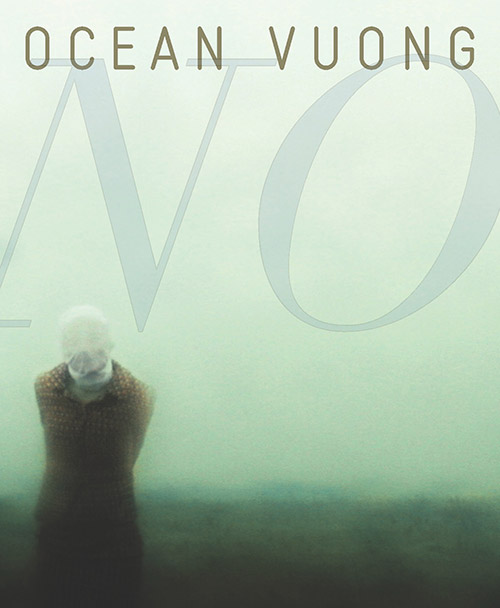
SATURDAY POETRY SERIES PRESENTS: NO

no


from NO
By Ocean Vuong


TORSO OF AIR

Suppose you do change your life.
& the body is more than

a portion of night—sealed
with bruises. Suppose you woke

& found your shadow replaced
by a black wolf. The boy, beautiful

and gone. So you take the knife to the wall
instead. You carve & carve.

Until a coin of light appears
& you get to look in, for once,

on happiness. The eye
staring back from the other side—

waiting.


HOME WRECKER

And this is how we danced: with our mothers’
white dresses spilling from our feet, late August

turning our hands dark red. And this is how we loved:
a fifth of vodka and an afternoon in the attic, your fingers

sweeping though my hair—my hair a wildfire.
We covered our ears and your father’s tantrum turned

into heartbeats. When our lips touched the day closed
into a coffin. In the museum of the heart

there are two headless people building a burning house.
There was always the shotgun above the fireplace.

Always another hour to kill—only to beg some god
to give it back. If not the attic, the car. If not the car,

the dream. If not the boy, his clothes. If not alive,
put down the phone. Because the year is a distance

we’ve traveled in circles. Which is to say: this is how
we danced: alone in sleeping bodies. Which is to say:

This is how we loved: a knife on the tongue turning
into a tongue.


Today’s poems are from NO, published by Yes Yes Books, copyright © 2013 by Ocean Vuong. “Torso of Air” previously appeared in BODY Literature, and “Home Wrecker” previously appeared in Linebreak. These poems appear here today with permission from the poet.


NO: Anyone who has already sensed that “hope is a feathered thing that dies in the Lord’s mouth,” should get their hands on NO. Honest, intimate, and brimming with lyric intensity, these stunning poems come of age with a fifth of vodka and an afternoon in an attic, with a record stuck on please, with starlight on a falling bomb. Even as Vuong leads you through every pleasure a body deserves and all the ensuing grief, these poems restore you with hope, that godforsaken thing—alive, singing along to the radio, suddenly sufficient. —Traci Brimhall, Our Lady of the Ruins


Ocean Vuong is a recipient of a 2013 Pushcart Prize as well as fellowships from Kundiman, Poets House, and The Saltonstall Foundation for the Arts. Poems appear in Poetry, The Nation, Beloit Poetry Journal, Passages North, Quarterly West, Denver Quarterly, and American Poetry Review, which awarded him the 2012 Stanley Kunitz Prize for Younger Poets. He lives in Queens, NY.


Editor’s Note: I’m just going to come right out and say this: Ocean Vuong is one of the best and most important poets writing in America today. I have not been so moved as I am by Vuong’s words since I first read Li-Young Lee. This poet has changed my life. He has renewed my belief in American poetry. That it can be emotional and heartbreaking. That is can be beautiful and full of hope. That modern American poetry can—and does—matter. In my humble opinion your poetry collection is simply not complete unless it houses both Vuong’s groundbreaking chapbook, Burnings, and his newest release from Yes Yes Books, NO.

NO is a surprisingly experimental collection, yet Vuong remains dedicated to the lyric and the narrative, guiding us through its formal twists and turns through emotive language and evocative imagery. Throughout its pages the poet intimately explores themes of love, sexuality, and belonging against a backdrop of devastating loss. It is a brilliant and beautiful collection, a true heartbreaking work of staggering genius. As the book’s publisher did when reading through the manuscript for the first time, when Ocean Vuong says NO to you, be prepared to say “Yes Yes!”


Want to see more from Ocean Vuong?
Buy NO from Yes Yes
The Poetry Foundation
Interview in The Well & Often Reader
Ben Lerner on mentoring Ocean Vuong, Brooklyn College

SATURDAY POETRY SERIES PRESENTS: SPRING!

photo 3Spring’s first flowers spotted this week in New York’s Jefferson Market Garden.


WITH A BUNCH OF SPRING FLOWERS
By Kate Seymour Maclean

In the spring-time, out of the dew,
      From my garden, sweet friend, I gather,
      A garland of verses, or rather
A poem of blossoms for you.

There are pansies, purple and white,
      That hold in their velvet splendour,
      Sweet thoughts as fragrant and tender,
And rarer than poets can write.

The Iris her pennon unfurls,
      My unspoken message to carry,
      A flower-poem writ by a fairy,
And Buttercups rounder than pearls.

And Snowdrops starry and sweet,
      Turn toward thee their pale pure faces
      And Crocus, and Cowslips, and Daisies
The song of the spring-time repeat.

So merry and full of cheer,
      With the warble of birds overflowing,
      The wind through the fresh grass blowing
And the blackbirds whistle so dear.

These songs without words are true,
      All sung in the April weather–
      Music and blossoms together–
I gather and weave them for you.


(Today’s poem is in the public domain, belongs to the masses, and appears here today accordingly.)


Kate Seymour Maclean (1829-1916): Born in Fulton, New York, seemingly as “Chloe Ann Seymour” and educated at the Falley Seminary, Kate Seymour moved to Canada a few years after her 1857 marriage to Allan MacLean of Ingersoll, Ontario. She was well known as a poet in her day, producing three volumes of verse and publishing frequently in Canadian and American magazines. Her first book, The Coming of the Princess, And Other Poems (1881), is prefaced by Graeme Mercer Adam, then editor of the Canadian Monthly. Loyal to her adopted country, MacLean became a strong advocate of the “Canada First” movement. She died in Toronto at the age of 86. (Biography courtesy of The Simon Fraser University Library.)

Editor’s Note: If you are an avid reader of this series, you have faithfully read along as I lamented this year’s winter and dared Mother Nature to bring on the spring. This week, spring has finally arrived. The cherry blossoms are bursting in all their glory in Washington D.C., and here in New York City there is warm weather and sunshine, the first cherry blossoms have been spotted on the trees, and spring flowers can finally be seen lining the streets and blooming in the parks.

If you read this series, you know how we on the East Coast have suffered this long winter, and you know how anxiously your faithful Editor has awaited spring. Today I am happy to report that SPRING IS HERE, and in its honor I offer you “A flower-poem writ by a fairy,” “sung in the April weather,” “Music and blossoms together.” To celebrate spring’s arrival, here is a poem in the form of a bouquet, “gather[ed] and weave[d] … for you.”

Want to see more by Kate Seymour Maclean?
All Poetry
Public Domain Poetry

A Review of Catherine Pierce’s The Girls of Peculiar

Pierce Girls of Peculiar

A Review of Catherine Pierce’s The Girls of Peculiar

By Jennifer Dane Clements

Catherine Pierce’s second poetry collection, The Girls of Peculiar, resurrects the gangly and awkward ghosts of adolescence, in turns honoring and questioning those young spectres. Indeed, it is impossible to read The Girls of Peculiar and not consider one’s own unglamorous coming-of-age, from the sensation of “a globe welling up inside” to “that red ache that came from lying/to our mothers.”

For me, The Girls of Peculiar harkened back to the brick school buildings and blue carpeted halls where my own teenage years were spent. But Pierce’s words ring universal:

Last year you weighed more. This year you’re as tall
as you’ll get, and there’s a boy whose eyes are poisoned
marbles. You’ve photographed him again and again
but you can’t get the poison right. You’re sixteen.
You say this again and again but you can’t believe it.
(Fire Blight)

I went to a high school built by women, for women. There were the things we were told, that we were strong and intelligent and the leaders of tomorrow, and would not be stifled by gender inequity. We were taught by incredible women and introduced to women who defied the expectations of the world. We were bound to the women who had walked those carpeted halls before us, phantoms of girls past that we, like our predecessors, were destined to become.

We never cooled
with twilight. We were busy prowling
by the river; sending our lit eyes into tree hollows,
beneath parked cars.
(The Delinquent Girls)

And there were the things we knew that we didn’t have to say, that perhaps our parents and teachers didn’t wish to acknowledge. Some of us had eating disorders, or inflicted self-harm, or saw shrinks for diagnoses we didn’t have to secure medications we didn’t need. We identified as adults in ways that ranged from noble to naive. We had sex with older men. We pulled all-nighters on school grounds with the strange and forbidden blessing of our teachers. We hung out in rough parts of town, oblivious to how our uniforms marked us as young and entitled and unattainable in ways we couldn’t know. We wielded our small rations of power in a dozen micro-rebellions a day, then tucked in our shirttails and learned algebra.

We were all flavors of adolescent girl kept in one place, and nothing has quite captured that dynamic as accurately as The Girls of Peculiar.

But I’m so tired of the small steps–
the pentatonic scale, the frequent flyer
hoarding, the one exquisite sentence
in a forest of exquisite sentences.
There is a globe welling up inside of me.
Mountain ranges ridging my skin,
oceans filling my mouth. If I stay still
long enough, I could become my own world.
(Because I’ll Never Swim in Every Ocean)

Poems like “Dear Self I Might Have Been,” “Before the Reunion (Her Lament),” and “Postcards from her Alternate Lives,” look backward, from a vantage point informed by several decades. Resisting the nostalgic, they instead acknowledge the difficulties of youth, moving into the “long highway days of your twenties” and beyond. Each of these poems serves as a postscript to old yearbooks, answering the question of what we’ll become: One girl writes speeches for the First Lady. One girl married the bus driver. One works for the CIA. One remains a virgin at 30.

For some of us, the school-age moments feel lifetimes old; for some of us, as close as this morning’s latte. But The Girls of Peculiar has nothing to do with wanting to return to those days–its poems are elegies, truthful monuments to the myths, the expectations, and the anxieties we carried in youth.

This is every house on your block
lit from within, each bedroom window
shining with safety and you outside
in the icing dusk, knowing nothing
will ever warm you….
The Future? This is The Future
If you were here, you’d know that.
(The Girls We Were)

Twelve years past high school, I am tempted to wrap a copy of The Girls of Peculiar and send it to my school’s newly appointed headmaster, the first woman to oversee the school in decades. Pierce’s collection seems the briefest and most comprehensive reminder of how burgeoning adulthood feels to “the delinquent girls,” and “the quiet girls,” and “the drama girls,” and then all of them together–a manual of understanding and a call to empathy.

Let these strangenesses be like the impossible lizard’s
tail: gone forever, because how could it be otherwise,

and then reappearing, iridescent and blood-warmed,
because how could it be otherwise?
(For This You Have No Reason)

And what could be more vital to someone newly charged with overseeing all of those girls, and all of the peculiars in which they–for the moment–reside.


Catherine Pierce, The Girls of Peculiar. Saturnalia Books, 2012: $14.00.

***

Jennifer Dane Clements received her MFA in creative writing from George Mason University, where she served as Editor-in-Chief of So to Speak: A Feminist Journal of Language & Art. A writer of prose and plays, she has been published in WordRiot, Nerve, and Psychopomp and has had plays produced by Capital Repertory Theatre (Albany, NY), Creative Cauldron (Falls Church, VA), and elsewhere. Clements currently works at a theatre-service organization and serves as a prose editor for ink&coda. More at jennifer-dane-clements.com.

SATURDAY POETRY SERIES PRESENTS: ONLY RIDE

OnlyRide-Front

from ONLY RIDE
By Megan Volpert:


Screen Shot 2014-04-04 at 3.16.20 PM

Screen Shot 2014-04-04 at 3.18.58 PM


Screen Shot 2014-04-04 at 3.20.28 PM

Screen Shot 2014-04-04 at 3.29.11 PM


Picture 1

Picture 3


Today’s poems are from Only Ride, published by Sibling Rivalry Press, copyright © 2014 by Megan Volpert. “You are suspended” was first published in This assignment is so gay, edited by Megan Volpert and published by Sibling Rivalry Press. These poems appear here today with permission from the poet.


Only Ride: If Denis Johnson had written Tuesdays with Morrie, it’d feel like Megan Volpert’s book of prose poems. Clawing its way out through this minimalist checklist of suburban malaise is an emphatically optimistic approach to growing up. These tiny essays carefully detail how to avoid becoming one’s parents, how to manage a body addled by disease, and how to keep having the best possible time in life. After all: this is the only ride there is, and we can only ride it. Volpert’s is a story of Springsteenian proportions, a gentleman’s guide to rebellion complete with iron horses and the church of rock & roll.

Megan Volpert is the author of five books on communication and popular culture, most notably about Andy Warhol. She has been teaching high school English in Atlanta for the better part of a decade, and is currently serving as her school’s Teacher of the Year. She edited the American Library Association-honored anthology This assignment is so gay: LGBTIQ Poets on the Art of Teaching, which is currently a Lambda Literary Award finalist. Predictably, www.meganvolpert.com is her website.

Editor’s Note: Megan Volpert’s Only Ride is a no-holds-barred journey through personal history, with sage wisdom bursting from its rough-and-tumble seams. The book is less Zen and the Art of Motorcycle Maintenance and more Get a Grip and Ride Like it’s Your Only Ride. This is a book about how to live life. Suck it up and move past the childhood issues that scarred you. Don’t just cope with illness, thrive in the face of it. Live life full throttle no matter what it throws at you, because life is short and living demands fierce courage.

Throughout her journey Volpert takes personal and political stands, inspiring her readers to do the same. Sometimes you’ve just gotta smash things, because “a deep frustration that hurls pottery against the concrete floor… is not the thing to bottle up in shame.” Sometimes a teacher has a responsibility to teach more than just standard curriculum. As “the only openly queer faculty member in [a] public Southern high school,” Volpert is “fully equipped to teach both English & tolerance,” and she’ll write a student up for failing the latter.

Brimming with humor and hubris and wicked wit, the greatest gift of this book is the life lessons it relays. Stand up for what you believe in. Move past life’s bullshit and face adversity with a battle cry. Let go of the small stuff. “Many things annoy me,” Volpert confides, “but I seldom get really angry because now I just feel so lucky to be alive.” And we all should, the implication echoes. In a world where “[d]eath knocks twice: once for introductions & once to take you away,” why waste your precious life letting things get your goat? Having faced death, the poet gave her goat away; she has no goat to give. And we would all be well served to follow her example. “After all: this is the only ride there is, and we can only ride it.”

Want to see more from Megan Volpert?
Official Website
This assignment is so gay
Sibling Rivalry Press
FRONTIER PSYCHIATRIST

A Review of Bushra Rehman’s Corona

bushra rehman corona

A Review of Bushra Rehman’s Corona

By J. Andrew Goodman

Bushra Rehman’s Corona is a witty and moving story of liminal spaces and the narrator Razia’s abuttal with the thresholds of sex, ethnicity, and place. The novel follows Razia from her childhood in New York City and through her dangerous initiation to adult independence. She was expelled from her home after refusing an arranged marriage by her orthodox Muslim parents, and her long search for a new home frequently begs the question: What am I willing to compromise for freedom? After reading Rehman’s quick and elegant prose, the wide world seems intimate, awaiting the will of one displaced woman.

The title, Corona, refers to a poor neighborhood in Queens, New York, whose hegemony shifts generationally between different ethnicities—Italian, Puerto Rican, Korean, and Pakistani. Razia, her family, and nearest neighbors are Pakistani. They are unified by their faith and the generosity of Razia’s father. He is the owner and butcher at Corona Halal Meats. Their Muslim community holds two books in high esteem: the Quran and the tab her father keeps of goods he’s given away.

In one scene, Razia brings tea to her father and his friends, as she does every day at lunch. She notices her father always eats the least, takes his tea last, and cleans up after everyone, including the thoughtless imam. Razia is endeared by the small sacrifices her father makes for the sake of courtesy and the authority of faith. When he weeps during prayer, Razia feels closer to her father than before:

The azan came through over the loudspeakers. Men and women everywhere came out on the street. Everyone in the neighborhood tilted their heads and listened. Out of basement apartments and six-floor walkups, Muslim men started walking toward the sound, pulling their topis out of the backseats of their pockets.

The sun went down, and the clouds bent low over the buildings. I stood in front of the masjid and held my father’s hand. The light was turning pink and darkening, and I saw my father was weeping as a sleepy, blue light settled on everything.

Rehman softens the image of Razia’s father and displays the neighborhood’s solidarity, writing such moments with a deep reverence and tenderness that intensify our ambivalence toward Razia’s home.

Outside of Queens, as a young adult, Razia is defined by her romantic relationships. She substitutes the comforts of home with men, women, or drugs. She isn’t fortunate in the affections of men. Through a series of boyfriends, she travels the breadth of the United States—New York City to San Francisco and back to the Atlantic coast. Her first relationship after refusing the arranged marriage begins well enough; Razia and Eric escape the tumults of their respective homes, but their relationship deteriorates as they fail to hold jobs and as Eric becomes volatile and belligerent. Razia realizes the world she inherited is not fatalistic; she decides hunger and escape are more agreeable than abuse.

Razia is thirty or near thirty before she meets Ravi, a man she believes she can love despite his inability to always please her sexually. He is “on loan” from India, a decade-long student with a visa. He is heavy, hairy, and can answer questions with encyclopedic diction; he and Razia also share the same political views and maintain a moderate respect for their parents’ religion. During a sleepover at a mutual friend’s, Razia says Ravi looks good, even in traditional Muslim sleepwear. Ravi reminds Razia of her father and uncles, she confesses. Her childhood home is always on her mind, and Rehman’s writing makes the ugly, tan brick under the railroad tracks tangible upon utterance.

Finally, their relationship plateaus. Ravi explains he wants to see other women before he leaves the United States, but Razia wants them to be exclusive. She has, at last, found something she has been looking for. The moment has potential for derivative melodrama, but Rehman delivers the two lovers from each other with cool, comedic, and empathic dialogue. At every turn, there is an appraisal and a concession. Razia has to run shorter and shorter distances.

Razia eventually returns to New York, but not to the mythologized neighborhood she loves. She learns there are degrees of separation, and decides for herself how close she must be to her family and where she grew up. She will not agree to an arranged marriage, but to a truce, to the small comforts of conditional love. Razia’s home is as constant as the North Star. On clouded nights, when the oldest navigational tool is rendered useless, will we circle around it, lost, or stoop to build our fire.

Bushra Rehman, Corona. Sibling Rivalry Press, 2013: $14.95

***

J. Andrew Goodman is a recent MFA graduate from Murray State University and an intern for the independent literary publisher, White Pine Press. He currently lives and works in Louisville, Kentucky.