SATURDAY POETRY SERIES PRESENTS: ROSE NIELSEN

theresa1


WATER-WITCH
By Rose Nielsen

As April mist blew chill against the rocky beach,
the wishing pines, the trembling birch and cedars
leaned out as if to catch a glimpse of Mary Lake’s
ice petticoat swept to shore on last night’s tempest.

Divining rod in hand, stem pointing at the lake,
Y hugging at my hips, I felt no tug;
I thought the misty air, the soggy forest floor
must be too drenched to dowse a single source.

But when I looked again and saw the leaning birches
reach out their limbs, each one a pair of arms
held out to greet the lake, I turned the stem to point
toward me and felt the tug as it divined a hidden spring.


Today’s poem appears here today with permission from the poet.


Rose Nielsen is a writer, poet, musician, and a physical therapist in a small mountain town in British Columbia, Canada. She also teaches biology and English at the local community college. She recently received her MFA in Creative Writing from the University of British Columbia. Her work has appeared or will be appearing in RiverLit and CV2; and she is working on a novel and on a collection of poems about water and the bonds humans hold with it.

Editor’s Note: Rose Nielsen’s poetry reminds me of Alaska’s Poet Laureate, Peggy Shumaker, a favorite here on this series. These poets share a love of the interconnectivity of nature and the written word. Simple, yet rich, and working on the micro level, with sounds lulling and inspiring us, with images clear as if painted by brushstroke.

As tomorrow is Mother’s Day, I dedicate today’s selection to my Mama. The woman who taught me the wonders of water, witchcraft, nature, and poetry alike. For my mother, and for Mother Earth, the Great Mother of us all.

Want to read more by Rose Nielsen?
River Lit

SATURDAY POETRY SERIES PRESENTS: JENNA LE

Jenna Le photo

By Jenna Le:


MOM’S COCKS

Mom grew up beside the Perfume River in Vietnam,
in a brick house overrun by chickens.
Those horny-footed fowl were always
rubbing their feather-padded genitals
against sofa legs and children’s shoes
as if they were fit to burst. Mom laughs

as she tells me how they ground
their pelvises against her leather sandal,
stuporous with misdirected lust—
How strange that she
is talking to me about sex
in this casual way. She’s returning to her roots

as a child who lived among
unmannered beasts. And I, through hearing her words,
am returning there with her: I
am the aggressive rooster; I’m the hens
cowering behind the outhouse; I’m the much-abased,
much-abraded, Size Four shoe.


THREE SHORT POEMS ON A COMMON THEME

1.

Staring at you across the room, my body seemed composed
of nothing but eyes.

Even my mouth
watered, like an eye.

2.

I couldn’t sleep a wink all night: my brain agitated its solitude
like a washing machine

filled with copies
of your immaculate white shirt.

3.

In the morning, I went out and bought a book of your poems.
It’s a poor substitute for a straightedge, it’s true,

but you won’t
sell me your curves for any price.


Today’s poems are from Six Rivers, published by NYQ Books, copyright © 2011 by Jenna Le, and appear here today with permission from the poet.


Jenna Le was born in Minneapolis, Minnesota, a daughter of two Vietnam War refugees. She received a B.A. in mathematics from Harvard University and an M.D. from Columbia University. She has worked as a physician in Flushing, New York, and the Bronx, New York. Her full-length poetry collection, Six Rivers (NYQ Books, 2011), was a Small Press Distribution Poetry Bestseller. Her poetry, fiction, essays, book criticism, and translations of French poetry have appeared or are forthcoming in journals such as AGNI Online, Barrow Street, Bellevue Literary Review, Massachusetts Review, Measure, Pleiades, and 32 Poems.

Editor’s Note: Lyric, narrative, accessible, and unafraid, Jenna Le’s Six Rivers opens along the banks of the Perfume River, in a scene that pairs mother with sex and “horny-footed fowl.” The relationships—between mother and daughter, between ‘here’ and ‘there’—are rich and complex, with the poet embodying her mother’s past, her roots, and the “much-abased, much-abraded, Size Four shoe.” Throughout the book love and sex, personal, familial, and cultural history, healing and death are all explored as we travel with the poet along the six rivers of her life. Le allows herself to be vulnerable and imperfect, and so we relate to her, root for her, are drawn into her vivid world. A keen seer and a captivating reporter, it is no wonder that, at times, the poet feels she is “composed of nothing but eyes.” Hungry for life, hungry for love, it is no wonder that “Even [her] mouth watered, like an eye.”

Want to read more by and about Jenna Le?
NYQ Poets
Mascara Literary Review
The Nervous Breakdown
The Toronto Quarterly
Sycamore Review

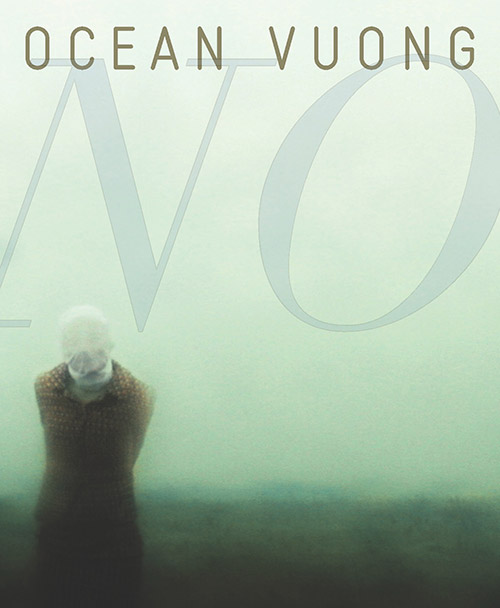
SATURDAY POETRY SERIES PRESENTS: NO

no


from NO
By Ocean Vuong


TORSO OF AIR

Suppose you do change your life.
& the body is more than

a portion of night—sealed
with bruises. Suppose you woke

& found your shadow replaced
by a black wolf. The boy, beautiful

and gone. So you take the knife to the wall
instead. You carve & carve.

Until a coin of light appears
& you get to look in, for once,

on happiness. The eye
staring back from the other side—

waiting.


HOME WRECKER

And this is how we danced: with our mothers’
white dresses spilling from our feet, late August

turning our hands dark red. And this is how we loved:
a fifth of vodka and an afternoon in the attic, your fingers

sweeping though my hair—my hair a wildfire.
We covered our ears and your father’s tantrum turned

into heartbeats. When our lips touched the day closed
into a coffin. In the museum of the heart

there are two headless people building a burning house.
There was always the shotgun above the fireplace.

Always another hour to kill—only to beg some god
to give it back. If not the attic, the car. If not the car,

the dream. If not the boy, his clothes. If not alive,
put down the phone. Because the year is a distance

we’ve traveled in circles. Which is to say: this is how
we danced: alone in sleeping bodies. Which is to say:

This is how we loved: a knife on the tongue turning
into a tongue.


Today’s poems are from NO, published by Yes Yes Books, copyright © 2013 by Ocean Vuong. “Torso of Air” previously appeared in BODY Literature, and “Home Wrecker” previously appeared in Linebreak. These poems appear here today with permission from the poet.


NO: Anyone who has already sensed that “hope is a feathered thing that dies in the Lord’s mouth,” should get their hands on NO. Honest, intimate, and brimming with lyric intensity, these stunning poems come of age with a fifth of vodka and an afternoon in an attic, with a record stuck on please, with starlight on a falling bomb. Even as Vuong leads you through every pleasure a body deserves and all the ensuing grief, these poems restore you with hope, that godforsaken thing—alive, singing along to the radio, suddenly sufficient. —Traci Brimhall, Our Lady of the Ruins


Ocean Vuong is a recipient of a 2013 Pushcart Prize as well as fellowships from Kundiman, Poets House, and The Saltonstall Foundation for the Arts. Poems appear in Poetry, The Nation, Beloit Poetry Journal, Passages North, Quarterly West, Denver Quarterly, and American Poetry Review, which awarded him the 2012 Stanley Kunitz Prize for Younger Poets. He lives in Queens, NY.


Editor’s Note: I’m just going to come right out and say this: Ocean Vuong is one of the best and most important poets writing in America today. I have not been so moved as I am by Vuong’s words since I first read Li-Young Lee. This poet has changed my life. He has renewed my belief in American poetry. That it can be emotional and heartbreaking. That is can be beautiful and full of hope. That modern American poetry can—and does—matter. In my humble opinion your poetry collection is simply not complete unless it houses both Vuong’s groundbreaking chapbook, Burnings, and his newest release from Yes Yes Books, NO.

NO is a surprisingly experimental collection, yet Vuong remains dedicated to the lyric and the narrative, guiding us through its formal twists and turns through emotive language and evocative imagery. Throughout its pages the poet intimately explores themes of love, sexuality, and belonging against a backdrop of devastating loss. It is a brilliant and beautiful collection, a true heartbreaking work of staggering genius. As the book’s publisher did when reading through the manuscript for the first time, when Ocean Vuong says NO to you, be prepared to say “Yes Yes!”


Want to see more from Ocean Vuong?
Buy NO from Yes Yes
The Poetry Foundation
Interview in The Well & Often Reader
Ben Lerner on mentoring Ocean Vuong, Brooklyn College

SATURDAY POETRY SERIES PRESENTS: SPRING!

photo 3Spring’s first flowers spotted this week in New York’s Jefferson Market Garden.


WITH A BUNCH OF SPRING FLOWERS
By Kate Seymour Maclean

In the spring-time, out of the dew,
      From my garden, sweet friend, I gather,
      A garland of verses, or rather
A poem of blossoms for you.

There are pansies, purple and white,
      That hold in their velvet splendour,
      Sweet thoughts as fragrant and tender,
And rarer than poets can write.

The Iris her pennon unfurls,
      My unspoken message to carry,
      A flower-poem writ by a fairy,
And Buttercups rounder than pearls.

And Snowdrops starry and sweet,
      Turn toward thee their pale pure faces
      And Crocus, and Cowslips, and Daisies
The song of the spring-time repeat.

So merry and full of cheer,
      With the warble of birds overflowing,
      The wind through the fresh grass blowing
And the blackbirds whistle so dear.

These songs without words are true,
      All sung in the April weather–
      Music and blossoms together–
I gather and weave them for you.


(Today’s poem is in the public domain, belongs to the masses, and appears here today accordingly.)


Kate Seymour Maclean (1829-1916): Born in Fulton, New York, seemingly as “Chloe Ann Seymour” and educated at the Falley Seminary, Kate Seymour moved to Canada a few years after her 1857 marriage to Allan MacLean of Ingersoll, Ontario. She was well known as a poet in her day, producing three volumes of verse and publishing frequently in Canadian and American magazines. Her first book, The Coming of the Princess, And Other Poems (1881), is prefaced by Graeme Mercer Adam, then editor of the Canadian Monthly. Loyal to her adopted country, MacLean became a strong advocate of the “Canada First” movement. She died in Toronto at the age of 86. (Biography courtesy of The Simon Fraser University Library.)

Editor’s Note: If you are an avid reader of this series, you have faithfully read along as I lamented this year’s winter and dared Mother Nature to bring on the spring. This week, spring has finally arrived. The cherry blossoms are bursting in all their glory in Washington D.C., and here in New York City there is warm weather and sunshine, the first cherry blossoms have been spotted on the trees, and spring flowers can finally be seen lining the streets and blooming in the parks.

If you read this series, you know how we on the East Coast have suffered this long winter, and you know how anxiously your faithful Editor has awaited spring. Today I am happy to report that SPRING IS HERE, and in its honor I offer you “A flower-poem writ by a fairy,” “sung in the April weather,” “Music and blossoms together.” To celebrate spring’s arrival, here is a poem in the form of a bouquet, “gather[ed] and weave[d] … for you.”

Want to see more by Kate Seymour Maclean?
All Poetry
Public Domain Poetry

A Review of Catherine Pierce’s The Girls of Peculiar

Pierce Girls of Peculiar

A Review of Catherine Pierce’s The Girls of Peculiar

By Jennifer Dane Clements

Catherine Pierce’s second poetry collection, The Girls of Peculiar, resurrects the gangly and awkward ghosts of adolescence, in turns honoring and questioning those young spectres. Indeed, it is impossible to read The Girls of Peculiar and not consider one’s own unglamorous coming-of-age, from the sensation of “a globe welling up inside” to “that red ache that came from lying/to our mothers.”

For me, The Girls of Peculiar harkened back to the brick school buildings and blue carpeted halls where my own teenage years were spent. But Pierce’s words ring universal:

Last year you weighed more. This year you’re as tall
as you’ll get, and there’s a boy whose eyes are poisoned
marbles. You’ve photographed him again and again
but you can’t get the poison right. You’re sixteen.
You say this again and again but you can’t believe it.
(Fire Blight)

I went to a high school built by women, for women. There were the things we were told, that we were strong and intelligent and the leaders of tomorrow, and would not be stifled by gender inequity. We were taught by incredible women and introduced to women who defied the expectations of the world. We were bound to the women who had walked those carpeted halls before us, phantoms of girls past that we, like our predecessors, were destined to become.

We never cooled
with twilight. We were busy prowling
by the river; sending our lit eyes into tree hollows,
beneath parked cars.
(The Delinquent Girls)

And there were the things we knew that we didn’t have to say, that perhaps our parents and teachers didn’t wish to acknowledge. Some of us had eating disorders, or inflicted self-harm, or saw shrinks for diagnoses we didn’t have to secure medications we didn’t need. We identified as adults in ways that ranged from noble to naive. We had sex with older men. We pulled all-nighters on school grounds with the strange and forbidden blessing of our teachers. We hung out in rough parts of town, oblivious to how our uniforms marked us as young and entitled and unattainable in ways we couldn’t know. We wielded our small rations of power in a dozen micro-rebellions a day, then tucked in our shirttails and learned algebra.

We were all flavors of adolescent girl kept in one place, and nothing has quite captured that dynamic as accurately as The Girls of Peculiar.

But I’m so tired of the small steps–
the pentatonic scale, the frequent flyer
hoarding, the one exquisite sentence
in a forest of exquisite sentences.
There is a globe welling up inside of me.
Mountain ranges ridging my skin,
oceans filling my mouth. If I stay still
long enough, I could become my own world.
(Because I’ll Never Swim in Every Ocean)

Poems like “Dear Self I Might Have Been,” “Before the Reunion (Her Lament),” and “Postcards from her Alternate Lives,” look backward, from a vantage point informed by several decades. Resisting the nostalgic, they instead acknowledge the difficulties of youth, moving into the “long highway days of your twenties” and beyond. Each of these poems serves as a postscript to old yearbooks, answering the question of what we’ll become: One girl writes speeches for the First Lady. One girl married the bus driver. One works for the CIA. One remains a virgin at 30.

For some of us, the school-age moments feel lifetimes old; for some of us, as close as this morning’s latte. But The Girls of Peculiar has nothing to do with wanting to return to those days–its poems are elegies, truthful monuments to the myths, the expectations, and the anxieties we carried in youth.

This is every house on your block
lit from within, each bedroom window
shining with safety and you outside
in the icing dusk, knowing nothing
will ever warm you….
The Future? This is The Future
If you were here, you’d know that.
(The Girls We Were)

Twelve years past high school, I am tempted to wrap a copy of The Girls of Peculiar and send it to my school’s newly appointed headmaster, the first woman to oversee the school in decades. Pierce’s collection seems the briefest and most comprehensive reminder of how burgeoning adulthood feels to “the delinquent girls,” and “the quiet girls,” and “the drama girls,” and then all of them together–a manual of understanding and a call to empathy.

Let these strangenesses be like the impossible lizard’s
tail: gone forever, because how could it be otherwise,

and then reappearing, iridescent and blood-warmed,
because how could it be otherwise?
(For This You Have No Reason)

And what could be more vital to someone newly charged with overseeing all of those girls, and all of the peculiars in which they–for the moment–reside.


Catherine Pierce, The Girls of Peculiar. Saturnalia Books, 2012: $14.00.

***

Jennifer Dane Clements received her MFA in creative writing from George Mason University, where she served as Editor-in-Chief of So to Speak: A Feminist Journal of Language & Art. A writer of prose and plays, she has been published in WordRiot, Nerve, and Psychopomp and has had plays produced by Capital Repertory Theatre (Albany, NY), Creative Cauldron (Falls Church, VA), and elsewhere. Clements currently works at a theatre-service organization and serves as a prose editor for ink&coda. More at jennifer-dane-clements.com.

SATURDAY POETRY SERIES PRESENTS: ONLY RIDE

OnlyRide-Front

from ONLY RIDE
By Megan Volpert:


Screen Shot 2014-04-04 at 3.16.20 PM

Screen Shot 2014-04-04 at 3.18.58 PM


Screen Shot 2014-04-04 at 3.20.28 PM

Screen Shot 2014-04-04 at 3.29.11 PM


Picture 1

Picture 3


Today’s poems are from Only Ride, published by Sibling Rivalry Press, copyright © 2014 by Megan Volpert. “You are suspended” was first published in This assignment is so gay, edited by Megan Volpert and published by Sibling Rivalry Press. These poems appear here today with permission from the poet.


Only Ride: If Denis Johnson had written Tuesdays with Morrie, it’d feel like Megan Volpert’s book of prose poems. Clawing its way out through this minimalist checklist of suburban malaise is an emphatically optimistic approach to growing up. These tiny essays carefully detail how to avoid becoming one’s parents, how to manage a body addled by disease, and how to keep having the best possible time in life. After all: this is the only ride there is, and we can only ride it. Volpert’s is a story of Springsteenian proportions, a gentleman’s guide to rebellion complete with iron horses and the church of rock & roll.

Megan Volpert is the author of five books on communication and popular culture, most notably about Andy Warhol. She has been teaching high school English in Atlanta for the better part of a decade, and is currently serving as her school’s Teacher of the Year. She edited the American Library Association-honored anthology This assignment is so gay: LGBTIQ Poets on the Art of Teaching, which is currently a Lambda Literary Award finalist. Predictably, www.meganvolpert.com is her website.

Editor’s Note: Megan Volpert’s Only Ride is a no-holds-barred journey through personal history, with sage wisdom bursting from its rough-and-tumble seams. The book is less Zen and the Art of Motorcycle Maintenance and more Get a Grip and Ride Like it’s Your Only Ride. This is a book about how to live life. Suck it up and move past the childhood issues that scarred you. Don’t just cope with illness, thrive in the face of it. Live life full throttle no matter what it throws at you, because life is short and living demands fierce courage.

Throughout her journey Volpert takes personal and political stands, inspiring her readers to do the same. Sometimes you’ve just gotta smash things, because “a deep frustration that hurls pottery against the concrete floor… is not the thing to bottle up in shame.” Sometimes a teacher has a responsibility to teach more than just standard curriculum. As “the only openly queer faculty member in [a] public Southern high school,” Volpert is “fully equipped to teach both English & tolerance,” and she’ll write a student up for failing the latter.

Brimming with humor and hubris and wicked wit, the greatest gift of this book is the life lessons it relays. Stand up for what you believe in. Move past life’s bullshit and face adversity with a battle cry. Let go of the small stuff. “Many things annoy me,” Volpert confides, “but I seldom get really angry because now I just feel so lucky to be alive.” And we all should, the implication echoes. In a world where “[d]eath knocks twice: once for introductions & once to take you away,” why waste your precious life letting things get your goat? Having faced death, the poet gave her goat away; she has no goat to give. And we would all be well served to follow her example. “After all: this is the only ride there is, and we can only ride it.”

Want to see more from Megan Volpert?
Official Website
This assignment is so gay
Sibling Rivalry Press
FRONTIER PSYCHIATRIST

SATURDAY POETRY SERIES PRESENTS: LAURA YES YES

1970703_10152671596109251_151820833_n
By Laura Yes Yes:

SALEM 1994
(With touring partner Kim Johnson)

Courtesy of Jason Flynn’s youtube channel.


COLLEGE TRANSCRIPT

Courtesy of West Side School for the Desperate’s youtube channel.


Laura Swearingen-Steadwell (AKA Laura Yes Yes) has competed in slams nationwide, notably as a finalist in 2010’s Women of the World Poetry Slam. She tours and leads workshops as part of the queer female duo Shadowboxers Anonymous. Laura’s first book, How to Seduce a White Boy in Ten Easy Steps, was nominated for a National Book Award. She is currently an MFA candidate at Warren Wilson College.

Editor’s Note: I had the pleasure of seeing Laura Swearingen-Steadwell perform at louderARTS this week. louderARTS is home to a longstanding open mic, reading series, slam forum, and workshop series. Monday nights in Manhattan’s Bar 13 have been turning out the likes of Roger Bonair-Agard, Ocean Vuong, Elana Bell, Sabrina Hayeem-Ladani, John Paul Davis, Regie Cabico, and countless other rising stars and champions of the written and spoken word for years. The tradition continues every week. Show up at 6:00, like I did, and be treated to a FREE writing workshop with louderARTS members and visiting workshop leaders. I was lucky enough to kick off my evening with a workshop lead by today’s featured poet.

When Laura Swearingen-Steadwell opened up “Salem 1994” by inviting us all to join in a Kumbaya-esque rendition of Alanis Morissette’s “You Oughta Know,” I was all in. When the performance morphed into a feminist celebration of the songstresses who have been writing and performing the soundtrack of my life since I was fourteen years old, the poet officially had a new fan. When she performed “College Transcript” we were all invited to call out “brain,” “cunt,” “liver,” “fist” to accompany each of the poet’s hand gestures. It was fun. It was interactive. It was engaging. And it was truth, spoken from the poet’s own honest experience to resonate with our own. This is a poet who speaks her mind, who speaks her heart, who tells it like it is, unafraid, claiming the world for herself and for us all.

Want to see more by Laura Yes Yes?
“Habitat”
“Octopussy: The Playboy Interview”

SATURDAY POETRY SERIES PRESENTS: LIZZIE LAWSON ON SPRING

1185601_827625185839_902627425_nPhoto by Lydia Polimeni.


SPRING
By Lizzie Lawson

The tiny crocus is so bold
           It peeps its head above the mould,
           Before the flowers awaken,
To say that spring is coming, dear,
With sunshine and that winter drear
           Will soon be overtaken.


(Today’s poem is in the public domain, belongs to the masses, and appears here today accordingly.)


Lizzie Lawson (circa 1867–1902 OR 1858-1905) appears to have been a poet and children’s visual artist. This is a rare instance in which I was able to find many poems by the poet, but almost no biographical information whatsoever. The woman appears to have been lost to us, while her artistic creations remain. If anyone knows about the biography of this enigmatic artist, please share with us in the comments below!

Editor’s Note: Crocuses have been spotted on the east coast, “To say that spring is coming.” (See photographic evidence from photographer Lydia Polimeni above.) In fact, the first day of spring has come and gone. But… we here in the northeast expect snow next week, and are facing record lows for the beginning of spring. So, today’s entry is a kind of a rain dance, or, rather, a spring dance. A call to the powers that be: Bring on the spring! Bring on the sunshine! Bring on the—dare I say it?—warmth!!! Let the crocuses be the sign “that winter drear / Will soon be overtaken.” For we have had our fill of winter drear, thank you very much.

Want to see more by Lizzie Lawson?
Public Domain Poetry
Visual Art

SATURDAY POETRY SERIES PRESENTS: THE ARROW

Picture 9


from THE ARROW
By Lauren Ireland


Picture 4


Picture 8


Picture 7


Today’s poems are from The Arrow, published by Coconut Books, copyright © 2014 by Lauren Ireland, and appear here today with permission from the poet.


The Arrow: “It took almost a lifetime’s worth of emotions to read Lauren Ireland’s THE ARROW. She says Time eats at the edges of things so we hear her say other things, too, I am hating you from very far away and I am a grownup/flying right into the mouth of fear. This book is fraught with emotional emergencies, sometimes reckless, almost a little demented as one has to be when one faces who and what and where and how we are. Lucky for Ireland there are friends to whom many of these poems are dedicated who accompany her as she’s permanently lost in this very very mysterious flight we all share.” —Dara Wier


Lauren Ireland grew up in southern Maryland and coastal Virginia. She is a graduate of the MFA program for Poets and Writers at the University of Massachusetts-Amherst and an editor at Lungfull! Magazine. Lauren is the author of Dear Lil Wayne (Magic Helicopter Press, 2014) and two chapbooks, Sorry It’s So Small (Factory Hollow Press, 2011) and Olga & Fritz (Mondo Bummer Press, 2011). She co-curated The Reading at Chrystie Street in New York. Currently, she lives in Seattle with her husband and her husband’s cat.


Editor’s Note: As I read Lauren Ireland’s The Arrow I pushed against the book’s air of flippancy, its self-preservation in the guise of farce and self-deprecation, its false oaths of apathy. These are, as Naomi Shihab Nye would say, “the armor [the book] put[s] on to pretend [it has] a purpose in the world.” But this book does not need to pretend. It wears its armor as a tricked out husk around its fervent vulnerability. The poems within its pages are the bloodlettings of a twisted, tortured, and exceedingly human mind.

The Arrow is full of moments of lyric beauty and stunning, brutal clarity interwoven with equal portions of heaviness and frivolity that make for quite the witches’ brew. There is something unsettling about this book. Something that does not sit well. A wound or scab that begs to be healed yet must be picked at. I was often uncomfortable reading it, yet I could not put it down. I was drawn to the beauty and put off by the grotesque, and I believe this was meant to be the author’s poetic commentary on life. Life—like this book—is full of debauchery and death, fear and imagination, the mundane and the absurd. Love is inextricably linked with hate. There is a thin line between reality, waking dreams, and nightmares. This book is labyrinthine, in both the literal sense and the David Bowie sense of the word.

While it is easier to take some poems in the book more seriously than others, this, too, is an artistic reflection of the human life. As a work of art, however, I felt myself anchored throughout my journey by very deliberate artistic choices. Wickedly smart and poignant titles. Moments of lyric clarity that took my breath away. And a healthy dose of killer end-lines, which I am always a sucker for. “Now I am a grownup flying right into the mouth of fear,” “Now… I am running / from the nighttime wolves / in the forest that never was,” and that crushing Orphic echo, “Oh / I am exiled / my friend / this once / don’t turn.”


Want to see more from Lauren Ireland?
Official Author Website
Buy The Arrow from Coconut Books
Buy Dear Lil Wayne from Magic Helicopter Press
Small Press Distribution

SATURDAY POETRY SERIES PRESENTS: GUILLERMO FILICE CASTRO

download


RITUAL
By Guillermo Filice Castro

into a hole
something      of the self

always
disappears

light    mother

tongue

into
mouths

and this morning

that
bunch
of hairs

peeled off
the drain

and dropped into the toilet

almost
as mournful      a gesture

as a wreath
laid

in the ocean


(Today’s poem was originally published in Fogged Clarity and appears here today with permission from the poet.)


Guillermo Filice Castro is a recipient of the 2013 “Emerge-Surface-Be” fellowship from the Poetry Project. His work appears in Assaracus, Barrow Street, The Bellevue Literary Review, The Brooklyn Rail, Court Green, Ducts.org, Fogged Clarity, LaFovea.org, Quarterly West, among others, as well as the anthologies Rabbit Ears, Flicker and Spark, Divining Divas, Saints of Hysteria, and more. His translations of Olga Orozco, in collaboration with Ron Drummond, are featured in Guernica, Terra Incognita, U.S. Latino Review, and Visions. In 2012 he was a finalist for the Andrés Montoya prize. He lives in New York City.

Editor’s Note: Into the abyss of grief, of loss, something always disappears. And in the absence that follows it is the little things that remain, reminding us that one day they too will disappear. Those little bits left behind, as they too depart, become “almost / as mournful a gesture // as a wreath / laid // in the ocean.” Death is universal, yet it is the specificity with which today’s poet mourns and pays homage that allows us to feel his unique loss as if it were our own.

Want to read more by and about Guillermo Filice Castro?
“Ritual” in Fogged Clarity (with audio)
“Jones Beach” in Fogged Clarity (with audio)
LaFovea.org
Assaracus
The Bellevue Literary Review