Snuffleupagus as Depression: A Conversation with Poet Daniel Crocker

Snuffleupagus as Depression:

A Conversation with Poet Daniel Crocker

By Chase Dimock


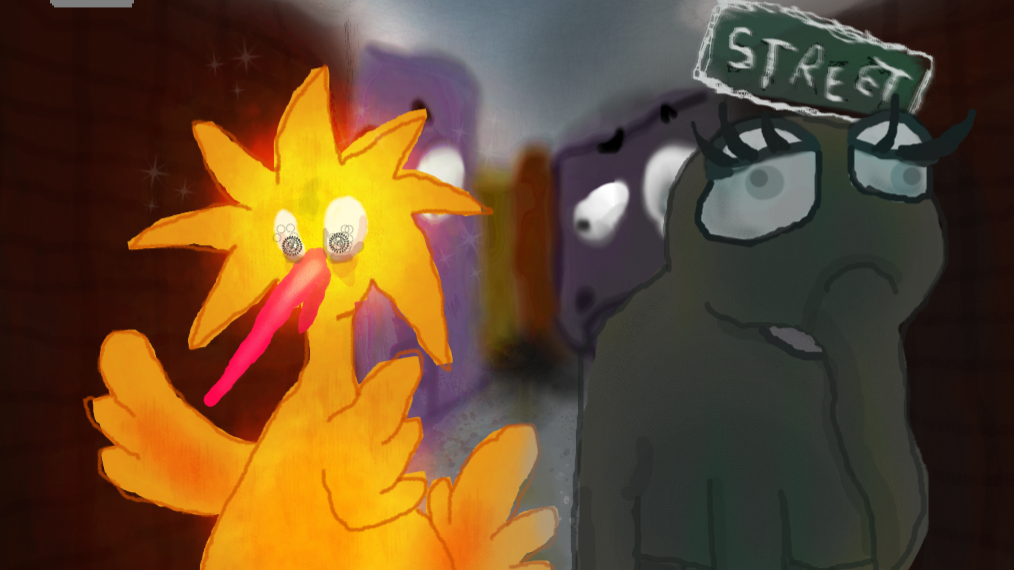
If you ask Daniel Crocker how to get to Sesame Street, he’d point you toward a twisting road of manic depression, frustrated desires, and existential malaise. In his latest book, Shit House Rat, Crocker’s poetry reimagines the furry childhood icons of Sesame Street embodying torments and foibles as adult and human as the people whose hands are lodged up their muppet behinds. Cookie Monster is an addict, Big Bird has mania, Snuffy is the haunting specter of depression, and Grover’s anxiety led to a hell of a divorce. But, Sesame Street is only the starting point. Shit House Rat takes the reader to Leadwood, Missouri, Crocker’s rural, predictably lead polluted hometown, where he engages themes from his childhood to his adulthood, including mental illness, queer sexuality, poverty, and small town conservativism. I got a chance to ask Crocker about the appeal of dark humor in poetry, the struggle of growing up bipolar and bisexual in rural America, and most importantly, what exactly a “shit house rat” is.  


Chase Dimock: The first thing your readers will notice about your new book will obviously be the title, Shit House Rat. I know that as you were working on this collection, you had some trepidations about how the title might be perceived by your audience. Where did you get the idea for this title and why did you ultimately decide to use it?


Daniel Crocker: I have trepidation when it comes to just about anything, so I try not to let it worry me too much as a writer. I really put myself out there, especially in this new book, and there’s always a lot of anxiety that comes with that. I did have some specific concerns about the title though. I got the idea from the old saying, “Crazy as a shithouse rat.’ I don’t know if it’s a Midwestern or southern thing, but I’ve heard it a lot growing up and even now. It’s a nice turn of phrase, really. So, I just took the last half of  the saying (kind of like I did with Like a Fish) and used it. My worry is that it’s a real putdown to people, like me, with a mental illness. I don’t want anyone with a mental illness to think I’m making fun of them at all. My hope is to take the phrase and subvert it. Own it.


Chase Dimock: I think it will be clear to anyone who reads your poetry that your goal isn’t to make fun of the mentally ill, but to use humor to explore the experience of mental illness. A lot of your poems are funny, and I mean literally laugh out loud funny, which is pretty rare for modern poetry. (Robert Lowell wasn’t much of a yuckster) Why are you drawn to using humor in your work? What does using humor reveal about the experience of mental illness?


Daniel Crocker: A lot of my early work is pretty dark and without a lot of humor. I don’t like a lot of that early work either (some of it still holds up). But, I always like humor. I thought I was funny. Eventually, I wrote a short story or two for Do Not Look Directly Into Me that were funny, and I quickly found that I loved doing it. I haven’t written fiction in a while, and it’s pretty clear to me now that I’m mainly a poet. However, once humor started seeping its way into my poems it was like a creative flood. I guess it was me finally finding a voice that was all my own. As Steve Barthelme one said to me, it has to be more than just funny though. I think that’s true. For me, the perfect poem of mine is something that makes people laugh when they first read or hear it, but then they find they are still thinking about it later because there was something deeper and darker in it as well. Which I guess if you think about it, it’s the two extremes of bipolar disorder mixed together.

I can’t say what dealing with mental health issues with humor means for anyone else, but for me humor is just a way I deal with a lot of things. When you have mental health issues, every day can be a struggle. With my own particular diagnoses–bipolar, anxiety, OCD, probably PTSD, I worry about a lot of things. I’m doing well on medication right now, but when I wasn’t little things like planning an extra ten minutes before work just to get out of the house just in case there was something you needed to check over and over. You never really know what kind of mood you’re going to wake up in, what your anxiety level for the day is going to be, etc. If you’re going to be successful in any way, you have to plan ahead for just about anything. It’s tough to commit to anything in the future because you don’t know where you’re head space is going to be on that day. Or, before medication for me, I might commit to a ton of stuff while manic and then regret it while depressed. I guess this is a long way of saying if you don’t have a sense of humor about things they can become overwhelming. At least that’s my go to stress relief. Jokes.

The good thing about writing funny poems is everyone usually likes them. The worry is if they are going to take them seriously or not. In Shit House Rat I’m using Big Bird as a symbol for mania and Snuffleupagus as depression. Will people buy it? I dunno.

Continue reading “Snuffleupagus as Depression: A Conversation with Poet Daniel Crocker”

SATURDAY POETRY SERIES PRESENTS: THEY WERE BEARS


From THEY WERE BEARS
By Sarah Marcus:


PEOPLE HAVE ALWAYS KNOWN BEARS

You said you were afraid of bears—

we weren’t safe until there was ice
along the shoreline. I said we all need trauma,

and my heart breaks every Autumn, so we broke
ourselves against those rocks until the cave mouth opened:

a womb for blind crayfish,
a passageway harboring beetles.

I want you to reach into the depths of your backwoods
and remember our Winters. We need the bears, ourselves

ursine sleeping in dens—the caverns drip-stoned and stunning.
I was and still am in search of a great bear

because people have always known bears—
we will always be shelter for each other.

When we first met, I told you that a long time ago,
grizzlies came down from the Rockies—

they were poisoned on the range, trapped,
hounded, shot out—we found cranial fragments.

We still listen to those legends of bounties paid
to mountain men, harboring that ancient fear of

the bears that made meat of us, boar and sow,
mauled and gnawed away. Our bones resting in caves,

because you were born to hunt, and I was
born of hunting: a witness of great fires.


LOVE POEM

First snow of the season—
your eyes say
there’s not much oxygen
                  in the mountain air
.

I have never wanted someone
                  as much as I want you.

I devalued the damage:
you won’t belong—stay gone longer—

                  let it melt.


I’ve been thinking about you
                  because we cannot be separate.
The gravitational pull defies
                  the thousands of miles between us.

Even in the deepest woods,
                  we kneel beside the rill,
the river’s riffle,
the spruce’s mantle of rime,

                  until the point of rock
                                  swells tightly around us.

There’s a chant building in the forest: I won’t be your secret.

Everyone knows how to leave,
but I don’t know how to be
in this city
without you.


MYTHOLOGY FOR DESERT LOVERS II

These things are real:
you are a desert moon rising a hundred mornings away.
My horses paw a cracked Earth.
The air threatening Winter.
The solitude of sand.
We can smell the danger

of you and her
in that house.
In every house.

When you are so strongly connected
to another person, what did you call it? Rare?
It’s like the sunset.
No one can hold that kind of beauty
for more than a moment.

Our small ribs are thick
enough to take on a prairie panic.
The fear of too much open space.
So many acres;
we can never catch up.

You say I’m always on your side
and this will always mean more
to a woman.

I try to explain that love is a violence,
even when it’s beautiful.
When you enter someone,
you must also leave them.

And there’s always that moment of relief
when I realize that I’ve always known—
I am a hundred deserts.

I will wait for you or some version of you
to become sky.


Today’s poems are from They Were Bears (Sundress Publications, 2017), copyright © 2017 by Sarah Marcus, and appear here today with permission from the poet.


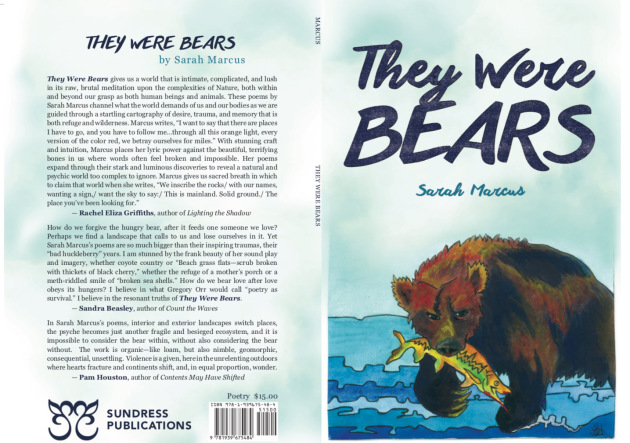
They Were Bears gives us a world that is intimate, complicated, and lush in its raw, brutal meditation upon the complexities of Nature, both within and beyond our grasp as both human beings and animals. These poems by Sarah Marcus channel what the world demands of us, and our bodies as we are guided through a startling cartography of desire, trauma, and memory that is both refuge and wilderness. Marcus writes, ‘I want to say that there are places I have to go, and you have to follow me…through all this orange light, every version of the color red, we betray ourselves for miles.’ With stunning craft and intuition, Marcus places her lyric power against the beautiful, terrifying bones in us where words often feel broken and impossible. Her poems expand through their stark and luminous discoveries to reveal a natural and psychic world too complex to ignore. Marcus gives us sacred breath in which to claim that world when she writes, ‘We inscribe the rocks/with our names, wanting a sign,/want the sky to say:/This is mainland. Solid ground./The place you’ve been looking for.’” -Rachel Eliza Griffiths, author of Lighting the Shadow


Sarah Marcus is the author of They Were Bears (2017, Sundress Publications), Nothing Good Ever Happens After Midnight (2016, GTK Press), and the chapbooks BACKCOUNTRY (2013) and Every Bird, To You (2013). Her other work can be found at NPR’s Prosody, The Huffington Post, McSweeney’s, Cimarron Review, Spork, The Establishment, Cosmopolitan.com, and Marie Claire.com SA, among others. She is an editor at Gazing Grain Press and the Series Editor for As It Ought To Be’s High School Poetry Series: Gender, Identity, & Race. She holds an MFA in poetry from George Mason University and currently teaches and writes in Cleveland, OH.


Editor’s Note: In the Jewish calendar, the days between Rosh Hashanah and Yom Kippur are a surreal and reflective time of reckoning. During these days we are introspective, coming to terms with our true selves before turning outward and asking forgiveness from those who we have wronged. It is in these Days of Awe that I come back to a collection I have been meaning to review for quite some time. It is in this magical time of brutal honesty that I dive deeply into a carefully-wrought world that is far beyond my comfort zone, with eyes and heart wide open to its savage and beautiful truths.

They Were Bears is one of the most thoughtful–if not the most thought-provoking–poetry collections to be released in recent memory. Rife with hunger and blood and animal instinct, this work pulsates at the intersection of nature and violence, family, sex, and love. They Were Bears drags us mercilessly back to our animal nature, honoring vulnerability and calling out sexual violence. This book pulls no punches, spares us little. What is reflected in its waters is our truest selves, as beautiful and terrifying as they are wont to be.

The tender, ravenous, brutal honesty of the book’s thematic spectrum is brought to life by the true craftsmanship of the poet. This is an absolutely stunning collection on every level–its words and images thrash and breathe, fly and tether. The poems are lush in their soundscape, and on the page they mark their territory distinctly. And the moments. The breathtaking moments. How true their revelation, declarations, and admissions: “because you were born to hunt, and I was / born of hunting: a witness of great fires;” “I try to explain that love is a violence, / even when it’s beautiful. / When you enter someone, / you must also leave them.”

Mazal tov to Sarah Marcus on this incredible work, and may we all start anew together in these Days of Awe.


Want more from Sarah Marcus?
Sarah Marcus’ Official Website

Prose Poem in the Wake of Charlottesville

Embed from Getty Images

.

Prose Poem in the Wake of Charlottesville

By Brett Ashley Kaplan

.

The forgotten stone memorials awaken and remind us of the confederate glories the ubiquitous cross-hatched flag celebrates slavery repression pain racism is as apple pie as baseball and in the mix is the Jewhatred why is the left surprised?

Seriously, the marching torches aren’t resonant enough with Triumph of the Will the will to overcome difference to erase difference to wash everything Aryan whiter than the white KKKsheets and purer than melting icecaps of dubious snow purity and danger the danger of impurity and the call to get rid of the Jews get rid of the blacks get rid of the immigrants get rid of

In the night unseen but with great force the stone statues of the confederacy topple

Somewhere in the country people play at the civil war

Reenactment as a game of chance…who wants to be a union soldier when a confederate soldier is so much more fun so much more pure so much more American? The side that lost forever wanting to ride again on those stone statue horses to victory a victory that would have ossified a plantation economy

The south under water now no power

“Jews will not replace us”

hand raised aloft “The Jewish Media is going down”

the jews control hollywood the jews control hollywood the jews control hollywood—how many times I have heard that shit? When I heard it in one of my own graduate seminars I was shocked I shouldn’t have been it is everywhere this claim of control

tensions, anxieties, zero-sum competitions for memorial resources between blacks and Jews jews are white jews get white privilege yes, yes, many of us do tensions anxieties we are lumped together unite the right bonds antisemitism to racism expulsion of all of us purity and a straight up nostalgia for desire for love for Nazism not masked just their “Sieg Heil” those fuckers even said do they know fully know about genocide? Do they care? Can they really celebrate the genocide of millions of Jews, communists, queers, Jehovah’s witnesses, resistance fighters? Do they celebrate the enslavement and murder and rape of millions of black women men children…

the stone statues to the confederacy are alive now their horses gallop through the south through the world they have always trembled at the edge of awakeness and they are here in the present the civil war is still being fought

.

About the Author:

Brett Ashley Kaplan is the Director of the Program in Jewish Culture & Society, Director of the Initiative in Holocaust, Genocide, and Memory Studies, and Professor and Conrad Humanities Scholar in the Program in Comparative and World Literature at the University of Illinois, Urbana-Champaign. Her first books, Unwanted Beauty: Aesthetic Pleasure in Holocaust Representation (2007) and Landscapes of Holocaust Postmemory (2011), examine the Shoah’s intersections with art and space. Her newest book is Jewish Anxiety in the Novels of Philip Roth (2015) and she is working on a project tentatively entitled jewblack is blackjew: tensions, intersections, and interactions among Jewishness and Blackness in Contemporary art.

SATURDAY POETRY SERIES PRESENTS: NEW YEAR’S MORNING


NEW YEAR’S MORNING
By Helen Hunt Jackson

Only a night from old to new!
Only a night, and so much wrought!
The Old Year’s heart all weary grew,
But said: “The New Year rest has brought.”
The Old Year’s hopes its heart laid down,
As in a grave; but, trusting, said:
“The blossoms of the New Year’s crown
Bloom from the ashes of the dead.”
The Old Year’s heart was full of greed;
With selfishness it longed and ached,
And cried: “I have not half I need.
My thirst is bitter and unslaked.
But to the New Year’s generous hand
All gifts in plenty shall return;
True love it shall understand;
By all my failures it shall learn.
I have been reckless; it shall be
Quiet and calm and pure of life.
I was a slave; it shall go free,
And find sweet peace where I leave strife.”
Only a night from old to new!
Never a night such changes brought.
The Old Year had its work to do;
No New Year miracles are wrought.

Always a night from old to new!
Night and the healing balm of sleep!
Each morn is New Year’s morn come true,
Morn of a festival to keep.
All nights are sacred nights to make
Confession and resolve and prayer;
All days are sacred days to wake
New gladness in the sunny air.
Only a night from old to new;
Only a sleep from night to morn.
The new is but the old come true;
Each sunrise sees a new year born.


(Today’s poem is in the public domain, belongs to the masses, and appears here today accordingly.)


Helen Maria Hunt Jackson (1830 – 1885) was an American poet and writer who became an activist on behalf of improved treatment of Native Americans by the United States government. (Bio courtesy of Wikipedia, with edits.)

Editor’s Note: Wishing all who celebrate Rosh Hashanah this week a shanah tovah umetukah, a good and sweet new year. May today’s poem remind us that now is an opportunity for change, but that we must be the change we want to see in the world.

SATURDAY POETRY SERIES PRESENTS: WASN’T THAT A MIGHTY STORM

WASN’T THAT A MIGHTY STORM
Performed by Rolf Cahn and Eric Von Schmidt

Editor’s Note: I have been reading Isaac’s Storm by Erik Larson, which tells of the Great Storm of 1900. That Category 4 hurricane decimated the town of Galveston, Texas, killing between six and twelve thousand people, making it the deadliest natural disaster in U.S. history. I was reading this book as Hurricane Harvey ravaged Houston and beyond. I am reading it now, still, as Hurricane Irma sweeps over the Caribbean and heads for the U.S. mainland. I am thinking of those who are fleeing and those who are staying put to weather the storm. Of those who have lost everything. Of those who have lost their lives. I am thinking of global warming and our current regime of climate change deniers. I am thinking of the fires that are burning in the west. I am thinking of friends and their families, and of those who are my kin because of our shared humanity. I am thinking of how history repeats itself and of the lessons we fail to learn from the before time.

Today’s poem is a folk song that remembers the Great Storm of 1900, and dedicated to those who are now suffering, who have suffered, who will suffer still.

Two Poems By Sean Karns

Tina Modotti “Hands Resting on Tools”  from the Getty’s Open Content Program.

Two Poems

By Sean Karns


The Man of Dirt Toils in the Laughter of His Wayward World

A long way off, the Man of Dirt heard something.
He has been diluted by his design for years.

He took a moment to understand the commotion.
It has been a while. Once upon a time,

It is said, he walked away. Everything I have designed
Has been a disappointment, he contemplated.   

On all fours he placed his ear to his dirt.
Buried under his dirt, laughter.

Not that pat-your-back kind of laughter,
But the kind of laughter when all that is left

Is the sunken world. Work to be done.
A lot of dirt to dig through to bring light

To those laughs, he thought. He gazed at his dirty,
Chapped hands—brittle and old like a kid’s

Digging stick. He massaged his hands and remembered
When he was young and ambitious.

I had my whole world ahead of me, he somberly
Declared to no one particular.   

This is the last time, the last time, he bemoaned.
Those words, like words in an echo-chamber,

Caused laughter; so loud the laughter, the dirt
Murmured. He stumbled and cracked a rib

On an elbow protruded through dirt.
Ah, I get it. A little elbow ribbing, he snickered.

He began, again, as always, the digging.
He tunneled toward the laughter.

So sinister, so alive the dark laughter.
Blinded by the dark, he toiled in the laughter

.

The Son Witnesses

The son asks his father how the world works. The father looks at the car grease under his nails and cleans them with his front teeth. He pulls the globe out of the closet and selects a serrated knife, then sits. His knife feels familiar in his hand as he shows his son how to cut the globe. The son watches over his father’s shoulder, wanting to know. The father hands the knife to his fellow worker. But the son is nervous, like the first time he walked around his neighborhood block alone. The son cuts the globe; it feels like cutting into a tree branch. The plastic shards fall. The father stands; his hand is on his son’s back as pieces of the ocean and countries, unknown to both, fall.


“The Man of Dirt Toils in the Laughter of his Wayward World” originally appeared in the Birmingham Poetry Review.

“The Son Witnesses” originally appeared in Cold Mountain Review and is published in Jar of Pennies.

.

About the Author: 

Sean Karns has an MFA in creative writing from the University of Illinois and a BA from The Ohio State University. He is the author of a collection of poetry, Jar of Pennies, and his poetry has appeared in the Birmingham Poetry Review, Hobart, Rattle, Pleiades, Los Angeles Review, Cold Mountain Review, Folio, and elsewhere; and his poetry has been anthologized in New Poetry from the Midwest. He is currently the poetry editor at Mayday Magazine and teaches at Wittenberg University.

SATURDAY POETRY SERIES PRESENTS: MARIANNE PEEL

In the Afternoon, She Smelled Like the Earth
By Marianne Peel

Her shoulders were always burned.
We had smeared ourselves with baby oil infused with iodine
painting our skin a burnt orange deeper than the marigolds
planted in a circle to protect
the lettuce from the woodchucks.

She taught me how to thread
a frenetic worm onto a crooked hook.
Digging around in that coffee can tin
wet with dirt and the roots of the soil
there was always humid mud under her nails.

Sometimes trails streaked her cheeks
after she pushed her hair off her face.
In the afternoon she smelled
like the earth after the sun
went way, way down.

She taught me to cast my line
flinging her whole arm back past her shoulder
all in one calculated, measured motion.
She said the splash on the water should be quiet soft
so we don’t scare the fish away.

And then we waited.
Just the creak of the dock bouncing
in time with the water
moving all afternoon
bobbing us up and down.

Sometimes our toes would touch
splayed off the dock
and I would recite this little piggy went to market
– but just in my head because
we had to be silent soft, waiting for the fish.

She taught me to reel in, quickly,
but with no panic, no surprise,
knowing there would be only sunfish suspended from the hook
little orange sunshines in our hands
on the dock every summer afternoon.

And she taught me to unhinge the mouth
to pull the mouth slowly from its worm feast
to toss it gently back into the water and watch it,
still hungry,
swim away.


“In the Afternoon, She Smelled Like the Earth” previously appeared via Silver Birch Press and appears here today with permission from the poet.

Marianne Peel is a poet who is raising four daughters. She shares her life with her partner Scott. She received Fulbright-Hays Awards to Nepal and Turkey. She taught English at middle and high school for 32 years. She is now retired, doing Field Instructor work at Michigan State University. She recently won 1st prize for poetry in the Spring 2016 Edition of the Gadfly Literary Magazine. In addition, Marianne has been published in Muddy River Review; Silver Birch Press; Persephone’s Daughters; Encodings: A Feminist Literary Journal; Write to Heal; Writing for Our Lives: Our Bodies—Hurts, Hungers, Healing; Mother Voices; Ophelia’s Mom; Jellyfish Whispers; Remembered Arts Journal, and Gravel, among others.

Editor’s Note: Today’s poem is vivid, vibrant, and rich with imagery. You can almost smell the earth, feel it crumble through your fingers, watch the worm wriggle. So alive are the moments of memory that we are swept up into them, unaware that we don’t know who the poem’s “she” is. We are willing to suspend our curiosity, because, “In the afternoon she smelled / like the earth after the sun / went way, way down.” Because the poem leaves us with a feeling, with an echo in the shape of knowledge, because “she taught me to unhinge the mouth / to pull the mouth slowly from its worm feast / to toss it gently back into the water and watch it, / still hungry, / swim away.”

Want to read more by and about Marianne Peel?
Persephone’s Daughters
Muddy River Poetry Review
Jellyfish Whispers

SATURDAY POETRY SERIES PRESENTS: JANET R. KIRCHHEIMER

Wonder Beans
By Janet Kirchheimer

My father went each morning to his garden.
He taught me to smell the soil to see if it was good,
to feel the dirt slide across my hands, to never
wear gloves, to stay in the middle of the row when planting seeds.
We’d look for work to do in the garden,
and sometimes there was nothing more to do
than watch the garden grow, wait for the harvest.
He thought that haricot vert were the dumbest thing he’d ever seen–
he liked his Kentucky Wonder beans, big and bursting with seeds, leaving
them to grow in the summer sun as long as possible.
Last winter he told me we couldn’t save
the parsley from the snow and ice, even though
we put blankets over it.
He got pneumonia in February.
In April, he asked me if I thought he’d get to his garden, and I told him yes.
By the end of May I brought him
cherry tomato plants to keep on the deck.
He no longer had the strength to pick
the first tomatoes that ripened in June.
August: I bring dirt from the garden
to his grave and scatter grass seed.


“Wonder Beans” previously appeared on String Poet and appears here today with permission from the poet.

Janet R. Kirchheimer is the author of How to Spot One of Us, (Clal, 2007). A Pushcart Prize nominee, her work has appeared in several journals including Young Ravens Literary Review, Atlanta Review, String Poet, Connecticut Review, Kalliope, Common Ground Review, and several anthologies and online journals. Currently, she is producing a poetry performance documentary, After, exploring poetry written about the Holocaust.

Editor’s Note: Today’s poem is a celebration of life and a poignant reminder that one day we may be remembered by what we love. Through a daughter’s eyes we see a father, watch him plant and grow, watch him love and tend the earth. Through the poet we know what it is for this daughter to love her father, and what it is to lose him. How touching her remembrance, how bittersweet the sting at poem’s end when father is returned to earth.

Want to read more by and about Janet Kirchheimer?
After – A Poetry Film
Young Ravens Literary Review
Collegeville Institute
Podium Literary Journal
Forward’s Schmooze

“Language and Loss” By John Guzlowski

The ones we left behind. My mother’s brother and his family. The Soviet Union


Language and Loss

By John Guzlowski

My friend the writer Christina Sanantonioand I have been having a conversation about writing about loss. It’s a conversation fueled in part by the suicide of the novelist David Foster Wallace back in 2008. She wrote me a long letter about how we use or don’t use language to talk about loss, and about how hard it is to write about loss.

One of the things in her letter that really resonated with me was something she said about one of my favorite writers, Primo Levi, the Holocaust survivorand author of Survival in Auschwitz, who, like Wallace, apparently took his own life. Primo Levi frequently talked about the frustration of trying to write about loss and suffering, especially the loss and suffering he and so many othersexperienced in the Nazi camps. He felt we needed a new kind of language to talk about what happened there. Christina wrote that we ache for a language that doesn’t exist.

I’ve spent the last 35 years trying to find words to describe what happened to my Polish-Catholic parents in the German concentration and slave labor camps and what those experiences make me feel. I write about this event or that image; and no matter how powerful the original event described by my mother or father I can’t really describe it, explain it, bring it out of the past. I can’t bring it out of memory into this life. Instead, I’m left pushing around some words, trying to make myself feel what I felt the first time I heard that story when I was a child. Sometimes I think I almost succeed, but most of the time I know I’m not even close.

For me the poems that work best are the ones with my parents’ actual words in them. Those words are the real thing. In my poem “Here’s What My Mother Won’t Talk About,” my mother refuses to tell me anything about the murder of her mother and her sister and her sister’s baby and her own rape. All she will say to me is “If they give you bread, you eat it. If they beat you, you run.Likewise in my poem “The Work My Father Did in Germany,” my dad tells me what he said to the German guards who tormented and beat him and blinded him, “Please, sirs, don’t ever tell your children what you’ve done to me today.” There are bits and pieces of their words scattered throughout my poems, and when I read these words out loud my parents are there with me. I’m again a kid listening to my dad tell me about the day he saw a German soldier cut off a woman’s breast or listening to my mom tell me about the perfect house she lived in in the perfect woods in eastern Poland before the Germans came. My parents’ words are a kind of magic for me.

Continue reading ““Language and Loss” By John Guzlowski”

SATURDAY POETRY SERIES PRESENTS: HOLLY KARAPETKOVA

Song of the Exiles
By Holly Karapetkova

There never was a garden
only a leaving:
miles and miles
of footprints in the dirt.

In the beginning–
the shattered sun, the wind,
and nothing left but our shadows
sifting through the dust behind us.

When we turned
we did not turn to salt.
When we turned
there was nothing behind us to burn,

nothing to return to,
though who could blame us for turning
with only the long days ahead,
tongues tripping in the dirt.

They said we didn’t belong.
They blamed us
for leaving the garden
which never was or would be.

Where could we go,
we who had come from nowhere
and hence could not
return?


“Song of the Exiles” previously appeared via Split This Rock and appears here today with permission from the poet.

Holly Karapetkova’s poetry, prose, and translations from the Bulgarian have appeared recently in Alaska Quarterly Review, Prairie Schooner, North American Review, Drunken Boat, and many other places. Her second book, Towline, won the Vern Rutsala Poetry Contest and is just out from Cloudbank Books.

Editor’s Note: After a moment of silence following the loss of AIOTB’s Managing Editor, the Saturday Poetry Series returns this week with a poem worth breaking silence for. Holly Karapetkova’s “Song of the Exiles” begins in Eden. At once biblical and real, this Eden is a “garden / which never was or would be.” In this world we are storyteller and reader, mythological figure and landless refugee. This is world news, this is human interest story, this is myth in the truest sense of the word. And this, above all, is poetry. Expertly crafted, delicately wrought, brilliant poetry. “When we turned / we did not turn to salt. / When we turned / there was nothing behind us to burn.”

Want to read more by and about Holly Karapetkova?
Holly Karapetkova’s Official Website