Saturday Afternoon at The Midland Theatre in Newark, Ohio

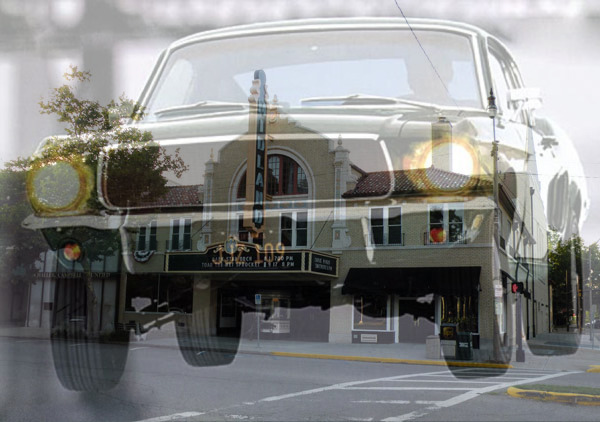
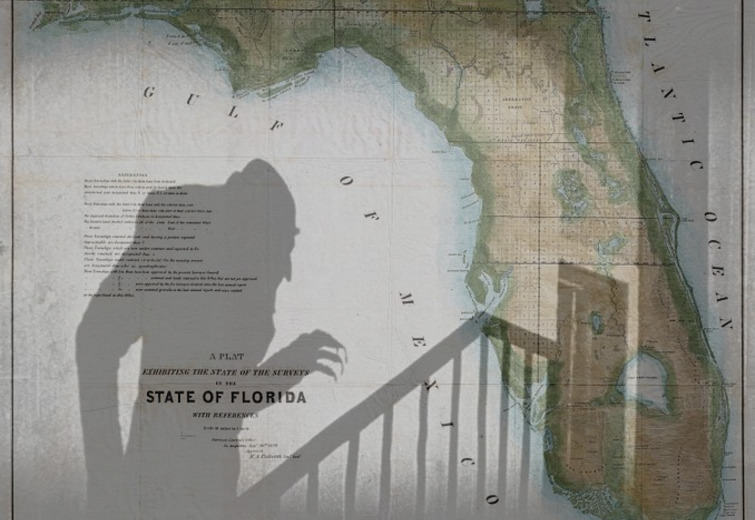
Montage of a scene from Bullitt and a photo by Leepaxton at en.wikipedia, CC BY-SA 4.0,


Saturday Afternoon at The Midland Theatre in Newark, Ohio

By Roy Bentley

.

Slouched in a theater seat and watching Bullitt for the third time, a look I
get from an usher might best be described as granting a general amnesty
and full pardon for my having shelled out only the one admission price.
There’s the balcony with its blue and red curved seat backs. By a door to the
upstairs men’s room a framed likeness of the Civil War drummer boy, Johnny
Clem, whose baby-faced looks and sudden-dark hair remind me of a young
Italian, then Sal Mineo in Rebel Without a Cause. There’s that angels-in-the-
architecture grand gesture of a ceiling, the wall of drapes of eloquently
pleated purple. And there’s the screen framed in its filigree of gold and silver.
The usher is accommodating me by simply not noticing—I’m on my third
popcorn, third enormous Coca-Cola, second box of Milk Duds, when I realize
I’m happy. Elated. In Ohio at fourteen you’re disappointed most of the
time. So I want to tell Frank Bullitt just how it feels to be from Dayton and
new here, a fat-kid eighth grader at Fulton Middle School. But then, Steve
McQueen is French-kissing Jacqueline Bisset good-morning. Strapping on
a shoulder holster and .38 pistol. Now he’s stopped at the corner of Clay and
Taylor, searching the pockets of his trench coat/suit coat for change. I’ve loved
that look all afternoon. The usher reacts as if that says it, that fuck-the-world
expression of Frank Bullitt as he gives up and bangs the cover and steals a
newspaper. Turns out, 1968 isn’t for the faint of heart. You need a Mustang
GT 390. Ice water for a blood type. A tolerance for the visages of the dead
you made dead, slaughtering out of that old American purity of motive
that dissolves into a communion of terrific car chases wherein thunderous
algorithms of horsepower rule.

This poem first appeared in The Southern Review


About the Author: Roy Bentley has published five books of poems, including Walking with Eve in the Loved City, which was selected as a finalist for the 2018 Miller Williams Poetry Prize and is available from the University of Arkansas Press or at Amazon. Bentley’s poems have appeared in Able Muse, Rattle, Blackbird, Shenandoah, Prairie Schooner, The Southern Review, and elsewhere. He is the recipient of a Creative Writing Fellowship in Poetry from the National Endowment for the Arts, as well as fellowships from the Florida Division of Cultural Affairs and the Ohio Arts Council.
Three Poems by Bunkong Tuon


Three Poems

By Bunkong Tuon

.


Editor’s Note: This is the second post in a series of poems about the immigrant experience in America. Our late Managing Editor, Okla Elliott, featured Bunkong Tuon’s work on As It Ought To Be back in January of 2017. Okla was particularly concerned about the anti-immigration rhetoric heating up in America and he hoped to showcase the voices of immigrants on our site. In honor of Okla’s memory, Tuon has allowed us to feature more of his poetry about his experience as an immigrant from Cambodia to the United States. The full series of links can be found below.

.


Snow Day

Silent as night

the morning snow covered

the school, the playground.

A ghost town in this city near the beach.
But no one told this refugee child
about such a day. No one said

to turn on the TV. No one called.

He walked in the white field

looking up to the sky, raising his hands,
letting his brown body fall backward
into the white landscape.

His eyes closed,

each flake gently caressing

his cheeks.

.


An Elegy for a Fellow Cambodian

The reason Vannark got into that fight

  was because Rob had called him a dog-eater.

.


Halloween, 1985

The saliva on your face
(for all the world to see!).

A lifetime of desire, a daily prayer
for death, a return to the beginning,
a place of warmth and affection,

a desire to be with Mother.

.


About the Author: Bunkong Tuon is the author of Gruel (2015) and And So I Was Blessed (2017), both poetry collections published by NYQ Books, and a regular contributor to Cultural Weekly  He is also an associate professor of English and Asian Studies at Union College, in Schenectady, NY.


Previous poems from Bunkong Tuon’s series on the immigrant experience in America:

Our Neighborhood in Revere, MA

Snow Day

An Elegy for a Fellow Cambodian

Halloween, 1985

Dancing Fu Manchu Master

Fishing for Trey Platoo

Lies I Told About Father


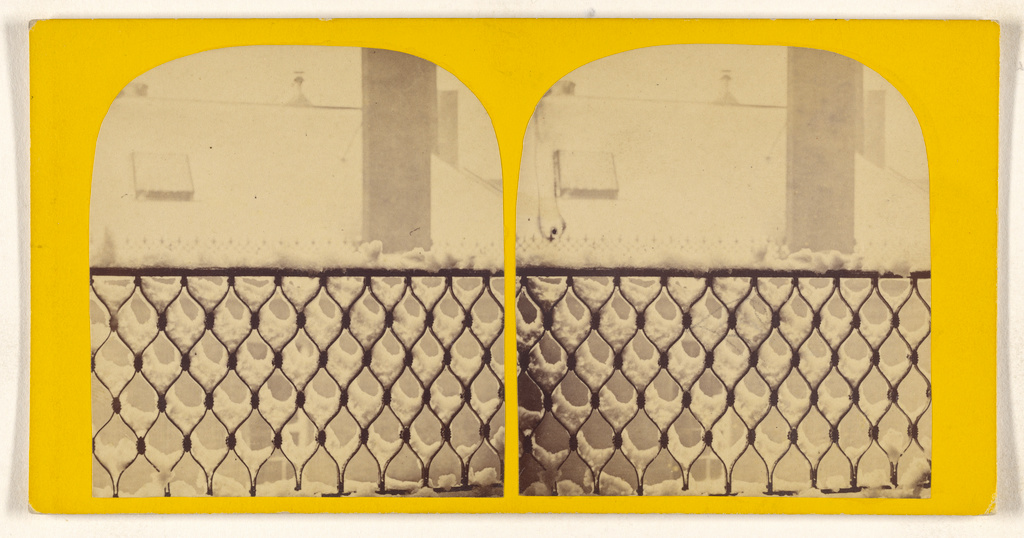
Image Credit: “Snow on Fence” Artist: Unknown, Digital image courtesy of the Getty’s Open Content Program.

Nosferatu in Florida

Nosferatu in Florida

By Roy Bentley

.

Maybe vampires hear an annunciatory trumpet solo.
Maybe they gather at the customary tourist traps
like a blanket of pink flamingos plating a lake
and lake shore by the tens of thousands to drink.
The whole, tacky blood circus is theme-park stuff
and as Disneyesque as lifting the lid on a casket
to flit about sampling the inexhaustible offerings
of O Positive like the Sunday brunch at IHOP.
But if you had a booming, amphitheatrical voice
and had been recently rescued from the grave—
if you wore the republic of the dark like a cape
at Halloween, all bets would be off by the signage
for Paradise Tire & Service, a neon-green royal palm.
Bela Lugosi could materialize on a trailer-park lawn
and the locals would miss it, though lap dogs howled
as kingdoms rose and fell. You could say a kingdom
of fangs glows and drips red by the broken temples
and wide, well-lit aisles of Best Buy and Wal-Mart.
By the shadowed homeless holding up placards
hand-lettered in English, as if the kind-hearted
of the nations of the world spoke one language
and could be counted on to forgive misspellings,
bad syntax that announces one life is never enough.
The resurrection of the body is tough everywhere.
In the Sunshine State, despite eons to shake off loss,
a body carries the added burden of perpetual labor
and cyclical, inescapable debt. The dead know this.

(This poem first appeared in Shenandoah)

.

About the Author: Roy Bentley has published five books of poems, including Walking with Eve in the Loved City, which was selected as a finalist for the 2018 Miller Williams Poetry Prize and is available from the University of Arkansas Press or at Amazon. Bentley’s poems have appeared in Able Muse, Rattle, Blackbird, Shenandoah, Prairie Schooner, The Southern Review, and elsewhere. He is the recipient of a Creative Writing Fellowship in Poetry from the National Endowment for the Arts, as well as fellowships from the Florida Division of Cultural Affairs and the Ohio Arts Council.
Bunkong Tuon: “Our Neighborhood in Revere, MA”

Our Neighborhood in Revere, MA

By Bunkong Tuon

.


Editor’s Note: This is the first of a series of poems about the immigrant experience in America. Our late Managing Editor, Okla Elliott, featured Bunkong Tuon’s work on As It Ought To Be back in January of 2017. Okla was particularly concerned about the anti-immigration rhetoric heating up in America and he hoped to showcase the voices of immigrants on our site. In honor of Okla’s memory, Tuon has allowed us to feature more of his poetry about his experience as an immigrant from Cambodia to the United States. The full series can be found below.

.


Our Neighborhood in Revere, MA
(circa 1984 and 2008)

Listen, you have seen it before
in countless movies and TV shows.
No matter which city it is,
the markers are the same:

The sneakers on telephone wires,
the cracked sidewalks, the potholes
you try so hard to avoid
you almost hit the double-parked cars,
the graffiti on street signs and public buildings,
the apartment complex and family houses slumped
so close together that you can smell
your neighbor’s fried pork with rice,
where you can taste the lemongrass, fish sauce,
red chilies, and brown golden garlic,
as if your grandmother is cooking next door.
Houses where English is not spoken,
and the first image greeting you might not be Christ,
where you need to lift up the reservoir’s lid and pull
the string to flush the toilet,
where young men hang out on the front porch
with broken windows and no future.
An air conditioner sits on the brown grass.
A mother walks down the sidewalk,
with some of her children running ahead of her,
a baby in only a diaper, cradled to her chest.

You have seen it on the local news.
A young reporter staring wide-eyed
speaking with anxiety and concern
about a shooting that claimed the lives
of young bystanders, about a drug bust
where police found some untold
amount of coke, and you’re shaking
your head, wondering what the world
has come to, now that these foreigners
are ruining our America.

I was in the old neighborhood the other day
with my fiancée. Fresh from graduate school
studying postcolonial literature and theory
we went there to pick up some curry.
I scanned, trying to get a sense of the scene,
making sure the car doors are locked.
The streets, the smells, the sights reminded
me of the old days, the markers were all there,
but the people that I knew were gone.
Now there were Middle Easterners.
I guess the United States was no longer at war
with Southeast Asia.

.


About the Author: Bunkong Tuon is the author of Gruel (2015) and And So I Was Blessed (2017), both poetry collections published by NYQ Books, and a regular contributor to Cultural Weekly  He is also an associate professor of English and Asian Studies at Union College, in Schenectady, NY.


Previous poems from Bunkong Tuon’s series on the immigrant experience in America:

Our Neighborhood in Revere, MA

Snow Day

An Elegy for a Fellow Cambodian

Halloween, 1985

Dancing Fu Manchu Master

Fishing for Trey Platoo

Lies I Told About Father

SATURDAY POETRY SERIES PRESENTS: RACHEL HEIMOWITZ


REFRESH
By Rachel Heimowitz

We raise them in lemons, in buttercream, in cornmeal,
we cut the crust off every loaf and serve blueberries
to those who can’t abide the crumbs. We let them

ride our arms like cowboys, and when their imaginations
cry elephants, we give them elephants, thick skinned
and wrinkled, but theirs. We sail them off due west,

into the froth of their own desires, tell them their lives
will roll like the hills behind the hills behind the hills
into a mist the color of tamarind and smoke. Lovely

parenthood, open and bright, sunlight through a window,
a hand smoothing sheets, Lego basketed in a corner.
The refresh button under my index finger, set to the local news site

pressed over and over and over to discover
if my child has gone to war.


Today’s poem previously appeared in the Winter 2017 issue of Prairie Schooner (Volume 91 Number 4) and appears here today with permission from the poet.

Rachel Heimowitz is the author of the chapbook, What the Light Reveals (Tebot Bach Press, 2014.) Her work has appeared or is forthcoming in Crab Orchard Review, Spillway, Prairie Schooner and Georgia Review. She was recently a finalist for the COR Richard Peterson Prize, winner of the Passenger Prize and she has been nominated for The Pushcart Prize. Rachel received her MFA from Pacific University in Spring 2015 and is currently a doctoral candidate at the University of Southern California.

Guest Editor’s Note: This is a poem of immense restraint, power, and impact. How we are lulled by its lyric, set softly adrift amid its imagery, then gutted by its simple, brutal truth. How effortless the poet makes it appear to live this unbearable life, to write this poem.

Today’s poem is dedicated to the children’s lives lost to gun violence. It is offered as a battle cry as we take to the streets today with the #NeverAgain movement to save our children, to march for their lives. So that the next time this poem is written it does not end: “The refresh button under my index finger, set to the local news site // pressed over and over and over to discover / if my child has died at school.”

Want to read more by and about Rachel Heimowitz?
Rachel Heimowitz Official Website
Buy What the Light Reveals from Amazon
Atticus Review
Twyckenham Notes
Tinderbox Poetry Journal
Cutthroat
The Missing Slate


A NOTE FROM THE MANAGING EDITOR:

After nearly ten years as Contributing Editor of this series, I am thrilled to expand my role to Managing Editor and provide the opportunity for fresh voices to contribute to this ongoing dialogue. It is an honor and a unique opportunity to now share this series with a number of guest editors, and we’ll be hearing more from them in the coming weeks. Today’s feature, however, is a labor of love from yours truly.

Viva la poesia!
Sivan, Managing Editor
Saturday Poetry Series, AIOTB


SATURDAY POETRY SERIES PRESENTS: HALA ALYAN


IN JERUSALEM
By Hala Alyan

Forgetting something doesn’t change it.
In Jerusalem a man blocked the door in front of a hostel

to tell me to unpin my hair. I did,
but then kept the story from anyone for years.

There are times I can see the bus stops clear as day,
the jasmine soap I bought from the Armenian quarter,

how I rewatched an episode of The Wire in bed
the first night, afraid if I left my room I would lose it.

That summer I was lousy with photographs—
church pews, skinny trees. A single one

of myself, peeking into a mirror. My hair over one eye.
Sometimes I wonder if the man even asked,

if I am misremembering, whether I am the culprit
of my own fear. But then I remember the two pairs of shoes

I wore through the soles that trip, how I finally walked barefoot
down the Mount of Olives until a cab stopped for me,

speaking in English first, then Arabic,
asking if I’d like to see photographs of his granddaughter,

telling me to write a story about him. The city was all men.
But he was kind and eager and me ka’ak

to eat, calling me asfoura when I picked it apart
with my fingers. Bird. You eat like one.

What should I name you in the story, I asked.
Land remembers like a body does. A city full of men

still has a mother. I told myself I disliked Jerusalem
but that was code for couldn’t shake it. I was capable of too much.

I cursed the heat and cried on the way to the airport.
There never was another story. When I got back home,

I cut my hair, then dreamt I buried my grandmother
under Al-Aqsa mosque, but she hadn’t even died yet.


Today’s poem first appeared in Thrush Poetry Journal and appears here today with permission from the poet.


Hala Alyan is a Palestinian American writer and clinical psychologist whose work has appeared in The New York Times, Guernica and elsewhere. Her poetry collections have won the Arab American Book Award and the Crab Orchard Series. Her debut novel, SALT HOUSES, was published by Houghton Mifflin Harcourt in 2017, and was longlisted for the Aspen Words Literary Prize.


Guest Editor’s Note: Hala Alyan’s “In Jerusalem” begins with a maxim: “Forgetting something doesn’t change it,” laying the groundwork for what is to come. In this poem of place, the poet sets out assured that she knows where she is going, and in the cascade of couplets, following her steps through her narrative seems natural and the conclusions the speaker draws instinctive. Cultural conflicts filled with contradiction arise in “A city full of men,” in which the traveler wonders “whether I am the culprit/of my own fear,” creating a distinctive turn and shift to a slight difference in tone and purpose for the reader and the speaker, ending with a dream of an act of preservation that could leave evidence that she had been there and remembered things as they really happened. She tells us that “Land remembers like a body does,” and her wish to bury her grandmother under the Al-Aqsa mosque is her way of wanting to add to the land’s memory what she knows to be true, that “A city full of men/ still has a mother.” Sensory imagery contributes to the veracity of the speaker’s recollections and to an understanding of her conclusions drawn from the experiences that, like most human experiences, are filled with conflict and uncertainty, ripe for introspection.


Want to read more by and about Hala Alyan?
Hala Alyan’s Official Website


Guest Editor Anne Graue is the author of Fig Tree in Winter (Dancing Girl Press, 2017), and has published poems in literary journals and anthologies, including The Book of Donuts (Terrapin Books), the Plath Poetry Project, One Sentence Poems, and Rivet Journal.


A NOTE FROM THE MANAGING EDITOR:

After nearly ten years as Contributing Editor of this series, the time has come for change. I am thrilled to expand my role to Managing Editor and provide the opportunity for fresh voices to contribute to this ongoing dialogue. It is an honor and a unique opportunity to share this series with a number of guest editors, including the editor featured here today.

Viva la poesia!
Sivan, Managing Editor
Saturday Poetry Series, AIOTB


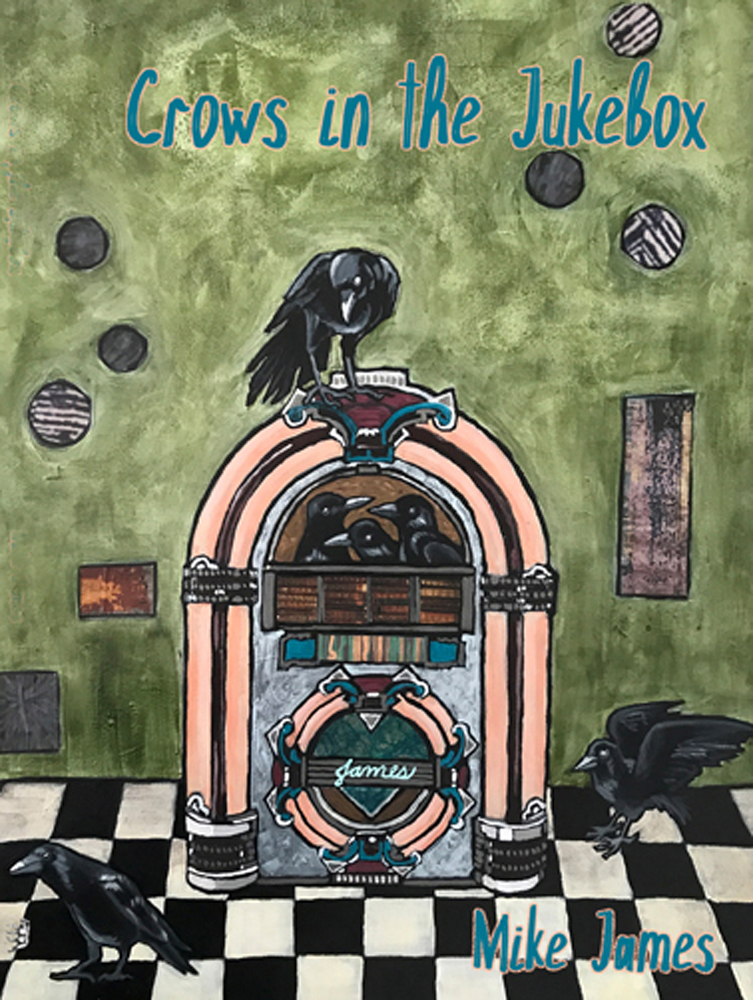
The Very Southern Pronunciation Still Rings In My Ears: A Conversation With Poet Mike James

.

The Very Southern Pronunciation Still Rings In My Ears:

A Conversation With Poet Mike James

By Chase Dimock

.

Keats had his nightingale, Shelley had his skylark, Poe had his raven, Stevens had 13 ways of looking at a blackbird, and Mike James has a jukebox full of crows. While fans of poems about birds will not be disappointed, Crows in the Jukebox is just as much about the jukebox as it is about the crows. James’s book reads like the playlist of an old jukebox in a roadside, greasy spoon diner. There are folk songs that retell old family lore, slow ballads that honestly and sweetly pay tribute to his love, and melancholic memories of a self-destructive father on par with any country tune sung by Loretta Lynn or Tammy Wynette. You can hear the drawl in his words, but James is not constrained by the clichés or expectations of his background in the Carolinas. His poetry is, as the crow flies, direct in its route and positioned with a vision that can muse on the specific while connecting it to a wider, areal view.

.

Chase Dimock: Crows pop up as the subject of several poems in your book, Crows in the Jukebox. In “The Crows,” you write that you “love those damned birds for what they aren’t” and in “Poem” you declare that “crows are good at waiting, much better than we are with our alphabet of needs.” What is it about crows that makes them such a fertile subject for poems? How does your interest in crows connect with some of the other ideas and themes in your work?


Mike James:  I’ve always loved crows. They are, with pigeons, my favorite birds.  Part of what I like about them is their intelligence, but I also love the fact that they exist at the margins. No one goes to the zoo to see crows. They are always around, watching and plotting survival. Many people have a real aversion to them. That marginality probably interests me as much as anything since I think the best writing comes from working against dominant culture, of getting by at the margins. So many of “the great dead” I admire worked actively outside of the mainstream.  (I’m thinking of poets like Stephen Jonas, Bill Knott, Jack Spicer, Lorine Niedecker, and Mbembe Milton Smith.) I don’t make a conscious decision to work around any specific themes; however, I have a real love for the decayed, the failing, and the decrepit. In so many ways I am in love with ruination. Give me the choice between walking through a mansion and walking through a closed factory and I will choose the factory on every occasion.


Chase Dimock: Let’s talk more about your interest in marginality and resisting the dominant culture. I feel that one way writers cultivate a unique voice and resist the dominant culture in their work is through identifying with the unique region and culture in which they live and write. Steinbeck had Monterrey Bay and Faulkner had rural Mississippi. You were born in the Carolinas, and you currently live in Chapel Hill. A number of your poems make references to places in the South, including a town in the poem “Off Interstate 95” where “people hope for jury duty ’cause it’s a job.” How does living in this region inform your poetry and influence your feeling of marginality?


Mike James: It’s easy for a southerner to relate to marginalized cultures because the south has always been either looked down upon or romanticized in an unhealthy and non-useful way.  Coming from a blue collar background, as I do, presents two choices:  Either accept the dominant culture imposed by wealth and commercialism and forget your origins or stand slightly outside the mainstream and question basic assumptions. Good writing, for me, is all about questioning assumptions.

I’ve been very determined to never lose my, fairly thick, southern accent.  My voice identifies my birth region.  So many people have negative views of southerners.  Once, at a training seminar for my job, the instructor, who I had not spoken with, mentioned her hatred for southern accents because, she said, southerners do not sound educated.  When I questioned her, she asked, “Honestly, don’t you ever think you sound like a hillbilly?” I replied, “No.  I think I sound like William Faulkner and Reynolds Price and Tennessee Williams.”

One way the south definitely influenced me was through the orality of the culture I grew up in.  During my childhood, my relatives gathered on an almost nightly basis and told stories. Even though I’m not a narrative poet, that spoken tradition still informs my work. And the very southern pronunciation still rings in my ears. It’s only in the south that tired and hard can come off like off-rhymes. (You can hear that rhyme in Loretta Lynn’s “Coal Miner’s Daughter.”)

All that being said, I really don’t consider myself a southern writer. James Dickey and Everette Maddox are, probably, the only two southern poets I can definitely say have influenced me and those are two wildly disparate voices.  Most of the poets I read and relate to are from places outside of the south.

Continue reading “The Very Southern Pronunciation Still Rings In My Ears: A Conversation With Poet Mike James”

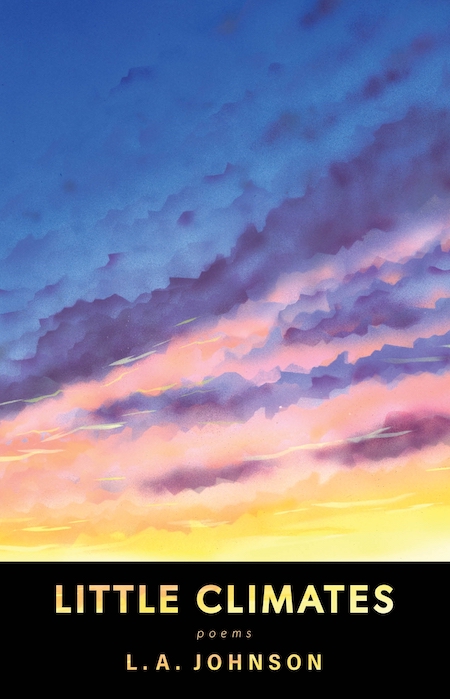
SATURDAY POETRY SERIES PRESENTS: LITTLE CLIMATES


From Little Climates
By L. A. Johnson:


EPISTEMOLOGY

I never had quiet times in the kitchen
making an icebox cake.
I never inspected the back of the box,
folded wafers up with cream.

In the morning, you fix whatever
needs fixing. You make eggs
with toast. And in the afternoon, I walk
out far past the end of the acre.

Only then do the strays come
to the porch, looking for a dish of milk,
a can of fish left open. No arguing
or crying can be heard nearby.

In the evening, the walls confine
the regular angers. We listen
to the kettle sing on the stove
that nobody bothers to stop.

In the freezer, always, only the notion
of an icebox cake—its layers
softening to be like the real thing.
The icing, milk and smooth.

Stranger, if only things had been
a little different, I could be
old-fashioned in my happiness,
blushing and easy to love.


SPLIT-LEVEL

Today the six of us perform a funeral for a home—
we wreathe the doorway with lilies, carry
our possessions above our heads like caskets.

We scatter the enviable parts of our lives
across the lawn: a radio, ceramic bowls, a sweater

that never fit. Strangers stop by to look
at all our things, each one dressed in black.

Then with hammers, we begin the destruction.
Afternoon sun exposes the fine particles
of wool and fiberglass that kept us warm.

Behind the medicine cabinet, we find razor blades
rusted in a wall-hollow. In the vacant lot next door,

a ravine appears that no stray dog will cross.
We know in some towns, this demolition is modest

or even ordinary. A bulldozer loiters elsewhere.
In a future, this house will become honeycomb
and bees will make clear honey out of all our mistakes.


“Epistemology” previously appeared in the Antioch Review and “Split-Level” previously appeared in the Indiana Review. Both peoms are from the collection Little Climates (Bull City Press, 2017; copyright L. A. Johnson) and appear here today with permission from the poet.


Little Climates: The lyric poems of Little Climates address the divisions between the self and the world, the self and the lover, and self with the self. In her debut collection, L. A. Johnson examines of the disparate spaces humans occupy in relationships: together and separately, alone and as unit. Each partner’s past, how they’ve changed, how they dream of the present—these are the little climates.


L. A. Johnson is the author of the chapbook Little Climates (Bull City Press). She received her MFA from Columbia University and is currently pursuing her PhD in literature and creative writing from the University of Southern California, where she is a Provost’s Fellow. She’s received scholarships and fellowships from Vermont Studio Center and Sewanee Writers’ Conference. Her poems have recently appeared or are forthcoming in The American Poetry Review, Antioch Review, The Iowa Review, Narrative Magazine, The Southern Review, and elsewhere.


Guest Editor’s Note: I first heard L. A. Johnson’s poems at a reading the poet gave in Los Angeles. When I read Little Climates a few weeks later, I realized that her imagery is so acute and vivid that it had stayed with me. Johnson is an expert at creating poignant landscapes and visceral environments. At times, they are intensely familiar: “the notion/of an icebox cake—it’s layers/softening to be like the real thing,” but the poet also deftly moves in directions the reader might never have imagined; “In the evening, / the walls confine the regular angers.” The detailed, sensory world the poet creates builds into unforgettable landscapes that stay with the reader long after the pages of Little Climates have been closed.


Want to read more by and about L. A. Johnson?
L. A. Johnson’s Official Website
Buy Little Climates from Bull City Press
Buy Little Climates from Amazon
Read more poems via At Length
Read more poems via The Account


Guest Editor Alan Toltzis is the author of The Last Commandment. Recent work has appeared in print and online publications including Hummingbird, Right Hand Pointing, IthacaLit, r.k.v.r.y. Quarterly, and Cold Noon. Find him online at alantoltzis.com.


A NOTE FROM THE MANAGING EDITOR:

After nearly ten years as Contributing Editor of this series, the time has come for change. I am thrilled to expand my role to Managing Editor and provide the opportunity for fresh voices to contribute to this ongoing dialogue. Today and in the coming weeks, please help me welcome a series of guest editors to the newest incarnation of the Saturday Poetry Series.

Viva la poesia!
Sivan, Managing Editor
Saturday Poetry Series, AIOTB


From a Tree Limb

Jean-Baptiste Oudry “A Deer Attacked by Dogs” (1725)

From a Tree Limb

By Sean Karns


Outside my house, a gutted buck dangles
from a tree limb.  Two men pull the buck’s hide
like tugging on a bell rope in a tower.
Their children swing on the swing set.
I’ve never seen a deer slaughtered,
never seen many things slaughtered.

I once saw my father gut a squirrel.
Doesn’t smell right, he said.  He put the squirrel
an inch away from my face.
Sniff it, he said. I smelled it, sucked in the odor
like my last breath and shrugged my shoulders
not knowing what I was sniffing for.
He dug a hole in the yard.
You got to dig the hole deep enough,
he said. So the dogs can’t smell it and dig it up.

I wonder where the heart is,
where the spleen is,
if the men will leave the buck
disemboweled in two locations.

I press my face to the screen door.
A child pets the hide splayed over
the laundry line, the other watches
the hacking off of hooves.

.

“From a Tree Limb” first appeared in Pleiades and is in Jar of Pennies. 

.

About the Author: Sean Karns has an MFA in creative writing from the University of Illinois and a BA from The Ohio State University. He is the author of a collection of poetry, Jar of Pennies, and his poetry has appeared in the Birmingham Poetry Review, Hobart, Rattle, Pleiades, Los Angeles Review, Cold Mountain Review, Folio, and elsewhere; and his poetry has been anthologized in New Poetry from the Midwest. He is currently the poetry editor at Mayday Magazine.

SATURDAY POETRY SERIES PRESENTS: PATRICE BOYER CLAEYS

By Patrice Boyer Claeys:

Favorite Color
after Ruth Stone’s “White on White”

A yellow flag iris,
a lick of flame,
glass of Sauternes.

Blinking lights at intersections,
the bills of mallards, old knotty pine
paneling, sticky to the touch.

Lemon meringue pie,
spent elm leaves, the fish brought home
from the fair in its water-filled bag.

Caution tape to mark the murder scene,
the road to Oz,
a wobbling flan, chicken fat.

The burning hydrogen of Arcturus,
broken brooms,
xenophobic dread.

A cheesy joke, wheezy phlegm,
the running rheumy eyes and shaded
teeth of jaundiced men.

Mustard, pus and broken yolks.
The nicotine-stained fingers
of Johnny Cash and Vonnegut.

Slimy bile, old bruises, the pulsing
membrane on the poisonous gland.
The dusty, bitter sex of crocus throat.


Today’s poem first appeared in Volume 5, Issue 1 of Bird’s Thumb and appears here today with permission from the poet.


Patrice Boyer Claeys enjoys the freedom of the empty nest. She thanks her writing group, Plumb Line Poets, for keeping her chiseling away. Her work has appeared in Mom Egg Review, Found Poetry Review, Blue Heron, Avocet, ARDOR, the Aurorean, Beech Street Review and Bird’s Thumb, and is forthcoming in Nassau Review. She was featured in Light, a Journal of Photography and Poetry. She was nominated for Best of the Net.

Guest Editor’s Note: On the surface, the literal and the metaphorical are given equal weight in this poem by Patrice Boyer Claeys. Each item anticipates the next, and the effect is a list of things that are yellow that might or might not be favorable in spite of the title “Favorite Color.” The poet references Ruth Stone’s “White on White” to give some direction for reading, which feels like an excavation, a mining for truth in the scrutiny of the color, its denotation and connotations.

Each line of the poem seems innocuous until the fifth stanza which ends with “xenophobic dread.” This metaphor stops the speaker’s examination of the more benign imagery that includes mallard bills, knotty pine, and “Lemon meringue pie,” and illuminates the “blinking lights of intersections” that has become a portent of imminent threats.

The final three stanzas do not disappoint in providing perilous symbols of imminent dangers, both familiar and unfamiliar. The depictions of disease—the “wheezy phlegm,” the “rheumy eyes,” the “old bruises”—succeed in changing the tone and in producing a mood of ominous expectation. The speaker observes instances of yellow and presents those that are the most necessary to the theme which seems to be a warning and a lesson in keen observation and meaning in context.

Want to read more by and about Patrice Boyer Claeys?
RHINO Poetry
Blue Heron Review
Beech Street Review


Anne Graue

Guest Editor Anne Graue is the author of Fig Tree in Winter (Dancing Girl Press, 2017), and has published poems in literary journals and anthologies, including The Book of Donuts (Terrapin Books), the Plath Poetry Project, One Sentence Poems, and Rivet Journal.


A NOTE FROM THE MANAGING EDITOR:

After nearly ten years as Contributing Editor of this series, the time has come for change. I am thrilled to expand my role to Managing Editor and provide the opportunity for fresh voices to contribute to this ongoing dialogue. Today and in the coming weeks, please help me welcome a series of guest editors to the newest incarnation of the Saturday Poetry Series.

Viva la poesia!
Sivan, Managing Editor
Saturday Poetry Series, AIOTB