“Mania Makes Me A Better Poet” By Daniel Crocker

.

Mania Makes Me A Better Poet

By Daniel Crocker


I paced up and down the front porch on a rare, cool Missouri night.

“The government wants me to take pills,” I told my wife. She asked why, but I didn’t have an answer. Part of me knew it wasn’t true. Part of me wasn’t convinced. My thoughts shifted rapidly.

“Do you ever wonder about that guy from the Oak Ridge Boys? You know, the one with the big beard?”  I had also suddenly become obsessed by William Lee Golden. I was worried about him.

“Do you think he feels trapped? Like, he wishes he could shave off that scraggly damned beard and be free of if.”

 I wondered if he’d ever regretted growing that beard, probably sometime in his early twenties, and regretted it.

“He has to think his fans just won’t get the real Oak Ridge Boys experience without it? And what about John Berryman? Did he have the same problem? Is that why he jumped off that bridge?”

This was just a few days before I broke down, went to a clinic, and got help for bipolar 1 disorder. The symptoms had been ramping up for months—compulsive intrusive thoughts and rituals—I’m going to kill myself tomorrow was a favorite of mine, running on a loop in my mind.  I was trucking along on little to no sleep or food. My speech was pressured.  The mania had started out fun. I was creative. I felt unstoppable. I had the energy to do some work.  In the end it always gets scary. It devolves into anxiety, paranoia and the occasional mild delusion.  In the end, however, I got a hell of a poem about William Lee Golden out of it.

The truth is, mania makes me a better poet, although it’s taboo to say so. Not among other bipolar people. We’ll readily admit to each other that we love parts of our mania. We usually just don’t tell the sane people in our lives. They look at us shocked, or sad, or worse. Sometimes they look at us with anger. Our loved ones have seen the wake of destruction left behind by mania. I’ve hurt plenty of people myself while manic, including my significant other. I swear by my medications now. They keep me stable, if not fully content. Sometimes something is missing.

Unless you’ve been through it, you just can’t understand how mania feels. It’s like being on speed and booze at the same time—except better. Your mind, at least for a while, is laser-focused. You actually have the desire and energy to want to create—or do whatever it is that you do. Depression, on the other hand, is a creativity killer. It can be hard to get out of bed, much less write a poem. Mania, when it hits just right, calls for hours of steady work. Continue reading ““Mania Makes Me A Better Poet” By Daniel Crocker”

Two Ghazals

Two Ghazals

By Mike James

.

Cowboys & Cinderellas

I’m waiting for the apocalypse or the rapture. In the meantime, I’m reading Stein.
Also, growing cabbages, Watching John Wayne movies, while I paint my nails.

Some people pretend to live without shadows. Are always perfectly shaved.
Ignore salsa stains, flatulence. Expect worry to be, at least, three houses away.

The best we hope for are angels grown tired of heaven’s many perfections.
Who miss beer, sex, mascara. Who miss a world happy to wake from dreams.

On slow days, I work in the garden. The squirrels seem to like what I produce.
In good years I harvest peppers, cucumbers. Bad years, profanity and (yep) dust.

Art News tells us, second chances are no harder than the first. We just write
Songs about the second. We romanticize failure since we all have practice.

.

Ghazal

A garden doesn’t make you a farmer any more than boots make you a
Cowboy. Go on and play your make-believe. Go to your fashion show.

Appropriation is the least appreciated art. Going forward, we should
Only speak in quotes from Collete, Betty Boop, and her doe-eyed ilk.

If thievery was legal, where would the fun be? Cat burglars no more
Romantic than postman. Duchamp another man with an extra urinal.

Listen, the whole world practices make-believe. Have you ever seen
A President give an oath with fingers not crossed? That’s was a dream.

Matthew Broderick, once parroted the line, There’s a kind of freedom in
Being completely screwed. Let me an offer an agreement. Give an amen.

.

About the Author:  Mike James is the author of eleven poetry collections. His most recent books include: Crows in the Jukebox (Bottom Dog), My Favorite Houseguest (FutureCycle)and Peddler’s Blues (Main Street Rag.) He has previously served as associate editor for both The Kentucky Review and Autumn House Press. After years spent in South Carolina, Missouri, Pennsylvania, and Georgia, he now makes his home in Chapel Hill, North Carolina with his large family and a large assortment of cats.

SATURDAY POETRY SERIES PRESENTS: EMILY BLAIR


By Emily Blair:


Today’s poems previously appeared in cream city review (vol. 41.1) and Indiana Review (vol. 39, no.1) and appear here today with permission from the poet.

Emily Blair’s poetry has appeared in Gulf Coast, Sixth Finch, Juked, Indiana Review, New Ohio Review, cream city review, Gettysburg Review and the Brooklyn Poets Anthology, among other places. She received a New York Foundation of the Arts Fellowship in Poetry in 2014 and in Fiction in 2006, and is the author of the illustrated chapbook Idaville (Booklyn Artists’ Alliance, 2010). Also a visual artist, she creates multimedia books and collaborates with social practice artist Michelle Illuminato under the name Next Question.

Guest Editor’s Note: To begin reading a poem by Emily Blair is to step onto a sturdy roadway only to find halfway along that you are swaying wildly on a rickety rope bridge, your foot’s about to fall through the rotting jute, and there’s no going back. All you can do is rush forward and hope you make it to the other side before it collapses behind you. She pulls you along with brilliant wordplay: “—were the heavens ablaze—was there a topiary maze—” and half-recognized allusions to the plot points of movies you probably slept through while you were babysitting those demon kids across the street. Toward the end of the poem you realize that the poet is cleverly yet subtly addressing some of your most mundane and commonly shared fears and despite all signs to the contrary–is every single sentence a question?–the poet gives us a temporary reprieve from that anxiety in the form of a quirky answer: “Are you going to haunt me forever? I’m free every night this week.”

Want to read more by and about Emily Blair?
Barrel House Mag
Juked


Originally from MN, Guest Editor Julie Hart has lived in London, Zurich and Tokyo and now in Brooklyn Heights. Her work can be found in PANK Magazine, The Rumpus, Vol. 1 Brooklyn, the Brooklyn Poets Anthology and at juliehartwrites.com. She is a founder with Mirielle Clifford and Emily Blair of the poetry collective Sweet Action.

A NOTE FROM THE MANAGING EDITOR:

After nearly ten years as Contributing Editor of this series, it is an honor and a unique opportunity to share this space with a number of guest editors, including the editor featured here today. I am thrilled to usher in an era of new voices in poetry as the Managing Editor of this series.

Viva la poesia!
Sivan, Managing Editor
Saturday Poetry Series, AIOTB


The Incredible Bipolar Hulk: A Conversation with Poet Daniel Crocker

.

The Incredible Bipolar Hulk:

A Conversation with Poet Daniel Crocker

By Chase Dimock

.

The genius of The Incredible Hulk is that everyone can identify with him. All people have a reservoir of anger inside them, and we all know the painful discipline of managing anger, lest it erupt into senseless rage. The Hulk Smash is the fantasy of acting on our anger with a violent ferocity that mirrors the inner, emotional experience of pain.

In his latest chapbook, Gamma Rays, Daniel Crocker identifies with the Hulk as a metaphor for the experience of bipolar disorder. As It Ought To Be debuted Crocker’s Hulk poem “The Incredible Hulk Tries to Write a Poem” last January. For Crocker, the Hulk is more than just a momentary outburst; he is an enduring persona who embodies the manic energy of bipolar disorder. Crocker’s poems humanize the Hulk, and in turn, provide insight into the mind of the bipolar person as they navigate the impulses within them. I had a chance to ask Crocker about the Hulk and how he personifies the bipolar experience in his poetry.


Chase Dimock:  The first question on anyone’s mind when they first look at your cover is going to be “Why the Hulk?” In the past, you’ve written poems in which you take on the personas of Cookie Monster, Skeletor, and George Bailey from It’s a Wonderful Life among others. What is it about the Hulk that made him worthy of an entire collection of poetry? What does taking on his persona uniquely achieve among your pantheon of pop culture icons?


Daniel Crocker: The simple answer is, I love the Hulk. I wrote one Hulk poem, the one where he goes shopping after taking klonopin, and then I couldn’t stop for awhile. I was filtering everything through the Hulk. I originally thought I might end up with a full length, but after about 20 poems I realized I was kind of done with the story I wanted to tell. But, he’s a great metaphor. Any negative aspect of your personality, especially those that center around losing control, that’s basically the Hulk. He’s the things you bury deep. In a lot of ways this books is about coming to terms with that.

So I used it as a metaphor for my bipolar disorder because you never know when you’re going to have another episode. You just try to keep them at bay with medication. Then I started thinking about what it means to navigate love and a relationship when you have this hanging over your head–when you’re not always sure you’re going to wake up okay. Unlike Shit House Rat, however, this is more about coming to terms with it. It is, I think, a happy book with a happy ending.


Chase Dimock: The Hulk has been incarnated as a comic, a cartoon, a TV show, and several movies. I know the TV show version of the Hulk the best because I grew up watching reruns. In that version, he’s somewhat of a loner who tries to manage his rage alone and channel it toward productive ways to help the people he runs into. The show always ends with “The Lonely Man Theme.” It seems like your Hulk is more like the Hulk from the comics, which places him in a romantic relationship with Betty. Why was it important to focus so many of your poems on the Hulk in a relationship?


Daniel Crocker: In the end, it’s a book about navigating a relationship while having a mental illness. In my favorite runs of the Hulk, Bruce was always afraid of his anger coming out. He would do anything to keep the Hulk away–even though it’s a part of him. He was so obsessed with finding a cure that his relationship with Betty would be strained. When I was diagnosed with bipolar, I read up everything I could on it. So, I understand that level of obsession. I also, of course, worry that my symptoms could come back at any time—even while on medication.  So, I hope it shows the impact of bipolar disorder on one’s immediate family as well as just the person who has it. In the end, though, it’s just coming to terms with the monster inside of you–whatever that may be.

Continue reading “The Incredible Bipolar Hulk: A Conversation with Poet Daniel Crocker”

“Paul Lynde” By Mike James

.

Paul Lynde

Died on an early January Sunday in Beverly Hills. If he’d been born in early January, he’d be a Capricorn. He was a Gemini. During the 1970’s it was popular to tell people “your sign.” Like shag carpet, that’s less popular now. Paul trusted astrology. Call him a man of the times. Call him Liberace without a piano, add a scarf. Geminis love illusions and music. Prefer light blue and yellow. The great talents of Geminis “are in the social realm.” Does that include cooking? Paul Lynde liked to drink white wine while cooking. He loved to cook.

.


About the Author: Mike James has been widely published in magazines, large and small, throughout the country. His thirteen poetry collections include: Jumping Drawbridges in Technicolor (Blue Horse), First-Hand Accounts from Made-Up Places (Stubborn Mule), Crows in the Jukebox (Bottom Dog), My Favorite Houseguest (FutureCycle)and Peddler’s Blues (Main Street Rag.) He has served as an associate editor for the Kentucky Review and Autumn House Press, as well as the publisher of the now defunct Yellow Pepper Press. He makes his home outside Nashville, Tennessee.More information can be found on his website at mikejamespoetry.com.


More By Mike James:

Grace

Two Ghazals

Under the Tamarind Tree

Francisco Manuel Blanco: “Tamarindus Indica”
.

Under the Tamarind Tree

By Bunkong Tuon

.

Editor’s Note: This past week, the nation witnessed devastating images from detention centers and heard hateful rhetoric spewed about immigration. Now, more than ever, it is important to humanize immigration and emphasize empathy. It is in this spirit that we are proud to present the final post in a series of poems about the immigrant experience in America.

Our late Managing Editor, Okla Elliott, featured Bunkong Tuon’s work on As It Ought To Be back in January of 2017. Okla was particularly concerned about the anti-immigration rhetoric heating up in the country and he hoped to showcase the voices of immigrants on our site. In honor of Okla’s memory, Tuon has allowed us to feature more of his poetry about his experience as an immigrant from Cambodia in the United States. All of the poems from this series can be found linked at the end of this article.

.

Under the Tamarind Tree

The child sits on the lap
of his aunt, under the old tamarind tree
outside the family home.

The tree stands still, quiet,
indifferent. The house sways
on stilts.

Monks in saffron robes,
and nuns with shaved heads,
lips darkened with betel-nut stain,

sit chanting prayers
for the child’s mother.

Incense perfumes the hot dry air.

There emerges a strange familiar song
between the child and his aunt that day—
a distant one, melodic but harsh,
as if the strings are drawn too tight—

Each time the child hears prayers
coming from the house, he cries;
each time he cries, the aunt, a girl herself,
pinches the boy’s thigh.

.

Previous poems from Bunkong Tuon’s series on the immigrant experience in America:

Fragments

Our Neighborhood in Revere, MA

Snow Day

An Elegy for a Fellow Cambodian

Halloween, 1985

Dancing Fu Manchu Master

Fishing for Trey Platoo

Lies I Told About Father


.

About the Author: Bunkong Tuon is the author of Gruel (2015) and And So I Was Blessed (2017), both poetry collections published by NYQ Books, and a regular contributor to Cultural Weekly  He is also an associate professor of English and Asian Studies at Union College, in Schenectady, NY.

SATURDAY POETRY SERIES PRESENTS: LAURA READ


RIP, LAURA’S VAGINA
By Laura Read


Your vagina is beginning to devitalize,
the doctor explained, when I asked him why
I had had so many urinary tract infections lately.
The first thing I thought was that I should say
No, your vagina is devitalizing, because I have
two teenage sons, and that is what passes for wit
in our house. But then I got lost in the fact
that he didn’t, in fact, have a vagina,
and I thought I should point that out instead
because in some circles—say, mine—
that would be an insult. Then, in the little
room inside my mind where Dorothy Parker
was holding court at the Algonquin,
I thought maybe devitalize is just a medical term,
give the guy a break. But I didn’t even know
this man. Couldn’t he just give me a prescription
and say something vague about aging?
What about euphemism? I guess devitalize
was one because he went on to more vividly
explain that my tissues were, frankly, deteriorating.
At that point, I was thinking But you haven’t even
seen the area in question
and How did you get
this far without knowing how to talk to women?

Devitalize reminds me of de-ice which is what
I was doing just before this tricky moment
at the Urgent Care. My son was late to Algebra
because it’s really cold and it took a while
to clean the car. And at 8:00 the door
where he usually goes in automatically closes,
so I had to take him around to the front,
and he dropped his phone in the snow
and it got run over, so now there’s a crack
in the screen. He wants me to replace it,
but I said, No, it still works.


Today’s poem previously appeared in the Beloit Poetry Journal, Volume 68, No. 1. Winter 2018, and appears here today with permission from the poet.

Laura Read’s first collection of poems, Instructions for My Mother’s Funeral, was published in 2012 by the University of Pittsburgh Press. Her second collection, Dresses from the Old Country, will be published by BOA in fall of 2018. She teaches English at Spokane Falls Community College.

Guest Editor’s Note: This poem moves through thought and returns to previous memory in a deceptively effortless progression, as if listening to someone recount an experience in conversation. The speaker fixates on a word that informs the tone of the experience and the poem: devitalize. This word takes her down a linguistic path that leads to another path and another, but, unlike Robert Frost, she returns to the fork in the road at the end of the poem with her response to her son that is meant for the insensitive doctor: “No, it still works.”

The allusive dark humor of Dorothy Parker is conjured as a familiar satirical connection and an anchor for association or a metaphorical leap. The “little room” inside the speaker’s mind is where pithy retorts are stored for occasions such as the encounter at the Urgent Care clinic, but she doesn’t respond in the way that she wants to, keeping her thoughts to herself, as many women do in these situations when they are being told that their bodies have failed them in some way by doctors who make assumptions without being completely sure.

The significant linguistic turn the speaker takes to a new word: “Devitalize reminds me of de-ice” leads her to recent memory, and the experience of taking her son to school that morning evokes mournful anger and defiance in the face of a doctor’s proclamation that a vital part of her female-ness is deteriorating. The details are important in her reliving the moments with her son as she is sitting in the clinic, and seemingly mundane facts become the thematic crux, informing the reader how life and language connect to produce intense emotion when we least expect it.

Want to read more by and about Laura Read?
Laura Read’s Official Website


Guest Editor Anne Graue is the author of Fig Tree in Winter (Dancing Girl Press, 2017), and has published poems in literary journals and anthologies, including The Book of Donuts (Terrapin Books), the Plath Poetry Project, One Sentence Poems, and Rivet Journal.

A NOTE FROM THE MANAGING EDITOR:

After nearly ten years as Contributing Editor of this series, it is an honor and a unique opportunity to share this space with a number of guest editors, including the editor featured here today. I am thrilled to usher in an era of new voices in poetry as the Managing Editor of this series.

Viva la poesia!
Sivan, Managing Editor
Saturday Poetry Series, AIOTB


Visit Our Updated Author Interviews Page

Vanessa Bell “Conversation at Asheham House” (1912)

Over the years, we have had the privilege to interview a range of poets, novelists, and multimedia artists. Check out our updated archive of interviews and discover some new, contemporary literary voices.

Bunkong Tuon: “Lies I Told about Father”

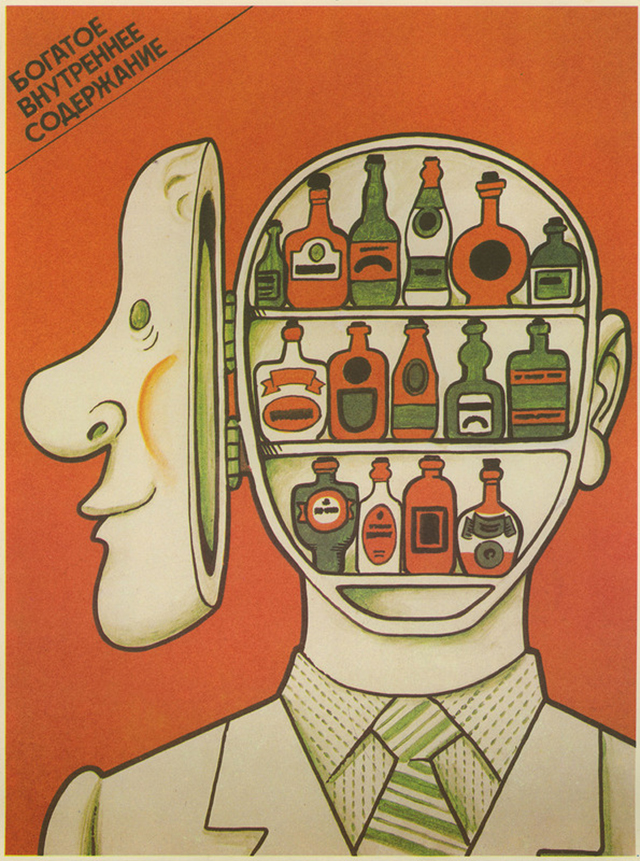
From a Russian Anti-Alcohol Poster

.

Editor’s Note: This is the fifth post in a series of poems about the immigrant experience in America. Our late Managing Editor, Okla Elliott, featured Bunkong Tuon’s work on As It Ought To Be back in January of 2017. Okla was particularly concerned about the anti-immigration rhetoric heating up in America and he hoped to showcase the voices of immigrants on our site. In honor of Okla’s memory, Tuon has allowed us to feature more of his poetry about his experience as an immigrant from Cambodia in the United States. You can find the full series of poems at the end of this page.

.


Lies I Told about Father

I believed I had the power to revive you,
to sit you up in the family’s pigsty,
drunk off your ass, smiling at nothingness,
the late morning light shining on your face.
With a son’s quiet adoration, I chiseled you:
a gangster from the East, a Khmer Krom
whose blood cried out Khmer characters (not Vietnamese),
who, guided by fate, found himself in the West
and married mother for her virtue and beauty.

In these poems you drink because, well, real men
drink, curse, and sleep around (the cursing
and sleeping around, you didn’t do, of course,
because of your love and respect for Mother).
I was an aspiring writer then,
renting a tiny studio on Ocean Boulevard
in Long Beach, following in the drunken
bouts of Charles Bukowski, buying cheap wine,
imitating free verse,
waking up to the stench of sour vomit.
Of course, this life did not last long.
I can’t hold liquor, let alone women.
I have always been a reader,
safe behind words, punctuation, and sentences,
between the pages, where I can conquer
an entire nation or seduce women with my long dash—.

Now, I am engaged to a kind, generous person.
Mother would approve of her.
I am returning to you once again,
not for approval, just to talk,
son to father, but it dawns on me:
I am without you.

.


About the Author: Bunkong Tuon is the author of Gruel (2015) and And So I Was Blessed (2017), both poetry collections published by NYQ Books, and a regular contributor to Cultural Weekly. He is also an associate professor of English and Asian Studies at Union College, in Schenectady, NY.


Previous poems from Bunkong Tuon’s series on the immigrant experience in America:

Our Neighborhood in Revere, MA

Snow Day

An Elegy for a Fellow Cambodian

Halloween, 1985

Dancing Fu Manchu Master

Fishing for Trey Platoo

Lies I Told About Father

Bunkong Tuon: “Fishing for Trey Platoo”

Fishing for Trey Platoo

By Bunkong Tuon


Editor’s Note: This is the fourth post in a series of poems about the immigrant experience in America. Our late Managing Editor, Okla Elliott, featured Bunkong Tuon’s work on As It Ought To Be back in January of 2017. Okla was particularly concerned about the anti-immigration rhetoric heating up in America and he hoped to showcase the voices of immigrants on our site. In honor of Okla’s memory, Tuon has allowed us to feature more of his poetry about his experience as an immigrant from Cambodia in the United States. The full series of poems is available below.

.


Fishing for Trey Platoo 

You might have seen them 
fishing on the shores of the Cape Cod Canal: 

My uncle in his fisherman’s hat 
pulling in a one-foot scup, my aunt in her pajama-like 

pants walking backward up the bike path, 
snapping a line that’s got stuck between the rocks, 

my other aunt reeling in a sea bass 
her husband by her side directing. 

Bikers, joggers, teenagers and their dates, 
families with their children look curiously on. 

Or maybe you have seen them
lining up all three sides of a pier in Salem, 

their wrists jerking in a language 
that bewitches the squids below. 

They are not the only ones.
Other Cambodians and Vietnamese, once enemies, 

fish side by side on the same American pier. 
Other immigrants, Chinese, Spanish, Portuguese 

speaking languages that I can’t understand, come together 
on this spot: sacred rods in hands, beckoning the squid. 

Or maybe you have seen them
under a bridge fishing the Providence River, 

looking for trey platoo, a type of mackerel
like they used to eat in the refugee camps in Thailand. 

Sometimes, my aunts and uncles run into an old friend 
from those long ago days. They talk about the lack 

of food, of sneaking out at night to fish, and of running, 
always running, from the Thai police. 

They exchange phone numbers, share fishing secrets,
and set up a time and place where they’ll fish together again. 

When they get home, my aunts gut the fish,
clean them, fry them, and put them in boiling stew 

of galangal, lemongrass, and kaffir leaves.
My uncles and aunts sit in a circle on the floor, 

eat, and tell stories of how this fish got away
or how one of them got caught by the Thai police. 

No matter how hard they try, they can never understand 
why my cousin and I ever bother with fishing— 

Why we catch and release food, as if it’s some sport.

.


About the Author: Bunkong Tuon is the author of Gruel (2015) and And So I Was Blessed (2017), both poetry collections published by NYQ Books, and a regular contributor to Cultural Weekly  He is also an associate professor of English and Asian Studies at Union College, in Schenectady, NY.


Previous poems from Bunkong Tuon’s series on the immigrant experience in America:

Our Neighborhood in Revere, MA

Snow Day

An Elegy for a Fellow Cambodian

Halloween, 1985

Dancing Fu Manchu Master

Fishing for Trey Platoo

Lies I Told About Father


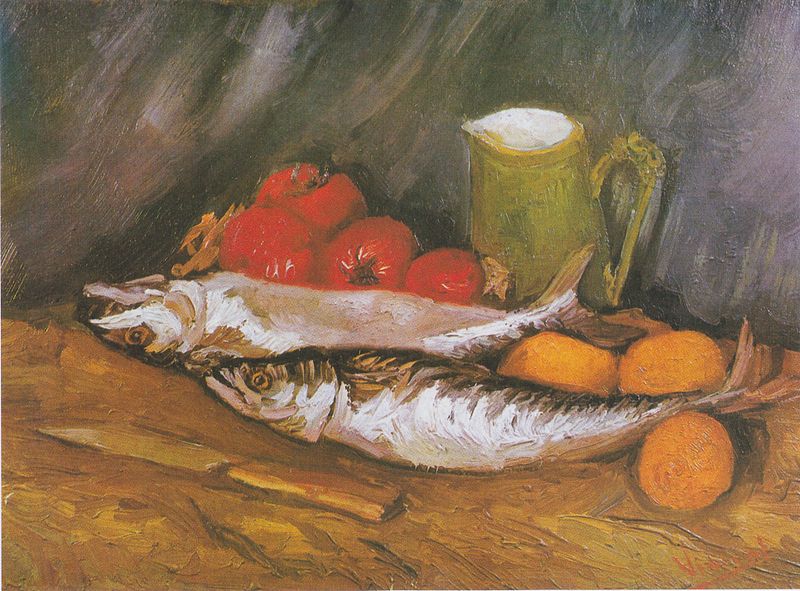
Image Credit: “Still Life with Mackerel, Lemon and Tomato” By Vincent Van Gogh (1886) Public Domain