SATURDAY POETRY SERIES PRESENTS: KAREN ALKALAY-GUT

karen2014


By Karen Alkalay-Gut:


HER STORY

I have never been able to tell her story
Sometimes it escapes me, sometimes I am not sure
It could really have happened, sometimes I read
Different accounts of her demise, or a paragraph
From some testimony jogs my memory and the terrible days
When I first heard what happened to her return.

This much is in my blood:
I was conceived on the day she died.
This much is in my blood.
She blew up trains.
The courage came from her uplifted chin
And the two infants she watched
Dashed against the wall of their home.
Avram twelve months old and Masha two years.
My first cousins.
They too – in my blood – all that is left.

If I can write of these babies,
I can manage the rest –
Following her path as she escaped
The prison camp with her husband
And joined the Otrianski Otriade
Lenin Brigade, Lipinskana Forest.

I can feel her mouth, her narrow lips clamped
As she bends over the delicate mines,
Solemn as in the photo when as a child
She sat for with the rest of the choir
Unsmiling amid the festive singers
Unwilling perhaps to feel poetic joy
Perhaps destined for so much more.

There are at least three accounts of her death:
The partisan Abba Kovner told me she was caught
In a mission and hung. He looked away when he spoke,
Not piercing me as always with his tragic eyes,
And I knew there was more he would not say.

Another book says she lagged behind the platoon
Escaping an attack, perhaps pregnant,
And was imprisoned in Zhedtl.
The jail was ignited, perhaps by accident,
And she was just one of the victims.

When mother first told me the story
She had just heard at the hairdresser’s,
I must have been fifteen, and outraged
That she was weeping, tears
Rolling down her face. She knew
All I cared for was my own life,
And her latest discovery
Of the fate of her youngest sister
A disruption.
But who else could she tell?

The loft in the barn, she said,
They were hiding there – three women,
Her husband and her. They came
And set the barn afire. He helped
The women first, and his wife came last
But didn’t come, was burnt alive.

Malcah Malcah who saved all our lives
Malcah who was waiting for them
When the ship brought them back to Danzig
After they were barred from the Holy Land,
Who found them the agricultural visas to England
And saw them off the night that Hitler invaded.
But there is no real story.
All that remains is a faded snapshot
A few sentences in unread memorial tomes,
And me, who cannot tell any story for sure.


Today’s poem was originally published in Prairie Schooner and appears here with permission from the poet.


Karen Alkalay-Gut is now easing out of a fifty-year academic career at Tel Aviv University and beginning to concentrate on writing. Born in London during World War II, she was raised in Rochester, New York and moved to Israel in 1972. She has published almost 30 books in English, and Hebrew, Spanish, and Italian translation, and has collaborated on half a dozen music CDs.

Editor’s Note: Is it possible to read today’s poem without being moved to tears? To wax poetic (this is the place for that, after all), when I read today’s poem the first words that come to mind are “How do I love thee? Let me count the ways.” No, really. Let me.

1) Parallelism, as both an incantatory device and as a conversation between the poem and biblical poetry. “This much is in my blood: / I was conceived on the day she died. / This much is in my blood.” “Malcah Malcah who saved all our lives / Malcah who was waiting for them.” This parallelism is working on more levels than we might imagine. To echo the Bible in this way is a tradition that dates back to the earliest World War II and Holocaust poetry. But, in fact, it dates back to long before the Holocaust, finding rich roots among the varied history of all Jews in exile, and particularly those in Spain’s Golden Age and the time of the expulsion.

2) Vivid imagery that does not let us forget the many tragedies of “her story.” “[T]he two infants she watched / Dashed against the wall of their home,” “I can feel her mouth, her narrow lips clamped / As she bends over the delicate mines,” “He helped / The women first, and his wife came last / But didn’t come, was burnt alive.” This poem is rife with what Aristotle termed Pathos, the emotional connection to the audience. This is not a poem that you can read without feeling, deeply.

3) The poet herself shines through as a character, real and flawed and human. We know her struggles and her failings, and we experience them with her. “If I can write of these babies, / I can manage the rest,” “When mother first told me the story… I must have been fifteen, and outraged / That she was weeping… She knew / All I cared for was my own life, / And her latest discovery / Of the fate of her youngest sister / A disruption.”

4) Malcah, on the other hand, is made a hero through raw nostalgia. Malcah means “queen,” and while the poet did not invent her lost aunt’s name, bringing her name into the poem elevates the heroine to near-godly proportions. “She blew up trains. / The courage came from her uplifted chin,” “Malcah who saved all our lives / Malcah who was waiting for them / When the ship brought them back to Danzig / After they were barred from the Holy Land, / Who found them the agricultural visas to England / And saw them off the night that Hitler invaded.” Malcah the martyr, who did not die before first ensuring that the poet and her family would live.

5) “Her Story.” It is no secret that I am a big fan of herstory. I created a project to revive and celebrate it. But herstory, as today’s poem makes clear, is multi-faceted. It is women’s history, it is one woman’s history, it is women’s stories, and it is one woman’s story. But in today’s poem it is also the admission that there is no one story. (An idea I am incredibly interested in, as I spent the fall of 2013 researching my own family’s history through the lens of varying versions of the same story, much as today’s poem does.) In today’s poem we are given every known version of Malcah’s story, but the poet twins the telling of “her story” with the idea that “there is no real story” to tell. This is as true to an accurate historical retelling as anyone can come.

Want more from Karen Alkalay-Gut?
Karen Alkalay-Gut’s Official Website
Interview in The Madison Journal of Literary Criticism
Tel Aviv Radio
Buy The Encantadas: Evolution and Emotion from Amazon
The Bridge at Raqqa (eBook)
Youtube
SATURDAY POETRY SERIES PRESENTS: NORMA LILIANA VALDEZ

NLValdez head shot


By Norma Liliana Valdez:


UNACCOMPANIED

Everything is happening now. Everything is present tense. The horses. The running.

The losing. This operation is a well-oiled machine. All is slow motion until dusk. After

dusk come the icy furrows. Overnight temperatures the kind of cold that enters marrow.

There is so much winter in the eyes. From here the only lights: the moon and Chula

Vista. After the ice, the running. Ravine. Huizache. Thorns. The hiding. A Cadillac.

There is a gun in the glove compartment. There are two boys in the trunk. Two other

boys contort their bodies on the back seat floor, legs entwined. Face down. Face down.

He is the one balled on the front passenger floor because he is the smallest. He is bones

and destiny.


HUMMINGBIRD

every breath you exhaled

a blanket of hosannas

each hand like prayer, like

unfettered music

you were night, naked

shoulders in moonlight

I lost my breath

beneath your gravity

your touch slid along the arc

of every whisper

I inhaled greedily

filled every room

filled every empty space

inside of me

you must have known my anthem

when you left

urgent as an animal


“Unaccompanied” was the poetry winner of the 2015 San Miguel Writers’ Conference Writing Contest, and “Hummingbird” is an original feature on the Saturday Poetry Series on As It Ought To Be. Both poems appear here today with permission from the poet.


Norma Liliana Valdez is an alumna of the VONA/Voices Writing Workshop, the Writing Program at UC Berkeley Extension, and a 2014 Hedgebrook writer-in-residence. Her poems have appeared in Calyx Journal, The Acentos Review, As It Ought To Be, La Bloga, and Dismantle: An Anthology of Writing from the VONA/Voices Writing Workshop. She is the poetry winner of the 2015 San Miguel Writers’ Conference Writing Contest. Additional work is forthcoming in Poetry of Resistance: A Multicultural Anthology by University of Arizona Press. She lives and works in the San Francisco Bay Area.

Editor’s Note: Over the years Norma Liliana Valdez’s writing has grown much in the way bougainvillea grows. Along earth-toned buildings in warm places. A steady, fertile spread erupting in vibrant blossoms. Like the sight of bright and blooming bougainvillea, today’s poems take my breath away.

“Unaccompanied,” winner of the 2015 San Miguel Writers’ Conference Writing Contest in poetry, is a work of art. The title is evocative, deftly making its mark. The narrative envelopes us in a gripping and heart-wrenching tale that speaks as much to the experience of the few as to the dreams and suffering of the masses. This work is vocal, political, and brave. Brimming with stunning lyric, we feel “the kind of cold that enters marrow,” see how “there is so much winter in the eyes,” and are left with what reads like a told fortune: “He is bones / and destiny.”

While “Unaccompanied” is yin-like—covert and treacherous—”Hummingbird” is like the yang—in relief, open, belonging to this world. The energy is sensual and intense, with “each hand like prayer.” And while both poems end spectacularly, “Hummingbird” is volta-like in its finale, confessing that “you must have known my anthem / when you left / urgent as an animal.”

This is the poet’s third Saturday Poetry Series feature. Three is a sacred number. The Holy Trinity. Maiden, Mother, Crone. The Triple Bodhi. The Trimurti. Which is fitting, as the poet divines poems that are alchemical. Spiritual. Faithfully wrought and nearly religious in their lyricism. Evocative of a humanity made palpable through poetry.

Want to read more by Norma Liliana Valdez?
Saturday Poetry Series feature, As It Ought To Be, 2011
Saturday Poetry Series feature, As It Ought To Be, 2010
Winners of the 2015 San Miguel Writers’ Conference Writing Contest
Spiral Orb
The Acentos Review

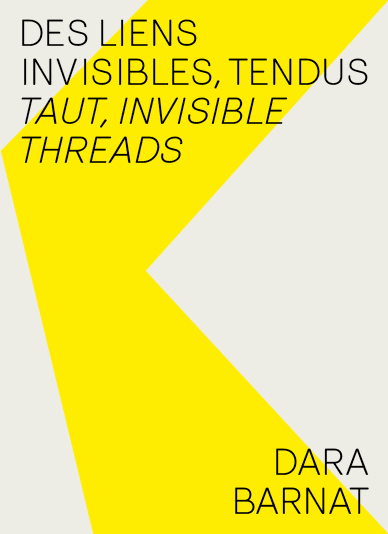
SATURDAY POETRY SERIES PRESENTS: DES LIENS INVISIBLES, TENDUS / TAUT, INVISIBLE THREADS


Liens


From DES LIENS INVISIBLES, TENDUS / TAUT, INVISIBLE THREADS
Poems by Dara Barnat; Translations by Sabine Huynh:


A BRILLIANT FISH

We must choose each other
again and again.

The feeling is a brilliant fish
you catch a thousand times.

We must carry each other
like smooth stones
in the palms of our hands –

a familiar feel,
a roundness.


UN POISSON MOIRÉ

Un poisson moiré
Se choisir l’un l’autre, s’y reprendre
à plusieurs fois.

Cet émoi ressenti face à un poisson moiré
qu’on pourrait attraper des milliers de fois.

Transportons-nous
tels des galets lisses
dans le creux de la paume –

toucher familier,
rondeur.


GROWING VEGETABLES

Her wide hips remind me
that I was born,
because in photos at twenty
they are still narrow
and slim.

Bending over
and planting roses
she gathers immense joy
from the dirty pebbles
and the new petals.

I hold her basket
like a daughter should
and almost pretend
to smile and be grateful
for the fresh, ripened tomatoes.

Is it with age
that happiness can be found
in growing mint
and drinking ice water
that has collected tiny bugs?

My mother shares soap
with a man who is not my father
but a good man,
waiting inside
to make our sauce.

The basket is now full
and since her joy
takes up the whole garden
there is no room
for my joy.

But she says daughter,
you will have your own life,
and your own garden,
just pray for rain,
and grow your vegetables.


CULTIVER SON POTAGER

Ses hanches généreuses
me rappellent ma naissance
– dans des photos d’elle à vingt ans
elles sont encore étroites
elle est encore mince.

Penchée
sur les roses mises en terre
elle recueille une joie immense
des cailloux sales
et des jeunes pétales.

Je lui tiens son panier
telle une fille dévouée
et réussis presque
à sourire de gratitude
pour ces tomates mûres.

Est-ce avec l’âge
que l’on trouve du bonheur
à faire pousser de la menthe
à boire de l’eau glacée
où surnagent des petites bêtes?

Ma mère partage son savon
avec un homme qui n’est pas
mon père, un homme bon,
il attend à l’intérieur
de préparer notre sauce.

Le panier est plein
la joie de ma mère
remplit le jardin
plus de place
pour la mienne.

Alors elle me dit : tu sais ma fille,
tu auras ta propre vie
et ton propre jardin,
prie pour qu’il pleuve
et cultive ton potager.


PRAYER I DO NOT KNOW

No one is here, just me,
alone. I close

my eyes and try
to remember your face,

its light, your
fingers, their light

touch, your laugh,
the lightness. I recite a prayer

that is my own:
May we live

a thousand years together
in another life.


PRIÈRE OBSCURE

Comment prier
pour toi ? Personne

ici, moi
seule. Je ferme

les yeux, tente de voir
ton visage,

sa lumière, tes doigts,
l’affleurement,

ton rire,
la légèreté. Je récite une prière

qui est mienne:
Puissions-nous vivre

mille ans ensemble
dans une autre vie.


Today’s poems are from Des liens invisibles, tendus / Taut, Invisible Threads, published by Recours au poème éditeurs (2014), and appear here today with permission from the poet.


Des liens invisibles, tendus / Taut, Invisible Threads is a bilingual collection of poems by the American poet Dara Barnat, translated to French by Sabine Huynh. Dara Barnat explores migration (between New York, where she was raised, and Tel Aviv, her adopted city), the experience of being an English-language poet in Tel Aviv, intimate familial relationships, her father’s long illness and passing, as well as secrets, history, and memory. Loss is certainly at the core of the poems; although she succeeds in guiding her readers to comfort, even joy, with wisdom she has learned from enduring grief. In the last poem of the book, the speaker addresses her father in the afterlife, and they are both happy to be “alive.” This exhilarating vision demonstrates how Walt Whitman informs the poet’s elegies. She imagines herself walking down the street with Whitman. It is also not surprising to encounter Emily Dickinson or Robert Frost, since the power of Dara Barnat’s poetry resides in its capacity to observe our solitude with grace and honesty.


Dara Barnat was born in 1979. Her poetry appears widely in journals in the United States and Israel. She is the author of the chapbook Headwind Migration (2009), as well as poetry translations and scholarly essays. Dara holds a Ph.D. from the School of Cultural Studies at Tel Aviv University. Her dissertation explored Walt Whitman’s influence on Jewish American poetics. She teaches poetry and creative writing.


Sabine Huynh was born in 1972. She holds a Ph.D. in Linguistics (Hebrew University of Jerusalem), has authored poetry and prose books (novel, short stories, academic book, literary essay, diary), and has edited an anthology of modern French poetry, which were published by Galaade Editions, Voix d’encre, La Porte, éditions publie.net, Recours au poème éditeurs, E-Fractions Editions, among other French publishers. She writes in English and French, translates daily, occasionally teaches creative writing classes, and regularly contributes to the French literary journals Terre à ciel, Terres de femmes, and Recours au poème. Her website: http://www.sabinehuynh.com


Editor’s Note: The opening poem in Dara Barnat’s debut collection begins, “Please know that taut, / invisible threads / tethered us / to those years.” Threads that bind the speaker to mother and home, to father and illness, to time, to what comes into being and what inevitably slips away. And so Des liens invisibles, tendus / Taut, Invisible Threads invites us into a deeply personal yet resonant world of life and death, love and loss, relationship and the human experience.

Nestled within the honest, reflective, beautiful lyric of these poems are the moments poetry was made for: “maybe / we should part now, because oceans / dry up in time, / even the whitest bones / turn to ash.” Equally powerful are so many of the poems’ closing stanzas and end-lines: “daughter, / you will have your own life, / and your own garden, / just pray for rain, and grow your vegetables;” “May we live // a thousand years together / in another life.”

Throughout the book we are welcomed into a private, sacred space. Into kitchens and gardens, hospitals and homelands. We are invited to bake bread and receive intimate moments like sacrament. Crossing the wide span between memory and horizon, Taut, Invisible Threads is like a migrating bird that “fights the seasons, / and lands wherever / there are seeds, / water, and soft earth, // until it arrives.”

I wish that I were well-versed in French and thereby able to comment on the translations by Sabine Huynh housed within this moving bilingual collection. Falling far short of that wish, I can only say that I have had the pleasure of hearing the translator read some of her poetry translations aloud in French, and it was a transformative experience. Her voice is emboldened by its quiet humility, and the passion she has for translation is well-known amongst the numerous writers who seek to have their work translated by this gifted writer and translator.

I have had the pleasure of featuring both Dara Barnat and Sabine Huynh on this series, and am thrilled to see these two incredibly talented writers and translators brought together in one stunning collection. This book—and this collaboration—is a gift to the poetry world that should be read, shared, and celebrated.


Want to see more by Dara Barnat?
Buy Des liens invisibles, tendus / Taut, Invisible Threads from Recours au poème éditeurs
Dara Barnat’s Official Website
Dara Barnat’s Official Blog
“At Least Forward Now” in Haaretz

SATURDAY POETRY SERIES PRESENTS: THE GLAD HAND OF GOD POINTS BACKWARDS

9780896728547


From THE GLAD HAND OF GOD POINTS BACKWARDS
By Rachel Mennies:


HOW GRANDMOTHER PAID HER PASSAGE TO NEW YORK

One by one her mother sold her silver spoons
and heirloom bracelets; goodbye, porcelain bear,
silk blouses, patent-leather Mary Janes, the scarves
and stud earrings for newly pierced ears, the red wool coat
spotted walking on another tiny body’s shoulders
down Wittenbergplatz. Goodbye, books bound
in leather, bone china, even the hangers, the goblets
and cabinets; goodbye to the Torah buried in the backyard,

the neighbors, the schoolmates, the mothers dressed so well
at services, the men with businesses who stayed behind
one week, two weeks more. What stylish
objects they became: the coins from fillings
and wedding rings, the soap, the wigs, lamp
after lamp to light a thousand decorated homes.


PHILADELPHIA WOMAN

The old sisters spoke with the wild gestures of trapped birds, snared or
cooped, their wings working toward an impossible escape. They stood
on street corners in Germantown and gesticulated the full span of their
arms. They argued over coffee, over books, over the dinner table, food
chilled to the temperature of the air. They hewed their beliefs for the
sake of debate. Soft-handed and pale-skinned, they lived mostly inside.

They took the trolley to Center City when they were in their twenties,
living in Logan with the rest of the refugee Jews. They told wild stories
of their childhoods, never explored or questioned. They worked as
bookkeepers, secretaries. They went to Girls’ High School, classrooms
filled with young women speaking foreign tongues, caught and released,
caught and released each day, back when men and women were kept
separately until marriage, fine china and daily dishware.

The oldest of the three married a soldier (never explored) who loved her
dearly (never questioned). When he died his mouth made words that
opened her chest like shrapnel. Tell them whatever you want, he said,
but I need you to know. I need you to know. Her hands stayed slack at her
side. Her name was. It was. She left his bedside and paced a block of Old
York Road, north and south, east and west, as if a cage around her kept
her close.


YAHRZEIT

Here the eye of God opens, unblinking,
at the throats of our grandmothers. The small pale
candle flickers on the windowsill, making
constellations of all our deaths.

How long a wick, how short a year. And here,
the family site, the only real estate
that’s mine—how clever, the way earth
makes us into mud—how heavy

the feet of our commemorators, how white
the knuckles that clasp their books of prayer.


Today’s poems are from The Glad Hand of God Points Backwards, published by Texas Tech University Press, copyright © 2014 by Rachel Mennies, and appear here today with permission from the poet.


The Glad Hand of God Points Backwards: In her first poetry collection, Rachel Mennies chronicles a young woman’s relationship with a complicated God, crafting a nuanced world that reckons with its past as much as it yearns for a new and different future. These poems celebrate ritual, love, and female sexuality; they bear witness to a dark history, and introduce us to “our God, the / collector of stories / and bodies,” a force somehow responsible for both death and liberation. Here, Mennies examines survival, assimilation, and intermarriage, subjects bound together by complex, if sometimes compromised, ties to the speaker’s Judaism. Through wit and careful prosody, The Glad Hand of God Points Backwards lays bare the struggles and triumphs experienced through a teenage girl’s coming of age, showing the reader what it means to become—and remain—a Jewish woman in America. —TTUP


Rachel Mennies is the author of The Glad Hand of God Points Backwards, winner of the Walt McDonald First-Book Prize in Poetry (Texas Tech University Press, 2014), and the chapbook No Silence in the Fields (Blue Hour Press, 2012). Her poems have appeared in Hayden’s Ferry Review, Poet Lore, The Journal, and elsewhere, and have been reprinted at Poetry Daily. She teaches in the First-Year Writing Program at Carnegie Mellon University.


Editor’s Note: The Glad Hand of God Points Backwards is an absolutely stunning collection. It is that rare breed of poetry book that you cannot help but read cover to cover, knowing all the while that you will return to it again and again. There is magic in this work. Ritual. Tradition. Its stories rise from the page in painstaking detail—vivid, emotive, and all too real. History is both honored and excavated; bones and memories are buried in the backyard. Time is not linear, but fifth dimensional; the past, present, and future unfold more like a snowflake than a line. The soundscape is rich and evocative, the themes resonant and deeply lyric, the entirety layered and striking.

And then there are these moments. These perfect, brilliant, heartbreaking moments. Reveals like the volta in “How Grandmother Paid Her Passage to New York,” when we discover what became of “the men with businesses who stayed behind / one week, two weeks more.” Lines like “When he died his mouth made words that / opened her chest like shrapnel.” Like every freakin’ moment of “Yahrzeit.”

Easy to invest in, the rewards of The Glad Hand of God Points Backwards are “as numerous as the stars in the sky and the sand on the seashore.”


Want to see more from Rachel Mennies?
Rachel Mennies – Official Website
Buy The Glad Hand of God Points Backwards from Texas Tech University Press
Buy The Glad Hand of God Points Backwards from Amazon
Linebreak
Thrush Poetry Journal

SATURDAY POETRY SERIES PRESENTS: NOMI STONE

Stone headshot

By Nomi Stone:


WAR GAME, AMERICA

The war scenario has: [vegetables stalls], [roaming animals],
and [people] in it. The people speak

the language of the country we
are trying to make into a kinder country.
Some of the people over there are good
others evil others circumstantially

bad some only want cash some
just want their family to not
die. The game says figure

out which
are which.


WHAT IS GROWING IN THESE WOODS

Green in here, gleaming like
being inside a fable but with
stalls of fruit you can’t eat.
To go home, leave crumbs.
When the wood circles you
back here instead, let the lost
and the impossible ripen in
you, ripen and go.


US AND THEM

“I would make love to one of our

whores before I
would fuck one of their
bourgeoisie.” There was a proverb,

like this: Don’t trust a         if
he becomes a         even though
he remains a       for

forty years. And the sister opposite
proverb: Don’t trust a       even
though he has been in the grave

for forty years. It was a difficult day,
a bomb had spun open
a bus, and children

had been crushed down by
a machine. Each wondered if he was born
too soon, if later would have been better, if 40

+ 40 + 40 + 40


War Game, America” and “What is Growing in these Woods” previously appeared in Painted Bride Quarterly, and “Us and Them” previously appeared via The Poetry Foundation. These poems appear here today with permission from the poet.


Nomi Stone is the author of the poetry collection Stranger’s Notebook (TriQuarterly, 2008), a PhD Candidate in Cultural Anthropology at Columbia University, and an MFA Candidate in Poetry at Warren Wilson. She previously earned a Masters in Modern Middle Eastern Studies from Oxford and was a Creative Writing Fulbright scholar in Tunisia. Her poems have been published or are forthcoming in Poetry Northwest, Memorious, The Painted Bride Quarterly, The Bloomsbury Anthology of Contemporary Jewish Poetry, at The Poetry Foundation, and elsewhere. She is currently researching and writing a book of poetry as well as a book of non-fiction about combat simulations in mock Middle Eastern villages erected by the US military across America.

Editor’s Note: Nomi Stone’s poetry is a veritable minefield of experience. Politics, war, violence, history, proverbs, culture, peoplehood, nationality, borders, mythology, folklore, fairy tales, and biblical referentiality lie in wait for the keen and unsuspecting reader alike. The unsaid is as present and powerful as what is written, so that her poetry echoes the Bible’s black fire written on white fire. This is a poetry rich and blooming. Thick with the sights and smells of Near Eastern markets, yet heavy with human tragedy. Herein lies the old world. Herein lies the Levant. Herein lies the wild woods of our imagination set against the all-too-real world of war. If you cannot find your way out, “let the lost / and the impossible ripen in / you, ripen and go.”

Want more from Nomi Stone?
“Many Scientists Convert to Islam”
“Trapped on Djerba, Island of the Lotus Eaters”
“Purim, Spring Festival: How to Escape Massacres”
Interview with Nomi Stone with poems: “The Notionally Dead” and “War Game America”
An interview about Nomi Stone’s research on war games

SATURDAY POETRY SERIES PRESENTS: JEN CAMPBELL

Jen Campbell


Vaginaland
By Jen Campbell


Screen Shot 2014-09-19 at 10.59.02 PM
Screen Shot 2014-09-19 at 10.59.16 PM
Screen Shot 2014-09-19 at 11.00.21 PM


“Vaginaland” was previously published in English Pen “Poems for Pussy Riot” and appears here today with permission from the poet.


Jen Campbell is an award-winning poet and short story writer. She’s also the author of the bestselling Weird Things Customers Say in Bookshops Series. Her poetry collection, The Hungry Ghost Festival, is published by The Rialto and her latest book, The Bookshop Book, will be published in October by Little, Brown.


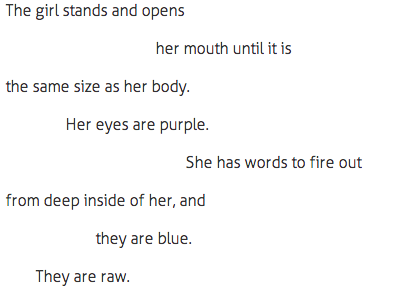
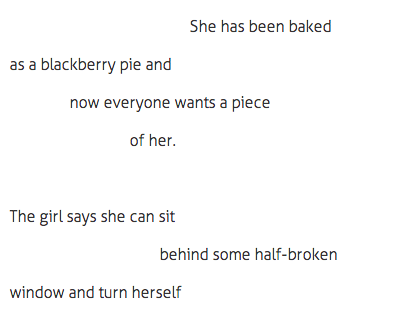
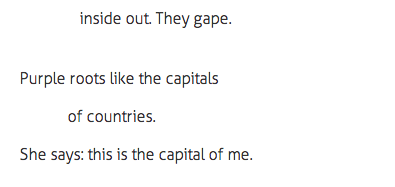
Editor’s Note: What is a girl? What is her mouth, her body, her words? Who is that girl when the world tries to hold her down and shut her up? When “She has been baked / as a blackberry pie and / now everyone wants a piece / of her”?

“Vaginaland” was originally published by English PEN as a political act. In an act of solidarity. In support of three members of the Russian punk band Pussy Riot, who were then in prison for their outspoken feminism, LGBT advocacy, and opposition to the policies of Russian President Vladimir Putin.

Who — and what — does a girl become when she stands up, breaks free, and fires out the words that are deep inside of her? When those words are political? When her voice is political? When “She says: this is the capital of me”?


Want to read more by Jen Campbell?
Jen Campbell Official Website
The Hungry Ghost Festival
The Prose-Poem Project
Jane Martin Poetry Prize 2013
The Plough Prize

SATURDAY POETRY SERIES PRESENTS: GLOSSOLALIA

GLOSSOLALIACOVER


from GLOSSOLALIA
By Marita Dachsel:


PATTY BARTLETT SESSIONS

I

I was 17, newly married
when I first put a woman to bed,
her new babe in arms.

Awaiting death, I’ve tallied,
attended 3977 births. Midwife,
my eminent title.

Pride is a sin,
but I think I will be forgiven
for the surge I feel
when I consider my record.


II

47 did not feel old,
but looked ancient to him.
A month after my daughter,
me. Sexless, righteous.
Virtuous. Finished.


III

I became a Mother in Israel,
coaxing young women
into the new covenant.

We were Sarah & Hagar. Rachel & Leah.

But I was wrong about polygamy.

Lust, envy & wrath are sins,
& I know I will never be forgiven
for being the zealous handmaiden
to this difficult life.


IV

I have lost four children. Heartache
is my chronic companion,
chafing the every day.

But my dear husband David
took a second wife
& I will tell you
what the others won’t admit:

There is no other earthly pain,
constant, raw & rending,
like sharing your man
with a younger wife.


V

I am a practical woman:
I can heal with herbs & my hands,
I brew my own beer, sew, knit,
& speak in tongues.

After birth, I would show
the mother the slick placenta,
raised up, a stretched orb.
An offering.

It carries the tree of life.
Rough, ropey. Red,
the colour of strawberry jam
boiling low on the stove.


VI

Being the first hand
to touch a life
is a powerful thing.

I have wondered
what imprint
I have left

& what has been
left on me.


AFTER THE MARTYRDOM

The men, they surged
from their homes,
from their women,
a confluence
in search of
their Galilee.

They shuffled, they scuffed
dirt across the land,
a hand of a crone.

The men, they fished.
Eyes skimmed the shore
for a stranger they would know.
Hope bobbed in their throats.
Loss, a lure, caught
shredding what they once knew true.

The women, they were left
with the children,
the dead.
The scriptures gave no guide
for wives at a time like this.


Today’s poems are from Glossolalia, published by Anvil Press, copyright © 2013 by Marita Dachsel, and appear here today with permission from the poet.


GLOSSOLALIA is an unflinching exploration of sisterhood, motherhood, and sexuality as told in a series of poetic monologues spoken by the thirty-four polygamous wives of Joseph Smith, founder of The Church of Jesus Christ of Latter-day Saints. In Marita Dachsel’s second full-length collection, the self-avowed agnostic feminist uses mid-nineteenth century Mormon America as a microcosm for the universal emotions of love, jealousy, loneliness, pride, despair, and passion. Glossolalia is an extraordinary, often funny, and deeply human examination of what it means to be a wife and a woman through the lens of religion and history. (From the Anvil Press website.)


Marita Dachsel is the author of Glossolalia, Eliza Roxcy Snow, and All Things Said & Done. Her poetry has been shortlisted for the Robert Kroetsch Award for Innovative Poetry and the ReLit Prize and has appeared in many literary journals and anthologies. Her play Initiation Trilogy was produced by Electric Company Theatre, was featured at the 2012 Vancouver International Writers Fest, and was nominated for the Jessie Richardson Award for Outstanding New Script. She is the 2013/2014 Artist in Residence at UVic’s Centre for Studies in Religion and Society.


Editor’s Note: In this collection Marita Dachsel has taken on no small task. By seeking to reclaim women’s stories from the polygamous world of Joseph Smith, the poet gives voice to the voiceless, the unknown, the lost and forgotten. Their stories come to life, their lives become known history. In “Patty Bartlett Sessions,” polygamous wife Patty Bartlett converts other women to the Mormon faith, “coaxing young women / into the new covenant.” But when she realizes the insurmountable trials of polygamy, she knows she “will never be forgiven / for being the zealous handmaiden / to this difficult life.” Instead she finds inspiration and fulfillment in her work as a midwife, for “Being the first hand / to touch a life / is a powerful thing.” In “After the Marytrdom” Dachsel speaks for a chorus of wives left by husbands seeking a divine experience, noting ruefully that “The scriptures gave no guide / for wives at a time like this.”


Want to see more from Marita Dachsel?
All Things Said & Done – Marita Dachsel’s Official Blog
Canadian Poetries
The Rusty Toque
The Barnstormer
Youtube: Too True: The poetry of four acclaimed BC poets

SATURDAY POETRY SERIES PRESENTS: JENNY SADRE-ORAFAI

Sadre-Orafai

KARAJ
By Jenny Sadre-Orafai

When I miss her, I open my popout map.
I spill my face into the streets of Tehran.
I hide in Laleh Park. I read street names
aloud, like I’m reporting to someone.
I pretend I see things no one else can─
who took the Peacock Throne, how the burnt
city fell. I say Karaj like I’m telling you your future.


Today’s poem was originally published in Thrush Poetry Journal and appears here today with permission from the poet.


Jenny Sadre-Orafai is the author of four chapbooks. Her first collection Paper, Cotton, Leather will be published this fall by Press 53. Recent poetry has appeared in Redivider, Thrush Poetry Journal, PANK, Rhino, Sixth Finch, ILK, iO: A Journal of New American Poetry, and Poemeleon. Recent prose has appeared in The Rumpus, The Toast, and Delirious Hem. She is co-founding editor of Josephine Quarterly and an Associate Professor of English at Kennesaw State University.

Editor’s Note: I fell in love with today’s poem because it so intimately and distinctly tells the poet’s story, and yet, this is not her story. I have my own Karaj, and anyone who has ever loved a city that lies on the other side of the world—anyone who has ever loved a city by way of memory and longing—speaks the language of this poem. I am reminded, too, of Danusha Laméris’ beautiful poem, “Arabic,” of the ways in which love—of a language, of a people, of a place—remain with us across the span of distance and time. When Jenny Sadre-Orafai leaves us with her (killer!) end-line, I know what my future holds. I know what city waits for me on distant shores.

Want to read more by Jenny Sadre-Orafai?
Official Website
Two poems with audio in PANK
Creative nonfiction essay with audio in The Rumpus

SATURDAY POETRY SERIES PRESENTS: ROSE NIELSEN

theresa1


WATER-WITCH
By Rose Nielsen

As April mist blew chill against the rocky beach,
the wishing pines, the trembling birch and cedars
leaned out as if to catch a glimpse of Mary Lake’s
ice petticoat swept to shore on last night’s tempest.

Divining rod in hand, stem pointing at the lake,
Y hugging at my hips, I felt no tug;
I thought the misty air, the soggy forest floor
must be too drenched to dowse a single source.

But when I looked again and saw the leaning birches
reach out their limbs, each one a pair of arms
held out to greet the lake, I turned the stem to point
toward me and felt the tug as it divined a hidden spring.


Today’s poem appears here today with permission from the poet.


Rose Nielsen is a writer, poet, musician, and a physical therapist in a small mountain town in British Columbia, Canada. She also teaches biology and English at the local community college. She recently received her MFA in Creative Writing from the University of British Columbia. Her work has appeared or will be appearing in RiverLit and CV2; and she is working on a novel and on a collection of poems about water and the bonds humans hold with it.

Editor’s Note: Rose Nielsen’s poetry reminds me of Alaska’s Poet Laureate, Peggy Shumaker, a favorite here on this series. These poets share a love of the interconnectivity of nature and the written word. Simple, yet rich, and working on the micro level, with sounds lulling and inspiring us, with images clear as if painted by brushstroke.

As tomorrow is Mother’s Day, I dedicate today’s selection to my Mama. The woman who taught me the wonders of water, witchcraft, nature, and poetry alike. For my mother, and for Mother Earth, the Great Mother of us all.

Want to read more by Rose Nielsen?
River Lit

SATURDAY POETRY SERIES PRESENTS: JENNA LE

Jenna Le photo

By Jenna Le:


MOM’S COCKS

Mom grew up beside the Perfume River in Vietnam,
in a brick house overrun by chickens.
Those horny-footed fowl were always
rubbing their feather-padded genitals
against sofa legs and children’s shoes
as if they were fit to burst. Mom laughs

as she tells me how they ground
their pelvises against her leather sandal,
stuporous with misdirected lust—
How strange that she
is talking to me about sex
in this casual way. She’s returning to her roots

as a child who lived among
unmannered beasts. And I, through hearing her words,
am returning there with her: I
am the aggressive rooster; I’m the hens
cowering behind the outhouse; I’m the much-abased,
much-abraded, Size Four shoe.


THREE SHORT POEMS ON A COMMON THEME

1.

Staring at you across the room, my body seemed composed
of nothing but eyes.

Even my mouth
watered, like an eye.

2.

I couldn’t sleep a wink all night: my brain agitated its solitude
like a washing machine

filled with copies
of your immaculate white shirt.

3.

In the morning, I went out and bought a book of your poems.
It’s a poor substitute for a straightedge, it’s true,

but you won’t
sell me your curves for any price.


Today’s poems are from Six Rivers, published by NYQ Books, copyright © 2011 by Jenna Le, and appear here today with permission from the poet.


Jenna Le was born in Minneapolis, Minnesota, a daughter of two Vietnam War refugees. She received a B.A. in mathematics from Harvard University and an M.D. from Columbia University. She has worked as a physician in Flushing, New York, and the Bronx, New York. Her full-length poetry collection, Six Rivers (NYQ Books, 2011), was a Small Press Distribution Poetry Bestseller. Her poetry, fiction, essays, book criticism, and translations of French poetry have appeared or are forthcoming in journals such as AGNI Online, Barrow Street, Bellevue Literary Review, Massachusetts Review, Measure, Pleiades, and 32 Poems.

Editor’s Note: Lyric, narrative, accessible, and unafraid, Jenna Le’s Six Rivers opens along the banks of the Perfume River, in a scene that pairs mother with sex and “horny-footed fowl.” The relationships—between mother and daughter, between ‘here’ and ‘there’—are rich and complex, with the poet embodying her mother’s past, her roots, and the “much-abased, much-abraded, Size Four shoe.” Throughout the book love and sex, personal, familial, and cultural history, healing and death are all explored as we travel with the poet along the six rivers of her life. Le allows herself to be vulnerable and imperfect, and so we relate to her, root for her, are drawn into her vivid world. A keen seer and a captivating reporter, it is no wonder that, at times, the poet feels she is “composed of nothing but eyes.” Hungry for life, hungry for love, it is no wonder that “Even [her] mouth watered, like an eye.”

Want to read more by and about Jenna Le?
NYQ Poets
Mascara Literary Review
The Nervous Breakdown
The Toronto Quarterly
Sycamore Review