In that great journey of the stars through space
About the mighty, all-directing Sun,
The pallid, faithful Moon, has been the one
Companion of the Earth. Her tender face,
Pale with the swift, keen purpose of that race,
Which at Time’s natal hour was first begun,
Shines ever on her lover as they run
And lights his orbit with her silvery smile.
Sometimes such passionate love doth in her rise,
Down from her beaten path she softly slips,
And with her mantle veils the Sun’s bold eyes,
Then in the gloaming finds her lover’s lips.
While far and near the men our world call wise
See only that the Sun is in eclipse.
(Today’s poem is in the public domain, belongs to the masses, and appears here today accordingly.)
Ella Wheeler Wilcox was born on in Johnstown, Wisconsin in 1850. She was a popular writer characterized mainly by her upbeat and optimistic poetry, though she was also an activist and a teacher of the occult. She died in Connecticut in 1919. (Bio courtesy of The Academy of American Poets.)
Editor’s Note: When the moon meets the sun in a lover’s embrace, what do men see? “only that the Sun is in eclipse,” according to today’s poet. A little sun-moon love, with a healthy dose of questioning perspective, in honor of this week’s solar eclipse.
In the Afternoon, She Smelled Like the Earth
By Marianne Peel
Her shoulders were always burned.
We had smeared ourselves with baby oil infused with iodine
painting our skin a burnt orange deeper than the marigolds
planted in a circle to protect
the lettuce from the woodchucks.
She taught me how to thread
a frenetic worm onto a crooked hook.
Digging around in that coffee can tin
wet with dirt and the roots of the soil
there was always humid mud under her nails.
Sometimes trails streaked her cheeks
after she pushed her hair off her face.
In the afternoon she smelled
like the earth after the sun
went way, way down.
She taught me to cast my line
flinging her whole arm back past her shoulder
all in one calculated, measured motion.
She said the splash on the water should be quiet soft
so we don’t scare the fish away.
And then we waited.
Just the creak of the dock bouncing
in time with the water
moving all afternoon
bobbing us up and down.
Sometimes our toes would touch
splayed off the dock
and I would recite this little piggy went to market
– but just in my head because
we had to be silent soft, waiting for the fish.
She taught me to reel in, quickly,
but with no panic, no surprise,
knowing there would be only sunfish suspended from the hook
little orange sunshines in our hands
on the dock every summer afternoon.
And she taught me to unhinge the mouth
to pull the mouth slowly from its worm feast
to toss it gently back into the water and watch it,
still hungry,
swim away.
“In the Afternoon, She Smelled Like the Earth” previously appeared via Silver Birch Press and appears here today with permission from the poet.
Marianne Peel is a poet who is raising four daughters. She shares her life with her partner Scott. She received Fulbright-Hays Awards to Nepal and Turkey. She taught English at middle and high school for 32 years. She is now retired, doing Field Instructor work at Michigan State University. She recently won 1st prize for poetry in the Spring 2016 Edition of the Gadfly Literary Magazine. In addition, Marianne has been published in Muddy River Review; Silver Birch Press; Persephone’s Daughters; Encodings: A Feminist Literary Journal; Write to Heal; Writing for Our Lives: Our Bodies—Hurts, Hungers, Healing; Mother Voices; Ophelia’s Mom; Jellyfish Whispers; Remembered Arts Journal, and Gravel, among others.
Editor’s Note: Today’s poem is vivid, vibrant, and rich with imagery. You can almost smell the earth, feel it crumble through your fingers, watch the worm wriggle. So alive are the moments of memory that we are swept up into them, unaware that we don’t know who the poem’s “she” is. We are willing to suspend our curiosity, because, “In the afternoon she smelled / like the earth after the sun / went way, way down.” Because the poem leaves us with a feeling, with an echo in the shape of knowledge, because “she taught me to unhinge the mouth / to pull the mouth slowly from its worm feast / to toss it gently back into the water and watch it, / still hungry, / swim away.”
My father went each morning to his garden.
He taught me to smell the soil to see if it was good,
to feel the dirt slide across my hands, to never
wear gloves, to stay in the middle of the row when planting seeds.
We’d look for work to do in the garden,
and sometimes there was nothing more to do
than watch the garden grow, wait for the harvest.
He thought that haricot vert were the dumbest thing he’d ever seen–
he liked his Kentucky Wonder beans, big and bursting with seeds, leaving
them to grow in the summer sun as long as possible.
Last winter he told me we couldn’t save
the parsley from the snow and ice, even though
we put blankets over it.
He got pneumonia in February.
In April, he asked me if I thought he’d get to his garden, and I told him yes.
By the end of May I brought him
cherry tomato plants to keep on the deck.
He no longer had the strength to pick
the first tomatoes that ripened in June.
August: I bring dirt from the garden
to his grave and scatter grass seed.
“Wonder Beans” previously appeared on String Poet and appears here today with permission from the poet.
Janet R. Kirchheimer is the author of How to Spot One of Us, (Clal, 2007). A Pushcart Prize nominee, her work has appeared in several journals including Young Ravens Literary Review, Atlanta Review, String Poet, Connecticut Review, Kalliope, Common Ground Review, and several anthologies and online journals. Currently, she is producing a poetry performance documentary, After, exploring poetry written about the Holocaust.
Editor’s Note: Today’s poem is a celebration of life and a poignant reminder that one day we may be remembered by what we love. Through a daughter’s eyes we see a father, watch him plant and grow, watch him love and tend the earth. Through the poet we know what it is for this daughter to love her father, and what it is to lose him. How touching her remembrance, how bittersweet the sting at poem’s end when father is returned to earth.
I ASK FORGIVENESS
By Alex Ben-Ari
Translated by Vivan Eden
I ask forgiveness of all the poems
Born misshapen because of my desire to write them
I ask forgiveness of all the people
Whose lives were disrupted by my desire to influence
And of the world
For the superfluous things added to it
And those unnecessarily severed
Because of my lust for symmetry
And happy endings.
I ask forgiveness of my mother
For not knowing how to love her in her misery
Of my children
For the moments when I don’t want them
Of my wife for every time I was too small
To contain her love.
I am lighter than a falling leaf
I am softer than grass
Now a small bird could
Build its nest in me.
Today’s poem originally appeared in Haaretz and appears here today with permission from both the poet and translator.
Alex Ben-Ari is 43 years old. His debut volume of poetry, Concealed Seas (Yamim Samuiim), was awarded honorable mention at the 2008 Metulla Poetry Festival and the 2015 Helicon/Ramy Ditzanny Poetry Prize. His second book, The Gatepost (Korat Hasha’ar), published in 2015, is composed of his original Hebrew haiku. His third book, planned to be published during 2017, is a volume of conceptual poetry.
Alex is one of the six members of the “Waning Moon” blog and publishing house dedicated to Haiku in Hebrew. He is also co-editor (with poets Gilad Meiri and Noa Shkargy) of Nanopoetica, a literary journal of short form literature.
Editor’s Note: Part personal, part pastoral, part ars poetica, today’s poem is emotive, honest, and raw. The poem’s I approaches the reader — and the page — seeking forgiveness. Free from false modesty, free from pride, the poem’s I is humble, admitting failings as poet and father, husband and son. The confessional, narrative nature of the poem is carefully constructed within the framework of the lyric, while the elegant, gentle translation midwives the essence of the poem as it crosses the borders of language. As the reader, we cannot help but be moved — to compassion, to transcendence, to forgiveness and beyond.
Janet R. Kirchheimer is the author of How to Spot One of Us. She is currently producing a documentary, “After,” about poetry of the Holocaust then and now, and is a teaching fellow at Clal-The National Jewish Center for Learning and Leadership.
Editor’s Note: Unearth the humble offerings of today’s poem and discover what grows from its rich soil. What love, what relationship, what sage advice about life. This is a poem as intimate as tending one’s own garden, and as universal as studying scripture. How wise, how simple, how sage. How lovely today’s poem, with all its offerings.
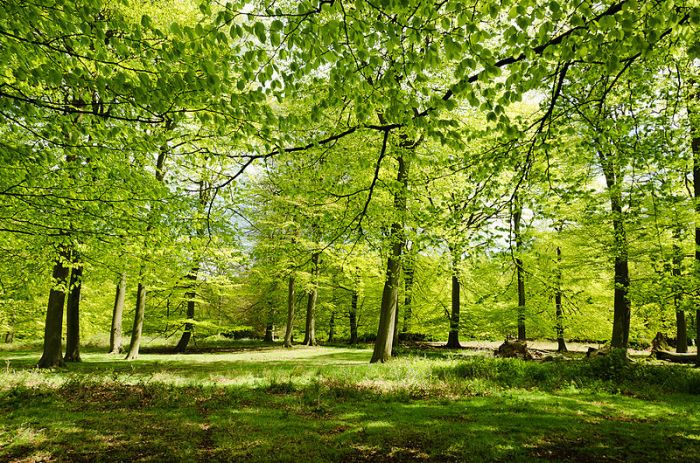
“England – English Summer Woods” courtesy of Jacopo Werther via Creative Commons: http://bit.ly/1qRZ81t
LILY-BELL AND THISTLEDOWN SONG
By Louisa May Alcott
Awake! Awake! for the earliest gleam
Of golden sunlight shines
On the rippling waves, that brightly flow
Beneath the flowering vines.
Awake! Awake! for the low, sweet chant
Of the wild-birds’ morning hymn
Comes floating by on the fragrant air,
Through the forest cool and dim;
Then spread each wing,
And work, and sing,
Through the long, bright sunny hours;
O’er the pleasant earth
We journey forth,
For a day among the flowers.
Awake! Awake! for the summer wind
Hath bidden the blossoms unclose,
Hath opened the violet’s soft blue eye,
And awakened the sleeping rose.
And lightly they wave on their slender stems
Fragrant, and fresh, and fair,
Waiting for us, as we singing come
To gather our honey-dew there.
Then spread each wing,
And work, and sing,
Through the long, bright sunny hours;
O’er the pleasant earth
We journey forth,
For a day among the flowers.
SUMMER RAIN
By Fannie Isabel Sherrick
Oh, what is so pure as the glad summer rain,
That falls on the grass where the sunlight has lain?
And what is so fair as the flowers that lie
All bathed in the tears of the soft summer sky?
The blue of the heavens is dimmed by the rain
That wears away sorrow and washes out pain;
But we know that the flowers we cherish would die
Were it not for the tears of the cloud-laden sky.
The rose is the sweeter when kissed by the rain,
And hearts are the dearer where sorrow has lain;
The sky is the fairer that rain-clouds have swept,
And no eyes are so bright as the eyes that have wept.
Oh, they are so happy, these flowers that die,
They laugh in the sunshine, oh, why cannot I?
They droop in the shadow, they smile in the sun,
Yet they die in the winter when summer is done.
The lily is lovely, and fragrant her breath,
But the beauty she wears is the emblem of death;
The rain is so fair as it falls on the flowers,
But the clouds are the shadows of sunnier hours.
Why laugh in the sunshine, why smile in the rain?
The world is a shadow and life is a pain;
Why live in the summer, why dream in the sun,
To die in the winter, when summer is done?
Oh, there is the truth that each life underlies,
That baffles the poets and sages so wise;
Ah! there is the bitter that lies in the sweet
As we gather the roses that bloom at our feet.
Oh, flowers forgive me, I’m willful to-day,
Oh, take back the lesson you gave me I pray;
For I slept in the sunshine, I woke in the rain
And it banished forever my sorrow and pain.
(Today’s poems are in the public domain, belong to the masses, and appear here today accordingly.)
Louisa May Alcott: (1832-1888) was an American novelist and poet best known as the author of the novel Little Women (1868). Raised by her transcendentalist parents, Abigail May and Amos Bronson Alcott in New England, she grew up among many of the well-known intellectuals of her day. (Annotated biography of Louisa May Alcott courtesy of Wikipedia, with edits.)
Fannie Isabel Sherrick: (Lived circa mid-to-late 19th c.) was a native of St. Louis. Much of her early life was spent in California and Colorado, where many of her best productions in verse were written. Her collected poems were published in 1888, in a volume entitled Star Dust. Poor health caused her–at least temporarily–to give up literary endeavors. (Annotated biography of Fannie Isabel Sherrick courtesy of Evenings with Colorado Poets: an Anthology of Colorado Verse, with edits.)
Editor’s Note: Technically summer is not for another month yet, but here in New York the sun is shining, and Memorial Day weekend is the official start of our summer season, so “O’er the pleasant earth / We journey forth, / For a day among the flowers.” And, while summer rain was not a common occurrence in California–from whence I came–here in New York the sky opens up to quench the grasses, the flowers, the rivers and streams, all summer long: “Oh, what is so pure as the glad summer rain, / That falls on the grass where the sunlight has lain? / And what is so fair as the flowers that lie / All bathed in the tears of the soft summer sky?”
This spring as it comes bursts up in bonfires green,
Wild puffing of emerald trees, and flame-filled bushes,
Thorn-blossom lifting in wreaths of smoke between
Where the wood fumes up and the watery, flickering rushes.
I am amazed at this spring, this conflagration
Of green fires lit on the soil of the earth, this blaze
Of growing, and sparks that puff in wild gyration,
Faces of people streaming across my gaze.
And I, what fountain of fire am I among
This leaping combustion of spring? My spirit is tossed
About like a shadow buffeted in the throng
Of flames, a shadow that’s gone astray, and is lost.
(Today’s poem is in the public domain, belongs to the masses, and appears here today accordingly.)
David Herbert Richards Lawrence (1885 – 1930) was an English novelist, poet, playwright, essayist, literary critic and painter who published as D. H. Lawrence. His collected works, among other things, represent an extended reflection upon the dehumanising effects of modernity and industrialisation. Although best known for his novels, Lawrence wrote almost 800 poems, most of them relatively short. His first poems were written in 1904 and two of his poems, “Dreams Old” and “Dreams Nascent,” were among his earliest published works in The English Review. His early works clearly place him in the school of Georgian poets, a group not only named after the reigning monarch but also to the romantic poets of the previous Georgian period whose work they were trying to emulate. (Annotated biography of Yehuda Amichai courtesy of Wikipedia, with edits.)
Editor’s Note: Lyric gyrations, thick alliteration, words and images like blossoms and wildfire. D.H. Lawrence helps us welcome spring while questioning the I amidst such a season.
When the boy comes inside
with blood on his ripe hands
and a quiver of pointed explanations
on his back, I’m chopping yellow onions.
When he says it’s a doe, that she lies
on the edge of the wood, and that he knows
she was pregnant, my skin tightens.
The scar on my belly, that battered, barbwire grin
that opened like a window for him, twitches
for the dying mother and the calf like a love note in her womb.
When he hangs his knife on his belt
and heads toward the wood, I boil water, crush garlic.
I remember when the doctor pulled him, screaming,
from my belly. I remember the howl in my womb
as he sewed me shut. I remember my first meal
as a mother. Nothing could satisfy.
I salt the vegetables. Crush the mint.
Today’s poem was originally published in Boxcar and appears here today with permission from the poet.
Jen Lambert is a founding editor of Spark Wheel Press and burntdistrict magazine. She received an MFA from the University of Nebraska, and her work has appeared in journals such as Pank, The Los Angeles Review, Sugar House Review, and Redactions, among others.
Editor’s Note: As a new mother, I recently began a search for today’s best poems about motherhood. Jen Lambert’s “Dinner for the Dying” came highly recommended and does not disappoint. And so today we kick off a series of poems within this Saturday Poetry Series that will consider motherhood and hopefully leave their mark upon the reader as today’s poem has left its mark upon me.
There is something of Naomi Shihab Nye in this work. In the salted vegetables and crushed mint. In the intersection of the natural, the familial, and the body. This is a poem of quiet power, wherein tragedy is gently stitched to memory, where life and loss are depicted as two sides of the same coin. Moments of radiant lyric emerge from the subtlety and strength of today’s poem: “a quiver of pointed explanations,” “that battered, barbwire grin / that opened like a window for him, twitches / for the dying mother and the calf like love note in her womb.”
Why did you come when the trees were bare?
Why did you come with the wintry air?
When the faint note dies in the robin’s throat,
And the gables drip and the white flakes float?
What a strange, strange season to choose to come,
When the heavens are blind and the earth is dumb:
When nought is left living to dirge the dead,
And even the snowdrop keeps its bed!
Could you not come when woods are green?
Could you not come when lambs are seen?
When the primrose laughs from its childlike sleep,
And the violets hide and the bluebells peep?
When the air as your breath is sweet, and skies
Have all but the soul of your limpid eyes,
And the year, growing confident day by day,
Weans lusty June from the breast of May?
Yet had you come then, the lark had lent
In vain his music, the thorn its scent,
In vain the woodbine budded, in vain
The rippling smile of the April rain.
Your voice would have silenced merle and thrush,
And the rose outbloomed would have blushed to blush,
And Summer, seeing you, paused, and known
That the glow of your beauty outshone its own.
So, timely you came, and well you chose,
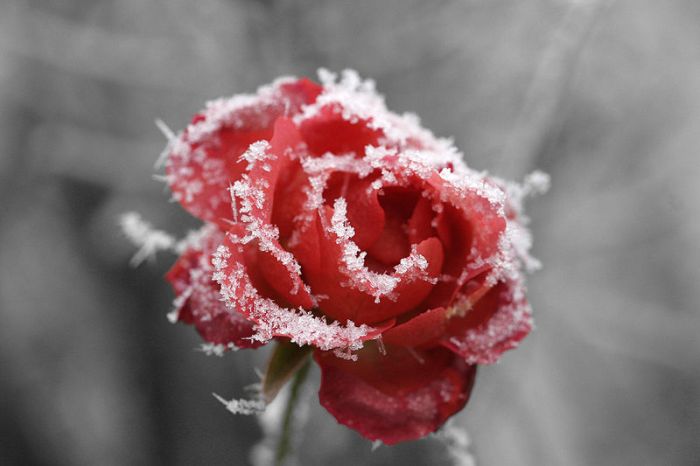
You came when most needed, my winter rose.
From the snow I pluck you, and fondly press
Your leaves ‘twixt the leaves of my leaflessness.
Today poem is in the public domain, belongs to the masses, and appears here accordingly.
Alfred Austin (1835 – 1913) was an English poet and journalist who succeeded Alfred, Lord Tennyson, as poet laureate. His acerbic criticism and jingoistic verse in the 1870s led Robert Browning to dismiss him as a “Banjo-Byron,” and his appointment to the laureateship in 1896 was much mocked. He also published a series of stiff verse dramas, some novels, and a good deal of lyrical but very minor nature poetry. A patriotic poet of the most confident phase of the British Empire, his work lacked the resonance of Rudyard Kipling’s. (Annotated biography courtesy of Encyclopedia Britannica, with edits.)
Editor’s Note: I love the use of metaphor in today’s poem, and the playful way language is paired with it. Moments like “And the year, growing confident day by day, / Weans lusty June from the breast of May.” I am taken, as well, by the allusion to the beloved, depicted as a winter rose arriving at what appears to be an inopportune time. But the poet eventually realizes that love–as it inevitably does–arrived exactly when it was most needed, occupying a space that had been waiting for just such an arrival: “You came when most needed, my winter rose. / From the snow I pluck you, and fondly press / Your leaves ‘twixt the leaves of my leaflessness.”
My long two-pointed ladder’s sticking through a tree
Toward heaven still,
And there’s a barrel that I didn’t fill
Beside it, and there may be two or three
Apples I didn’t pick upon some bough.
But I am done with apple-picking now.
Essence of winter sleep is on the night,
The scent of apples: I am drowsing off.
I cannot rub the strangeness from my sight
I got from looking through a pane of glass
I skimmed this morning from the drinking trough
And held against the world of hoary grass.
It melted, and I let it fall and break.
But I was well
Upon my way to sleep before it fell,
And I could tell
What form my dreaming was about to take.
Magnified apples appear and disappear,
Stem end and blossom end,
And every fleck of russet showing clear.
My instep arch not only keeps the ache,
It keeps the pressure of a ladder-round.
I feel the ladder sway as the boughs bend.
And I keep hearing from the cellar bin
The rumbling sound
Of load on load of apples coming in.
For I have had too much
Of apple-picking: I am overtired
Of the great harvest I myself desired.
There were ten thousand thousand fruit to touch,
Cherish in hand, lift down, and not let fall.
For all
That struck the earth,
No matter if not bruised or spiked with stubble,
Went surely to the cider-apple heap
As of no worth.
One can see what will trouble
This sleep of mine, whatever sleep it is.
Were he not gone,
The woodchuck could say whether it’s like his
Long sleep, as I describe its coming on,
Or just some human sleep.
AUTUMN: A DIRGE
By Percy Bysshe Shelley
The warm sun is falling, the bleak wind is wailing,
The bare boughs are sighing, the pale flowers are dying,
And the Year
On the earth is her death-bed, in a shroud of leaves dead,
Is lying.
Come, Months, come away,
From November to May,
In your saddest array;
Follow the bier
Of the dead cold Year,
And like dim shadows watch by her sepulchre.
The chill rain is falling, the nipped worm is crawling,
The rivers are swelling, the thunder is knelling
For the Year;
The blithe swallows are flown, and the lizards each gone
To his dwelling.
Come, Months, come away;
Put on white, black and gray;
Let your light sisters play–
Ye, follow the bier
Of the dead cold Year,
And make her grave green with tear on tear.
AUTUMN LEAVES
By Juliana Horatia Ewing
The Spring’s bright tints no more are seen,
And Summer’s ample robe of green
Is russet-gold and brown;
When flowers fall to every breeze
And, shed reluctant from the trees,
The leaves drop down.
A sadness steals about the heart,
–And is it thus from youth we part,
And life’s redundant prime?
Must friends like flowers fade away,
And life like Nature know decay,
And bow to time?
And yet such sadness meets rebuke,
From every copse in every nook
Where Autumn’s colours glow;
How bright the sky! How full the sheaves!
What mellow glories gild the leaves
Before they go.
Then let us sing the jocund praise,
In this bright air, of these bright days,
When years our friendships crown;
The love that’s loveliest when ’tis old–
When tender tints have turned to gold
And leaves drop down.
Today’s poems are in the public domain, belongs to the masses, and appears here accordingly.
Editor’s Note: Today we celebrate another change in seasons. As the leaves turn red, yellow, orange and gold, as they fall from the trees and blanket the ground, as Mother Earth sheds her summer splendor and Persephone prepares to go underground, may we bid farewell through poetry. And may we meet again in spring when life blooms anew.





![By Someone35 (Own work) [CC BY-SA 3.0 (http://creativecommons.org/licenses/by-sa/3.0)], via Wikimedia Commons](https://asitoughttobemagazine.com/wp-content/uploads/2015/11/new_hampshire_in_autumn.jpg?w=700&h=525)

