“Creatures of Our Better Nature” By John Dorsey


Creatures of Our Better Nature

as i stop to watch the gossip of a bluebird
through a dirty glass window
i think it is november
& i’m sipping champagne
on a half built deck
in the woods
that may never get finished

just me & some lonely bluebird
fluttering our wings
like crazed teenagers
mauling each other
in front of some steamy glass sunset
on some makeout mountain
that even time
can’t look away from  

for a few seconds i am that bird
& that bird is me

& we are both beautiful here

when all at once
the sun wraps its fingers
around our throats
& begins to sing.

.

About the Author: John Dorsey lived for several years in Toledo, Ohio. He is the author of several collections of poetry, including Teaching the Dead to Sing: The Outlaw’s Prayer (Rose of Sharon Press, 2006), Sodomy is a City in New Jersey (American Mettle Books, 2010), Tombstone Factory, (Epic Rites Press, 2013), Appalachian Frankenstein (GTK Press, 2015) Being the Fire (Tangerine Press, 2016) and Shoot the Messenger (Red Flag Press, 2017). He is the current Poet Laureate of Belle, MO. His work has been nominated for the Pushcart Prize. He may be reached at archerevans@yahoo.com


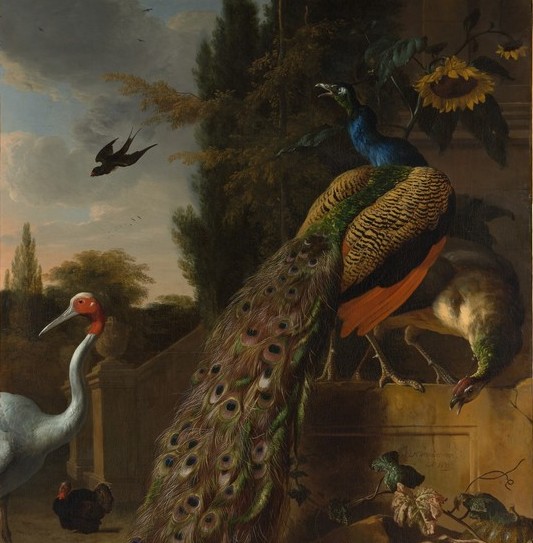
Image Credit: “Peacocks” by Melchior d’ Hondecoeter

“Robbie the Owl” By Ryan Quinn Flanagan


Robbie the Owl

My wife and I watch this show about this owl
who is not fit for the wild
and has imprinted on humans.

His name is Robbie the Owl.
He sits on their arms and eats handouts
because he doesn’t know how
to hunt for himself.

And they take him out to the forest each day.
Beat the ridges of leaves with sticks
to make the rabbits and squirrels run out
into the open.

Hoping Robbie will forget that he is a human
and remember he is a Great Horned Owl.

That his genetics will kick in.

Training him each night in the barn
to fly through impediments.
To learn to locate, manoeuver
and kill.

And Robbie does not disappoint.
When he kills his first rabbit and they
try to approach his kill, he throws
out his wings in dominance.

They step away
and could not be
prouder.

I tell my wife that I am proud of Robbie too.
That he is resurrecting the good name
of Robbie after that douchebag from Dirty Dancing
ruined it for everyone.

He’s bringing sexy back,
I say.

I think you really like Robbie,
she says.

I tell her I do
and show her my teeth
because it has been
awhile.

.

About the Author: Ryan Quinn Flanagan is a Canadian-born author residing in Elliot Lake, Ontario, Canada with his wife and many mounds of snow.  His work can be found both in print and online in such places as: Evergreen Review, The New York Quarterly, Cultural Weekly, In Between Hangovers, Red Fez, and The Oklahoma Review.


Image Credit: from A Book of Cheerful Cats and Other Animated Animals By JG Francis

SATURDAY POETRY SERIES PRESENTS: IRIS JAMAHL DUNKLE

DAPHNE’S BROKEN SONNET
By Iris Jamahl Dunkle


Apples are imagining themselves
onto hillsides – pink petals stick out their
tongues from the dark mouths of branches 
and the forest canopy ripens overnight
until it pulses like a green heart. Spring
frankensteins us all—softens our cyborg
brains (Admit it:  you were thinking about what
mysteries your phone will sing out!
) While your
body turns like a tree toward the light. Reader,
somedays it’s just too much: powder blue sky,
light wind stirring the leaves as if they are
waving, no, beckoning me to root 
and join in. How could I not give in? Trying
to find the song that’s buried in the soil.


Today’s poem first appeared in SWWIM Every Day and is reprinted here today with permission from the poet.

Iris Jamahl Dunkle was the 2017-2018 Poet Laureate of Sonoma County, CA. Interrupted Geographies, published by Trio House Press, is her third collection of poetry. It was featured as the Rumpus Poetry Book Club selection for July 2017. Her debut poetry collection, Gold Passage, was selected by Ross Gay to win the 2012 Trio Award. Her second collection, There’s a Ghost in this Machine of Air was published in 2015. Her work has been published in numerous publications including San Francisco Chronicle, Fence, Calyx, Catamaran, Poet’s Market 2013, Women’s Studies and Chicago Quarterly Review. Dunkle teaches at Napa Valley College and is the Poetry Director of the Napa Valley Writers’ Conference. 

Guest Editor’s Note: The octave from the beginning of this beautifully imperfect sonnet presents pastoral images that set a mood disrupted by the use of frankensteins as a verb, an abruptly delightful and unexpected choice by the poet, reminding us of what humans have done to the natural world to which we are aching to return and how it has affected us. And yet, “It’s just too much” for the speaker who in answer to a final question becomes a tree, as the mythical Daphne did to escape Apollo just before he caught up to her. Escaping into the natural world is an appealing idea when faced with how things have turned out or how things are headed for disaster.

This melding of sonnet forms—traditional, modern, old, and new—offers two voltas, significant turns in meaning, and the first happens at the beginning of the sestet with a simile that compares the body to a tree as it turns toward light. This is where the sonnet leaves its mark on the reader, who is then addressed directly with an anguish of images that lure the speaker to dig deep “to find the song that’s buried in the soil.” The second turn is the speaker’s response to the leaves and their beckoning. Once the speaker has taken root, this “broken sonnet” ends in a line of perfect iambic pentameter, repairing itself.

Want to read more by and about Iris Jamahl Dunkle?
Iris Jamahl Dunkle’s Official Website


Guest Editor Anne Graue is the author of Fig Tree in Winter (Dancing Girl Press), and has published poems in literary journals and anthologies, including The Book of Donuts (Terrapin Books), Blood and Roses: A Devotional for Aphrodite and Venus (Bibliotheca Alexandrina), Gluttony (Pure Slush Books), The Plath Poetry Project, One Sentence Poems, Random Sample Review, Into the Void Magazine, Allegro Poetry Magazine, and Rivet Journal.

A NOTE FROM THE MANAGING EDITOR:

After nearly ten years as Contributing Editor of this series, it is an honor and a unique opportunity to share this space with a number of guest editors, including the editor featured here today. I am thrilled to usher in an era of new voices in poetry as the Managing Editor of this series.

Viva la poesia!
Sivan, Managing Editor
Saturday Poetry Series, AIOTB


SATURDAY POETRY SERIES PRESENTS: LYNN POWELL


By Lynn Powell:


THE MOON RISING

Sly old guru, Rorschach moon,
you’re calling me again with your round riddle,
your paradox of Ohm and moan.
All day the sun was up on its soapbox, a Pollyanna
casting out the darkness in everybody else.
Now we’re back at the window where we started—
me with my midnight weakness, and you
with your sleight-of-silver ministry
to anyone unguarded and alone.

Slow moon, you’ve lingered near the cloister and the dance hall,
laid your soft law down on wide and narrow beds.
You’ve faced yourself in ponds, thrown yourself
on the mercy of a moody sea. You’ve been the slick
Houdini of horizons, sliding out of each tight spot
the night has tried to trap you in.
What’s left for me to misconstrue?

I’m tired of my mind and its whitewash,
tired of your low-light revelations.
And how will I find the dark forest if you keep
murmuring silky nothings to the trees?

Cold moon, unmake me
in your image. Pare me down
to the bleak beatitude, the black sum
of all you know for sure.


AT THE EQUINOX

             Has the rain a father, or who has begotten the drops of dew?
                                                                         —Job 38:28

From the car window, after the fog lifts,
the autumn fields flash with sudden flowers—

              like filigrees of mirror, like alloys of lace and light.

A weird miracle? Some brilliant, manic manna?
Until, of course, it’s only spiders—ten thousand

              that have worked the dark with rigs of silk

to snag a fly and then, surprising themselves,
have step-fathered the dew.

              And so, for an odd hour, hunger

glistens in galaxies, sieved
from passing thoughts of lake and air.


Today’s poems are from the collection Season of the Second Thought (University of Wisconsin Press, 2017), copyright Lynn Powell, and appear here today with permission from the poet.

Lynn Powell has published three books of poetry: Season of the Second Thought (winner of the 2017 Felix Pollak Prize), The Zones of Paradise, and Old & New Testaments. Her nonfiction book Framing Innocence won the Studs & Ida Terkel Award from The New Press in 2010. A native of East Tennessee, Powell teaches in the Creative Writing Program of Oberlin College.

Guest Editor’s Note: Lynn Powell’s work is reminiscent of “The Parable of the Sunfish” in Ezra Pound’s ABC of Reading. Powell is a poet who gains deep understanding and insight into her subjects, examining them over and over from unique angles until she has observed their essence. In “The Moon Rising,” for instance, the moon is a “Sly, old guru” a “Rorschach,” a “slick/Houdini of the horizons.” It possesses a “slight of hand ministry” or can lay its “soft law down on wide and narrow beds.”

Throughout her collection Seasons of the Second Thought, line by line Powell examines, prods, and dissects until she has mastered her subject, rewarding her readers with an intimacy and understanding that is both profound and revealing. In “At the Equinox,” she observes the world with such intensity that she is able to see the creators of the miracle she is viewing not as their mundane selves — “only spiders—ten thousand” — but as creatures that “have step-fathered the dew.” Powell’s work is an enlightenment that allows the reader to see the world for what it can be when observed fully.

Want to read more by and about Lynn Powell?
Buy Seasons of the Second Thought from University of Wisconsin Press
POETRY Magazine
Bellingham Review
Shenandoah
American Literary Review


Guest Editor Alan Toltzis is the author of The Last Commandment. Recent work has appeared in print and online publications including Hummingbird, Right Hand Pointing, IthacaLit, r.k.v.r.y. Quarterly, and Cold Noon. Find him online at alantoltzis.com.

A NOTE FROM THE MANAGING EDITOR:

After nearly ten years as Contributing Editor of this series, it is an honor and a unique opportunity to share this space with a number of guest editors, including the editor featured here today. I am thrilled to usher in an era of new voices in poetry as the Managing Editor of this series.

Viva la poesia!
Sivan, Managing Editor
Saturday Poetry Series, AIOTB


SATURDAY POETRY SERIES PRESENTS: HEATHER WHITED

A MAY EVENING, EVERYTHING IS OK
By Heather Whited


A pink and white bloom
Split open
splayed to look
like a pair
Of lungs breathing
on the sidewalk.
All cars
are diamonds
in glittering rows.
It is the sun
tonight;
It is the
lift
of my dog’s ears.


Today’s poem first appeared in the winter 2018 issue of The Broke Bohemian and appears here today with permission from the poet.

Heather Whited graduated from Western Kentucky University in 2006 with a BA in creative writing. She lived in Japan and Ireland before returning to her hometown of Nashville, Tennessee to get her graduate degree. She now lives in Portland, Oregon. She has been published in the literary magazines Straylight, Lingerpost, The Timberline Review, A Door is Ajar, Allegro, Foliate Oak, Adelaide Literary Magazine, Windmill; The Hofstra Journal of Art and Literature, Chantwood Literary Magazine, Cricket, Storm CellarForge, Gravel, and soon The Hungry Chimera and The Broke Bohemian. In 2015, she was an honorable mention in Gemini Magazine’s annual short story contest. She is a contributor to The Drunken Odyssey podcast and Secondhand Stories Podcast.

Guest Editor’s Note: Matthew Zapruder in Why Poetry writes, “A poem, literally, makes a space to move through. To read a poem is to move through that constructed space of ideas and thinking.” Whited has constructed such a space with short lines packed with sensory impressions of air, heat, color, and light. The speaker takes the lead from a position of sharpened perceptions of what someone else might pass by without noticing. Sound plays a significant role too, and the words progress in a softness: “Split… splayed… sidewalk… sun.” These and the ending s’s of the plural nouns make walking through this poem’s space a spontaneous and instinctive experience.

Reminiscent of H.D., imagery breathes through every line. Whited guides readers through familiar visuals, such as “A pink and white bloom” and “diamonds/ in glittering rows,” that in combination instruct a post-spring feeling following the discovery of a flower forgotten on a sidewalk. Simile and metaphor arrive smoothly in succession like a warm breeze at sunset. The speaker appears only at the end, and the final effect is far reaching.

Want to read more by and about Heather Whited?
Storm Cellar
The Timberline Review


Guest Editor Anne Graue is the author of Fig Tree in Winter (Dancing Girl Press, 2017), and has published poems in literary journals and anthologies, including The Book of Donuts (Terrapin Books), the Plath Poetry Project, One Sentence Poems, and Rivet Journal.

A NOTE FROM THE MANAGING EDITOR:

After nearly ten years as Contributing Editor of this series, the time has come for change. I am thrilled to expand my role to Managing Editor and provide the opportunity for fresh voices to contribute to this ongoing dialogue. It is an honor and a unique opportunity to share this series with a number of guest editors, including the editor featured here today.

Viva la poesia!
Sivan, Managing Editor
Saturday Poetry Series, AIOTB


SATURDAY POETRY SERIES PRESENTS: PATRICE BOYER CLAEYS

By Patrice Boyer Claeys:

Favorite Color
after Ruth Stone’s “White on White”

A yellow flag iris,
a lick of flame,
glass of Sauternes.

Blinking lights at intersections,
the bills of mallards, old knotty pine
paneling, sticky to the touch.

Lemon meringue pie,
spent elm leaves, the fish brought home
from the fair in its water-filled bag.

Caution tape to mark the murder scene,
the road to Oz,
a wobbling flan, chicken fat.

The burning hydrogen of Arcturus,
broken brooms,
xenophobic dread.

A cheesy joke, wheezy phlegm,
the running rheumy eyes and shaded
teeth of jaundiced men.

Mustard, pus and broken yolks.
The nicotine-stained fingers
of Johnny Cash and Vonnegut.

Slimy bile, old bruises, the pulsing
membrane on the poisonous gland.
The dusty, bitter sex of crocus throat.


Today’s poem first appeared in Volume 5, Issue 1 of Bird’s Thumb and appears here today with permission from the poet.


Patrice Boyer Claeys enjoys the freedom of the empty nest. She thanks her writing group, Plumb Line Poets, for keeping her chiseling away. Her work has appeared in Mom Egg Review, Found Poetry Review, Blue Heron, Avocet, ARDOR, the Aurorean, Beech Street Review and Bird’s Thumb, and is forthcoming in Nassau Review. She was featured in Light, a Journal of Photography and Poetry. She was nominated for Best of the Net.

Guest Editor’s Note: On the surface, the literal and the metaphorical are given equal weight in this poem by Patrice Boyer Claeys. Each item anticipates the next, and the effect is a list of things that are yellow that might or might not be favorable in spite of the title “Favorite Color.” The poet references Ruth Stone’s “White on White” to give some direction for reading, which feels like an excavation, a mining for truth in the scrutiny of the color, its denotation and connotations.

Each line of the poem seems innocuous until the fifth stanza which ends with “xenophobic dread.” This metaphor stops the speaker’s examination of the more benign imagery that includes mallard bills, knotty pine, and “Lemon meringue pie,” and illuminates the “blinking lights of intersections” that has become a portent of imminent threats.

The final three stanzas do not disappoint in providing perilous symbols of imminent dangers, both familiar and unfamiliar. The depictions of disease—the “wheezy phlegm,” the “rheumy eyes,” the “old bruises”—succeed in changing the tone and in producing a mood of ominous expectation. The speaker observes instances of yellow and presents those that are the most necessary to the theme which seems to be a warning and a lesson in keen observation and meaning in context.

Want to read more by and about Patrice Boyer Claeys?
RHINO Poetry
Blue Heron Review
Beech Street Review


Anne Graue

Guest Editor Anne Graue is the author of Fig Tree in Winter (Dancing Girl Press, 2017), and has published poems in literary journals and anthologies, including The Book of Donuts (Terrapin Books), the Plath Poetry Project, One Sentence Poems, and Rivet Journal.


A NOTE FROM THE MANAGING EDITOR:

After nearly ten years as Contributing Editor of this series, the time has come for change. I am thrilled to expand my role to Managing Editor and provide the opportunity for fresh voices to contribute to this ongoing dialogue. Today and in the coming weeks, please help me welcome a series of guest editors to the newest incarnation of the Saturday Poetry Series.

Viva la poesia!
Sivan, Managing Editor
Saturday Poetry Series, AIOTB


SATURDAY POETRY SERIES PRESENTS: MEGAN WILDHOOD

After nearly ten years as Contributing Editor of this series, the time has come for change. I am thrilled to expand my role to Managing Editor and provide the opportunity for fresh voices to contribute to this ongoing dialogue. Today and in the coming weeks, please help me welcome a series of guest editors to the newest incarnation of the Saturday Poetry Series.

Viva la poesia!
Sivan, Managing Editor
Saturday Poetry Series, AIOTB


How to Use Water as Fuel
By Megan Wildhood

Dad says I should have been born a fish,
what with the eerily natural way I moved through water.

He and I got our scuba diving certificates
together when I was 12 – I didn’t notice

the Caribbean makes your hair sticky as it’s drying
under a sun I didn’t care would rudely

find every last fleck of flesh exposed.
My sister rejected diving, getting in the water

at all, because of what the wild does
to your hair and skin.

We glossed arguments in the family,
like makeup on my sister’s face. I had to be

persuaded to start wearing the stuff because it seemed
like both Mom and sister needed a cleanup crew

every night just for their faces. They used water
to wash; I used it to fly.


Today’s poem is from Long Division (Finishing Line Press, 2017), copyright © 2017 by Megan Wildhood, and appears here today with permission from the poet.

Megan Wildhood: Do you feel isolated, uncertain about where in the world your story might be welcome? Megan Wildhood, a Seattle-based writer and poet, can deeply relate – she feels like an outsider most places she goes. She’s written about the various ways she’s felt like a misfit in The Atlantic, Contrary Magazine, America Magazine and in her chapbook Long Division, released September 2017 from Finishing Line Press, among other publications. She’s working on a novel and more poetry projects; head on over to meganwildhood.com to learn more.

Guest Editor’s Note: Family dynamics are notoriously complicated, and Megan Wildhood tackles them with unflinching honesty in “How to Use Water as Fuel” from her chapbook, Long Division. In this poem, we’re immersed in water, exploring a closeness to certain family members and a distance from others. The speaker feels connected to her father — “Dad says I should have been born a fish, / what with the eerily natural way I moved through water” — but disconnected from her mother and sister. The final lines of the poem highlight this aching contrast: “They used water / to wash; I used it to fly.” Finding commonalities and bridging the gaps between us is critical. “How to Use Water as Fuel” ultimately explores the longing for connection, even when our differences get in the way.

Want to read more by and about Megan Wildhood?
Megan Wildwood’s Official Website
Buy Long Division from Finishing Line Press
“Not Jumping” in America Magazine

Guest Editor Alana Saltz is a poet, writer, and freelance editor living in Tacoma, Washington. She received her MFA in Writing from Antioch University and her work has been published in The Washington Post, The LA Times, The Huffington Post, Angels Flight, voxpoetica, and The East Jasmine Review. You can find out more about her at alanasaltz.com or @alanasaltz on Instagram and Twitter.

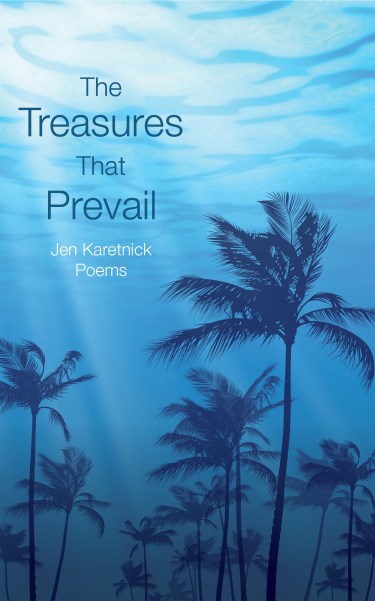
SATURDAY POETRY SERIES PRESENTS: THE TREASURES THAT PREVAIL


From THE TREASURES THAT PREVAIL
By Jen Karetnick:


ADVISE AND CONSENT

It seems to fall to men to create
disasters and women to mop up after.

The first thing people have to forget

is their sense of the senatorial

desk, the deep leather armchair.

There’s always
somebody screaming

off stage or window-shopping for the ridiculous,
arm in arm. Sooner or later these moments come.

We have seen this happen and cannot refrain.


UNDER MANGO CAMOUFLAGE

They bloomed too soon, pistils coral,
hung green like left-behind seawater
well into the sodden fall, ripened
into a bilirubinous yellow.

Falling, they broke themselves
open into Cyrillic letters on the unearthed
limestone as if they were envelopes
stuffed too full of possibilities.

Now marked only with a flag of memory,
this is where we buried the bits
of flesh snipped as easily as a stem
from an eight-day-old son, disguising

the dreams that in the wrong hands
could have been so readily rewritten.


THE OPPOSITE OF MECCA

Oh, the darkness of it all—black cat, black dog,
black monkey on the black-eyed woman’s shoulder,

rocking on a boat dock over water so absent of light
even our dreams have lost their shadows. In this house

made of books and planks, under the art of thatch
and weave, we are birds nesting together who have closed

our throats to song. This is where, without definition, we pin
the horizon as the center on a map of our always new world.


Today’s poems are from The Treasures That Prevail (Whitepoint Press, 2016), copyright © 2016 by Jen Karetnick, and appear here today with permission from the poet.


The Treasures That Prevail is about climate change and its effects on Miami; the poems in this collection confront the ills of modern society in general, mourn both public and personal losses, and predict the difficulties of a post-modern life in a flooded, Atlantis-like lost city. The narrators are two unnamed women, married with a teenage daughter and a teenage son, who live in a part of Miami that will be underwater unless action is taken. The Treasures That Prevail is a parable about what could happen to any of our low-lying coastal cities if we don’t start to make changes now.

Jen Karetnick is the author of seven poetry collections, including American Sentencing (Winter Goose Publishing, May 2016)–which was a long-list finalist for the Julie Suk Award from Jacar Press–and The Treasures That Prevail (Whitepoint Press, September 2016). She received an MFA in poetry from University of California, Irvine and an MFA in fiction from University of Miami. Her poetry, prose, playwriting and interviews have appeared recently or are forthcoming in TheAtlantic.com, The Evansville Review, Foreword Reviews, Guernica, The McNeese Review, Negative Capability, One, Painted Bride Quarterly, Prairie Schooner, Spillway, Valparaiso Poetry Review, Waxwing and Verse Daily. She is co-director for the reading series, SWWIM (Supporting Women Writers in Miami). Jen works as the Creative Writing Director for Miami Arts Charter School and as a freelance writer, dining critic and cookbook author. She lives in Miami Shores on the remaining acre of a historic mango plantation with her husband, two teenagers, three dogs, three cats and fourteen mango trees.

Editor’s Note: How fearfully prescient this collection has proven to be as California is burning, as large swathes of the world are recovering from hurricanes and earthquakes, as Harvey Weinstein has been outed as a sexual predator, as man after man shows us what it really mean to be “senatorial” in his “deep leather armchair,” as the world is melting and our future threatens to emerge underwater.

With The Treasures That Prevail Jen Karetnick has penned a collection that is beautiful and terrifying, that is lyric and devastating, that rings of Cassandra in the ways its truths fall upon deaf, ignorant, or apathetic ears. The language within these pages is thick and malleable, painting with words a picture that you might cut back with a machete in a valiant effort to combat the vengeful wrath of a raped and battered Mother Earth. For even the best among us — in the age of capitalism and consumerism and selfish, self-destructive climate change — are but “birds nesting together who have closed // our throats to song.”

Want more from Jen Karetnick?
Buy The Treasures That Prevail from Amazon
Jen Karetnick’s Writing Portfolio
Buy American Sentencing from Amazon

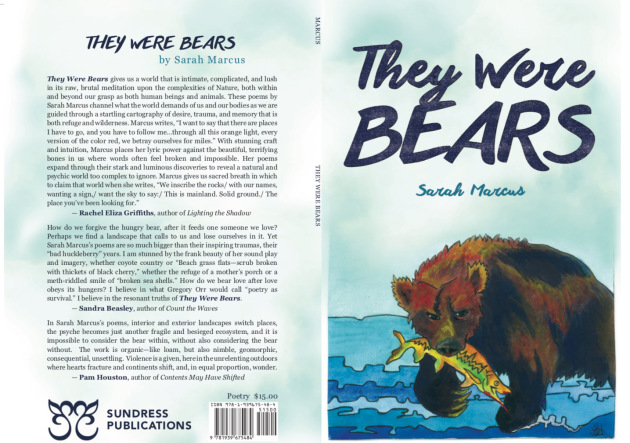
SATURDAY POETRY SERIES PRESENTS: THEY WERE BEARS


From THEY WERE BEARS
By Sarah Marcus:


PEOPLE HAVE ALWAYS KNOWN BEARS

You said you were afraid of bears—

we weren’t safe until there was ice
along the shoreline. I said we all need trauma,

and my heart breaks every Autumn, so we broke
ourselves against those rocks until the cave mouth opened:

a womb for blind crayfish,
a passageway harboring beetles.

I want you to reach into the depths of your backwoods
and remember our Winters. We need the bears, ourselves

ursine sleeping in dens—the caverns drip-stoned and stunning.
I was and still am in search of a great bear

because people have always known bears—
we will always be shelter for each other.

When we first met, I told you that a long time ago,
grizzlies came down from the Rockies—

they were poisoned on the range, trapped,
hounded, shot out—we found cranial fragments.

We still listen to those legends of bounties paid
to mountain men, harboring that ancient fear of

the bears that made meat of us, boar and sow,
mauled and gnawed away. Our bones resting in caves,

because you were born to hunt, and I was
born of hunting: a witness of great fires.


LOVE POEM

First snow of the season—
your eyes say
there’s not much oxygen
                  in the mountain air
.

I have never wanted someone
                  as much as I want you.

I devalued the damage:
you won’t belong—stay gone longer—

                  let it melt.


I’ve been thinking about you
                  because we cannot be separate.
The gravitational pull defies
                  the thousands of miles between us.

Even in the deepest woods,
                  we kneel beside the rill,
the river’s riffle,
the spruce’s mantle of rime,

                  until the point of rock
                                  swells tightly around us.

There’s a chant building in the forest: I won’t be your secret.

Everyone knows how to leave,
but I don’t know how to be
in this city
without you.


MYTHOLOGY FOR DESERT LOVERS II

These things are real:
you are a desert moon rising a hundred mornings away.
My horses paw a cracked Earth.
The air threatening Winter.
The solitude of sand.
We can smell the danger

of you and her
in that house.
In every house.

When you are so strongly connected
to another person, what did you call it? Rare?
It’s like the sunset.
No one can hold that kind of beauty
for more than a moment.

Our small ribs are thick
enough to take on a prairie panic.
The fear of too much open space.
So many acres;
we can never catch up.

You say I’m always on your side
and this will always mean more
to a woman.

I try to explain that love is a violence,
even when it’s beautiful.
When you enter someone,
you must also leave them.

And there’s always that moment of relief
when I realize that I’ve always known—
I am a hundred deserts.

I will wait for you or some version of you
to become sky.


Today’s poems are from They Were Bears (Sundress Publications, 2017), copyright © 2017 by Sarah Marcus, and appear here today with permission from the poet.


They Were Bears gives us a world that is intimate, complicated, and lush in its raw, brutal meditation upon the complexities of Nature, both within and beyond our grasp as both human beings and animals. These poems by Sarah Marcus channel what the world demands of us, and our bodies as we are guided through a startling cartography of desire, trauma, and memory that is both refuge and wilderness. Marcus writes, ‘I want to say that there are places I have to go, and you have to follow me…through all this orange light, every version of the color red, we betray ourselves for miles.’ With stunning craft and intuition, Marcus places her lyric power against the beautiful, terrifying bones in us where words often feel broken and impossible. Her poems expand through their stark and luminous discoveries to reveal a natural and psychic world too complex to ignore. Marcus gives us sacred breath in which to claim that world when she writes, ‘We inscribe the rocks/with our names, wanting a sign,/want the sky to say:/This is mainland. Solid ground./The place you’ve been looking for.’” -Rachel Eliza Griffiths, author of Lighting the Shadow


Sarah Marcus is the author of They Were Bears (2017, Sundress Publications), Nothing Good Ever Happens After Midnight (2016, GTK Press), and the chapbooks BACKCOUNTRY (2013) and Every Bird, To You (2013). Her other work can be found at NPR’s Prosody, The Huffington Post, McSweeney’s, Cimarron Review, Spork, The Establishment, Cosmopolitan.com, and Marie Claire.com SA, among others. She is an editor at Gazing Grain Press and the Series Editor for As It Ought To Be’s High School Poetry Series: Gender, Identity, & Race. She holds an MFA in poetry from George Mason University and currently teaches and writes in Cleveland, OH.


Editor’s Note: In the Jewish calendar, the days between Rosh Hashanah and Yom Kippur are a surreal and reflective time of reckoning. During these days we are introspective, coming to terms with our true selves before turning outward and asking forgiveness from those who we have wronged. It is in these Days of Awe that I come back to a collection I have been meaning to review for quite some time. It is in this magical time of brutal honesty that I dive deeply into a carefully-wrought world that is far beyond my comfort zone, with eyes and heart wide open to its savage and beautiful truths.

They Were Bears is one of the most thoughtful–if not the most thought-provoking–poetry collections to be released in recent memory. Rife with hunger and blood and animal instinct, this work pulsates at the intersection of nature and violence, family, sex, and love. They Were Bears drags us mercilessly back to our animal nature, honoring vulnerability and calling out sexual violence. This book pulls no punches, spares us little. What is reflected in its waters is our truest selves, as beautiful and terrifying as they are wont to be.

The tender, ravenous, brutal honesty of the book’s thematic spectrum is brought to life by the true craftsmanship of the poet. This is an absolutely stunning collection on every level–its words and images thrash and breathe, fly and tether. The poems are lush in their soundscape, and on the page they mark their territory distinctly. And the moments. The breathtaking moments. How true their revelation, declarations, and admissions: “because you were born to hunt, and I was / born of hunting: a witness of great fires;” “I try to explain that love is a violence, / even when it’s beautiful. / When you enter someone, / you must also leave them.”

Mazal tov to Sarah Marcus on this incredible work, and may we all start anew together in these Days of Awe.


Want more from Sarah Marcus?
Sarah Marcus’ Official Website
SATURDAY POETRY SERIES PRESENTS: WASN’T THAT A MIGHTY STORM

WASN’T THAT A MIGHTY STORM
Performed by Rolf Cahn and Eric Von Schmidt

Editor’s Note: I have been reading Isaac’s Storm by Erik Larson, which tells of the Great Storm of 1900. That Category 4 hurricane decimated the town of Galveston, Texas, killing between six and twelve thousand people, making it the deadliest natural disaster in U.S. history. I was reading this book as Hurricane Harvey ravaged Houston and beyond. I am reading it now, still, as Hurricane Irma sweeps over the Caribbean and heads for the U.S. mainland. I am thinking of those who are fleeing and those who are staying put to weather the storm. Of those who have lost everything. Of those who have lost their lives. I am thinking of global warming and our current regime of climate change deniers. I am thinking of the fires that are burning in the west. I am thinking of friends and their families, and of those who are my kin because of our shared humanity. I am thinking of how history repeats itself and of the lessons we fail to learn from the before time.

Today’s poem is a folk song that remembers the Great Storm of 1900, and dedicated to those who are now suffering, who have suffered, who will suffer still.