SATURDAY POETRY SERIES PRESENTS: ALEXIS KIENLEN

alexiskienlen

By Alexis Kienlen:


HOW TO PICK AN APPLE

find a ripe specimen,

gaze at its perfection,

cup it in your hand,

turn the bottom star to the sky.

show the end of the apple to heaven,

let it fall.


“How to Pick an Apple” appears here today with permission from the poet.


Alexis Kienlen is the author of two collections of poetry, 13 and She Dreams in Red. She’s also the author of a biography of a Sikh civil rights activist called Truth, love, non-violence; The story of Gurcharan Singh Bhatia. Alexis lives in Edmonton, Alberta, Canada where she works as an agricultural reporter for a newspaper called Alberta Farmer. From 2001-2006, she was the Literary Editor for Ricepaper magazine, a Vancouver based Asian Canadian arts and culture magazine. She currently writes a weekly literary column for The Grande Prairie Daily Herald Tribune. Her poetry, fiction and journalism pieces have appeared in numerous publications across Canada and online. She’s currently working on a novel and a new collection of poetry.

Editor’s Note: Today’s poem is vivid and whimsical and whisks the reader away on a brief yet epic journey. Placing us, at first, in the everyday pleasure of picking an apple, the poem turns on the word “turn” in the fourth line. From there we are shifted upward, toward the stars and the sky and the heavens, and are transported from the orchard into the realm of the spiritual, the mystical, the otherworldly. The last line echoes what has been biblically ingrained in the western apple, the fall.

Today’s poem is dedicated to my friend Luis, a faithful reader of this series and a man who knows and loves a good apple.

Want more from Alexis Kienlen?
Alexis Kienlen’s Official Website
Buy 13 and She Dreams in Red from Frontenac House
Buy Alexis Kienlen’s books from Amazon
Blue Skies Poetry
Alberta Farmer Express

SATURDAY POETRY SERIES PRESENTS: KAREN PAUL HOLMES

Karen Paul Holmes with roses

By Karen Paul Holmes:


DRAWN INTO CIRCLES

Last evening, I placed fresh towels on both dog beds
heard scratching and rearranging in the night.
This morning, each dog lay curled
into a circle of towel
like a bird’s nest.

How life loves
a circle:
the sun
cups of tea
pizza, roses, embraces
wedding rings, cathedral domes, bells
with notes radiating like ripples from skipped stones
the egg, the womb, the opening, downy heads
suckling mouths, breasts, eyes filled
with delight for bubbles
and bouncing balls.

Why do we box ourselves into corners
put our babies into rectangular cribs
build square houses and boxy buildings
drive cars to perpendicular crossroads
stare at newspapers, monitors, dollars
go to our rest in hard-edged coffins
slowly lowered into matching graves?

It’s a comfort
to imagine our rounded bones
becoming round bits of the globe
our spirits rising to orbit among spiral galaxies
joining those who completed the circle before us.


TEACHING MOZART IN STONE MOUNTAIN PRISON

I didn’t know what crimes they committed,
didn’t want to: those 12 guys glaring at me,
wondering what I had in store.

No female had taught there before
so I wore a calf-length, shapeless dress;
no make up; tortoise shell glasses instead of contacts.

Twice a week, iron gates banged behind me,
paperwork shuffled, an armed guard took me down
a warren of halls. He stationed himself by my door.

I needn’t have worried–soon knew, just as told,
if one prisoner caused trouble, he’d be jumped
by the others grateful for the chance of a college degree.

This was music appreciation. None knew the classics,
but one had played William Tell Overture in band.
All began to embrace opera, symphony, sonata—

I think the music transported them, comforted
even as they struggled to study in noisy rows of bunks.
One evaluation stays with me 30 years later,

Thanks be to God for blessing us with Mrs. Holmes.
But I felt blessed early in the semester:
We arrived at Mozart Piano Concerto Number 21.

Their books covered just the first movement, yet
I left the record playing into the second, saying,
You’ve got to hear a bit of the andante.

Muted violins conjured the ethereal melody while
repeated notes in the violas mesmerized.
After the pianist took up the solo for several bars,

I reached out to lift the needle… Twelve students
—no longer thief, mugger, murderer—
sang out in unison, No, leave it on!


“Drawn into Circles” was first published in Poetry East and appears in the collection Untying the Knot (Aldrich Press, 2014), and “Teaching Mozart in Stone Mountain Prison” was first published in POEM. These poems appear here today with permission from the poet.


Karen Paul Holmes is the author of the poetry collection, Untying the Knot (Aldrich Press, 2014), which tells a story of loss and healing “with grace, humor, self-awareness and without a dollop of self-pity,” according to Poet Thomas Lux. Karen received an Elizabeth George Foundation emerging writer grant in 2012. Publishing credits include Poetry East, Atlanta Review, Caesura, POEM, The Sow’s Ear Poetry Review, Every Day Poems, The Southern Poetry Anthology Vol 5: Georgia, and the forthcoming anthology of Georgia poets from Negative Capability Press.

Editor’s Note: Today’s poems shed new light on existence, demanding that we reconsider our human condition. “Drawn into Circles” deftly considers both the concept of the ‘circle of life’ and the roundness of nature versus the right angles of the man-made world. “How life loves / a circle: / the sun… the egg, the womb, the opening.” So “[w]hy do we box ourselves into corners / put our babies into rectangular cribs / build square houses and boxy buildings”? “It’s a comfort / to imagine our rounded bones… joining those who completed the circle before us.” While “Teaching Mozart in Stone Mountain Prison” engrosses us in a moving narrative that forces us to forfeit our assumptions and accept the beauty of being human. Both poems demand a second read, and a third, and neither poem leaves us quite the same as we were before we encountered them.

Want more from Karen Paul Holmes?
Buy Untying the Knot from Amazon
simply communicated, inc.
Interview with Karen Holmes on NetWest Writers
Reality Show: Save This Marriage on SoundCloud
Kentucky Review

SATURDAY POETRY SERIES PRESENTS: JACINTA V. WHITE

JVW by John H. White

STANDING IN COURAGE
By Jacinta V. White

Dangerous, wanted
Endangered, hunted
             Majestic
Beauty protected
Enraged
             You, young
                          Black man
Stand in courage
             In love
             In honor
                          Resurrected
             In glory
Forget put upon shame
Young man stand
             In beauty
             In strength
             In dignity
Stripped and threatened
Generations down
                                       Hands down
Young black man
             Brother, father, husband, son
Stand in your weariness
Stand in your strength
             In your courage
             In your truth
             In your faith
Stand knee high in the depths of your passion
                          Take your crown, young black man
             Wear your crown
Young black man


“Standing in Courage” was originally published by New Verse News and appears here today with permission from the poet.


Jacinta V. White is a NC Arts Council Teaching Artist and the founder of The Word Project. Her chapbook, broken ritual, was published by Finishing Line Press in 2012. Most recently, she has had poems published in Typoetic.us, Prime Number Magazine, and What Matters, an anthology published by Jacar Press.

Editor’s Note: “A wild patience has taken me this far…and when freedom is the question it is always time to begin.” So says Adrienne Rich, and your faithful editor agrees. It is time to begin. Speaking up. Speaking out. For freedom, and against injustice.

There is a rich history of poetry in social justice. Of outcries from the poetic heart of humanity for human rights. Since time immemorial poets have used their words to demand equality, whether based on race or class or gender, and from time to time they have even been heard.

Today’s poem takes part in this critical tradition, demanding the world pay attention and that the world order be reversed. It cries out for the oppressed to rise up, not in violent retribution, but in glory. It requires us to admit and to remember, while allowing us our outrage, our grief, and a new hope alike.

Want more from Jacinta V. White?
Jacinta White’s Official Website
Typoetic.us
Prime Numbers Magazine
The Word Project
Jacinta White on Facebook

SATURDAY POETRY SERIES PRESENTS: JEN CAMPBELL

Jen Campbell


Vaginaland
By Jen Campbell


Screen Shot 2014-09-19 at 10.59.02 PM
Screen Shot 2014-09-19 at 10.59.16 PM
Screen Shot 2014-09-19 at 11.00.21 PM


“Vaginaland” was previously published in English Pen “Poems for Pussy Riot” and appears here today with permission from the poet.


Jen Campbell is an award-winning poet and short story writer. She’s also the author of the bestselling Weird Things Customers Say in Bookshops Series. Her poetry collection, The Hungry Ghost Festival, is published by The Rialto and her latest book, The Bookshop Book, will be published in October by Little, Brown.


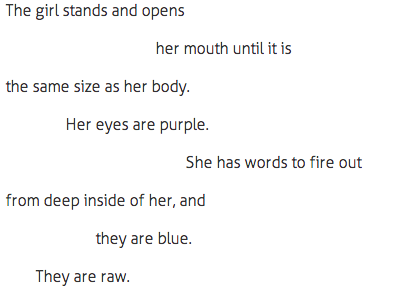
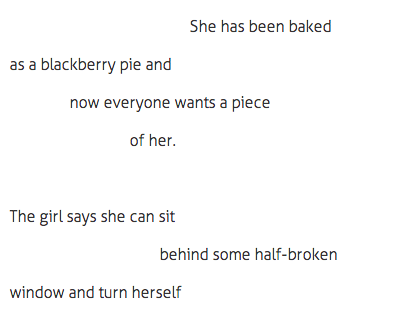
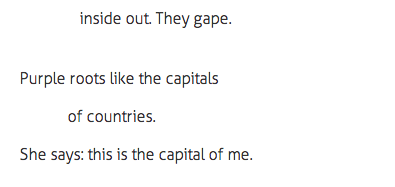
Editor’s Note: What is a girl? What is her mouth, her body, her words? Who is that girl when the world tries to hold her down and shut her up? When “She has been baked / as a blackberry pie and / now everyone wants a piece / of her”?

“Vaginaland” was originally published by English PEN as a political act. In an act of solidarity. In support of three members of the Russian punk band Pussy Riot, who were then in prison for their outspoken feminism, LGBT advocacy, and opposition to the policies of Russian President Vladimir Putin.

Who — and what — does a girl become when she stands up, breaks free, and fires out the words that are deep inside of her? When those words are political? When her voice is political? When “She says: this is the capital of me”?


Want to read more by Jen Campbell?
Jen Campbell Official Website
The Hungry Ghost Festival
The Prose-Poem Project
Jane Martin Poetry Prize 2013
The Plough Prize

SATURDAY POETRY SERIES PRESENTS: ALLIE MARINI BATTS

Allie Back_Photo

By Allie Marini Batts:


breeding, trumpet flowers out of the dead ash


a cautious unfurling, petals, these fragile fingers,

extended through layers of silt and salt,

the battle-blown lands where once a city stood.

these vines, they labor furiously,


expanding and dividing beneath the dust of nations

nightshades in mitosis, their toxins lovely, bright and narrow

set against a land destroyed.


likewise myself and my skin,

a playground for dead things

and invasive plants to rise from,

a phoenix, in botany.


the mythology of the night skies


you were once a man

square but bright

incense in the dark


your story, told by Greeks

naïve, the way we

lit sticks of incense and prayed


wantonly to false hopes and square gods

and stars, naïve offerings

and devotions meant to keep us safe


protections and punishments

remembered in the

rotations of the planet


naïve, how we thought

you loved us

and would keep us safe


“breeding, trumpet flowers out of the dead ash” previously appeared in quarter after and “the mythology of the night skies” previously appeared in Symmetry Pebbles. These poems appear here today with permission from the poet.


Allie Marini Batts holds degrees from both Antioch University of Los Angeles and New College of Florida, meaning she can explain deconstructionism, but cannot perform simple math. Her work has been a finalist for Best of the Net and nominated for the Pushcart Prize. She is managing editor for the NonBinary Review and Zoetic Press, and has previously served on the masthead for Lunch Ticket, Spry Literary Journal, The Weekenders Magazine, Mojave River Review & Press, and The Bookshelf Bombshells. Allie is the author of the poetry chapbooks, You Might Curse Before You Bless (ELJ Publications, 2013) Unmade & Other Poems, (Beautysleep Press, 2013) and This Is How We End (forthcoming 2014, Bitterzoet.)

Editor’s Note: “breeding, trumpet flowers out of the dead ash” is so stunning that the poem speaks for itself. I am loathe to feature a favorite line in the face of so many beautifully wrought images emerging one after another. The subject matter is as rich as the soil the poem’s flowers rise from. The world revealed is post apocalyptic, brimming with nature’s resilience and with death nurturing new life, “a phoenix, in botany.”

“the mythology of the night skies” turns our eyes upward to the heavens and our minds to the gods. While pressing against the idea of worship in antiquity, the poem’s echo seems to question deity worship altogether. “naïve, how we thought / you loved us / and would keep us safe.”

Want more from Allie Marini Batts?
Find her on the web
Follow her on Twitter @kiddeternity

SATURDAY POETRY SERIES PRESENTS: PAPER COTTON LEATHER

Paper_Cotton_Leather_cover


From PAPER COTTON LEATHER
By Jenny Sadre-Orafai:


RETRACT OR RECANT

This accordion love expands or exhales,
retracts or recants. It is only as much
as we allow. It squeezes out warnings
of cardboard walls closing in.

Its wheezing fills a willful tide
with dread. I turn to this gone
love. I was taught curve into the slide
when spinning on frozen road.


CUTTING YOUR HAIR

When I was done, a ring of hair
or a halo curved your hunched
shoulders. Your broad back didn’t
flinch when the scissors’ legs twitched,
when I wanted to cut more than you mimed.


PREMATURE OBITUARY

I pretend you’re dead.
I don’t let them say your name.
I was taught it’s impolite
to talk behind a dead man’s back.

I wear black four months and ten days.

I smell your clothes before
hand washing, bagging,
and then giving them away.
I don’t give your mother a thing.

I pray for what’s left of you.

I stack the wedding ring, all the rings
you gave me on my right hand,
my proclamation that you are no longer
with us or like us, the living, listening.

I tell myself what I tell myself
to keep from going back.


Today’s poems are from Paper, Cotton, Leather, published by Press 53, copyright © 2014 by Jenny Sadre-Orafai, and appear here today with permission from the poet.


PAPER COTTON LEATHER: “The specter of divorce haunts Sadre-Orafai’s debut, although Paper, Cotton, Leather is much more than a lyrical response to loss. Paper, Cotton, Leather is an instruction manual for the amateur anthropologist, the domestic ghost-hunter, and the doomsday prepper. In ‘Retract or Recant,’ Sadre-Orafai writes: ‘I was taught curve into the slide/when spinning on frozen road.’ This is exactly what Paper, Cotton, Leather can teach us: how to navigate the heart’s switchbacks, how to survive a spin-out on its loneliest back roads.” —Shelley Puhak, author of Guinevere in Baltimore (From the Press 53 website.)


Jenny Sadre-Orafai is the author of four poetry chapbooks—Weed Over Flower (Finishing Line Press), What Her Hair Says About Her (H_NGM_N Books), Dressing the Throat Plate (Finishing Line Press), and Avoid Disaster (Dancing Girl Press). Her poetry has appeared in H_NGM_N, Gargoyle, Rhino, Redivider, PANK, Mount Hope, Sixth Finch, iO: A Journal of New American Poetry, and other journals. Her creative nonfiction has been published in The Los Angeles Review, South Loop Review, and The Rumpus. She co-founded and co-edits the literary journal Josephine Quarterly. She lives in Atlanta and is an Associate Professor of English at Kennesaw State University.


Editor’s Note: Reading Paper, Cotton, Leather is like reading a diary written in achingly executed lyric. The compact, controlled poems function almost ironically; tiny scaffolding straining beneath the pressure of massive weight and breadth. The poems are honest. Fiercely, unapologetically honest. Surely it took no small amount of courage for the poet to sift through the wreckage of her failed marriage and catalogue its failures for us in verse.

In the poem “Fortune,” Sadre-Orafai writes, “Our pictures live in a box marked / THE PAST in my parents’ garage.” Each poem reads like its own discreet picture from that box. Vignettes of trying, failing, moving on, and learning to let go. Together those pictures—these poems—tell a story. This book is carefully held by a narrative arc that gives the illusion that we might piece together the end of this marriage like a puzzle. And yet, You know nothing, Jon Snow. This is an expertly crafted book of poems, not a memoir. We are left only with what the poet chooses to reveal. With what poetry is perhaps best at conveying. A selection of life’s moments as if through lens and shutter. Emotion. Regret and loss and heartache. Experience that finds a kindred spirit in the reader. This is a book that one reads to remember that life’s trials are universal, that we are not alone.

We are not alone. So many of us know, or have known, love like an accordion, squeezing out warnings, wheezing and transforming into gone love. “Cutting Your Hair” recalls Delilah, in all her power, destroying her lover. So, too, does that recollection call forth Regina Spektor (who is quoted in one of the book’s epigrams) in her song “Sampson”: “I cut his hair myself one night, a pair of dull scissors in the yellow light.” In this manner one can read Paper, Cotton, Leather like an archaeologist, dusting away layers to discern history, or, as Shelley Puhak suggests, like an anthropologist, observing humanity, past and present. So how does the poet pick herself up, dust herself off, and move into the future? In the most human way imaginable: striving and imperfect. “I pretend you’re dead. / I don’t let them say your name.” “I smell your clothes before / hand washing, bagging, / and then giving them away.” “I tell myself what I tell myself / to keep from going back.”


Want to see more from Jenny Sadre-Orafai?
Buy Paper, Cotton, Leather from Press 53
Jenny Sadre-Orafai’s Official Website
Jenny Sadre-Orafai on As It Ought To Be

SATURDAY POETRY SERIES PRESENTS: ALLIE MORENO

photo (1)

TOO MUCH OF A GOOD THING
By Allie Moreno

I have been stretched like
skin to dry in the sun
I am a blanket
I’m a tightrope
a staircase
a palace of forgotten
photographs
a sandcastle exposed in the wind
I love and
cover you

I have filled all the glasses
on the table
I have eaten what is
left on every plate
to be free of it

I have swallowed your
skeletons on cue
I should probably apologize
for complaining
but I’m the parade and the rain


“Too Much of a Good Thing” appears here today with permission from the poet.


Allie Moreno spends her daytime hours writing for a large tech company in the San Diego area. She received an MFA in Writing from UC San Diego and sometimes writes poetry from the confines of her cubicle. Allie tends to write about identity, belonging, and her experience as a trans-racial adoptee.

Editor’s Note: Simple, straightforward, and full of evocative imagery, today’s poem takes us inside the world of one who has lived for another. Stretched tight, walked upon, now disappearing grain by grain, “a sandcastle exposed in the wind.” To give love is not enough, when in so doing we give too much of ourselves. In end end we are almost left with a woman’s tendency to apologize for herself, but instead we are left with a counterweight. A provocative image slightly obscured. What is a woman when she is “the parade and the rain”?

Want to read more by Allie Moreno?
Allie Moreno’s Blog
Interview: Allie Moreno’s Adoption Experience

SATURDAY POETRY SERIES PRESENTS: RACHEL MENNIES

alisonsteve02327c

By Rachel Mennies:


AMIDAH FOR TEENAGE GIRLS

We said it Friday nights in unison: blessed
is Abraham, Isaac, patriarchs whose weight
we felt against our chests, Jacob, whose brother

filled his mouth with the sand of hate,
who split sisters with his body
of patience. The God of History, reads

the Siddur, nothing more dangerous
than this sort of God. Any good girl
will tell you so: ask Leah, who watched

as her betrothed tilled fields in agony,
rutted at her nightly, his pious bride, as he dreamed
for seven years of younger Rachel’s face. God,

our brute teacher. God, whom we thank
and thank for these big men. You are mighty forever,
my Lord. You resurrect the dead. My Lord, open

my lips, that my mouth may declare
Your praise.
Imagine the shock, that first boy
or man inside us for mere seconds, the tremor

of realization — some smaller God at our clavicle
thrumming in awareness. The creator of all things. And so
when I lie with him, my body already knows what to do

while he shifts his weight, moves his hips. You cause
the wind to blow and the rain to fall.
The hard ram’s horn,
the arms thrust high, parting a sea of salt. The open mouth

of incantation. O King, helper, savior and shield. And what of our
pleasure, that quiet subtext, that patient search against
our partners’ sweaty brows, near to finished? We already

know the phrase: bestow, bestow.


BUMPER CROP

Wet pink shock of a sliced-open
peach, pit hard between our teeth,
reached in a liquid, honest hurry.
Peach in the fingers of a certain lover’s hand.
Peach juice sliding down the wrist of a man
with assertive hungers. Peach, bringer
of rapture: the climax, but not
the fall. Peach sky rising up and up, free
of consequence. Impossible, but for
our chase of it. Peach in the crisper drawer,
softening. We hear stories of the pastor
and his book, so certain of fire, his biblical
calculus. Peach hot, sugared in an oven.
The mouth of red around the brain-
shaped, dumbstruck stone. Peach the very taste
of sin. Peach that sends the crows circling,
rapture here and gone. Peach God, rapt for carrion,
turning above us in the heavens, waiting for
us, ripening, to satisfy ourselves;
come to him pitted, come to him
finished, made rotten by
your sweet time in his sun.


“Amidah for Teenage Girls” was originally published in Witness, and “Bumper” was originally published in Linebreak. These poems appear in the collection The Glad Hand of God Points Backwards (Texas Tech University Press 2014) and appear here today with permission from the poet.


Rachel Mennies is the author of The Glad Hand of God Points Backwards, winner of the Walt McDonald First-Book Prize in Poetry (Texas Tech University Press, 2014), and the chapbook No Silence in the Fields (Blue Hour Press, 2012). Her poems have appeared in Hayden’s Ferry Review, Poet Lore, The Journal, and elsewhere, and have been reprinted at Poetry Daily. She teaches in the First-Year Writing Program at Carnegie Mellon University.

Editor’s Note: I really love today’s poems. Discretely and in conjunction. For the ways they press against the same themes, and for the ways they diverge. “Amidah for Teenage Girls” had me at “patriarchs whose weight / we felt against our chests,” and held me there, exalting, with “Jacob, whose brother // filled his mouth with the sand of hate, / who split sisters with his body / of patience.” Yes. Yes and yes. I could write pages about the first two stanzas of this poem alone. Instead, I urge you to read and reread it, to savor what stews and what simmers.

When I think of peaches and poems, I think of Li-Young Lee. And while “Bumper Crops” and “From Blossoms” each make their own unique contribution to the poetic landscape, I think Li-Young Lee would meditate along with Rachel Mennies on God and humanity, and that he would relish the poem’s sweet sensuality. As, I believe, would Anya Silver and Rabbi Rachel Barenblat, whose “French Toast” and “Sufganiyot” would, along with Mennies’ peaches, make up a picnic that would give Fifty Shades of Grey a good blush.

Want to read more by Rachel Mennies?
Rachel Mennies – Official Website
Buy The Glad Hand of God Points Backwards from Texas Tech University Press
Buy The Glad Hand of God Points Backwards from Amazon
Poetry Daily
Sixth Finch

SATURDAY POETRY SERIES PRESENTS: LAURA E. DAVIS

LEDavis-2014

By Laura E. Davis:


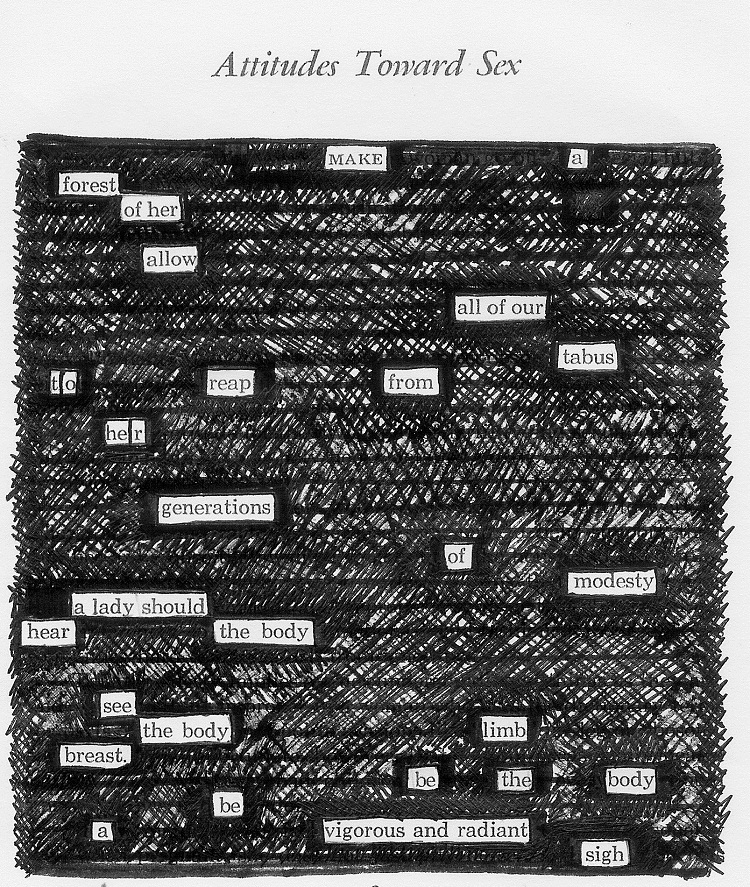
ATTITUDES TOWARD SEX

attitudestowardsex.small


THE BOYS ARE ALWAYS TALKING

about their cocks, naming
names—Rebecca, Elizabeth,
Ashley—we see these girls
all lined up, waiting to admire

the boys’ cocks. And the boys
talk about size of their cocks,
seven inches becomes ten, then
thirteen. They tell us how

they measured their cocks
after their first wet dream: they
woke up sweaty, quick-covered,
got their cocks hard again, pulled

out the ruler. Boys and cocks
everywhere. A boy shows his
cock to a girl on the playground.
Another boy watches girls from

a parked car while he touches
his cock. On the subway, boys
unzip their pants, put cocks
on display. Baby boys discover

their tiny cocks during every
diaper change. I didn’t see
my own clit was until I was
twenty-three. I had to hold

a mirror just to see it rise
like slow-motion stalagmite.
Had to hold back my own skin
just to show it to myself.


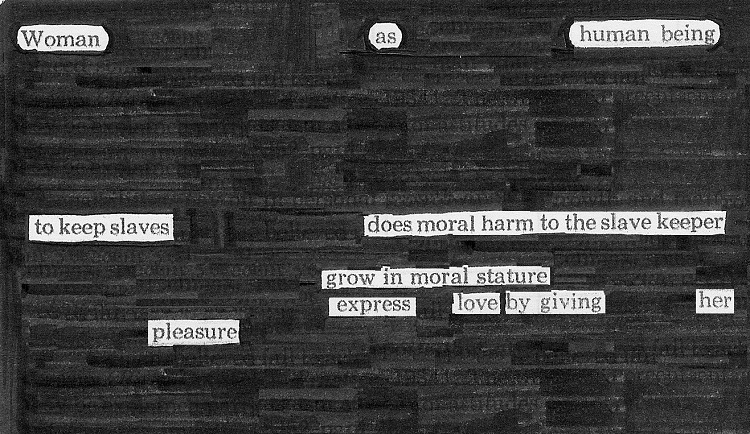
WOMAN AS HUMAN BEING

woman as human being.smaller


“Attitudes Toward Sex” was originally published in iARTistas. “The Boys Are Always Talking” was originally published in Muzzle. “Woman as Human Being” was originally published in Toad Journal. These poems appear here today with permission from the poet.


Laura E. Davis is the author of Braiding the Storm (Finishing Line, 2012), founding editor of Weave Magazine, and founder of Submission Bombers. Her poems are featured or forthcoming in Toad, Stirring, Corium Magazine, So to Speak, Muzzle, and others. Laura teaches for Poetry Inside Out, a K-12 a bilingual poetry program in San Francisco, where she lives with her partner, Sal.

Editor’s Note: This week I had the honor of working with an artist to create an artistic response to the Hobby Lobby Supreme Court decision. I have already written an editorial response to the ruling, but I wanted to speak out against this injustice in many ways, through many voices.

Today’s poems speak for womankind. They speak for our bodies, for our vantage point within a man’s world. When read together today, they are meant to be a shout from the rooftops. That no one exercises control over our bodies but ourselves. That we are human beings whose rights are superior to the rights of corporations. Yes, that we are human beings. Beautiful, complex, powerful human beings who are as capable of a battle cry as we are of “a vigorous and radiant sigh.”

Want to read more by Laura E. Davis?
Dear Outer Space – Laura E. Davis’ Blog
“Quiet Lightning” on Youtube
Buy Braiding the Storm from Finishing Line Press
“Relics” in Sundress
“Vessels” and “Red Storm” in The Doctor T. J. Eckleburg Review

SATURDAY POETRY SERIES PRESENTS: JENNY SADRE-ORAFAI

Sadre-Orafai

KARAJ
By Jenny Sadre-Orafai

When I miss her, I open my popout map.
I spill my face into the streets of Tehran.
I hide in Laleh Park. I read street names
aloud, like I’m reporting to someone.
I pretend I see things no one else can─
who took the Peacock Throne, how the burnt
city fell. I say Karaj like I’m telling you your future.


Today’s poem was originally published in Thrush Poetry Journal and appears here today with permission from the poet.


Jenny Sadre-Orafai is the author of four chapbooks. Her first collection Paper, Cotton, Leather will be published this fall by Press 53. Recent poetry has appeared in Redivider, Thrush Poetry Journal, PANK, Rhino, Sixth Finch, ILK, iO: A Journal of New American Poetry, and Poemeleon. Recent prose has appeared in The Rumpus, The Toast, and Delirious Hem. She is co-founding editor of Josephine Quarterly and an Associate Professor of English at Kennesaw State University.

Editor’s Note: I fell in love with today’s poem because it so intimately and distinctly tells the poet’s story, and yet, this is not her story. I have my own Karaj, and anyone who has ever loved a city that lies on the other side of the world—anyone who has ever loved a city by way of memory and longing—speaks the language of this poem. I am reminded, too, of Danusha Laméris’ beautiful poem, “Arabic,” of the ways in which love—of a language, of a people, of a place—remain with us across the span of distance and time. When Jenny Sadre-Orafai leaves us with her (killer!) end-line, I know what my future holds. I know what city waits for me on distant shores.

Want to read more by Jenny Sadre-Orafai?
Official Website
Two poems with audio in PANK
Creative nonfiction essay with audio in The Rumpus