SATURDAY POETRY SERIES PRESENTS: MARIANNE PEEL

In the Afternoon, She Smelled Like the Earth
By Marianne Peel

Her shoulders were always burned.
We had smeared ourselves with baby oil infused with iodine
painting our skin a burnt orange deeper than the marigolds
planted in a circle to protect
the lettuce from the woodchucks.

She taught me how to thread
a frenetic worm onto a crooked hook.
Digging around in that coffee can tin
wet with dirt and the roots of the soil
there was always humid mud under her nails.

Sometimes trails streaked her cheeks
after she pushed her hair off her face.
In the afternoon she smelled
like the earth after the sun
went way, way down.

She taught me to cast my line
flinging her whole arm back past her shoulder
all in one calculated, measured motion.
She said the splash on the water should be quiet soft
so we don’t scare the fish away.

And then we waited.
Just the creak of the dock bouncing
in time with the water
moving all afternoon
bobbing us up and down.

Sometimes our toes would touch
splayed off the dock
and I would recite this little piggy went to market
– but just in my head because
we had to be silent soft, waiting for the fish.

She taught me to reel in, quickly,
but with no panic, no surprise,
knowing there would be only sunfish suspended from the hook
little orange sunshines in our hands
on the dock every summer afternoon.

And she taught me to unhinge the mouth
to pull the mouth slowly from its worm feast
to toss it gently back into the water and watch it,
still hungry,
swim away.


“In the Afternoon, She Smelled Like the Earth” previously appeared via Silver Birch Press and appears here today with permission from the poet.

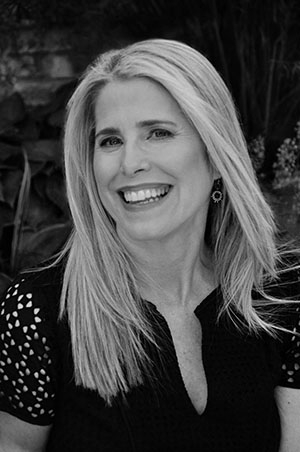
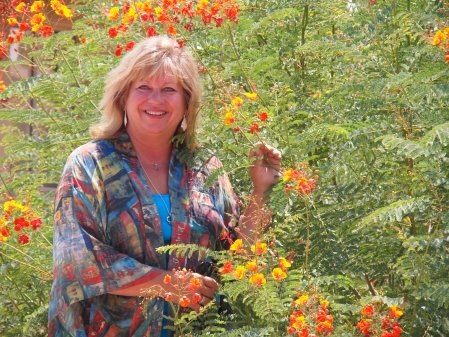
Marianne Peel is a poet who is raising four daughters. She shares her life with her partner Scott. She received Fulbright-Hays Awards to Nepal and Turkey. She taught English at middle and high school for 32 years. She is now retired, doing Field Instructor work at Michigan State University. She recently won 1st prize for poetry in the Spring 2016 Edition of the Gadfly Literary Magazine. In addition, Marianne has been published in Muddy River Review; Silver Birch Press; Persephone’s Daughters; Encodings: A Feminist Literary Journal; Write to Heal; Writing for Our Lives: Our Bodies—Hurts, Hungers, Healing; Mother Voices; Ophelia’s Mom; Jellyfish Whispers; Remembered Arts Journal, and Gravel, among others.

Editor’s Note: Today’s poem is vivid, vibrant, and rich with imagery. You can almost smell the earth, feel it crumble through your fingers, watch the worm wriggle. So alive are the moments of memory that we are swept up into them, unaware that we don’t know who the poem’s “she” is. We are willing to suspend our curiosity, because, “In the afternoon she smelled / like the earth after the sun / went way, way down.” Because the poem leaves us with a feeling, with an echo in the shape of knowledge, because “she taught me to unhinge the mouth / to pull the mouth slowly from its worm feast / to toss it gently back into the water and watch it, / still hungry, / swim away.”

Want to read more by and about Marianne Peel?
Persephone’s Daughters
Muddy River Poetry Review
Jellyfish Whispers

SATURDAY POETRY SERIES PRESENTS: JANET R. KIRCHHEIMER

Wonder Beans
By Janet Kirchheimer

My father went each morning to his garden.
He taught me to smell the soil to see if it was good,
to feel the dirt slide across my hands, to never
wear gloves, to stay in the middle of the row when planting seeds.
We’d look for work to do in the garden,
and sometimes there was nothing more to do
than watch the garden grow, wait for the harvest.
He thought that haricot vert were the dumbest thing he’d ever seen–
he liked his Kentucky Wonder beans, big and bursting with seeds, leaving
them to grow in the summer sun as long as possible.
Last winter he told me we couldn’t save
the parsley from the snow and ice, even though
we put blankets over it.
He got pneumonia in February.
In April, he asked me if I thought he’d get to his garden, and I told him yes.
By the end of May I brought him
cherry tomato plants to keep on the deck.
He no longer had the strength to pick
the first tomatoes that ripened in June.
August: I bring dirt from the garden
to his grave and scatter grass seed.


“Wonder Beans” previously appeared on String Poet and appears here today with permission from the poet.

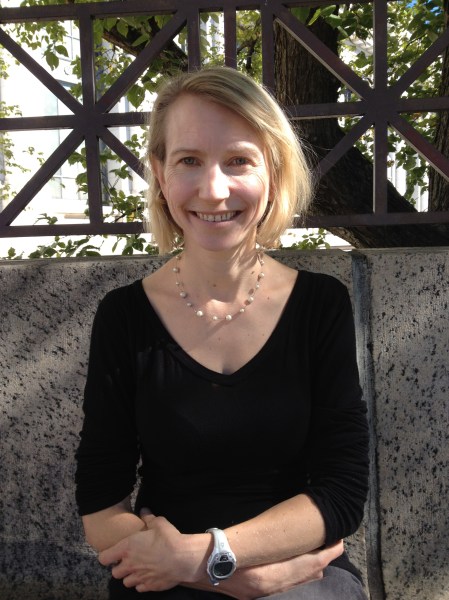
Janet R. Kirchheimer is the author of How to Spot One of Us, (Clal, 2007). A Pushcart Prize nominee, her work has appeared in several journals including Young Ravens Literary Review, Atlanta Review, String Poet, Connecticut Review, Kalliope, Common Ground Review, and several anthologies and online journals. Currently, she is producing a poetry performance documentary, After, exploring poetry written about the Holocaust.

Editor’s Note: Today’s poem is a celebration of life and a poignant reminder that one day we may be remembered by what we love. Through a daughter’s eyes we see a father, watch him plant and grow, watch him love and tend the earth. Through the poet we know what it is for this daughter to love her father, and what it is to lose him. How touching her remembrance, how bittersweet the sting at poem’s end when father is returned to earth.

Want to read more by and about Janet Kirchheimer?
After – A Poetry Film
Young Ravens Literary Review
Collegeville Institute
Podium Literary Journal
Forward’s Schmooze

SATURDAY POETRY SERIES PRESENTS: HOLLY KARAPETKOVA

Song of the Exiles
By Holly Karapetkova

There never was a garden
only a leaving:
miles and miles
of footprints in the dirt.

In the beginning–
the shattered sun, the wind,
and nothing left but our shadows
sifting through the dust behind us.

When we turned
we did not turn to salt.
When we turned
there was nothing behind us to burn,

nothing to return to,
though who could blame us for turning
with only the long days ahead,
tongues tripping in the dirt.

They said we didn’t belong.
They blamed us
for leaving the garden
which never was or would be.

Where could we go,
we who had come from nowhere
and hence could not
return?


“Song of the Exiles” previously appeared via Split This Rock and appears here today with permission from the poet.

Holly Karapetkova’s poetry, prose, and translations from the Bulgarian have appeared recently in Alaska Quarterly Review, Prairie Schooner, North American Review, Drunken Boat, and many other places. Her second book, Towline, won the Vern Rutsala Poetry Contest and is just out from Cloudbank Books.

Editor’s Note: After a moment of silence following the loss of AIOTB’s Managing Editor, the Saturday Poetry Series returns this week with a poem worth breaking silence for. Holly Karapetkova’s “Song of the Exiles” begins in Eden. At once biblical and real, this Eden is a “garden / which never was or would be.” In this world we are storyteller and reader, mythological figure and landless refugee. This is world news, this is human interest story, this is myth in the truest sense of the word. And this, above all, is poetry. Expertly crafted, delicately wrought, brilliant poetry. “When we turned / we did not turn to salt. / When we turned / there was nothing behind us to burn.”

Want to read more by and about Holly Karapetkova?
Holly Karapetkova’s Official Website

SATURDAY POETRY SERIES REMEMBERS OKLA ELLIOT WITH JOHN GUZLOWSKI

By John Guzlowski:


LISTENING TO DEATH

How do we listen to death?

We listen to the sound of death
The way we listen to the sound of the sea
To the message the waves pound against the shore
Their soft rush of foam upon the sand

We hear the things we forgot to tell the dead
The questions we forgot to ask them
The enigmatic dreams they will never explain
The useless arguments we will neither win nor lose
The mutual misunderstandings
That will never be clarified
The lies for which we forgot to ask forgiveness
The problems death defers
The unresolved quarrels with the dead

And what can we do in the face of death?

We can leave this house
And keep going
Never to return

We will not even take
The things that have meant
The most to us, our books
The plants we have nursed
The children we have raised
Punished and praised
The clothes (the dark
Blue ties, the tweed jackets
The rakish wool caps)
That make us look
More the man
More the woman
More the hero
More the young lover
Searching for love

We can leave this house
And keep going
Never to return

And what is death?

It is the hand of God
The meal prepared with love
Flowers from the pierced breast
Of the Blessed Virgin
The shore that smells of widows
Studying the foam

And should we fear death?

No, we shouldn’t fear death
We should fear the loud man’s coming

The pain of cancer
That does this or that
To the body

That pain that is longer than sorrow
Stronger than love

The tumor that grows like
A child who then learns
To hate you

A child who will not take
The love and joy you give her

What is as difficult as death?

Nothing

Nothing

Nothing


POET’S NOTE: I met Okla on Facebook.

One day maybe 7 years ago, I got a friend request from him. I didn’t know a thing about him. He was just another fellow asking to be my friend. I said sure.

I’ve never been sorry I did.

Reading Okla’s posts, his status updates, his responses to other people has always been inspiring. What he wrote was smart and funny and engaging. Sometimes he sounded like Jean Paul Sartre, and sometimes he sounded like a kid in love with literature and life and friendship and thinking and dreaming. Both Oklas were wonderful.

And even more wonderful was the Okla I discovered when I started reading his poems and his essays and his fiction.

Okla was the real thing.

He was all the writers I ever admired, and he was right there with me on Facebook.

When I heard he was dead, I couldn’t believe it. He was too filled with life, too good, too dreaming, to be dead.

But he was dead.

But I will not let go of him.

Here [above] is a poem for Okla.


ONLINE MEMORIALS AND TRIBUTES
As It Ought To Be Mourns the Loss of Our Founder
“Some testimonies to Okla Elliott, 1 May 1977 – 19 March 2017” – Days and Memory
“Requiescat in pace: poet, novelist, translator Okla Elliott, 1977-2017” – Book Haven
“Go Read Okla Elliott’s Stuff, Please. (A Remembrance)” – Great Writers Steal
“Remembering Okla Elliott” – Mildred Barya’s House of Life


REMEMBER OKLA WITH AS IT OUGHT TO BE
As It Ought To Be welcomes art and writing in Okla’s memory. Please email sivan.sf [at] gmail [dot] com with your submissions.


SATURDAY POETRY SERIES REMEMBERS OKLA ELLIOT WITH PAUL CRENSHAW

Photo Credit: Brandon Pierce

By Paul Crenshaw:

FOR OKLA

All that late-night talk of light, and life,
all those words, which became like worlds.
Which we both know were.
If you even need words anymore,
wherever you are, what world
you find yourself in.

Let me just say I hope there’s light.
Let me say I want to send this to you
so you know all the poetry was enough.
That the porch light is still on
in my mind. That the windows are open,
and the songs from inside the house still play.
You are still sitting in the overstuffed chair.
You are still smiling. Let me say
the lighting of a cigarette or
clink of ice in a glass is as much poetry
as anything we ever said.
Let me remind myself I remember all the words,
even if I’ve forgotten how to say them.


ONLINE MEMORIALS AND TRIBUTES
As It Ought To Be Mourns the Loss of Our Founder
“Some testimonies to Okla Elliott, 1 May 1977 – 19 March 2017” – Days and Memory
“Requiescat in pace: poet, novelist, translator Okla Elliott, 1977-2017” – Book Haven
“Go Read Okla Elliott’s Stuff, Please. (A Remembrance)” – Great Writers Steal
“Remembering Okla Elliott” – Mildred Barya’s House of Life


REMEMBER OKLA WITH AS IT OUGHT TO BE
As It Ought To Be welcomes art and writing in Okla’s memory. Please email sivan.sf [at] gmail [dot] com with your submissions.


SATURDAY POETRY SERIES PRESENTS: STACY R. NIGLIAZZO


By Stacy R. Nigliazzo:


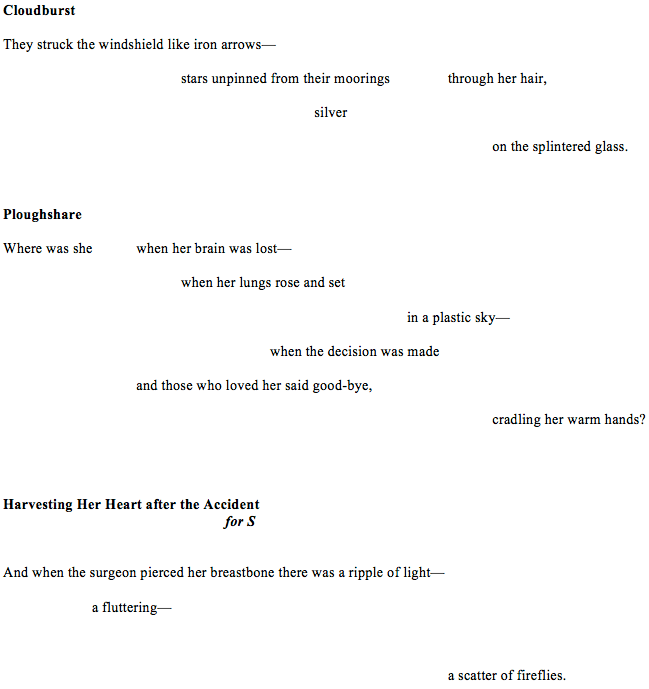
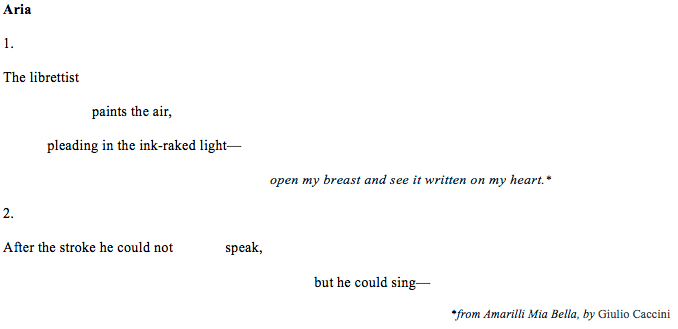
“Harvesting Her Heart after the Accident” first appeared in The Journal of Compressed Creative Arts/Matter Press. All other pieces are previously unpublished. Today’s poems appear here today with permission from the poet.

Stacy R. Nigliazzo‘s debut poetry collection Scissored Moon was published in 2013 by Press 53. It was named Book of the Year by the American Journal of Nursing. It was also short-listed as a finalist for the Julie Suk Poetry Prize (Jacar Press) and the Texas Institute of Letters First Book Award for Poetry/Bob Bush Award. She is co-editor of Red Sky, an anthology addressing the global epidemic of violence against women.

Editor’s Note: Stacy R. Nigliazzo imagines the unimaginable, writes those words which cannot be spoken. An emergency room nurse, it is when her personal losses make their way to the page that her experience becomes poetry, and that poetry becomes an act of healing for poet and reader alike. How visual her imagery, how visceral her grief. And yet her poems leave us not in darkness, but with the necessary reminder that even in our darkest hour there is a “ripple of light.”

Want to read more by and about Stacy R. Nigliazzo?
Stacy Nigliazzo’s Official Website

SATURDAY POETRY SERIES PRESENTS: GILI HAIMOVICH


AND THERE’S SOMETHING ABOUT SOFTNESS
By Gili Haimovich

People are still flirting
with trying to look younger,
to make each other laugh.
Their existence is softened
by the luxuries of having some time, some needs, met.
People are still eager,
not too tired of being keen,
I have found out
among the snow banks,
pushing
the stroller of my soft new baby.


Today’s poem appears here today with permission from the poet.

Gili Haimovich is an international poet and translator who writes in both Hebrew and English. She has six volumes of poetry in Hebrew, including her most recent, Landing Lights (Iton 77 Publishing House), which received a grant from Acum, as did her previous book. She also received a grant nominating her as an outstanding artist by the Ministry of Immigrant Absorption on 2015. Her poetry in English is featured in her chapbook, Living on a Blank Page (Blue Angel Press, 2008) and in numerous journals and anthologies, such as Poetry International, International Poetry Review, Poem Magazine, LRC – Literary Review of Canada, Asymptote, Drain Magazine, Blue Lyra, Circumference, TOK1: Writing the New Toronto and Mediterranean Poetry, as well as main Israeli journals and anthologies such as The Most Beautiful Poems in Hebrew (Yedioth Ahronot Books, 2013). Her poems have been translated into several languages including Chinese, French, Italian, Bengali, and Romanian. Gili is also presenting her work as a photographer, teaches creative writing, and facilitates writing focused arts therapy.

Editor’s Note: Today’s poem excels in the realm of wordplay. Double entendres luxuriate in a language that is as rich as it is simple, as straightforward as it is complex. The poet’s clear love of language — the sheer joy of it — culminates in a narrative of the unexpected, in a revelation that demands we enter the poem again and consider it anew. Delicate and layered, this poem is a labor of love that offers the reader the fruits of its bounty.

Want to read more by and about Gili Haimovich?
Poetry International Rotterdam
Mediterranean Poetry
Drain Magazine
Taylor & Frances Online
PoetryOn – Gili Haimovich’s Official Website

SATURDAY POETRY SERIES PRESENTS: ELISE PASCHEN

elisepaschen_blackwhite_300px-2016


AFTER THE SQUALL
By Elise Paschen

In need of air, she unhinged every
window, revolving ones downstairs,
upstairs skylights, mid-floor French doors,
swept into the house the salt-brine,
the cricket chirp, the osprey whistle,
the sea-current, sound of the Sound,
but had not noticed the basement
bedroom window shielded by blinds,
screen-less. Later that night when they
returned home, lights illuminating
the downstairs hall, insects inhabited
the ground floor rooms. She carried handfuls
of creatures across a River Styx—
the katydids perched on lampshades,
beach tiger beetles shuttling across
floorboards, nursery web spiders splotching
the ceiling—trying to put back
the wild fury she had released.


“After the Squall” originally appeared via the Academy of American Poets’ Poem-a-Day series and appears here today with permission from the poet.


Elise Paschen is the author of Bestiary, Infidelities (winner of the Nicholas Roerich Poetry Prize), and Houses: Coasts. Her poems have been published in numerous anthologies and magazines, including The New Yorker and Poetry Magazine. Co-editor of Poetry Speaks and Poetry in Motion, she teaches in the MFA Writing Program at the School of the Art Institute of Chicago. Her forthcoming book of poetry, The Nightlife, will be published in spring 2017.

Editor’s Note: “After the Squall” is a masterpiece of sound and image. A modern retelling of Pandora’s Box, this rich, vivid poem reaches a perfect crescendo with it’s killer end-line: “trying to put back / the wild fury she had released.” Careful, concise, and expertly wrought, this poem is a stellar example of fine poetic craft.

Want more from Elise Paschen?
VQR Journal
Harvard Magazine
The Scream Online
The Poetry Foundation
Elise Paschen’s Official Website

SATURDAY POETRY SERIES PRESENTS: IN THE ABSENCE


41b9wuq1vzl-_sx331_bo1204203200_


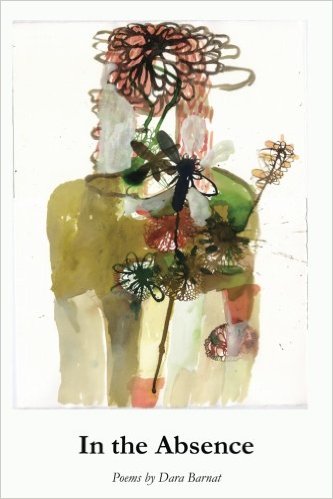
From IN THE ABSENCE
By Dara Barnat:


IMPRINT

I hear you’re gone and I fall with you.

In that place part of me stays,

like a hand in clay,

even as I make rice for dinner, boil water,

measure the grains,

pour wine, set out flowers with all their petals.

The imprint holds the loss of everything.

It holds what we thought was joy.


IN THE ABSENCE

              Dark is just dark–

rooms and all we’ve built are nothing.

Chairs with their backs, tables with their legs, beds with their heads.

Outside, trees with their leaves.

I can’t write that wood into a vessel

that will carry us to a place

where life is a river never not flowing.

I close my hand around a filament of sun as it filters

through the window, try to catch
              its meaning,

              but light is just light.


PRAYER I DO NOT KNOW

There’s no one here, but me
alone. I close

my eyes and try
to remember your face,

its light, your
fingers, their light

touch, your laugh,
the lightness. I say a prayer

that is my own:
May we live

a thousand years together,
in another life.


Today’s poems are from In the Absence (Turning Point Books, 2016), copyright © 2016 by Dara Barnat, and appear here today with permission from the poet.


In the Absence: Dara Barnat’s In the Absence evokes a yearning of the spirit so strong that it becomes presence, its light unstopped.


Dara Barnat is the author of the poetry collection In the Absence (Turning Point, 2016), as well as Headwind Migration, a chapbook (Pudding House, 2009). She also writes critical essays on poetry and translates poetry from Hebrew. Her research explores Walt Whitman’s influence on Jewish American poetry. Dara holds a Ph.D. from The School of Cultural Studies at Tel Aviv University. She currently teaches at Tel Aviv University and Queens College, CUNY.


Editor’s Note: Dara Barnat’s first full-length collection begins by declaring that “Dark is just dark.” But the assertion casts a shadow question: Is dark just dark? For it is light that is at the heart of this work: “I close my hand around a filament of sun as it filters / through the window, try to catch / its meaning, / but light is just light.”

But “light is just light” is no more the truth of these poems — and the poet’s journey that unfolds across them — than “dark is just dark.” This work is neither a book of questions nor of answers. Instead, In the Absence is an honest experience of grief that explores the inevitable, never-ending pilgrimage inherent within loss: “I hear you’re gone and I fall with you. / In that place part of me stays, / like a hand in clay.”

Not since Li-Young Lee’s Rose have I been so slain by a book of mourning. Like Rose, In the Absence mourns the loss of a father while acknowledging that such a loss is anything but simple, that the complications of life remain a reckoning for the living. “The imprint holds the loss of everything. / It holds what we thought was joy.”

Held close within this incredibly moving and painstakingly wrought collection is a poem titled “Walt Whitman.” I had the honor of featuring this poem here on the Saturday Poetry Series in 2013 as I marked my father’s first yahrzeit (Jewish death anniversary). Tomorrow will be five years since my father’s death. What at one year could be commemorated with a single poem, five years later needs an entire book. Such is the nature of grief — it does not diminish; it grows. And in its growing it becomes more painful and more beautiful all at once.

In the Absence transforms the poet’s personal grief into communion. I will re-read this book tomorrow as I remember my father on his five-year yahrzeit, and I will grieve. But, more than that, I will say a prayer that is the poet’s and is my own: “May we live / a thousand years together, / in another life.”


Want more from Dara Barnat?
Buy In the Absence from IndieBound
Buy In the Absence on Amazon
Poems in YEW
Poems in diode
Interview in Poet Lore
Dara Barnat’s Official Website

SATURDAY POETRY SERIES PRESENTS: LEAH UMANSKY

img_20170114_214625_974


By Leah Umansky:


HARD

It is hard to quiet the blackberrying pain.
The little chronicles, the streaks, and the intimate workings.

I will face this by red-winging my truths.
I will push my blues into orchids.


BALLAD

I decided to claim more space
         But I chose the opposite
What are the words I would go to: hunger// longing// love
         When you feel drawn to something you should.
Whatever your terrible is is up to you.
         The question is how you lead.
I lead myself to distress; I lead myself to happiness.
         This is the history of our times.
I claw my way to the surface.
         I get a hold of this world with my teeth
& wolf down what I thirst for.
         How do I take the I out of here?
(why should I take the I out?)

*

I am always hungry
         I am always thinking of my next meal
         Is it the preemie in me?
Is it just the want?

*

We all have our oddities.
         I am always trying to be practical, logical, rational,
but it doesn’t always add up.
         There is so much of my life that I am forever holding under the light.
What falls below the seam?
         What falls outside of this poem?

*

I want to put the happy in.
         I want to put the hard world in.
I want to say this is a ballad, and so it is.
         Let’s enter it differently.
Any mammal feeds a hunger
         Any heart needs oxygen.


CARNAGE

Everyone is saying no to me
Just as they do now
Just as they will
A kind of civil riot
A staged parade
It makes every kind of sense
That carnage that comes with falling hard,
That carnage that hassles and times,
That carnage that language picks up;
I am wanting to be picked up.
It is rarely an accident.
Elements are employed
Pounds are ranged
The number of possible routes are lost
All to force my foot door to door
To match the heart of my drive to
Coffee after coffee after coffee.
Take me as a whole,
Take these birds outside my window
Alive with the world’s chirp
Alive with the everyday thrill of
Worm or bug or crumb. Take them,
Then remember my thrills.
Everyone is saying no to me,
And I am flummoxed each time
I ask for more; or try for more.
I strive and I strive.
That’s the 21st century calling.
It’s doable. I travel great lengths
So I can match the heart
With the focus of each and every obstacle.
Can there be a rallying point?
This is not an accident.

(Is that what I should be learning here?)

Well, isn’t that magnificent.


“Hard” originally appeared in Thrush, “Ballad” originally appeared in The Inquisitive Eater, and “Carnage” originally appeared in Queen Mob’s. These poems appear here today with permission from the poet.


Leah Umansky is the author of the poetry collection, The Barbarous Century, forthcoming from London’s Eyewear Publishing in 2018, the dystopian-themed chapbook Straight Away the Emptied World (Kattywompus Press, 2016), the Mad Men–inspired chapbook Don Dreams and I Dream (Kattywompus Press, 2014), and the full length Domestic Uncertainties (BlazeVOX, 2012). She is a graduate of the MFA Program in Poetry at Sarah Lawrence College and teaches middle and high school English in New York City. More at www.LeahUmansky.com.

Editor’s Note: It seems I can’t read (or write) anything these days without seeing it through the lens of politics. Least of all poetry. Today’s poems — at once political and private — may or may not have been crafted to address the current moment. And yet they can be read as a direct address and used, accordingly, as a salve. What can we do, we ask? “I will face this by red-winging my truths,” says the poet; “I will push my blues into orchids.” Even in an ars poetica the poet’s words can function as a mirror: “The question is how you lead. / I lead myself to distress; I lead myself to happiness. / This is the history of our times.” No matter their intent, today’s poems are in the world now, speaking to us as they will. They might incite action or nurse wounds or take stalk of our humanity. “Take me as a whole,” they say, “Take these birds outside my window / Alive with the world’s chirp / Alive with the everyday thrill of / Worm or bug or crumb.”

Want more from Leah Umansky?
Border Crossing
Poetry Magazine
Jet Fuel
Minola Review
Quotidian Bee