SATURDAY POETRY SERIES PRESENTS: ALEX BEN-ARI

alex-ben-ari


I ASK FORGIVENESS
By Alex Ben-Ari
Translated by Vivan Eden


I ask forgiveness of all the poems
Born misshapen because of my desire to write them
I ask forgiveness of all the people
Whose lives were disrupted by my desire to influence
And of the world
For the superfluous things added to it
And those unnecessarily severed
Because of my lust for symmetry
And happy endings.

I ask forgiveness of my mother
For not knowing how to love her in her misery
Of my children
For the moments when I don’t want them
Of my wife for every time I was too small
To contain her love.

I am lighter than a falling leaf
I am softer than grass
Now a small bird could
Build its nest in me.


Today’s poem originally appeared in Haaretz and appears here today with permission from both the poet and translator.


Alex Ben-Ari is 43 years old. His debut volume of poetry, Concealed Seas (Yamim Samuiim), was awarded honorable mention at the 2008 Metulla Poetry Festival and the 2015 Helicon/Ramy Ditzanny Poetry Prize. His second book, The Gatepost (Korat Hasha’ar), published in 2015, is composed of his original Hebrew haiku. His third book, planned to be published during 2017, is a volume of conceptual poetry.
Alex is one of the six members of the “Waning Moon” blog and publishing house dedicated to Haiku in Hebrew. He is also co-editor (with poets Gilad Meiri and Noa Shkargy) of Nanopoetica, a literary journal of short form literature.

Editor’s Note: Part personal, part pastoral, part ars poetica, today’s poem is emotive, honest, and raw. The poem’s I approaches the reader — and the page — seeking forgiveness. Free from false modesty, free from pride, the poem’s I is humble, admitting failings as poet and father, husband and son. The confessional, narrative nature of the poem is carefully constructed within the framework of the lyric, while the elegant, gentle translation midwives the essence of the poem as it crosses the borders of language. As the reader, we cannot help but be moved — to compassion, to transcendence, to forgiveness and beyond.

Want more from Alex Ben-Ari?
“Ripe Peach,” a poem from Concealed Seas (bi-lingual version)
Haiku poems from The Gatepost (bi-lingual)
Alex Ben-Ari’s official blog (Hebrew)
Ben-Ari lectures (in Hebrew) on music covers
Alex Ben-Ari on Twitter

SATURDAY POETRY SERIES PRESENTS: KELLY CRESSIO-MOELLER


Profile b/w scarf – aroho – Version 3


ON WHY I NO LONGER SIT AT THE WINDOW SEAT ON A TRAIN
By Kelly Cressio-Moeller


Germany was like a step-mother: utterly familiar, utterly despised. ~ Erica Jong


It’s a good day for a lie-down, overcast and
wet-wooled – even the rain wants to be horizontal.
I am day-dreaming of goose down when I
enter the train, scoot into an open seat,
press my cheek against the streaked window.
The station’s soothing voice announces,
Zurückbleiben bitte, someone runs in just before
the doors close, slams me against the side
of the compartment, takes a lungful of my air.
In an accent foreign as my own, he asks
my name, if I “want some fun” back
at his room. I buy time before the next stop,
tell him I’m “Whitney from America”
(anything but my real name in his mouth).
Now he locks his arm through mine and thick
fingers jab my ribs. His leg, an anchor –
his pocked face smirks like he’s already
notched his belt.

I imagine the defence move my brother
taught me where I smash my palm heel into
some asshole’s nose, shifting bone into brain.
(Where is my Siegfried in this country of the
“Nibelungenlied”. What would Kriemhild do?)
My eyes ransack the forest of businessmen,
cutpurses, hausfraus, the heroin chic: rows of
enameled faces, cow-dumb, indifferent as teeth.
Let the Ausländer fight it out!

Thigh-grab, elbow-jab, hand-slap – his broken
English splinters the air. Whitney Houston
in my head singing “I Will Always Love You” on
some godforsaken loop as I mentally run through
my list of German imperatives: Hilfe! Polizei!
Vergewaltigung! (a word that takes longer to say
than the act it defines). I backhand him across
the mouth, escape before the doors slam.
He’s waving (waving!) through the glass,
a blurry fat-lipped sneer retreating – the air
staccatoed with rasps of my breath. It begins
to hail marbles (even the gods are throwing stones),
feathers or lightening bolts would feel just the same.

Only later with candlelight und Butterkuchen,
do I re-surface to Vivaldi’s soaring strings on the radio.
I mention my morning combat-commute.
My host shrugs his shoulders before loading
the Meissen with another helping of Schadenfreude.
He says, Da muβ man durch : ‘one must go through it’ –
as if it were a tunnel, something to be run through.


** The line What shall I wish for myself? is a reworking Mary Oliver’s line What shall I wish for, for myself?

Today’s poem originally appeared online in Tinderbox Poetry Journal, Issue 1 and appears here today with permission from the poet.


Kelly Cressio-Moeller has new work forthcoming in Radar Poetry and has been previously published at Boxcar Poetry Review, burntdistrict, Crab Orchard Review, Gargoyle, Poet Lore, Southern Humanities Review, THRUSH Poetry Journal, Tinderbox Poetry Journal, Valparaiso Poetry Review, and ZYZZYVA among others. Her poems have been nominated for three Pushcart Prizes, Best New Poets, and Best of the Net. She is an Associate Editor at Glass Lyre Press. Visit her website at www.kellycressiomoeller.com.

Editor’s Note: During the dark days this November I delved into poetry as a kind of antidote, and in this way I arrived at today’s poem. Incredibly timely, it speaks to an experience that is all too common and far too marginalized. “I moved on her like a bitch,” America’s President-elect said, “I did try and fuck her,” he said, “Grab them by the pussy,” he said; “You can do anything.” And I thought, “anything but my real name in his mouth.” I thought, “even the gods are throwing stones.” I thought this poem. And those who have no idea what this poem is about, those who do not have to regularly question their safety, those who are unsympathetic to this experience– “one must go through it,” those people say. “[A]s if it were a tunnel, something to be run through.”

Want more from Kelly Cressio-Moeller?
Cha: An Asian Literary Journal
Escape into Life
THRUSH Poetry Journal
Tinderbox Poetry Journal
Valparaiso Poetry Review

SATURDAY POETRY SERIES PRESENTS: MANISHA SHARMA

sharma-image


Millions of girls continue to vanish pre-birth in India simply because they are girls. The following poems imagine these vanished girls.


DEAR DAUGHTER

In my mind I cradled you in my arms
            I didn’t cage you
you latched onto my breasts
             I didn’t siphon life into you
you mumbled bilabial sounds, m…p
yet my ears did not hear you speak
I know you exist
              waiting to be reborn as my son
then, I will cradle you in my arms
              let you latch onto my breasts
              siphon life into you
              hear you mumble Ma, Pa
              welcome you as the heir
              who will carry your father’s name


WOULD YOU STILL BLAME ME?

You were like circles of incense
It wasn’t that we couldn’t feed another mouth
It was the kind of feeding we would do
For every roti soaked in ghee for your brother
You would get only one not soaked
Every glass of milk that went down his throat
You would drink chai with a hint of milk
Every pair of new clothes he would get each month
You would only get one pair a year
He would utter complex phrases in English
You would say soft words in Hindi and the local tongue
He would earn fancy degrees to do something great
You would master fine skills to please others
He would walk with his head held high
You would walk with your head bent
For you are leased property
Returned to its rightful owner in two decades


Today’s poems appear here today with permission from the poet.


Manisha Sharma: Born and raised in India, Manisha Sharma earned an MFA in Creative Writing from Virginia Tech. A graduate of the Bread Loaf Writers’ Conference, she was a Spring 2016 poetry mentee in AWP’s mentorship program, where Shikha Malaviya mentored her. Her recent poetry and writing has appeared in or is forthcoming from TAB, a journal of poetry and poetics, New Asian Writing, The Bombay Review and The Huffington Post. More of her work can be seen at www.genderedarrangements.com.

Editor’s Note: Between 2000 and 2011 seven-to-ten million girls in India were prevented from being born simply because they were girls. With her important poetry and collaborations, Manisha Sharma tells research-based stories of these girls-who-never-were. Her work goes a step beyond giving voice to the voiceless. Sharma literally gives life — through her art — to those who never came into being because of their sex.

In today’s poems Sharma imagines these “vanished girls” from the perspective of the mothers who carried, but never birthed them. “I know you exist,” one such mother reflects, “waiting to be reborn as my son.” Another considers the gender inequity she wanted to spare her would-be-daughter: “It wasn’t that we couldn’t feed another mouth / It was the kind of feeding we would do/ For every roti soaked in ghee for your brother / You would get only one not soaked / Every glass of milk that went down his throat / You would drink chai with a hint of milk.”

It is heartbreaking to think of the lost souls whose sex alone prevented them from having a chance at life. But it is perhaps more challenging to consider the mothers who conceived, who carried the seeds of life inside them, and who made the choice — if they were given a choice at all — to terminate their pregnancies when they discovered they were carrying girls. One mother harbors no illusions as to the kind of life a girl child in India would have had to lead, while the other acknowledges that, despite the choice made, she suffered a great loss: “In my mind I cradled you in my arms.”

Want to see more from Manisha Sharma?
Gendered Arrangements
“Indian Girl Crumbling” in New Asian Writing
“#17”, “#18”, “#22”, “#23”, and “#25” in The Bombay Review

SATURDAY POETRY SERIES PRESENTS: SANDRA L. FAULKNER

sfaulkner


THE INTERVIEW
By Sandra L. Faulkner

for Sylvia Plath (after “The Applicant”)

Can you separate lights from darks,
gabardine from linen?
Too much bother? I cannot care

if your hands are
warm like Georgia hot springs
capable of sparing my feet

the Sisyphean walk over broken
crayons and wine glasses,
the laundry room of dog and dust.

Do you know how to make coffee,
float a river of cream
in my capacious cup?

Forget the sugar and call
my name with an accent auf Deutsch?
But speak only ein bisschen,

patch the noise of domestic bliss
with a steady pour and two clinks of ice.
Will you wait for the repairs,

bury the hamster with the holey
blanket, behind the dying Holly?
Never mind if you dig too shallow,
I want a wife, too.


Today’s poem originally appeared in the Pine Hills Review and appears here today with permission from the poet.


Sandra L. Faulkner is Professor of Communication at BGSU. Her poetry appears in places such as Gravel, Literary Mama, Rat’s Ass Review, and damselfly. She authored three chapbooks, Hello Kitty Goes to College (dancing girl press, 2012), Knit Four, Make One (Kattywompus, 2015), and Postkarten aus Deutschland. Sense published her memoir in poetry, Knit Four, Frog One (2014). She researches, teaches, and writes about relationships in NW Ohio where she lives with her partner, their warrior girl, a hamster, and two rescue mutts.


Editor’s Note: Today’s poem invites us in for coffee and contemplation. Welcomes us to a life–a real life replete with a “walk over broken / crayons and wine glasses, / the laundry room of dog and dust.” Lets us in on the secret desires and realities of the speaker, that a “steady pour and two clinks of ice” and a willingness to “wait for the repairs” trumps–or perhaps is–domestic bliss. Imperfection is expected–welcome, even–in this refreshingly honest portrayal of an interview for the role of wife.


Want to see more from Sandra L. Faulkner?
Carpe Noctum Chapbook Interview
A collection of Sandra L Faulkner’s work via Bowling Green State University
Buy Family Stories, Poetry, and Women’s Work: Knit Four, Frog One from Sense Publishers
Buy Writing the Personal: Getting Your Stories onto the Page from Sense Publishers
Buy Knit Four, Make One from Kattywompus Press
Buy Hello Kitty Goes to College from dancing girl press

SATURDAY POETRY SERIES PRESENTS: STEPHANIE WELLEN LEVINE

unnamed

HOPE, TRUTH, FEAR, AND MY SPIRITUAL QUEST. YES!
By Stephanie Wellen Levine


Yes, I’m on a quest for truth, but only IF.
IF there’s a story behind the stories I see, I want to know.
A line of meaning running behind them.
A beam of concern.
Something.

The man in the grimy wheelchair begging for money by the Harvard Square subway
Pushing himself right up to people with his one leg, as if to ask:
Could YOU hold a job if you had a sawed-off leg
And eyes that watered from the slightest hint of sun?

The woman staring at her cappuccino at Crema Café
Laughing at the creamy heart added by the barista.
She touches the heart with her pinky
So lightly, making sure she doesn’t ruin it
And then takes out a book called On Losing a Child.

Even the little girl in the T-shirt covered with clowns
On the first warm day of the season
Running through the sprinkler in front of her house
Again and again
Happy at first, screaming: “This is so fun!”
Each time the water sprays her face.
And then looking around
Scanning her yard, then the street
As if to ask: “Isn’t there more?”

Well, isn’t there?
That’s my question —
Hokey, grandiose, absurd, and unanswerable.
Or maybe answerable.
But do I want the answer?

Um, wow. I swear I’m not making this up.
I just saved this document and the title shocked me.
I didn’t choose it; I was being careless.
The title is yes.
Just plain yes.
Not the first several words of line one
Like it usually is when I’m careless about saving.
Just yes, no “if.”
No “but only.”

A happier, simpler person might rejoice now.
Isn’t there more?
Yes. Yes!
I got my answer, the one I wanted
In the guise of a word processing glitch.

Before this happened, I was going to say
That “yes” is the only answer I can handle.
The only one I seek.

“Yes” carries many possibilities.
God, like in the Torah.
Or an organizing energy uncapturable by any existing religion.
Or the dazzling power of individual and collective consciousness
Creating the world as we know it
Like some physicists believe
And some New Age types.

Or all of the above
Or something else entirely.
Or, or, or.

On one level, the details don’t matter
As long as “yes” is unmistakable.
As long as there’s something beyond the people in the street
Hurrying to their destinations while checking their phones
Not thinking, not once, that one day they won’t be well enough to hurry
And another day, later on, no one in any street, anywhere,
Will remember them
Or care whether they reached their appointments on time
Or even that someone cried after reading their poem.

Now, let me add a caveat, since I’m self-centered like that.
The details of “yes” don’t matter
As long as they include immortality for my consciousness
And the consciousness of everyone I love.
(And I love everyone who isn’t mean.)
I’m just not a “self pales in the face of the all” kind of soul.

But what if the true answer is “no”
Like many of the most brilliant minds insist?
No, there’s nothing mystical, or magical, or godlike, or transcendently loving.
Nothing beyond what we ourselves can do for each other, and for the earth.
The beauty of one soul reaching out to another
Doing their work, growing their passions
And then their time is up
And it’s time for a new generation.

No, there’s nothing “beyond”
No side door in the sky
No world hiding within the air
No time beyond the clock’s harsh tick
No heart beyond our smashed and battered hearts.

What if all my diligent searching brought me there
To “no”?
Would I want to realize that?
To remove all doubt?
If the actual, capital “T” truth is “no,”
Do I want to know?

NO.
No, no, no.
Some would say: Yes! Yes, of course!
Let me seize every moment with the fullness of infinity.
If that’s all I have, let me know, and savor all I can, now.
Because now is the prize, and that’s OK.
Now is good.

For me, now is only good if it carries at least a hope of then, or after.
Something else, something beyond.
Just plain now is horrifying.
It’s the man in the café rubbing his face until it bleeds
Because he’s nervous.
Because now is everything and nothing.

So why do I search?
What is my quest
If I want no part of a real possibility?

Why am I not one of those who leap and sing
At every piece of evidence,
Who embrace all those pride-filled spiritual leaders
High-fiving them and joining their circles?
Why am I the one who sits in the corner
Stewing, questioning, finding holes in all their answers
Alienating myself from all the peaceful souls?

I want the truth that I want
But I want it to actually be the truth.
I want to cross-examine and put it through a million paces
And then I want to smile. And know.

I’ll take the “yes” I received today as a hint.
Not proof. That would be crazy.
But a hint. A piece of hope.
It’s not the first I’ve received.
All those slices of hope add up to something.
Not proof, not peace, not joy
But a real thing
As real as, say, your memory of the wind against your face
On a warm night, at a barbecue, while your aunt told you tales
Of her first year at college.

Was the wind actually cool like you remember it?
Was your aunt really eating a chicken thigh and laughing about her roommate
While you battled a bee that came dangerously close to your plate?
Maybe. Maybe not.
Regardless, there’s truth in the overall flavor your mind creates
As it conjures the scene.

Hope is like that.
It carries a kind of truth.
Not provable. Not logical.
But sane and even precious.

Hope is the wind that carries my dreams
Even in the harshest weather.


Today’s poem previously appeared in Hevria, and appears here today with permission from the poet.


Stephanie Wellen Levine is the author of Mystics, Mavericks, And Merrymakers: An Intimate Journey Among Hasidic Girls: winner of the Moment Magazine Emerging Writer Book Award. She contributes regularly to the online magazines Hevria and The Wisdom Daily. Stephanie brings lifelong passion to her current book project, which explores her spiritual quest. She teaches at Tufts University and lives in Cambridge, MA, but she misses NYC more and more.

Editor’s Note: Today’s poem is an honest inquisition, probing into the depths of existence while admitting there is only so much we are willing to know, to learn, to hear. I am particularly taken in by the vignette stanzas early in the poem, the vivid little moments that so clearly illustrate how human it is to wonder, in life, whether there is more than this. The poet’s inquiry is urgent, insistent; “Isn’t there more?”

Want more Stephanie Wellen Levine?
Buy Mystics, Mavericks, and Merrymakers: An Intimate Journey among Hasidic Girls from Amazon
Hevria
The Wisdom Daily
Facebook

SATURDAY POETRY SERIES PRESENTS: KELLY HANSEN MAHER

IMG_0480

CO-SLEEPING
By Kelly Hansen Maher


Accepting the rise and fall of boxcars heaving
across the city, our industrial neighborhood.
Old neighborhood, in which immigrants,
studying for citizenship exams,
named the streets in the order of the presidents.
Trains make their slow move uphill, Fillmore,
Pierce, Buchanan, measuring each breath taken,
the newborn on my chest. Her small head
in the dark room, nose and mouth open,
sleeping. We stir; we are steady as train yards, lids
flutter. I hear insects at the open windows, the out
and in of her breath, my husband’s
deep twitching, the dog’s snore. Our bed
smells of human milk, which is lean
of fat and protein so that she will wake frequently
and want me. She has this one country.
I’m on an incline, never fully prone,
kept my word, kept her head
above the blankets, on the pillow of my arm,
kept her face to the air of the room all spring, all
summer. It’s before dawn when the birds…
the light in the room doesn’t change, but the trains
have stopped rolling over the narrow
bridges… birds must know… the pale yellow
beyond the yard… what first birds? chickadees
or sparrow, or thrush? I have small dreams
all night, it’s a covenant to keep her
breathing. Her new system in delicate
crating at the rail of my clavicle,
she’ll track with me, start again after stopping.
I don’t miss depth, tuned from sleep, Lincoln,
Johnson, Ulysses, anything could happen
to her in that other room
without me, and god help me,
there will be no more death in this house.


Today’s poem was was previously published in the Blue Mesa Review and appears in the collection Tremolo (Tinderbox Editions, 2016, copyright Kelly Hansen Maher). It appears here today with permission from the poet.


Kelly Hansen Maher is originally from Minneapolis, Minnesota but now lives in Grinnell, Iowa. She is the author one book of poetry, Tremolo (Tinderbox Editions, 2016), and is currently working on a second collection, as well as a book of memoir/essays. Her poems have been published by the New Orleans Review, Briar Cliff Review, and others journals. She teaches creative writing courses with the Minnesota Prison Writing Workshop.

Editor’s Note: With its evocative imagery and haunting ending, today’s poem is motherhood poetry that resonates, that stays with the reader. There are truths here all mothers of infants know: “I have small dreams / all night, it’s a covenant to keep her / breathing.” Time is measured like breath. Breath is the promise that life will go on, one breath at a time. Sound functions on the level of the line, the scene, the moment, propelling the poem forward, pacing the reader to go on expectantly, breath slow, aware and uncertain.

Want to read more by and about Kelly Hansen Maher?
Kelly Hansen Maher’s Official Website
Buy Tremolo from Tinderbox Editions
New Orleans Review
Midway Journal
Tinderbox Poetry Journal

SATURDAY POETRY SERIES PRESENTS: D.H. LAWRENCE ON SPRING

DH_Lawrence_1906
THE ENKINDLED SPRING
By D.H. Lawrence

This spring as it comes bursts up in bonfires green,
Wild puffing of emerald trees, and flame-filled bushes,
Thorn-blossom lifting in wreaths of smoke between
Where the wood fumes up and the watery, flickering rushes.

I am amazed at this spring, this conflagration
Of green fires lit on the soil of the earth, this blaze
Of growing, and sparks that puff in wild gyration,
Faces of people streaming across my gaze.

And I, what fountain of fire am I among
This leaping combustion of spring? My spirit is tossed
About like a shadow buffeted in the throng
Of flames, a shadow that’s gone astray, and is lost.


(Today’s poem is in the public domain, belongs to the masses, and appears here today accordingly.)


David Herbert Richards Lawrence (1885 – 1930) was an English novelist, poet, playwright, essayist, literary critic and painter who published as D. H. Lawrence. His collected works, among other things, represent an extended reflection upon the dehumanising effects of modernity and industrialisation. Although best known for his novels, Lawrence wrote almost 800 poems, most of them relatively short. His first poems were written in 1904 and two of his poems, “Dreams Old” and “Dreams Nascent,” were among his earliest published works in The English Review. His early works clearly place him in the school of Georgian poets, a group not only named after the reigning monarch but also to the romantic poets of the previous Georgian period whose work they were trying to emulate. (Annotated biography of Yehuda Amichai courtesy of Wikipedia, with edits.)

Editor’s Note: Lyric gyrations, thick alliteration, words and images like blossoms and wildfire. D.H. Lawrence helps us welcome spring while questioning the I amidst such a season.

Want to read more by and about D.H. Lawrence?
The world of DH Lawrence
Biography.com
Academy of American Poets

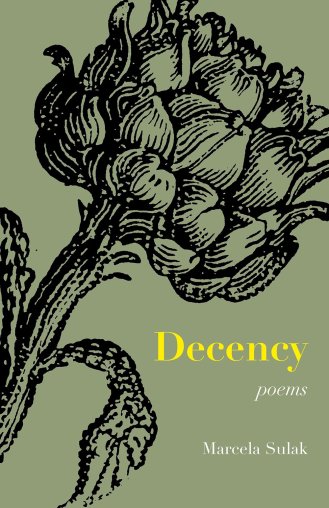
SATURDAY POETRY SERIES PRESENTS: DECENCY


Decency


From DECENCY
By Marcela Sulak:


selections from SOLIDARITY

vi. Virginity

It’s not that you get tired, it’s that it starts to be the only thing,
starts to disappear you.

Your parents phone you at college to ask: how is your virginity
doing? Did your virginity have a good day?

What does it want to be when it grows up? Your virginity sounds
a little sad this morning. What kind of cake does your virginity want

for its birthday? your girlfriends saw the most amazing shoes
that your virginity would look terrific in!

Want to go shopping? your boyfriends—would your virginity like to see
a movie? What about dinner?


ix. witches

My daughter is named for my grandmother, a midwife
who attended the births of 90 babies in rural Texas

before they had cars and after they finished having witches
but before there were doctors. Now you may understand

what I mean when I say another woman
gave my daughter a book called “The witches and the rabbi”

for her birthday. Here is the plot: a village is terrorized by a plague
of witches who fly from their cave when the moon is full,

on brooms through the sky except when it’s raining. I’m not sure
what the witches actually do to the village, since no one

actually goes outside on those nights. Gary, Indiana, could use
an infestation of witches—no stabbings

or gunshot wounds on evenings of full moons.
But one full moon when it is raining the rabbi shows up

with twenty townsmen. The witches
are so delighted they make them a feast of all the good things

they have. The rabbi tricks them into dancing with him and
the vigilante men, out into the rain,

which kills them. I knew her father’s mother was secretly
glad when I started to hemorrhage. She didn’t want me

to have a homebirth with a midwife.
“What kind of rabbis are these?”

Says my rabbi, stopped by for a quick hello. My daughter
wanted to show him that we had a book about rabbis. “They’re

engaging the poor witches
in mixed dancing and leading them astray,” he says.

This is the broom which sweeps the sky of the stars you have
to be too drunk to write about, as Daisy put it.

This is the housework the princesses do disguised
as village maidens. These are the constellations that form

in the shadow of the stars.
Silent are the women in the village

who took their cloth packets of herbs and were silent
when their husbands rushed off to kill the witches in that story.


CHOCOLATE

The day I won the custody case my lawyer gave me a bitter chocolate
in black and silver paper. Once I saw cacao pods
drying in a Venezuelan village square

during Easter week; through the open church doors, peeling saints sniffed
        and were carried
like colicky children through night streets. The local hot chocolate
was thickened with cornmeal and canella bark

somebody tore from the trees. To reach that village we found a fisherman,
        plowed
through rows of porpoises, then hiked five kilometers
inland through banana and cocoa trees,

which like shade. Once only men could drink
chocolate. Women were permitted cacao beans as currency,
to buy meat or slaves or pay tribute. It feels good to imagine a single seed,

hidden in the forbidden mouth, the tongue
curled, gathering the strength to push. The Aztec king discarded
each gold-hammered cup after its initial use; his chocolate was red as fresh
        blood.

He was a god to them. It was frothy,
poured from great heights. When we bathed in the village river, girls
gathered around me, whispering, why is your skin so pale? Why is your
        hair so straight?

Can we braid it? Dime, eres blanca?
The judge, our lawyers, her father, and I decided the fate
of my child. The dark liquid we poured was ink, initialing our little
        negotiations.

Who can know the heart of another, the blood
spiced with memory, poured from one generation to the next
over great distances? The Mayan word for chocolate means bitter. The
        village

used to be a plantation; now it is a co-operative, owned by descendants
of the former slaves. At Easter Vigil the women lined up
behind the most beautiful, in a long sky

-blue dress adorned with gold stars. Between the decades of the rosary she
        called out,
while we shuffled our feet in merengue beat, bearing the saints
through the streets, someone shot off a Roman

candle. The men’s procession paused for rum. I know I’ll be paying for it
        the rest
of my life. The Mayan word means bitter water. The cacao
tree was uprooted from paradise.


HOW TO USE A NAPKIN

Understand the napkin
has been unnecessary
for most of human history.

Understand the world is filled with people
eager to bend
things to their will.
We shall practice on the napkin.
When you have finished eating
place your napkin loosely
next to your plate
.

It should not be crumpled or twisted,
which would reveal untidiness or nervousness;
nor should it be folded,

which might be seen as an implication
that you think your hosts
might reuse it without washing
.
.
It is a delicate affair.
Don’t argue with me
said my husband

who had called for my advice
about the apartment he was renting
when he didn’t want to live with me.

It is largely
symbolic today
except for barbecues.
Lightly dab the lips.

I suspect the word
argue is the space
in the mouth for things
to come apart in.

The napkin must not be left
on the chair, it might seem
as if you have an inappropriately

dirty napkin to hide
or even that you are trying
to run off with the table linens.

It takes great trust
to use a napkin.
It takes an act
of faith to leave
the table.


Today’s poems are from Decency (Black Lawrence Press, 2015), copyright © 2015 by Marcela Sulak, and appear here today with permission from the poet.


Decency: Poetry. Jewish Studies. Women’s Studies. Decency celebrates the spunky wenches, the unfortunate queens, the complicated translators, the wistful wives who have been hustled off the spotlit stages of history. Through the lens of Victorian manuals of etiquette, through the unfolding of religion from the Middle East to the American Southwest, Decency thinks through the brutal things we do to one another, recording the ways the individual operates in relation to society’s mores and harms. From the Sumerian queen Puabi to contemporary female recruits to the Israeli intelligence’s “Honeytrap” operation, Decency is a mix of the documentary and the lyrical, the wrathful and the joyful.


Marcela Sulak‘s poetry collections include Decency (2015) and Immigrant (2010), both with Black Lawrence Press. She’s translated four collections of poetry from the Czech and French, and, most recently, the Hebrew: Orit Gidali’s Selected Poems: Twenty Girls to Envy Me (University of Texas Press, July 2016). She’s co-edited the 2015 Rose Metal Press title Family Resemblance: An Anthology and Exploration of 8 Hybrid Literary Genres. Sulak directs the Shaindy Rudoff Graduate Program in Creative Writing at Bar-Ilan University. ​​


Editor’s Note: If there is a question driving the poems in Marcela Sulak’s sophomore collection, it is a question of the ways in which we are and are not decent to one another. As individuals and as countries. As intimates and strangers. Both within and across the (real or artificial) divides of race, creed, culture, and nationality. Sulak pursues the answers to this question with the keen eye of an academic and a researcher, then relays her observations and discoveries with the skilled and deliberate abandon of an artist. These questions of decency are considered and depicted through the lenses of history, relationship, and etiquette. The result is a brave yet dainty collection. A powerful yet vulnerable collage. A work that charms the reader with its quaintness so that its harsh truths and difficult revelations go down like chocolate–bitter yet sweet, delicate yet bold.

Among the many long poems in this collection is one that stopped me in my tracks when I heard the poet read it aloud at the book’s New York launch last year. “Solidarity” is a stunning inquiry into rape–its ramifications and its afterlife and the endless experiences that collide with sexual violence in concentric circles. Today, for example, are Sulak’s reflections on misogyny and witch hunts, virginity and agency. Of virginity she writes, “It’s not that you get tired, it’s that it starts to be the only thing, / starts to disappear you.” Determined that her daughter know the truth about the history of hysteria, misogyny, and women healers, she considers witches through the skewed twin lenses of history and scaremongering: “Silent are the women in the village // who took their cloth packets of herbs and were silent / when their husbands rushed off to kill the witches in that story.” If I could have, I would have reprinted this long poem in its entirety. But then, you really ought to buy the book so that you can read this breathtaking work for yourself.

Throughout this masterful collection the poet’s own experiences are coupled with the larger lenses of the book–history and etiquette, for example–so that what is gleaned by the reader is at once deeply personal and delightfully educational. “The day I won the custody case my lawyer gave me a bitter chocolate,” Sulak writes of her unique experience, then later, in the same poem, writes of the history of chocolate: “Once only men could drink / chocolate. Women were permitted cacao beans as currency, / to buy meat or slaves or pay tribute.” Yet these ideas are not disparate; they are finely woven together by the poet’s skilled hand. The genius of this interrelation is beautifully evidenced by moments like this, in a poem that appears to be about the history of the napkin, but is equally about the poet’s leaving her husband: “It takes great trust / to use a napkin. / It takes an act / of faith to leave / the table.” The art of the poem–like the collection that houses it–is enriched beyond experience and information by a powerful lyric: “It feels good to imagine a single seed, // hidden in the forbidden mouth, the tongue / curled, gathering the strength to push.”


Want to see more from Marcela Sulak?
Marcela Sulak Official Website
“Jerusalem” in the Cortland Review
Decency” and “Raspberry” in Haaretz
Buy Decency from Black Lawrence Press, Book Depository, or Amazon

SATURDAY POETRY SERIES PRESENTS: RIVER ELECTRIC WITH LIGHT

river-electric-with-light


From RIVER ELECTRIC WITH LIGHT
By Sarah Wetzel:


A WORSHIP OF RIVERS

If I must choose a word for you,
let it be river. Not the river’s smoothed banks
that, like skin, give form
to breath and blood, the throb
of twenty trillion red cells wildly
ferrying their burdens.
If I must choose a word for you,
let it be the word
for what flows. Down one river,
a ruined house, down another,
eight empty boats bobbing. Inside a ninth,
there is a girl on her knees, knife
in hand. A kind of river
is running through her.
Because the worship of rivers
is also the worship of a chimney
for smoke, the needle its thread
as it closes the wound, of the wire
for its extra electron.
Because all three are worships
of motion, which is why
I race after rainclouds and trains, the postman
and bicycle messengers. Why I think
wind speaks to me. You,
you don’t speak. Yet you take
whatever I throw in. Which is why
I will always live close to water
but never again by the sea
from which everything eventually
finds its way shore again—
arthritic driftwood, the bones
of dogfish and dogs, and Mr. Levi,
the wristwatch still on his wrist. Which is why
I believe the girl puts down the knife
and she rises, the river
                                          electric with light.


THIRD VERSION

The rain leaves fingerprints
in last summer’s
window dust,

while just off shore, anchored
and waiting,
the barge that will ferry the lucky.

In one version of my story,
I sell my hair
and the good skin of my stomach.

In one version, I carry you
from the burning car
and this time you don’t die.

The sea with the rubber hose of a river
down its throat
is swallowing as fast as it can.

If you watch long enough, you’ll see that rain
shapes a path in the pane
for what falls behind it—

yet if you put a hand
to the glass,
the water will fall toward you.

Our lives are always half over.
There’s still time.


SAYING JERUSALEM

It’s become tricky to talk about Jerusalem
these days. Tricky, that is, without saying
cinnamon trees and narrow alleys, overfed
sparrows
, or Hasidic boys in metal spectacles.

I’ve nothing to say about trees or sparrows
or quaint Jerusalem characters, mustached men
selling talismans. Why don’t you like Arabs,
one asked, when I tried to bargain. Some Israelis joke

all we really need is Tel Aviv and the freeway
to Ben Gurion airport. Let the Arabs and fanatics
fight over everything else. From the roof
of my Tel Aviv house, I can sometimes glimpse

Jerusalem, the gleaming tip of al-Haram ash-Sharif.
Let them have everything else. Everything.


Today’s poems are from River Electric With Light (Red Hen Press, 2015), copyright © 2015 by Sarah Wetzel, and appear here today with permission from the poet.


River Electric With Light: Sarah Wetzel’s stunning second collection of poems, River Electric with Light, is a work of pilgrimage, a work in search of the sacred and the spiritually significant. Touching down in Tel Aviv and Jerusalem, Kabul, New York, and Rome, Wetzel’s poems, ranging from lyric meditations to discursive drama, weave themselves from her life as wife, lover, stepmother, and traveler. She names the force propelling her River—“If I must choose a word for you, / let it be the word / for what flows,” she writes. At times joyful, at times grief-ridden, Wetzel’s poems accumulate associatively pulling slivers of secular solace from a world where violence infuses the body, the landscape, and even dreams, recognizing that while: “Our lives are always half over. / There’s still time.” – See more at Red Hen Press


Sarah Wetzel is the author of River Electric with Light, which won the AROHO Poetry Publication Prize and was published by Red Hen Press in 2015, and Bathsheba Transatlantic, which won the Philip Levine Prize for Poetry and was published in 2010. Sarah currently teaches creative writing at The American University of Rome, Italy. She still spends a lot of time on planes, however, dividing time between Manhattan, Rome, and Tel Aviv, Israel. Sarah holds an engineering degree from Georgia Institute of Technology and a MBA from the University of California, Berkeley. More importantly for her poetry, Sarah completed a MFA in Creative Writing at Bennington College in January 2009. You can read samples of her work at www.sarahwetzel.com. ​​


Editor’s Note: Sarah Wetzel’s River Electric With Light is enigmatic, transversive, transformative. There is a motion within its pages–between sections and poems, between concepts and experiences–that is reminiscent of the Italian notion of attraversiamo; crossing over, moving on, getting to another place. Be it that of the smallest rain drop or the greatest ocean, be it that of trains, planes, or automobiles, this collection is electric with movement, even in its deepest and most sacred moments of quiet contemplation.

There is water–and the life water ensures–running through this book. Rivers that carry words, ideas, people. “If I must choose a word for you, / let it be the word / for what flows.” And along with this motion comes an unsettled feeling underlying the life of these poems: “Which is why / I will always live close to water / but never again by the sea.”

This collection hums with a delicate, thoughtful lyricism that lulls the reader so that we float along easily–though shifting locales, through political commentary, through mindful meditations on religion, relationship, life and death. Never set or singular–because life is never as black and white as one experience or perspective–we are reminded that “Our lives are always half over,” but, in the same breath, “There’s still time.”


Want to see more from Sarah Wetzel?
Superstition Review
Poetrynet.org
Ilanot Review
Recours au Poeme

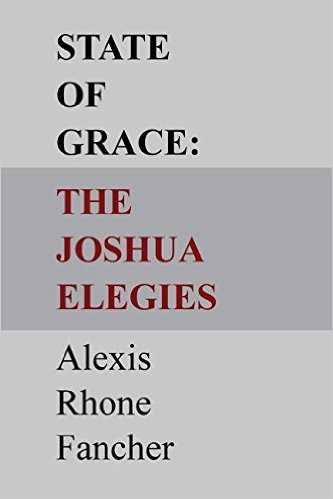
SATURDAY POETRY SERIES PRESENTS: STATE OF GRACE: THE JOSHUA ELEGIES

41oGCGJb2kL._SX331_BO1,204,203,200_


From STATE OF GRACE: THE JOSHUA ELEGIES
By Alexis Rhone Fancher:


DYING YOUNG

Midnight, and again I’m chasing
sleep: its fresh-linen smell and
deep sinking, but when I close my eyes I see
my son, closing his eyes. I’m afraid of that dream,
the tape-looped demise as cancer claims him.

My artist friend cancels her L.A. trip. Unplugs the
internet. Reverts to source. If cancer
will not let go its grip, then she will
return its embrace. Squeeze the life out of
her life. Ride it for all it’s worth.

By the time his friends arrive at the cabin
my son is exhausted, stays behind while
the others set out on a hike. He picks up the phone.
“Mom, it’s so quiet here. The air has never
been breathed before. It’s snowing.”

I put on Mozart. A warm robe. Make a pot
of camomile tea. The view from my 8th floor
window, spectacular, the sliver moon, the stark,
neon-smeared buildings, their windows dark.
Sometimes I think I am the only one not sleeping.

My artist friend wants to draw the rain. She
wants to paint her memories, wrap the canvas
around her like a burial shroud.

Tonight, a girl in a yellow dress stands below
my window, top lit by a street lamp, her long shadow
spilling into the street. She’s waiting for someone.

I want to tell my friend I’ll miss her.
I want to tell my son I understand.
I want to tell the girl he won’t be coming.
That it’s nothing personal. He died young.


SNOW GLOBE

Despair arrived, disguised as
nine pounds of ashes in a
velvet bag, worried so
often between my fingers
that wear-marks now stain
the fabric.

Is it wrong to sift
the remains of my dead son,
bring my ashen finger to my
forehead, make the mark of
the penitent above my eyes?

His eyes, the brown of mine,
the smooth of his skin, like mine.
Unless I look in the mirror
I can’t see him.

Better he’d arrived
as a snow globe, a small figure,
standing alone at the bottom of his
cut-short beauty.

Give him a shake, and watch
his life float by.


OVER IT

Now the splinter-sized dagger that jabs at my heart has
lodged itself in my aorta, I can’t worry it
anymore. I liked the pain, the
dig of remembering, the way, if I
moved the dagger just so, I could
see his face, jiggle the hilt and hear his voice
clearly, a kind of music played on my bones
and memory, complete with the hip-hop beat
of his defunct heart. Now what am I
supposed to do? I am dis-
inclined toward rehab. Prefer the steady
jab jab jab that reminds me I’m still
living. Two weeks after he died,
a friend asked if I was “over it.”
As if my son’s death was something to get
through, like the flu. Now it’s past
the five-year slot. Maybe I’m okay that he isn’t anymore,
maybe not. These days,
I am an open wound. Cry easily.
Need an arm to lean on. You know what I want?
I want to ask my friend how her only daughter
is doing. And for one moment, I want her to tell me she’s
dead so I can ask my friend if she’s over it yet.
I really want to know.


Today’s poems are from State of Grace: The Joshua Elegies (KYSO Flash, 2015), copyright © 2015 by Alexis Rhone Fancher, and appear here today with permission from the poet.


State of Grace: The Joshua Elegies: “Alexis Rhone Fancher’s book, State of Grace: The Joshua Elegies, maps in searing detail a landscape no parent ever wants to visit—a mother’s world after it’s flattened by her child’s death. Though her son’s early passing was ‘nothing personal,’ her poems howl with personal devastation. They insist that the reader take the seat next to hers in grief’s sitting room and ‘imagine him in his wooden forever.’ Fancher grapples with how to reconcile oneself to the slow loss of memory’s fade-out, and with how to go on living without betraying the dead, how to ‘[s]queeze the life out of / her life.’ You’ll need tissues when you read this book, but it’s well worth rubbing your heart raw against the beauty of these poems and their brave, fierce honesty.” — Francesca Bell, eight-time nominee for the Pushcart Prize in poetry, and winner of the 2014 Neil Postman Award for Metaphor from Rattle


Alexis Rhone Fancher is the author of How I Lost My Virginity To Michael Cohen and Other Heart Stab Poems, (Sybaritic Press, 2014). Find her work in Rattle, Menacing Hedge, Slipstream, Fjords Review, H_NGM_N, great weather for media, River Styx,The Chiron Review, and elsewhere. Her poems have been published in over twenty American and international anthologies. Her photos have been published worldwide. Since 2013 Alexis has been nominated for three Pushcart Prizes and two Best of The Net awards. She is photography editor of Fine Linen, and poetry editor of Cultural Weekly, where she also publishes The Poet’s Eye, a monthly photo essay about her ongoing love affair with Los Angeles. www.alexisrhonefancher.com


Editor’s Note: The poems in today’s collection slew me. Long after I finished reading them, they stayed with me, a specter. As I nursed my young son, worried over his maladies, rejoiced in his small accomplishments, there in the shadows was the poetry of Alexis Rhone Fancher reminding me that life is precious, fleeting, that nothing should be taken for granted, that anything–no matter how dear–can be taken away.

It is impossible not to be moved by these poems. By “a girl in a yellow dress [who] stands below / my window, top lit by a street lamp, her long shadow / spilling into the street… waiting for someone.” By the poet, the mother, who wants “to tell the girl he won’t be coming. / That it’s nothing personal. He died young.” By the admission, “Unless I look in the mirror / I can’t see him.” By the callousness of a friend who would ask if a mother is “over” her son’s death. By a mother’s very human reaction to such a question: “I want to ask my friend how her only daughter / is doing. And for one moment, I want her to tell me she’s / dead so I can ask my friend if she’s over it yet. / I really want to know.”

State of Grace: The Joshua Elegies is raw, brave, honest. It rips you apart as you read it–and leaves you grieving long after–because of the very vulnerable and wounded place from whence the poems arose. This is an incredibly compelling collection that does what lyric, confessional, narrative poetry does best: invites the reader into a human experience that is at once personal and shared, pairing vivid imagery and beautiful language with a story so moving that the reader is forever changed by the very act of having read it.


Want to see more from Alexis Rhone Fancher?
Buy State of Grace: The Joshua Elegies from Amazon
Four poems in Ragazine, including “When I turned fourteen, my mother’s sister took me to lunch and said:,” chosen by Edward Hirsch for inclusion in The Best American Poetry, 2016
Broad (“Dying Young” was first published in Broad)
Alexis Rhone Fancher’s Official Website / link to published works