DS Maolalai: “A Perfume”


A perfume.

winter crowds
through windows
in the ellis
quay apartments.
the stairwell, thick
with a perfume
of spice and frying
steaks. someone
on the landing
has opened
their apartment,
clearing the kitchen
while they cook. steam
comes out, rushing
like a person
late for a train,
their wallet
in their mouth,
keys frantic,
fiddling their folded
up jacketsleeves.
it rolls along
the windows
which run on down
the stairwell,
makes mushroom
shapes which flatten
on the glass and frame
of winter. rises
on my footsteps,
like I left
something behind.
I turn, stepping brightly
along another flight,
quite delighted
and searching
my pockets for keys,
tasting the savoury
perfume.


About the Author: DS Maolalai has been nominated four times for Best of the Net and three times for the Pushcart Prize. His poetry has been released in two collections, “Love is Breaking Plates in the Garden” (Encircle Press, 2016) and “Sad Havoc Among the Birds” (Turas Press, 2019)


Image Credit: INTERIOR VIEW, THIRD FLOOR, NORTH ROOM, NORTHWEST WALL, VIEW THROUGH DORMER WINDOW – Gambrill House, Urbana Park, Frederick, Frederick County, MD, The Library of Congress (public domain)

Victor Clevenger: “Thursday Evening in September “


Editor’s Note: This is the 3rd in a series of poems by Victor Clevenger about his son, nicknamed “The Milkman”


Thursday Evening in September  

for nothing more
than to close an open window
i rushed into the first room on the left
with a bust-down-a-door
cop mentality

& his sudden search for concealment

reminded me why
it’s always best to knock first
& wait for him to finish twisting the knob
before entering the room with caution

it doesn’t always take a gunshot
or a slice from a sharp blade
to leave a scar

sometimes

it’s just a hard object
gripped by a hand


Victor Clevenger’s latest chapbook of poetry, Low-Flying Birds, is available here on AIOTB Magazine as a free pdf.


About the Author: Victor Clevenger spends his days in a Madhouse and his nights writing poetry.  Selected pieces of his work have appeared in print magazines and journals around the world.  He is the author of several collections of poetry including Sandpaper Lovin’ (Crisis Chronicles Press, 2017), A Finger in the Hornets’ Nest (Red Flag Poetry, 2018), and Corned Beef Hash By Candlelight (Luchador Press, 2019).  Together with American poet John Dorsey, they run River Dog.


More by Victor Clevenger:

$5.00 Wok

Milkman’s Mustache


Image Credit: “West bedroom, second floor, door to hall – Robert Pierce House, 24 Oakton Avenue, Dorchester, Suffolk County, MA” The Library of Congress (public domain)

Alex Z. Salinas: “Neruda in Six Haikus”


Neruda in Six Haikus

I.
Huntress of the depths
Of my eyes, snare these pupils,
Blood tear trails your prize.

II.
Host flesh, locust teeth,
Waxen crypt candle after-
Taste like cinnamon.

III.
O Luna, listen:
Abandon me tonight, I
Crave death in lilac shades.

IV.
Sprinkle verse, twinkle
Glacial stars, Medusa’s stone
Grandmotherly gaze.

V.
I walk on callused
Soles to distant realms,
Love’s wondrous highlands.

VI.
A woman’s heart is
A breath birthed in an era’s
Warm milk, sugar-sweet glands.


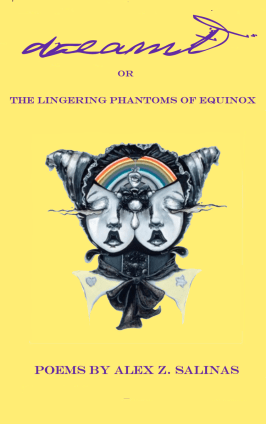
This poem appears in Alex Z. Salinas’ new book of poetry, DREAMT, or The Lingering Phantoms of Equinox:
 

cover+mid+adjust


WARBLES, Alex Z. Salinas’ first collection of poetry, was the author’s attempt to reconcile his lifelong feeling of being sandwiched between cultures—and languages—in South Texas. In DREAMT, or The Lingering Phantoms of Equinox, Salinas’ second full-length poetry collection propels further his investigation of his identity by entering into the dream realm—populated by literary and musical influences such as Haruki Murakami, Roberto Bolaño, Ayn Rand, Sherman Alexie, John Coltrane and OutKast. By the book’s conclusion, Salinas brings to the surface the disturbing reality of the Trump administration, hopefully challenging his readers to ask themselves: So what action can I take next?


About the Author: Alex Z. Salinas lives in San Antonio, Texas. He is the author of two full-length poetry collections, WARBLES (2019) and DREAMT, or The Lingering Phantoms of Equinox (2020), both published by Hekate Publishing. His poems, short fiction and op-eds have appeared in various print and electronic publications. He holds an M.A. in English Literature and Language from St. Mary’s University.


More by Alex Z. Salinas:

Pen Dream

The Great Thing About Driving With A Crack In Your Windshield


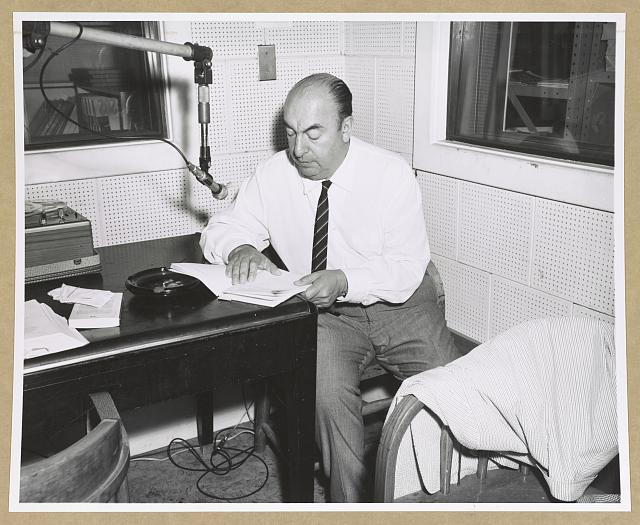
Image Credit: Photograph shows Chilean poet Pablo Neruda, seated at a table in front of a microphone in the Library of Congress Recording Laboratory, Studio B, Washington, D.C., during the recording of his poem “Alturas de Macchu Picchu” for the Archive of Hispanic Literature on Tape. (1966) The Library of Congress (public domain)
Agnes Vojta: “Everybody Likes the Person who Brings Muffins”


Everybody Likes the Person who Brings Muffins

She is baking to keep
the darkness at bay.
A loaf of bread
will render her worthy,
a pie loved.

She bakes herself
a place in the world.
Bakes acceptance,
a purpose for being
measured in brownies.

As long as she’s baking,
she’s got something to offer,
to trade for your time.
Most people prefer
cookies to poems anyway.


About the Author: Agnes Vojta grew up in Germany and started writing poetry as a child. She spent a few years in California, Oregon, and England, and now lives in Rolla, Missouri where she teaches physics at Missouri S&T and hikes the Ozarks. She is the author of Porous Land (Spartan Press, 2019) and The Eden of Perhaps (Spartan Press, 2020), and her poems  have appeared in a variety of magazines.


More By Agnes Vojta:

Legend

Sisyphus Calls It Quits

Flotsam


Image Credit: “International baking powder. Manufactured by Queen City Chemical Co., Buffalo, N.Y.” G.H. Dunston, Lith., c1885. The Library of Congress (Public Domain)

Carson Pytell: “Frequencies”


Frequencies

I’m down now to Doppler affairs:
A frequency flicks my ear,
Approaches, grows, arrives,
Raises to rattling relations,
Departs, diminishes, disappears
Like it was never even there,
And leaves me listening again.

These decibels have yet to deafen,
Sheaths are cheap, the clinic’s free
And the bony finger of psychiatry
Scares the living shit from me.


About the Author: Carson Pytell is a poet living in a very small town outside Albany, NY. His work has appeared in numerous venues online and is currently available or forthcoming in print from such publications as Vita Brevis Press, The Virginia Normal, NoD Magazine, Blue Moon Lit & Art Review, Spank the Carp, Crack the Spine, Futures Trading, Down in the Dirt Magazine, Gideon Poetry Review and Children, Churches & Daddies, among others.


Image Credit: Robert Hicks “View to the north of the Two Communications Antenna – Over-the-Horizon Backscatter Radar Network, Christmas Valley Radar Site Transmit Sector Four Communications Antennas, On unnamed road west of Lost Forest Road, Christmas Valley, Lake County, OR” (2005) The Library of Congress.

Hilary Otto: “Underworld”


Underworld

We press against the oozing dirt, thrive
on the tang of damp matter. By the time
you become aware of us easing up
from the earth like time-lapse capsules
disturbed, we will have popped out, soiled
as if surprised during private acts, to buff
our bald caps and moisten our pale skin.

Beneath, where you cannot see us work
our spores transform into moons of milk.
Our mycelium threads extend, bind together
and we emerge, fringed with gills to perpetuate
our presence inside those crevices we find
fertile. We look too ordinary to pose a threat.
We are experts at waiting in silence.


About the Author: Hilary Otto is an English poet, teacher and translator based in Barcelona. She reads regularly in Barcelona in both English and Spanish, most recently as part of the Berlin International Poetry Festival. Her work has been published in Popshot Quarterly, Black Bough Poetry and Fixpoetry, as well as in anthologies.


Image Credit: Nouvel atlas de poche des champignons comestibles et vénéneux. v.1.
Paris,Léon Lhome,1911-1912. http://biodiversitylibrary.org/item/24293

Matthew Borczon: “The Question Is”


The question is

In Afghanistan
we saw almost
three thousand
patients with
a 97 percent
survival rate

in two
months in
New York City
we saw
another 12
hundred covid
patients helping
nearly all
get from
the hospital
back to
their homes

so how
come I
only ever
see the
faces of
the dead
only hear
crying children
and the
last gasp
for air

when anyone
thanks me
for my
service.


About the Author: Matthew Borczon is a nurse and Navy sailor from Erie pa. He has written 14 books of poetry; the most recent, Prison Nurse poems, is available from Analog Submissions press. He recently returned from being deployed to New York City where he was working in an ICU to take care of Covid positive patients. When he is not working for the Navy he is a nurse to adults with developmental disabilities.


More by Matthew Borczon

In 2010


Image Credit: “Second floor hallway running NW-SE in SW wing of building. Clinical Director’s office on right. – Fort Lewis, Post Hospital, Near Ninth Division Drive & Idaho Avenue, DuPont, Pierce County, WA.” The Library of Congress

Jason Baldinger: “cape henlopen blues”


cape henlopen blues

among the coastal pine
the herons, the fescues
I look up on a sky
that hangs heavy
with words unsaid

horizon catches fire
standing on a sandbar
washed in red and lighthouse
tide roars the other side of the cape
I say a prayer for a friend
and his wife, I say prayers
then throw them in the ocean

north star hangs above
thumbnail moon
miles davis “shhh peaceful”
fills the car, my niece
asked my resolution
I told her I didn’t believe that
I told her time is not linear
that the narratives
the timelines we follow
don’t kowtow to calendars
it’s something understood
better as you get older

no fireworks tonight
warm december
I escape light pollution
to hail orion’s stars
a joint on my lips
gulls fight the noise
of an approximately
infinite ocean. alone
on the dunes
time has passed


About the Author: Jason Baldinger is a poet from Pittsburgh, Pennsylvania.  He was recently a Writer in Residence at Osage Arts Community, and is founder and co-director of The Bridge Series. He has multiple books available including the soon to be released The Better Angels of our Nature (Kung Fu Treachery) and the split books The Ugly Side of the Lake with John Dorsey (Night Ballet Press) as well as Little Fires Hiding with James Benger (Kung Fu Treachery Press). His work has been published widely in print journals and online. You can listen to him read his work on Bandcamp on lps by the bands Theremonster and The Gotobeds.


More by Jason Baldinger:

“I forgot the earth and heaven”

“When Cancer Come to Evansville, Indiana”

“blind into leaving”


Image Credit: “Cape Henlopen” (1891) The Library of Congress

Ryan Quinn Flanagan: “Chewy Circle”


Chewy Circle

We watch this show 
where dogs compete in a series of things 
to see who is America’s Top Dog.

First, through a timed obstacle track
where the slowest timed dog and handler team
are eliminated.

Then through a scent challenge 
where they have to sniff out drugs or explosives.
The two slowest times are eliminated.

Lastly, the two remaining teams compete
through another obstacle course 
to see who can do it in the fastest time.

The winner gets to go into the Chewy Circle.
Have bragging rights and $5000 dollars donated 
to the charity of their choice.

The winner tonight wore these blue pair of doggles 
over his eyes.
Even though he was afraid to go in the water.
It was a straight fashion thing with this one,
you could tell.

His doggles made him feel sexy.
Beating out all the other police dogs
and one civilian trained entry.

So he could bark proudly from the Chewy Circle
in his bright blue doggles.

As Curt Menefee wondered how the hell he 
ever got roped into doing this gig.

And the studio audience 
cheered on.


About the Author: Ryan Quinn Flanagan is a Canadian-born author residing in Elliot Lake, Ontario, Canada with his wife and many mounds of snow.  His work can be found both in print and online in such places as: Evergreen Review, As It Ought To Be Magazine The New York Quarterly, Cultural Weekly, In Between Hangovers, Red Fez, and The Oklahoma Review.


More by Ryan Quinn Flanagan:

Robbie the Owl

Artisanal Birds

Listening to Blue Monday on a Friday


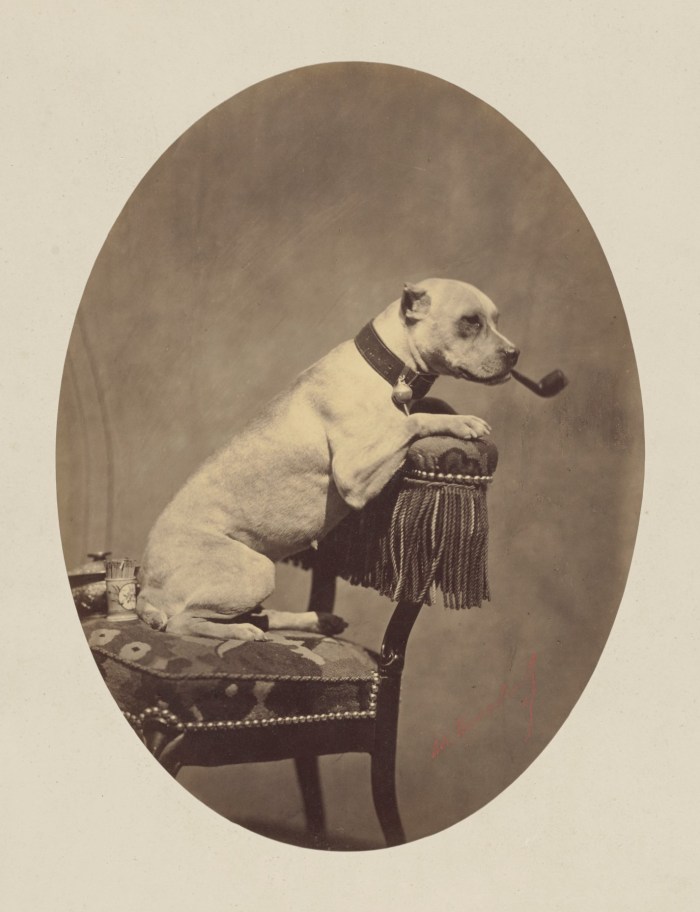
Image Credit: Henry Pointer: “Touch this if you dare [little dog guarding a cup]” (1870) Digital image courtesy of the Getty’s Open Content Program.


Cody Sexton: “Heathen”

.

.

Heathen

By Cody Sexton


Here’s my problem. I want to believe in God and religion. I do. I want the certainty that comes along with it. I also want the comfort in knowing that when I die, I could be reunited with the ones I love. But I can’t. I’ve tried. I have prayed to God for years to help make me believe. But all I’ve ever received back is silence. Which can mean only one of two things, so far as I can tell. That I am either damned and have been from birth, or, and more likely, that God doesn’t exist.

I tried to be a religious person. The impulse lasted approximately one year before it one day vanished. I went to sleep one night and when I awoke the next morning the capacity to believe was gone. It simply wasn’t there anymore.

The way I look at it is that I didn’t have the talent to believe. I’ve always had a hard time getting past the obvious fiction of the whole thing. Having grown up in relative poverty, religion held complete irrelevance to my life. I had no time for it and the religious leaders had nothing to say about it either and if they did it was only to say that suffering, on the whole, was a good thing. Which only infuriated me. Which is probably one of the reasons I was so angry as a young man. To a large extent I still am. As a result I lost all respect for any type of authority. Which has both served me as well as handicapped me in life.

Religion proved to me that authority was impotent when faced with real problems. So my eventual atheism had as much to do with human reason, as it did with a rejection of authority itself. But, digging deeper, I realize now, that my eventual atheism, had just as much to do with a rejection of family itself. Continue reading “Cody Sexton: “Heathen””