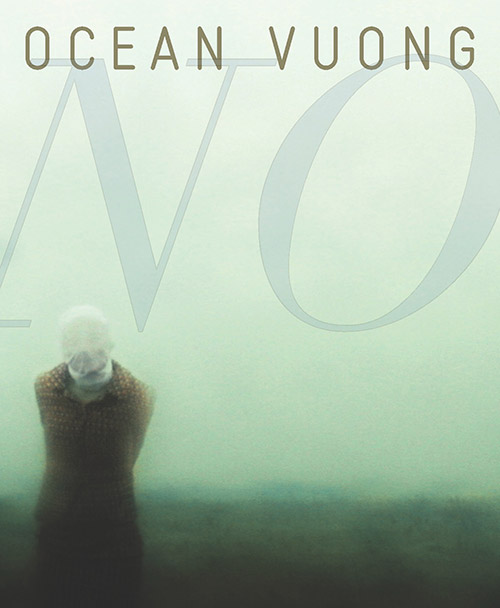
SATURDAY POETRY SERIES PRESENTS: NO

no


from NO
By Ocean Vuong


TORSO OF AIR

Suppose you do change your life.
& the body is more than

a portion of night—sealed
with bruises. Suppose you woke

& found your shadow replaced
by a black wolf. The boy, beautiful

and gone. So you take the knife to the wall
instead. You carve & carve.

Until a coin of light appears
& you get to look in, for once,

on happiness. The eye
staring back from the other side—

waiting.


HOME WRECKER

And this is how we danced: with our mothers’
white dresses spilling from our feet, late August

turning our hands dark red. And this is how we loved:
a fifth of vodka and an afternoon in the attic, your fingers

sweeping though my hair—my hair a wildfire.
We covered our ears and your father’s tantrum turned

into heartbeats. When our lips touched the day closed
into a coffin. In the museum of the heart

there are two headless people building a burning house.
There was always the shotgun above the fireplace.

Always another hour to kill—only to beg some god
to give it back. If not the attic, the car. If not the car,

the dream. If not the boy, his clothes. If not alive,
put down the phone. Because the year is a distance

we’ve traveled in circles. Which is to say: this is how
we danced: alone in sleeping bodies. Which is to say:

This is how we loved: a knife on the tongue turning
into a tongue.


Today’s poems are from NO, published by Yes Yes Books, copyright © 2013 by Ocean Vuong. “Torso of Air” previously appeared in BODY Literature, and “Home Wrecker” previously appeared in Linebreak. These poems appear here today with permission from the poet.


NO: Anyone who has already sensed that “hope is a feathered thing that dies in the Lord’s mouth,” should get their hands on NO. Honest, intimate, and brimming with lyric intensity, these stunning poems come of age with a fifth of vodka and an afternoon in an attic, with a record stuck on please, with starlight on a falling bomb. Even as Vuong leads you through every pleasure a body deserves and all the ensuing grief, these poems restore you with hope, that godforsaken thing—alive, singing along to the radio, suddenly sufficient. —Traci Brimhall, Our Lady of the Ruins


Ocean Vuong is a recipient of a 2013 Pushcart Prize as well as fellowships from Kundiman, Poets House, and The Saltonstall Foundation for the Arts. Poems appear in Poetry, The Nation, Beloit Poetry Journal, Passages North, Quarterly West, Denver Quarterly, and American Poetry Review, which awarded him the 2012 Stanley Kunitz Prize for Younger Poets. He lives in Queens, NY.


Editor’s Note: I’m just going to come right out and say this: Ocean Vuong is one of the best and most important poets writing in America today. I have not been so moved as I am by Vuong’s words since I first read Li-Young Lee. This poet has changed my life. He has renewed my belief in American poetry. That it can be emotional and heartbreaking. That is can be beautiful and full of hope. That modern American poetry can—and does—matter. In my humble opinion your poetry collection is simply not complete unless it houses both Vuong’s groundbreaking chapbook, Burnings, and his newest release from Yes Yes Books, NO.

NO is a surprisingly experimental collection, yet Vuong remains dedicated to the lyric and the narrative, guiding us through its formal twists and turns through emotive language and evocative imagery. Throughout its pages the poet intimately explores themes of love, sexuality, and belonging against a backdrop of devastating loss. It is a brilliant and beautiful collection, a true heartbreaking work of staggering genius. As the book’s publisher did when reading through the manuscript for the first time, when Ocean Vuong says NO to you, be prepared to say “Yes Yes!”


Want to see more from Ocean Vuong?
Buy NO from Yes Yes
The Poetry Foundation
Interview in The Well & Often Reader
Ben Lerner on mentoring Ocean Vuong, Brooklyn College

SATURDAY POETRY SERIES PRESENTS: GUILLERMO FILICE CASTRO

download


RITUAL
By Guillermo Filice Castro

into a hole
something      of the self

always
disappears

light    mother

tongue

into
mouths

and this morning

that
bunch
of hairs

peeled off
the drain

and dropped into the toilet

almost
as mournful      a gesture

as a wreath
laid

in the ocean


(Today’s poem was originally published in Fogged Clarity and appears here today with permission from the poet.)


Guillermo Filice Castro is a recipient of the 2013 “Emerge-Surface-Be” fellowship from the Poetry Project. His work appears in Assaracus, Barrow Street, The Bellevue Literary Review, The Brooklyn Rail, Court Green, Ducts.org, Fogged Clarity, LaFovea.org, Quarterly West, among others, as well as the anthologies Rabbit Ears, Flicker and Spark, Divining Divas, Saints of Hysteria, and more. His translations of Olga Orozco, in collaboration with Ron Drummond, are featured in Guernica, Terra Incognita, U.S. Latino Review, and Visions. In 2012 he was a finalist for the Andrés Montoya prize. He lives in New York City.

Editor’s Note: Into the abyss of grief, of loss, something always disappears. And in the absence that follows it is the little things that remain, reminding us that one day they too will disappear. Those little bits left behind, as they too depart, become “almost / as mournful a gesture // as a wreath / laid // in the ocean.” Death is universal, yet it is the specificity with which today’s poet mourns and pays homage that allows us to feel his unique loss as if it were our own.

Want to read more by and about Guillermo Filice Castro?
“Ritual” in Fogged Clarity (with audio)
“Jones Beach” in Fogged Clarity (with audio)
LaFovea.org
Assaracus
The Bellevue Literary Review

SATURDAY POETRY SERIES PRESENTS: THE MOONS OF AUGUST

Lameris Cover-1


FROM THE MOONS OF AUGUST
By Danusha Laméris


EVE, AFTER

Did she know
there was more to life
than lions licking the furred
ears of lambs,
fruit trees dropping
their fat bounty,
the years droning on
without argument?

Too much quiet
is never a good sign.
Isn’t there always
something itching
beneath the surface?

But what could she say?
The larder was full
and they were beautiful,
their bodies new
as the day they were made.

Each morning the same
flowers broke through
the rich soil, the birds sang,
again, in perfect pitch.

It was only at night
when they lay together in the dark
that it was almost palpable—
the vague sadness, unnamed.

Foolishness, betrayal,
—call it what you will. What a relief
to feel the weight
fall into her palm. And after,
not to pretend anymore
that the terrible calm
was Paradise.


LONE WOLF

On December 8, 2011, the first wolf in nearly a hundred years was seen
crossing the border of the Sierra Nevada from Oregon to California.

A male, probably looking for a mate
in this high wilderness
along the cusp of Mount Shasta.
Already there are ranchers waiting, armed.
True, it’s only one wolf.
Except that a wolf is never just a wolf.
We say “wolf” but mean our own hunger,
walking around outside our bodies.
The thief desire is. the part of wanting
we want to forget but can’t. Not
with the wolf loose in the woods
carrying the thick fur
of our longing. Not with it taking
in its mouth the flocks we keep
penned behind barbed wire.
If only we didn’t have to hear it
out in the dark, howling.


THE BALANCE

She was at a friend’s apartment,
my mother, a third floor walk-up.
It was summer. Why she slipped
into the back room, she can’t recall.
Was there something she wanted
fro her purse…lipstick?
a phone number?
Fumbling through the pile
on the bed she looked up and saw—
was this possible?—outside,
on the thin concrete ledge
a child, a girl, no more than two or three.
She was crouched down
eyeing an object with great interest.
A pebble, or a bright coin.
What happened next
must have happened very slowly.
My mother, who was young then,
leaned out the window, smiled.
Would you like to see
what’s in my purse?
she asked.
Below, traffic rushed
down the wide street, horns blaring.
Students ambled home
under the weight of their backpacks.
From the next room,
strains of laughter.
The child smiled back, toddled along
the ledge. What do we know
of fate or chance, the threads
that hold us in the balance?
My mother did not imagine
one day she would
lose her own son, helpless
to stop the bullet
he aimed at his heart.
She reached out to the girl,
grabbed her in both arms,
held her to her chest.


Today’s poems are from The Moons of August, published by Autumn House Press, copyright © 2014 by Danusha Laméris, and appear here today with permission from the poet.


The Moons of August: “Danusha Laméris writes with definitive, savoring power—in perfectly well-weighted lines and scenes. Her poems strike deeply, balancing profound loss and new finding, employing a clear eye, a way of being richly alive with appetite and gusto, and a gift of distilling experience to find its shining core. Don’t miss this stunning first book.” —Naomi Shihab Nye

“This book of motherhood, memory, and elegiac urgency crosses borders, cultures, and languages to bring us the good news of being alive. With language clear as water and rich as blood, The Moons of August offers a human communion we can all believe in. Reckoning with and grieving for the past as they claim the future, these poems are wise, direct, and fearless. “What’s gone / is not quite gone, but lingers,” Laméris reminds us. “Not the language, but the bones / of the language. Not the beloved, / but the dark bed the beloved makes / inside our bodies.” —Dorianne Laux


Danusha Laméris’s work has been published in Alaska Quarterly Review, Poetry Northwest, Rattle, The Sun and Crab Orchard Review as well as in a variety of other journals. Her poems have also appeared in the anthologies In a Fine Frenzy: Poets Respond to Shakespeare, A Bird Black as the Sun: California Poets on Crows and Ravens, and Intimate Kisses. She was a finalist for the 2010 and 2012 New Letters Prize in poetry and has been nominated for a Pushcart Prize. Her poem, “Riding Bareback,” won the 2013 Morton Marcus Memorial prize in poetry, selected by Gary Young and her first book, The Moons of August, was chosen by Naomi Shihab Nye as the winner of the Autumn House Press poetry contest. She lives in Santa Cruz, California and teaches an ongoing poetry workshop.


Editor’s Note: I first discovered Danusha Laméris when I featured her stunning poem “Arabic” in the fall of 2013. When I read that her first book was forthcoming this year—and chosen by Naomi Shihab Nye as the winner of the Autumn House Press poetry contest, no less—I begged the poet remember me when the book was released. When it arrived I read, devoured, re-read, explored, breathed, bled, and grew whole once more within the boundless confines of its pages.

Through Laméris’ words I was the first woman born; I knew the burden—and relief—of being Eve. I was as old as time and as all-encompassing as nature. I was as helpless and as grieved as a mother, and as powerful. The Moons of August is small and light and fits effortlessly in my hands. Yet it reaches far back to human origins and delves deep into the human experience and the complex soul of (wo)man. “With,” as Dorianne Laux so aptly states, “language clear as water and rich as blood,” this is a book to read when you want to feel alive, from the very atoms that comprise you to the farthest reaches of your white light.


Want to see more by Danusha Laméris?
Author’s Official Website

SATURDAY POETRY SERIES PRESENTS: THE SONG OF SONGS

739px-Song_of_solomonDepiction of Solomon and Pharaoh’s daughter reciting the Song of Solomon.
This image is in the public domain.


From THE SONG OF SONGS
From the Hebrew Bible

I am a rose of Sharon,
a lily of the valleys.

As a lily among brambles,
so is my love among maidens.

As an apple tree among the trees of the wood,
so is my beloved among young men.
With great delight I sat in his shadow,
and his fruit was sweet to my taste.
He brought me to the banqueting house,
and his banner over me was love.
Sustain me with raisins,
refresh me with apples;
for I am sick with love.
O that his left hand were under my head,
and that his right hand embraced me!
I adjure you, O daughters of Jerusalem,
by the gazelles or the hinds of the field,
that you stir not up nor awaken love until it please.

The voice of my beloved!
Behold, he comes,
leaping upon the mountains,
bounding over the hills.
My beloved is like a gazelle,
or a young stag.
Behold, there he stands
behind our wall,
gazing in at the windows,
looking through the lattice.

My beloved speaks and says to me:
“Arise, my love, my fair one,
and come away;
for lo, the winter is past,
the rain is over and gone.
The flowers appear on the earth,
the time of singing has come,
and the voice of the turtledove
is heard in our land.
The fig tree puts forth its figs,
and the vines are in blossom;
they give forth fragrance.
Arise, my love, my fair one,
and come away.
O my dove, in the clefts of the rock,
in the covert of the cliff,
let me see your face,
let me hear your voice,
for your voice is sweet,
and your face is comely.
Catch us the foxes,
the little foxes,
that spoil the vineyards,
for our vineyards are in blossom.”

My beloved is mine and I am his,
he pastures his flock among the lilies.
Until the day breathes
and the shadows flee,
turn, my beloved, be like a gazelle,
or a young stag upon rugged mountains.


(Today’s poem is in the public domain, belongs to the masses, and appears here today accordingly.)


The Song of Songs, also known as the “Song of Solomon” or “Canticles,” is one of the megillot (scrolls) found in the last section of the Tanakh, known as the Ketuvim (or “Writings”), a book of the Old Testament/Hebrew Bible. The Song of Songs is unique within the Hebrew Bible: it shows no interest in Law or Covenant or the God of Israel; instead, it seems to celebrate sexual love. It gives “the voices of two lovers, praising each other, yearning for each other, proffering invitations to enjoy.” The two are in harmony, each desiring the other and rejoicing in sexual intimacy. (Annotated biography of King Solomon courtesy of Wikipedia.org, with edits.)

Editor’s Note: In honor of Valentine’s Day, the Saturday Poetry Series offers you a good old fashioned love poem, emphasis on the old. An anomaly among the fire and brimstone, monotheistic propaganda, and general prescription of the Bible, the illicit sexual nature and unbridled romance of The Song of Songs has baffled scholars for centuries. Believed to have been written some time between the tenth and second centuries BCE, there is no authoritative agreement regarding the poem’s authorship, inception, or setting. The subject matter of the poem itself has long been heatedly debated, with some scholars embracing the titillating nature of this epic poem, while others insist it is a metaphor for man’s love of God. While its milder language is often quoted in the context of weddings, showcasing a true love with ancient roots, when one sits down and reads this masterpiece from beginning to end—with eyes wide open—they encounter a hot and steamy poem that gives Fifty Shades of Grey a real run for its money.

Want to read more about Biblical poetry?
Wikipedia

SATURDAY POETRY SERIES PRESENTS: MARK NEPO

mark nepo

BREAKING SURFACE
By Mark Nepo

Let no one keep you from your journey,
no rabbi or priest, no mother
who wants you to dig for treasures
she misplaced, no father
who won’t let one life be enough,
no lover who measures their worth
by what you might give up,
no voice that tells you in the night
it can’t be done.

Let nothing dissuade you
from seeing what you see
or feeling the winds that make you
want to dance alone
or go where no one
has yet to go.

You are the only explorer.
Your heart, the unreadable compass.
Your soul, the shore of a promise
too great to be ignored.


(Today’s poem originally appeared via Mark Nepo’s Official Website and appears here today with permission from the poet.)

Mark Nepo is a poet and philosopher who has taught in the fields of poetry and spirituality for forty years. A New York Times #1 bestselling author, he has published fourteen books and recorded eight audio projects. Recent work includes: Reduced to Joy (2013), Seven Thousand Ways to Listen which won the 2012 Books for a Better Life Award, Staying Awake (2012), Holding Nothing Back (2012), As Far As the Heart Can See (2011), Finding Inner Courage (2011), and Surviving Has Made Me Crazy (2007), as well as audio books of The Book of Awakening, Finding Inner Courage, and As Far As the Heart Can See (2011). As a cancer survivor, Mark devotes his writing and teaching to the journey of inner transformation and the life of relationship.

Editor’s Note: Today Mark Nepo blesses us with a poem that celebrates all that each of us are capable of achieving. Poetry has historically been a source of inspiration, and “Breaking Surface” takes part in this age-old tradition, speaking straight to the heart, and imploring us to “Let nothing dissuade you from … [going] where no one has yet to go.”

Today’s piece is dedicated to Virginia Wilcox, herself a constant source of inspiration and a reminder of all that we are capable of when equipped with the right outlook and a willingness to seek out inspiration in the world.

Want to read more by and about Mark Nepo?
Mark Nepo’s Official Website

SATURDAY POETRY SERIES PRESENTS: LINDA STERN ZISQUIT

DSC_0396 (2)
POSIT
By Linda Stern Zisquit

“Ten measures of beauty came down into the world;

Nine were taken by Jerusalem, one by the rest of the world.”

                                                                         Tractate Kiddushin


“Ten parts of suffering came down into the world; nine

were taken by Jerusalem, one by the rest of the world.”

                                                                         Avot d’Rabbi Natan


Had Rachel not looked up

Jacob would not have seen her.

There would have been no water,

no winding dream,


no tribe or unrelenting

portion of sadness

dispersed on his land, his Jerusalem,

and I would not have promised


to gather then home. But Rachel

saw him and he loved her.

She was barren and she suffered

and she followed him.


So I have this heaviness

to bear. Her life before him

had also the dailiness of lives,

an hour at which she would rise and go


to the well. Then out of the blue

her future came crashing against her lids

when she looked up, those hours changed,

and I was moved to his, another well.


(Today’s poem originally appeared in the collection Ritual Bath (Broken Moon Press, 1993), was recently published in The Ilanot Review, and appears here today with permission from the poet.)


Linda Stern Zisquit has published four full-length collections of poetry, most recently Havoc: New & Selected Poems (Sheep Meadow Press, 2013). Return from Elsewhere, her fifth volume of poetry, will be published in Spring 2014. Her other books are The Face in the Window (2004), Unopened Letters (1996), and Ritual Bath (1993). Ghazal-Mazal, a chapbook, appeared in 2011. Her translations from Hebrew poetry include These Mountains: Selected Poems of Rivka Miriam (2010), a finalist for the National Jewish Book Award, Let the Words: Selected Poems of Yona Wallach (2006), Wild Light: Selected Poems of Yona Wallach (1997), for which she received an NEA Translation Grant and was shortlisted for the PEN Translation Award, and Desert Poems of Yehuda Amichai (1991). Her work has appeared in journals including The Denver Quarterly, Harvard Review, Paris Review, Ploughshares, The Southern Review, Salmagundi and the Virginia Quarterly Review. Born in Buffalo, NY, Zisquit has lived in Jerusalem with her husband and five children since 1978; she is Associate Professor and Poetry Coordinator for the MA in Creative Writing Program at Bar Ilan University, and runs ARTSPACE, an art gallery in Jerusalem representing contemporary artists.

The Ilanot Review, where today’s poem recently appeared, is a biannual journal of creative writing which publishes a stellar selection of poetry, fiction, non-fiction, and literary interviews. The journal publishes two themed issues a year, inviting submissions from English-language poets and writers from anywhere in the world. The Ilanot Review is currently seeking submissions for its winter 2014 edition, through November 30th. The theme of the winter 2014 issue is sacred words.

Editor’s Note: Today’s selection contemplates the question so many of us are wont to ask: “What if?” In today’s piece the poet straddles two worlds; her own life and the biblical tales that shape so much of our modern lives. Within the poet’s words her own life is inextricably linked with the biblical love story of Rachel and Jacob. “Had Rachel not looked up / Jacob would not have seen her,” the poet posits, “But Rachel / saw him and he loved her,” and “So I have this heaviness / to bear.” Had the stories of our people unfolded differently, the poet seems to say, so, too, would our own lives now be different. Time, place, religion, literature, and the poet’s own path are conflated as the poem considers the universal themes of belonging, suffering, love, home, and self.

Want to read more by and about Linda Stern Zisquit?
Buy Havoc from Sheep Meadow Press
Sheep Meadow Press Author Page
Buy Unopened Letters from Amazon
ARTSPACE Gallery

SATURDAY POETRY SERIES PRESENTS: ORIT GIDALI

loml
KOHELET
By Orit Gidali, Translated by Marcela Sulak

I, Kohelet, was king of Jerusalem,
I really was.
Treading over a thousand flowers on my way to the white bed
where my wives waited to remove the crown from my head–
made of marzipan in the biting of sweet tongues–
my silk rubbing against their silk, my flesh would choose among
them, and my flesh was already sweet in their flesh.
Kohelet, I held a thousand women
and I didn’t have a single one
I could recognize by smell
or by her skin or her feet,
her steps as she walked away from me: David’s lament.
Her steps toward me: his song.
I am Kohelet, Solomon,
my linen is the mystery of shrouds
and my bitten crown is above me.


קוהלת

אני קוהלת מלך הייתי בירושלים
באמת הייתי
דורך על אלף פרחים בדרכי למיטה הלבנה
שם חיכו נשותי, שהסירו את כתר ראשי
העשוי מרציפן בנגיסת לשונות מתוקות, משיי
מתחכך במשיין, והייתי בוחר מתוכן לבשרי,
ובשרי כבר מתוק בבשרן.
קוהלת החזקתי אלף נשים
ולא היתה לי אישה יחידה
לזהות את ריחה
ועורה ורגליה
צעדיה ממני: קינת דוד
צעדיה אלי: שירתו
אני קוהלת שלמה
סתרי תכריכים של סדיני
וכתרי הנגוס מעלי.


(Today’s poem originally appeared in The Bakery, was published in the collection Esrim Ne’arot LeKane [Twenty Girls to Envy Me] (Sifriat Poalim, Tel Aviv, 2003), and appears here today with permission from the translator.)

Orit Gidali is an Israeli poet. Her first poetry collection, Esrim Ne’arot LeKane [Twenty Girls to Envy Me], was published by Sifriat Poalim in 2003. Gidali is also the author of Smikhut [Construct State] (2009), and the children’s book Noona Koret Mahshavot [Noona the Mindreader] (2007). She is married to poet Ben-Ari Alex, and is a mother, writing workshop facilitator, and lecturer in the Department of Communication at Tel Aviv University.

Marcela Sulak is the author of two collections of poetry and has translated three collections of poetry from the Czech Republic and Congo-Zaire. Her essays appear in The Iowa Review, Rattle, and The Los Angeles Review of Books, among others. She directs the Shaindy Rudoff Graduate Program in Creative Writing at Bar-Ilan University, where she is senior lecturer in American Literature.

Editor’s Note: Kohelet is the original Hebrew name for Ecclesiastes, one of the Writings that comprises a portion of the Hebrew Bible. The book is an autobiographical account of Kohelet’s search for the meaning of life and the best way to live. Kohelet introduces himself as “son of David, king in Jerusalem,” and is therefore sometimes believed to be Solomon. This book, however, was written anonymously and is believed to have ben penned late in the 3rd century B.C.E., while Solomon’s reign was circa 970 to 931 B.C.E.

In today’s piece the poet associates Kohelet with King Solomon and explores the notion that “heavy is the head that wears the crown.” To get to his marriage bed the king must trample a thousand flowers. He has “held a thousand women” (Solomon had 700 wives and 300 concubines and may have had an affair with the Queen of Sheba), but “didn’t have a single one / [he] could recognize by smell / or by her skin or her feet.” His wives remove his crown from his head—perhaps an allusion to his wives’ polytheism which influenced Solomon and displeased God—and at that his crown is “made of marzipan” and therefore vulnerable to “the biting of sweet tongues.” In the end he is left shrouded in mystery with a bitten crown.

As fascinating as the midrashic element of today’s piece is, it is the vibrant and lyrically explicit language that brings the scene to life. The beauty of the lyric is itself almost biblical: “my silk rubbing against their silk, my flesh would choose among / them, and my flesh was already sweet in their flesh.” It was no small effort on the part of the poem’s translator, Marcela Sulak, whose original work was featured on this series last week, to translate today’s poem from Hebrew into English while still maintaining elements of rhyme, meter, and lyric beauty. This is a piece as rich in English as in the original Hebrew, and which carries as much depth and beauty in both languages.

Want to read more by and about Orit Gidali?
Author’s Official Website (in Hebrew)
The Ilanot Review
Blue Lyra Review
Buy Nora the Mindreader on Amazon
Orit Gidali’s Blog (in Hebrew)

SATURDAY POETRY SERIES PRESENTS: MARCELA SULAK

me.avoda str
By Marcela Sulak:

THE CASTING OF LOTS

1.

Dear Ahasuerus, it is eleven-thirty am and my number is one hundred and eighty-six. I feel the lack of communion striving for a higher purpose in this government assistance office, and it is beyond sadness and feet and the distance of aircraft and tires and inner-tubes on turgid rivers in midsummer with aluminum cans of beer. It’s not just the ones who pick discarded numbers from the floor and say they missed their turn. The flower-selling prepubescent children sniffing glue in paper bags outside the margins of the magazine I’m reading remind me of the laundry I hung up that must be dry by now, filled as they are with warmth and wings and snapping.

This office is a fine line. The wind from the open window rustles the pages of my magazine, pumps the lungs of paper bags, lifts the plastic shopping sacks discarded in the fields, fills the vacant sheets.

When God withdraws, we all must breathe a little harder.

2.

Are these hosts the kind of people who refrigerate red wine? I wasn’t breastfed, I smelled different. I never learned to desire consolation prizes. The water hisses from the tap, sliced by the tips of lettuce leaves. The cut-crystal conversation turns on the tiniest incisions. So little of it is about you, you have to address yourself as one of your second persons. At the click of one of our host’s glances, each woman at the table presses forward, like a bullet into the chamber. It goes without saying, this is how I see myself among the women, Dear Ahasuerus, you fuck.

3.

One of the trafficked prostitutes in the Tel Aviv shelter always carries a book with her. When she’s fucked up she reads it upside down. It’s a best seller, a thriller, a romance, so it doesn’t really matter the order of the events. She can describe them in detail afterwards, which she’ll do for you when you ask about her life.


HEBREW LESSONS: LESHALEM
To pay, to bring to a conclusion, bring to perfection, to make peace.

i.

I am not a piece
of cake—sometimes
the eternal á
la mode, which is
to say, I am
your mouth, not your whole
mouth, just the part
that, when full, worries
about its next meal.

ii.

The eggs must first come
to room temperature,
which is to say for
everything there is
time. While the cotton
opened white fists at her
window, one by one
my grandmother beat
six eggs by hand till
they were stiff. The hands
of the kitchen clock
tapped each fat minute,
the ready spoon curved.
The frothy batter
she poured herself into
the tube pan steadied itself
in the wood-fueled oven
and lifted. Those who ate
a single bite were filled
with an inexplicable
happiness. Sometimes
that was enough.


(Today’s poems originally appeared in The Bakery, and appear here today with permission from the poet.)

Marcela Sulak is the author of two collections of poetry and has translated three collections of poetry from the Czech Republic and Congo-Zaire. Her essays appear in The Iowa Review, Rattle, and The Los Angeles Review of Books, among others. She directs the Shaindy Rudoff Graduate Program in Creative Writing at Bar-Ilan University, where she is senior lecturer in American Literature.

Editor’s Note: While living and working in Israel for the fall semester I have become inspired by the local English-speaking writing community, as well as the plethora of work being done in translation. I hope to be able to share some of the gems the local writers and translators are creating here with you on this series, beginning today with Marcela Sulak.

Of course I am interested in Sulak’s work, in part, because of its biblical interests and midrashic tendencies. Ahasuerus, for instance, from today’s first piece, was a Persian king and husband of Queen Esther. He chose Esther for his queen after kicking out his first wife, Queen Vashti, for refusing to display herself naked before his guests. The process of choosing Esther as Vashti’s predecessor was more like a casting call; all of the eligible virgins were gathered together, put through months of rigorous beauty rituals, then paraded around for Ahasuerus to choose his favorite from among them. Today, Sulak’s bent on this tale has her channeling these young women on display, noting the lack of communion among women under such competitive circumstances. Sulak eloquently sums up the experience: “It goes without saying, this is how I see myself among the women, Dear Ahasuerus, you fuck.”

But beyond the biblical explorations lie moments of brilliant lyric and philosophy. Moments that stop you dead in your tracks: “When God withdraws, we all must breathe a little harder,” “I am / your mouth, not your whole / mouth, just the part / that, when full, worries / about its next meal,” “which is to say for / everything there is / time.” Sulak’s is writing that considers the historical, the human, and the astronomical through the lens of the day-to-day. Her vivid imagery brings to life the scenes she paints, while the ideas she plants take the reader from the microscopic to the telescopic.

Want to read more by and about Marcela Sulak?
Marcela Sulak’s Official Website
Guernica Mag
Drunken Boat
The Cortland Review
Verse Daily

SATURDAY POETRY SERIES PRESENTS: DANUSHA LAMÉRIS

Author Web Photo
ARABIC
By Danusha Laméris

I don’t remember the sounds
rising from below my breastbone
though I spoke that golden language
with the girls of Beirut, playing hopscotch
on the hot asphalt. We called out to our mothers
for lemonade, and when the men
walking home from work stooped down,
slipped us coins for candy, we thanked them.
At the market, I understood the bargaining
of the butcher, the vendors of fig and bread.
In Arabic, I whispered into the tufted ears
of a donkey, professing my love. And in Arabic
I sang at school, or dreamt at night.
There is an Arab saying,
Sad are only those who understand.
What did I know then of the endless trail
of losses? In the years that have passed,
I’ve buried a lover, a brother, a son.
At night, the low drumroll
of bombs eroded the edges of the city.
The girls? Who knows what has been taken
from them.

For a brief season I woke
to a man who would whisper to me
in Arabic, then tap the valley of my sternum,
ask me to repeat each word,
coaxing the rusty syllables from my throat.
See, he said, they’re still here.
Though even that memory is faint.
And maybe he was right. What’s gone
is not quite gone, but lingers.
Not the language, but the bones
of the language. Not the beloved,
but the dark bed the beloved makes
inside our bodies.


(Today’s poem originally appeared in Rattle and appears here today with permission from the poet.)

Danusha Laméris’s work has been published in Alaska Quarterly Review, Poetry Northwest, Rattle, The Sun and Crab Orchard Review as well as in a variety of other journals. She was a finalist for the 2010 and 2012 New Letters Prize in poetry and has been nominated for a Pushcart Prize four times. Her first book, The Moons of August, was chosen by Naomi Shihab Nye as the winner of the Autumn House Press poetry contest, and is set for release in early 2014. She lives in Santa Cruz, California and teaches an ongoing poetry workshop.

Editor’s Note: What riches lie within today’s poem. How alive the market of the poet’s memory. Reading this piece is like walking through a souq; the corridors are buzzing and vibrant, but be aware. Keep your eyes wide open. In the caverns below the language lie both treasures and warnings. Both the language and the bones.

Want to read more by and about Danusha Laméris?
Author’s Official Website

SATURDAY POETRY SERIES PRESENTS: ROBERT FANNING

Fanningpic
WATCHING MY DAUGHTER THROUGH
THE ONE-WAY MIRROR OF A PRESCHOOL
OBSERVATION ROOM

By Robert Fanning

Maggie’s finishing a portrait
of our family, gluing googly eyes
       onto a stately stick figure

I hope is me. Now she doesn’t know
who to play with, as other kids,
       pockets full of posies,

all fall down. She wears my face
superimposed. I almost tap
       the glass, point her toward

the boy with yellow trucks.
Lost, she stares out the window
       toward the snow-humped pines

beyond the playground.
When I’m dead, I hope there’ll be a thin pane
       such as this between us. I’ll stand forever

out in the dark to watch my grown children
move through their bright rooms.
       Maybe just once they’ll cup

their hands against the glass, caught
by some flicker or glint,
       a slant of light touching their faces.


(Today’s poem originally appeared in Rattle and appears here today with permission from the poet.)

Robert Fanning is the author of American Prophet (Marick Press), The Seed Thieves (Marick Press) and Old Bright Wheel (Ledge Press Poetry Award). His poems have appeared in Poetry, Ploughshares, Shenandoah, The Atlanta Review, and other journals. A graduate of the University of Michigan and Sarah Lawrence College, he is an Associate Professor of Creative Writing at Central Michigan University. He is also the founder and facilitator of the Wellspring Literary Series in Mt. Pleasant, MI., where he lives with his wife, sculptor Denise Whitebread Fanning, and their two children. To read more of his work, visit www.robertfanning.wordpress.com.

Editor’s Note: Today’s poem is dedicated to my father, who I know is watching me through the glass. I see you in every flicker and glint, now and always.

Want to read more by and about Robert Fanning?
Robert Fanning’s Website
Poems Featured in Journals
Youtube: Robert Fanning Reading at Poetry@Tech Series, Atlanta, GA
Robert Fanning Interviewed by Grace Cavalieri on “The Poet and the Poem,” at The Library of Congress
Buy Robert Fanning’s Books via SPD