SATURDAY POETRY SERIES PRESENTS: ANTHONY SEIDMAN

TRANSMISSION
By Anthony Seidman

A jungle, a small jungle, the size
of a hummingbird-heart or crab-nebula
witnessed through an Arizona telescope the girth
of a blue whale’s lungs; a jungle
only I can hear: its rustle of fronds, ant
mandibles scissoring leaves which
will raft phalanxes across the river
and into the bush, ox-carcasses scattered and
picked to the bone; a jungle with its thunder
as rain clatters on the canopy
covering this page; a jungle,
no larger than a toddler’s tooth,
yet teeming with beetles, rills,
spider-monkeys, irritable tarantulas, termites;
it is a jungle I taste in the manner
a boy extends his tongue in a snowfield,
and flake lands on tongue’s tip and
twilight is like voices reverberating
through amniotic fluid into an embryo’s sleep;
a jungle I savor as fruitful, fluvial, tang of lemon,
lifetimes of salt, a fountain of milk,
a tributary, the blossom of a wet dream;
this jungle which you too
apprehend, like a man smelling lust
in the pores of a female flushed with estrus,
the way a woman tastes the stiffened nerves
in a boy awakening to puberty like
fanged fish flitting through warm currents–
this, the jungle I bequeath you. It is the genius
jungle, the genus jungle, the shaman’s feather,
and the word’s ovulation. It is the only
jungle that matters. The emerald
flash between two immemorial nocturnes.


(“Transmissions” originally appeared in The Bitter Oleander, and appears here today with permission from the poet.)


Anthony Seidman is the author of six collections of poetry, including Where Thirsts Intersect (The Bitter Oleander Press), Black Neon (Pudding House Press), and the artist’s book The Motel Insomnia, created with French artist, Jean-Claude Loubieres, and published by AdeLeo Editions of Paris, France. His poetry, short fiction, essays and translations have appeared in such publications as Pearl, The Bitter Oleander, Nimrod, Borderlands: Texas Poetry Review, Cider Press Review, Poetry International, and in Latin America in Newsweek en Español, La Jornada, Critica, La Prensa of Managua, Nicaragua, the University of Guadalajara’s Luvina.

Editor’s Note: Today’s poem is as thick as the jungle it shares with us. Words, hard consonants, alliteration, and images have to be cut through with the mind’s machete to trek along this rich track. Your reward? The Congo, the Amazon, the jungles of Papa New Guinea. A jungle that can only be seen under a microscope; a jungle that reaches the far corners of the universe. Be patient, be persistent, be adventurous. Seek, and you shall find.

Want to see more by and about Anthony Seidman?
Out of Nothing
Big Bridge
Scythe
White Print Inc.

SATURDAY POETRY SERIES PRESENTS: ELANA BELL

ON A HILLTOP AT THE NASSAR FARM,
OVERLOOKING THE SETTLEMENT OF NEVE DANIEL
By Elana Bell

This is for Amal, whose name means hope,
who thinks of each tree she’s planted like a child,
whose family has lived in the same place
for a hundred years, and when I say place
I mean this exact patch of land
where her father was born, and his father,
so that the shoots he planted before her birth
now sweep over her head. Every March
she plucks the green almonds and chews
their sour fuzzy husks like medicine.

I have never stayed anywhere long enough
to plant something and watch it settle into its bloom.
I am from a people who move.
Who crossed sea and desert and city
with stone monuments, with clocks, with palaces,
on foot, on skeleton trains, through barracks
with iron bunks, aching for a place we could stay.
All our prayers, all our songs for that place
where we had taken root once, where we had been
the ones to send the others packing and now—

Amal laughs with all her teeth and her feet
tickle the soil when she walks. She moves
through her land like an animal. She knows it
in the dark. She feeds stalks to the newborn
colt and collects its droppings like coins
to fertilize the field. Amal loves this land
and when I say land I mean this
exact dirt and the fruit of it
and the sheep who graze it and the children
who eat from it and the dogs who protect it
and the tiny white blossoms it scatters in spring.

And when I say love I mean Amal has never married.

All around her land the settlements sprout like weeds.
They block out the sun and suck precious water
through taps and pipes while Amal digs wells
to collect the rain. I am writing this poem
though I have never drunk rain
collected from a well dug by my own hands,
never pulled a colt through
the narrow opening covered in birth fluid
and watched its mother lick it clean,
or eaten a meal made entirely of things
I got down on my knees to plant.

And when I say settlement I mean
I love the red tiled roofs,
the garden in the shape of a garden,
water that comes when I call it forth
with the flick of my wrist and my hand on the tap.
Only lately I find that when I ache
it takes the shape of a well.
And when I bleed I emit a scent
something like a sheep in heat,
like dirt after rain,
like a patch of small white flowers
too wild to name.

(“On a Hilltop at the Nassar Farm, Overlooking the Settlement of Neve Daniel” originally appeared in CALYX Journal Summer 2011 issue, Volume 26:3, and appears here today with permission from the poet.)

See Elana Bell Read in New York 8/24/2011:
Rediscovering Literature by Women:
Readings by CALYX Authors
Elana Bell, Claudia Cortese, and Janlori Goldman
Bluestockings Bookstore, 172 Allen St. New York, NY 10002
Wednesday August 24, 2011 at 7 P.M.

Elana Bell was selected by Fanny Howe as the winner of the Walt Whitman Award for 2011. Her first collection of poetry, Eyes, Stones, will be published by Louisiana State University Press in 2012. Elana is the recipient of grants and fellowships from the Jerome Foundation, the Edward Albee Foundation, and the Drisha Institute. Her work has recently appeared in Harvard Review, CALYX Journal, Bellevue Literary Review, and Storyscape. Elana has led creative writing workshops for women in prison, for educators, and for underserved high school students in Israel, Palestine, and throughout the five boroughs of New York City. She currently serves as the writer-in-residence for the Bronx Academy of Letters and sings with the a cappella trio Saheli.

Editor’s Note: Peace poetry, like peace itself, is not always easy. An effective peace poem gets the reader thinking by pushing them to the edges of their own comfort zones, thereby shifting their stance, if only a little. Today’s poem pushes me to the edges of my own mindset, makes me a little uncomfortable, and leaves me thinking about Israeli Palestinian borders in a slightly altered way. Elana Bell has a true gift for this. Before the work she does, before who and what she stands for, I am humbled. But at the end of the day, the poem itself must capture me for me to share it here with you. When I first laid eyes on her words, Elana Bell had me at “the ache at the center of the world,” and today she blew me away with “Only lately I find that when I ache / it takes the shape of a well.”

Want to see more by and about Elana Bell?
Academy of American Poets
Harvard Review
Storyscape
Union Station

SATURDAY POETRY SERIES PRESENTS: MARTIN CAMPS


MOSQUITOES
By Martin Camps

Mosquitoes do not die of hunger.

There is always a leg for them

an arm or a deaf ear to their hungry voice.

You will never see the aged corpse of a gnat.

They only know about violent death:

of a body burst by a slap,

by a discharge of light or by air poisoning.

They will sink the day they find out they can

walk on the water.


(“Mosquitos” appears here today with permission from the poet.)


Martin Camps has published three books of poetry in Spanish: Desierto Sol (Desert Sun, 2003), La invencion del mundo (The Invention of the World, 2008), and La extincion de los atardeceres (The Extintion of Twilight, 2009). Has is the recipient of two poetry prizes from the Institute of Culture of Mexico and an Honorable Mention in the Bi-National Poetry Prize Pellicer-Frost in 1999. His poems have been published in The Bitter Oleander (Pemmican Press), Alforja, and Tierra Adentro, among others. He answers all email at markampz@hotmail.com.

Editor’s Note: Martin Camps is among my all-time favorite poets. His work never ceases to be breathtaking in its form, its function, and–especially–its sound. The way Camps plays with language appears, in some ways, to stem more from his Spanish-speaking roots than from an experimental poetry slant, and the effects simply blow me away. And then, of course, in all his poetic brilliance, he concludes with an epic end-line.

Want to see more by and about Martin Camps?
Email markampz@hotmail.com to buy his books directly from the poet for $6 each.
See an alternate version of today’s poem: Mosquitoes

Peticao a NASA
La Belleza de No Pensar

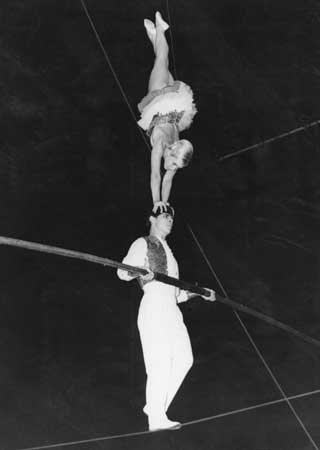
Pas de Deux on the High Wire

Photo credit: dadcentric.com

For Chelsea and Maz, whose wedding last weekend prompted me to dust this off.
And for Patti.

Pas de Deux on the High Wire
by John Unger Zussman

One Saturday, in our twenties,
We put up the tightrope.
Eyed it warily.  No sweat,
We reassured each other.
Piece of cake.

At first, we could barely manage
A few quick steps on the rope,
Stretched taut, inches off the floor.
We’d push out tentatively,
Teeter, recover, flail, step off.
Laugh nervously, try again.

No instructor, no mentor,
Just the trying, and ourselves.
Slowly we learned to center our balance,
Arms extended, touching lightly for support.
The posts grew higher, year by year,
And our moves more intricate.
We took tumbles, gathered bruises.
When one wavers, the rope jiggles,
Endangering the other.
Once I toppled from eight feet.
She came too. It took years
To recover.  The scars
Remind us how we learned.

Now we run, hand in hand, from peak to peak,
Skyscraper to skyscraper, triple pirouette,
Grand jeté, entrechat huit. I partner her
In a deep penché, the tip of her pointe shoes
Balanced on the narrow wire. It is exhilarating
And marvelous. We are confident until,
In middle age, we look down. Then we seem
Unbelievably, foolishly precarious.

Just us two. No children, families distant,
A few friends gazing up from below.
We are working without a net. It is glorious,
Yet there is always the premonition
Of the inevitable gust of wind.

SATURDAY POETRY SERIES PRESENTS: JUDITH NEWTON

LAST QUARTET
By Judith Newton

In the end,
you would no longer hear your music—
you, whose rooms had been alive with it,
whose life was Late Quartet.

I think of you and I remember Beethoven
in a Berkeley house,
the light from quiet windows
heightening the patina of well used surfaces,
ferns, like green swords,
piercing the heart of the afternoon,
and, through the swelling turbulence of the strings—
the counterpoint of intellect
serenely resonant at its labors.

To forgo your music was, for you, the worst farewell,
to live in silence, a dark prelude to what you knew would come.
I think of you in the end—a holy man despite yourself—
bearing your body’s discord with deliberate grace,
and with a tremolo of acquiescence
closing off the sweet vibratos of this world.

I think of you, in this after moment,
when the tone arm lifts, the record ends,
and Late Quartet
still dilates the impassioned air.
(“Last Quartet” appears here today with permission from the poet.)
Judith Newton lives in Kensington, CA. She is the author of several books of nonfiction and is completing a memoir: The Joys of Cooking: A Love Story. She is a food columnist for the iPinion Syndicate, and is completing a book of poetry entitled Poetry for the Immune Deficient.

Editor’s Note: Judith Newton’s poems go straight to the heart of what it is to deal with with loss as the one left behind. I was just talking about this with a dear friend of mine who suffered the loss of his partner, and, like Judith Newton, wrote his way through his struggle. I dedicate today’s post to my friend, who knows what it is to endure loss, and who is in tune with the music inherent in life and death.

Want more by and about Judith Newton?
The Joys of Cooking – A Love Story
iPinion
As It Ought To Be

SATURDAY POETRY SERIES PRESENTS: SEAN KARNS

CUTTING DOWN THE PROPERTY LINE
By Sean Karns

1. Tire Swing

He hacks at the thicket, grabs hold
of the blackberry canes,
bloodies his hands;
blackens them with juices.
He looks at his hands,
sees labor: a future in tearing
down. There are children swinging
on a swinging tire. He wants to join them.
He feels a stare; his father sits
on the porch; it’s mid-day and hot.
The yard is dry grass and dirt.
He feels the thorny sting
to take away
what is in the house
that keeps him hacking.
There’s a silk scarf
his mother left under his pillow.
The tire swing creaks.
A swing that creaks
like a deranged mosquito
singing in his ear.
They swing, seeing
how far the lake.
He rubs the blackness
from his hands,
looks at the house, its tilted porch
and chipped paint.
The dark tree-line
and forgetting the clink
of the doorknob.

2. Woods

He goes farther into the woods;
his father stares—
faces in the bark of every tree.
He wants to drop a match
on the everywhere leaves.
And then the twisting
of the bronze door knob.
He hides his face with the scarf
from the footsteps and the black
polished boots under the bed.
He gathers the sturdiest tree
limbs he can pull
with his thirteen years of strength.
With a hatchet, he cuts the limbs
into logs and hammers
them around a tree.
He stole rope
from his father’s work-shed.

3. Fortress

He peeks out of the hollow
of the oak tree.
He slips on the dewy ground.
His father’s dream-weight
pushes down on him. He swipes the mud
from his lips. The insects
sound like the twist
of a door knob. So do the branches
falling. He throws
the rope over the tree limb,
dollies up his scarf, hatchet and hammer.
There’s no higher place
for him to throw his rope.


(“Cutting Down the Property Line” previously appeared in Mayday Magazine and is reprinted here today with permission from the poet.)

Sean Karns’ work has appeared or is forthcoming in Cold Mountain Review, Folio, Los Angeles Review, Ninth Letter, Mayday Magazine, Pleiades, and elsewhere.

Editor’s Note: There is a weight to the aural nature of the words in today’s piece that alludes to a corresponding heaviness of subject matter. A narrative poem, the story is not neatly laid out for the reader, but instead consonants become palpable, and the story oozes from the language, thick like syrup forcibly drained from a tree deep in the woods.

Want more by and about Sean Karns?
Mayday Magazine (1)
Mayday Magazine (3)
Sean Karns reads his poem “A Rural Weekend”

SATURDAY POETRY SERIES PRESENTS: OKLA ELLIOTT

ON PERFECTION
By Okla Elliott

1.
My arrogance is perfect—
I want everything I say taken down
in italics. I want
footnotes longer than the original text.
Every woman and many men
will want to look into the green almond eye
of my perversion.
They will thank me
for the privilege of disinterested touch.

I claim to be made of starstuff
brought here across a million million miles.

I claim to be happy
in the inevitable loneliness.

2.
The sanctified blade is perfect.

The colossal slowness of dying is perfect.

Everything is exactly as it should be
here where a goat’s shit glistens with the water
of an idyllic river
he drank at hours ago,
hydrating his living (and dying) cells.

I have become a mystic
a perfect destiny
after all these years
of studied incredulity.

The unsanctified flesh is perfect,
I tell you,
because it always-already knew
every kind of love
our holy pornographers pretend
they invented.

3.
The slick tongue of metaphysics
flicks between stained teeth.

A tongue that could wet
dry lips or give a lecture
on Wittgenstein or lick the needy
flesh we hide (stupidly)
most of the enormous time we have.

4.
The spindle pricks the thumb wants
the needle.

A vest of goldthread
should be buried
with the dead.

Everything will rhyme
in the afterlife
as it does in the beforedeath.
It’s as I’ve
said: perfection permeates
the sound fundament
and the cracked firmament.

It’s as I’ve said, tsk tsk,
it’s perfect
just as it is.

The feast prepares itself.

***

(“On Perfection” previously appeared in Zone 3 and in the poet’s latest chapbook, A Vulgar Geography, and is reprinted here today with permission from the poet.)

Okla Elliott is currently the Illinois Distinguished Fellow at the University of Illinois, where he studies comparative literature and cultural theory. He also holds an MFA from Ohio State University. For the academic year 2008-09, he was a visiting assistant professor at Ohio Wesleyan University. His drama, non-fiction, poetry, short fiction, and translations have appeared or are forthcoming in Another Chicago Magazine, Indiana Review, The Literary Review, Natural Bridge, New Letters, North Dakota Quarterly, A Public Space, and The Southeast Review, among others. He is the author of three poetry chapbooks–The Mutable Wheel, Lucid Bodies and Other Poems, and A Vulgar Geography–and he co-edited (with Kyle Minor) The Other Chekhov.

Editor’s Note: Okla Elliot is the Co-Creator and Webmaster of As It Ought To Be. But today’s post is not about nepotism. Today’s post is about excellent poetry and the fact that you ought to be reading it. Recently Okla sent me a copy of his latest chapbook, A Vulgar Geography, at my behest. The first night I read it cover to cover, something I am almost never able to do with books of poetry. There were moments I literally had to put the book down and exclaim out loud to myself with amazement at the brilliance of a line, a moment, an idea. The second night I re-read the book, cover to cover, this time aloud. My mouth took to the words like a finely crafted dessert. The way one consonant rolled into another, the words were tangible morsels on my tongue.

I say this not because Okla is my Editor here at As It Ought To Be. Not because he is my friend, nor because he is an inspiration, though he is these things. I say this because it is true: A Vulgar Geography is a near-perfect book of poetry. From its outward appearance (a simple clean design with a lone, intricate image that reflects the book’s title) to the types of poems chosen (ranging from left-aligned to prose to experimental) to–most importantly–the poems themselves, which are finely crafted masterpieces of thought, idea, story, and word. I highly recommend you don’t take my word for it, but rather, read A Vulgar Geography and find out for yourself.

Want to read more by and about Okla Elliot?
Buy Okla Elliott’s new book, A Vulgar Geography.

SATURDAY POETRY SERIES PRESENTS: W. TODD KANEKO

NORTHWEST POEM
by W. Todd Kaneko

You will find no herons perched
in this poem. No salmonberries or pine
cones on sodden paths through cedar.
But here is an old woman who slices
her calendar into weeks lost and weeks
to come—those piles sifting together
while she waits for the leaves to turn
into blankets full of moths and ravens.

Here is a girl who dwells in dollhouses
deep in this poem, porcelain boys hiding
fingers from whales’ teeth and butterfly
knives. There are no miles of shoreline
lapping at ends of days like wolves,
no fishladders swarming with sockeye,
only a skeleton where the ocean once was.

Extinction begins as absence, ends gaping
like a surgery, a hole in my chest
marking that mythology we call home.
Mount Rainier does not drift phantomlike
in this poem, but here is that old woman,
crooked under the weight of a century.
She waves off that flock of dark birds
thronging overhead, threatening to pluck
eyes from sockets, tongues from mouths,
until all we can discern is the tide washing
over bare feet, the sound of wings.


(“Northwest poem” previously appeared in Lantern Review and is reprinted here today with permission from the poet.)

W. Todd Kaneko lives and writes in Grand Rapids, Michigan. His stories and poems can be seen in Puerto Del Sol, Crab Creek Review, Fairy Tale Review, Portland Review, Southeast Review, Blackbird and elsewhere. He has received fellowships from Kundiman and the Kenyon Review Writer’s Workshop. He teaches at Grand Valley State University.

Editor’s Note: In response to today’s poem I say, “Thank God for stunning moments in poetry!” If not God, then The Universe, Creative Energy, The Muse. Here’s to W. Todd Kaneko’s muse, at the very least. She is a creature to be awed and honored.

Want to read more by and about W. Todd Kaneko?
Blackbird
Superstition Review
Word Riot

SATURDAY POETRY SERIES PRESENTS: CATHERINE PIERCE

FIREFLY
by Catherine Pierce

Its six legs coated with disease, it’s vulgar
like the aphid, the earwig. Its eyes are nightmare

globes. It does not love you or thank you
for the glass jar with air holes. Still, you want it

in your hands. Not for its yellow light like the soft
glow in the wooded cabin. Not for the vibrating

wings against your palms like champagne
bubbles bursting. Not even for the perfect

metaphors that ride on its sunflower-seed back—
the catching of a gone childhood, the memory

of keeping something alive. You pursue it
because it’s a slow beast, easily captured. Because

it hovers and floats. Because you can win at this,
and because it will fly off when you unfold

your hands, single-minded, unmoved by its loss.

 
(“Firefly” previously appeared in AGNI and is reprinted here today with permission from the poet.)
Catherine Pierce is the author of Famous Last Words (Saturnalia, 2008) and The Girls of Peculiar (forthcoming from Saturnalia in 2012). Her poems have appeared or are forthcoming in Slate, Ploughshares, Boston Review, Best American Poetry 2011, and elsewhere. She lives in Starkville, Mississippi, where she teaches and co-directs the creative writing program at Mississippi State University.

Editor’s Note: I saw my first firefly this summer. I know, for those of you who grew up in the Midwest or on the East Coast this is a bit blasphemous, but we don’t have fireflies in San Francisco. I’ve dreamt of seeing one for as long as I can remember, and this summer, when conditions were right, someone who loves me very much and wanted to make my dream of fireflies a reality took me to an enchanted garden, and, lo and behold–magical creatures of my imagination! To me, today’s poem is as if looking at fireflies through Alice’s Looking Glass. I never understood why people would want to contain the creatures, how children could tear their glowing orbs from their bodies and wear them on the tips of their fingers.

Today’s poem is about the darker side of the allure of the firefly. Those human traits that make people want to capture them, to keep them in jars, to pursue only for the sake of the chase. Of course, as with so much poetry, today’s poem is also about human nature. “It does not love you or thank you / for the glass jar with air holes. Still, you want it / in your hands… Because you can win at this, / and because it will fly off when you unfold /your hands, single-minded, unmoved by its loss.”

Want to read more by and about Catherine Pierce?
Catherine Pierce Official Website
The Paris Review
Blackbird
Diode
Anti-Poetry

SATURDAY POETRY SERIES PRESENTS: DOROTHEA GROSSMAN

THE TWO TIMES I LOVED YOU THE MOST IN A CAR
by Dorothea Grossman

It was your idea
to park and watch the elephants
swaying among the trees
like royalty
at that make-believe safari
near Laguna.
I didn’t know anything that big
could be so quiet.

And once, you stopped
on a dark desert road
to show me the stars
climbing over each other
riotously
like insects
like an orchestra
thrashing its way
through time itself
I never saw light that way
again.


(“The Two Times I Loved You the Most In A Car” previously appeared in Poetry Magazine and Askew Poetry, and is reprinted here today with permission from the poet.)


Dorothea Grossman: I have no bio for Dorothea Grossman, who is a bit of an enigma, but you can read an interview with her from Poetry Magazine here.

Editor’s Note: Some poems speak for themselves. And if the poet herself doesn’t need a bio, perhaps it’s evidence that this poem doesn’t need me to say much, if anything, on its behalf. I will say only that I love the simplicity, the way this poem evokes a kind of nostalgia that most everyone can relate to, and I must compliment the poet on a killer end line.

Want to read more by and about Dorothea Grossman?
Poetry Magazine
The Outlaw Poetry Network
Video: Dorothea Grossman and Michael Vlatkovich