AND THERE’S SOMETHING ABOUT SOFTNESS
By Gili Haimovich
People are still flirting
with trying to look younger,
to make each other laugh.
Their existence is softened
by the luxuries of having some time, some needs, met.
People are still eager,
not too tired of being keen,
I have found out
among the snow banks,
pushing
the stroller of my soft new baby.
Today’s poem appears here today with permission from the poet.
Gili Haimovich is an international poet and translator who writes in both Hebrew and English. She has six volumes of poetry in Hebrew, including her most recent, Landing Lights (Iton 77 Publishing House), which received a grant from Acum, as did her previous book. She also received a grant nominating her as an outstanding artist by the Ministry of Immigrant Absorption on 2015. Her poetry in English is featured in her chapbook, Living on a Blank Page (Blue Angel Press, 2008) and in numerous journals and anthologies, such as Poetry International, International Poetry Review, Poem Magazine, LRC – Literary Review of Canada, Asymptote, Drain Magazine, Blue Lyra, Circumference, TOK1: Writing the New Toronto and Mediterranean Poetry, as well as main Israeli journals and anthologies such as The Most Beautiful Poems in Hebrew (Yedioth Ahronot Books, 2013). Her poems have been translated into several languages including Chinese, French, Italian, Bengali, and Romanian. Gili is also presenting her work as a photographer, teaches creative writing, and facilitates writing focused arts therapy.
Editor’s Note: Today’s poem excels in the realm of wordplay. Double entendres luxuriate in a language that is as rich as it is simple, as straightforward as it is complex. The poet’s clear love of language — the sheer joy of it — culminates in a narrative of the unexpected, in a revelation that demands we enter the poem again and consider it anew. Delicate and layered, this poem is a labor of love that offers the reader the fruits of its bounty.
In need of air, she unhinged every
window, revolving ones downstairs,
upstairs skylights, mid-floor French doors,
swept into the house the salt-brine,
the cricket chirp, the osprey whistle,
the sea-current, sound of the Sound,
but had not noticed the basement
bedroom window shielded by blinds,
screen-less. Later that night when they
returned home, lights illuminating
the downstairs hall, insects inhabited
the ground floor rooms. She carried handfuls
of creatures across a River Styx—
the katydids perched on lampshades,
beach tiger beetles shuttling across
floorboards, nursery web spiders splotching
the ceiling—trying to put back
the wild fury she had released.
Elise Paschen is the author of Bestiary, Infidelities (winner of the Nicholas Roerich Poetry Prize), and Houses: Coasts. Her poems have been published in numerous anthologies and magazines, including The New Yorker and Poetry Magazine. Co-editor of Poetry Speaks and Poetry in Motion, she teaches in the MFA Writing Program at the School of the Art Institute of Chicago. Her forthcoming book of poetry, The Nightlife, will be published in spring 2017.
Editor’s Note: “After the Squall” is a masterpiece of sound and image. A modern retelling of Pandora’s Box, this rich, vivid poem reaches a perfect crescendo with it’s killer end-line: “trying to put back / the wild fury she had released.” Careful, concise, and expertly wrought, this poem is a stellar example of fine poetic craft.
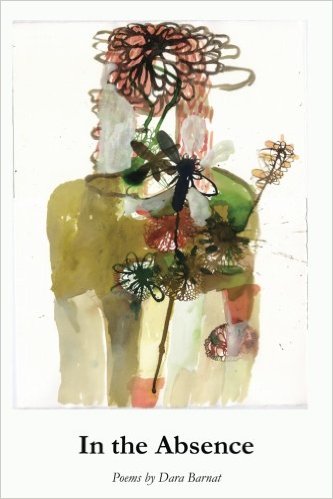
In the Absence: Dara Barnat’s In the Absence evokes a yearning of the spirit so strong that it becomes presence, its light unstopped.
Dara Barnat is the author of the poetry collection In the Absence (Turning Point, 2016), as well as Headwind Migration, a chapbook (Pudding House, 2009). She also writes critical essays on poetry and translates poetry from Hebrew. Her research explores Walt Whitman’s influence on Jewish American poetry. Dara holds a Ph.D. from The School of Cultural Studies at Tel Aviv University. She currently teaches at Tel Aviv University and Queens College, CUNY.
Editor’s Note: Dara Barnat’s first full-length collection begins by declaring that “Dark is just dark.” But the assertion casts a shadow question: Is dark just dark? For it is light that is at the heart of this work: “I close my hand around a filament of sun as it filters / through the window, try to catch / its meaning, / but light is just light.”
But “light is just light” is no more the truth of these poems — and the poet’s journey that unfolds across them — than “dark is just dark.” This work is neither a book of questions nor of answers. Instead, In the Absence is an honest experience of grief that explores the inevitable, never-ending pilgrimage inherent within loss: “I hear you’re gone and I fall with you. / In that place part of me stays, / like a hand in clay.”
Not since Li-Young Lee’s Rose have I been so slain by a book of mourning. Like Rose, In the Absence mourns the loss of a father while acknowledging that such a loss is anything but simple, that the complications of life remain a reckoning for the living. “The imprint holds the loss of everything. / It holds what we thought was joy.”
Held close within this incredibly moving and painstakingly wrought collection is a poem titled “Walt Whitman.” I had the honor of featuring this poem here on the Saturday Poetry Series in 2013 as I marked my father’s first yahrzeit (Jewish death anniversary). Tomorrow will be five years since my father’s death. What at one year could be commemorated with a single poem, five years later needs an entire book. Such is the nature of grief — it does not diminish; it grows. And in its growing it becomes more painful and more beautiful all at once.
In the Absence transforms the poet’s personal grief into communion. I will re-read this book tomorrow as I remember my father on his five-year yahrzeit, and I will grieve. But, more than that, I will say a prayer that is the poet’s and is my own: “May we live / a thousand years together, / in another life.”
It is hard to quiet the blackberrying pain.
The little chronicles, the streaks, and the intimate workings.
I will face this by red-winging my truths.
I will push my blues into orchids.
BALLAD
I decided to claim more space
But I chose the opposite
What are the words I would go to: hunger// longing// love
When you feel drawn to something you should.
Whatever your terrible is is up to you.
The question is how you lead.
I lead myself to distress; I lead myself to happiness.
This is the history of our times.
I claw my way to the surface.
I get a hold of this world with my teeth
& wolf down what I thirst for.
How do I take the I out of here?
(why should I take the I out?)
*
I am always hungry
I am always thinking of my next meal
Is it the preemie in me?
Is it just the want?
*
We all have our oddities.
I am always trying to be practical, logical, rational,
but it doesn’t always add up.
There is so much of my life that I am forever holding under the light.
What falls below the seam?
What falls outside of this poem?
*
I want to put the happy in.
I want to put the hard world in.
I want to say this is a ballad, and so it is.
Let’s enter it differently.
Any mammal feeds a hunger
Any heart needs oxygen.
CARNAGE
Everyone is saying no to me
Just as they do now
Just as they will
A kind of civil riot
A staged parade
It makes every kind of sense
That carnage that comes with falling hard,
That carnage that hassles and times,
That carnage that language picks up;
I am wanting to be picked up.
It is rarely an accident.
Elements are employed
Pounds are ranged
The number of possible routes are lost
All to force my foot door to door
To match the heart of my drive to
Coffee after coffee after coffee.
Take me as a whole,
Take these birds outside my window
Alive with the world’s chirp
Alive with the everyday thrill of
Worm or bug or crumb. Take them,
Then remember my thrills.
Everyone is saying no to me,
And I am flummoxed each time
I ask for more; or try for more.
I strive and I strive.
That’s the 21st century calling.
It’s doable. I travel great lengths
So I can match the heart
With the focus of each and every obstacle.
Can there be a rallying point?
This is not an accident.
(Is that what I should be learning here?)
Well, isn’t that magnificent.
“Hard” originally appeared in Thrush, “Ballad” originally appeared in The Inquisitive Eater, and “Carnage” originally appeared in Queen Mob’s. These poems appear here today with permission from the poet.
Leah Umansky is the author of the poetry collection, The Barbarous Century, forthcoming from London’s Eyewear Publishing in 2018, the dystopian-themed chapbook Straight Away the Emptied World (Kattywompus Press, 2016), the Mad Men–inspired chapbook Don Dreams and I Dream (Kattywompus Press, 2014), and the full length Domestic Uncertainties (BlazeVOX, 2012). She is a graduate of the MFA Program in Poetry at Sarah Lawrence College and teaches middle and high school English in New York City. More at www.LeahUmansky.com.
Editor’s Note: It seems I can’t read (or write) anything these days without seeing it through the lens of politics. Least of all poetry. Today’s poems — at once political and private — may or may not have been crafted to address the current moment. And yet they can be read as a direct address and used, accordingly, as a salve. What can we do, we ask? “I will face this by red-winging my truths,” says the poet; “I will push my blues into orchids.” Even in an ars poetica the poet’s words can function as a mirror: “The question is how you lead. / I lead myself to distress; I lead myself to happiness. / This is the history of our times.” No matter their intent, today’s poems are in the world now, speaking to us as they will. They might incite action or nurse wounds or take stalk of our humanity. “Take me as a whole,” they say, “Take these birds outside my window / Alive with the world’s chirp / Alive with the everyday thrill of / Worm or bug or crumb.”
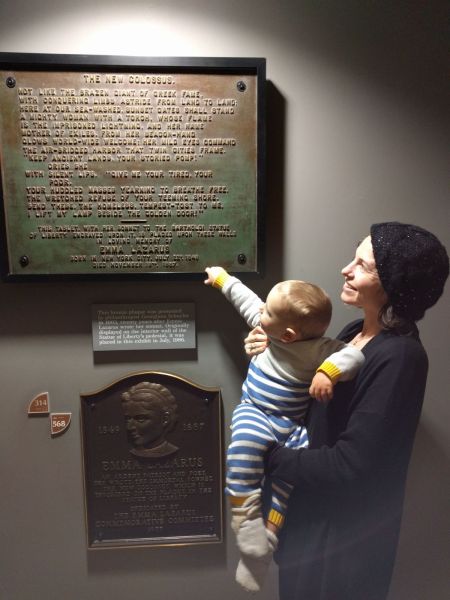
Yours faithful editor, with 14-month-old son in tow, visiting “The New Colossus” at the Statue of Liberty Museum, Liberty Island, NY THE NEW COLOSSUS
By Emma Lazarus
Not like the brazen giant of Greek fame,
With conquering limbs astride from land to land;
Here at our sea-washed, sunset gates shall stand
A mighty woman with a torch, whose flame
Is the imprisoned lightning, and her name
Mother of Exiles. From her beacon-hand
Glows world-wide welcome; her mild eyes command
The air-bridged harbor that twin cities frame.
“Keep, ancient lands, your storied pomp!” cries she
With silent lips. “Give me your tired, your poor,
Your huddled masses yearning to breathe free,
The wretched refuse of your teeming shore.
Send these, the homeless, tempest-tost to me,
I lift my lamp beside the golden door!”
(Today’s poem is in the public domain, belongs to the masses, and appears here today accordingly.)
The New Colossus: “In 1883, a young writer, Emma Lazarus, donated a poem to an auction raising funds for the pedestal of the Statue of Liberty. ‘The New Colossus’ vividly depicted the Statue of Liberty as offering refuge from the miseries of Europe. The sonnet received little attention at the time, but in 1903 was engraved on a bronze plaque and affixed to the base of the Statue. Still, it was only in the late 1930’s, when millions fled fascism, that the poem became fully identified with the Statue.
“Between 1886 and 1924, 14 million immigrants entered America through New York. The Statue of Liberty was a reassuring sign that they had arrived in the land of their dreams. To these anxious newcomers, the Statue’s uplifted torch did not suggest ‘enlightenment,’ as her creators intended, but rather, ‘welcome.’ Over time, the Statue of Liberty emerged as Emma Lazarus’ ‘Mother of Exiles,’ a symbol of hope to generations of immigrants.”
— “Mother of Exiles” historical marker, Statute of Liberty Museum, Liberty Island, NY
Editor’s Note: Forget the wall. Lift the ban. Let Lady Liberty’s torch, once again, be a beacon of welcome. You want to make America great again?
Give me your tired, your poor, your huddled masses yearning to breathe free. Give me your tired, your poor, your huddled masses yearning to breathe free. Give me your tired, your poor, your huddled masses yearning to breathe free. Give me your tired, your poor, your huddled masses yearning to breathe free. Give me your tired, your poor, your huddled masses yearning to breathe free. Give me your tired, your poor, your huddled masses yearning to breathe free. Give me your tired, your poor, your huddled masses yearning to breathe free. Give me your tired, your poor, your huddled masses yearning to breathe free. Give me your tired, your poor, your huddled masses yearning to breathe free. Give me your tired, your poor, your huddled masses yearning to breathe free. Give me your tired, your poor, your huddled masses yearning to breathe free. Give me your tired, your poor, your huddled masses yearning to breathe free. Give me your tired, your poor, your huddled masses yearning to breathe free. Give me your tired, your poor, your huddled masses yearning to breathe free. Give me your tired, your poor, your huddled masses yearning to breathe free. Give me your tired, your poor, your huddled masses yearning to breathe free. Give me your tired, your poor, your huddled masses yearning to breathe free. Give me your tired, your poor, your huddled masses yearning to breathe free. Give me your tired, your poor, your huddled masses yearning to breathe free. Give me your tired, your poor, your huddled masses yearning to breathe free. Give me your tired, your poor, your huddled masses yearning to breathe free. Give me your tired, your poor, your huddled masses yearning to breathe free. Give me your tired, your poor, your huddled masses yearning to breathe free. Give me your tired, your poor, your huddled masses yearning to breathe free. Give me your tired, your poor, your huddled masses yearning to breathe free. Give me your tired, your poor, your huddled masses yearning to breathe free. Give me your tired, your poor, your huddled masses yearning to breathe free. Give me your tired, your poor, your huddled masses yearning to breathe free. Give me your tired, your poor, your huddled masses yearning to breathe free. Give me your tired, your poor, your huddled masses yearning to breathe free. Give me your tired, your poor, your huddled masses yearning to breathe free. Give me your tired, your poor, your huddled masses yearning to breathe free. Give me your tired, your poor, your huddled masses yearning to breathe free. Give me your tired, your poor, your huddled masses yearning to breathe free. Give me your tired, your poor, your huddled masses yearning to breathe free. Give me your tired, your poor, your huddled masses yearning to breathe free. Give me your tired, your poor, your huddled masses yearning to breathe free. Give me your tired, your poor, your huddled masses yearning to breathe free. Give me your tired, your poor, your huddled masses yearning to breathe free. Give me your tired, your poor, your huddled masses yearning to breathe free. Give me your tired, your poor, your huddled masses yearning to breathe free. Give me your tired, your poor, your huddled masses yearning to breathe free. Give me your tired, your poor, your huddled masses yearning to breathe free. Give me your tired, your poor, your huddled masses yearning to breathe free. Give me your tired, your poor, your huddled masses yearning to breathe free. Give me your tired, your poor, your huddled masses yearning to breathe free. Give me your tired, your poor, your huddled masses yearning to breathe free. Give me your tired, your poor, your huddled masses yearning to breathe free. Give me your tired, your poor, your huddled masses yearning to breathe free. Give me your tired, your poor, your huddled masses yearning to breathe free. Give me your tired, your poor, your huddled masses yearning to breathe free. Give me your tired, your poor, your huddled masses yearning to breathe free. Give me your tired, your poor, your huddled masses yearning to breathe free. Give me your tired, your poor, your huddled masses yearning to breathe free.
Poet’s Note: “This poem was written well before [the 2017] Presidential Inauguration and without this event in mind. But it seems a day worth remembering the fate of our shared planet and all its beings, human and beyond.” —Jane Hirshfield, via The Academy of American Poets
Editor’s Note: Today I defer to Jane Hirshfield and The Academy of American Poets. Listen to the poet read this important work of protest. Read the poem in its entirety.
Today’s poem is dedicated to those who are marching with the Million Woman March and those who stand with us in solidarity.
I ASK FORGIVENESS
By Alex Ben-Ari
Translated by Vivan Eden
I ask forgiveness of all the poems
Born misshapen because of my desire to write them
I ask forgiveness of all the people
Whose lives were disrupted by my desire to influence
And of the world
For the superfluous things added to it
And those unnecessarily severed
Because of my lust for symmetry
And happy endings.
I ask forgiveness of my mother
For not knowing how to love her in her misery
Of my children
For the moments when I don’t want them
Of my wife for every time I was too small
To contain her love.
I am lighter than a falling leaf
I am softer than grass
Now a small bird could
Build its nest in me.
Today’s poem originally appeared in Haaretz and appears here today with permission from both the poet and translator.
Alex Ben-Ari is 43 years old. His debut volume of poetry, Concealed Seas (Yamim Samuiim), was awarded honorable mention at the 2008 Metulla Poetry Festival and the 2015 Helicon/Ramy Ditzanny Poetry Prize. His second book, The Gatepost (Korat Hasha’ar), published in 2015, is composed of his original Hebrew haiku. His third book, planned to be published during 2017, is a volume of conceptual poetry.
Alex is one of the six members of the “Waning Moon” blog and publishing house dedicated to Haiku in Hebrew. He is also co-editor (with poets Gilad Meiri and Noa Shkargy) of Nanopoetica, a literary journal of short form literature.
Editor’s Note: Part personal, part pastoral, part ars poetica, today’s poem is emotive, honest, and raw. The poem’s I approaches the reader — and the page — seeking forgiveness. Free from false modesty, free from pride, the poem’s I is humble, admitting failings as poet and father, husband and son. The confessional, narrative nature of the poem is carefully constructed within the framework of the lyric, while the elegant, gentle translation midwives the essence of the poem as it crosses the borders of language. As the reader, we cannot help but be moved — to compassion, to transcendence, to forgiveness and beyond.
Editor’s Note: Each year for Hanukkah I make sufganiyot. Measuring out the ingredients from my mother’s recipe, I will myself to have the patience necessary to wait for yeast to rise. I knead the dough with equal parts pressure and love then apply more patience, more waiting, before rolling and cutting “pale circles,” transforming them in oil into “doughy moons inflating.” Each year I make sufganiyot, and each year when I do, I think of this poem. It has been four years since I first featured this poem on the Saturday Poetry Series, and it has been with me each year since, an indelible part of my Hanukkah tradition.
As sensual as this poem is — as hot — it is very much a poem about tradition, about ritual, and about the coming together of women. For it is women who have traditionally ruled the domain of the Jewish kitchen, and women who, year in and year out since time immemorial, have applied their pressure and patience, their love and their care, to wright the delicious sustenance that is Jewish holiday food. And what, really, brings us together in our rituals and traditions more than food?
Each year as my best friend and I make our sufganiyot together, my mother makes the same recipe 2,500 miles away. Meanwhile, women all over the world are doing the same: “There, and here, / a million women finger / these cupped curves.” Each year, today’s poem reminds me of that disparate togetherness of women. This year I reprint this poem in honor of the women all over the world who do the work necessary to make the holiday season what it is.
May this season of light be a beacon in the darkness, and may the new year be better than the last.
ON WHY I NO LONGER SIT AT THE WINDOW SEAT ON A TRAIN
By Kelly Cressio-Moeller
Germany was like a step-mother: utterly familiar, utterly despised. ~ Erica Jong
It’s a good day for a lie-down, overcast and
wet-wooled – even the rain wants to be horizontal.
I am day-dreaming of goose down when I
enter the train, scoot into an open seat,
press my cheek against the streaked window.
The station’s soothing voice announces,
Zurückbleiben bitte, someone runs in just before
the doors close, slams me against the side
of the compartment, takes a lungful of my air.
In an accent foreign as my own, he asks
my name, if I “want some fun” back
at his room. I buy time before the next stop,
tell him I’m “Whitney from America”
(anything but my real name in his mouth).
Now he locks his arm through mine and thick
fingers jab my ribs. His leg, an anchor –
his pocked face smirks like he’s already
notched his belt.
I imagine the defence move my brother
taught me where I smash my palm heel into
some asshole’s nose, shifting bone into brain.
(Where is my Siegfried in this country of the
“Nibelungenlied”. What would Kriemhild do?)
My eyes ransack the forest of businessmen,
cutpurses, hausfraus, the heroin chic: rows of
enameled faces, cow-dumb, indifferent as teeth.
Let the Ausländer fight it out!
Thigh-grab, elbow-jab, hand-slap – his broken
English splinters the air. Whitney Houston
in my head singing “I Will Always Love You” on
some godforsaken loop as I mentally run through
my list of German imperatives: Hilfe! Polizei!
Vergewaltigung! (a word that takes longer to say
than the act it defines). I backhand him across
the mouth, escape before the doors slam.
He’s waving (waving!) through the glass,
a blurry fat-lipped sneer retreating – the air
staccatoed with rasps of my breath. It begins
to hail marbles (even the gods are throwing stones),
feathers or lightening bolts would feel just the same.
Only later with candlelight und Butterkuchen,
do I re-surface to Vivaldi’s soaring strings on the radio.
I mention my morning combat-commute.
My host shrugs his shoulders before loading
the Meissen with another helping of Schadenfreude.
He says, Da muβ man durch : ‘one must go through it’ –
as if it were a tunnel, something to be run through.
** The line What shall I wish for myself? is a reworking Mary Oliver’s line What shall I wish for, for myself?
Today’s poem originally appeared online in Tinderbox Poetry Journal, Issue 1 and appears here today with permission from the poet.
Kelly Cressio-Moeller has new work forthcoming in Radar Poetry and has been previously published at Boxcar Poetry Review, burntdistrict, Crab Orchard Review, Gargoyle, Poet Lore, Southern Humanities Review, THRUSH Poetry Journal, Tinderbox Poetry Journal, Valparaiso Poetry Review, and ZYZZYVA among others. Her poems have been nominated for three Pushcart Prizes, Best New Poets, and Best of the Net. She is an Associate Editor at Glass Lyre Press. Visit her website at www.kellycressiomoeller.com.
Editor’s Note: During the dark days this November I delved into poetry as a kind of antidote, and in this way I arrived at today’s poem. Incredibly timely, it speaks to an experience that is all too common and far too marginalized. “I moved on her like a bitch,” America’s President-elect said, “I did try and fuck her,” he said, “Grab them by the pussy,” he said; “You can do anything.” And I thought, “anything but my real name in his mouth.” I thought, “even the gods are throwing stones.” I thought this poem. And those who have no idea what this poem is about, those who do not have to regularly question their safety, those who are unsympathetic to this experience– “one must go through it,” those people say. “[A]s if it were a tunnel, something to be run through.”
On the days when we wept—
and they were many—we did it
over the sound of a television
or radio, or the many engines
of the sky. It was rarely so quiet
we could hear just our sadness,
the smallness of it
that is merely the sound of wind
and water between the many pages
of the lungs. Many afternoons
we left the house still crying
and drove to a café or the movies,
or back to the hospital where we sat
dumb under the many eyes
of Paul Klee. There were many
umbrellas, days when it refused
to rain, cups of tea ignored. We
washed them all in the sink,
dry eyed. It’s been a while,
we’re cried out. We collect pauses
and have taken to reading actual
books again. We go through them
like yellow lights, like tunnels
or reunions, we forget which;
the older you are the more similes,
the more pangs per hour. Indeed,
this is how we break one hour into
many, how healing wounds time
in return. And though we know
there will always be crying to do,
just as there’s always that song,
always a leaf somewhere in the car,
this may be the only sweetness left,
to have a few griefs we cherish
against the others, which are many.
Today’s poem first appeared via The Academy of American Poets’ ‘Poem A Day’ series, was then published in the collection Dementia, My Darling (2016 Red Hen Press), and appears here today with permission from the poet.
Brendan Constantine‘s work has appeared in Prairie Schooner, FIELD, Ploughshares, Virginia Quarterly, and Hotel Amerika, among other journals. His most recent collection is Dementia, My Darling (2016 Red Hen Press). He has received grants and commissions from the Getty Museum, James Irvine Foundation, and the National Endowment for the Arts. He currently teaches poetry at the Windward School and regularly offers classes to hospitals, foster homes, veterans, and the elderly.
Editor’s Note: I’m just going to come out and say it: You need this poem. Right now. At this moment. In the wake of tragedies too hard to hold and too heavy to bear. You have watched the sky fall. You have been broken by the debris of what you thought to be true, of what has and has not been shattered. All that you know in your heart about what is right and what is wrong, about human kindness and decency, about the kind of country you want to live and raise your children and grow old in, the kind of world you want this to be. It’s all fallen apart. And that sadness you feel? That resistance to getting out of bed in the morning? Those spontaneous tears you find yourself bursting into? You are not alone. You. Are. Not. Alone.
But this poem. This poem! This poem knows our suffering. This poem knows our shared grief. This poem knows that “On the days when we wept— / and they were many—we did it / over the sound of a television.” This poem knows that “Many afternoons / we left the house still crying.” And this poem knows, too, that there is a time beyond this time — for better or worse — that the day will come when we are cried out, when we will read books again and reach milestones, and yet. And yet this poem knows that some griefs we will carry with us. Held fast by markers like where you were when Kennedy was shot or when 9/11 happened. This poem knows that there are “a few griefs we cherish / against the others, which are many.” And we know that this moment in American history is one of those griefs we will cherish against the others, which will be many.




 As It Ought To Be