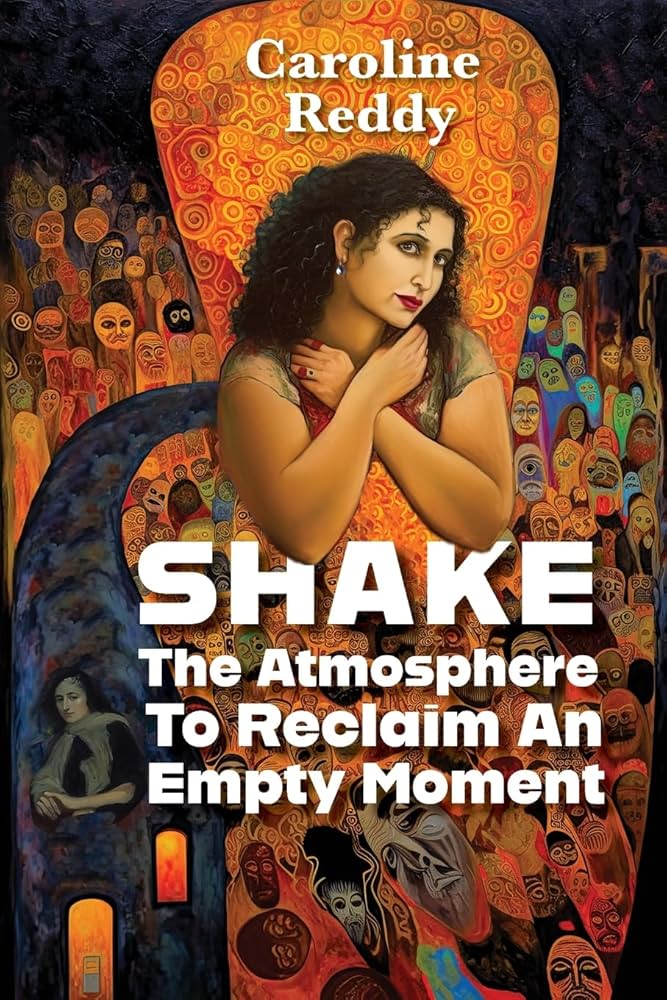
Scott Ferry Reviews “Shake the Atmosphere to Reclaim an Empty Moment” By Caroline Reddy

A Review of

Shake the Atmosphere to Reclaim an Empty Moment

By Caroline Reddy

In Caroline Reddy’s Shake the Atmosphere to Reclaim an Empty Moment she emerges from the skull of modern warfare and violence a fully grown Athena, in her “steampunk space suit / underneath the human skin” wielding her weapons of language: “I release my daggers / after years of betrayal / molting into a warrior.” Being of Iranian and Ghanaian heritage, she brings the power and songs of her elders as a way to unify the world’s discord: “My ancestors / who protected mountains, / climb on opposite / sides of the world / to bring me harmony.” Through her poignant and powerful verse, Reddy triumphs in her goal to preserve the holiness: “After our last dokusan / when I told you about / how music had been murdered / you requested / that I keep the legacy / of the world alive.” 

She has been through terror herself, in Tehran: “Hold still child / to the fuzzy blanket / until the siren stops” and she knows the fear of the children in current conflicts, Ukraine, Gaza, and how to somehow heal and transmute these atrocities into song of spirit: “We have learned that harsh moments / can be alchemized into particles of light / that unfurl from Indra’s net / to help us on our ascension.” 

In this way, her book becomes timely and crucial to somehow processing our present grief and anger at the continued killing of innocents on this earth. Reddy, in assuming the role of poetic warrior and magician, allows us to ride the brightness of her robe, the glint of her spear, the clarity of her words. We feel this with her because we have been there: “but i had been beaten / and belittled by so many / that i didn’t believe / in my own myth.” But this is an intimate battle done in the darkest places, and this is what makes it even more transformative once the light is found:

I closed my eyes and let the tears drip 
and dreamt of the quartz crystals to pour,
for the light of Earendil appeared
and the planets smiled
as I began to widen:
beyond the shadows
beyond the bitter wind.

She transforms ashes into fire, necrotic tissue into stem cells, violence into compassion and unity. As she states:
Songs rise from the ashes
as Qoqnoos burns away debris 
of thistles and last bits of sterile soil 
from the chambers of my heart.

The spring Equinox brings Nowruz
as I tumble through tombs
and burst from beneath the snow
like a lustrous tulip.


In this collection, Reddy takes in all of the rancor and cruelty she has faced, and others continue to suffer, and reanimates them as feathered things which guide us also to emerge from this torment as changed beings. She becomes a mother of birds, of hope: “I dream of a womb / where the ashes of a wondered bird / do not spoil.” With much of the poetry written being one of victimhood and being caged within a sadness or a trauma, Reddy’s work elevates to a level of one who has walked the desert for forty days and forty nights and who has come back with these ethereal and thunderous truths, this glowing body and this glowing sword. This is a wonderous book. Reddy invites us to all to once again believe our own myths.

About the Author: Scott Ferry helps our veterans heal as a RN in the Seattle area. His book Sapphires on the Graves is coming out from Glass Lyre Press in late 2024.

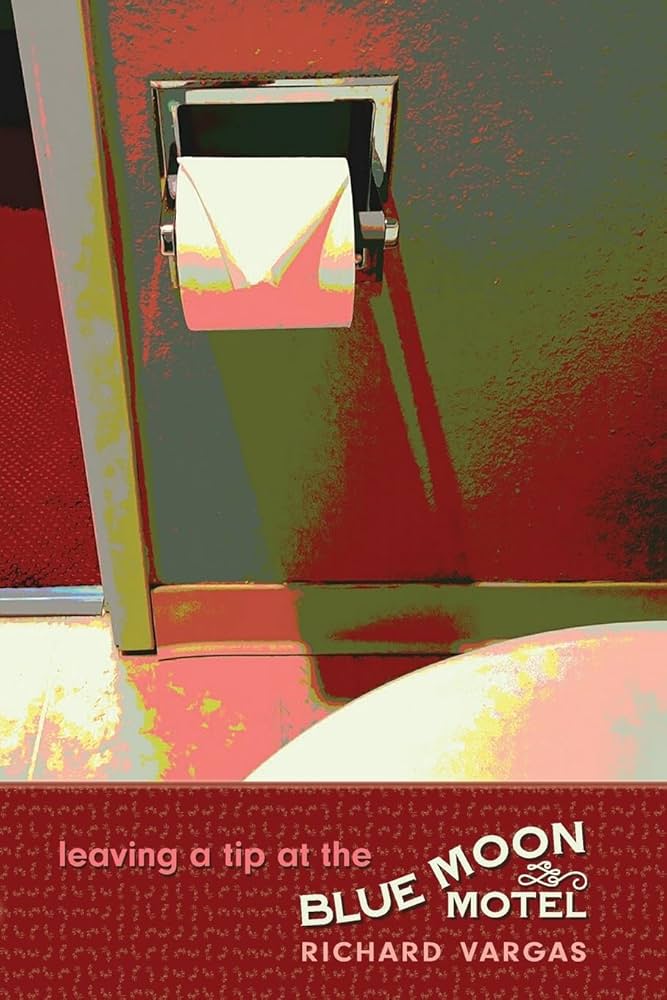
A Review of leaving a tip at the Blue Moon Motel By Richard Vargas

leaving a tip at the Blue Moon Motel

By Richard Vargas:

a book review

By J.T. Whitehead

I want to hit on about three things, all of which intersect, in praising Richard Vargas’s collection, “leaving a tip at the Blue Moon Motel.” I want to talk a little bit about what it means to do a ‘political poem,’ in the loosest sense that this means. Meaning: I want to talk about writing from direct experience, as opposed to writing from theory. This brings up Vargas’s unique sense of empathy. And last, I want to talk about style just a little bit, to remind us all that clarity and clean writing is not an abandonment of it. All these things explain why I like Richard Vargas’s poetry.

In an anthology of essays titled “Poetry and Politics,” edited by Richard Jones, I want to say I recall the poet Denise Levertov making a succinct point about some of what we call “political poetry.” She alluded to Bertolt Brecht’s version of the political poem as something akin to “marching orders.” I remembered this and wrote it down and it has stuck with me, but I don’t have the patience to re-read her essay right now. So if she did not characterize some political poetry, like Brecht’s, as something like “marching orders,” then let me do so now, and continue to credit her with the idea, just in case.

Don’t get me wrong. A theoretician or an academic poet who cares about humanity, without having experienced the bad jobs or prison experience he or she writes about, is still on the human and not the dehumanizing side of things. Bertolt Brecht was on the side of humanity. But when poets write about such things from some place other than their own experience, they must invariably do so in the third person, or do so in an abstract or at least imagined way. We, as readers, tend not to relate as much to such work. But Vargas only writes about what he has experienced himself, without assuming to understand worse. He wonders about it, and more on that later, but he never presumes.

Continue reading “A Review of leaving a tip at the Blue Moon Motel By Richard Vargas”

A Review of “What Is Left” By Bunkong Tuon

Shawn Pavey Reviews

What is Left

By Bunkong Tuon

In What Is Left, part of Jacar Press’ “Greatest Hits” chapbook series, Bunkong Tuon brings us on his personal journey as a child refugee of the Khmer Rouge’s atrocities in his homeland of Cambodia. As David Rigsby states in his insightful foreword, “Bunkong Tuon’s childhood took place in a country whose national life in the 1970s underwent unimaginable depredation at the hands of the Khmer Rouge: slaughter, torture, starvation, and the forceful smashing and separation of families.”

To set the tone for the entire collection, the titular opening poem, recently announced as a winner of the 2024 Pushcart Prize, begins:

What is left after war is the gratitude for what is left.
My dreams are filled with ghosts looking for home.
The dead speak to the living through my poetry.
Each time I write, I rebuild. Retrieve what was stolen.

Tuon, while being open about struggle and loss and deep, deep pain, infuses each of these poems with an almost incessant sense of hope. This is one of the most surprising aspects of this work: how Tuon navigates the telling of his story yet, somehow, gives the reader a sense that the life he leads now is both unexpected and a joy. However, as this first poem continues, Tuon, soberly, informs the reader:

Nothing is dead until I let it. English is not the language
Of my birth. It is the language of death. More bombs
Dropped on Cambodia's countryside than in Hiroshima
And Nagasaki. I was bombarded by this language.

I had no choice but to use it.

Tuon references, of course, the covert bombing of Cambodia by the United States from 1969 to 1973 designed to minimize the capabilities of the People’s Army of Vietnam. Tuon as a small child knows America as bombs, destruction, and death. During the reign of the Khmer Rouge, more than a million people were executed – more than 13% of the country’s total population. Families were shattered and much of the country’s population fled the atrocities as refugees.

This is the historical backdrop for Tuon’s poems. The second poem, Under the Tamarind Tree, Tuon reveals a memory of sitting on the lap of an aunt – a child herself – witnessing the funereal rites performed by monks for his mother.

The tree stands still, quiet, 
indifferent. The house sways 
on stilts. 

Monks in saffron robes
and nuns with shaved heads,
lips darkened with betel-nut stain, 

sit chanting prayers 
for the child’s mother. 
Incense perfumes the hot dry air.

The image is heartbreaking but the true marvel is Tuon’s sparse yet musical language. He writes these poems with an almost journalistic detachment, avoiding the temptation to overwrite the emotional vulnerability. Tuon shows us, with his carefully chosen lexicon, the sheer tragedy and loss of this moment experienced by a child in the care of a slightly older aunt. The poem concludes:

Each time the child hears prayers
coming from the house, he cries;
each time he cries, the aunt, a girl herself, 
pinches the boy’s thigh.

It is that last line that shares with the reader the absolute cruelty of the moment. The funeral is witnessed as a result of institutional cruelty, but that tiny act of violence, the thigh-pinch of the aunt on the crying boy’s thigh shows that in that moment, there was little time to grieve. Survival of what lies ahead will require its own toughness.

The next few poems detail Tuon’s refugee journey. In “The Carrying,” he gives us a glimpse of their long journey – on foot – as his grandmother carried the small boy on her back to the refugee camp. In the poem “Gruel,” Tuon recalls a conversation with his uncle about survival.

“When you were young,
we had nothing to eat.
Your grandmother saved for you
the thickest part of her rice gruel.
Tasting that cloudy mixture
of salt, water, and grain, you cried out,
‘This is better than beef curry.’”

All my life I told myself I never knew
suffering under the regime, only love.
This is still true.

The last two lines of this poem may be the true heart of this collection. What carried Tuon through all of this tragedy and trauma was knowing he was loved by extended family members who gave him this, the only thing they had left to their names, this love and this belonging in love, desperate as it was. Tuon’s poem “Debt” shows us a glimpse of his father begging the Khmer Rouge, after they slaughtered children and cut open the bodies to eat the livers.

My father got down
on his knees,
clasped hands over head,
and begged them
for a sliver of a victim’s liver
so that I would not starve.
While everyone was sleeping
my father snuck into the kitchen,
stole a branch of coconuts,
and buried them in the woods.
Each time I cried from hunger
he disappeared into the night,
dug up a coconut,
gave me the juice to drink
and with dirt-encrusted fingers
spooned out the flesh
for me, his only child.

This terrible memory ends the poems specifically about fleeing terror. The following poems in the book deal with how Tuon built a life and is, in a way, relaying his experience to his children but, also, to the readers. There is a poem about how air conditioning in a library hurts to breathe after fleeing jungles. There are poems to his daughter and son. There are poems trying to find purpose in living and moving on from unspeakable loss.

And there is so very much hope.

This hope, deeply ingrained in every single poem, drives this collection. These poems are intimate, they are deeply personal, they reveal the vilest atrocities, and these poems do all that while holding tightly to hope and love and never once slip into maudlin self-pity. While these poems, at least on the surface, could be considered confessional, they never feel like confessional poems. Autobiographical, certainly, which is a type of confessionalism, but they avoid writing about emotion in favor of stark imagery. Tuon shows us the horror and despair and struggle of living through and in spite of the Khmer Rouge. He shows us the life he built because of the sacrifice of the family members who kept him alive. And, ultimately, Tuon shows us the joy that life can hold in contrast to experienced evil.

What Is Left 
by Bunkong Tuon,
2024, Jacar Press.
ISBN: 978-0-936481-56-2,
28 pages.

About the Author: Shawn Pavey is the author of Talking to Shadows (Main Street Rag Press, 2008), Nobody Steals the Towels From a Motel 6 (Spartan Press, 2015), and Survival Tips for the Pending Apocalypse (2019, Spartan Press) which was 1st runner up for the 2020 Thorpe Menn Literary Excellence Award. He co-founded The Main Street Rag Literary Journal and served as an Associate Editor. Recently, he was featured in the second anthology by THE NU PROFIT$ OF P/O/E/T/I/C/ DI$CHORD entitled, And Even If We Did, So What!? from OAC Books. His infrequently updated blog is at http://www.shawnpavey.com.

	

A Review of “As We Cover Ourselves With Light” By Sandra Rivers-Gill

Wendy McVicker Reviews

As We Cover Ourselves With Light

By Sandra Rivers-Gill

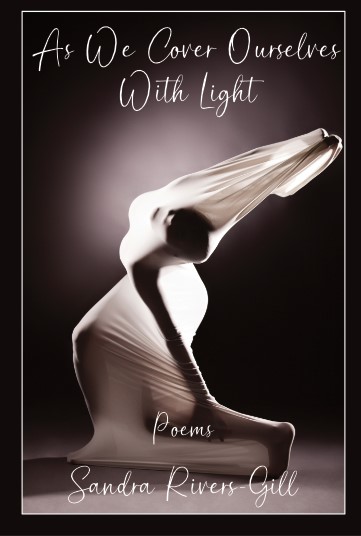
With deft and musical language, and a great deal of heart, Sandra Rivers-Gill gives us a collection that honors family, food, community: love, and its complications. The very first poem, “Ain’t Nothing Like Family,” sets the table for the rest of the book. She tells us:

Family is like leftover stew

and: 

We are a culture of ripened fruit
consuming what is not always easy.

and:

We are marinated in love,
seasoned with salt for our journey.

From the start we know that we are in the capable hands of a woman with the courage (from the Latin cor: heart) to look into the shadows cast by the light. She asserts her own vision, her own right to name that vision, and she passes this message on to her children — and us. In “Colored Imagination,” she writes about her daughter and, I suspect, herself, brown girls asserting their visions in a too often uncaring, if not downright hostile, world. She writes,

If a girl teaches her teacher about her sun
colored from the world of her brown hands,
beyond the margin of a grammar school desk,
the girl will weave her own narrative.

You would be forgiven for thinking about hair, and how hair itself is politicized in our world. In another poem, “Snip,” she writes

It is how the barber begins
to censor a man.

And yet these poems are crafted and delivered with a light touch and a great deal of warmth. In the poem that gives us the title of this collection, “The Quilt Maker,” she writes, 

Home is where the edges are salvaged—

and we are made aware of the edges, sometimes still raw, where the family pieces, parents, children, grandparents and great-great grandparents, have been stitched together, and sometimes ripped apart, to form a family, a life, many lives, all of them precious.

Rivers-Gill has chosen lines from Gwendolyn Brooks as the epigraph of this book: “Reading is important—read between the lines. Don’t swallow everything.” Rivers-Gill clearly “reads between the lines,” and, while she may swallow some of the home-cooked meals offered to her, she also looks carefully at what is set before her. In the poem that whispers back to Gwendolyn Brooks’ lines, fittingly titled “Between the Lines,” she examines the largely unspoken, often uneasy, understandings that tie mothers and daughters, when her mother suggests, between the lines, that she take on a task the mother can no longer manage. Rivers-Gill tells us,

She does not invite my help
but teaches me time and timbre—
the fine art of reading.
Between unspoken lines
mothers and daughters dwell.

I would venture to say, between unspoken lines, poets dwell — and they report back on what they read there.

There are many tender moments in this book; one comes away with a clear sense of the people the poet has been shaped by, the people she loves, in all their complexity. Reading this collection can be like sitting at that table and listening in on conversations that fly back and forth over the rapidly devoured food. We are well-nourished by Rivers-Gill’s clean lines. Even when she brings us poems about difficult subjects (as in the one called “Fat Meat is Greasy,” which begins

“The air in our home spat like fat meat in a cast iron skillet.”) her light touch makes us eager to swallow what she puts before us.

I would be remiss if I did not mention the brilliant way Rivers-Gill addresses one of the more devastating events in our recent history. Toward the end of this collection, we have the poem, “D’Anjou.” You would be forgiven for thinking that this is another ode to a favorite food, but then you read, beneath the title, that she writes, “for George Floyd.” Clearly there is another dimension at work here. The poem begins as an ode to the pear, segues into the memory of “the white woman next door” who grew pear trees, and shared the fruits with her neighbor children, instructing Rivers-Gill and her brother on how to be patient and wait for the right moment to enjoy their sweetness. She brings us into the present moment, where she is paring a pear in her own kitchen, and then ends the poem with these lines:

I remember the instructions
that guarantee a pear’s ripeness:
simply press its neck.

This may be the most devastating and delicate political poem I’ve ever read. We need to know who George Floyd was, and what happened to him, but we should know: it is our collective responsibility to carry and reckon with this knowledge. Showing us how to hold the sweetness of a pear in one hand and the horror of George Floyd’s death in the other is Sandra Rivers-Gill’s gift, one that is reflected throughout this rich and beautiful collection.

About the Author: Wendy McVicker is poet laureate emerita of Athens, OH, and a longtime Ohio Arts Council teaching artist. She is the author of several books of poetry, most recently a dialogic collection with Cathy Cultice Lentes, called Stronger When We Touch (The Orchard Street Press, 2023) and, forthcoming from Sheila-Na-Gig Editions, Alone in the Burning. Her poems have appeared in a number of anthologies and journals, online and in print, including Pine Mountain Sand & Gravel, Women Speak, Gyroscope Review, and Sheila-Na-Gig online. She performs whenever she can with musician Emily Prince, under the name another language altogether.


A Review of “If It Comes To That” By Marc Frazier

Chuck Kramer Reviews

If It Comes to That

By Marc Frazier

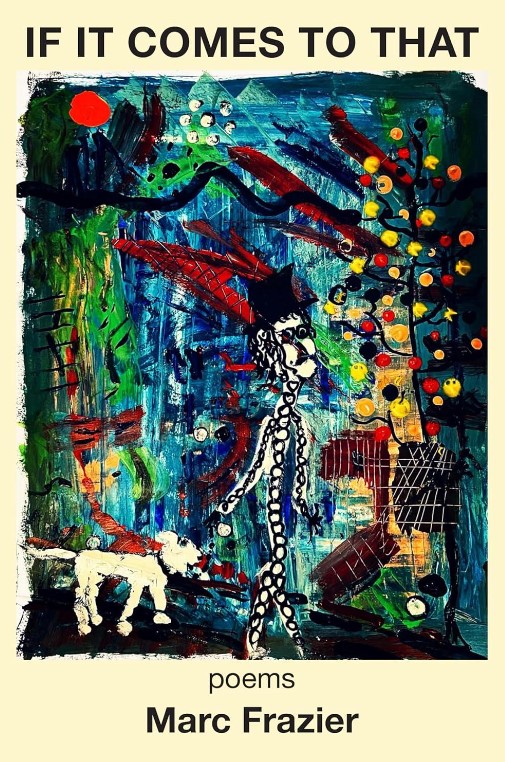
Marc Frazier is a poet who often ends a poem with a bombshell—a turn of phrase, an insight, or even a question. His skill at producing powerful endings is one of the delights of reading his work in If It Comes to That, his fourth book of poems, this one from Kelsay books. In “Kahlo” he asks, “Who is who they wanted to become?” In “The Discovery” he ends by stating “…our adolescent lives move on. Always move on. And not much is learned.” In “Journal of the Plague Years: One,” he concludes: “I was the river once. He was the sea.”

These poems wrestle with questions of identity, elitism and privilege, life and death, especially death, as they engage in a constant conversation with the arts. Some begin with a poetic epigraph while others reference movies, painting and art.  This gives the poems a large canvas to explore as they deal with both contemporary issues and the dark, lonely corners of Frazier’s personal family history.

In that history he looks for answers, often from people who can’t speak, as in “To Grandmothers Deceased Before My Birth.” Yes, the dead are always with him and he’s filled with dread of his own death. Three poems grouped together —”The Visit,” “Pasture of Dead Horses” and “Gathering,”— present these concerns with sharp focus.

Underlaying all this is his identity as a gay man which he openly explores, presenting the many facets of its reality in poems like “The Blind Leading the Blind” about auto repair with his dad and “Weekly Ritual,” his lament for all the gossip and feminine intimacies he missed because his mom and sisters never went to a beauty parlor. 

What is a real pleasure in reading Frazier is his formal dexterity. While most of the poems are free verse, there are also prose poems, a villanelle, a pantoum, and an unusual attempt to wring poetry from pages of material heavy with redactions.  “bulletproof blanket” starts with a sales promo from the manufacturer and “The Reward” is Frazier’s reworking of a statement by Boston bomber Tsarnaev. Given the difficult nature of the material he started with, Frazier achieves limited, mixed results here.

Far more vibrant are those poems conceived as conversations with the arts: film (“Indochine”), paintings (“Rivera” and “Little Nude by Table”), and poetry itself by many authors such as Plath, Oliver, Williams, and Gallagher. Some are full of admiration while others are full of questions but each provides a new slant on the work of other artists.

“Journal of the Plague Years: One and Two” are a pair of poems full of sadness and loss, histories of a love gone awry and the ephemeral nature of human experience. These same themes also run through “If It Comes to That,” which ends by asking the question, “In the deafening dusk, do I fit in us?”

The book ends with “Incident on the Green Line” which explodes first in violence and then in unexpected optimism. Like the rest of the collection, it doesn’t shy away from contemporary reality but isn’t overwhelmed by it either, and that is what makes this book an important assemblage of incisive, well-crafted poems.

If It Comes To That by Marc Frazier
Kelsay Books/September 2023
Cover painting by Steven Ostrowski
113 pages
Reviewed by Chuck Kramer

John Compton: “Your Fear Becomes Holy”

your fear becomes holy,

your marriage frail. you decide mine will ruin yours.

your sentences pervert scripture. plagiarize what

you believe is real. what you claim to conjure

you want god to believe. if no one else loves you

why should he?
your fear becomes holy, 2

amen. let me turn your heads:
jesus never married, had disciples: men.
judas turned against him. jealousy
comes from the bed. if i can’t have you
no one can.

These two poems appear in John Compton’s new book the castration of a minor god, available from Ghost City Press

the castration of a minor god” is built like a classic opera, composed of many lyric passages full of strange and powerful images cast in words, where dresses of flames mix horrifically with our culture’s dishonesty and secret perversion to cast a searchlight onto earth from the heavens above where this thing called god tells us to love one another, fully, completely, without exception. Compton’s short book of poems answers the implicit and explicit questions that other Book poses. Without apology or fear, anger is met with anger, love with love. While sometimes his metaphors go too far, other times the images created are perfectly beautiful and compelling. This is a book that embraces what was forbidden love and shows the reader the universality of fear, desire, and belonging.

-Fred Dodsworth, Dodsworth Books

About the Author: john compton (b. 1987) is a gay poet who lives in Kentucky. He lives in a tiny town with his husband Josh and their dogs and cats.

Image Credit: Ernst Ludwig Kirchner “Head of Dr. Bauer” (1921) Public domain image courtesy of Artvee.

A Review of Sundown At The Redneck Carnival By John Dorsey

Chase Dimock Reviews

Sundown at the Redneck Carnival

By John Dorsey

With his trademark spare and exact style, John Dorsey’s latest book of poetry guides us through a carnival of characters that stretches across the country in space, and deep into his decades on the road. What sets Dorsey apart from the other geographers of trailer parks, small town diners, and dollar stores is the balanced empathy of his writing. There isn’t anything sensationalized or exploited. What he reports may shock, but his work never relies on shock value or gratuitously gruesome description to strike its blow. The power of his work is in his ability to make his readers empathize with the marginalized and grotesque without straying into the cheap pathos of pity.

In a poem about a man who lost part of his nose to cancer, Dorsey concludes in the final stanza:

but he’s not pretty enough for heaven
or the silver screen
& not ugly enough
to hide his face
& let some lonesome dirt road
forget he was ever there

This liminal space between beauty and ugliness, between heaven and hell, is where Dorsey’s redneck carnival is located. Beauty is always tempered by the constraints of the environment in which it lives, and what gets written off as ugly is infused with humanity, glowing with careful understanding. At this carnival, the “prettiest girl in town,” “pours drinks/ &becomes a wingless canary/ singing for tips/ in a cage filled with smoke.” Later, Dorsey’s poem for his grandmother similarly envelops us with smoke, describing her with the following:

I never remember you looking young
shaky hands lighting one cigarette
off the other
black rings under your eyes
but your smile was magic
talking about tv preachers
by their first names
as if they really did care
about your salvation

Cigarette smoke is the before and after: beauty destined to shrivel in its environment and the unsinkable beauty deep within an already withered face. As you thumb through Dorsey’s poems, the question is always, who is living in the before and who is living in the after? Who is the young and beautiful destined for pain and age, and who is the weathered soul whose beauty still flickers from inside a battle scarred body?

Take his short “Trailer Park Song, 1982” for example:

my brother
angry
red faced
screaming
& beautiful.

Brief, simple, yet unexpected. Dorsey hands us the unanticipated connection of anger and beauty without a treatise on their causal relationship. In another poem, “Love Letter for Jana Horn”:

the mailbox is full of postcards
from hipster boys
&aging dreamers
who just want
to be swallowed whole
by a desert rose

The young who are destined to become old, and the old who cling to what makes us young in spirit all desire to be consumed by beauty. In Dorsey’s poetry, beauty is as much an aspiration as it is a physical state. Physical beauty is fated to fade, which in of itself is beautiful, but the aspiration toward beauty is what remains after flesh fails.

The only time Dorsey is explicit in labeling true ugliness, is ironically, when he describes a young woman asking “for donations/ for a baby beauty pageant”:

$10 here
$5 there
for a twirl
at the baton
of immortality

sometimes there
is nothing uglier
than
hope.

It’s here where Dorsey draws somewhat of a line where his appreciation of the aspiration toward beauty stops. There is an inherent ugliness in these pageants that exploit the bodies of young people and inculcates in them a belief that beauty should be subject to the judgment of others. Yet, even in his distaste for the pageant, Dorsey isn’t judgmental of the young woman asking for donations. She has bought into the ugly side of hope when our culture commodifies our aspirations to be beautiful. The same is implied in the earlier poem about his grandmother and the TV preachers who pretend to care about her salvation. It’s not the women having hope that is ugly, but instead, the ugliness is in the cynical hope sold to them by institutions that promise what they won’t deliver.

Dorsey never patronizes his subjects by lapsing from empathy to condescension. Sympathy can often be a temporary license we give ourselves to gawk at someone’s misery. While Dorsey doesn’t shy away from presenting the sad circumstances of someone’s life, he also never infringes on their agency by flattening them into one-dimensional victims. Even the aforementioned cancer survivor:

says we are all ravenous locusts
at the same overcrowded trough
as he explains his theories on women

We can only imagine what these “theories” might be, or what he might be expressing with the locusts comment. What is sure is that these complicating aspects of the man’s personality play against any impulse to use his cancer as a thin premise for sympathy. He is not the perfect victim, just a human whose cancer is part of his story. 

Dorsey’s poems are all honest reports on the damage we all live with, and whether this damage is a circumstance of birth or self-inflicted, the damage is inextricable from our stories. For example, Dorsey bluntly spells this out in his poem “Young Man”:

david
i’m not saying 
you were no good
just rotten on the inside
like a bag of sour apples
who left us too young.

Dorsey does not fear pinpointing the rot inside this young man, but also avoids any kind of judgment on him or blame on anyone else. It is taboo to speak ill of the dead, but our culture’s fear of this taboo often leads us to invent a fictitious version of the dead that paints them as blameless and brightsides their darkness. This is more of a dishonor than providing an accurate record of the life they led because it erases all their choices and every mark they made, good or bad. It doesn’t remember the dead; it forgets them immediately and entirely.

This leads me back to what I refer to as John Dorsey’s balanced empathy. Empathy doesn’t mean excusing or ignoring the faults and failings of an individual, but understanding the trauma residing in someone’s scars, including the self-inflicted.  Dorsey’s balanced empathy calls attention to the ugliness of the sour apples rotting in all of us, but in just a few words, he makes the pain of carrying this rot momentarily beautiful.

.

Sundown at the Redneck Carnival is available via Spartan Press

About the Reviewer: Chase Dimock is the Managing Editor of As It Ought To Be Magazine. His debut book of poetry, Sentinel Species, was published in 2020.

Mike James Reviews James Dickey: A Literary Life

Mike James Reviews

James Dickey: A Literary Life

By Gordon Van Ness

./

In his essay, “Reflections on Wallace Stevens,” the poet and critic Randall Jarrell wrote, “A good poet is someone who manages, in a lifetime of standing out in thunderstorms, to be struck by lightning five or six times; a dozen or two dozen times and he is great.” James Dickey was fond of quoting Jarrell’s line to students and in interviews. The quote encapsulates Dickey’s ambition as well as the luck involved in literary reputations. 

Gordon Van Ness offers the definitive biography of James Dickey and reviews how the reputation of Dickey’s work has collapsed since the 1960’s when he was, with Robert Lowell, considered one of the two most important poets in America. For those who are familiar with Dickey’s life, either through literary gossip or from the previous hatchet work of Henry Hart’s biography, it offers a familiar rise and fall. 

During the 1950’s and 1960’s, James Dickey published an extraordinary number of well received poems, essays, and book reviews. His work regularly appeared in magazines such as the New Yorker and the Atlantic. His 1965 collection, Buckdancers’s Choice, won the National Book Award. Then, in 1970, he published his first novel Deliverance. The adventure story of four men going down a river was a tremendous best-seller. Two years after the novel’s publication it became a hit movie. Dickey wrote the screenplay and even had a memorable role as the sheriff. It was at this point that celebrity began to replace the artist. 

Van Ness makes clear that Dickey enjoyed fame. He wrote several lucrative coffee table books and accepted commissions for a few occasional poems. One of these, “The Strength of the Fields,” was read by Dickey as part of Jimmy Carter’s 1976 inaugural. (The poem is one of the best examples of a “public poem” and has aged better than similar pieces from other inaugural poets.)

What Van Ness also makes clear is that after the summation of his work in Poems: 1957-1967 Dickey became interested in a different kind of poetry. Dickey’s work, in what he referred to as his “early motion,” ranges from the narrative to the lyric, from the mystic to the confessional, from the formal to the experimental. A reader would be hard pressed to find a more various or successful book of poetry and Poems: 1957-1967 remains comparable to Pound’s Personae and Steven’s Harmonium.

The later poetry (the work after 1967) is both more rhetorical and more visual. The poems often range across the page with word and image clusters which sometimes mirror a speaker’s breath units and sometimes mirror high energy synapses firing. While many individual passages often stand out, the poems are less successful and more indulgent. Dickey’s later work often asks more of the reader than it gives. 

Van Ness does a fine job of covering the later work and how it relates to Dickey’s life. He reviews the critical and public reception of Dickey’s two later novels, Alnilam and To the White Sea, as well as the wildly mixed response to his late poetry collection Puella. He also spends a considerable amount of time discussing Dickey’s role as a teacher at the University of South Carolina. Van Ness was a student of Dickey’s in the 1980’s and the exuberance Dickey often brought to the classroom is apparent. 

Exuberance is a key word for describing Dickey’s best work. In poems like “Cherrylog Road,” “On the Hill Below the Lighthouse,” “Adultery,” “The Performance,” “The Lifeguard,” and “To Be Done in Winter” Dickey’s work seems bathed in vitality and life joy. His poetry is not concerned with mundane, small moments. It is concerned with transcendence. 

There are many reasons why Dickey’s reputation has dimmed over the last fifty years. Van Ness covers all of them. His womanizing and alcoholism wrecked many of his friendships and some readers and critics remain willing to dismiss his work based on the numerous misbehaviors of his life.  Also, unlike one of his contemporaries, James Wright, Dickey outlived most of his best work. To quote Nietzsche out of context, Dickey did not “die at the right time.” Finally, the type of masculinity Dickey publicly embodied (think John Wayne and Ernest Hemingway combined with erudition and southern twang) is now out of fashion. 

Van Ness does a fine and necessary job of separating Dickey’s indulgences from his art. He focuses on key early works and adds understanding and appreciation to later, overlooked gems. As someone who has edited two volumes of Dickey’s letters, his early notebooks, and a posthumous collection of late poems, Van Ness is a worthy guide to Dickey’s work. In writing this biography he sends the reader back to Dickey’s poetry and fiction. Dickey remains a poet with a lightning rod, wide awake as he walks through a crackling summer field.

.

James Dickey: A Literary Life, by Gordon Van Ness

Mercer University Press, 2022

Biography, $45

About the Author: Mike James makes his home outside Nashville, Tennessee. He has published in numerous magazines, large and small, throughout the country. His most recent book, Portable Light: Poems 1991-2021, was published by Red Hawk in April 2022. Mike’s previous poetry collections include: Leftover Distances (Luchador), Parades (Alien Buddha), Jumping Drawbridges in Technicolor (Blue Horse), and Crows in the Jukebox (Bottom Dog.) 

.

Image Credit: Digitally remixed image of a public domain James Dickey photo

Mike James Reviews “Erotic” by Alexis Rhone Fancher

.

225636706_587776885937365_5288385786663195327_n

.

Mike James Reviews

Erotic

By Alexis Rhone Fancher

.

Some poets bring a very cerebral enjoyment. Think of the pleasure of watching John Ashbery’s mind work as he leaps from surprise to surprise, tossing out great lines as extravagantly as a child tossing candy from a parade float at Christmas time. A reader comes away from his work with a voyeur’s amazement akin to watching a skilled acrobat do trick after trick.

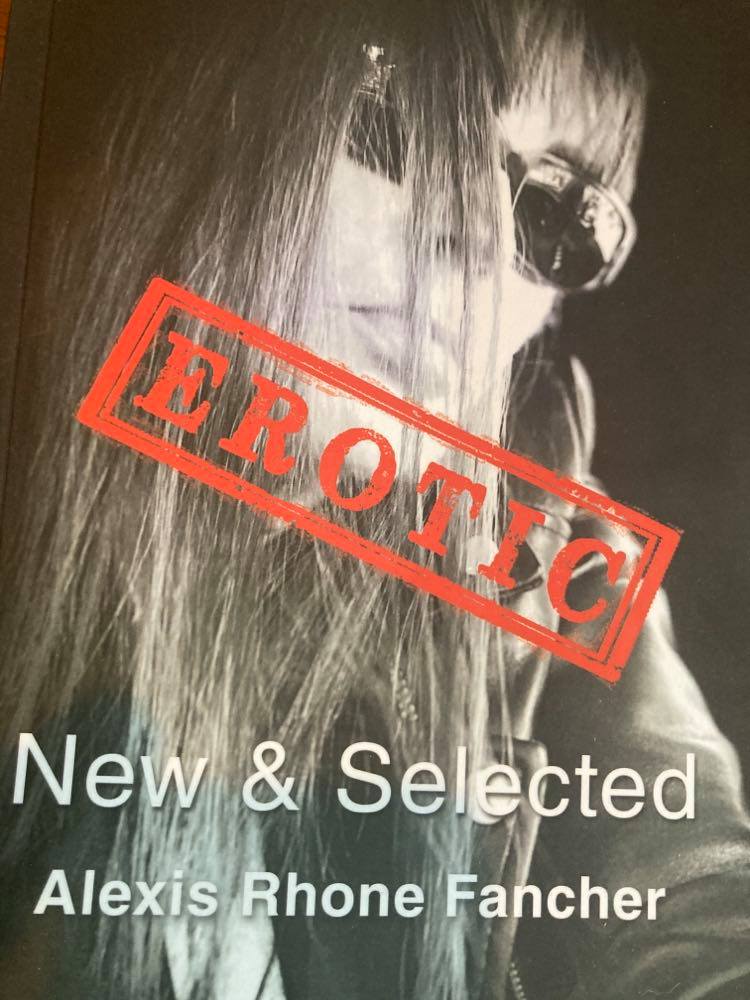
Alexis Rhone Fancher’s work offers a different enjoyment. Though her poems display tremendous skill, it’s the stand out nearness of her images and the relatability of her stories which are most striking. She writes about break ups and disappointing relatives, about first lusts and “the regret that hides outside.”

As the title suggests, this collection is broadly concerned with sex. There’s a lot of it, with men and women. The narrator seems aware of every desire and records them with vividness. Her often long titles are a lot of fun and prepare the reader for what’s ahead. For instance, the collection’s second poem is titled, “Tonight I Will Dream of Anjelica, My First Ex-Girlfriend, Who Taught Me the Rules of the Road…” The title ties into Angelica’s T-Bird and what takes place there, which is a lot. The narrator tells us, “I’ve always been driven to sin.”

She writes poems about one night stands where, “We are each bodies, hard-wired for pleasure, / destined for momentary blooming / then extinction.” And she writes poems about relationships which linger past their shelf life. She tells us, “Tonight I am ripe for forgiveness.” She tells us, “We had a history / all dead ends.”

What’s most exhilarating about this collection is the number of risks it takes. So many of these poems would not work for less talented poets. Fancher is fearless in her approach to subject and form. This collection contains prose poems and free verse. It contains litanies and Americanized haiku. Fancher reinvents them all.

One of the best poems in the collection, “White Flag”, is based on an Edward Hopper painting. Fancher adds a sensuality to the occupants of Hopper’s world. Loneliness is what can come the night after a hook up or during the weeks after a break up. She tells us “No one paints loneliness like Edward Hopper paints me, missing you, apologies on my lips.”

Thankfully, no apologies are needed for these stunning, life-filled poems.

.

Erotic; New & Selected by Alexis Rhone Fancher
New York Quarterly Books, 2021
Poetry, $21

.

About the Author: Mike James makes his home outside Nashville, Tennessee. He has published in numerous magazines, large and small, throughout the country. His 18 poetry collections include: Leftover Distances (Luchador), Parades (Alien Buddha), Jumping Drawbridges in Technicolor (Blue Horse), and Crows in the Jukebox (Bottom Dog), He has received multiple Pushcart and Best of the Net nominations.

.

More Reviews by Mike James:

Mike James reviews Mingo Town & Memories by Larry Smith

Mike James reviews “Dead Letter Office: Selected Poems” By Marko Pogacar

Mike James reviews Beautiful Aliens: A Steve Abbott Reader and Have You Seen This Man? The Castro Poems of Karl Tierney

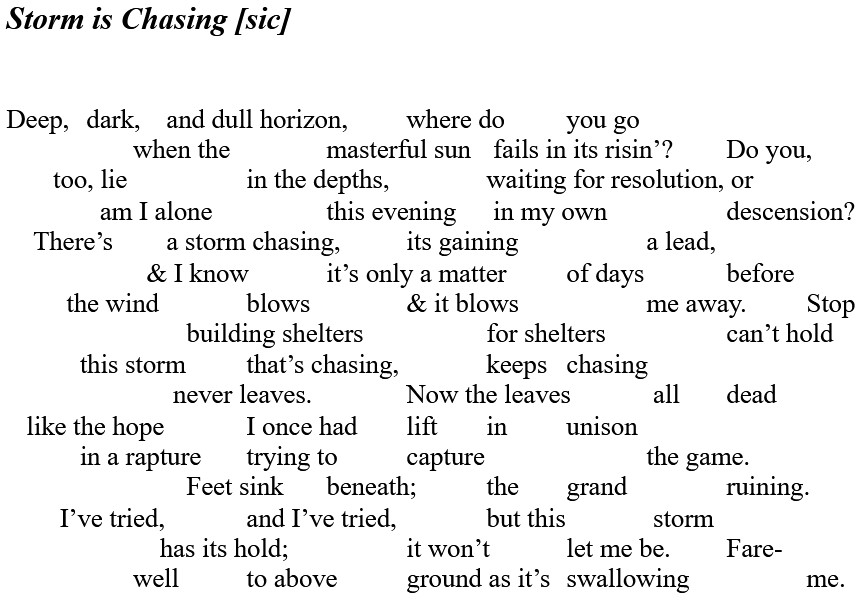
Tim Heerdink: “Storm is Chasing [sic]”

.

507044ld

.

.

Screenshot 2021-08-11 101335

.

About the Author: Tim Heerdink is the author of Somniloquy & Trauma in the Knottseau Well, The Human Remains, Red Flag and Other Poems, Razed Monuments, Checking Tickets on Oumaumua, Sailing the Edge of Time, I Hear a Siren’s Call, Ghost Map, A Cacophony of Birds in the House of Dread, and short stories, The Tithing of Man and HEA-VEN2. His poems appear in various journals and anthologies. He is the President of Midwest Writers Guild of Evansville, Indiana.

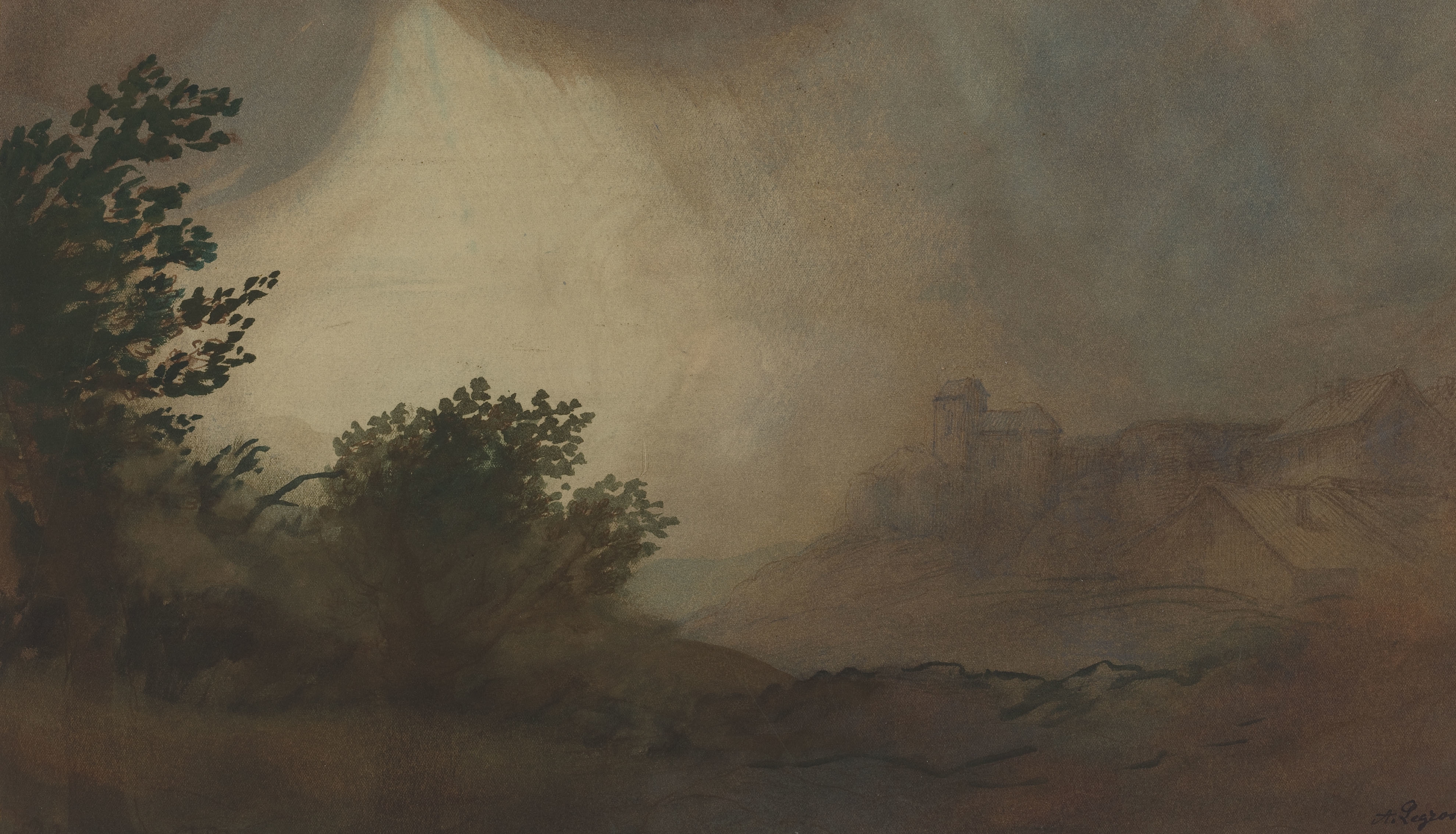
Image Credit: “Alphonse Legros “Storm” (French 1837-1911) Public Domain. Image courtesy of Artvee