SATURDAY POETRY SERIES PRESENTS: MALAK


From MALAK
By Jenny Sadre-Orafai:


LAST READING

There is a pregnant bird in the cup.
Malak looks at me like she has never looked

at that in a cup before. My father looks at me
like there are things I’m not telling him.

She crochets baby caps, square blankets,
booties in Neapolitan ice cream colors.

If I ever have these babies, if I’m the bird
in the cup, I’ll want to devour them.

After the last reading she leaves the cup turned up,
daring the bird to forget I was pregnant.


MOTHER SPELL

I felt for mountain
and ocean, my first globe.

Mouth or beak. Arm or wing.
Skin or feather. Feet or feet.

Who brought these to me
to dress in booties and caps.

I didn’t ask to know a belly
so tight.

I didn’t ask if it was girl
or boy or bird.


LANGUAGE OF SIGNS

I slept the whole day
without remembering, Malak.

I dreamt I had a son
growing so fast,

a tomato plant sprawled
everywhere, unstoppable.

I held him at my hipline.
And I fed his hunger.

Now he’s a pitcher
of water.


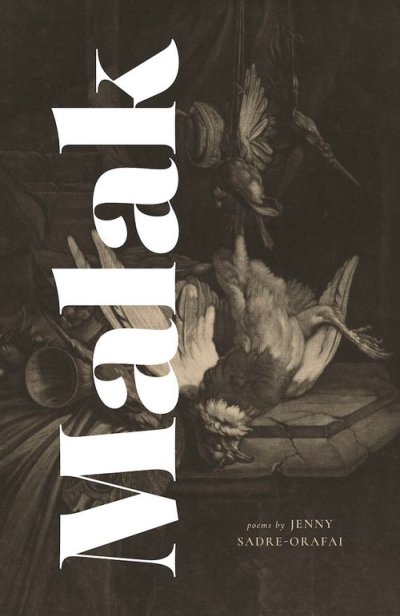
Today’s poems are from Malak (Playtpus Press, 2017), copyright © 2017 by Jenny Sadre-Orafai, and appear here today with permission from the poet.


Malak is an invocation of past and future. With familial lament and childish wonder, the words lay tribute to the infinite—to the beauty in descent and the heartache that binds us to place. To our smallness in death and the importance of conjuring anew.

Jenny Sadre-Orafai is the author of Paper, Cotton, Leather and five chapbooks. Her poetry has appeared in Cream City Review, Ninth Letter, The Cortland Review, Hotel Amerika, The Pinch, and other journals. Her prose has appeared in Los Angeles Review, The Rumpus, South Loop Review, Fourteen Hills, The Collagist, and other journals. She is co-founding editor of Josephine Quarterly and an Associate Professor of English at Kennesaw State University.

Editor’s Note: Birds, tea leaves, foxes. If there are talismans that illuminate the path Jenny Sadre-Orafai’s Malak lays out for the reader, these may be those divining objects. There is magic within these pages — the kind that is conjured up in Gypsy tents and over old world kitchen tables, magic from a time and place when women were believed. But the future is always uncertain, and the tales that unfurl within Malak‘s pages curve and splinter like the lines on a palm.

What is inheritance, this collection asks. What is lived? What is lost? Do we inherit even that which cannot be passed down? Are predictions only as good as their fruition?

Malak is a book that pairs loss with beauty, future with past, the certainty of fate with the unknown and the unknowable. Throughout its pages, a sense of familiarity is established that both grounds and destabilizes. Its stories are told in the dark of night, but under the light of a full and generous moon. When Malak‘s truths reveal themselves, you bask in their luminosity and marvel at the careful magic of their making. You do not ask if they are boy or girl or bird.

Want more from Jenny Sadre-Orafai?
Buy Malak in paperback from Platypus Press
Buy Malak on Kindle from Amazon
Jenny Sadre-Orafai’s Official Website

SATURDAY POETRY SERIES PRESENTS: #METOO POETRY


Editor’s Note: As the #metoo movement that originated ten years ago with Tarana Burke reached a critical mass this week, together we bore witness to innumerable traumas. Perhaps, like me, you felt far more than you were able to articulate. In times like these I turn to poetry to find the words there are no words for. To that end, today I turn to poetry of witness and testimony. To poems that are unafraid to call out sexual assault and its aftereffects. To poetry that says: me, too.


“Seized” by Rachel Heimowitz

“I Should Quit Teaching” by Lois Roma-Deeley

Rupi Kaur’s #metoo poem

“bone” by Yrsa Daley-Ward

Nayyirah Waheed

SATURDAY POETRY SERIES PRESENTS: THEY WERE BEARS


From THEY WERE BEARS
By Sarah Marcus:


PEOPLE HAVE ALWAYS KNOWN BEARS

You said you were afraid of bears—

we weren’t safe until there was ice
along the shoreline. I said we all need trauma,

and my heart breaks every Autumn, so we broke
ourselves against those rocks until the cave mouth opened:

a womb for blind crayfish,
a passageway harboring beetles.

I want you to reach into the depths of your backwoods
and remember our Winters. We need the bears, ourselves

ursine sleeping in dens—the caverns drip-stoned and stunning.
I was and still am in search of a great bear

because people have always known bears—
we will always be shelter for each other.

When we first met, I told you that a long time ago,
grizzlies came down from the Rockies—

they were poisoned on the range, trapped,
hounded, shot out—we found cranial fragments.

We still listen to those legends of bounties paid
to mountain men, harboring that ancient fear of

the bears that made meat of us, boar and sow,
mauled and gnawed away. Our bones resting in caves,

because you were born to hunt, and I was
born of hunting: a witness of great fires.


LOVE POEM

First snow of the season—
your eyes say
there’s not much oxygen
                  in the mountain air
.

I have never wanted someone
                  as much as I want you.

I devalued the damage:
you won’t belong—stay gone longer—

                  let it melt.


I’ve been thinking about you
                  because we cannot be separate.
The gravitational pull defies
                  the thousands of miles between us.

Even in the deepest woods,
                  we kneel beside the rill,
the river’s riffle,
the spruce’s mantle of rime,

                  until the point of rock
                                  swells tightly around us.

There’s a chant building in the forest: I won’t be your secret.

Everyone knows how to leave,
but I don’t know how to be
in this city
without you.


MYTHOLOGY FOR DESERT LOVERS II

These things are real:
you are a desert moon rising a hundred mornings away.
My horses paw a cracked Earth.
The air threatening Winter.
The solitude of sand.
We can smell the danger

of you and her
in that house.
In every house.

When you are so strongly connected
to another person, what did you call it? Rare?
It’s like the sunset.
No one can hold that kind of beauty
for more than a moment.

Our small ribs are thick
enough to take on a prairie panic.
The fear of too much open space.
So many acres;
we can never catch up.

You say I’m always on your side
and this will always mean more
to a woman.

I try to explain that love is a violence,
even when it’s beautiful.
When you enter someone,
you must also leave them.

And there’s always that moment of relief
when I realize that I’ve always known—
I am a hundred deserts.

I will wait for you or some version of you
to become sky.


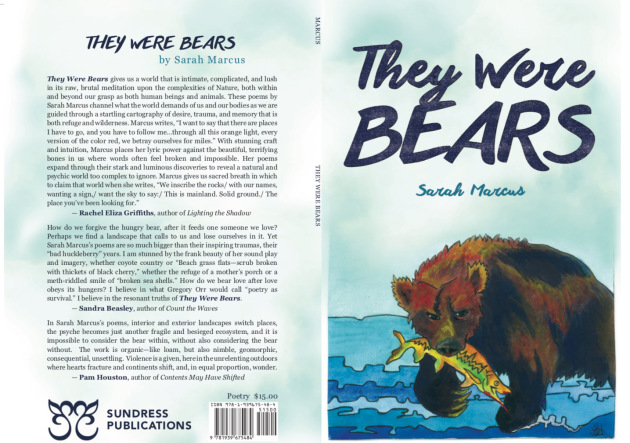
Today’s poems are from They Were Bears (Sundress Publications, 2017), copyright © 2017 by Sarah Marcus, and appear here today with permission from the poet.


They Were Bears gives us a world that is intimate, complicated, and lush in its raw, brutal meditation upon the complexities of Nature, both within and beyond our grasp as both human beings and animals. These poems by Sarah Marcus channel what the world demands of us, and our bodies as we are guided through a startling cartography of desire, trauma, and memory that is both refuge and wilderness. Marcus writes, ‘I want to say that there are places I have to go, and you have to follow me…through all this orange light, every version of the color red, we betray ourselves for miles.’ With stunning craft and intuition, Marcus places her lyric power against the beautiful, terrifying bones in us where words often feel broken and impossible. Her poems expand through their stark and luminous discoveries to reveal a natural and psychic world too complex to ignore. Marcus gives us sacred breath in which to claim that world when she writes, ‘We inscribe the rocks/with our names, wanting a sign,/want the sky to say:/This is mainland. Solid ground./The place you’ve been looking for.’” -Rachel Eliza Griffiths, author of Lighting the Shadow


Sarah Marcus is the author of They Were Bears (2017, Sundress Publications), Nothing Good Ever Happens After Midnight (2016, GTK Press), and the chapbooks BACKCOUNTRY (2013) and Every Bird, To You (2013). Her other work can be found at NPR’s Prosody, The Huffington Post, McSweeney’s, Cimarron Review, Spork, The Establishment, Cosmopolitan.com, and Marie Claire.com SA, among others. She is an editor at Gazing Grain Press and the Series Editor for As It Ought To Be’s High School Poetry Series: Gender, Identity, & Race. She holds an MFA in poetry from George Mason University and currently teaches and writes in Cleveland, OH.


Editor’s Note: In the Jewish calendar, the days between Rosh Hashanah and Yom Kippur are a surreal and reflective time of reckoning. During these days we are introspective, coming to terms with our true selves before turning outward and asking forgiveness from those who we have wronged. It is in these Days of Awe that I come back to a collection I have been meaning to review for quite some time. It is in this magical time of brutal honesty that I dive deeply into a carefully-wrought world that is far beyond my comfort zone, with eyes and heart wide open to its savage and beautiful truths.

They Were Bears is one of the most thoughtful–if not the most thought-provoking–poetry collections to be released in recent memory. Rife with hunger and blood and animal instinct, this work pulsates at the intersection of nature and violence, family, sex, and love. They Were Bears drags us mercilessly back to our animal nature, honoring vulnerability and calling out sexual violence. This book pulls no punches, spares us little. What is reflected in its waters is our truest selves, as beautiful and terrifying as they are wont to be.

The tender, ravenous, brutal honesty of the book’s thematic spectrum is brought to life by the true craftsmanship of the poet. This is an absolutely stunning collection on every level–its words and images thrash and breathe, fly and tether. The poems are lush in their soundscape, and on the page they mark their territory distinctly. And the moments. The breathtaking moments. How true their revelation, declarations, and admissions: “because you were born to hunt, and I was / born of hunting: a witness of great fires;” “I try to explain that love is a violence, / even when it’s beautiful. / When you enter someone, / you must also leave them.”

Mazal tov to Sarah Marcus on this incredible work, and may we all start anew together in these Days of Awe.


Want more from Sarah Marcus?
Sarah Marcus’ Official Website
SATURDAY POETRY SERIES PRESENTS: MARIANNE PEEL

In the Afternoon, She Smelled Like the Earth
By Marianne Peel

Her shoulders were always burned.
We had smeared ourselves with baby oil infused with iodine
painting our skin a burnt orange deeper than the marigolds
planted in a circle to protect
the lettuce from the woodchucks.

She taught me how to thread
a frenetic worm onto a crooked hook.
Digging around in that coffee can tin
wet with dirt and the roots of the soil
there was always humid mud under her nails.

Sometimes trails streaked her cheeks
after she pushed her hair off her face.
In the afternoon she smelled
like the earth after the sun
went way, way down.

She taught me to cast my line
flinging her whole arm back past her shoulder
all in one calculated, measured motion.
She said the splash on the water should be quiet soft
so we don’t scare the fish away.

And then we waited.
Just the creak of the dock bouncing
in time with the water
moving all afternoon
bobbing us up and down.

Sometimes our toes would touch
splayed off the dock
and I would recite this little piggy went to market
– but just in my head because
we had to be silent soft, waiting for the fish.

She taught me to reel in, quickly,
but with no panic, no surprise,
knowing there would be only sunfish suspended from the hook
little orange sunshines in our hands
on the dock every summer afternoon.

And she taught me to unhinge the mouth
to pull the mouth slowly from its worm feast
to toss it gently back into the water and watch it,
still hungry,
swim away.


“In the Afternoon, She Smelled Like the Earth” previously appeared via Silver Birch Press and appears here today with permission from the poet.

Marianne Peel is a poet who is raising four daughters. She shares her life with her partner Scott. She received Fulbright-Hays Awards to Nepal and Turkey. She taught English at middle and high school for 32 years. She is now retired, doing Field Instructor work at Michigan State University. She recently won 1st prize for poetry in the Spring 2016 Edition of the Gadfly Literary Magazine. In addition, Marianne has been published in Muddy River Review; Silver Birch Press; Persephone’s Daughters; Encodings: A Feminist Literary Journal; Write to Heal; Writing for Our Lives: Our Bodies—Hurts, Hungers, Healing; Mother Voices; Ophelia’s Mom; Jellyfish Whispers; Remembered Arts Journal, and Gravel, among others.

Editor’s Note: Today’s poem is vivid, vibrant, and rich with imagery. You can almost smell the earth, feel it crumble through your fingers, watch the worm wriggle. So alive are the moments of memory that we are swept up into them, unaware that we don’t know who the poem’s “she” is. We are willing to suspend our curiosity, because, “In the afternoon she smelled / like the earth after the sun / went way, way down.” Because the poem leaves us with a feeling, with an echo in the shape of knowledge, because “she taught me to unhinge the mouth / to pull the mouth slowly from its worm feast / to toss it gently back into the water and watch it, / still hungry, / swim away.”

Want to read more by and about Marianne Peel?
Persephone’s Daughters
Muddy River Poetry Review
Jellyfish Whispers

SATURDAY POETRY SERIES PRESENTS: JANET R. KIRCHHEIMER

Wonder Beans
By Janet Kirchheimer

My father went each morning to his garden.
He taught me to smell the soil to see if it was good,
to feel the dirt slide across my hands, to never
wear gloves, to stay in the middle of the row when planting seeds.
We’d look for work to do in the garden,
and sometimes there was nothing more to do
than watch the garden grow, wait for the harvest.
He thought that haricot vert were the dumbest thing he’d ever seen–
he liked his Kentucky Wonder beans, big and bursting with seeds, leaving
them to grow in the summer sun as long as possible.
Last winter he told me we couldn’t save
the parsley from the snow and ice, even though
we put blankets over it.
He got pneumonia in February.
In April, he asked me if I thought he’d get to his garden, and I told him yes.
By the end of May I brought him
cherry tomato plants to keep on the deck.
He no longer had the strength to pick
the first tomatoes that ripened in June.
August: I bring dirt from the garden
to his grave and scatter grass seed.


“Wonder Beans” previously appeared on String Poet and appears here today with permission from the poet.

Janet R. Kirchheimer is the author of How to Spot One of Us, (Clal, 2007). A Pushcart Prize nominee, her work has appeared in several journals including Young Ravens Literary Review, Atlanta Review, String Poet, Connecticut Review, Kalliope, Common Ground Review, and several anthologies and online journals. Currently, she is producing a poetry performance documentary, After, exploring poetry written about the Holocaust.

Editor’s Note: Today’s poem is a celebration of life and a poignant reminder that one day we may be remembered by what we love. Through a daughter’s eyes we see a father, watch him plant and grow, watch him love and tend the earth. Through the poet we know what it is for this daughter to love her father, and what it is to lose him. How touching her remembrance, how bittersweet the sting at poem’s end when father is returned to earth.

Want to read more by and about Janet Kirchheimer?
After – A Poetry Film
Young Ravens Literary Review
Collegeville Institute
Podium Literary Journal
Forward’s Schmooze

SATURDAY POETRY SERIES PRESENTS: HOLLY KARAPETKOVA

Song of the Exiles
By Holly Karapetkova

There never was a garden
only a leaving:
miles and miles
of footprints in the dirt.

In the beginning–
the shattered sun, the wind,
and nothing left but our shadows
sifting through the dust behind us.

When we turned
we did not turn to salt.
When we turned
there was nothing behind us to burn,

nothing to return to,
though who could blame us for turning
with only the long days ahead,
tongues tripping in the dirt.

They said we didn’t belong.
They blamed us
for leaving the garden
which never was or would be.

Where could we go,
we who had come from nowhere
and hence could not
return?


“Song of the Exiles” previously appeared via Split This Rock and appears here today with permission from the poet.

Holly Karapetkova’s poetry, prose, and translations from the Bulgarian have appeared recently in Alaska Quarterly Review, Prairie Schooner, North American Review, Drunken Boat, and many other places. Her second book, Towline, won the Vern Rutsala Poetry Contest and is just out from Cloudbank Books.

Editor’s Note: After a moment of silence following the loss of AIOTB’s Managing Editor, the Saturday Poetry Series returns this week with a poem worth breaking silence for. Holly Karapetkova’s “Song of the Exiles” begins in Eden. At once biblical and real, this Eden is a “garden / which never was or would be.” In this world we are storyteller and reader, mythological figure and landless refugee. This is world news, this is human interest story, this is myth in the truest sense of the word. And this, above all, is poetry. Expertly crafted, delicately wrought, brilliant poetry. “When we turned / we did not turn to salt. / When we turned / there was nothing behind us to burn.”

Want to read more by and about Holly Karapetkova?
Holly Karapetkova’s Official Website

SATURDAY POETRY SERIES REMEMBERS OKLA ELLIOT WITH PAUL CRENSHAW

Photo Credit: Brandon Pierce

By Paul Crenshaw:

FOR OKLA

All that late-night talk of light, and life,
all those words, which became like worlds.
Which we both know were.
If you even need words anymore,
wherever you are, what world
you find yourself in.

Let me just say I hope there’s light.
Let me say I want to send this to you
so you know all the poetry was enough.
That the porch light is still on
in my mind. That the windows are open,
and the songs from inside the house still play.
You are still sitting in the overstuffed chair.
You are still smiling. Let me say
the lighting of a cigarette or
clink of ice in a glass is as much poetry
as anything we ever said.
Let me remind myself I remember all the words,
even if I’ve forgotten how to say them.


ONLINE MEMORIALS AND TRIBUTES
As It Ought To Be Mourns the Loss of Our Founder
“Some testimonies to Okla Elliott, 1 May 1977 – 19 March 2017” – Days and Memory
“Requiescat in pace: poet, novelist, translator Okla Elliott, 1977-2017” – Book Haven
“Go Read Okla Elliott’s Stuff, Please. (A Remembrance)” – Great Writers Steal
“Remembering Okla Elliott” – Mildred Barya’s House of Life


REMEMBER OKLA WITH AS IT OUGHT TO BE
As It Ought To Be welcomes art and writing in Okla’s memory. Please email sivan.sf [at] gmail [dot] com with your submissions.


SATURDAY POETRY SERIES PRESENTS: STACY R. NIGLIAZZO


By Stacy R. Nigliazzo:


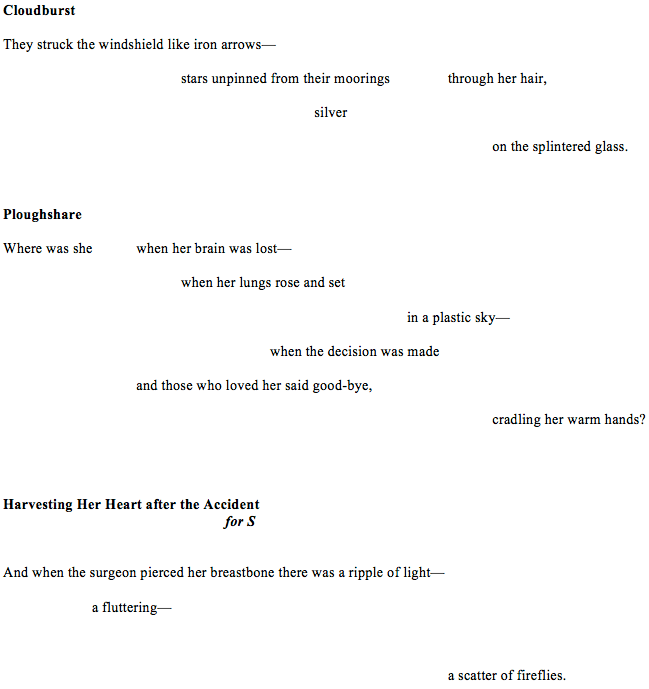
“Harvesting Her Heart after the Accident” first appeared in The Journal of Compressed Creative Arts/Matter Press. All other pieces are previously unpublished. Today’s poems appear here today with permission from the poet.

Stacy R. Nigliazzo‘s debut poetry collection Scissored Moon was published in 2013 by Press 53. It was named Book of the Year by the American Journal of Nursing. It was also short-listed as a finalist for the Julie Suk Poetry Prize (Jacar Press) and the Texas Institute of Letters First Book Award for Poetry/Bob Bush Award. She is co-editor of Red Sky, an anthology addressing the global epidemic of violence against women.

Editor’s Note: Stacy R. Nigliazzo imagines the unimaginable, writes those words which cannot be spoken. An emergency room nurse, it is when her personal losses make their way to the page that her experience becomes poetry, and that poetry becomes an act of healing for poet and reader alike. How visual her imagery, how visceral her grief. And yet her poems leave us not in darkness, but with the necessary reminder that even in our darkest hour there is a “ripple of light.”

Want to read more by and about Stacy R. Nigliazzo?
Stacy Nigliazzo’s Official Website

SATURDAY POETRY SERIES PRESENTS: GILI HAIMOVICH


AND THERE’S SOMETHING ABOUT SOFTNESS
By Gili Haimovich

People are still flirting
with trying to look younger,
to make each other laugh.
Their existence is softened
by the luxuries of having some time, some needs, met.
People are still eager,
not too tired of being keen,
I have found out
among the snow banks,
pushing
the stroller of my soft new baby.


Today’s poem appears here today with permission from the poet.

Gili Haimovich is an international poet and translator who writes in both Hebrew and English. She has six volumes of poetry in Hebrew, including her most recent, Landing Lights (Iton 77 Publishing House), which received a grant from Acum, as did her previous book. She also received a grant nominating her as an outstanding artist by the Ministry of Immigrant Absorption on 2015. Her poetry in English is featured in her chapbook, Living on a Blank Page (Blue Angel Press, 2008) and in numerous journals and anthologies, such as Poetry International, International Poetry Review, Poem Magazine, LRC – Literary Review of Canada, Asymptote, Drain Magazine, Blue Lyra, Circumference, TOK1: Writing the New Toronto and Mediterranean Poetry, as well as main Israeli journals and anthologies such as The Most Beautiful Poems in Hebrew (Yedioth Ahronot Books, 2013). Her poems have been translated into several languages including Chinese, French, Italian, Bengali, and Romanian. Gili is also presenting her work as a photographer, teaches creative writing, and facilitates writing focused arts therapy.

Editor’s Note: Today’s poem excels in the realm of wordplay. Double entendres luxuriate in a language that is as rich as it is simple, as straightforward as it is complex. The poet’s clear love of language — the sheer joy of it — culminates in a narrative of the unexpected, in a revelation that demands we enter the poem again and consider it anew. Delicate and layered, this poem is a labor of love that offers the reader the fruits of its bounty.

Want to read more by and about Gili Haimovich?
Poetry International Rotterdam
Mediterranean Poetry
Drain Magazine
Taylor & Frances Online
PoetryOn – Gili Haimovich’s Official Website

SATURDAY POETRY SERIES PRESENTS: ELISE PASCHEN

elisepaschen_blackwhite_300px-2016


AFTER THE SQUALL
By Elise Paschen

In need of air, she unhinged every
window, revolving ones downstairs,
upstairs skylights, mid-floor French doors,
swept into the house the salt-brine,
the cricket chirp, the osprey whistle,
the sea-current, sound of the Sound,
but had not noticed the basement
bedroom window shielded by blinds,
screen-less. Later that night when they
returned home, lights illuminating
the downstairs hall, insects inhabited
the ground floor rooms. She carried handfuls
of creatures across a River Styx—
the katydids perched on lampshades,
beach tiger beetles shuttling across
floorboards, nursery web spiders splotching
the ceiling—trying to put back
the wild fury she had released.


“After the Squall” originally appeared via the Academy of American Poets’ Poem-a-Day series and appears here today with permission from the poet.


Elise Paschen is the author of Bestiary, Infidelities (winner of the Nicholas Roerich Poetry Prize), and Houses: Coasts. Her poems have been published in numerous anthologies and magazines, including The New Yorker and Poetry Magazine. Co-editor of Poetry Speaks and Poetry in Motion, she teaches in the MFA Writing Program at the School of the Art Institute of Chicago. Her forthcoming book of poetry, The Nightlife, will be published in spring 2017.

Editor’s Note: “After the Squall” is a masterpiece of sound and image. A modern retelling of Pandora’s Box, this rich, vivid poem reaches a perfect crescendo with it’s killer end-line: “trying to put back / the wild fury she had released.” Careful, concise, and expertly wrought, this poem is a stellar example of fine poetic craft.

Want more from Elise Paschen?
VQR Journal
Harvard Magazine
The Scream Online
The Poetry Foundation
Elise Paschen’s Official Website