SATURDAY POETRY SERIES PRESENTS: MARISA CRAWFORD


By Marisa Crawford:


I’m too sensitive for this world / this Foot Locker

Oh right, the bomb
Sorry so boring
300-year-old wiener dog
China teacups rimmed in gold
Oh right, underwater
Backwards somersault, no
Outside w/ the flowers
Uhhhhhhhhhhhhhh like it matters
9th grade Metallica disaster
Cutest hottest-pink dress ever
Janie / not Janie / not over
Summer that bled into forever
See that backslash that’s the gash in my left arm
See that scar that’ll always be there
Janie’d be like, so show me so stop doing it
So eat something, J
So coconut cake bonne bell
You shoved it in my face / posted on my wall
Smell it, smells like a memory
Smells like a fake cake
This metal gate has been a gift to me
That metal guy at the party with the long hair and the gift for
Piercing the beer can / swallowing it all in one gulp
Was that the first time
He like, put his arms around me from behind
Somehow I willed it to happen w/ my mind
& then there was / a porch swing
Macbeth, my whole life, my death, everything


Poem

I like being a lil bit mean to Stephen
Wearing things that look architecture-y
Eating apple pie with my ice cream
I guess I couldn’t help it
I imagined my wedding brunch
on the tabletop catalog spread
called “A Perfect Match”
Girls at work who talk on the phone
in another language, girls who don’t
She asks me where I live in New York City
I don’t live there, I don’t live anywhere
Clip art of a nine-year-old
girl climbing a tree
leaning on her elbow
skinning her knee
VP of Creative sending an email
with the subject line “The Future”
You calling my tampon a “little mouse”
as you pulled it out


Today’s poems appear here today with permission from the poet.

Marisa Crawford is a New York-based writer, poet, and editor. She is the author of the poetry collections Reversible (2017) and The Haunted House (2010) from Switchback Books, and the chapbooks Big Brown Bag (Gazing Grain) and 8th Grade Hippie Chic (Immaculate Disciples). Her poetry has appeared in publications including Prelude, Bone Bouquet, Glittermob, and No, Dear, and she’s written about feminism, art, and pop culture for Hyperallergic, BUST, Bitch, Broadly, The Hairpin, and elsewhere. Marisa is the founder and editor-in-chief of Weird Sister, a website and organization that explores the intersections of feminism, literature, and pop culture.

Guest Editor’s Note: Reading Marisa Crawford’s poems reminds one of the feeling you get while looking through a Viewmaster. The reader experiences a gut punch of image and sensory recognition as Crawford takes the reader to the a New York City street, to a party, to a phone screen, face-to-face with a tampon. She plays on our olfactory senses. Macbeth shows up and makes us briefly feel those feelings of doom and futility in the face of human fallacies, blood trails and all. In “Poem” we confront the absurdity and futility of office life. Crawford writes, “VP of Creative sending an email / with the subject line ‘The Future,’” and with that the future unfolds. What will it taste like? What will it remind us of? She is a master of non-sentimental nostalgia. There’s a lightness of being to reading these poems, but the poems themselves are not light. They speak of the feminist and the feminine, the collective experience of being alive in these weird times.

Want to read more by and about Marisa Crawford?
Marisa Crawford’s Official Website
Buy Reversible from Swtichback Books
Weird Sister


Guest Editor Natalie Lyalin is the author of two books of poetry, Blood Makes Me Faint, But I Go For It (Ugly Duckling Presse 2014), and Pink & Hot Pink Habitat (Coconut Books 2009), as well as a chapbook, Try A Little Time Travel (Ugly Duckling Presse 2010). She is the co-editor of Natural History Press. She lives in Philadelphia and is working to befriend a flock of crows.

A NOTE FROM THE MANAGING EDITOR:

After nearly ten years as Contributing Editor of this series, the time has come for change. I am thrilled to expand my role to Managing Editor and provide the opportunity for fresh voices to contribute to this ongoing dialogue. Today and in the coming weeks, please help me welcome a series of guest editors to the newest incarnation of the Saturday Poetry Series.

Viva la poesia!
Sivan, Managing Editor
Saturday Poetry Series, AIOTB


SATURDAY POETRY SERIES PRESENTS: ALICE IN GREENPOINT


from Alice in Greenpoint
By Iva Ticic:


Alice in Greenpoint

Four glasses of fine red wine at a dinner party in Brooklyn
and you go from being a wallflower to discussing Trieste.

Though they mostly wanted to speak of Girls at this soirée—
An irony which caught in the mind of the writer
as an annoying bug caught in the web of a spider.

These four girls in Greenpoint discussing a show
about the four girls in Greenpoint
mirroring lives.

But I felt like Alice, the one from the book,
crossing on to the other side
of the baroque looking mirror the apartment contained— a
s if I haven’t been looking as it is
to check if I’m worthy, in presence of smooth skirts.

Meanwhile, the wine glasses have been placed on a puzzle
portraying Manhattan in three hundred pieces

minus one.

For there’s a piece missing in midst of the chatter
the clinking and clacking
with edges of crystal leaving a stain ring
on the Chrysler building.

The point of fixation and hypnotic frustration;
this elaborate jigsaw
without the very part which would have provided
someplace to draw meaning—

While white rabbits and grinning cats
are starting to be born
in the pregnant pauses of the evening.

And yet it gapes open, this odd imperfection,
shaped like a bug that chewed through the web

and eerily left.


On Loan

I have eavesdropped all day in search of something
beautiful.
Under Brooklyn Bridge where sewers funnel into beaches—

I have found it in the reverb
stolen from the unsuspecting:

The girl who flings her Conway bag
back and forth, a Sunday church bell—

Chiming for the crimson palette,
the holy shimmer of skyscraper
swimming on water.

I mean just look at that shit.

The boys who wrestle in shaggy grass,
strangling each other with an

Attitude adjustment
after
Attitude adjustment.

The lovers who say nothing.

A jet ski slits the water open like a wound;

I smell like coffee on the weekends,
if that’s something you’re into.


The Interpreter

I want to live in the hollow
of your Steinway piano.

Right there beneath the
slender silk of peeled ebony.

I want to become
a part of your conversation
between the pulse
of your fingertip symphony
and the dignified elephant
which you saddle and tame.

I want to learn the dialects
of this foreign arena.

Where are you taking me?

Give me the keys by which to decipher
the treble and bass
needed in order
to follow the melody
of tangy disorder.

Please bring me along.

I can be very still
while you improvise symphonies,
ponder the harmonies—

I’ll translate the hum.


Today’s poems are from Alice in Greenpoint (Finishing Line Press, 2015), copyright © 2015 by Iva Ticic, and appear here today with permission from the poet.

Alice in Greenpoint: “Welcome to the world of Alice in Greenpoint where everything is an eerie reflection of itself but slightly different — the global village tilted and on air. Our speaker strides through a foreign landscape at once knowing and homesick – but for where? The traveler is in constant exile – but the poems are witty and joyous, brimming with expectancy and hunger. Such a debut collection!” –Marie Howe, award-winning author of What the Living Do and the State Poet of New York

Iva Ticic is an internationally published bilingual poet from Zagreb, Croatia, who has lived, worked and studied in the US, Honduras, and now China. Her poems and short stories appear in Four Way Review, Prelude Magazine, and The Tishman Review. In 2013, she was awarded the Academy of American Poets John B. Santoianni Award for Excellence in Poetry for her poem, “The Interpreter.” Alice in Greenpoint is her first published poetry collection.

Guest Editor’s Note: Ticic’s poetry rings the many changes of dislocation: in place, in time, in the long struggle to become one’s own self against all challenges. She maps the many misunderstandings we both try and fail to overcome in our lives. Even when we believe we do understand one another, we still wonder if we got it all. The title poem, “Alice in Greenpoint,” makes, among others, the excellent point that even if some people feel themselves seen, really seen, others are always standing nearby, looking on, amazed, mystified. There is always a missing piece. In “On Loan,” the speaker walks through the city looking for beauty, picking up bits of language like pebbles, keeping some, tossing others back into the water. “I have found it in the reverb,” she writes. In “The Interpreter,” she documents the place in between where the translator lives, nearly invisible, the only one to hear “the melody of tangy disorder.” Iva Ticic’s poems are built of the recognizable and quotidian, but also spangled with arresting phrases: “I keep dreaming of parallel lines/slowly diverging/like the first sign of trouble/between lovers” or “As if . . . to believe in something, anything—could never be innocent,” or “the holy shimmer of skyscraper/swimming on water.”

Want to read more by and about Iva Ticic?
Four Way Review
COLDNOON
Buy Alice in Greenpoint from Finishing Line Press

Originally from MN, Guest Editor Julie Hart has lived in London, Zurich and Tokyo and now in Brooklyn Heights. Her work can be found in PANK Magazine, The Rumpus, Vol. 1 Brooklyn, the Brooklyn Poets Anthology and at juliehartwrites.com. She is a founder with Mirielle Clifford and Emily Blair of the poetry collective Sweet Action.


A NOTE FROM THE MANAGING EDITOR:

After nearly ten years as Contributing Editor of this series, the time has come for change. I am thrilled to expand my role to Managing Editor and provide the opportunity for fresh voices to contribute to this ongoing dialogue. Today and in the coming weeks, please help me welcome a series of guest editors to the newest incarnation of the Saturday Poetry Series.

Viva la poesia!
Sivan, Managing Editor
Saturday Poetry Series, AIOTB

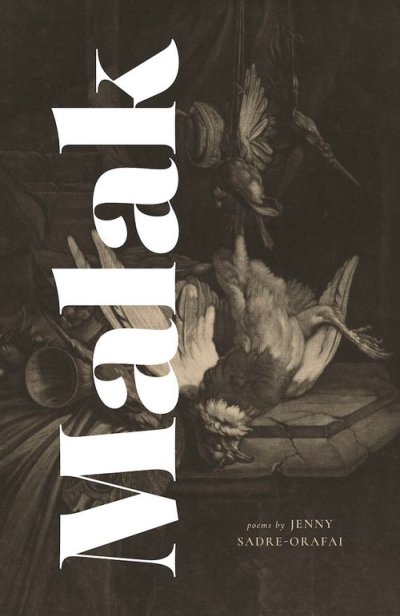
SATURDAY POETRY SERIES PRESENTS: MALAK


From MALAK
By Jenny Sadre-Orafai:


LAST READING

There is a pregnant bird in the cup.
Malak looks at me like she has never looked

at that in a cup before. My father looks at me
like there are things I’m not telling him.

She crochets baby caps, square blankets,
booties in Neapolitan ice cream colors.

If I ever have these babies, if I’m the bird
in the cup, I’ll want to devour them.

After the last reading she leaves the cup turned up,
daring the bird to forget I was pregnant.


MOTHER SPELL

I felt for mountain
and ocean, my first globe.

Mouth or beak. Arm or wing.
Skin or feather. Feet or feet.

Who brought these to me
to dress in booties and caps.

I didn’t ask to know a belly
so tight.

I didn’t ask if it was girl
or boy or bird.


LANGUAGE OF SIGNS

I slept the whole day
without remembering, Malak.

I dreamt I had a son
growing so fast,

a tomato plant sprawled
everywhere, unstoppable.

I held him at my hipline.
And I fed his hunger.

Now he’s a pitcher
of water.


Today’s poems are from Malak (Playtpus Press, 2017), copyright © 2017 by Jenny Sadre-Orafai, and appear here today with permission from the poet.


Malak is an invocation of past and future. With familial lament and childish wonder, the words lay tribute to the infinite—to the beauty in descent and the heartache that binds us to place. To our smallness in death and the importance of conjuring anew.

Jenny Sadre-Orafai is the author of Paper, Cotton, Leather and five chapbooks. Her poetry has appeared in Cream City Review, Ninth Letter, The Cortland Review, Hotel Amerika, The Pinch, and other journals. Her prose has appeared in Los Angeles Review, The Rumpus, South Loop Review, Fourteen Hills, The Collagist, and other journals. She is co-founding editor of Josephine Quarterly and an Associate Professor of English at Kennesaw State University.

Editor’s Note: Birds, tea leaves, foxes. If there are talismans that illuminate the path Jenny Sadre-Orafai’s Malak lays out for the reader, these may be those divining objects. There is magic within these pages — the kind that is conjured up in Gypsy tents and over old world kitchen tables, magic from a time and place when women were believed. But the future is always uncertain, and the tales that unfurl within Malak‘s pages curve and splinter like the lines on a palm.

What is inheritance, this collection asks. What is lived? What is lost? Do we inherit even that which cannot be passed down? Are predictions only as good as their fruition?

Malak is a book that pairs loss with beauty, future with past, the certainty of fate with the unknown and the unknowable. Throughout its pages, a sense of familiarity is established that both grounds and destabilizes. Its stories are told in the dark of night, but under the light of a full and generous moon. When Malak‘s truths reveal themselves, you bask in their luminosity and marvel at the careful magic of their making. You do not ask if they are boy or girl or bird.

Want more from Jenny Sadre-Orafai?
Buy Malak in paperback from Platypus Press
Buy Malak on Kindle from Amazon
Jenny Sadre-Orafai’s Official Website

SATURDAY POETRY SERIES PRESENTS: #METOO POETRY


Editor’s Note: As the #metoo movement that originated ten years ago with Tarana Burke reached a critical mass this week, together we bore witness to innumerable traumas. Perhaps, like me, you felt far more than you were able to articulate. In times like these I turn to poetry to find the words there are no words for. To that end, today I turn to poetry of witness and testimony. To poems that are unafraid to call out sexual assault and its aftereffects. To poetry that says: me, too.


“Seized” by Rachel Heimowitz

“I Should Quit Teaching” by Lois Roma-Deeley

Rupi Kaur’s #metoo poem

“bone” by Yrsa Daley-Ward

Nayyirah Waheed

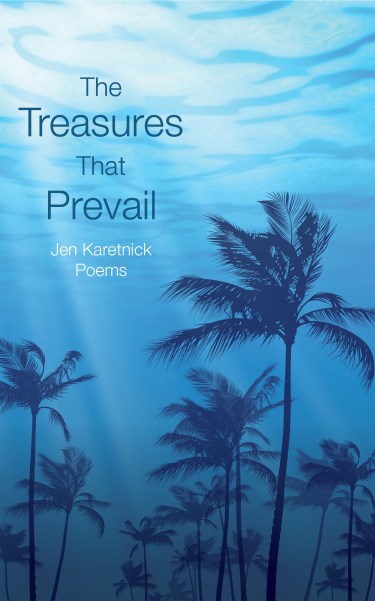
SATURDAY POETRY SERIES PRESENTS: THE TREASURES THAT PREVAIL


From THE TREASURES THAT PREVAIL
By Jen Karetnick:


ADVISE AND CONSENT

It seems to fall to men to create
disasters and women to mop up after.

The first thing people have to forget

is their sense of the senatorial

desk, the deep leather armchair.

There’s always
somebody screaming

off stage or window-shopping for the ridiculous,
arm in arm. Sooner or later these moments come.

We have seen this happen and cannot refrain.


UNDER MANGO CAMOUFLAGE

They bloomed too soon, pistils coral,
hung green like left-behind seawater
well into the sodden fall, ripened
into a bilirubinous yellow.

Falling, they broke themselves
open into Cyrillic letters on the unearthed
limestone as if they were envelopes
stuffed too full of possibilities.

Now marked only with a flag of memory,
this is where we buried the bits
of flesh snipped as easily as a stem
from an eight-day-old son, disguising

the dreams that in the wrong hands
could have been so readily rewritten.


THE OPPOSITE OF MECCA

Oh, the darkness of it all—black cat, black dog,
black monkey on the black-eyed woman’s shoulder,

rocking on a boat dock over water so absent of light
even our dreams have lost their shadows. In this house

made of books and planks, under the art of thatch
and weave, we are birds nesting together who have closed

our throats to song. This is where, without definition, we pin
the horizon as the center on a map of our always new world.


Today’s poems are from The Treasures That Prevail (Whitepoint Press, 2016), copyright © 2016 by Jen Karetnick, and appear here today with permission from the poet.


The Treasures That Prevail is about climate change and its effects on Miami; the poems in this collection confront the ills of modern society in general, mourn both public and personal losses, and predict the difficulties of a post-modern life in a flooded, Atlantis-like lost city. The narrators are two unnamed women, married with a teenage daughter and a teenage son, who live in a part of Miami that will be underwater unless action is taken. The Treasures That Prevail is a parable about what could happen to any of our low-lying coastal cities if we don’t start to make changes now.

Jen Karetnick is the author of seven poetry collections, including American Sentencing (Winter Goose Publishing, May 2016)–which was a long-list finalist for the Julie Suk Award from Jacar Press–and The Treasures That Prevail (Whitepoint Press, September 2016). She received an MFA in poetry from University of California, Irvine and an MFA in fiction from University of Miami. Her poetry, prose, playwriting and interviews have appeared recently or are forthcoming in TheAtlantic.com, The Evansville Review, Foreword Reviews, Guernica, The McNeese Review, Negative Capability, One, Painted Bride Quarterly, Prairie Schooner, Spillway, Valparaiso Poetry Review, Waxwing and Verse Daily. She is co-director for the reading series, SWWIM (Supporting Women Writers in Miami). Jen works as the Creative Writing Director for Miami Arts Charter School and as a freelance writer, dining critic and cookbook author. She lives in Miami Shores on the remaining acre of a historic mango plantation with her husband, two teenagers, three dogs, three cats and fourteen mango trees.

Editor’s Note: How fearfully prescient this collection has proven to be as California is burning, as large swathes of the world are recovering from hurricanes and earthquakes, as Harvey Weinstein has been outed as a sexual predator, as man after man shows us what it really mean to be “senatorial” in his “deep leather armchair,” as the world is melting and our future threatens to emerge underwater.

With The Treasures That Prevail Jen Karetnick has penned a collection that is beautiful and terrifying, that is lyric and devastating, that rings of Cassandra in the ways its truths fall upon deaf, ignorant, or apathetic ears. The language within these pages is thick and malleable, painting with words a picture that you might cut back with a machete in a valiant effort to combat the vengeful wrath of a raped and battered Mother Earth. For even the best among us — in the age of capitalism and consumerism and selfish, self-destructive climate change — are but “birds nesting together who have closed // our throats to song.”

Want more from Jen Karetnick?
Buy The Treasures That Prevail from Amazon
Jen Karetnick’s Writing Portfolio
Buy American Sentencing from Amazon

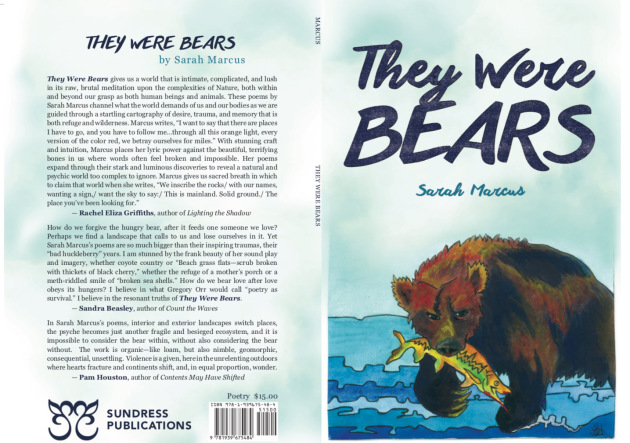
SATURDAY POETRY SERIES PRESENTS: THEY WERE BEARS


From THEY WERE BEARS
By Sarah Marcus:


PEOPLE HAVE ALWAYS KNOWN BEARS

You said you were afraid of bears—

we weren’t safe until there was ice
along the shoreline. I said we all need trauma,

and my heart breaks every Autumn, so we broke
ourselves against those rocks until the cave mouth opened:

a womb for blind crayfish,
a passageway harboring beetles.

I want you to reach into the depths of your backwoods
and remember our Winters. We need the bears, ourselves

ursine sleeping in dens—the caverns drip-stoned and stunning.
I was and still am in search of a great bear

because people have always known bears—
we will always be shelter for each other.

When we first met, I told you that a long time ago,
grizzlies came down from the Rockies—

they were poisoned on the range, trapped,
hounded, shot out—we found cranial fragments.

We still listen to those legends of bounties paid
to mountain men, harboring that ancient fear of

the bears that made meat of us, boar and sow,
mauled and gnawed away. Our bones resting in caves,

because you were born to hunt, and I was
born of hunting: a witness of great fires.


LOVE POEM

First snow of the season—
your eyes say
there’s not much oxygen
                  in the mountain air
.

I have never wanted someone
                  as much as I want you.

I devalued the damage:
you won’t belong—stay gone longer—

                  let it melt.


I’ve been thinking about you
                  because we cannot be separate.
The gravitational pull defies
                  the thousands of miles between us.

Even in the deepest woods,
                  we kneel beside the rill,
the river’s riffle,
the spruce’s mantle of rime,

                  until the point of rock
                                  swells tightly around us.

There’s a chant building in the forest: I won’t be your secret.

Everyone knows how to leave,
but I don’t know how to be
in this city
without you.


MYTHOLOGY FOR DESERT LOVERS II

These things are real:
you are a desert moon rising a hundred mornings away.
My horses paw a cracked Earth.
The air threatening Winter.
The solitude of sand.
We can smell the danger

of you and her
in that house.
In every house.

When you are so strongly connected
to another person, what did you call it? Rare?
It’s like the sunset.
No one can hold that kind of beauty
for more than a moment.

Our small ribs are thick
enough to take on a prairie panic.
The fear of too much open space.
So many acres;
we can never catch up.

You say I’m always on your side
and this will always mean more
to a woman.

I try to explain that love is a violence,
even when it’s beautiful.
When you enter someone,
you must also leave them.

And there’s always that moment of relief
when I realize that I’ve always known—
I am a hundred deserts.

I will wait for you or some version of you
to become sky.


Today’s poems are from They Were Bears (Sundress Publications, 2017), copyright © 2017 by Sarah Marcus, and appear here today with permission from the poet.


They Were Bears gives us a world that is intimate, complicated, and lush in its raw, brutal meditation upon the complexities of Nature, both within and beyond our grasp as both human beings and animals. These poems by Sarah Marcus channel what the world demands of us, and our bodies as we are guided through a startling cartography of desire, trauma, and memory that is both refuge and wilderness. Marcus writes, ‘I want to say that there are places I have to go, and you have to follow me…through all this orange light, every version of the color red, we betray ourselves for miles.’ With stunning craft and intuition, Marcus places her lyric power against the beautiful, terrifying bones in us where words often feel broken and impossible. Her poems expand through their stark and luminous discoveries to reveal a natural and psychic world too complex to ignore. Marcus gives us sacred breath in which to claim that world when she writes, ‘We inscribe the rocks/with our names, wanting a sign,/want the sky to say:/This is mainland. Solid ground./The place you’ve been looking for.’” -Rachel Eliza Griffiths, author of Lighting the Shadow


Sarah Marcus is the author of They Were Bears (2017, Sundress Publications), Nothing Good Ever Happens After Midnight (2016, GTK Press), and the chapbooks BACKCOUNTRY (2013) and Every Bird, To You (2013). Her other work can be found at NPR’s Prosody, The Huffington Post, McSweeney’s, Cimarron Review, Spork, The Establishment, Cosmopolitan.com, and Marie Claire.com SA, among others. She is an editor at Gazing Grain Press and the Series Editor for As It Ought To Be’s High School Poetry Series: Gender, Identity, & Race. She holds an MFA in poetry from George Mason University and currently teaches and writes in Cleveland, OH.


Editor’s Note: In the Jewish calendar, the days between Rosh Hashanah and Yom Kippur are a surreal and reflective time of reckoning. During these days we are introspective, coming to terms with our true selves before turning outward and asking forgiveness from those who we have wronged. It is in these Days of Awe that I come back to a collection I have been meaning to review for quite some time. It is in this magical time of brutal honesty that I dive deeply into a carefully-wrought world that is far beyond my comfort zone, with eyes and heart wide open to its savage and beautiful truths.

They Were Bears is one of the most thoughtful–if not the most thought-provoking–poetry collections to be released in recent memory. Rife with hunger and blood and animal instinct, this work pulsates at the intersection of nature and violence, family, sex, and love. They Were Bears drags us mercilessly back to our animal nature, honoring vulnerability and calling out sexual violence. This book pulls no punches, spares us little. What is reflected in its waters is our truest selves, as beautiful and terrifying as they are wont to be.

The tender, ravenous, brutal honesty of the book’s thematic spectrum is brought to life by the true craftsmanship of the poet. This is an absolutely stunning collection on every level–its words and images thrash and breathe, fly and tether. The poems are lush in their soundscape, and on the page they mark their territory distinctly. And the moments. The breathtaking moments. How true their revelation, declarations, and admissions: “because you were born to hunt, and I was / born of hunting: a witness of great fires;” “I try to explain that love is a violence, / even when it’s beautiful. / When you enter someone, / you must also leave them.”

Mazal tov to Sarah Marcus on this incredible work, and may we all start anew together in these Days of Awe.


Want more from Sarah Marcus?
Sarah Marcus’ Official Website

SATURDAY POETRY SERIES PRESENTS: HOLLY KARAPETKOVA

Song of the Exiles
By Holly Karapetkova

There never was a garden
only a leaving:
miles and miles
of footprints in the dirt.

In the beginning–
the shattered sun, the wind,
and nothing left but our shadows
sifting through the dust behind us.

When we turned
we did not turn to salt.
When we turned
there was nothing behind us to burn,

nothing to return to,
though who could blame us for turning
with only the long days ahead,
tongues tripping in the dirt.

They said we didn’t belong.
They blamed us
for leaving the garden
which never was or would be.

Where could we go,
we who had come from nowhere
and hence could not
return?


“Song of the Exiles” previously appeared via Split This Rock and appears here today with permission from the poet.

Holly Karapetkova’s poetry, prose, and translations from the Bulgarian have appeared recently in Alaska Quarterly Review, Prairie Schooner, North American Review, Drunken Boat, and many other places. Her second book, Towline, won the Vern Rutsala Poetry Contest and is just out from Cloudbank Books.

Editor’s Note: After a moment of silence following the loss of AIOTB’s Managing Editor, the Saturday Poetry Series returns this week with a poem worth breaking silence for. Holly Karapetkova’s “Song of the Exiles” begins in Eden. At once biblical and real, this Eden is a “garden / which never was or would be.” In this world we are storyteller and reader, mythological figure and landless refugee. This is world news, this is human interest story, this is myth in the truest sense of the word. And this, above all, is poetry. Expertly crafted, delicately wrought, brilliant poetry. “When we turned / we did not turn to salt. / When we turned / there was nothing behind us to burn.”

Want to read more by and about Holly Karapetkova?
Holly Karapetkova’s Official Website

SATURDAY POETRY SERIES REMEMBERS OKLA ELLIOT WITH PAUL CRENSHAW

Photo Credit: Brandon Pierce

By Paul Crenshaw:

FOR OKLA

All that late-night talk of light, and life,
all those words, which became like worlds.
Which we both know were.
If you even need words anymore,
wherever you are, what world
you find yourself in.

Let me just say I hope there’s light.
Let me say I want to send this to you
so you know all the poetry was enough.
That the porch light is still on
in my mind. That the windows are open,
and the songs from inside the house still play.
You are still sitting in the overstuffed chair.
You are still smiling. Let me say
the lighting of a cigarette or
clink of ice in a glass is as much poetry
as anything we ever said.
Let me remind myself I remember all the words,
even if I’ve forgotten how to say them.


ONLINE MEMORIALS AND TRIBUTES
As It Ought To Be Mourns the Loss of Our Founder
“Some testimonies to Okla Elliott, 1 May 1977 – 19 March 2017” – Days and Memory
“Requiescat in pace: poet, novelist, translator Okla Elliott, 1977-2017” – Book Haven
“Go Read Okla Elliott’s Stuff, Please. (A Remembrance)” – Great Writers Steal
“Remembering Okla Elliott” – Mildred Barya’s House of Life


REMEMBER OKLA WITH AS IT OUGHT TO BE
As It Ought To Be welcomes art and writing in Okla’s memory. Please email sivan.sf [at] gmail [dot] com with your submissions.


SATURDAY POETRY SERIES PRESENTS: STACY R. NIGLIAZZO


By Stacy R. Nigliazzo:


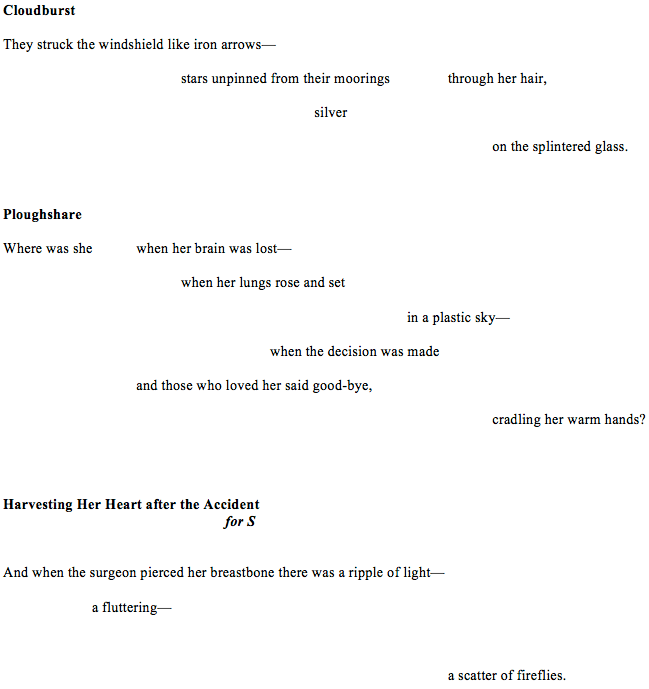
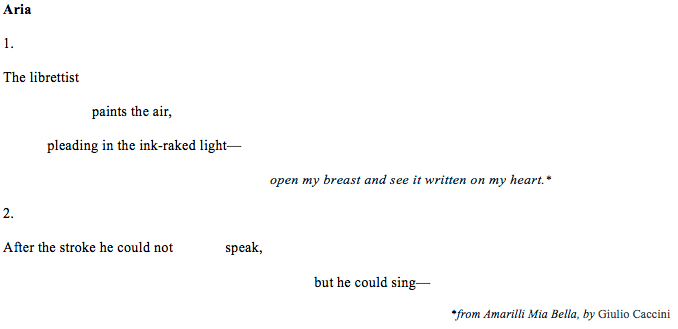
“Harvesting Her Heart after the Accident” first appeared in The Journal of Compressed Creative Arts/Matter Press. All other pieces are previously unpublished. Today’s poems appear here today with permission from the poet.

Stacy R. Nigliazzo‘s debut poetry collection Scissored Moon was published in 2013 by Press 53. It was named Book of the Year by the American Journal of Nursing. It was also short-listed as a finalist for the Julie Suk Poetry Prize (Jacar Press) and the Texas Institute of Letters First Book Award for Poetry/Bob Bush Award. She is co-editor of Red Sky, an anthology addressing the global epidemic of violence against women.

Editor’s Note: Stacy R. Nigliazzo imagines the unimaginable, writes those words which cannot be spoken. An emergency room nurse, it is when her personal losses make their way to the page that her experience becomes poetry, and that poetry becomes an act of healing for poet and reader alike. How visual her imagery, how visceral her grief. And yet her poems leave us not in darkness, but with the necessary reminder that even in our darkest hour there is a “ripple of light.”

Want to read more by and about Stacy R. Nigliazzo?
Stacy Nigliazzo’s Official Website

SATURDAY POETRY SERIES PRESENTS: GILI HAIMOVICH


AND THERE’S SOMETHING ABOUT SOFTNESS
By Gili Haimovich

People are still flirting
with trying to look younger,
to make each other laugh.
Their existence is softened
by the luxuries of having some time, some needs, met.
People are still eager,
not too tired of being keen,
I have found out
among the snow banks,
pushing
the stroller of my soft new baby.


Today’s poem appears here today with permission from the poet.

Gili Haimovich is an international poet and translator who writes in both Hebrew and English. She has six volumes of poetry in Hebrew, including her most recent, Landing Lights (Iton 77 Publishing House), which received a grant from Acum, as did her previous book. She also received a grant nominating her as an outstanding artist by the Ministry of Immigrant Absorption on 2015. Her poetry in English is featured in her chapbook, Living on a Blank Page (Blue Angel Press, 2008) and in numerous journals and anthologies, such as Poetry International, International Poetry Review, Poem Magazine, LRC – Literary Review of Canada, Asymptote, Drain Magazine, Blue Lyra, Circumference, TOK1: Writing the New Toronto and Mediterranean Poetry, as well as main Israeli journals and anthologies such as The Most Beautiful Poems in Hebrew (Yedioth Ahronot Books, 2013). Her poems have been translated into several languages including Chinese, French, Italian, Bengali, and Romanian. Gili is also presenting her work as a photographer, teaches creative writing, and facilitates writing focused arts therapy.

Editor’s Note: Today’s poem excels in the realm of wordplay. Double entendres luxuriate in a language that is as rich as it is simple, as straightforward as it is complex. The poet’s clear love of language — the sheer joy of it — culminates in a narrative of the unexpected, in a revelation that demands we enter the poem again and consider it anew. Delicate and layered, this poem is a labor of love that offers the reader the fruits of its bounty.

Want to read more by and about Gili Haimovich?
Poetry International Rotterdam
Mediterranean Poetry
Drain Magazine
Taylor & Frances Online
PoetryOn – Gili Haimovich’s Official Website