SATURDAY POETRY SERIES PRESENTS: HILA RATZABI


By Hila Ratzabi:


"Sedna the Arctic Sea Goddess" broadside, designed by poet and visual artist MaryAnn Miller
“Sedna the Arctic Sea Goddess” broadside, designed by poet and visual artist MaryAnn Miller.


SEDNA IN SPACE

             “Our newly discovered object is the coldest most distant place known in the solar
             system, so we feel it is appropriate to name it in honor of Sedna, the Inuit goddess of
             the sea, who is thought to live at the bottom of the frigid arctic ocean.”
                                                                                                                     ––Mike Brown, astronomer

Now you’re nothing
but a dwarf planet at the edge
of the asteroid formerly known as Pluto,

neighbor to demoted planet,
atmosphere-less,
stunted.

When the scientists ran out of Greek and Roman gods
they settled on you, “Big Bad Woman,”
as one tribe puts it.

You are made of water,
methane, nitrogen ice,
frozen all over.

It takes you
more than ten thousand years
to orbit the Sun.

I want to place a blanket
around your shivering surface,
tuck you in surrounded by stars.

Where I’m from, we’ve released
so much heat into the sky
it’s burning us back.

But I can’t turn up the heat
at your edge of the solar system,
can’t drag you any closer to the Sun.

From your corner the Sun
Is a wink of a star, so small
you could block it out

with the head of a pin.
Just look what a nothing it is
next to you, big girl.


“Sedna the Arctic Sea Goddess” was previously published in Alaska Quarterly Review and “Sedna in Space” was previously published in Narrative. These poems appear here today with permission from the poet.


Hila Ratzabi was selected by Adrienne Rich as a recipient of a National Writers Union Poetry Prize and has been nominated for a Pushcart Prize. She is the author of the chapbook The Apparatus of Visible Things (Finishing Line Press). Her poetry is published or forthcoming in The Bloomsbury Anthology of Contemporary Jewish American Poetry, Narrative, Alaska Quarterly Review, Drunken Boat, About Place, The Normal School, H_NGM_N, Cortland Review, and others. She holds an MFA from Sarah Lawrence College, and lives in Philadelphia where she founded the Red Sofa Salon & Poetry Workshop.


Editor’s Note: In Hila Ratzabi’s Sedna poems the Inuit goddess becomes a symbol of the trauma of climate crisis as explored through the lens of feminist response.

In “Sedna the Arctic Sea Goddess” we are introduced to Sedna’s creation myth. So, too, are we introduced to the misogyny and violence inherent in her tale. She is a “bitch goddess” whose father throws her to the sea and then cuts of her fingers when she tries to save herself.

In “Sedna in Space” we see Sedna rise again when a dwarf planet is discovered and named for her, but still she is “nothing / but a dwarf planet at the edge / of the asteroid formerly known as Pluto, // neighbor to demoted planet, / atmosphere-less, / stunted.” Through poetry, Ratzabi seeks to reclaim Sedna, to save her from the grips of oppression: “I want to place a blanket / around your shivering surface, / tuck you in surrounded by stars.” By shifting perspective, the poet empowers Sedna, making her grander than the sun: “From your corner the Sun / Is a wink of a star, so small / you could block it out // with the head of a pin. / Just look what a nothing it is / next to you, big girl.”


Want to read more by Hila Ratzabi?
Read recently published poems on climate change by Hila Ratzabi in About Place and Drunken Boat.
Learn about Hila’s poetry workshops in Philadelphia at The Red Sofa Salon & Poetry Workshop.
Purchase “Sedna the Arctic Sea Goddess” broadside (pictured above).
Purchase “Sedna in Space” broadside (poem above).
Purchase The Apparatus of Visible Things chapbook.

SATURDAY POETRY SERIES PRESENTS: RESURRECTION PARTY

resurrection_cover


From RESURRECTION PARTY
By Michalle Gould:


SELF-PORTRAIT AS A SERIES OF PREPARATORY STUDIES FOR A NUDE BY MATISSE

The breasts hang low like fruit hoping
to be picked yet still on the branch,
While the body largely reclines, a letter K
lain on its side and slightly bent,
or in a less common pose, my back faces the viewer
so I resemble a pushed in O, my arms and legs drawn in,
like a turtle withdrawing far into its shell
to escape some predator that has come to suck;
We are become a rock. Our hearts lie hidden far
Below its skin. The artist scrapes my flesh onto his brush
but cannot touch what lies beneath, whatever he thinks—
nor can you, my dear, even as you read me.


SELF-PORTRAIT AS THE MAIDEN OF ATHENS

That day, I went forth to kill the Minotaur.
Since Theseus, they sent us all naked;
I had no ball of string; I had no sword.
For tools, instead, I had only the instruments
of my body: my nails for daggers, my hair for thread.
I had heard of his legendary cruelty;
I had heard how he killed without a word.
Then I came to the center and saw him.
His strong arms beckoned—and I cut the cord.


SELF-PORTRAIT AS A PAIR OF LOVEBIRDS

Opening their beaks, they thrust
their tongues out for one last kiss
before the long journey south—
like worms they each intend to drop
into the other’s hungry waiting mouth.


Today’s poems are from Resurrection Party, published by Silver Birch Press, copyright © 2014 by Michalle Gould, and appear here today with permission from the poet.


RESURRECTION PARTY concerns itself, almost to the point of obsession, with the question of how the imagination grapples with the fear of death. The collection intertwines religious and mythical subjects and themes with more fleshly concerns about the body and decay, presence and absence. It has been described as containing poems of “almost exquisite refinement, illuminated by the taut glow of sensuous prosody and imagery” and as “a deeply meditative collection at once intelligent, tender, and utterly human.” (From the Silver Birch Press website.)


Michalle Gould has been working on the poems that constitute Resurrection Party for almost 15 years. In that time, her poems and short stories have appeared in Slate, New England Review, Poetry, American Literary Review, The Texas Observer, and other journals. She currently lives in Los Angeles, where she works as a librarian, and is in the process of researching and writing a novel set in the North of England during the 1930s.


Editor’s Note: Michalle Gould has a deep and fearless understanding of the self. In her quest to write poems that grapple with life’s big questions—life and death, self-awareness, relationships—she is bold and unafraid. She views her own body as honestly as an artist would. Yet she understands truths about the self that no other can reveal: “The artist scrapes my flesh onto his brush / but cannot touch what lies beneath, whatever he thinks— / nor can you, my dear, even as you read me.”

In “Self Portrait as the Maiden of Athens” the poet re-examines the Greek myth of the minotaur from a female perspective. Here she notes that, unlike the male hero in the story, when the maiden faces the beast, “I had no sword. / For tools, instead, I had only the instruments / of my body: my nails for daggers, my hair for thread.” This concept translates into the larger role of women in the world, and the question of what few tools and resources we have traditionally been allowed.

SPS-beloved poet Louise Mathias writes that the terrain of Resurrection Party “is somewhere between body and spirit, life and death, intimacy and solitude, elegance and intuition. Possessing a sly humor coupled with a laser sharp awareness and assertion of how all is ephemeral, Resurrection Party accomplishes the rare: it makes even the big questions fresh.”


Want to see more from Michalle Gould?
Michalle Gould Official Website
Buy Resurrection Party from Amazon
Resurrection Party on Goodreads
More Excerpts from Resurrection Party

SATURDAY POETRY SERIES PRESENTS: JEN CAMPBELL

Jen Campbell


Vaginaland
By Jen Campbell


Screen Shot 2014-09-19 at 10.59.02 PM
Screen Shot 2014-09-19 at 10.59.16 PM
Screen Shot 2014-09-19 at 11.00.21 PM


“Vaginaland” was previously published in English Pen “Poems for Pussy Riot” and appears here today with permission from the poet.


Jen Campbell is an award-winning poet and short story writer. She’s also the author of the bestselling Weird Things Customers Say in Bookshops Series. Her poetry collection, The Hungry Ghost Festival, is published by The Rialto and her latest book, The Bookshop Book, will be published in October by Little, Brown.


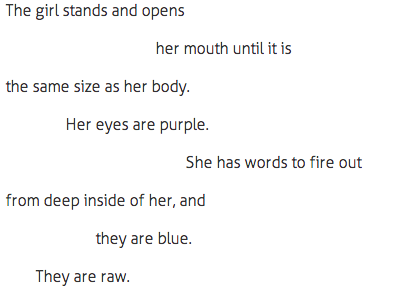
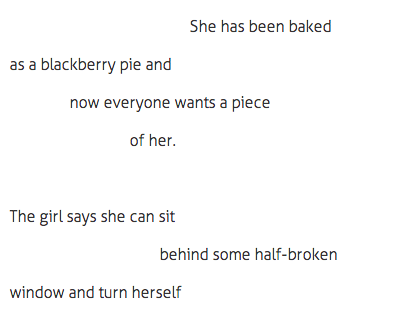
Editor’s Note: What is a girl? What is her mouth, her body, her words? Who is that girl when the world tries to hold her down and shut her up? When “She has been baked / as a blackberry pie and / now everyone wants a piece / of her”?

“Vaginaland” was originally published by English PEN as a political act. In an act of solidarity. In support of three members of the Russian punk band Pussy Riot, who were then in prison for their outspoken feminism, LGBT advocacy, and opposition to the policies of Russian President Vladimir Putin.

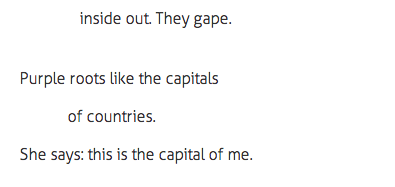
Who — and what — does a girl become when she stands up, breaks free, and fires out the words that are deep inside of her? When those words are political? When her voice is political? When “She says: this is the capital of me”?


Want to read more by Jen Campbell?
Jen Campbell Official Website
The Hungry Ghost Festival
The Prose-Poem Project
Jane Martin Poetry Prize 2013
The Plough Prize

SATURDAY POETRY SERIES PRESENTS: ALLIE MARINI BATTS

Allie Back_Photo

By Allie Marini Batts:


breeding, trumpet flowers out of the dead ash


a cautious unfurling, petals, these fragile fingers,

extended through layers of silt and salt,

the battle-blown lands where once a city stood.

these vines, they labor furiously,


expanding and dividing beneath the dust of nations

nightshades in mitosis, their toxins lovely, bright and narrow

set against a land destroyed.


likewise myself and my skin,

a playground for dead things

and invasive plants to rise from,

a phoenix, in botany.


the mythology of the night skies


you were once a man

square but bright

incense in the dark


your story, told by Greeks

naïve, the way we

lit sticks of incense and prayed


wantonly to false hopes and square gods

and stars, naïve offerings

and devotions meant to keep us safe


protections and punishments

remembered in the

rotations of the planet


naïve, how we thought

you loved us

and would keep us safe


“breeding, trumpet flowers out of the dead ash” previously appeared in quarter after and “the mythology of the night skies” previously appeared in Symmetry Pebbles. These poems appear here today with permission from the poet.


Allie Marini Batts holds degrees from both Antioch University of Los Angeles and New College of Florida, meaning she can explain deconstructionism, but cannot perform simple math. Her work has been a finalist for Best of the Net and nominated for the Pushcart Prize. She is managing editor for the NonBinary Review and Zoetic Press, and has previously served on the masthead for Lunch Ticket, Spry Literary Journal, The Weekenders Magazine, Mojave River Review & Press, and The Bookshelf Bombshells. Allie is the author of the poetry chapbooks, You Might Curse Before You Bless (ELJ Publications, 2013) Unmade & Other Poems, (Beautysleep Press, 2013) and This Is How We End (forthcoming 2014, Bitterzoet.)

Editor’s Note: “breeding, trumpet flowers out of the dead ash” is so stunning that the poem speaks for itself. I am loathe to feature a favorite line in the face of so many beautifully wrought images emerging one after another. The subject matter is as rich as the soil the poem’s flowers rise from. The world revealed is post apocalyptic, brimming with nature’s resilience and with death nurturing new life, “a phoenix, in botany.”

“the mythology of the night skies” turns our eyes upward to the heavens and our minds to the gods. While pressing against the idea of worship in antiquity, the poem’s echo seems to question deity worship altogether. “naïve, how we thought / you loved us / and would keep us safe.”

Want more from Allie Marini Batts?
Find her on the web
Follow her on Twitter @kiddeternity

SATURDAY POETRY SERIES PRESENTS: PAPER COTTON LEATHER

Paper_Cotton_Leather_cover


From PAPER COTTON LEATHER
By Jenny Sadre-Orafai:


RETRACT OR RECANT

This accordion love expands or exhales,
retracts or recants. It is only as much
as we allow. It squeezes out warnings
of cardboard walls closing in.

Its wheezing fills a willful tide
with dread. I turn to this gone
love. I was taught curve into the slide
when spinning on frozen road.


CUTTING YOUR HAIR

When I was done, a ring of hair
or a halo curved your hunched
shoulders. Your broad back didn’t
flinch when the scissors’ legs twitched,
when I wanted to cut more than you mimed.


PREMATURE OBITUARY

I pretend you’re dead.
I don’t let them say your name.
I was taught it’s impolite
to talk behind a dead man’s back.

I wear black four months and ten days.

I smell your clothes before
hand washing, bagging,
and then giving them away.
I don’t give your mother a thing.

I pray for what’s left of you.

I stack the wedding ring, all the rings
you gave me on my right hand,
my proclamation that you are no longer
with us or like us, the living, listening.

I tell myself what I tell myself
to keep from going back.


Today’s poems are from Paper, Cotton, Leather, published by Press 53, copyright © 2014 by Jenny Sadre-Orafai, and appear here today with permission from the poet.


PAPER COTTON LEATHER: “The specter of divorce haunts Sadre-Orafai’s debut, although Paper, Cotton, Leather is much more than a lyrical response to loss. Paper, Cotton, Leather is an instruction manual for the amateur anthropologist, the domestic ghost-hunter, and the doomsday prepper. In ‘Retract or Recant,’ Sadre-Orafai writes: ‘I was taught curve into the slide/when spinning on frozen road.’ This is exactly what Paper, Cotton, Leather can teach us: how to navigate the heart’s switchbacks, how to survive a spin-out on its loneliest back roads.” —Shelley Puhak, author of Guinevere in Baltimore (From the Press 53 website.)


Jenny Sadre-Orafai is the author of four poetry chapbooks—Weed Over Flower (Finishing Line Press), What Her Hair Says About Her (H_NGM_N Books), Dressing the Throat Plate (Finishing Line Press), and Avoid Disaster (Dancing Girl Press). Her poetry has appeared in H_NGM_N, Gargoyle, Rhino, Redivider, PANK, Mount Hope, Sixth Finch, iO: A Journal of New American Poetry, and other journals. Her creative nonfiction has been published in The Los Angeles Review, South Loop Review, and The Rumpus. She co-founded and co-edits the literary journal Josephine Quarterly. She lives in Atlanta and is an Associate Professor of English at Kennesaw State University.


Editor’s Note: Reading Paper, Cotton, Leather is like reading a diary written in achingly executed lyric. The compact, controlled poems function almost ironically; tiny scaffolding straining beneath the pressure of massive weight and breadth. The poems are honest. Fiercely, unapologetically honest. Surely it took no small amount of courage for the poet to sift through the wreckage of her failed marriage and catalogue its failures for us in verse.

In the poem “Fortune,” Sadre-Orafai writes, “Our pictures live in a box marked / THE PAST in my parents’ garage.” Each poem reads like its own discreet picture from that box. Vignettes of trying, failing, moving on, and learning to let go. Together those pictures—these poems—tell a story. This book is carefully held by a narrative arc that gives the illusion that we might piece together the end of this marriage like a puzzle. And yet, You know nothing, Jon Snow. This is an expertly crafted book of poems, not a memoir. We are left only with what the poet chooses to reveal. With what poetry is perhaps best at conveying. A selection of life’s moments as if through lens and shutter. Emotion. Regret and loss and heartache. Experience that finds a kindred spirit in the reader. This is a book that one reads to remember that life’s trials are universal, that we are not alone.

We are not alone. So many of us know, or have known, love like an accordion, squeezing out warnings, wheezing and transforming into gone love. “Cutting Your Hair” recalls Delilah, in all her power, destroying her lover. So, too, does that recollection call forth Regina Spektor (who is quoted in one of the book’s epigrams) in her song “Sampson”: “I cut his hair myself one night, a pair of dull scissors in the yellow light.” In this manner one can read Paper, Cotton, Leather like an archaeologist, dusting away layers to discern history, or, as Shelley Puhak suggests, like an anthropologist, observing humanity, past and present. So how does the poet pick herself up, dust herself off, and move into the future? In the most human way imaginable: striving and imperfect. “I pretend you’re dead. / I don’t let them say your name.” “I smell your clothes before / hand washing, bagging, / and then giving them away.” “I tell myself what I tell myself / to keep from going back.”


Want to see more from Jenny Sadre-Orafai?
Buy Paper, Cotton, Leather from Press 53
Jenny Sadre-Orafai’s Official Website
Jenny Sadre-Orafai on As It Ought To Be

SATURDAY POETRY SERIES PRESENTS: JOANNA FUHRMAN AND TONI SIMON

Screen Shot 2014-07-25 at 2.52.06 PM


By Joanna Fuhrman and Toni Simon:

from FRIEND OF THE DEAD


Screen Shot 2014-07-25 at 2.55.05 PM


Screen Shot 2014-07-25 at 2.54.49 PM


Screen Shot 2014-07-25 at 2.53.53 PM


from HOW MANY TIMES DO I HAVE TO TELL YOU?


Screen Shot 2014-07-25 at 3.06.29 PM


Screen Shot 2014-07-25 at 3.06.12 PM


from THE RULER OF RUSTED KNEES


Screen Shot 2014-07-25 at 3.03.57 PM


Screen Shot 2014-07-25 at 3.11.21 PM


Selections from “Friend of the Dead” originally appeared in Paperbag, selections from “How Many Times Do I Have to Tell You” originally appeared in Talisman, and selections from “The Ruler of Rusted Knees” originally appeared in Posit. These selections appear here today with permission from the poet.


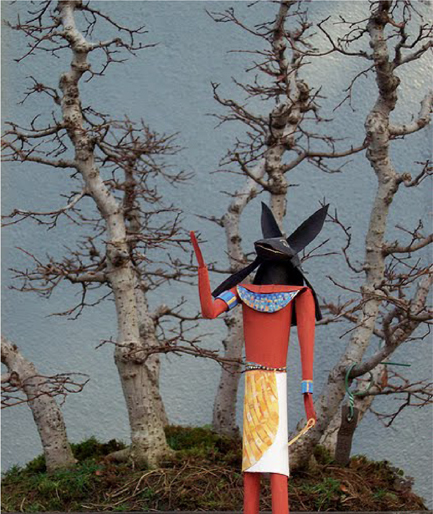
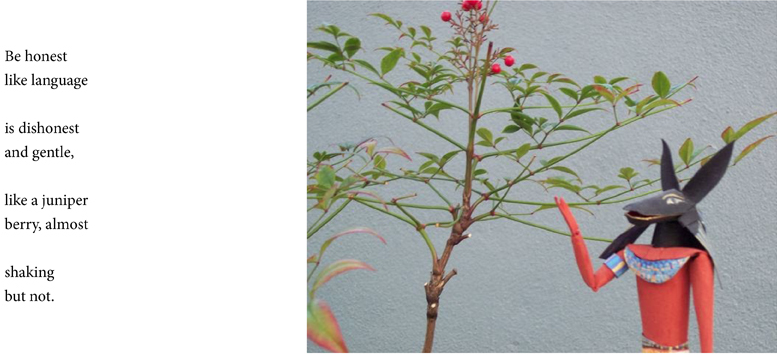
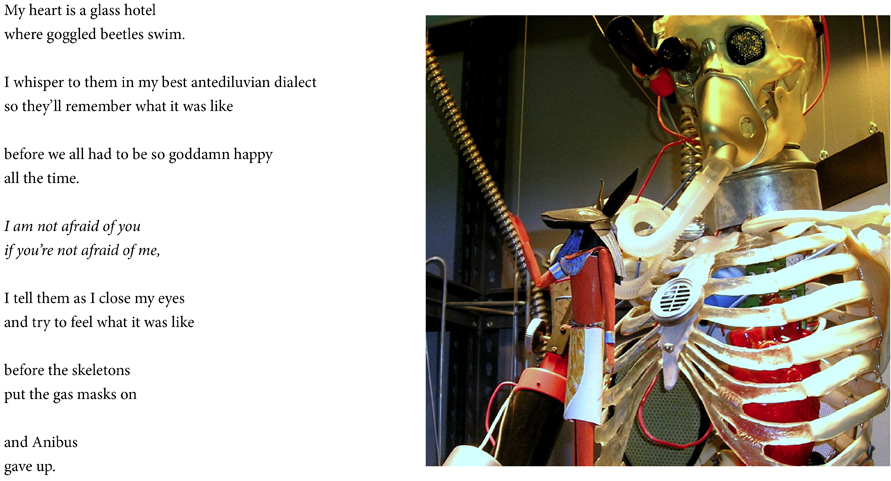
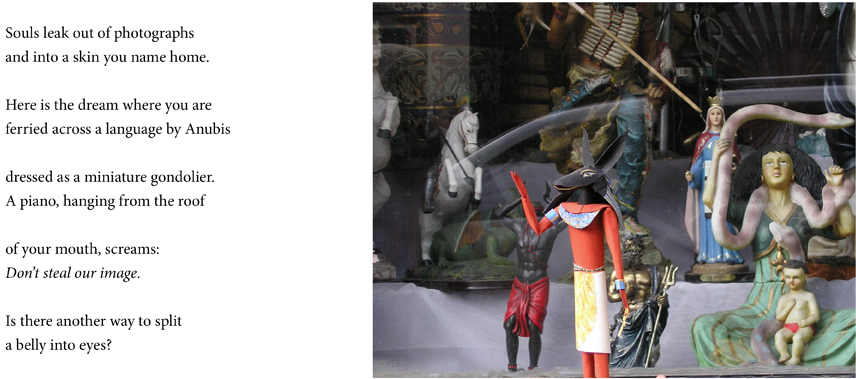
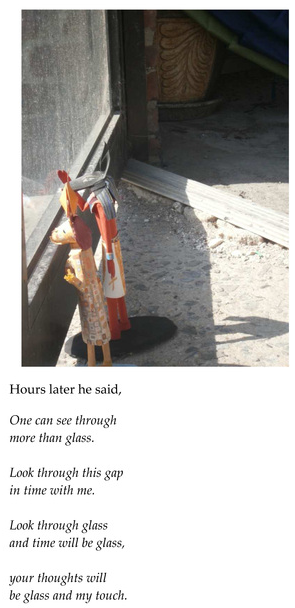
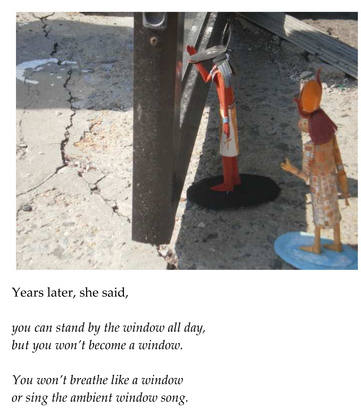
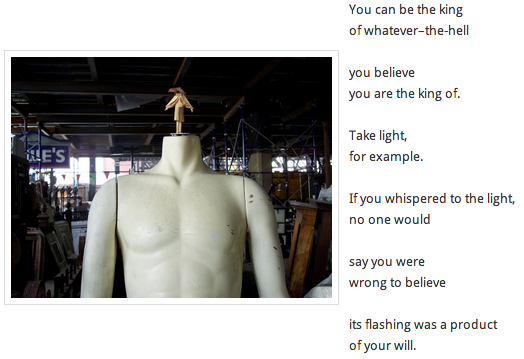
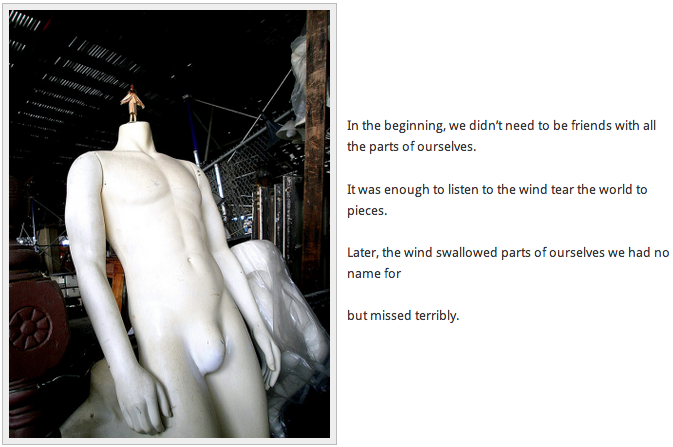
Artists’ Statement: In our mixed-media literary project, Egyptian gods, stripped of their context and role, wander various New York City neighborhoods trying to figure out where they belong, how to make sense of what they have lost, and how to get along with one another.

In the first step of our project, Toni Simon constructs three-dimensional, small-scale figurines out of paper, modeled on Egyptian gods. She then paints them with abstract, graphic details. We then take the little gods out into different neighborhoods and take hundreds of photographs of them. We select eight to ten images, which become the basis for a series of poems written by Joanna Fuhrman.

So far, we have created picture/poem serial combinations in Park Slope, Windsor Terrace, Chinatown, the Reversible Destiny Studio, Red Hook and Gowanus. Parts of the project have appeared online in Paperbag, Talisman, and Posit, and in print in the 100th issue of Hanging Loose.


Joanna Fuhrman is the author of four books of poetry, most recently Pageant (Alice James Books 2009). Her fifth book, The Year of Yellow Butterflies, is forthcoming from Hanging Loose Press in 2015. Recent poems appear in The Believer, Court Green, The Brooklyn Rail, and Puerto del Sol. In 2011, Least Weasel published a beautifully printed chapbook, The Emotive Function. She teaches poetry writing at Rutgers, SLC Writer’s Village and in private workshops. Her essays on teaching appear regularly in Teachers & Writers Magazine.


Toni Simon is a multimedia artist living in Brooklyn. Her illustrated book of prose poetry, Earth After Earth, was published by Lunar Chandelier Press in 2012. Over 80 of her illustrations appear in Contradicta: Aphorisms (Green Integer, 2010) by Nick Piombino. She has exhibited her drawings at the Drawing Center and at the AIR Gallery in NYC.


Editor’s Note: What’s not to love? Two stellar artists in collaboration, pairing visual art and poetry. Egyptian gods wandering the streets of New York, searching for life’s meaning. Unique, hand-crafted images. And the words. Yes. The words. After all, this is the Saturday Poetry Series, and as unique as this concept is, it would not be here if it weren’t for the words. “Be honest / like language // is dishonest.” “I am not afraid of you / if you’re not afraid of me.” “One can see through / more than glass.” “You can stand by the window all day, / but you won’t become a window.” “In the beginning, we didn’t need to be friends with all / the parts of ourselves.” These reflections, offered in the guise of meditations of fallen gods, are truly a reflection of ourselves.


Want to read more by Joanna Fuhrman and Toni Simon?
Joanna Fuhrman Official Website
Toni Simon Official Blog
Paperbag
Posit
Talisman

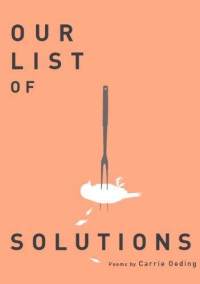
A Review of Carrie Oeding’s Our List of Solutions

Carrie Oeding Our List of SolutionsA Review of Carrie Oeding’s Our List of Solutions

by Angie Mazakis

In a January 2010 blog post at HTMLGIANT, Elisa Gabbert, with the help of Mike Young*, cataloged popular “moves” in contemporary poetry, and the list, which is singular and far-reaching, is veracious in its deconstruction of the recent (and nearly-recent) ways in which poets’ work has attempted a unique voice. The list was undoubtedly welcomed by poetry’s readers and writers, corroborating our suspicions that certain repeated current devices may have become gimmick, especially if they are vulnerable to a collection of several examples and labeled as “moves.” At the same time, the list is somewhat dispiriting―all our word tricks exposed in one bill of misfare. (See #34 on Gabbert’s list: “Clipping or altering a cliché.”)

Carrie Oeding’s poems in Our List of Solutions, winner of the inaugural 42 Miles Press Poetry Award, transcend reliance on any of the devices delineated in Gabbert’s list, which, even to a minor extent, can be found in most current poetry. Oeding has achieved an exceptionally distinct voice that stands out among the assemblage of blossoming contemporary camps and persuasions by creating personae in her poems that illuminate the incidental, that offer hyper-awareness through witty, appealingly and truly unique voices. Oeding’s poems are a refreshing shift from imposture or imitation.

Though readers may find the speakers in Our List of Solutions alone on a dance floor or navigating a barbeque in a way that is more meditative and remote than social, they aren’t easily categorized as the standard introvert and socially isolated ingenues they may seem to represent at first glance; they belong to a social category of cool outside observers that has transcended the vagrant cynic; they’ve replaced aloofness with sensitive observation, have deflected incuriosity with perspicacity. They’re appealing because readers will want to participate in their unique perceptions, in the exclusivity of their rare appreciations (their own nice ears, for example). We feel their anxiety and envy it for its accuracy.

Their intimations of detachment often seem either accepted or self-invoked–they know too much about social normalcy (“Don’t wait for me to point out how people work”; “They all do what they’re only made to”). They are furtive and unbending at once, deliberate introverts who make directive statements while retaining their vulnerability. They are the solitary who do not want/need to be found (“Someone find someone who wants to find anyone/ and tell them no one wants to be found”). They are speakers who’ve resolutely jilted the stars (“Sandy Says No More! To Just About Everything”). They seem less anxious about their aloneness than they do about their advertent observations of the world and the people living in it. In “Sandy’s Beauty,” the speaker’s exposure of the social obligation of flattery creates a response that is both hilarious and touching at once:

One of my neighbors said, You’re beautiful!
As if she discovered Beautiful for me…

Hello Beautiful.
What do you like? It’s almost winter.

Frankly Beautiful,
I have always had a feeling about myself.

Sandy personifies the superfluous “beauty,” sits it down and deconstructs and talks to it, having been given something she already had.

Despite the shy authority of these voices, the solitary inwardness of many of the speakers does not lose its moving, heartbreaking quality:

and I’ll make my own table too.
Better, without chairs.

—from “Amy Wears Blue Shirts Every Day, Too”

The voice of “we” weaves in and out of the book, dispensing instruction or exerting a warning (“We all know what happened to Dean”) or acting as a collective speaker of the poem (“Do you whisper, I can do this better,/ Susanna? Funny how we knew that. / We’ve already done better.”) Though it seems that the voice of “we” in Oeding’s poems is caricatured, the collective voice has desires or tastes that act so singularly readers will feel as though the we’s assertion is something they should have already felt or considered along with them. The voice is so convincing that we’re left wishing we were part of the group. It is also another avenue through which humor is used in the collection. (“We’re going to stop. We have a date. You understand.”)

When we think Oeding’s speakers are going to indulge in “description by negation,” (number 36 in Gabbert’s list of “moves”), even then they surprise by turning the negation further, so that there is still something unexpected around a corner we hadn’t anticipated.

After six whiskeys he can’t tell which neighbor can see through him.
Without seven he can’t tell the night what he doesn’t see.

—from “His List of Solutions”

Oeding does this another time as a kind of hyperbolic way of criticizing a prescriptive approach to finding love:

Don’t just like the lack of choice
in who you could really love, like all the choices
you could make to avoid love in hopes of finding love.

—from “We Like Steve and Louise’s Love”

The line break after “choices” creates an unexpected turn in the directive as well as in the negative indicators don’t, lack, and avoid, which oppose the positive could, could, and in hopes. This works to create surprise and subversion while deconstructing the meaning of the word “choice” and considering the various possibilities of choices.

Another way that Oeding impresses through the unexpected is by asking an ordinary question and then asking the relevant question readers likely wouldn’t think to ask—one that, in the following lines, makes up an inquiry concerning fundamental desire that beautifully, achingly resonates:

I wish it wasn’t dancing that gave me joy—

Can’t there be something besides dancing?
or maybe can’t there be something besides joy?
Oh, can’t there be something besides joy?

—from “Joy”

Another technical way Oeding uses language inventively is when she returns to a minor word, phrase, or idea soon after it has escaped the reader’s attention in a pleasing and unexpected reintroduction. This is done in a way that makes the reader surprised at the technique and surprised that he or she didn’t expect it. In “Storm’s A’Comin’,” we’re told there’s “a story about Dean and one about a funny hat, a favorite hat flying off in the wind.” Two lines later, when the wind seems to have ordinarily passed, “Someone’s mom has gout or goat―it’s hard to hear above the wind.” The phrase “asking for trouble” comes up again, wearing a new layer of meaning, as well as “pineapple”―just when we thought the case on the pineapple was closed.

One of the delights of Our List of Solutions is in the way that Oeding illuminates the minutiae. In “Lullaby for a Barrette,” the single act of pulling back hair is illuminated and examined, as is the act of sending a package in “Packages Under Our Control,” but illumination of the seemingly negligible and forgotten is a quiet strength throughout each of the poems, whether for its own sake or to create the rare, exquisite impressions that singularize unforgettable speakers. Carrie Oeding exposes the hidden sides―the felt but unexpressed, the loudly perceived but unsaid, and in the act of saying illuminates them, “each sequin getting its moment to be seen.”

Carrie Oeding, Our List of Solutions. 42 Mile Press, 2012: $14.25

*Correction: This review originally misattributed Elisa Gabbert’s article as being primarily written by Mike Young.

***

Angie Mazakis’s poems have appeared in The New Republic, Boston Review, Narrative Magazine, Best New Poets 2008, Drunken BoatNew Ohio Review, Everyday Genius, and other journals. She has received a Dorothy Sargent Rosenberg Prize and prizes from New Letters, New Ohio Review, and Smartish Pace.