SATURDAY POETRY SERIES PRESENTS: THE GLAD HAND OF GOD POINTS BACKWARDS

9780896728547


From THE GLAD HAND OF GOD POINTS BACKWARDS
By Rachel Mennies:


HOW GRANDMOTHER PAID HER PASSAGE TO NEW YORK

One by one her mother sold her silver spoons
and heirloom bracelets; goodbye, porcelain bear,
silk blouses, patent-leather Mary Janes, the scarves
and stud earrings for newly pierced ears, the red wool coat
spotted walking on another tiny body’s shoulders
down Wittenbergplatz. Goodbye, books bound
in leather, bone china, even the hangers, the goblets
and cabinets; goodbye to the Torah buried in the backyard,

the neighbors, the schoolmates, the mothers dressed so well
at services, the men with businesses who stayed behind
one week, two weeks more. What stylish
objects they became: the coins from fillings
and wedding rings, the soap, the wigs, lamp
after lamp to light a thousand decorated homes.


PHILADELPHIA WOMAN

The old sisters spoke with the wild gestures of trapped birds, snared or
cooped, their wings working toward an impossible escape. They stood
on street corners in Germantown and gesticulated the full span of their
arms. They argued over coffee, over books, over the dinner table, food
chilled to the temperature of the air. They hewed their beliefs for the
sake of debate. Soft-handed and pale-skinned, they lived mostly inside.

They took the trolley to Center City when they were in their twenties,
living in Logan with the rest of the refugee Jews. They told wild stories
of their childhoods, never explored or questioned. They worked as
bookkeepers, secretaries. They went to Girls’ High School, classrooms
filled with young women speaking foreign tongues, caught and released,
caught and released each day, back when men and women were kept
separately until marriage, fine china and daily dishware.

The oldest of the three married a soldier (never explored) who loved her
dearly (never questioned). When he died his mouth made words that
opened her chest like shrapnel. Tell them whatever you want, he said,
but I need you to know. I need you to know. Her hands stayed slack at her
side. Her name was. It was. She left his bedside and paced a block of Old
York Road, north and south, east and west, as if a cage around her kept
her close.


YAHRZEIT

Here the eye of God opens, unblinking,
at the throats of our grandmothers. The small pale
candle flickers on the windowsill, making
constellations of all our deaths.

How long a wick, how short a year. And here,
the family site, the only real estate
that’s mine—how clever, the way earth
makes us into mud—how heavy

the feet of our commemorators, how white
the knuckles that clasp their books of prayer.


Today’s poems are from The Glad Hand of God Points Backwards, published by Texas Tech University Press, copyright © 2014 by Rachel Mennies, and appear here today with permission from the poet.


The Glad Hand of God Points Backwards: In her first poetry collection, Rachel Mennies chronicles a young woman’s relationship with a complicated God, crafting a nuanced world that reckons with its past as much as it yearns for a new and different future. These poems celebrate ritual, love, and female sexuality; they bear witness to a dark history, and introduce us to “our God, the / collector of stories / and bodies,” a force somehow responsible for both death and liberation. Here, Mennies examines survival, assimilation, and intermarriage, subjects bound together by complex, if sometimes compromised, ties to the speaker’s Judaism. Through wit and careful prosody, The Glad Hand of God Points Backwards lays bare the struggles and triumphs experienced through a teenage girl’s coming of age, showing the reader what it means to become—and remain—a Jewish woman in America. —TTUP


Rachel Mennies is the author of The Glad Hand of God Points Backwards, winner of the Walt McDonald First-Book Prize in Poetry (Texas Tech University Press, 2014), and the chapbook No Silence in the Fields (Blue Hour Press, 2012). Her poems have appeared in Hayden’s Ferry Review, Poet Lore, The Journal, and elsewhere, and have been reprinted at Poetry Daily. She teaches in the First-Year Writing Program at Carnegie Mellon University.


Editor’s Note: The Glad Hand of God Points Backwards is an absolutely stunning collection. It is that rare breed of poetry book that you cannot help but read cover to cover, knowing all the while that you will return to it again and again. There is magic in this work. Ritual. Tradition. Its stories rise from the page in painstaking detail—vivid, emotive, and all too real. History is both honored and excavated; bones and memories are buried in the backyard. Time is not linear, but fifth dimensional; the past, present, and future unfold more like a snowflake than a line. The soundscape is rich and evocative, the themes resonant and deeply lyric, the entirety layered and striking.

And then there are these moments. These perfect, brilliant, heartbreaking moments. Reveals like the volta in “How Grandmother Paid Her Passage to New York,” when we discover what became of “the men with businesses who stayed behind / one week, two weeks more.” Lines like “When he died his mouth made words that / opened her chest like shrapnel.” Like every freakin’ moment of “Yahrzeit.”

Easy to invest in, the rewards of The Glad Hand of God Points Backwards are “as numerous as the stars in the sky and the sand on the seashore.”


Want to see more from Rachel Mennies?
Rachel Mennies – Official Website
Buy The Glad Hand of God Points Backwards from Texas Tech University Press
Buy The Glad Hand of God Points Backwards from Amazon
Linebreak
Thrush Poetry Journal

SATURDAY POETRY SERIES PRESENTS: RESURRECTION PARTY

resurrection_cover


From RESURRECTION PARTY
By Michalle Gould:


SELF-PORTRAIT AS A SERIES OF PREPARATORY STUDIES FOR A NUDE BY MATISSE

The breasts hang low like fruit hoping
to be picked yet still on the branch,
While the body largely reclines, a letter K
lain on its side and slightly bent,
or in a less common pose, my back faces the viewer
so I resemble a pushed in O, my arms and legs drawn in,
like a turtle withdrawing far into its shell
to escape some predator that has come to suck;
We are become a rock. Our hearts lie hidden far
Below its skin. The artist scrapes my flesh onto his brush
but cannot touch what lies beneath, whatever he thinks—
nor can you, my dear, even as you read me.


SELF-PORTRAIT AS THE MAIDEN OF ATHENS

That day, I went forth to kill the Minotaur.
Since Theseus, they sent us all naked;
I had no ball of string; I had no sword.
For tools, instead, I had only the instruments
of my body: my nails for daggers, my hair for thread.
I had heard of his legendary cruelty;
I had heard how he killed without a word.
Then I came to the center and saw him.
His strong arms beckoned—and I cut the cord.


SELF-PORTRAIT AS A PAIR OF LOVEBIRDS

Opening their beaks, they thrust
their tongues out for one last kiss
before the long journey south—
like worms they each intend to drop
into the other’s hungry waiting mouth.


Today’s poems are from Resurrection Party, published by Silver Birch Press, copyright © 2014 by Michalle Gould, and appear here today with permission from the poet.


RESURRECTION PARTY concerns itself, almost to the point of obsession, with the question of how the imagination grapples with the fear of death. The collection intertwines religious and mythical subjects and themes with more fleshly concerns about the body and decay, presence and absence. It has been described as containing poems of “almost exquisite refinement, illuminated by the taut glow of sensuous prosody and imagery” and as “a deeply meditative collection at once intelligent, tender, and utterly human.” (From the Silver Birch Press website.)


Michalle Gould has been working on the poems that constitute Resurrection Party for almost 15 years. In that time, her poems and short stories have appeared in Slate, New England Review, Poetry, American Literary Review, The Texas Observer, and other journals. She currently lives in Los Angeles, where she works as a librarian, and is in the process of researching and writing a novel set in the North of England during the 1930s.


Editor’s Note: Michalle Gould has a deep and fearless understanding of the self. In her quest to write poems that grapple with life’s big questions—life and death, self-awareness, relationships—she is bold and unafraid. She views her own body as honestly as an artist would. Yet she understands truths about the self that no other can reveal: “The artist scrapes my flesh onto his brush / but cannot touch what lies beneath, whatever he thinks— / nor can you, my dear, even as you read me.”

In “Self Portrait as the Maiden of Athens” the poet re-examines the Greek myth of the minotaur from a female perspective. Here she notes that, unlike the male hero in the story, when the maiden faces the beast, “I had no sword. / For tools, instead, I had only the instruments / of my body: my nails for daggers, my hair for thread.” This concept translates into the larger role of women in the world, and the question of what few tools and resources we have traditionally been allowed.

SPS-beloved poet Louise Mathias writes that the terrain of Resurrection Party “is somewhere between body and spirit, life and death, intimacy and solitude, elegance and intuition. Possessing a sly humor coupled with a laser sharp awareness and assertion of how all is ephemeral, Resurrection Party accomplishes the rare: it makes even the big questions fresh.”


Want to see more from Michalle Gould?
Michalle Gould Official Website
Buy Resurrection Party from Amazon
Resurrection Party on Goodreads
More Excerpts from Resurrection Party

SATURDAY POETRY SERIES PRESENTS: PAPER COTTON LEATHER

Paper_Cotton_Leather_cover


From PAPER COTTON LEATHER
By Jenny Sadre-Orafai:


RETRACT OR RECANT

This accordion love expands or exhales,
retracts or recants. It is only as much
as we allow. It squeezes out warnings
of cardboard walls closing in.

Its wheezing fills a willful tide
with dread. I turn to this gone
love. I was taught curve into the slide
when spinning on frozen road.


CUTTING YOUR HAIR

When I was done, a ring of hair
or a halo curved your hunched
shoulders. Your broad back didn’t
flinch when the scissors’ legs twitched,
when I wanted to cut more than you mimed.


PREMATURE OBITUARY

I pretend you’re dead.
I don’t let them say your name.
I was taught it’s impolite
to talk behind a dead man’s back.

I wear black four months and ten days.

I smell your clothes before
hand washing, bagging,
and then giving them away.
I don’t give your mother a thing.

I pray for what’s left of you.

I stack the wedding ring, all the rings
you gave me on my right hand,
my proclamation that you are no longer
with us or like us, the living, listening.

I tell myself what I tell myself
to keep from going back.


Today’s poems are from Paper, Cotton, Leather, published by Press 53, copyright © 2014 by Jenny Sadre-Orafai, and appear here today with permission from the poet.


PAPER COTTON LEATHER: “The specter of divorce haunts Sadre-Orafai’s debut, although Paper, Cotton, Leather is much more than a lyrical response to loss. Paper, Cotton, Leather is an instruction manual for the amateur anthropologist, the domestic ghost-hunter, and the doomsday prepper. In ‘Retract or Recant,’ Sadre-Orafai writes: ‘I was taught curve into the slide/when spinning on frozen road.’ This is exactly what Paper, Cotton, Leather can teach us: how to navigate the heart’s switchbacks, how to survive a spin-out on its loneliest back roads.” —Shelley Puhak, author of Guinevere in Baltimore (From the Press 53 website.)


Jenny Sadre-Orafai is the author of four poetry chapbooks—Weed Over Flower (Finishing Line Press), What Her Hair Says About Her (H_NGM_N Books), Dressing the Throat Plate (Finishing Line Press), and Avoid Disaster (Dancing Girl Press). Her poetry has appeared in H_NGM_N, Gargoyle, Rhino, Redivider, PANK, Mount Hope, Sixth Finch, iO: A Journal of New American Poetry, and other journals. Her creative nonfiction has been published in The Los Angeles Review, South Loop Review, and The Rumpus. She co-founded and co-edits the literary journal Josephine Quarterly. She lives in Atlanta and is an Associate Professor of English at Kennesaw State University.


Editor’s Note: Reading Paper, Cotton, Leather is like reading a diary written in achingly executed lyric. The compact, controlled poems function almost ironically; tiny scaffolding straining beneath the pressure of massive weight and breadth. The poems are honest. Fiercely, unapologetically honest. Surely it took no small amount of courage for the poet to sift through the wreckage of her failed marriage and catalogue its failures for us in verse.

In the poem “Fortune,” Sadre-Orafai writes, “Our pictures live in a box marked / THE PAST in my parents’ garage.” Each poem reads like its own discreet picture from that box. Vignettes of trying, failing, moving on, and learning to let go. Together those pictures—these poems—tell a story. This book is carefully held by a narrative arc that gives the illusion that we might piece together the end of this marriage like a puzzle. And yet, You know nothing, Jon Snow. This is an expertly crafted book of poems, not a memoir. We are left only with what the poet chooses to reveal. With what poetry is perhaps best at conveying. A selection of life’s moments as if through lens and shutter. Emotion. Regret and loss and heartache. Experience that finds a kindred spirit in the reader. This is a book that one reads to remember that life’s trials are universal, that we are not alone.

We are not alone. So many of us know, or have known, love like an accordion, squeezing out warnings, wheezing and transforming into gone love. “Cutting Your Hair” recalls Delilah, in all her power, destroying her lover. So, too, does that recollection call forth Regina Spektor (who is quoted in one of the book’s epigrams) in her song “Sampson”: “I cut his hair myself one night, a pair of dull scissors in the yellow light.” In this manner one can read Paper, Cotton, Leather like an archaeologist, dusting away layers to discern history, or, as Shelley Puhak suggests, like an anthropologist, observing humanity, past and present. So how does the poet pick herself up, dust herself off, and move into the future? In the most human way imaginable: striving and imperfect. “I pretend you’re dead. / I don’t let them say your name.” “I smell your clothes before / hand washing, bagging, / and then giving them away.” “I tell myself what I tell myself / to keep from going back.”


Want to see more from Jenny Sadre-Orafai?
Buy Paper, Cotton, Leather from Press 53
Jenny Sadre-Orafai’s Official Website
Jenny Sadre-Orafai on As It Ought To Be

SATURDAY POETRY SERIES PRESENTS: GLOSSOLALIA

GLOSSOLALIACOVER


from GLOSSOLALIA
By Marita Dachsel:


PATTY BARTLETT SESSIONS

I

I was 17, newly married
when I first put a woman to bed,
her new babe in arms.

Awaiting death, I’ve tallied,
attended 3977 births. Midwife,
my eminent title.

Pride is a sin,
but I think I will be forgiven
for the surge I feel
when I consider my record.


II

47 did not feel old,
but looked ancient to him.
A month after my daughter,
me. Sexless, righteous.
Virtuous. Finished.


III

I became a Mother in Israel,
coaxing young women
into the new covenant.

We were Sarah & Hagar. Rachel & Leah.

But I was wrong about polygamy.

Lust, envy & wrath are sins,
& I know I will never be forgiven
for being the zealous handmaiden
to this difficult life.


IV

I have lost four children. Heartache
is my chronic companion,
chafing the every day.

But my dear husband David
took a second wife
& I will tell you
what the others won’t admit:

There is no other earthly pain,
constant, raw & rending,
like sharing your man
with a younger wife.


V

I am a practical woman:
I can heal with herbs & my hands,
I brew my own beer, sew, knit,
& speak in tongues.

After birth, I would show
the mother the slick placenta,
raised up, a stretched orb.
An offering.

It carries the tree of life.
Rough, ropey. Red,
the colour of strawberry jam
boiling low on the stove.


VI

Being the first hand
to touch a life
is a powerful thing.

I have wondered
what imprint
I have left

& what has been
left on me.


AFTER THE MARTYRDOM

The men, they surged
from their homes,
from their women,
a confluence
in search of
their Galilee.

They shuffled, they scuffed
dirt across the land,
a hand of a crone.

The men, they fished.
Eyes skimmed the shore
for a stranger they would know.
Hope bobbed in their throats.
Loss, a lure, caught
shredding what they once knew true.

The women, they were left
with the children,
the dead.
The scriptures gave no guide
for wives at a time like this.


Today’s poems are from Glossolalia, published by Anvil Press, copyright © 2013 by Marita Dachsel, and appear here today with permission from the poet.


GLOSSOLALIA is an unflinching exploration of sisterhood, motherhood, and sexuality as told in a series of poetic monologues spoken by the thirty-four polygamous wives of Joseph Smith, founder of The Church of Jesus Christ of Latter-day Saints. In Marita Dachsel’s second full-length collection, the self-avowed agnostic feminist uses mid-nineteenth century Mormon America as a microcosm for the universal emotions of love, jealousy, loneliness, pride, despair, and passion. Glossolalia is an extraordinary, often funny, and deeply human examination of what it means to be a wife and a woman through the lens of religion and history. (From the Anvil Press website.)


Marita Dachsel is the author of Glossolalia, Eliza Roxcy Snow, and All Things Said & Done. Her poetry has been shortlisted for the Robert Kroetsch Award for Innovative Poetry and the ReLit Prize and has appeared in many literary journals and anthologies. Her play Initiation Trilogy was produced by Electric Company Theatre, was featured at the 2012 Vancouver International Writers Fest, and was nominated for the Jessie Richardson Award for Outstanding New Script. She is the 2013/2014 Artist in Residence at UVic’s Centre for Studies in Religion and Society.


Editor’s Note: In this collection Marita Dachsel has taken on no small task. By seeking to reclaim women’s stories from the polygamous world of Joseph Smith, the poet gives voice to the voiceless, the unknown, the lost and forgotten. Their stories come to life, their lives become known history. In “Patty Bartlett Sessions,” polygamous wife Patty Bartlett converts other women to the Mormon faith, “coaxing young women / into the new covenant.” But when she realizes the insurmountable trials of polygamy, she knows she “will never be forgiven / for being the zealous handmaiden / to this difficult life.” Instead she finds inspiration and fulfillment in her work as a midwife, for “Being the first hand / to touch a life / is a powerful thing.” In “After the Marytrdom” Dachsel speaks for a chorus of wives left by husbands seeking a divine experience, noting ruefully that “The scriptures gave no guide / for wives at a time like this.”


Want to see more from Marita Dachsel?
All Things Said & Done – Marita Dachsel’s Official Blog
Canadian Poetries
The Rusty Toque
The Barnstormer
Youtube: Too True: The poetry of four acclaimed BC poets

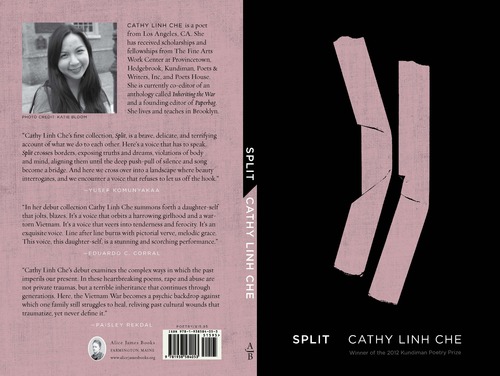
SATURDAY POETRY SERIES PRESENTS: SPLIT

30m0dbb


from SPLIT
By Cathy Linh Che:


THE FUTURE THERAPIST ASKS ABOUT RAPE

This morning, I watched a woman shatter
the thin ice on the pavement. I made the bed,
tucked in the sheets, and in the window,
I saw reflected my mother’s face.

Men in my life walked in and out of the rooms,
tramping snow. My mother shushed me,
and my father with his powder keg hands
pulled up a pair of clean black socks.

It isn’t what you think.
My father was a soldier.
He taught me nothing about men.

They are an empty barrel.
You’re not supposed to look into
a gun you dismantle

to try and see its parts.


HOME VIDEO

There are flowers on this bed, an elbow planted by an ear.
No, you cannot touch this breast. No darkness, no shatter,
and no, no pendulum. The past is a blood clot lodged inside
your lung.

                                                  *

In the living room, shapes move against the wall. You are
wearing a thin dress. You watch Beetlejuice while he moves
his fingers over your white underwear. You watch the screen
and see his fingers. Your brothers are in the room, but they
never seem to notice.

                                                  *

Behind the lens is the father. Mother offstage calls, Con gai
nay
. On the phone, Con gai thuoi, which means, This girl. This
girl’s rotten. This girl like swollen fruit. She cuts off the
bruises. She teaches me to cut.

                                                  *

He rises to the surf. It detonates with a sheering crash.
Inside each wave is a barrel. In each barrel is a vacuum that can suck
you in, spin you round, snap your bones if you tumble the
wrong way.

                                                  *

If I say, I have been touched. If I say, by my cousin, then, a
neighbor boy and then another. If I say no, I didn’t want it
from my first boyfriend. There was blood and membrane
and he didn’t believe me. If my body can be a box. If I can
close it up. If it has to be open. Who will touch me again?


POMEGRANATE

I open my chest and birds flock out.
In my mother’s garden, the roses flare
toward the sun, but I am an arrow

pointing back.
I am Persephone,
a virgin abducted.

In the Underworld,
I starve a season
while the world wilts

into the ghost
of a summer backyard.
My hunger open and raw.

I lay next to a man
who did not love me—
my body a performance,

his body a single eye,
a director watching an actress,
commanding her

to scintillate.

I was the clumsy acrobat.
When he came, I cracked open
like a pomegranate

and ate six ruddy seeds.

I was the whipping boy.
I was thorny, barbed wire
wound around a muscular heart.


Today’s poems are from Split, published by Alice James Books, copyright © 2014 by Cathy Linh Che, and appear here today with permission from the poet.


SPLIT: “Che effectively weaves the trauma of the Vietnam War into her own personal trauma, making herself a war victim—only her war is not against enemy combatants, but against her past.” —The Philadelphia Review of Books

“Cathy Linh Che’s first collection, Split, is a brave, delicate, and terrifying account of what we do to each other. Here’s a voice that has to speak. Split crosses borders, exposing truths and dreams, violations of body and mind, aligning them until the deep push-pull of silence and song become a bridge. And here we cross over into a landscape where beauty interrogates, and we encounter a voice that refuses to let us off the hook.” —Yusef Komunyakaa


Cathy Linh Che is the author of Split (Alice James, 2014), winner of the 2012 Kundiman Poetry Prize. She has been awarded fellowships and residencies from Poets & Writers, Poets House, The Lower Manhattan Cultural Council’s Workspace Residency, and the Jerome Foundation.


Editor’s Note: Words—my words—seem ineffective here. But I was deeply moved by this poet, by this book, and so I will try. Split is a sacrifice; raw and unrelenting. It is blood and memory and gasoline. It is the truth no one wants to hear, that we all need to hear. But it is more than the phoenix choking on ash, thrashing to be free. It is lineage and heritage, truth offered up in the name of a history, a family, a self. This is a stunning book by a bold and dedicated poet, a book that dares us to look, listen, and speak up.


Want to see more from Cathy Linh Che?
Official Website
Buy Split from Alice James Books
Fireside: A Kundiman Blog
Hyphen
Poets.org

SATURDAY POETRY SERIES PRESENTS: UNDRESSING

tumblr_n0v0y0a0Vq1rxylgxo1_1280
from UNDRESSING
By Nicole Steinberg


BEAUTY

is a ritual, passed
along in slow drags
of the fingers—foundation
swept across cheekbones
in runny smears, stark
beige until it blends.
Salt, pepper, and ashtrays;
we keep the kitchen
warm with smoke and
sweet, still-wet hair.
A silver lipstick tube
rolls ribbed between us.
One day I’ll carry
your bones in sacks.
I’ll remember cotton
pressed into your eyes
and up your nostrils. I’ll be
sorry they ever listened,
when I said I wanted
to see you that way.
You switch to violet
lips after some years,
which clash with your
bleached hair. I miss
the old burgundy outline.
Draw lines to prevent
bleeding, you once explained.
Hold back the color
of your mouth and
every careless thing
it wants to say.


MY DARK, SEMITIC WILES

I took my dark, Semitic wiles on the road.
The train was empty and that was lovely,
everywhere an open space. En route to Berlin,
I held the bathroom mirror and spoke
to my mother, foreign leaves of foreign trees
and the conductor’s garbled nothings
blurred above my head. She thinks I’m going
to get myself killed. Lost forever. I remember
a straight-haired little girl at the kindergarten
table with eyeglasses as petite as her pink
Polly Pocket. I crushed them in my fat hand,
arranged the lozenge lenses next to the legs,
purple plastic bird femurs. Like chicken,
I picked it apart. My fellow passengers,
the unwed Jewess rides among you, come
to tour your capital of tragedy. Love me
out of guilt like an unborn sister, a mother’s
final scowl before death, the very nose
on your face you’d hack off just to belong.


THERE IS NO ROMANTIC

Truly, everything is monstrous,
even wild horses and especially
their heads. The tree trunk necks
of boys who finish sandwiches
in three bites and the impatient
lumps that harden in their freshly
bleached briefs. We’re all so warm
and pink, it’s obscene. I don’t want any
part of it. It took me years to learn
simple tasks: how to snap my fingers,
tie my shoes. My mother’s early gaze
full of worry that love would escape
me, too. If I peel back my breast, I’ll find her
passport heart, stamps still smeared
from all the quailing in Queens, the tears
in Tel Aviv. She taught me this: the way
a woman travels, under a moving
shadow of small panic; all too aware
that even a plane about to crash,
for one bright, myopic moment,
will fill completely with the sun.


Today’s poems are from Undressing, published by dancing girl press, copyright © 2014 by Nicole Steinberg, and appear here today with permission from the poet. “There is No Romantic” previously appeared via 30 x Lace, and “My Dark, Semitic Wiles” previously appeared via Leveler.


Nicole Steinberg is the author of Getting Lucky, now available from Spooky Girlfriend Press, Birds of Tokyo (dancing girl press, 2011), and two new chapbooks in 2014: Undressing from dancing girl press and Clever Little Gang from Furniture Press, winner of the 4X4 Chapbook Award. She is also the editor of an anthology, Forgotten Borough: Writers Come to Terms with Queens (SUNY Press, 2011).

Editor’s Note: I love chapbooks. And small presses. And books that are little works of art to hold in your hands, open, and immerse yourself in. Undressing is such a book; one of 200+ books made to date by dancing girl press, which publishes titles “by emerging women poets in delectable open-run handmade editions.” Delectable. Yes. From its beautiful cover art to its textured binding and hand-cut pages, this is the kind of creation that can never be replaced by an ebook.

Within its pages, Undressing is just that. The poet sheds her veils like Salome, stripping off not only clothes, but skin, revealing the raw bits of flesh and bone, organ and memory, that comprise an inner life. At times Nicole Steinberg looks at herself critically, as a woman does when considering her reflection in a mirror, her point of view filtered through a smog of American cultural misogyny. At other times Steinberg puts on the dress of her mother, of illness and loss, of the guilt and introspection and distortion that remains.

Amidst a maelstrom of pop culture, feminism, religion, sex, relationships, and memory, there is something hectic in these poems, like the pile of clothes at the foot of a bed. But amidst the torrent there are moments in which the poet forces us to slow down and face the reality she unveils head on. There are lines so poignant they wash over their more topical surroundings, forcing us to breathe and remember we are engaged with an artifact: “Draw lines to prevent / bleeding, you once explained. / Hold back the color / of your mouth and / every careless thing / it wants to say.” “She taught me this: the way / a woman travels, under a moving / shadow of small panic; all too aware / that even a plane about to crash, for one bright, myopic moment, / will fill completely with the sun.”

Want to see more from Nicole Steinberg?
Nicole Steinberg’s Official Blog
Buy Undressing and Birds of Tokyo from dancing girl press
Buy Forgotten Borough: Writers Come to Terms with Queens on Amazon

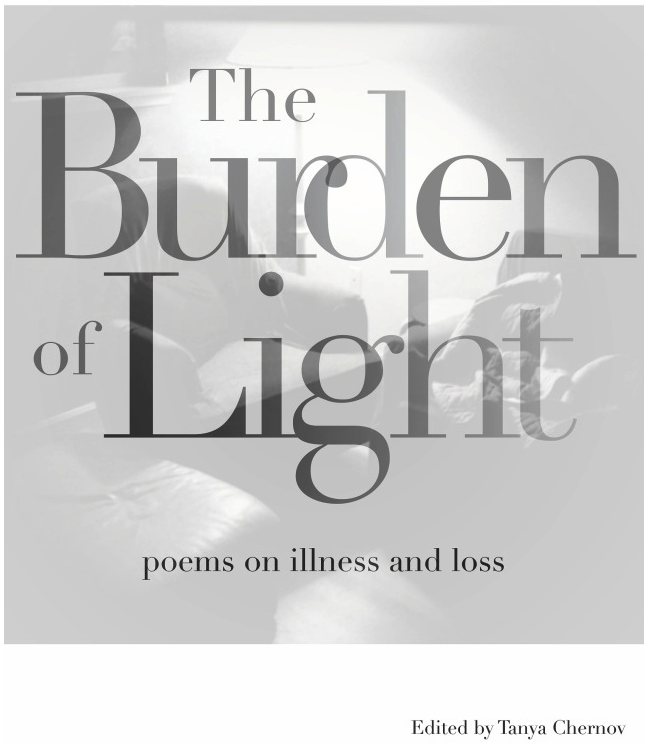
SATURDAY POETRY SERIES PRESENTS: THE BURDEN OF LIGHT

Picture 1


from THE BURDEN OF LIGHT: POEMS ON ILLNESS AND LOSS
Edited by Tanya Chernov
Selected Poems From the Anthology By Sivan Butler-Rotholz:


ELEGY FOR THE STILL LIVING:
FATHER CANNOT STAND STILL

[My father taught me] every time you breathe in,
say thank you. Every time you breathe out, say goodbye.

                                                                             —Li-Young Lee

The thing about my father is I wear my sadness like the inside of a jar.
How can you not see inside of it? How the slightest bit of air destroys me.
How I love him so much          I struggle

                           to love him

                                                                    at all.


GENESIS

i. The thing is, XXXXXXXXXXXXXXXXXXXXXXXXXXXXXXXXXXXXXXXXXXXXXX
XXXXXXXXXXXXXXXXXXXXXXXXXXX and in this way the world was created.

ii. Definitions

“Wife”:           The person I love most
                         in the world.

“Death”:         He is not here
                         in this hole
                         in the ground
                         piled with dirt
                         and seashells.

“Mother”:       Inlaid tongue.

“Wedding”:    When I was young I liked to play ‘wedding’ and my father would walk me                          down the aisle and it’s a good thing he did then because
                         Flowers are like that.

“How”:            We go on

“Flowers”:      Are not stones.

“One God”:     Let us make human beings in our image, to be like us.


Today’s poems are from The Burden of Light: Poems on Illness and Loss, available by donation on Smashwords and Amazon. These poems appear here today with permission from the poet.


The Burden of Light: Part poetry anthology, part field guide, part multimedia art collection, The Burden of Light offers its readers companionship through the darkest days. With work by artists who have confronted serious illness or grief in their own lives, the poems and artwork in these pages hold the power to touch the heart, stir the mind, and heal the spirit, each in its own way. These pieces illuminate the vital force of our humanity, while encouraging us to reach out to others in need.

With 100% of the proceeds benefiting the National Colorectal Cancer Research Alliance, even a small donation from one has the power to affect change when added to the contributions of others. Colorectal cancer is the second leading cause of cancer-related deaths in America, yet this cancer is largely preventable when detected early. By supporting the groundbreaking work of the NCCRA, we’re all helping to promote regular medical screening and fund the research needed to develop better tests, treatments, and ultimately, a cure. Just as The Burden of Light is designed to help readers move forward from trauma, so too will donations help those currently experiencing serious illness.


Editor’s Note: Yes, yes, today’s poems are a first here on the Saturday Poetry Series in that they are written by your faithful editor. I am honored to be featured in this anthology alongside a plethora of talented artists, including SPS-beloved poet Peggy Shumaker. But beyond sharing a little of my own work with you here for the first time, I wanted to share with you this important collection.

Whether you purchase it for your Kindle or download it as a PDF, you get to decide how much you want to pay for this anthology, and 100% of the proceeds benefit the National Colorectal Cancer Research Alliance. Via the Kindle edition or PDF you will find links to listen to the poets read their poems aloud, for an added layer of experience and immersion. This is a thoughtful, powerful, philanthropic endeavor with the power to both move the reader and effectuate change.

Check out the full anthology for more poems by yours truly and many more talented poets writing through their own experiences with illness and grief. Please donate what you can, and then go forth and read!


Want more from The Burden of Light?
Download the PDF via Smashwords
Purchase the Kindle edition from Amazon
Listen to “Elegy for the Still Living: Father Cannot Stand Still”
Listen to “Genesis”

SATURDAY POETRY SERIES PRESENTS: JENNA LE

Jenna Le photo

By Jenna Le:


MOM’S COCKS

Mom grew up beside the Perfume River in Vietnam,
in a brick house overrun by chickens.
Those horny-footed fowl were always
rubbing their feather-padded genitals
against sofa legs and children’s shoes
as if they were fit to burst. Mom laughs

as she tells me how they ground
their pelvises against her leather sandal,
stuporous with misdirected lust—
How strange that she
is talking to me about sex
in this casual way. She’s returning to her roots

as a child who lived among
unmannered beasts. And I, through hearing her words,
am returning there with her: I
am the aggressive rooster; I’m the hens
cowering behind the outhouse; I’m the much-abased,
much-abraded, Size Four shoe.


THREE SHORT POEMS ON A COMMON THEME

1.

Staring at you across the room, my body seemed composed
of nothing but eyes.

Even my mouth
watered, like an eye.

2.

I couldn’t sleep a wink all night: my brain agitated its solitude
like a washing machine

filled with copies
of your immaculate white shirt.

3.

In the morning, I went out and bought a book of your poems.
It’s a poor substitute for a straightedge, it’s true,

but you won’t
sell me your curves for any price.


Today’s poems are from Six Rivers, published by NYQ Books, copyright © 2011 by Jenna Le, and appear here today with permission from the poet.


Jenna Le was born in Minneapolis, Minnesota, a daughter of two Vietnam War refugees. She received a B.A. in mathematics from Harvard University and an M.D. from Columbia University. She has worked as a physician in Flushing, New York, and the Bronx, New York. Her full-length poetry collection, Six Rivers (NYQ Books, 2011), was a Small Press Distribution Poetry Bestseller. Her poetry, fiction, essays, book criticism, and translations of French poetry have appeared or are forthcoming in journals such as AGNI Online, Barrow Street, Bellevue Literary Review, Massachusetts Review, Measure, Pleiades, and 32 Poems.

Editor’s Note: Lyric, narrative, accessible, and unafraid, Jenna Le’s Six Rivers opens along the banks of the Perfume River, in a scene that pairs mother with sex and “horny-footed fowl.” The relationships—between mother and daughter, between ‘here’ and ‘there’—are rich and complex, with the poet embodying her mother’s past, her roots, and the “much-abased, much-abraded, Size Four shoe.” Throughout the book love and sex, personal, familial, and cultural history, healing and death are all explored as we travel with the poet along the six rivers of her life. Le allows herself to be vulnerable and imperfect, and so we relate to her, root for her, are drawn into her vivid world. A keen seer and a captivating reporter, it is no wonder that, at times, the poet feels she is “composed of nothing but eyes.” Hungry for life, hungry for love, it is no wonder that “Even [her] mouth watered, like an eye.”

Want to read more by and about Jenna Le?
NYQ Poets
Mascara Literary Review
The Nervous Breakdown
The Toronto Quarterly
Sycamore Review

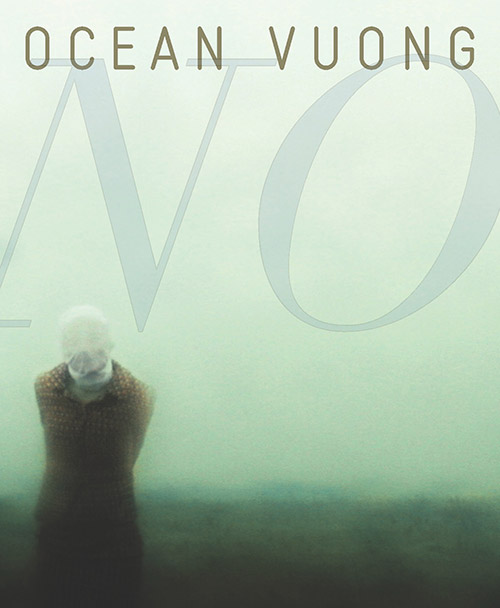
SATURDAY POETRY SERIES PRESENTS: NO

no


from NO
By Ocean Vuong


TORSO OF AIR

Suppose you do change your life.
& the body is more than

a portion of night—sealed
with bruises. Suppose you woke

& found your shadow replaced
by a black wolf. The boy, beautiful

and gone. So you take the knife to the wall
instead. You carve & carve.

Until a coin of light appears
& you get to look in, for once,

on happiness. The eye
staring back from the other side—

waiting.


HOME WRECKER

And this is how we danced: with our mothers’
white dresses spilling from our feet, late August

turning our hands dark red. And this is how we loved:
a fifth of vodka and an afternoon in the attic, your fingers

sweeping though my hair—my hair a wildfire.
We covered our ears and your father’s tantrum turned

into heartbeats. When our lips touched the day closed
into a coffin. In the museum of the heart

there are two headless people building a burning house.
There was always the shotgun above the fireplace.

Always another hour to kill—only to beg some god
to give it back. If not the attic, the car. If not the car,

the dream. If not the boy, his clothes. If not alive,
put down the phone. Because the year is a distance

we’ve traveled in circles. Which is to say: this is how
we danced: alone in sleeping bodies. Which is to say:

This is how we loved: a knife on the tongue turning
into a tongue.


Today’s poems are from NO, published by Yes Yes Books, copyright © 2013 by Ocean Vuong. “Torso of Air” previously appeared in BODY Literature, and “Home Wrecker” previously appeared in Linebreak. These poems appear here today with permission from the poet.


NO: Anyone who has already sensed that “hope is a feathered thing that dies in the Lord’s mouth,” should get their hands on NO. Honest, intimate, and brimming with lyric intensity, these stunning poems come of age with a fifth of vodka and an afternoon in an attic, with a record stuck on please, with starlight on a falling bomb. Even as Vuong leads you through every pleasure a body deserves and all the ensuing grief, these poems restore you with hope, that godforsaken thing—alive, singing along to the radio, suddenly sufficient. —Traci Brimhall, Our Lady of the Ruins


Ocean Vuong is a recipient of a 2013 Pushcart Prize as well as fellowships from Kundiman, Poets House, and The Saltonstall Foundation for the Arts. Poems appear in Poetry, The Nation, Beloit Poetry Journal, Passages North, Quarterly West, Denver Quarterly, and American Poetry Review, which awarded him the 2012 Stanley Kunitz Prize for Younger Poets. He lives in Queens, NY.


Editor’s Note: I’m just going to come right out and say this: Ocean Vuong is one of the best and most important poets writing in America today. I have not been so moved as I am by Vuong’s words since I first read Li-Young Lee. This poet has changed my life. He has renewed my belief in American poetry. That it can be emotional and heartbreaking. That is can be beautiful and full of hope. That modern American poetry can—and does—matter. In my humble opinion your poetry collection is simply not complete unless it houses both Vuong’s groundbreaking chapbook, Burnings, and his newest release from Yes Yes Books, NO.

NO is a surprisingly experimental collection, yet Vuong remains dedicated to the lyric and the narrative, guiding us through its formal twists and turns through emotive language and evocative imagery. Throughout its pages the poet intimately explores themes of love, sexuality, and belonging against a backdrop of devastating loss. It is a brilliant and beautiful collection, a true heartbreaking work of staggering genius. As the book’s publisher did when reading through the manuscript for the first time, when Ocean Vuong says NO to you, be prepared to say “Yes Yes!”


Want to see more from Ocean Vuong?
Buy NO from Yes Yes
The Poetry Foundation
Interview in The Well & Often Reader
Ben Lerner on mentoring Ocean Vuong, Brooklyn College

SATURDAY POETRY SERIES PRESENTS: ONLY RIDE

OnlyRide-Front

from ONLY RIDE
By Megan Volpert:


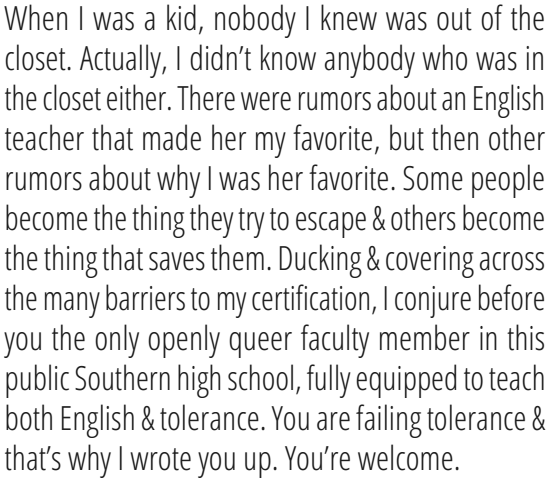
Screen Shot 2014-04-04 at 3.16.20 PM

Screen Shot 2014-04-04 at 3.18.58 PM


Screen Shot 2014-04-04 at 3.20.28 PM

Screen Shot 2014-04-04 at 3.29.11 PM


Picture 1

Picture 3


Today’s poems are from Only Ride, published by Sibling Rivalry Press, copyright © 2014 by Megan Volpert. “You are suspended” was first published in This assignment is so gay, edited by Megan Volpert and published by Sibling Rivalry Press. These poems appear here today with permission from the poet.


Only Ride: If Denis Johnson had written Tuesdays with Morrie, it’d feel like Megan Volpert’s book of prose poems. Clawing its way out through this minimalist checklist of suburban malaise is an emphatically optimistic approach to growing up. These tiny essays carefully detail how to avoid becoming one’s parents, how to manage a body addled by disease, and how to keep having the best possible time in life. After all: this is the only ride there is, and we can only ride it. Volpert’s is a story of Springsteenian proportions, a gentleman’s guide to rebellion complete with iron horses and the church of rock & roll.

Megan Volpert is the author of five books on communication and popular culture, most notably about Andy Warhol. She has been teaching high school English in Atlanta for the better part of a decade, and is currently serving as her school’s Teacher of the Year. She edited the American Library Association-honored anthology This assignment is so gay: LGBTIQ Poets on the Art of Teaching, which is currently a Lambda Literary Award finalist. Predictably, www.meganvolpert.com is her website.

Editor’s Note: Megan Volpert’s Only Ride is a no-holds-barred journey through personal history, with sage wisdom bursting from its rough-and-tumble seams. The book is less Zen and the Art of Motorcycle Maintenance and more Get a Grip and Ride Like it’s Your Only Ride. This is a book about how to live life. Suck it up and move past the childhood issues that scarred you. Don’t just cope with illness, thrive in the face of it. Live life full throttle no matter what it throws at you, because life is short and living demands fierce courage.

Throughout her journey Volpert takes personal and political stands, inspiring her readers to do the same. Sometimes you’ve just gotta smash things, because “a deep frustration that hurls pottery against the concrete floor… is not the thing to bottle up in shame.” Sometimes a teacher has a responsibility to teach more than just standard curriculum. As “the only openly queer faculty member in [a] public Southern high school,” Volpert is “fully equipped to teach both English & tolerance,” and she’ll write a student up for failing the latter.

Brimming with humor and hubris and wicked wit, the greatest gift of this book is the life lessons it relays. Stand up for what you believe in. Move past life’s bullshit and face adversity with a battle cry. Let go of the small stuff. “Many things annoy me,” Volpert confides, “but I seldom get really angry because now I just feel so lucky to be alive.” And we all should, the implication echoes. In a world where “[d]eath knocks twice: once for introductions & once to take you away,” why waste your precious life letting things get your goat? Having faced death, the poet gave her goat away; she has no goat to give. And we would all be well served to follow her example. “After all: this is the only ride there is, and we can only ride it.”

Want to see more from Megan Volpert?
Official Website
This assignment is so gay
Sibling Rivalry Press
FRONTIER PSYCHIATRIST