A Review of “What Is Left” By Bunkong Tuon

Shawn Pavey Reviews

What is Left

By Bunkong Tuon

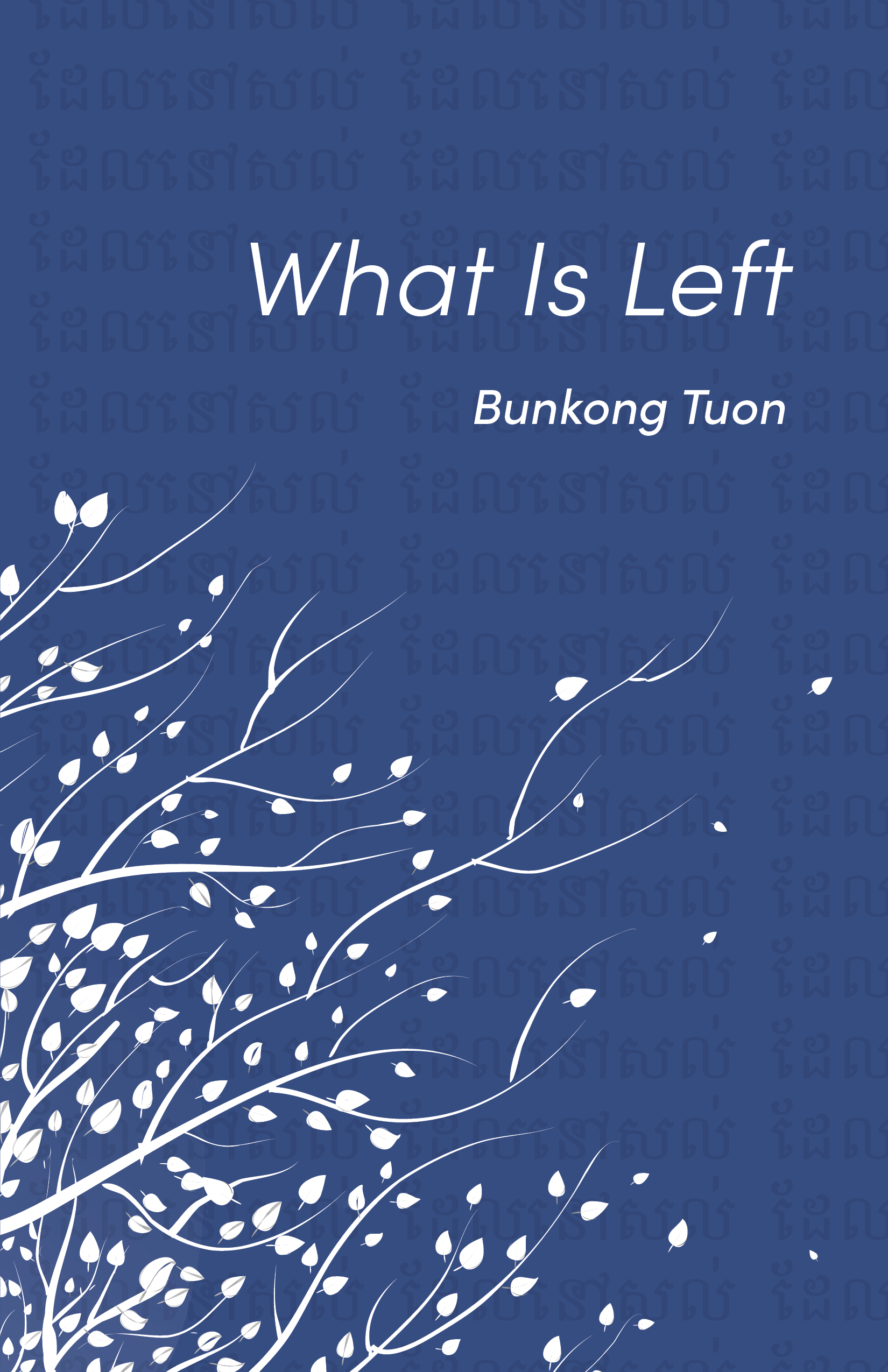
In What Is Left, part of Jacar Press’ “Greatest Hits” chapbook series, Bunkong Tuon brings us on his personal journey as a child refugee of the Khmer Rouge’s atrocities in his homeland of Cambodia. As David Rigsby states in his insightful foreword, “Bunkong Tuon’s childhood took place in a country whose national life in the 1970s underwent unimaginable depredation at the hands of the Khmer Rouge: slaughter, torture, starvation, and the forceful smashing and separation of families.”

To set the tone for the entire collection, the titular opening poem, recently announced as a winner of the 2024 Pushcart Prize, begins:

What is left after war is the gratitude for what is left.
My dreams are filled with ghosts looking for home.
The dead speak to the living through my poetry.
Each time I write, I rebuild. Retrieve what was stolen.

Tuon, while being open about struggle and loss and deep, deep pain, infuses each of these poems with an almost incessant sense of hope. This is one of the most surprising aspects of this work: how Tuon navigates the telling of his story yet, somehow, gives the reader a sense that the life he leads now is both unexpected and a joy. However, as this first poem continues, Tuon, soberly, informs the reader:

Nothing is dead until I let it. English is not the language
Of my birth. It is the language of death. More bombs
Dropped on Cambodia's countryside than in Hiroshima
And Nagasaki. I was bombarded by this language.

I had no choice but to use it.

Tuon references, of course, the covert bombing of Cambodia by the United States from 1969 to 1973 designed to minimize the capabilities of the People’s Army of Vietnam. Tuon as a small child knows America as bombs, destruction, and death. During the reign of the Khmer Rouge, more than a million people were executed – more than 13% of the country’s total population. Families were shattered and much of the country’s population fled the atrocities as refugees.

This is the historical backdrop for Tuon’s poems. The second poem, Under the Tamarind Tree, Tuon reveals a memory of sitting on the lap of an aunt – a child herself – witnessing the funereal rites performed by monks for his mother.

The tree stands still, quiet, 
indifferent. The house sways 
on stilts. 

Monks in saffron robes
and nuns with shaved heads,
lips darkened with betel-nut stain, 

sit chanting prayers 
for the child’s mother. 
Incense perfumes the hot dry air.

The image is heartbreaking but the true marvel is Tuon’s sparse yet musical language. He writes these poems with an almost journalistic detachment, avoiding the temptation to overwrite the emotional vulnerability. Tuon shows us, with his carefully chosen lexicon, the sheer tragedy and loss of this moment experienced by a child in the care of a slightly older aunt. The poem concludes:

Each time the child hears prayers
coming from the house, he cries;
each time he cries, the aunt, a girl herself, 
pinches the boy’s thigh.

It is that last line that shares with the reader the absolute cruelty of the moment. The funeral is witnessed as a result of institutional cruelty, but that tiny act of violence, the thigh-pinch of the aunt on the crying boy’s thigh shows that in that moment, there was little time to grieve. Survival of what lies ahead will require its own toughness.

The next few poems detail Tuon’s refugee journey. In “The Carrying,” he gives us a glimpse of their long journey – on foot – as his grandmother carried the small boy on her back to the refugee camp. In the poem “Gruel,” Tuon recalls a conversation with his uncle about survival.

“When you were young,
we had nothing to eat.
Your grandmother saved for you
the thickest part of her rice gruel.
Tasting that cloudy mixture
of salt, water, and grain, you cried out,
‘This is better than beef curry.’”

All my life I told myself I never knew
suffering under the regime, only love.
This is still true.

The last two lines of this poem may be the true heart of this collection. What carried Tuon through all of this tragedy and trauma was knowing he was loved by extended family members who gave him this, the only thing they had left to their names, this love and this belonging in love, desperate as it was. Tuon’s poem “Debt” shows us a glimpse of his father begging the Khmer Rouge, after they slaughtered children and cut open the bodies to eat the livers.

My father got down
on his knees,
clasped hands over head,
and begged them
for a sliver of a victim’s liver
so that I would not starve.
While everyone was sleeping
my father snuck into the kitchen,
stole a branch of coconuts,
and buried them in the woods.
Each time I cried from hunger
he disappeared into the night,
dug up a coconut,
gave me the juice to drink
and with dirt-encrusted fingers
spooned out the flesh
for me, his only child.

This terrible memory ends the poems specifically about fleeing terror. The following poems in the book deal with how Tuon built a life and is, in a way, relaying his experience to his children but, also, to the readers. There is a poem about how air conditioning in a library hurts to breathe after fleeing jungles. There are poems to his daughter and son. There are poems trying to find purpose in living and moving on from unspeakable loss.

And there is so very much hope.

This hope, deeply ingrained in every single poem, drives this collection. These poems are intimate, they are deeply personal, they reveal the vilest atrocities, and these poems do all that while holding tightly to hope and love and never once slip into maudlin self-pity. While these poems, at least on the surface, could be considered confessional, they never feel like confessional poems. Autobiographical, certainly, which is a type of confessionalism, but they avoid writing about emotion in favor of stark imagery. Tuon shows us the horror and despair and struggle of living through and in spite of the Khmer Rouge. He shows us the life he built because of the sacrifice of the family members who kept him alive. And, ultimately, Tuon shows us the joy that life can hold in contrast to experienced evil.

What Is Left 
by Bunkong Tuon,
2024, Jacar Press.
ISBN: 978-0-936481-56-2,
28 pages.

About the Author: Shawn Pavey is the author of Talking to Shadows (Main Street Rag Press, 2008), Nobody Steals the Towels From a Motel 6 (Spartan Press, 2015), and Survival Tips for the Pending Apocalypse (2019, Spartan Press) which was 1st runner up for the 2020 Thorpe Menn Literary Excellence Award. He co-founded The Main Street Rag Literary Journal and served as an Associate Editor. Recently, he was featured in the second anthology by THE NU PROFIT$ OF P/O/E/T/I/C/ DI$CHORD entitled, And Even If We Did, So What!? from OAC Books. His infrequently updated blog is at http://www.shawnpavey.com.
	

Poetry Soundbite: A Reading and Interview with Bunkong Tuon


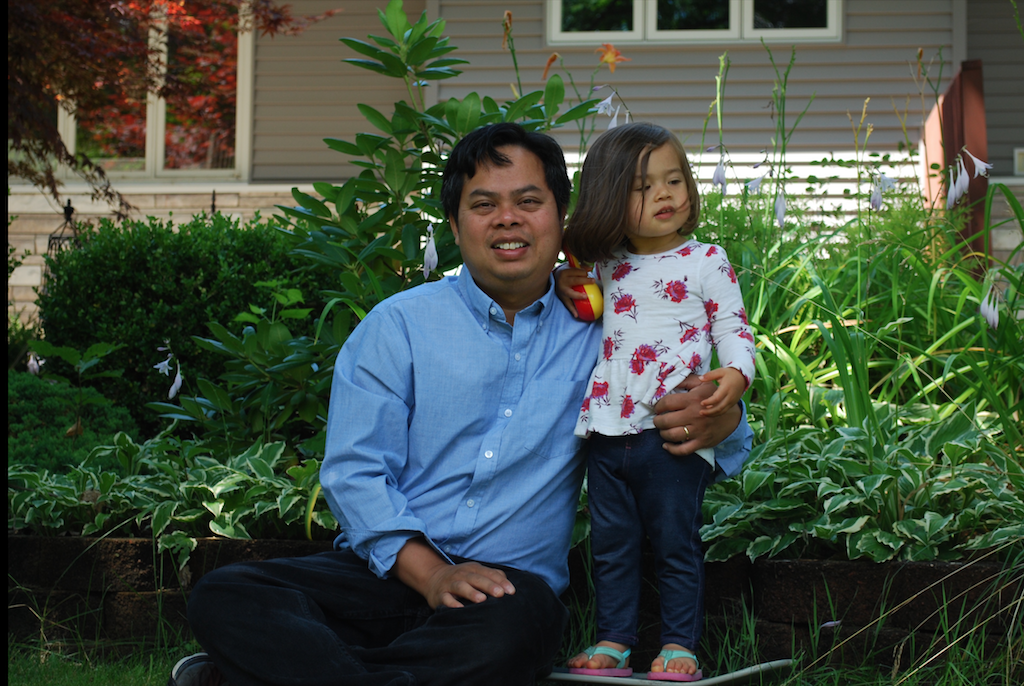
Welcome to AIOTB Magazine’s second Poetry Soundbite, an on-going series of poetry readings and interviews. For this edition, we welcome Bunkong Tuon, a Cambodian-American writer and critic. He is the author of GruelAnd So I Was Blessed (both published by NYQ Books), The Doctor Will Fix It (Shabda Press), and Dead Tongue (a chapbook with Joanna C. Valente, Yes Poetry). He teaches at Union College, in Schenectady, NY. He tweets @BunkongTuon

Below the video, you can find links to the poems from Tuon’s reading.


From Bunkong Tuon’s reading:

“Our Neighborhood in Revere, MA”

“Snow Day”

“Tightrope Dancer”

“Women’s March in Albany”

“My Mother on Her Deathbed”

SATURDAY POETRY SERIES PRESENTS: LI-YOUNG LEE

lee_si-303x335


By Li-Young Lee:


from ALWAYS A ROSE

Not for the golden pears, rotten on the ground—
their sweetness their secret—not for the scent
of their dying did I go back to my father’s house. Not for the grass
grown wild as his beard in his lasts months,
nor for the hard, little apples that littered the yard,
and vines, rampant on the porch, tying the door shut,
did I stand there, late, rain arriving.
The rain came. And where there is rain
there is time, and memory, and sometimes sweetness.
Where there is a son there is a father.
And if there is love there is
no forgetting, but regret rending
two shaggy hearts.
I said good-bye to the forsythia, flowerless for years.
I turned from the hive-laden pine.
Then, I saw it—you, actually.
Past the choked rhododendrons,
behind the perishing gladiolas, there
in the far corner of the yard, you, my rose,
lovely for nothing, lonely for no one,
stunning the afternoon
with your single flower ablaze.
I left that place, I let the rain
mediate on the brilliance of one blossom
quivering in the beginning downpour.


VISIONS AND INTERPRETATIONS

Because this graveyard is a hill,
I must climb up to see my dead,
stopping once midway to rest
beside this tree.

It was here, between the anticipation
of exhaustion, and exhaustion,
between vale and peak,
my father came down to me

and we climbed arm in arm to the top.
He cradled the bouquet I’d brought,
and I, a good son, never mentioned his grave,
erect like a door behind him.

And it was here, one summer day, I sat down
to read an old book. When I looked up
from the noon-lit page, I saw a vision
of a world about to come, and a world about to go.

Truth is, I’ve not seen my father
since he died, and, no, the dead
do not walk arm in arm with me.

If I carry flowers to them, I do so without their help,
the blossoms not always bright, torch-like,
but often heavy as sodden newspaper.

Truth is, I came here with my son one day,
and we rested against this tree,
and I fell asleep, and dreamed

a dream which, upon my boy waking me, I told.
Neither of us understood.
Then we went up.

Even this is not accurate.
Let me begin again:

Between two griefs, a tree.
Between my hands, white chrysanthemums, yellow
      chrysanthemums.

The old book I finished reading
I’ve since read again and again.

And what was far grows near,
and what is near grows more dear,

and all of my visions and interpretations
depend on what I see,

and between my eyes is always
the rain, the migrant rain.


Today’s poems were published in Rose (BOA Editions, 1986) and appear here with permission from the poet.


Li-Young Lee is the author of four books of poetry, including, most recently, Behind My Eyes. His earlier collections are Book of My Nights; Rose, winner of the Delmore Schwartz Memorial Award; The City in Which I Love You, the 1990 Lamont Poetry Selection; and a memoir entitled The Winged Seed: A Remembrance, which received an American Book Award from the Before Columbus Foundation and will be reissued by BOA Editions in 2012. Lee’s honors include fellowships from the National Endowment for the Arts, The Lannan Foundation, and the John Simon Guggenheim Memorial Foundation, as well as grants from the Illinois Arts Council, the Commonwealth of Pennsylvania, and the Pennsylvania Council on the Arts.

Editor’s Note: Because it has been three years since my father died. Because three years ago, Li-Young Lee’s Rose was the labyrinth I walked to access my grief. Because “Truth is, I’ve not seen my father / since he died.” And while rereading this collection forces me to confront this reality, it also reminds me that “if there is love there is / no forgetting.”

Want more from Li-Young Lee?
Blue Flower Arts
The Poetry Foundation
Academy of American Poets

SATURDAY POETRY SERIES PRESENTS: MARCI CALABRETTA

MarciCalabretta


By Marci Calabretta:


CATERPILLAR SEASON

Wild strawberries were blooming
as we ambled toward the cottonwood shade.

You were examining the prophecy of snowfall
in the measurements of woolly caterpillars

and I asked your opinion on the nature of happiness,
perhaps because you called me sister

or because I called you brother and stranger.
Tiger-banded dragonflies skimmed the grass.

Fern and myrtle, downy brown and black.
You laid the larvae on my palms without speaking.

I never knew you had such silences.
Overhead, wires heavy with starlings or crows―

I couldn’t tell against the steel sky. But I remember
later that night, the steam from our tea

curling above us and into our mouths, as though
the answer could last us a whole season of snow.


BROTHER RETURNS AS CHRYSANTHEMUM

Didn’t we think we were more than this―
little suns unfurling above the earth?

We thought we were constellations
in soil, entire galaxies anchored to dust.

Ravenous, we believed our thousand
arms could hoard the horizon―

eclipsing ourselves even as we waned,
bereft of all but shadow.


Today’s poems were originally published in Thrush Poetry Journal, and appear here with permission from the poet.


Marci Calabretta is the recipient of poetry fellowships from Kundiman and the John S. and James L. Knight Foundation. Her work has appeared most recently in Thrush, Lunch Ticket, American Letters & Commentary, and Chautauqua. Her chapbook, Last Train to the Midnight Market, was published by Finishing Line Press. She is co-founder and managing editor for Print-Oriented Bastards, an assistant editor for Jai-Alai Magazine, and a contributing editor for Florida Book Review.

Editor’s Note: Today’s poems are wildly vivid and pleasantly unexpected. In “Caterpillar Season,” the poet couples the lush of wild strawberries with the oracular act of “examining the prophecy of snowfall.” The poem is like a parable in which the nature of happiness might be gleaned from the wonders of a nature so vibrant it feels at times as if it might fly or blossom from the page. “Brother Returns as Chrysanthemum” is anchored in the metaphysical, grappling with human existence and our role in the universe. The culmination of the poem, “eclipsing ourselves even as we waned, / bereft of all but shadow,” is a gorgeous finale that grounds us in the observable while inviting us to contemplation. Both poems indulge in delicious alliteration, fervently celebrating language and the poetic act.

Want more from Marci Calabretta?
Marci Calabretta’s official website
Lunch Ticket
Purchase Last Train to the Midnight Market from Finishing Line Press
Co-founder and managing editor for Print-Oriented Bastards

SATURDAY POETRY SERIES PRESENTS: ALLIE MORENO

photo (1)

TOO MUCH OF A GOOD THING
By Allie Moreno

I have been stretched like
skin to dry in the sun
I am a blanket
I’m a tightrope
a staircase
a palace of forgotten
photographs
a sandcastle exposed in the wind
I love and
cover you

I have filled all the glasses
on the table
I have eaten what is
left on every plate
to be free of it

I have swallowed your
skeletons on cue
I should probably apologize
for complaining
but I’m the parade and the rain


“Too Much of a Good Thing” appears here today with permission from the poet.


Allie Moreno spends her daytime hours writing for a large tech company in the San Diego area. She received an MFA in Writing from UC San Diego and sometimes writes poetry from the confines of her cubicle. Allie tends to write about identity, belonging, and her experience as a trans-racial adoptee.

Editor’s Note: Simple, straightforward, and full of evocative imagery, today’s poem takes us inside the world of one who has lived for another. Stretched tight, walked upon, now disappearing grain by grain, “a sandcastle exposed in the wind.” To give love is not enough, when in so doing we give too much of ourselves. In end end we are almost left with a woman’s tendency to apologize for herself, but instead we are left with a counterweight. A provocative image slightly obscured. What is a woman when she is “the parade and the rain”?

Want to read more by Allie Moreno?
Allie Moreno’s Blog
Interview: Allie Moreno’s Adoption Experience

SATURDAY POETRY SERIES PRESENTS: SHARON SUZUKI-MARTINEZ

ssm author pic

By Sharon Suzuki-Martinez:


ONE HUNDRED BRIDGES

1.

One day
I gave myself a gift certificate
because who knows what I want?

One night
without thinking
I traded it for one hundred bridges.

2.

We turn the house upside-down
in search of our passports.

A century passes
before we find them in the pages
of our children.

3.

Too many bridges to cross.

Paths like rotting smiles, rat-kissed
tatters swinging loose
in the maw of some river god.

4.

It has always been this way–only
your voice carries me to the other side.


GOODBYE ISLAND

Then Marie said, “I’m in love with a man
who is an island.” Of course,

many of us had our doubts.
This did sound familiar.

We said, “Which of our legs
are you trying to pull?”

She stared at us like we were insects
from the future.

Our metaphysical existence
(vis-à-vis Marie)

grew negligible: tenuous, at best.
Further on down the road, we saw the man

for ourselves. We couldn’t help but
admire his thick vegetation,

his long languid beaches, his centuries
of blue-eyed solitude.

We desperately wanted to bear his young,
even the males among us.

Thus we engulfed
his shores with sweet lingering visits.

Soon, Marie saw the man
was no longer her own.

Sadly thereafter, she realized he never was.


“One Hundred Bridges” originally appeared in CURA and “Goodbye Island” originally appeared in Spooky Boyfriend. These poems appear here today with permission from the poet.


Sharon Suzuki-Martinez is the author of The Way of All Flux (New Rivers Press, 2012). She grew up in Hawaii and now lives in Tempe, Arizona where she created/curates the music/poetry website, The Poet’s Playlist and blogs about strange animals and the even stranger poet’s life at Sharon Planet.

Editor’s Note: Today’s poems are thinking poems. We are asked to slow down, to be present, and to really consider the ideas and imaginings the poet has carefully crafted for our contemplation. “One day / I gave myself a gift certificate / because who knows what I want?” “We turn the house upside-down / in search of our passports. // A century passes / before we find them in the pages / of our children.” I could read these lines again and again and meditate on the depths of their meaning.

In “Goodbye Island,” the poet pushes the boundaries of metaphor, painting us a picture of what a man might look like if he really were an island: “We couldn’t help but / admire his thick vegetation, // his long languid beaches, his centuries / of blue-eyed solitude.” As if this is not enough, she takes us a step further, deep into reflecting upon what it is to love a man who is an island: “Marie saw the man / was no longer her own. // Sadly thereafter, she realized he never was.”

Want to read more by Sharon Suzuki-Martinez?
The Poet’s Playlist
Sharon Planet

SATURDAY POETRY SERIES PRESENTS: SPLIT

30m0dbb


from SPLIT
By Cathy Linh Che:


THE FUTURE THERAPIST ASKS ABOUT RAPE

This morning, I watched a woman shatter
the thin ice on the pavement. I made the bed,
tucked in the sheets, and in the window,
I saw reflected my mother’s face.

Men in my life walked in and out of the rooms,
tramping snow. My mother shushed me,
and my father with his powder keg hands
pulled up a pair of clean black socks.

It isn’t what you think.
My father was a soldier.
He taught me nothing about men.

They are an empty barrel.
You’re not supposed to look into
a gun you dismantle

to try and see its parts.


HOME VIDEO

There are flowers on this bed, an elbow planted by an ear.
No, you cannot touch this breast. No darkness, no shatter,
and no, no pendulum. The past is a blood clot lodged inside
your lung.

                                                  *

In the living room, shapes move against the wall. You are
wearing a thin dress. You watch Beetlejuice while he moves
his fingers over your white underwear. You watch the screen
and see his fingers. Your brothers are in the room, but they
never seem to notice.

                                                  *

Behind the lens is the father. Mother offstage calls, Con gai
nay
. On the phone, Con gai thuoi, which means, This girl. This
girl’s rotten. This girl like swollen fruit. She cuts off the
bruises. She teaches me to cut.

                                                  *

He rises to the surf. It detonates with a sheering crash.
Inside each wave is a barrel. In each barrel is a vacuum that can suck
you in, spin you round, snap your bones if you tumble the
wrong way.

                                                  *

If I say, I have been touched. If I say, by my cousin, then, a
neighbor boy and then another. If I say no, I didn’t want it
from my first boyfriend. There was blood and membrane
and he didn’t believe me. If my body can be a box. If I can
close it up. If it has to be open. Who will touch me again?


POMEGRANATE

I open my chest and birds flock out.
In my mother’s garden, the roses flare
toward the sun, but I am an arrow

pointing back.
I am Persephone,
a virgin abducted.

In the Underworld,
I starve a season
while the world wilts

into the ghost
of a summer backyard.
My hunger open and raw.

I lay next to a man
who did not love me—
my body a performance,

his body a single eye,
a director watching an actress,
commanding her

to scintillate.

I was the clumsy acrobat.
When he came, I cracked open
like a pomegranate

and ate six ruddy seeds.

I was the whipping boy.
I was thorny, barbed wire
wound around a muscular heart.


Today’s poems are from Split, published by Alice James Books, copyright © 2014 by Cathy Linh Che, and appear here today with permission from the poet.


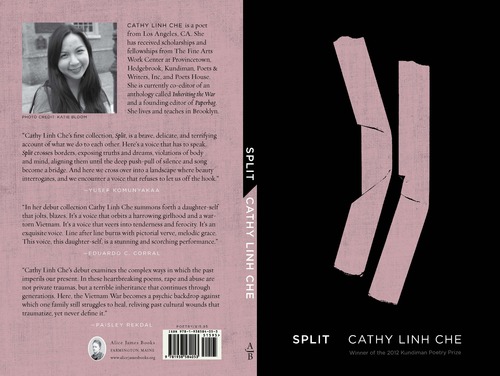
SPLIT: “Che effectively weaves the trauma of the Vietnam War into her own personal trauma, making herself a war victim—only her war is not against enemy combatants, but against her past.” —The Philadelphia Review of Books

“Cathy Linh Che’s first collection, Split, is a brave, delicate, and terrifying account of what we do to each other. Here’s a voice that has to speak. Split crosses borders, exposing truths and dreams, violations of body and mind, aligning them until the deep push-pull of silence and song become a bridge. And here we cross over into a landscape where beauty interrogates, and we encounter a voice that refuses to let us off the hook.” —Yusef Komunyakaa


Cathy Linh Che is the author of Split (Alice James, 2014), winner of the 2012 Kundiman Poetry Prize. She has been awarded fellowships and residencies from Poets & Writers, Poets House, The Lower Manhattan Cultural Council’s Workspace Residency, and the Jerome Foundation.


Editor’s Note: Words—my words—seem ineffective here. But I was deeply moved by this poet, by this book, and so I will try. Split is a sacrifice; raw and unrelenting. It is blood and memory and gasoline. It is the truth no one wants to hear, that we all need to hear. But it is more than the phoenix choking on ash, thrashing to be free. It is lineage and heritage, truth offered up in the name of a history, a family, a self. This is a stunning book by a bold and dedicated poet, a book that dares us to look, listen, and speak up.


Want to see more from Cathy Linh Che?
Official Website
Buy Split from Alice James Books
Fireside: A Kundiman Blog
Hyphen
Poets.org

SATURDAY POETRY SERIES PRESENTS: JENNA LE

Jenna Le photo

By Jenna Le:


MOM’S COCKS

Mom grew up beside the Perfume River in Vietnam,
in a brick house overrun by chickens.
Those horny-footed fowl were always
rubbing their feather-padded genitals
against sofa legs and children’s shoes
as if they were fit to burst. Mom laughs

as she tells me how they ground
their pelvises against her leather sandal,
stuporous with misdirected lust—
How strange that she
is talking to me about sex
in this casual way. She’s returning to her roots

as a child who lived among
unmannered beasts. And I, through hearing her words,
am returning there with her: I
am the aggressive rooster; I’m the hens
cowering behind the outhouse; I’m the much-abased,
much-abraded, Size Four shoe.


THREE SHORT POEMS ON A COMMON THEME

1.

Staring at you across the room, my body seemed composed
of nothing but eyes.

Even my mouth
watered, like an eye.

2.

I couldn’t sleep a wink all night: my brain agitated its solitude
like a washing machine

filled with copies
of your immaculate white shirt.

3.

In the morning, I went out and bought a book of your poems.
It’s a poor substitute for a straightedge, it’s true,

but you won’t
sell me your curves for any price.


Today’s poems are from Six Rivers, published by NYQ Books, copyright © 2011 by Jenna Le, and appear here today with permission from the poet.


Jenna Le was born in Minneapolis, Minnesota, a daughter of two Vietnam War refugees. She received a B.A. in mathematics from Harvard University and an M.D. from Columbia University. She has worked as a physician in Flushing, New York, and the Bronx, New York. Her full-length poetry collection, Six Rivers (NYQ Books, 2011), was a Small Press Distribution Poetry Bestseller. Her poetry, fiction, essays, book criticism, and translations of French poetry have appeared or are forthcoming in journals such as AGNI Online, Barrow Street, Bellevue Literary Review, Massachusetts Review, Measure, Pleiades, and 32 Poems.

Editor’s Note: Lyric, narrative, accessible, and unafraid, Jenna Le’s Six Rivers opens along the banks of the Perfume River, in a scene that pairs mother with sex and “horny-footed fowl.” The relationships—between mother and daughter, between ‘here’ and ‘there’—are rich and complex, with the poet embodying her mother’s past, her roots, and the “much-abased, much-abraded, Size Four shoe.” Throughout the book love and sex, personal, familial, and cultural history, healing and death are all explored as we travel with the poet along the six rivers of her life. Le allows herself to be vulnerable and imperfect, and so we relate to her, root for her, are drawn into her vivid world. A keen seer and a captivating reporter, it is no wonder that, at times, the poet feels she is “composed of nothing but eyes.” Hungry for life, hungry for love, it is no wonder that “Even [her] mouth watered, like an eye.”

Want to read more by and about Jenna Le?
NYQ Poets
Mascara Literary Review
The Nervous Breakdown
The Toronto Quarterly
Sycamore Review

SATURDAY POETRY SERIES PRESENTS: NO

no


from NO
By Ocean Vuong


TORSO OF AIR

Suppose you do change your life.
& the body is more than

a portion of night—sealed
with bruises. Suppose you woke

& found your shadow replaced
by a black wolf. The boy, beautiful

and gone. So you take the knife to the wall
instead. You carve & carve.

Until a coin of light appears
& you get to look in, for once,

on happiness. The eye
staring back from the other side—

waiting.


HOME WRECKER

And this is how we danced: with our mothers’
white dresses spilling from our feet, late August

turning our hands dark red. And this is how we loved:
a fifth of vodka and an afternoon in the attic, your fingers

sweeping though my hair—my hair a wildfire.
We covered our ears and your father’s tantrum turned

into heartbeats. When our lips touched the day closed
into a coffin. In the museum of the heart

there are two headless people building a burning house.
There was always the shotgun above the fireplace.

Always another hour to kill—only to beg some god
to give it back. If not the attic, the car. If not the car,

the dream. If not the boy, his clothes. If not alive,
put down the phone. Because the year is a distance

we’ve traveled in circles. Which is to say: this is how
we danced: alone in sleeping bodies. Which is to say:

This is how we loved: a knife on the tongue turning
into a tongue.


Today’s poems are from NO, published by Yes Yes Books, copyright © 2013 by Ocean Vuong. “Torso of Air” previously appeared in BODY Literature, and “Home Wrecker” previously appeared in Linebreak. These poems appear here today with permission from the poet.


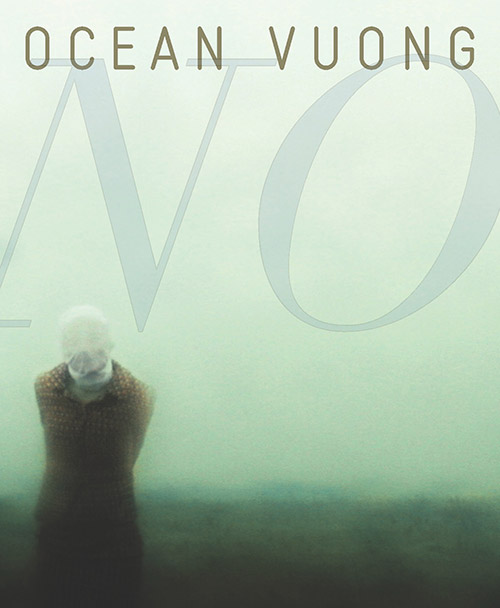
NO: Anyone who has already sensed that “hope is a feathered thing that dies in the Lord’s mouth,” should get their hands on NO. Honest, intimate, and brimming with lyric intensity, these stunning poems come of age with a fifth of vodka and an afternoon in an attic, with a record stuck on please, with starlight on a falling bomb. Even as Vuong leads you through every pleasure a body deserves and all the ensuing grief, these poems restore you with hope, that godforsaken thing—alive, singing along to the radio, suddenly sufficient. —Traci Brimhall, Our Lady of the Ruins


Ocean Vuong is a recipient of a 2013 Pushcart Prize as well as fellowships from Kundiman, Poets House, and The Saltonstall Foundation for the Arts. Poems appear in Poetry, The Nation, Beloit Poetry Journal, Passages North, Quarterly West, Denver Quarterly, and American Poetry Review, which awarded him the 2012 Stanley Kunitz Prize for Younger Poets. He lives in Queens, NY.


Editor’s Note: I’m just going to come right out and say this: Ocean Vuong is one of the best and most important poets writing in America today. I have not been so moved as I am by Vuong’s words since I first read Li-Young Lee. This poet has changed my life. He has renewed my belief in American poetry. That it can be emotional and heartbreaking. That is can be beautiful and full of hope. That modern American poetry can—and does—matter. In my humble opinion your poetry collection is simply not complete unless it houses both Vuong’s groundbreaking chapbook, Burnings, and his newest release from Yes Yes Books, NO.

NO is a surprisingly experimental collection, yet Vuong remains dedicated to the lyric and the narrative, guiding us through its formal twists and turns through emotive language and evocative imagery. Throughout its pages the poet intimately explores themes of love, sexuality, and belonging against a backdrop of devastating loss. It is a brilliant and beautiful collection, a true heartbreaking work of staggering genius. As the book’s publisher did when reading through the manuscript for the first time, when Ocean Vuong says NO to you, be prepared to say “Yes Yes!”


Want to see more from Ocean Vuong?
Buy NO from Yes Yes
The Poetry Foundation
Interview in The Well & Often Reader
Ben Lerner on mentoring Ocean Vuong, Brooklyn College

SATURDAY POETRY SERIES PRESENTS: ARLENE KIM

AK_0919

By Arlene Kim:

Screen Shot 2013-04-26 at 3.38.30 PM


(Today’s poems originally appeared in Diode and appear here today with permission from the poet.)

Arlene Kim grew up on the east coast of the U.S. before drifting westward. Her first collection of poems What have you done to our ears to make us hear echoes? (Milkweed Editions) won the 2012 American Book Award. She lives in Seattle where she reads for the poetry journal DMQ Review and writes poems, prose, and bits between.

Editor’s Note: The biography of Prince Sado is fascinating, but there is no entry into this (or any) history quite like that of a poet. Arlene Kim has latched onto this fascinating tale, and in her telling she not only invites us into a history, but also makes that history entirely new, entirely her own. Who was Prince Sado—in both his life and death—and how does he live anew in the imagination of the poet?

Want to read more by and about Arlene Kim?
Arlene Kim’s Official Website
Milkweed Editions: Video
DMQ Review: Poetry
Buy What have you done to our ears to make us hear echoes? from Milkweed Editions
Buy What have you done to our ears to make us hear echoes? on Amazon