SATURDAY POETRY SERIES PRESENTS: LAURA E. DAVIS

LEDavis-2014

By Laura E. Davis:


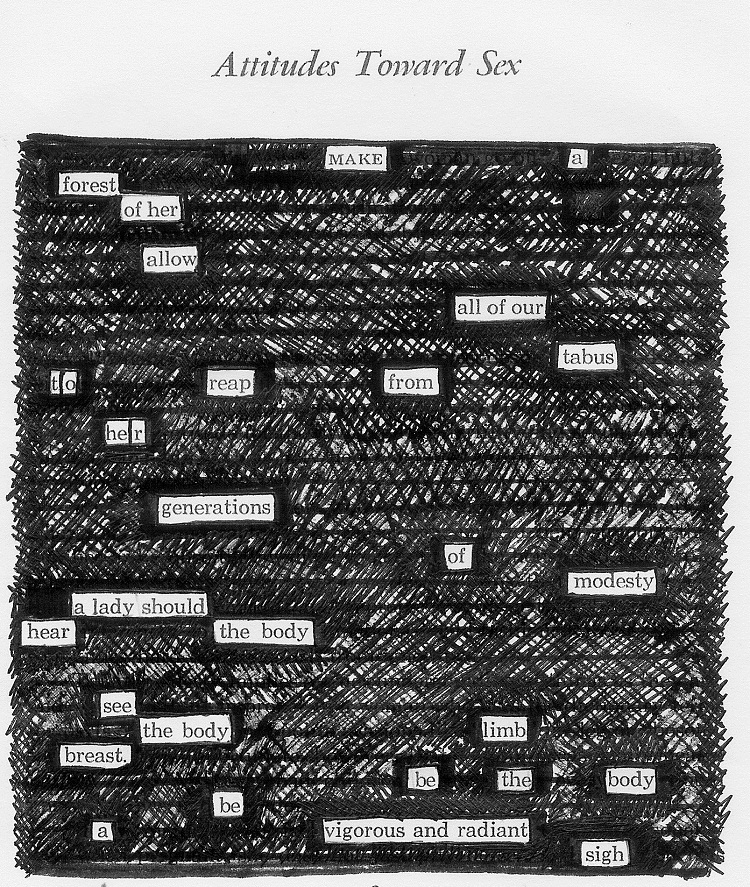
ATTITUDES TOWARD SEX

attitudestowardsex.small


THE BOYS ARE ALWAYS TALKING

about their cocks, naming
names—Rebecca, Elizabeth,
Ashley—we see these girls
all lined up, waiting to admire

the boys’ cocks. And the boys
talk about size of their cocks,
seven inches becomes ten, then
thirteen. They tell us how

they measured their cocks
after their first wet dream: they
woke up sweaty, quick-covered,
got their cocks hard again, pulled

out the ruler. Boys and cocks
everywhere. A boy shows his
cock to a girl on the playground.
Another boy watches girls from

a parked car while he touches
his cock. On the subway, boys
unzip their pants, put cocks
on display. Baby boys discover

their tiny cocks during every
diaper change. I didn’t see
my own clit was until I was
twenty-three. I had to hold

a mirror just to see it rise
like slow-motion stalagmite.
Had to hold back my own skin
just to show it to myself.


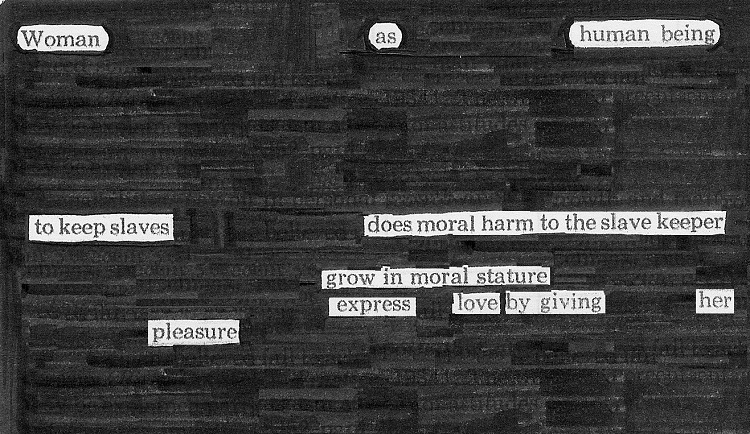
WOMAN AS HUMAN BEING

woman as human being.smaller


“Attitudes Toward Sex” was originally published in iARTistas. “The Boys Are Always Talking” was originally published in Muzzle. “Woman as Human Being” was originally published in Toad Journal. These poems appear here today with permission from the poet.


Laura E. Davis is the author of Braiding the Storm (Finishing Line, 2012), founding editor of Weave Magazine, and founder of Submission Bombers. Her poems are featured or forthcoming in Toad, Stirring, Corium Magazine, So to Speak, Muzzle, and others. Laura teaches for Poetry Inside Out, a K-12 a bilingual poetry program in San Francisco, where she lives with her partner, Sal.

Editor’s Note: This week I had the honor of working with an artist to create an artistic response to the Hobby Lobby Supreme Court decision. I have already written an editorial response to the ruling, but I wanted to speak out against this injustice in many ways, through many voices.

Today’s poems speak for womankind. They speak for our bodies, for our vantage point within a man’s world. When read together today, they are meant to be a shout from the rooftops. That no one exercises control over our bodies but ourselves. That we are human beings whose rights are superior to the rights of corporations. Yes, that we are human beings. Beautiful, complex, powerful human beings who are as capable of a battle cry as we are of “a vigorous and radiant sigh.”

Want to read more by Laura E. Davis?
Dear Outer Space – Laura E. Davis’ Blog
“Quiet Lightning” on Youtube
Buy Braiding the Storm from Finishing Line Press
“Relics” in Sundress
“Vessels” and “Red Storm” in The Doctor T. J. Eckleburg Review

Franz Douskey: A Micro-Interview and Three Poems

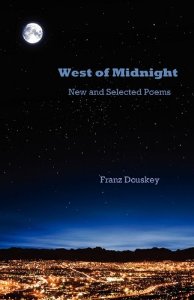
 westmidnight

Franz Douskey has published in Rolling Stone, the Nation, New York Quarterly, The New Yorker, and Las Vegas Life. His readings and travels with such notables as James Dickey, Allen Ginsberg, Ai, Charles Bukowski and F. D. Reeve are legendary. Some of his writing has been performed by Frederica Von Stade of the Metropolitan Opera Company, The Yale Glee Club and The Heaths. Along with writing, Franz Douskey produces radio shows for WQUN, Quinnipiac University, and hides out with the horses at Giant Valley Farm.

The following interview took place via email and the poems below are reprinted from West of Midnight: New and Selected Poems with permission of the author.

***

Okla Elliott: A thought that returns to me regularly is that in the table-of-contents of a journal, prose is broken up into fiction and nonfiction, and a lot of people are intensely serious about that distinction. Poetry, however, is not divided in such a way, so readers are left to assume whatever they prefer about a poem’s factual status. Of course, it’s the metaphor and joy of invention that finally carries all writing, no matter its genre or relationship to historical fact, but, that said, I think poems by war veterans or abuse victims or even highly paid lawyers that depict their lives as accurately as possible might gain something by being read as aesthetic depictions of real events. I bring all this up because I get the sense that many of your poems would be classified as creative-nonfiction-in-verse, if we bothered to make this sort of distinction for poetry. I am thinking particularly of your poems “Remembering James Dickey,” “Eric,” “Burning the Gypsies,” and others. Could you speak a bit about how your personal experience and travels or historical facts have informed the content (or even the form) of your poetry?

Franz Douskey: Personal experience and travel are strong forces of my writing. I like being there. About “Remembering James Dickey”… We got to know each other during the New York Quarterly annual Poetry Dinners at the Paris Hotel. We stumbled through that very dignified place often enough that the staff got to know us and would lead us safely away from their guests to preserve the hotel’s reputation. “Eric” was a student. One of those who came around to “take” my classes even when he hadn’t signed up. I still recall that phone call. “Burning the Gypsies” isn’t from direct experience, but the result of three separate forces that came together: my research of the Holocaust, my books of Gypsy life and lore, and Hell, I’m part Hungarian. Disturbing what we do to each other. Not every experience turns into poetry, but I find it difficult to be creative, inventive, etc. Enough extraordinary people and events have been part of my life that I seldom look inside. There is a Delphic maxim often ascribed to Socrates, “Know thyself.” I have no interest in knowing myself. What a dull book that would be.


OE: What got you started on poetry? And what do you think helped you develop most as a poet?

FD: Reading Kenneth Patchen, both prose and poetry, got me started writing. What came out was poetry. What helped develop my writing was travel. When I was excited by an author’s work, I sought out his and her books and, then sought them out. I visited Kenneth and Miriam Patchen often at 2340 Sierra Court. I was the only visitor allowed in the house, except for Kenneth’s dentist. Travel and reading caused me to visit Galway Kinnell, in Seattle, Henry Miller, at Big Sir, George Hitchcock, in Santa Cruz, and while living in Tucson I was strongly impressed by the poetry of Richard Shelton. I met a lot of writers there, including Raymond Carver, John Weston and Charles Bukowski. I traveled to several places, including New Orleans, with Bukowski, Gypsy Lou and Jon Webb, Bukowski’s first publishers (LouJon Press).

As I published more often, I traveled and did readings with Robert Penn Warren, James Dickey, William Packard, Allen Ginsberg and F. D. Reeve. Some of the Ginsberg-Douskey readings are in the Ginsberg Archive, at Stanford University, in Palo Alto. So I’d have to say, reading, traveling and getting to know the writers was a strong foundation.


OE: What advice might you give young poets today?

FD: Me give advice? First thing that comes to mind is: Why care what other people think? Self censorship is deadly for every human, and that goes triple for writers and especially poets. One time in a stop over at O’Hare, the plane attendant announced that our ground time would be brief Brilliant. How right she was and is. We don’t have forever. These bones are rented and we don’t know when the lease is up. Write, write, write, then revise, leave the work alone, go back and reread it, revise, revise and revise, knowing that revising is every bit a part of the creative process as writing down those original sparks. Go to readings, leave work early, travel, put yourself in weird experiences, even dangerous ones as long as you have an escape plan. Read a few writers, but make certain that you don’t fall in love with their style. Constantly become yourself. Leave the bough. Take on life and leave all blame behind. What you think and how you write are two elements uniquely you. And never take advice from anyone.


 ***

Beirut

things move quickly here
the roads are mined
they have trucks just to carry
human parts

I miss you a minute ago
I was smoking and out of the corner
of my eye I thought I saw your head
on my pillow I guess I’m losing
my mind

death scares me
I’ve never seen so much of it
bodies on the roads
blood seeps through shirts and blouses
heads leak and mouths eat dirt

and death could come now
while I smoke and listen to music
anyone might be the enemy
it is scary

you should see the faces of the living
worse than the dead

ten years ago it was different
now we are traveling
into something cold and dark

sometimes I think I’ll never see you–
if I get shot up
they’ll send what’s left in an empty glove
waving goodbye like a flag


***

Cat Dying of Cancer

too sick to do anything else
she twists in a chair to lick herself —
this is strange
because she has cancer
of the tongue

I guess it’s clean but I don’t let her lick me

one night I’ll turn around and see nothing in
her eyes
but me in my white robe leaning over her

her tongue will’ve fallen out and slid behind
the cushion

one day my sister will come over with her
kids
and the one who searches the furniture for
money
will pull out a piece of dried fruit
only it’ll be tongue of cat

as is his habit he’ll probably eat it

next time his granddaddy asks him
cat got your tongue? only you and I will know


***

Breton Speaking

First of all, there are the demented
fritillaries and raucous hummingbirds.
Yesterday Rimbaud came over to watch
Fantasy Island. His cough hasn’t improved,
still he won’t stop smoking.

It is difficult here. We hardly see
anyone. The night is lacerated by downpours
of shadows, a violent silence wings down
from the vertiginous, embroidered stars.

There are massive snails in the woods.
Trees are toothpicks in their jaws.
We lose old friends every day. Some of us,
especially Camus and Char, wonder if this
is heaven or hell. Celine says
it’s Paris, after the war.

Our wives are still on the other side,
wearing satins and sachets,
a minimal sign of virtue.

Did I tell you about the bats? Last year
only five people lived to tell about them.

Then there are the parties, equally deadly,
that one is expected to attend. Verlaine
threw up a week ago, and he still hasn’t
been able to eat anything but Wheatena.

Eluard hasn’t gotten over dying. He says
he wasn’t ready. He has something that
would clear his reputation. He has sent
a letter of protest to God,
the true originator of surrealism.

Meanwhile, any hope for hypogeous
restoration dwindles.

I once said, The future is never.
I didn’t know how right I’d be.
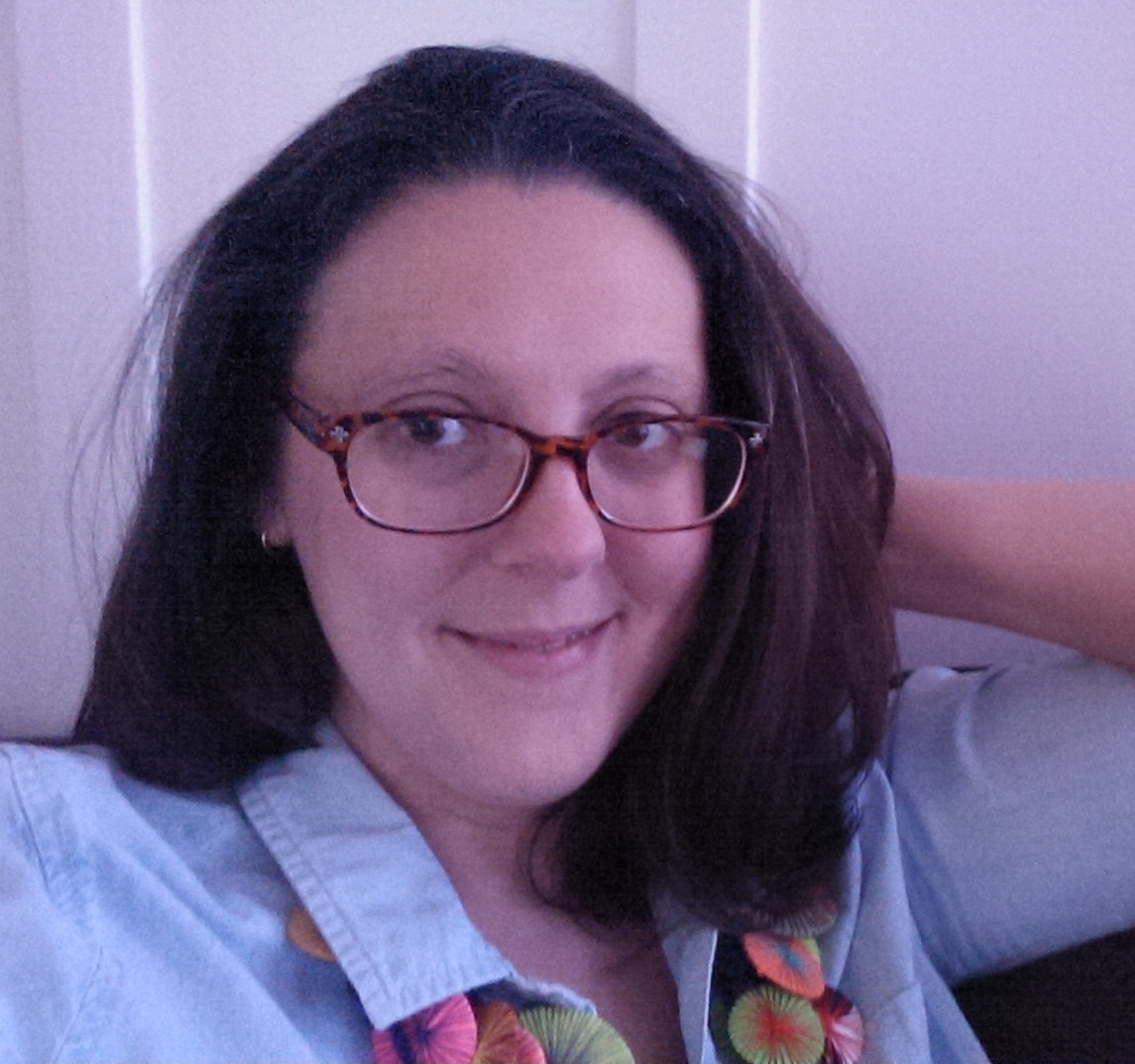
SATURDAY POETRY SERIES PRESENTS: JENNY SADRE-ORAFAI

Sadre-Orafai

KARAJ
By Jenny Sadre-Orafai

When I miss her, I open my popout map.
I spill my face into the streets of Tehran.
I hide in Laleh Park. I read street names
aloud, like I’m reporting to someone.
I pretend I see things no one else can─
who took the Peacock Throne, how the burnt
city fell. I say Karaj like I’m telling you your future.


Today’s poem was originally published in Thrush Poetry Journal and appears here today with permission from the poet.


Jenny Sadre-Orafai is the author of four chapbooks. Her first collection Paper, Cotton, Leather will be published this fall by Press 53. Recent poetry has appeared in Redivider, Thrush Poetry Journal, PANK, Rhino, Sixth Finch, ILK, iO: A Journal of New American Poetry, and Poemeleon. Recent prose has appeared in The Rumpus, The Toast, and Delirious Hem. She is co-founding editor of Josephine Quarterly and an Associate Professor of English at Kennesaw State University.

Editor’s Note: I fell in love with today’s poem because it so intimately and distinctly tells the poet’s story, and yet, this is not her story. I have my own Karaj, and anyone who has ever loved a city that lies on the other side of the world—anyone who has ever loved a city by way of memory and longing—speaks the language of this poem. I am reminded, too, of Danusha Laméris’ beautiful poem, “Arabic,” of the ways in which love—of a language, of a people, of a place—remain with us across the span of distance and time. When Jenny Sadre-Orafai leaves us with her (killer!) end-line, I know what my future holds. I know what city waits for me on distant shores.

Want to read more by Jenny Sadre-Orafai?
Official Website
Two poems with audio in PANK
Creative nonfiction essay with audio in The Rumpus

SATURDAY POETRY SERIES PRESENTS: SPLIT

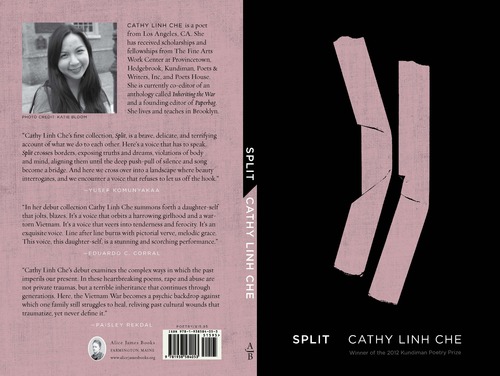
30m0dbb


from SPLIT
By Cathy Linh Che:


THE FUTURE THERAPIST ASKS ABOUT RAPE

This morning, I watched a woman shatter
the thin ice on the pavement. I made the bed,
tucked in the sheets, and in the window,
I saw reflected my mother’s face.

Men in my life walked in and out of the rooms,
tramping snow. My mother shushed me,
and my father with his powder keg hands
pulled up a pair of clean black socks.

It isn’t what you think.
My father was a soldier.
He taught me nothing about men.

They are an empty barrel.
You’re not supposed to look into
a gun you dismantle

to try and see its parts.


HOME VIDEO

There are flowers on this bed, an elbow planted by an ear.
No, you cannot touch this breast. No darkness, no shatter,
and no, no pendulum. The past is a blood clot lodged inside
your lung.

                                                  *

In the living room, shapes move against the wall. You are
wearing a thin dress. You watch Beetlejuice while he moves
his fingers over your white underwear. You watch the screen
and see his fingers. Your brothers are in the room, but they
never seem to notice.

                                                  *

Behind the lens is the father. Mother offstage calls, Con gai
nay
. On the phone, Con gai thuoi, which means, This girl. This
girl’s rotten. This girl like swollen fruit. She cuts off the
bruises. She teaches me to cut.

                                                  *

He rises to the surf. It detonates with a sheering crash.
Inside each wave is a barrel. In each barrel is a vacuum that can suck
you in, spin you round, snap your bones if you tumble the
wrong way.

                                                  *

If I say, I have been touched. If I say, by my cousin, then, a
neighbor boy and then another. If I say no, I didn’t want it
from my first boyfriend. There was blood and membrane
and he didn’t believe me. If my body can be a box. If I can
close it up. If it has to be open. Who will touch me again?


POMEGRANATE

I open my chest and birds flock out.
In my mother’s garden, the roses flare
toward the sun, but I am an arrow

pointing back.
I am Persephone,
a virgin abducted.

In the Underworld,
I starve a season
while the world wilts

into the ghost
of a summer backyard.
My hunger open and raw.

I lay next to a man
who did not love me—
my body a performance,

his body a single eye,
a director watching an actress,
commanding her

to scintillate.

I was the clumsy acrobat.
When he came, I cracked open
like a pomegranate

and ate six ruddy seeds.

I was the whipping boy.
I was thorny, barbed wire
wound around a muscular heart.


Today’s poems are from Split, published by Alice James Books, copyright © 2014 by Cathy Linh Che, and appear here today with permission from the poet.


SPLIT: “Che effectively weaves the trauma of the Vietnam War into her own personal trauma, making herself a war victim—only her war is not against enemy combatants, but against her past.” —The Philadelphia Review of Books

“Cathy Linh Che’s first collection, Split, is a brave, delicate, and terrifying account of what we do to each other. Here’s a voice that has to speak. Split crosses borders, exposing truths and dreams, violations of body and mind, aligning them until the deep push-pull of silence and song become a bridge. And here we cross over into a landscape where beauty interrogates, and we encounter a voice that refuses to let us off the hook.” —Yusef Komunyakaa


Cathy Linh Che is the author of Split (Alice James, 2014), winner of the 2012 Kundiman Poetry Prize. She has been awarded fellowships and residencies from Poets & Writers, Poets House, The Lower Manhattan Cultural Council’s Workspace Residency, and the Jerome Foundation.


Editor’s Note: Words—my words—seem ineffective here. But I was deeply moved by this poet, by this book, and so I will try. Split is a sacrifice; raw and unrelenting. It is blood and memory and gasoline. It is the truth no one wants to hear, that we all need to hear. But it is more than the phoenix choking on ash, thrashing to be free. It is lineage and heritage, truth offered up in the name of a history, a family, a self. This is a stunning book by a bold and dedicated poet, a book that dares us to look, listen, and speak up.


Want to see more from Cathy Linh Che?
Official Website
Buy Split from Alice James Books
Fireside: A Kundiman Blog
Hyphen
Poets.org

SATURDAY POETRY SERIES PRESENTS: UNDRESSING

tumblr_n0v0y0a0Vq1rxylgxo1_1280
from UNDRESSING
By Nicole Steinberg


BEAUTY

is a ritual, passed
along in slow drags
of the fingers—foundation
swept across cheekbones
in runny smears, stark
beige until it blends.
Salt, pepper, and ashtrays;
we keep the kitchen
warm with smoke and
sweet, still-wet hair.
A silver lipstick tube
rolls ribbed between us.
One day I’ll carry
your bones in sacks.
I’ll remember cotton
pressed into your eyes
and up your nostrils. I’ll be
sorry they ever listened,
when I said I wanted
to see you that way.
You switch to violet
lips after some years,
which clash with your
bleached hair. I miss
the old burgundy outline.
Draw lines to prevent
bleeding, you once explained.
Hold back the color
of your mouth and
every careless thing
it wants to say.


MY DARK, SEMITIC WILES

I took my dark, Semitic wiles on the road.
The train was empty and that was lovely,
everywhere an open space. En route to Berlin,
I held the bathroom mirror and spoke
to my mother, foreign leaves of foreign trees
and the conductor’s garbled nothings
blurred above my head. She thinks I’m going
to get myself killed. Lost forever. I remember
a straight-haired little girl at the kindergarten
table with eyeglasses as petite as her pink
Polly Pocket. I crushed them in my fat hand,
arranged the lozenge lenses next to the legs,
purple plastic bird femurs. Like chicken,
I picked it apart. My fellow passengers,
the unwed Jewess rides among you, come
to tour your capital of tragedy. Love me
out of guilt like an unborn sister, a mother’s
final scowl before death, the very nose
on your face you’d hack off just to belong.


THERE IS NO ROMANTIC

Truly, everything is monstrous,
even wild horses and especially
their heads. The tree trunk necks
of boys who finish sandwiches
in three bites and the impatient
lumps that harden in their freshly
bleached briefs. We’re all so warm
and pink, it’s obscene. I don’t want any
part of it. It took me years to learn
simple tasks: how to snap my fingers,
tie my shoes. My mother’s early gaze
full of worry that love would escape
me, too. If I peel back my breast, I’ll find her
passport heart, stamps still smeared
from all the quailing in Queens, the tears
in Tel Aviv. She taught me this: the way
a woman travels, under a moving
shadow of small panic; all too aware
that even a plane about to crash,
for one bright, myopic moment,
will fill completely with the sun.


Today’s poems are from Undressing, published by dancing girl press, copyright © 2014 by Nicole Steinberg, and appear here today with permission from the poet. “There is No Romantic” previously appeared via 30 x Lace, and “My Dark, Semitic Wiles” previously appeared via Leveler.


Nicole Steinberg is the author of Getting Lucky, now available from Spooky Girlfriend Press, Birds of Tokyo (dancing girl press, 2011), and two new chapbooks in 2014: Undressing from dancing girl press and Clever Little Gang from Furniture Press, winner of the 4X4 Chapbook Award. She is also the editor of an anthology, Forgotten Borough: Writers Come to Terms with Queens (SUNY Press, 2011).

Editor’s Note: I love chapbooks. And small presses. And books that are little works of art to hold in your hands, open, and immerse yourself in. Undressing is such a book; one of 200+ books made to date by dancing girl press, which publishes titles “by emerging women poets in delectable open-run handmade editions.” Delectable. Yes. From its beautiful cover art to its textured binding and hand-cut pages, this is the kind of creation that can never be replaced by an ebook.

Within its pages, Undressing is just that. The poet sheds her veils like Salome, stripping off not only clothes, but skin, revealing the raw bits of flesh and bone, organ and memory, that comprise an inner life. At times Nicole Steinberg looks at herself critically, as a woman does when considering her reflection in a mirror, her point of view filtered through a smog of American cultural misogyny. At other times Steinberg puts on the dress of her mother, of illness and loss, of the guilt and introspection and distortion that remains.

Amidst a maelstrom of pop culture, feminism, religion, sex, relationships, and memory, there is something hectic in these poems, like the pile of clothes at the foot of a bed. But amidst the torrent there are moments in which the poet forces us to slow down and face the reality she unveils head on. There are lines so poignant they wash over their more topical surroundings, forcing us to breathe and remember we are engaged with an artifact: “Draw lines to prevent / bleeding, you once explained. / Hold back the color / of your mouth and / every careless thing / it wants to say.” “She taught me this: the way / a woman travels, under a moving / shadow of small panic; all too aware / that even a plane about to crash, for one bright, myopic moment, / will fill completely with the sun.”

Want to see more from Nicole Steinberg?
Nicole Steinberg’s Official Blog
Buy Undressing and Birds of Tokyo from dancing girl press
Buy Forgotten Borough: Writers Come to Terms with Queens on Amazon

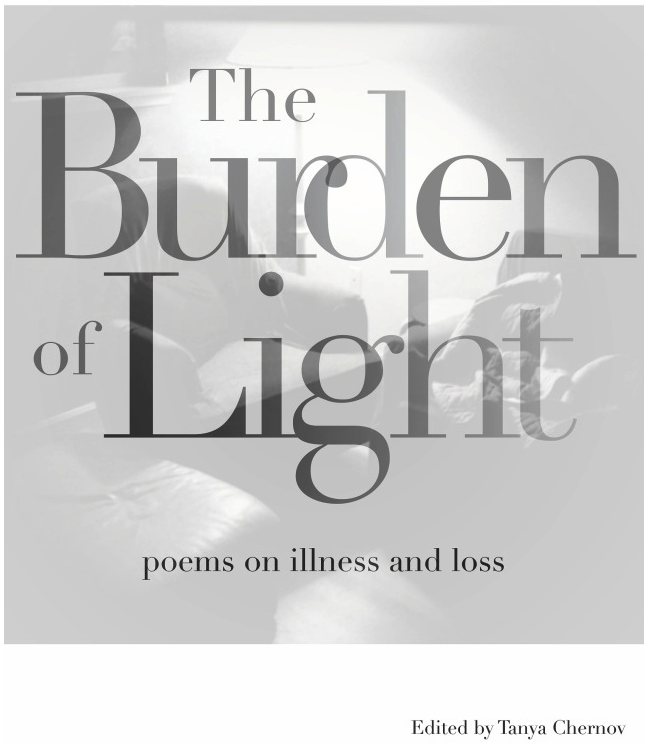
SATURDAY POETRY SERIES PRESENTS: THE BURDEN OF LIGHT

Picture 1


from THE BURDEN OF LIGHT: POEMS ON ILLNESS AND LOSS
Edited by Tanya Chernov
Selected Poems From the Anthology By Sivan Butler-Rotholz:


ELEGY FOR THE STILL LIVING:
FATHER CANNOT STAND STILL

[My father taught me] every time you breathe in,
say thank you. Every time you breathe out, say goodbye.

                                                                             —Li-Young Lee

The thing about my father is I wear my sadness like the inside of a jar.
How can you not see inside of it? How the slightest bit of air destroys me.
How I love him so much          I struggle

                           to love him

                                                                    at all.


GENESIS

i. The thing is, XXXXXXXXXXXXXXXXXXXXXXXXXXXXXXXXXXXXXXXXXXXXXX
XXXXXXXXXXXXXXXXXXXXXXXXXXX and in this way the world was created.

ii. Definitions

“Wife”:           The person I love most
                         in the world.

“Death”:         He is not here
                         in this hole
                         in the ground
                         piled with dirt
                         and seashells.

“Mother”:       Inlaid tongue.

“Wedding”:    When I was young I liked to play ‘wedding’ and my father would walk me                          down the aisle and it’s a good thing he did then because
                         Flowers are like that.

“How”:            We go on

“Flowers”:      Are not stones.

“One God”:     Let us make human beings in our image, to be like us.


Today’s poems are from The Burden of Light: Poems on Illness and Loss, available by donation on Smashwords and Amazon. These poems appear here today with permission from the poet.


The Burden of Light: Part poetry anthology, part field guide, part multimedia art collection, The Burden of Light offers its readers companionship through the darkest days. With work by artists who have confronted serious illness or grief in their own lives, the poems and artwork in these pages hold the power to touch the heart, stir the mind, and heal the spirit, each in its own way. These pieces illuminate the vital force of our humanity, while encouraging us to reach out to others in need.

With 100% of the proceeds benefiting the National Colorectal Cancer Research Alliance, even a small donation from one has the power to affect change when added to the contributions of others. Colorectal cancer is the second leading cause of cancer-related deaths in America, yet this cancer is largely preventable when detected early. By supporting the groundbreaking work of the NCCRA, we’re all helping to promote regular medical screening and fund the research needed to develop better tests, treatments, and ultimately, a cure. Just as The Burden of Light is designed to help readers move forward from trauma, so too will donations help those currently experiencing serious illness.


Editor’s Note: Yes, yes, today’s poems are a first here on the Saturday Poetry Series in that they are written by your faithful editor. I am honored to be featured in this anthology alongside a plethora of talented artists, including SPS-beloved poet Peggy Shumaker. But beyond sharing a little of my own work with you here for the first time, I wanted to share with you this important collection.

Whether you purchase it for your Kindle or download it as a PDF, you get to decide how much you want to pay for this anthology, and 100% of the proceeds benefit the National Colorectal Cancer Research Alliance. Via the Kindle edition or PDF you will find links to listen to the poets read their poems aloud, for an added layer of experience and immersion. This is a thoughtful, powerful, philanthropic endeavor with the power to both move the reader and effectuate change.

Check out the full anthology for more poems by yours truly and many more talented poets writing through their own experiences with illness and grief. Please donate what you can, and then go forth and read!


Want more from The Burden of Light?
Download the PDF via Smashwords
Purchase the Kindle edition from Amazon
Listen to “Elegy for the Still Living: Father Cannot Stand Still”
Listen to “Genesis”

SATURDAY POETRY SERIES PRESENTS: MEGAN MORIARTY


Moriarty Author Photo

LOOKING AT US LIVING
By Megan Moriarty

Through the binoculars, we saw us
moving through the foliage.

The world was on rewind:
a herd of horses ran
backwards across a field.

Yellow leaves kept climbing back
to their branches.

“What’s the opposite of fall?” I said,
and he said “Spring.”

Then it was August, then July,
then June. The sun kept
leaving and coming back

like a boomerang that no one
ever had to throw.

Snow appeared
on the ground, then it started
unsnowing, the flakes
travelling upwards.

I knew that soon
we wouldn’t know each other

so I asked him
what the opposite
of stay is.

He stood there,
his hands on his hips, thinking.


Today’s poem was published in the Summer 2011 issue of Rattle, and appears here today with permission from the poet.


Megan Moriarty grew up surrounded by water in Staten Island, New York and currently finds herself surrounded by mountains in Hillsboro, West Virginia. She holds an MFA in poetry from Virginia Tech and is the author of From the Dictionary of Living Things, a collection of dictionary definition poems.

Editor’s Note: Today’s poem is magic, full of fantastical invention and a vivid, playful story life. I am reminded of the work of Nicolas Destino, a beloved poet here on As It Ought To Be. What wonder, what imagination, what playfulness of concept, what love of ideas mirrored in the written word.

Want to read more by Megan Moriarty?
Buy From the Dictionary of Living Things from Finishing Line Press
Indiana Review
Vinyl Poetry
Jointed Autumn

SATURDAY POETRY SERIES PRESENTS: LOUISE MATHIAS

Louise Desert headshot

THE PROBLEM OF HANDS
By Louise Mathias

And how to fill them
is the problem of cigarettes and paint.

First time I felt my undoing
was in front of

a painting—Sam Francis, I believe.

Oh, his bloomed out, Xanax-ed California.

I liked the word guard, but you know

we made each other
nervous, standing too close

for everyone concerned. All art being

a form of violence
as a peony
is violence.

Here you come

with your open hands.


Today’s poem previously appeared via the Academy of American Poets and appears here today with permission from the poet.


Louise Mathias grew up in England and Los Angeles. She is the author of two books of poems, Lark Apprentice, which won the New Issues Poetry Prize, and The Traps, released in 2013 from Four Way Books. She lives in Joshua Tree, a small town in California’s Mojave Desert.

Editor’s Note: As my faithful readers of this series know, I am a sucker for a poem with a killer ending. In today’s piece, it is the penultimate moment that takes my breath away: “All art being // a form of violence / as a peony / is violence.” What a stunning phrase. Followed by the gift of release, of promise: “Here you come // with your open hands.”

Once again I have Dr. Poet Jenny Stella to thank for bringing today’s poem to my attention. Viva la poesia!

Want to read more by Louise Mathias?
Verse Daily
The Traps from Four Way Books
The Rumpus
The Offending Adam
Everyday Genius

SATURDAY POETRY SERIES PRESENTS: JENNA LE

Jenna Le photo

By Jenna Le:


MOM’S COCKS

Mom grew up beside the Perfume River in Vietnam,
in a brick house overrun by chickens.
Those horny-footed fowl were always
rubbing their feather-padded genitals
against sofa legs and children’s shoes
as if they were fit to burst. Mom laughs

as she tells me how they ground
their pelvises against her leather sandal,
stuporous with misdirected lust—
How strange that she
is talking to me about sex
in this casual way. She’s returning to her roots

as a child who lived among
unmannered beasts. And I, through hearing her words,
am returning there with her: I
am the aggressive rooster; I’m the hens
cowering behind the outhouse; I’m the much-abased,
much-abraded, Size Four shoe.


THREE SHORT POEMS ON A COMMON THEME

1.

Staring at you across the room, my body seemed composed
of nothing but eyes.

Even my mouth
watered, like an eye.

2.

I couldn’t sleep a wink all night: my brain agitated its solitude
like a washing machine

filled with copies
of your immaculate white shirt.

3.

In the morning, I went out and bought a book of your poems.
It’s a poor substitute for a straightedge, it’s true,

but you won’t
sell me your curves for any price.


Today’s poems are from Six Rivers, published by NYQ Books, copyright © 2011 by Jenna Le, and appear here today with permission from the poet.


Jenna Le was born in Minneapolis, Minnesota, a daughter of two Vietnam War refugees. She received a B.A. in mathematics from Harvard University and an M.D. from Columbia University. She has worked as a physician in Flushing, New York, and the Bronx, New York. Her full-length poetry collection, Six Rivers (NYQ Books, 2011), was a Small Press Distribution Poetry Bestseller. Her poetry, fiction, essays, book criticism, and translations of French poetry have appeared or are forthcoming in journals such as AGNI Online, Barrow Street, Bellevue Literary Review, Massachusetts Review, Measure, Pleiades, and 32 Poems.

Editor’s Note: Lyric, narrative, accessible, and unafraid, Jenna Le’s Six Rivers opens along the banks of the Perfume River, in a scene that pairs mother with sex and “horny-footed fowl.” The relationships—between mother and daughter, between ‘here’ and ‘there’—are rich and complex, with the poet embodying her mother’s past, her roots, and the “much-abased, much-abraded, Size Four shoe.” Throughout the book love and sex, personal, familial, and cultural history, healing and death are all explored as we travel with the poet along the six rivers of her life. Le allows herself to be vulnerable and imperfect, and so we relate to her, root for her, are drawn into her vivid world. A keen seer and a captivating reporter, it is no wonder that, at times, the poet feels she is “composed of nothing but eyes.” Hungry for life, hungry for love, it is no wonder that “Even [her] mouth watered, like an eye.”

Want to read more by and about Jenna Le?
NYQ Poets
Mascara Literary Review
The Nervous Breakdown
The Toronto Quarterly
Sycamore Review

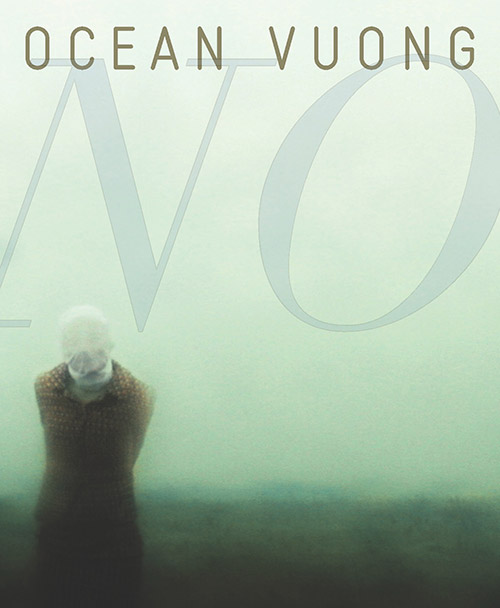
SATURDAY POETRY SERIES PRESENTS: NO

no


from NO
By Ocean Vuong


TORSO OF AIR

Suppose you do change your life.
& the body is more than

a portion of night—sealed
with bruises. Suppose you woke

& found your shadow replaced
by a black wolf. The boy, beautiful

and gone. So you take the knife to the wall
instead. You carve & carve.

Until a coin of light appears
& you get to look in, for once,

on happiness. The eye
staring back from the other side—

waiting.


HOME WRECKER

And this is how we danced: with our mothers’
white dresses spilling from our feet, late August

turning our hands dark red. And this is how we loved:
a fifth of vodka and an afternoon in the attic, your fingers

sweeping though my hair—my hair a wildfire.
We covered our ears and your father’s tantrum turned

into heartbeats. When our lips touched the day closed
into a coffin. In the museum of the heart

there are two headless people building a burning house.
There was always the shotgun above the fireplace.

Always another hour to kill—only to beg some god
to give it back. If not the attic, the car. If not the car,

the dream. If not the boy, his clothes. If not alive,
put down the phone. Because the year is a distance

we’ve traveled in circles. Which is to say: this is how
we danced: alone in sleeping bodies. Which is to say:

This is how we loved: a knife on the tongue turning
into a tongue.


Today’s poems are from NO, published by Yes Yes Books, copyright © 2013 by Ocean Vuong. “Torso of Air” previously appeared in BODY Literature, and “Home Wrecker” previously appeared in Linebreak. These poems appear here today with permission from the poet.


NO: Anyone who has already sensed that “hope is a feathered thing that dies in the Lord’s mouth,” should get their hands on NO. Honest, intimate, and brimming with lyric intensity, these stunning poems come of age with a fifth of vodka and an afternoon in an attic, with a record stuck on please, with starlight on a falling bomb. Even as Vuong leads you through every pleasure a body deserves and all the ensuing grief, these poems restore you with hope, that godforsaken thing—alive, singing along to the radio, suddenly sufficient. —Traci Brimhall, Our Lady of the Ruins


Ocean Vuong is a recipient of a 2013 Pushcart Prize as well as fellowships from Kundiman, Poets House, and The Saltonstall Foundation for the Arts. Poems appear in Poetry, The Nation, Beloit Poetry Journal, Passages North, Quarterly West, Denver Quarterly, and American Poetry Review, which awarded him the 2012 Stanley Kunitz Prize for Younger Poets. He lives in Queens, NY.


Editor’s Note: I’m just going to come right out and say this: Ocean Vuong is one of the best and most important poets writing in America today. I have not been so moved as I am by Vuong’s words since I first read Li-Young Lee. This poet has changed my life. He has renewed my belief in American poetry. That it can be emotional and heartbreaking. That is can be beautiful and full of hope. That modern American poetry can—and does—matter. In my humble opinion your poetry collection is simply not complete unless it houses both Vuong’s groundbreaking chapbook, Burnings, and his newest release from Yes Yes Books, NO.

NO is a surprisingly experimental collection, yet Vuong remains dedicated to the lyric and the narrative, guiding us through its formal twists and turns through emotive language and evocative imagery. Throughout its pages the poet intimately explores themes of love, sexuality, and belonging against a backdrop of devastating loss. It is a brilliant and beautiful collection, a true heartbreaking work of staggering genius. As the book’s publisher did when reading through the manuscript for the first time, when Ocean Vuong says NO to you, be prepared to say “Yes Yes!”


Want to see more from Ocean Vuong?
Buy NO from Yes Yes
The Poetry Foundation
Interview in The Well & Often Reader
Ben Lerner on mentoring Ocean Vuong, Brooklyn College