This is the first post in a monthly column about animal rights and critical animal studies.
Because I’m a poet and essayist some of my posts will move beyond the strict scope of animal rights philosophy and will concern literature specifically as it relates to nonhumans, veganism, and zoopoetics.
Zoopoetics is a new movement in literary theory and practice that treats nonhumans as individuals with agency, as conscious world-having individuals worthy of moral consideration.[1] Think Kafka, Coetzee, D. H. Lawrence. Think Oni Buchanan and Aracelis Girmay, Les Murray and John Kinsella, Gretchen Primack and Ashley Capps, among countless other innovative writers and editors actively helping to reconceive our relationships with nonhumans.
Zoopoetics is markedly different from ecocriticism, ecopoetics, ecopoetry, and ecological literature in general. Such movements are not concerned with nonhumans as individuals; rather, they are concerned with animals as populations. When they do concern themselves with nonhumans, the essays and anthologies in these genres typically express disquiet about threatened favored populations of animals in the wild — wolves, eagles, bison, monarch butterflies — and rarely if ever mention the plight of farmed animals or question the practice of enslaving, killing and eating the bodies and secretions of nonhumans. The animal in these works is aestheticized and collective. Terry Tempest Williams, for instance, might protest the killing of prairie dogs and owls in the Utah desert, as a part of the general “subjugation of women and nature” in her book Refuge, but think nothing of lauding the hunting of rabbits by her family only a few pages later as a practice integral to her family’s sacred (her word) relationship with nature. Dozens of poets in a collection of essays on ecopoetics will rail against damage to the environment and the loss of connection to the animal world and nature caused by human hubris but never once mention a slaughterhouse, the practice of meat eating, or the fact that animal farming is not only predicated on human supremacism but is also the single greatest driver of climate change and the chief ecological threat to rivers and aquifers worldwide. Forewords, prefaces, and introductions to recent anthologies of ecopoetry and the postmodern pastoral won’t mention the slaughterhouse at all, though the bodies of dead nonhumans are universally eaten and worn, and CAFOs are scattered across countrysides everywhere.[2]
The idea that literature should be written to benefit nonhumans is new. We see no hint of this in western letters prior to now. Book X of The Republic maintains that the only permissible literature is that which praises gods and famous men. Aristotle remarks in Book IV of The Poetics that literature’s purview is the imitation of the actions of men and gods. Sidney’s Defence holds that literature’s purpose is to improve the character of a gentleman. Shelley, Lessing, Schiller all declared that the intent of literature should be to improve humanity. In fact it’s been a broadscale and sustained note since the advent of humanism: the project of literature is humanity’s improvement. Full stop.
Writing literature for the improvement and benefit of nonhumans isn’t some boutique issue, especially when we consider how animal farming is altering our climate and damaging our health and environment. Even for those who cannot intrinsically value nonhumans as ends in themselves, they should recognize that our fate is bound up firmly with their well-being.
A human future that does not acknowledge the injustices done to nonhumans cannot be rosy. Thankfully, a growing body of thinkers, literary and non-literary alike, is increasingly in agreement with political theorist John Sanbonmatsu who writes,
“A Left or socialist politics which does not place our enslavement of other beings at its center, conceptually and politically, cannot possibly succeed: ‘speciesism’ is not merely one more ‘ism,’ but in fact lies at the root of every form of social domination.”
Indeed, Giorgio Agamben goes so far as to insist that the ways we conceive of nonhumans has for centuries been at the heart of all political oppression.
As with the rest of mainstream culture, there is in this eco-centric literature a general disavowal of the suffering of nonhumans despite the seventy billion who are killed each year (trillions if we consider the annual slaughter of sea creatures) for meat, jackets, fur collars, handbags, watchbands, hats, shoes – all commodities unnecessary for, and in fact detrimental to, our health and mental well-being. The rare animal who rises to the status of an individual by such authors is generally a domestic pet or a rescued farm animal.
Rather than coldly expressing concern over animals as populations, we should, in the words of philosopher David Sztybel be “’hot’ for the individual animal.”[3] This new literature does this. And none too soon. Now that we are living through the sixth mass extinction since multicellular life rose on the earth a billion years ago, an extinction caused in great part by animal farming, an extinction, what’s more, that is nearly invisible to us, it’s time we begin to think of literature as a force that can benefit nonhumans too. A zoopoetic literature, which is sometimes straightforwardly veganic, is being written for the benefit of all sentient beings, not just as populations but as individuals, as individuals with bodily and mental sovereignty.
Such a literature will correct our received notions about what it means to share a lived sense of mutual vulnerability with nonhumans, to be one among many, not first among a few, of sovereign and suffering beings, each of whom, like us, is surrounded by the causes of death. Such a literature will also help us understand that humans need no longer be one of those causes.
(photo by Elige Veganismo of cow in restraining device for slaughter)
[1] The term zoopoetics was introduced by Jacques Derrida in his 1997 The Animal that Therefore I Am, but it has recently been more carefully inflected by Aaron Moe in his book Zoopoetics: Animals and the Making of Poetry (Lexington 2013) as a counter to, and a clarification of, ecocriticism and ecopoetics.
The tiny crocus is so bold
It peeps its head above the mould,
Before the flowers awaken,
To say that spring is coming, dear,
With sunshine and that winter drear
Will soon be overtaken.
(Today’s poem is in the public domain, belongs to the masses, and appears here today accordingly.)
Lizzie Lawson (circa 1867–1902 OR 1858-1905) appears to have been a poet and children’s visual artist. This is a rare instance in which I was able to find many poems by the poet, but almost no biographical information whatsoever. The woman appears to have been lost to us, while her artistic creations remain. If anyone knows about the biography of this enigmatic artist, please share with us in the comments below!
Editor’s Note: Crocuses have been spotted on the east coast, “To say that spring is coming.” (See photographic evidence from photographer Lydia Polimeni above.) In fact, the first day of spring has come and gone. But… we here in the northeast expect snow next week, and are facing record lows for the beginning of spring. So, today’s entry is a kind of a rain dance, or, rather, a spring dance. A call to the powers that be: Bring on the spring! Bring on the sunshine! Bring on the—dare I say it?—warmth!!! Let the crocuses be the sign “that winter drear / Will soon be overtaken.” For we have had our fill of winter drear, thank you very much.
As part of what I’ve reviewed for at At the Margins, I like to give people a nice, smooth transition into the world of comics, which hasn’t always been… super inclusive. There was a time – a time many of us grew up in – in which comics were an infamous hive of everything wrong with mass media. Everyone was sexually exaggerated and villains were based solely on racist caricatures on the regular and excused through shoddy narrative.
This gives comics nerds a really bad name, one that a great many people live up when it comes to the questions we ask about the recent rise in superhero media. Make a billion dollar blockbuster where Superman’s entire personality is disregarded in favor of neck breaking and no one bats an eye. Give Wonder Woman pants and everyone loses their minds, to borrow from the medium itself. Nary a day goes by when any attempt at inclusion or updating on the part of the big comic publishers is met with the scorn and outcry of a hundred thousand nerds over the most absurd and minor things.
The most recent announcement to generate this sort of insanity is the casting announcement for Fox’s upcoming Fantastic Four film. Actor Michael B. Jordan, who is black, has been cast in the role of Johnny Storm, the Human Torch, a character who has historically been portrayed as white.
I feel like I don’t even need to discuss the first type of backlash here. I don’t even really care to give it attention. I just don’t think the argument that “the movie has to match the comic” holds any water. As in none. At all. To everyone who says “he’s white in the comics,” I say, he’s also been dead in the comics, and now he’s not.
Or, if that doesn’t catch you, I suggest this: One young black guy who was previously going to watch that movie without seeing a single hero that looks like him now will. If that’s less important to you than Johnny Storm’s skin color, if you say (as so many people have), that “seeing a black man in a role that was previously portrayed by a white man ruins the character” for you, I don’t know what to say to you, other than there’s a word for that.
It’s a six-letter word that starts with R and should make you cringe. Hint: It’s not reboot.
Don’t suggest to me that I don’t really care about these characters, that I’m not a real fan. I adore Robert Aguirre-Sacasa’s “4.” I think it was a great run because – and I’ll spare you the recap where I post panels of all of my favorite moments and make emotional commentary – because it nails down what the Fantastic Four are about, what makes them different from the Avengers or the X-Men. And that’s the idea of family.
So this brings me to my second talking point – people claiming that that somehow is shattered by casting a black actor in the part of Johnny Storm. The suggestion has been made that perhaps Sue Storm should have been cast as a black actress – Kerry Washington was suggested, and I think that would be just perfect. She hasn’t been, and white actress Kate Mara is playing the part. But if your perception of the Fantastic Four as a family, of Sue and Johnny Storm as siblings, is just shattered by them being different races, I suggest you watch a few Cheerios commercials. Or take a look at the multi-racial family of writer Brian Michael Bendis – the author of Ultimate Fantastic Four.
I want to be clear, from over here at the margins, that most of the people I know personally and follow socially are not the backwater nerds who are pissed off about this. This is what kind of kills me about the whole thing – literally everyone I know who actually buys comics weekly, all of the people who are reading Fantastic Four, the people who are going to dress up and be there at the midnight showing, who will see the movie four times in theaters so they can fill their Tumblr with references – aren’t bothered by this. All of the people you’d think to be the most hardcore nerds, the ones you’d expect to be giant jerks over this – they’re all for it.
The weird, vocal group of people I’ve encountered who are angry about this haven’t bought a comic in years. If they had, they’d understand what the medium is all about now, how it’s become a haven for characters too other for television and for concepts a little too off-the-beaten-path for those weenies in the mainstream media. These days, we’ve got Batgirl’s transgender roommate, a biracial Spiderman, and a team of teen Avengers who are led by a perfect Kelly-Kapowski-and-Zach-Morris dream couple – only they’re both boys. Stuff that just isn’t getting the representation it needs other places finds a home on the pages of superhero comics.
If nothing else, hear me out on this: If you’ve been staying away from comics because of a vocal group who fancies themselves to be old-school nerds and adheres to canon at the exclusion of minorities, please, come into the fold. The core of us, the fans and creators and cosplayers and conventioners, we love our diverse world. We welcome you into our family. It’s Fantastic.
***
Tini Howard is a writer and semi-professional nerd living in Wilmington, North Carolina. She has recently been featured on io9, Kotaku, and Nerd Caliber. TiniHoward.com, @TiniHoward.
The Arrow: “It took almost a lifetime’s worth of emotions to read Lauren Ireland’s THE ARROW. She says Time eats at the edges of things so we hear her say other things, too, I am hating you from very far away and I am a grownup/flying right into the mouth of fear. This book is fraught with emotional emergencies, sometimes reckless, almost a little demented as one has to be when one faces who and what and where and how we are. Lucky for Ireland there are friends to whom many of these poems are dedicated who accompany her as she’s permanently lost in this very very mysterious flight we all share.” —Dara Wier
Lauren Ireland grew up in southern Maryland and coastal Virginia. She is a graduate of the MFA program for Poets and Writers at the University of Massachusetts-Amherst and an editor at Lungfull! Magazine. Lauren is the author of Dear Lil Wayne (Magic Helicopter Press, 2014) and two chapbooks, Sorry It’s So Small (Factory Hollow Press, 2011) and Olga & Fritz (Mondo Bummer Press, 2011). She co-curated The Reading at Chrystie Street in New York. Currently, she lives in Seattle with her husband and her husband’s cat.
Editor’s Note: As I read Lauren Ireland’s The Arrow I pushed against the book’s air of flippancy, its self-preservation in the guise of farce and self-deprecation, its false oaths of apathy. These are, as Naomi Shihab Nye would say, “the armor [the book] put[s] on to pretend [it has] a purpose in the world.” But this book does not need to pretend. It wears its armor as a tricked out husk around its fervent vulnerability. The poems within its pages are the bloodlettings of a twisted, tortured, and exceedingly human mind.
The Arrow is full of moments of lyric beauty and stunning, brutal clarity interwoven with equal portions of heaviness and frivolity that make for quite the witches’ brew. There is something unsettling about this book. Something that does not sit well. A wound or scab that begs to be healed yet must be picked at. I was often uncomfortable reading it, yet I could not put it down. I was drawn to the beauty and put off by the grotesque, and I believe this was meant to be the author’s poetic commentary on life. Life—like this book—is full of debauchery and death, fear and imagination, the mundane and the absurd. Love is inextricably linked with hate. There is a thin line between reality, waking dreams, and nightmares. This book is labyrinthine, in both the literal sense and the David Bowie sense of the word.
While it is easier to take some poems in the book more seriously than others, this, too, is an artistic reflection of the human life. As a work of art, however, I felt myself anchored throughout my journey by very deliberate artistic choices. Wickedly smart and poignant titles. Moments of lyric clarity that took my breath away. And a healthy dose of killer end-lines, which I am always a sucker for. “Now I am a grownup flying right into the mouth of fear,” “Now… I am running / from the nighttime wolves / in the forest that never was,” and that crushing Orphic echo, “Oh / I am exiled / my friend / this once / don’t turn.”
(Today’s poem was originally published in Fogged Clarity and appears here today with permission from the poet.)
Guillermo Filice Castro is a recipient of the 2013 “Emerge-Surface-Be” fellowship from the Poetry Project. His work appears in Assaracus, Barrow Street, The Bellevue Literary Review, The Brooklyn Rail, Court Green, Ducts.org, Fogged Clarity, LaFovea.org, Quarterly West, among others, as well as the anthologies Rabbit Ears, Flicker and Spark, Divining Divas, Saints of Hysteria, and more. His translations of Olga Orozco, in collaboration with Ron Drummond, are featured in Guernica, Terra Incognita, U.S. Latino Review, and Visions. In 2012 he was a finalist for the Andrés Montoya prize. He lives in New York City.
Editor’s Note: Into the abyss of grief, of loss, something always disappears. And in the absence that follows it is the little things that remain, reminding us that one day they too will disappear. Those little bits left behind, as they too depart, become “almost / as mournful a gesture // as a wreath / laid // in the ocean.” Death is universal, yet it is the specificity with which today’s poet mourns and pays homage that allows us to feel his unique loss as if it were our own.
When I read a book, I don’t want to simply be entertained, I want to be fed. For years I had a copy of Faure’s Art History: Renaissance Art on my shelf and I finally took it down and feasted on it. I was nourished by its depth and insight. But what struck me as peculiar is that as I read Faure—a French writer born in the 19th century and writing about Renaissance art—what struck me is that I was constantly reminded of and thought about contemporary America.
Faure writes in his introduction, “The acquiring of riches destroys a people by raising up around it organs of isolation and defense which end by crushing it. The only real wealth of mankind is action.” I thought of America, devouring most of the earth’s resources though housing less than five percent of its people. We have exported our manufacturing to other places that will do it far cheaper than here: to Mexico and China, so we can live off the labor of others. Later Faure writes of the decline of Venice and states, “After having lived by her work, she lived from her income—that is to say, from the work of others. No society, no civilization can endure that.” Think of those workers in China or Mexico, or our prison culture (with more people in prison per capita than any other developed country in the world), which has worked on assembly lines for everything from cruise missiles to Hot Pockets.
Our isolation is writ large. Our cultural activities are colossal and fragmented at the same time. Two people on opposite sides of the continent might watch the same television show with thirteen million other viewers and chat about it on Facebook while probably not knowing the name of their respective neighbors. This is a deep cultural fragmentation. I might have more in common with someone in a different time zone than my neighbor who shares with me the same air and sunlight on any given day. This kind of colossal fragmentation can be traced in nearly every cultural outlet. For example, in poetry there are so many factions it’s impossible to keep up with them. Poets don’t speak for the community in which they live, they only speak for themselves and the few remote readers scattered throughout the continent. This state reminds me of Faure averring of France at a certain period that “The voice is weak because it is isolated, but it is pure.” Or another context in which Faure writes of a period in Venetian art, “It is an art of poverty, thin and threadbare like themselves, but it is alive and that is the essential thing.” This is what we need. We are in a declining empire and only our small fires will matter as the darkness comes on.
In 2004, New York Times reporter Ronald Suskind was interviewing a top advisor to President Bush and that advisor said, “We’re an empire now.” George Kennan, a political advisor and diplomat wrote in a post-World War II State Department policy planning document: “We have about 50 percent of the world’s wealth, but only 6.3 percent of its population … In this situation, we cannot fail to be the object of envy and resentment. Our real task in the coming period is to devise a pattern of relationships which will permit us to maintain this position of disparity … To do so, we will have to dispense with all sentimentality and day-dreaming; and our attention will have to be concentrated everywhere on our immediate national objectives … We should cease to talk about vague and … unreal objectives such as human rights, the raising of the living standards, and democratization. The day is not far off when we are going to have to deal in straight power concepts. The less we are then hampered by idealistic slogans, the better.” This is the language and motive of empire. And what role is there for a poet in a declining empire but to keep the small fires alive secretly away from the halls of power that Kennan talked about?
The parallels of our culture with the decline of Rome are a commonplace. Yet, it is sobering to outline them as Morris Berman did in his book Dark Ages America where he points out (and here I quote reviewer George Scialabba summing it up), “By the end of the empire . . . economic inequality was drastic and increasing, the legitimacy and efficacy of the state was waning, popular culture was debased, civic virtue among elites was practically nonexistent, and imperial military commitments were hopelessly unsustainable. As these volumes [Berman’s 3 books] abundantly illustrate, this is 21st century America in a nutshell.”
A friend in an online conversation asked if the isolation I mentioned could be broken using social media like Facebook. Some felt optimistic about this possibility. However, another peculiar thing to empires is they confuse spectacle and art. Art takes us into ourselves and refreshes the bonds between reality and the inner recesses “where the meanings are,” but spectacle takes us out of ourselves so we can forget for a little while the reality that pains us. Art is clarifying even if in only a rarefied way, spectacle is nebulous, at best, in its relationship to reality. Rome, in its decline had the gladiators to distract the populace from the immense economic disparities and scarce food supplies. America has Hollywood. What the Roman poet Juvenal wrote of the Roman people in his 10th Satire could be said of contemporary Americans,
Ever since the time their votes were a drug on the market,
The people don’t give a damn any more. Once they bestowed
Legions, the symbols of power, all things, but now they are cautious,
Playing it safe, and now there are only two things that they ask for,
Bread and the games
(Lines 78 – 82, translated by Rolfe Humphries)
The prelude to these days is the days in which art is understood as a luxury and is subject to the powers of wealth. Faure spoke to this as well, pointing out elsewhere that “In reality, the relationship which certainly exists between luxury and art has given to wealth the advantage of a role that it has never possessed. The intellectual forces of a people are born of the effort from which spring, with these forces, the wealth of individuals, the power of radiation, and expansion of the collectivity.” Going on, he writes, “If the aristocracies of wealth avail themselves of the flowering of literature and more especially of painting, it is also they who bring the arts into contempt.”
Thus we have in America, as our highest art, the Hollywood spectacle, and, at the same time an almost superabundant flowering of poetry, a legion of poets but a legion that is fragmented and isolated. We are rich and poor at the same time, our voice “is weak because it is isolated, but it is pure.” Berman suggests our only hope as we walk into a new dark age is in “creating ‘zones of intelligence’ in a private, local way, and then deliberately keeping them out of the public eye.” That is really how all meaning is ever created. It is always local. Perhaps forgetting this truth is what creates empires and their inevitable deterioration in the first place. The desire to dominate the world is antithetical to a meaningful life. Or as the economist E.F. Schumacher put it in the 70’s, “people can be themselves only in small comprehensible groups.”
That quote is from his 1973 book, Small is Beautiful: Economics As If People Mattered. The title says it all but Schumacher sets out in the book to show the dangers of endless growth and the necessity of reshaping our economic thinking to a smaller scale. He gives the lie to thinking in purely quantitative terms and shows the necessity in thinking in qualitative terms. As he puts it “Nothing makes economic sense unless its continuance for a long time can be projected without running into absurdities. There can be ‘growth’ toward a limited objective, but there cannot be unlimited, generalized growth. . . Permanence is incompatible with a predatory attitude.” The idea is true in all areas of life: culture, society, business, government. Uncontrolled growth is not healthy in anything, an organism or an organization. At some point the sheer size of the thing causes it to implode. That is, in many ways, what happened to the Roman Empire. In such times, what we need in all areas of our culture, our society, are small groups devoted to meaningful things. What Schumacher proposes is that we “learn to think in terms of an articulated structure that can cope with a multiplicity of small-scale units.” Or again he asserts, “The fundamental task is to achieve smallness within large organization.” Current thinkers in economics do realize this. They simply don’t get the press. For instance, in his article, “America’s Deficit Attention Disorder,” published on August 13th, 2012 at Common Dreams, Dr. David Korten asserts that one of the things we must do to stop the destruction of the planet to benefit the few wealthiest people is “restructure the global economy into a planetary system of networked bioregional economies that share information and technology and organize to live within their respective environmental means.” It is what is needed: an outlook that would solve small and large problems alike, a framework for local living within a context of national organization and international cooperation.
But I’m not hopeful. Our government is more obviously in the pocket of corporate money than it ever has been. Some people have marked the ever deeper reach of corporate money into politics from the 70’s, back when Schumacher was writing. Of course, that’s debatable. Others, like Berman, trace it back much further. Either way, economic prosperity is still calculated in terms of endless growth. That said, we can still—and must—organize the small units that will weather the storms that come from government and corporate follies. We need the poets, painters, carpenters, plumbers, farmers in their areas to work as small, meaningful communities. Schumacher also states that “man is destroyed by the inner conviction of uselessness. No amount of economic growth can compensate for such losses.” This harkens back to the Faure quote I started with, “the acquiring of riches destroys a people by raising up around it organs of isolation and defense which end by crushing it. The only real wealth of mankind is action.” Surprisingly, or maybe not so surprisingly, Faure’s insights chime with a late 20th century economist’s. But Faure was a man of profound insight. And from him I realized, the kind of poetry and art we need is a small light to illuminate just the portion of the path before us, and knowing we don’t need it to illuminate any more than that. We need an art like Elie Faure’s, one that nourishes us in small, meaningful ways.
***
Michael T. Young’s fourth collection of poems, The Beautiful Moment of Being Lost, will be published in 2014 by Poets Wear Prada Press. He received a Fellowship from the New Jersey State Council on the Arts and the Chaffin Poetry Award. His work has appeared in numerous journals including Fogged Clarity, The Louisville Review, The Potomac Review, RATTLE, and The Same. His essays, reviews and interviews can be found on his blog, The Inner Music: http://inermusic.blogspot.com/.
Rain and wind, and wind and rain.
Will the Summer come again?
Rain on houses, on the street,
Wetting all the people’s feet,
Though they run with might and main.
Rain and wind, and wind and rain.
Snow and sleet, and sleet and snow.
Will the Winter never go?
What do beggar children do
With no fire to cuddle to,
P’raps with nowhere warm to go?
Snow and sleet, and sleet and snow.
Hail and ice, and ice and hail,
Water frozen in the pail.
See the robins, brown and red,
They are waiting to be fed.
Poor dears, battling in the gale!
Hail and ice, and ice and hail.
(Today’s poem is in the public domain, belongs to the masses, and appears here today accordingly.)
Katherine Mansfield Beauchamp (1888–1923) was a New Zealand poet and short story writer who began publishing work at the age of ten. While her personal life was tumultuous, her literary achievements were stellar; Katherine is today considered New Zealand’s most famous author and one of the most significant influences on twentieth century short story writers. She published three books before her death from tuberculosis at the age of 34; two additional books were published posthumously. (Annotated biography courtesy of Your Daily Poem.)
Editor’s Note: With apologies to those readers in California who are suffering a terrible drought, today’s poem is for my fellow Northeasterners, Midwesterners, and all of us across the country who are suffering this seemingly endless winter. Every time I go outside I think of our fearless editor here at As It Ought To Be, and a comic he shared recently which posits, “The air hurts my face / Why am I living where the air hurts my face.” It is cold out there, as we only just round the bend into March and dream of the warmth that must be coming. But for now it is “Rain and wind, and wind and rain,” “Snow and sleet, and sleet and snow, “Hail and ice, and ice and hail;” it is freezing temperatures and brutal winds, and every day I feel Katherine Mansfield’s pain when she pleads, “Will the Summer come again?” “Will the Winter never go?”
Did she know
there was more to life
than lions licking the furred
ears of lambs,
fruit trees dropping
their fat bounty,
the years droning on
without argument?
Too much quiet
is never a good sign.
Isn’t there always
something itching
beneath the surface?
But what could she say?
The larder was full
and they were beautiful,
their bodies new
as the day they were made.
Each morning the same
flowers broke through
the rich soil, the birds sang,
again, in perfect pitch.
It was only at night
when they lay together in the dark
that it was almost palpable—
the vague sadness, unnamed.
Foolishness, betrayal,
—call it what you will. What a relief
to feel the weight
fall into her palm. And after,
not to pretend anymore
that the terrible calm
was Paradise.
LONE WOLF
On December 8, 2011, the first wolf in nearly a hundred years was seen
crossing the border of the Sierra Nevada from Oregon to California.
A male, probably looking for a mate
in this high wilderness
along the cusp of Mount Shasta.
Already there are ranchers waiting, armed.
True, it’s only one wolf.
Except that a wolf is never just a wolf.
We say “wolf” but mean our own hunger,
walking around outside our bodies.
The thief desire is. the part of wanting
we want to forget but can’t. Not
with the wolf loose in the woods
carrying the thick fur
of our longing. Not with it taking
in its mouth the flocks we keep
penned behind barbed wire.
If only we didn’t have to hear it
out in the dark, howling.
THE BALANCE
She was at a friend’s apartment,
my mother, a third floor walk-up.
It was summer. Why she slipped
into the back room, she can’t recall.
Was there something she wanted
fro her purse…lipstick?
a phone number?
Fumbling through the pile
on the bed she looked up and saw—
was this possible?—outside,
on the thin concrete ledge
a child, a girl, no more than two or three.
She was crouched down
eyeing an object with great interest.
A pebble, or a bright coin.
What happened next
must have happened very slowly.
My mother, who was young then,
leaned out the window, smiled. Would you like to see
what’s in my purse? she asked.
Below, traffic rushed
down the wide street, horns blaring.
Students ambled home
under the weight of their backpacks.
From the next room,
strains of laughter.
The child smiled back, toddled along
the ledge. What do we know
of fate or chance, the threads
that hold us in the balance?
My mother did not imagine
one day she would
lose her own son, helpless
to stop the bullet
he aimed at his heart.
She reached out to the girl,
grabbed her in both arms,
held her to her chest.
The Moons of August: “Danusha Laméris writes with definitive, savoring power—in perfectly well-weighted lines and scenes. Her poems strike deeply, balancing profound loss and new finding, employing a clear eye, a way of being richly alive with appetite and gusto, and a gift of distilling experience to find its shining core. Don’t miss this stunning first book.” —Naomi Shihab Nye
“This book of motherhood, memory, and elegiac urgency crosses borders, cultures, and languages to bring us the good news of being alive. With language clear as water and rich as blood, The Moons of August offers a human communion we can all believe in. Reckoning with and grieving for the past as they claim the future, these poems are wise, direct, and fearless. “What’s gone / is not quite gone, but lingers,” Laméris reminds us. “Not the language, but the bones / of the language. Not the beloved, / but the dark bed the beloved makes / inside our bodies.” —Dorianne Laux
Danusha Laméris’s work has been published in Alaska Quarterly Review, Poetry Northwest, Rattle, The Sun and Crab Orchard Review as well as in a variety of other journals. Her poems have also appeared in the anthologies In a Fine Frenzy: Poets Respond to Shakespeare, A Bird Black as the Sun: California Poets on Crows and Ravens, and Intimate Kisses. She was a finalist for the 2010 and 2012 New Letters Prize in poetry and has been nominated for a Pushcart Prize. Her poem, “Riding Bareback,” won the 2013 Morton Marcus Memorial prize in poetry, selected by Gary Young and her first book, The Moons of August, was chosen by Naomi Shihab Nye as the winner of the Autumn House Press poetry contest. She lives in Santa Cruz, California and teaches an ongoing poetry workshop.
Editor’s Note: I first discovered Danusha Laméris when I featured her stunning poem “Arabic” in the fall of 2013. When I read that her first book was forthcoming this year—and chosen by Naomi Shihab Nye as the winner of the Autumn House Press poetry contest, no less—I begged the poet remember me when the book was released. When it arrived I read, devoured, re-read, explored, breathed, bled, and grew whole once more within the boundless confines of its pages.
Through Laméris’ words I was the first woman born; I knew the burden—and relief—of being Eve. I was as old as time and as all-encompassing as nature. I was as helpless and as grieved as a mother, and as powerful. The Moons of August is small and light and fits effortlessly in my hands. Yet it reaches far back to human origins and delves deep into the human experience and the complex soul of (wo)man. “With,” as Dorianne Laux so aptly states, “language clear as water and rich as blood,” this is a book to read when you want to feel alive, from the very atoms that comprise you to the farthest reaches of your white light.
Depiction of Solomon and Pharaoh’s daughter reciting the Song of Solomon.
This image is in the public domain.
From THE SONG OF SONGS
From the Hebrew Bible
I am a rose of Sharon,
a lily of the valleys.
As a lily among brambles,
so is my love among maidens.
As an apple tree among the trees of the wood,
so is my beloved among young men.
With great delight I sat in his shadow,
and his fruit was sweet to my taste.
He brought me to the banqueting house,
and his banner over me was love.
Sustain me with raisins,
refresh me with apples;
for I am sick with love.
O that his left hand were under my head,
and that his right hand embraced me!
I adjure you, O daughters of Jerusalem,
by the gazelles or the hinds of the field,
that you stir not up nor awaken love until it please.
The voice of my beloved!
Behold, he comes,
leaping upon the mountains,
bounding over the hills.
My beloved is like a gazelle,
or a young stag.
Behold, there he stands
behind our wall,
gazing in at the windows,
looking through the lattice.
My beloved speaks and says to me:
“Arise, my love, my fair one,
and come away;
for lo, the winter is past,
the rain is over and gone.
The flowers appear on the earth,
the time of singing has come,
and the voice of the turtledove
is heard in our land.
The fig tree puts forth its figs,
and the vines are in blossom;
they give forth fragrance.
Arise, my love, my fair one,
and come away.
O my dove, in the clefts of the rock,
in the covert of the cliff,
let me see your face,
let me hear your voice,
for your voice is sweet,
and your face is comely.
Catch us the foxes,
the little foxes,
that spoil the vineyards,
for our vineyards are in blossom.”
My beloved is mine and I am his,
he pastures his flock among the lilies.
Until the day breathes
and the shadows flee,
turn, my beloved, be like a gazelle,
or a young stag upon rugged mountains.
(Today’s poem is in the public domain, belongs to the masses, and appears here today accordingly.)
The Song of Songs, also known as the “Song of Solomon” or “Canticles,” is one of the megillot (scrolls) found in the last section of the Tanakh, known as the Ketuvim (or “Writings”), a book of the Old Testament/Hebrew Bible. The Song of Songs is unique within the Hebrew Bible: it shows no interest in Law or Covenant or the God of Israel; instead, it seems to celebrate sexual love. It gives “the voices of two lovers, praising each other, yearning for each other, proffering invitations to enjoy.” The two are in harmony, each desiring the other and rejoicing in sexual intimacy. (Annotated biography of King Solomon courtesy of Wikipedia.org, with edits.)
Editor’s Note: In honor of Valentine’s Day, the Saturday Poetry Series offers you a good old fashioned love poem, emphasis on the old. An anomaly among the fire and brimstone, monotheistic propaganda, and general prescription of the Bible, the illicit sexual nature and unbridled romance of The Song of Songs has baffled scholars for centuries. Believed to have been written some time between the tenth and second centuries BCE, there is no authoritative agreement regarding the poem’s authorship, inception, or setting. The subject matter of the poem itself has long been heatedly debated, with some scholars embracing the titillating nature of this epic poem, while others insist it is a metaphor for man’s love of God. While its milder language is often quoted in the context of weddings, showcasing a true love with ancient roots, when one sits down and reads this masterpiece from beginning to end—with eyes wide open—they encounter a hot and steamy poem that gives Fifty Shades of Grey a real run for its money.
Want to read more about Biblical poetry? Wikipedia
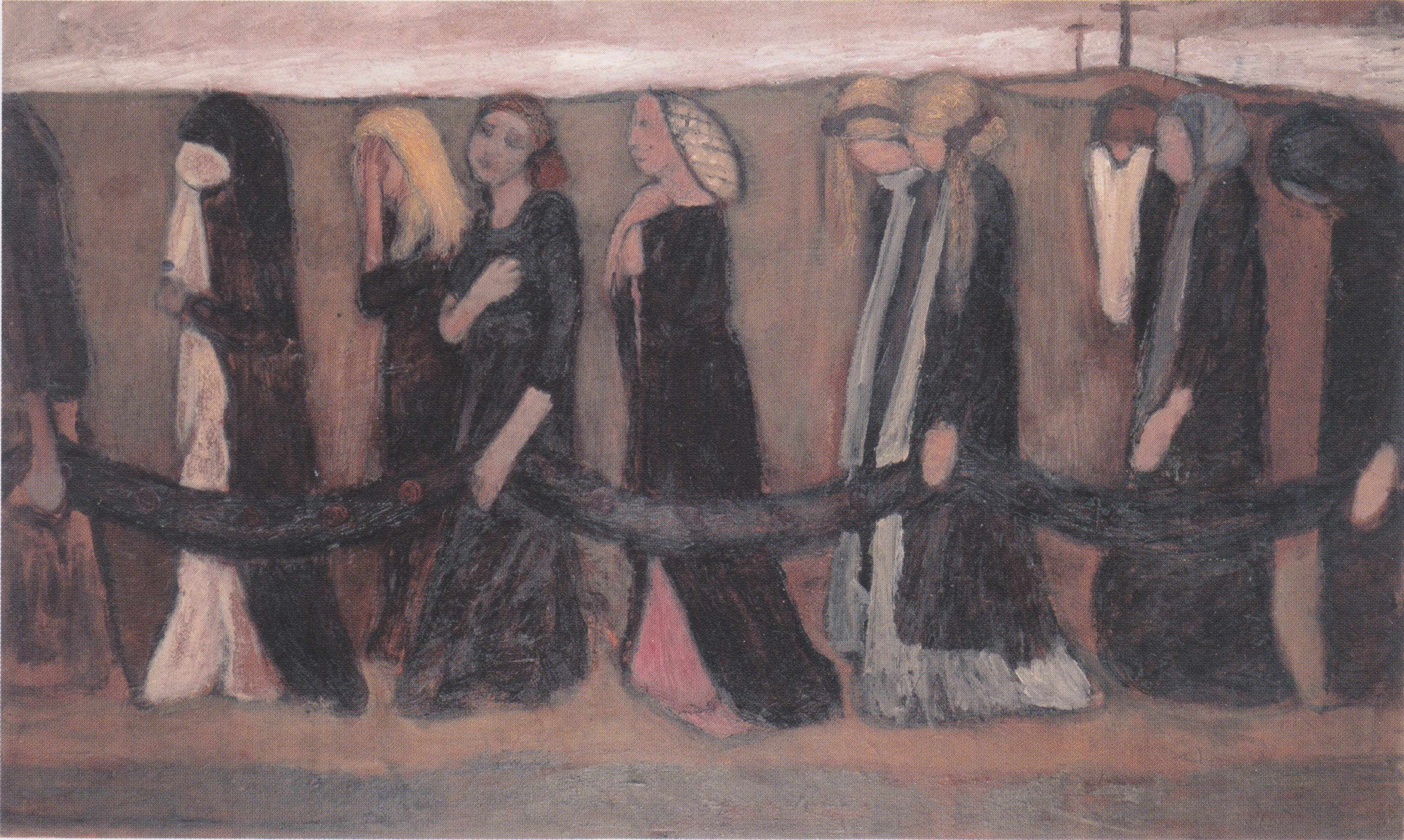
Paula Modersohn-Becker “Die Klagender Frauen” (1902) Public Domain
Women Are “Just More Emotional”
By Sarah Marcus
“Hey, the 1950s called, they want their stereotype back,” I said during a somewhat intense debate last night. I was asking a new friend, let’s call him Adam, what he thought of Garance Franke-Ruta’s recent article in The Atlantic called “Why Isn’t Better Education Giving Women More Power?”
If I’m being honest, I probably already knew his response; I just really wanted it to be different, because… I like him. The article is basically about how even though women are generally more successful in school, the same behaviors and tools that helped them to succeed in the academic arena don’t necessarily translate into the workforce. The article gives statistics on the disparity between genders and points out that studies show women in the workplace are criticized more, make less money, and are generally judged more negatively. But the most important piece of this essay, and the part that I am most interested in, deals with the root of the problem:
The university system aside, I suspect there is another, deeply ingrained set of behaviors that also undermine women: the habits they pick up—or don’t pick up—in the dating world. Men learn early that to woo women, they must risk rejection and be persistent. Straight women, for their part, learn from their earliest years that they must wait to be courted. The professional world does not reward the second approach. No one is going to ask someone out professionally if she just makes herself attractive enough. I suspect this is why people who put together discussion panels and solicit op‑eds always tell me the same thing: it’s harder to get women to say yes than men. Well, duh. To be female in our culture is to be trained from puberty in the art of rebuffing—rebuffing gazes, comments, touches, propositions, and proposals.
Bingo. This makes total sense to me. I am a woman. I have all too well mastered the art of rebuffing. It’s March: Women’s History Month. There are signs in stores that are supposed to be “celebrating” women. They read: 60% of our employees are women! But, it’s a party trick. “Hey, look over here!” Because when you look at upper management, it’s only 4% female. Now, Adam’s initial response to this article was to also look at the numbers. He’s very logical. He’s very smart. I like him. He would like to see the holistic ratio of employees in business. He’s had a 50/50 ratio of male to female bosses. Then, he gives me a word problem: If there are 100 employees in the office and 10 are women, and there are 10 spots to move up from that 100, then 1/9 women should be promoted and 9/90 men should be, too. His point being that no one thinks about the actual numbers, they only look straight to the top and see that there are 9 male bosses and 1 female boss. I acknowledge that he is speaking from a place of privilege, and in my mind, this isn’t the problem either.
The problem is much deeper; it’s much bigger. The problem is that there are only 10 women who are employees going after that promotion in the first place. The problem is that we (women) have been taught all of our lives to accept our position, to be submissive, and to self-objectify. These behaviors and states of being are so deeply ingrained that sometimes I’m not even aware that I’m participating in this dynamic. From a very early age, we lose belief in our own political and social efficacy. We learn to see ourselves and value ourselves how the media and the collective consciousness see us.
Still, the real problem is even more insidious and subtly woven into our social makeup. The REAL problem is that we still exist in a time and place that perpetuates an accepted culture of violence against women. At some point in our debate, Adam says that men and women ARE different, right? He brings up the obvious difference: our physical traits. This is the in. Yes, I think, herein lies the issue at the core of our patriarchal power dynamic. Our physical traits have been held against us and kept us repressed since the beginning of time. This is usually where I lose my male readers. They hear sexual assault/domestic violence and distance themselves, because they would never do that, so this part doesn’t apply to them. This is where we’re all wrong. Let me give you a scenario that most of the women in my life can relate to:
I am joking around with my boyfriend. Maybe there’s a mutual nudge or a thrown pillow (all in good fun—remember, we are being hilarious and having a great time). Then, he holds me down by the wrists (not maliciously, still joking around, maybe even in an effort to transition into something more intimate). But, I have a moment of panic. Being held down, in that split second, I am utterly terrified when I realize that I am completely helpless, physically. He is still laughing, and when I suddenly say, “let go,” and he (of course) does, he is caught completely off guard by my reaction. He asks, “What’s wrong?” and says, “I was just joking around.” AND he was just joking around… and he didn’t do anything wrong, but what I realize in that moment is that he will (hopefully) never feel that specific kind of complete helplessness. He doesn’t get it. He doesn’t know what that violation feels like. He doesn’t understand that even the threat, the possibility of violation, is intimidating. He doesn’t know how to empathize. We MUST have these conversations. If we don’t talk about it, if we don’t express the legitimate danger, then people (and men, specifically) simply don’t think about what’s actually at stake here. What feels like small, insignificant attitudes and actions are actually monumental in this way.
Circling back to my debate with Adam, he says, “Women take things more personally than men do.” I have a heart palpitation, and I want to call him out on it, but I make a joke instead. He says, “Women are more sensitive by nature.” I use that 1950s line, and then I urge him to read the fabulous piece on emotional gaslighting by Yashar Ali, “A Message to Women From a Man: You Are Not ‘Crazy’.”
This article essentially explains that “it’s a whole lot easier to emotionally manipulate someone who has been conditioned by our society to accept it. We continue to burden women because they don’t refuse our burdens as easily. It’s the ultimate cowardice.” Ali also argues that he doesn’t “think this idea that women are ‘crazy,’ is based in some sort of massive conspiracy,” but rather that this idea is instead “connected to the slow and steady drumbeat of women being undermined and dismissed, on a daily basis. And gaslighting is one of many reasons why we are dealing with this public construction of women as ‘crazy.’”
He goes on to talk about how men are conditioned to feel uncomfortable with emotional expression, because they are discouraged from emotional expression from an early age. Ali’s conclusion is in the form of a question. He asks: “Isn’t the issue of gaslighting ultimately about whether we are conditioned to believe that women’s opinions don’t hold as much weight as ours? That what women have to say, what they feel, isn’t quite as legitimate?” I think, yes.
Adam reads the article, but I am still met with more defensiveness, and I realize as we go back and forth that we are essentially having two completely different conversations. Adam initially interprets the article as an accusation. When he reads Ali’s plea to stop telling women that they are “crazy” or “too sensitive,” Adam thinks back to that one time with that one woman who said/did that super crazy thing and he “rightly” told her she was acting crazy. He feels like the message is: “Don’t do that. You’re wrong.” I see this interpretation/reaction all the time. My students, my friends, my family, most people do this. I realize then that Ali’s audience is “the choir.” He is essentially speaking to women who can already relate or men who already know not to do this, and this problem doesn’t exist in a vacuum.
As a teacher, a daughter, a friend, and a potential partner, the question for me has now become this: How can we enter into this conversation from a place of empathy? I have this hope that my attitude will inspire empathy in those who have a difficult time relating (coming from a place of privilege, or lack of exposure/experience) to the women who are being gaslighted. How do I talk to Adam?
Firstly, we need to recognize that men and women are taught to act and react differently. It is so important to take these kinds of articles and suggestions seriously, because I believe that this basic common respect, and our ability to value each other as equals, is the only way we will eradicate our culture of violence against women. This is how we stop victim blaming. This is how we end rape culture. This is how we become better humans, partners, family members, etc. We have to teach men not to violate women. We have to unlearn what we already know so well. This, as Adam points out to me, is essentially the Golden Rule: treat others the way you want to be treated. He asks, “What can I do that would be acceptable in the context of this article?” This is exactly what we all should be asking ourselves.
I think about Adam: He is a good human with a good heart… did I mention that I actually like him? So, what do I need to change about the way I am approaching this conversion? It dawns on me that we are all universally connected. We all have mothers, and sisters, and daughters, and friends. We all only have control over one thing in this world: our behavior. I try to shift our conversation towards this focus: “Don’t you want your partner/mother/sister/friend to feel valued? Shouldn’t we all (men and women) strive to put ourselves above emotional manipulation?” And the answer is obviously, yes. But Ali is also pointing out that we even enter this conversation on unequal footing.
“Little boys and little girls, when they’re 7 years old, in equal number want to be president of the United States when they grow up. But then you ask the same question when they’re 15, and you see this massive gap emerging.”
Undeniably, there is a hierarchical structure of power in our society, and women are not at the top.
Our conversation shifts back to us as individuals, and Adam starts to talk about what he can do about the “problem.” So, in the context of raising a family, and in the workplace, and in relationships, he says that he’s been taught, harshly, to take responsibility for his actions, period. That he should own up to his mistakes and not make excuses. He’s been taught (like so many of us) that everyone is the same, and that it’s important to surround yourself with people that make you better regardless of their sex, race, or sexual orientation. He then asks, if he is operating under that fundamental mentality, in the way that he should, then what should he do differently within the context of his everyday life? This is an awesome question; one that I think about constantly.
My response is something that I have to work on every single day of my life. It’s what I am working on in this moment: even when I believe that someone is being too sensitive or emotional, I try to listen with an open heart. Instead of poking holes in a belief or argument, I try to look for ways to be helpful and to empower people who feel as though they have lost efficacy. And then, Adam says something really powerful. He says that “in reality, if someone is being too sensitive, I listen to them, and I ‘empathize’ as you’d say. The only time that I say [the] things [in the article] is when I am at the end of my rope in a relationship and acting out. It’s my actions that cause it; I realize that. The good thing to do would be to cut it off or to not say those things at all.” While what Adam is saying seems so very simple, it is in practice, truly profound. It’s hard to act well, especially when our social instincts feel like they’re being threatened, and when we’re taught that vulnerability is “bad,” it’s no wonder we get so uncomfortable when people express themselves so directly.
All roads lead back to compassion. How do we teach and inspire compassion? I’m not saying that women shouldn’t be angry. I am furious. Everyone should be furious about violence against women. This is an issue that impacts all of us. Most of the men I know seem to be unaware, even, that 1 in 4 women in their lives have been sexually assaulted or an attempted assault has been made on them. Or maybe they (we) hear these numbers but can’t connect them to ourselves?
I imagine that our lack of information is primarily due to the fact that assault is difficult to talk about and difficult to hear about. We don’t really have safe spaces (especially in the public opinion arena) to talk about such things. We tend to retruamatize survivors. I want to know how we can express our anger in a way that doesn’t shut people down.
It is a travesty that there’s so much negativity connected with the Women’s Rights Movement. People are terrified to be a part of the feminist community, to call themselves FEMINISTS. I’m scared, too. I know, it’s hard to believe with my incessant facebook posting and boycotting and protesting that I feel scared, but I am human. I care about being judged just like everyone else. I wonder, because of the negative connotations surrounding the “F” word, whether I will “scare” off a potential partner or friends. I’m afraid it will scare Adam. What will my future employers think? These thoughts are persistent, though I have learned to move past that fear and do what I think is right regardless of how I feel.
Still, it’s important to continue thinking about and asking how feminism and the feminist community can become more inclusive. If a feminist is “anyone who recognizes the equality and full humanity of women and men,” then we should certainly all call ourselves feminists. If not, I think we have a whole lot of explaining to do to our wives, daughters, sisters, and friends.
A version of this article originally appeared in So to Speak. It has been reprinted here with permission from the author.