A Review of Catherine Pierce’s The Girls of Peculiar

Pierce Girls of Peculiar

A Review of Catherine Pierce’s The Girls of Peculiar

By Jennifer Dane Clements

Catherine Pierce’s second poetry collection, The Girls of Peculiar, resurrects the gangly and awkward ghosts of adolescence, in turns honoring and questioning those young spectres. Indeed, it is impossible to read The Girls of Peculiar and not consider one’s own unglamorous coming-of-age, from the sensation of “a globe welling up inside” to “that red ache that came from lying/to our mothers.”

For me, The Girls of Peculiar harkened back to the brick school buildings and blue carpeted halls where my own teenage years were spent. But Pierce’s words ring universal:

Last year you weighed more. This year you’re as tall
as you’ll get, and there’s a boy whose eyes are poisoned
marbles. You’ve photographed him again and again
but you can’t get the poison right. You’re sixteen.
You say this again and again but you can’t believe it.
(Fire Blight)

I went to a high school built by women, for women. There were the things we were told, that we were strong and intelligent and the leaders of tomorrow, and would not be stifled by gender inequity. We were taught by incredible women and introduced to women who defied the expectations of the world. We were bound to the women who had walked those carpeted halls before us, phantoms of girls past that we, like our predecessors, were destined to become.

We never cooled
with twilight. We were busy prowling
by the river; sending our lit eyes into tree hollows,
beneath parked cars.
(The Delinquent Girls)

And there were the things we knew that we didn’t have to say, that perhaps our parents and teachers didn’t wish to acknowledge. Some of us had eating disorders, or inflicted self-harm, or saw shrinks for diagnoses we didn’t have to secure medications we didn’t need. We identified as adults in ways that ranged from noble to naive. We had sex with older men. We pulled all-nighters on school grounds with the strange and forbidden blessing of our teachers. We hung out in rough parts of town, oblivious to how our uniforms marked us as young and entitled and unattainable in ways we couldn’t know. We wielded our small rations of power in a dozen micro-rebellions a day, then tucked in our shirttails and learned algebra.

We were all flavors of adolescent girl kept in one place, and nothing has quite captured that dynamic as accurately as The Girls of Peculiar.

But I’m so tired of the small steps–
the pentatonic scale, the frequent flyer
hoarding, the one exquisite sentence
in a forest of exquisite sentences.
There is a globe welling up inside of me.
Mountain ranges ridging my skin,
oceans filling my mouth. If I stay still
long enough, I could become my own world.
(Because I’ll Never Swim in Every Ocean)

Poems like “Dear Self I Might Have Been,” “Before the Reunion (Her Lament),” and “Postcards from her Alternate Lives,” look backward, from a vantage point informed by several decades. Resisting the nostalgic, they instead acknowledge the difficulties of youth, moving into the “long highway days of your twenties” and beyond. Each of these poems serves as a postscript to old yearbooks, answering the question of what we’ll become: One girl writes speeches for the First Lady. One girl married the bus driver. One works for the CIA. One remains a virgin at 30.

For some of us, the school-age moments feel lifetimes old; for some of us, as close as this morning’s latte. But The Girls of Peculiar has nothing to do with wanting to return to those days–its poems are elegies, truthful monuments to the myths, the expectations, and the anxieties we carried in youth.

This is every house on your block
lit from within, each bedroom window
shining with safety and you outside
in the icing dusk, knowing nothing
will ever warm you….
The Future? This is The Future
If you were here, you’d know that.
(The Girls We Were)

Twelve years past high school, I am tempted to wrap a copy of The Girls of Peculiar and send it to my school’s newly appointed headmaster, the first woman to oversee the school in decades. Pierce’s collection seems the briefest and most comprehensive reminder of how burgeoning adulthood feels to “the delinquent girls,” and “the quiet girls,” and “the drama girls,” and then all of them together–a manual of understanding and a call to empathy.

Let these strangenesses be like the impossible lizard’s
tail: gone forever, because how could it be otherwise,

and then reappearing, iridescent and blood-warmed,
because how could it be otherwise?
(For This You Have No Reason)

And what could be more vital to someone newly charged with overseeing all of those girls, and all of the peculiars in which they–for the moment–reside.


Catherine Pierce, The Girls of Peculiar. Saturnalia Books, 2012: $14.00.

***

Jennifer Dane Clements received her MFA in creative writing from George Mason University, where she served as Editor-in-Chief of So to Speak: A Feminist Journal of Language & Art. A writer of prose and plays, she has been published in WordRiot, Nerve, and Psychopomp and has had plays produced by Capital Repertory Theatre (Albany, NY), Creative Cauldron (Falls Church, VA), and elsewhere. Clements currently works at a theatre-service organization and serves as a prose editor for ink&coda. More at jennifer-dane-clements.com.

SATURDAY POETRY SERIES PRESENTS: ONLY RIDE

OnlyRide-Front

from ONLY RIDE
By Megan Volpert:


Screen Shot 2014-04-04 at 3.16.20 PM

Screen Shot 2014-04-04 at 3.18.58 PM


Screen Shot 2014-04-04 at 3.20.28 PM

Screen Shot 2014-04-04 at 3.29.11 PM


Picture 1

Picture 3


Today’s poems are from Only Ride, published by Sibling Rivalry Press, copyright © 2014 by Megan Volpert. “You are suspended” was first published in This assignment is so gay, edited by Megan Volpert and published by Sibling Rivalry Press. These poems appear here today with permission from the poet.


Only Ride: If Denis Johnson had written Tuesdays with Morrie, it’d feel like Megan Volpert’s book of prose poems. Clawing its way out through this minimalist checklist of suburban malaise is an emphatically optimistic approach to growing up. These tiny essays carefully detail how to avoid becoming one’s parents, how to manage a body addled by disease, and how to keep having the best possible time in life. After all: this is the only ride there is, and we can only ride it. Volpert’s is a story of Springsteenian proportions, a gentleman’s guide to rebellion complete with iron horses and the church of rock & roll.

Megan Volpert is the author of five books on communication and popular culture, most notably about Andy Warhol. She has been teaching high school English in Atlanta for the better part of a decade, and is currently serving as her school’s Teacher of the Year. She edited the American Library Association-honored anthology This assignment is so gay: LGBTIQ Poets on the Art of Teaching, which is currently a Lambda Literary Award finalist. Predictably, www.meganvolpert.com is her website.

Editor’s Note: Megan Volpert’s Only Ride is a no-holds-barred journey through personal history, with sage wisdom bursting from its rough-and-tumble seams. The book is less Zen and the Art of Motorcycle Maintenance and more Get a Grip and Ride Like it’s Your Only Ride. This is a book about how to live life. Suck it up and move past the childhood issues that scarred you. Don’t just cope with illness, thrive in the face of it. Live life full throttle no matter what it throws at you, because life is short and living demands fierce courage.

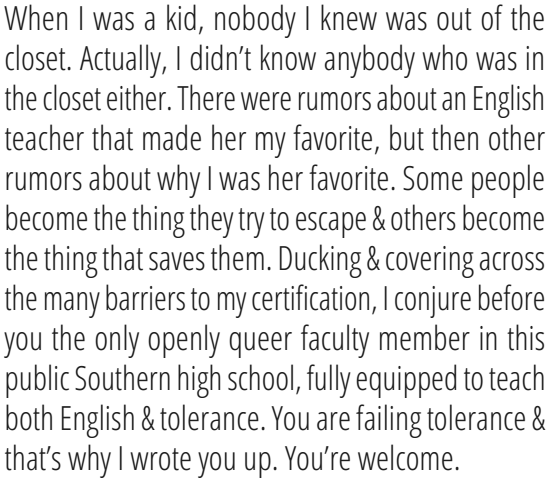
Throughout her journey Volpert takes personal and political stands, inspiring her readers to do the same. Sometimes you’ve just gotta smash things, because “a deep frustration that hurls pottery against the concrete floor… is not the thing to bottle up in shame.” Sometimes a teacher has a responsibility to teach more than just standard curriculum. As “the only openly queer faculty member in [a] public Southern high school,” Volpert is “fully equipped to teach both English & tolerance,” and she’ll write a student up for failing the latter.

Brimming with humor and hubris and wicked wit, the greatest gift of this book is the life lessons it relays. Stand up for what you believe in. Move past life’s bullshit and face adversity with a battle cry. Let go of the small stuff. “Many things annoy me,” Volpert confides, “but I seldom get really angry because now I just feel so lucky to be alive.” And we all should, the implication echoes. In a world where “[d]eath knocks twice: once for introductions & once to take you away,” why waste your precious life letting things get your goat? Having faced death, the poet gave her goat away; she has no goat to give. And we would all be well served to follow her example. “After all: this is the only ride there is, and we can only ride it.”

Want to see more from Megan Volpert?
Official Website
This assignment is so gay
Sibling Rivalry Press
FRONTIER PSYCHIATRIST

A Review of Bushra Rehman’s Corona

bushra rehman corona

A Review of Bushra Rehman’s Corona

By J. Andrew Goodman

Bushra Rehman’s Corona is a witty and moving story of liminal spaces and the narrator Razia’s abuttal with the thresholds of sex, ethnicity, and place. The novel follows Razia from her childhood in New York City and through her dangerous initiation to adult independence. She was expelled from her home after refusing an arranged marriage by her orthodox Muslim parents, and her long search for a new home frequently begs the question: What am I willing to compromise for freedom? After reading Rehman’s quick and elegant prose, the wide world seems intimate, awaiting the will of one displaced woman.

The title, Corona, refers to a poor neighborhood in Queens, New York, whose hegemony shifts generationally between different ethnicities—Italian, Puerto Rican, Korean, and Pakistani. Razia, her family, and nearest neighbors are Pakistani. They are unified by their faith and the generosity of Razia’s father. He is the owner and butcher at Corona Halal Meats. Their Muslim community holds two books in high esteem: the Quran and the tab her father keeps of goods he’s given away.

In one scene, Razia brings tea to her father and his friends, as she does every day at lunch. She notices her father always eats the least, takes his tea last, and cleans up after everyone, including the thoughtless imam. Razia is endeared by the small sacrifices her father makes for the sake of courtesy and the authority of faith. When he weeps during prayer, Razia feels closer to her father than before:

The azan came through over the loudspeakers. Men and women everywhere came out on the street. Everyone in the neighborhood tilted their heads and listened. Out of basement apartments and six-floor walkups, Muslim men started walking toward the sound, pulling their topis out of the backseats of their pockets.

The sun went down, and the clouds bent low over the buildings. I stood in front of the masjid and held my father’s hand. The light was turning pink and darkening, and I saw my father was weeping as a sleepy, blue light settled on everything.

Rehman softens the image of Razia’s father and displays the neighborhood’s solidarity, writing such moments with a deep reverence and tenderness that intensify our ambivalence toward Razia’s home.

Outside of Queens, as a young adult, Razia is defined by her romantic relationships. She substitutes the comforts of home with men, women, or drugs. She isn’t fortunate in the affections of men. Through a series of boyfriends, she travels the breadth of the United States—New York City to San Francisco and back to the Atlantic coast. Her first relationship after refusing the arranged marriage begins well enough; Razia and Eric escape the tumults of their respective homes, but their relationship deteriorates as they fail to hold jobs and as Eric becomes volatile and belligerent. Razia realizes the world she inherited is not fatalistic; she decides hunger and escape are more agreeable than abuse.

Razia is thirty or near thirty before she meets Ravi, a man she believes she can love despite his inability to always please her sexually. He is “on loan” from India, a decade-long student with a visa. He is heavy, hairy, and can answer questions with encyclopedic diction; he and Razia also share the same political views and maintain a moderate respect for their parents’ religion. During a sleepover at a mutual friend’s, Razia says Ravi looks good, even in traditional Muslim sleepwear. Ravi reminds Razia of her father and uncles, she confesses. Her childhood home is always on her mind, and Rehman’s writing makes the ugly, tan brick under the railroad tracks tangible upon utterance.

Finally, their relationship plateaus. Ravi explains he wants to see other women before he leaves the United States, but Razia wants them to be exclusive. She has, at last, found something she has been looking for. The moment has potential for derivative melodrama, but Rehman delivers the two lovers from each other with cool, comedic, and empathic dialogue. At every turn, there is an appraisal and a concession. Razia has to run shorter and shorter distances.

Razia eventually returns to New York, but not to the mythologized neighborhood she loves. She learns there are degrees of separation, and decides for herself how close she must be to her family and where she grew up. She will not agree to an arranged marriage, but to a truce, to the small comforts of conditional love. Razia’s home is as constant as the North Star. On clouded nights, when the oldest navigational tool is rendered useless, will we circle around it, lost, or stoop to build our fire.

Bushra Rehman, Corona. Sibling Rivalry Press, 2013: $14.95

***

J. Andrew Goodman is a recent MFA graduate from Murray State University and an intern for the independent literary publisher, White Pine Press. He currently lives and works in Louisville, Kentucky.

SATURDAY POETRY SERIES PRESENTS: LAURA YES YES

1970703_10152671596109251_151820833_n
By Laura Yes Yes:

SALEM 1994
(With touring partner Kim Johnson)

Courtesy of Jason Flynn’s youtube channel.


COLLEGE TRANSCRIPT

Courtesy of West Side School for the Desperate’s youtube channel.


Laura Swearingen-Steadwell (AKA Laura Yes Yes) has competed in slams nationwide, notably as a finalist in 2010’s Women of the World Poetry Slam. She tours and leads workshops as part of the queer female duo Shadowboxers Anonymous. Laura’s first book, How to Seduce a White Boy in Ten Easy Steps, was nominated for a National Book Award. She is currently an MFA candidate at Warren Wilson College.

Editor’s Note: I had the pleasure of seeing Laura Swearingen-Steadwell perform at louderARTS this week. louderARTS is home to a longstanding open mic, reading series, slam forum, and workshop series. Monday nights in Manhattan’s Bar 13 have been turning out the likes of Roger Bonair-Agard, Ocean Vuong, Elana Bell, Sabrina Hayeem-Ladani, John Paul Davis, Regie Cabico, and countless other rising stars and champions of the written and spoken word for years. The tradition continues every week. Show up at 6:00, like I did, and be treated to a FREE writing workshop with louderARTS members and visiting workshop leaders. I was lucky enough to kick off my evening with a workshop lead by today’s featured poet.

When Laura Swearingen-Steadwell opened up “Salem 1994” by inviting us all to join in a Kumbaya-esque rendition of Alanis Morissette’s “You Oughta Know,” I was all in. When the performance morphed into a feminist celebration of the songstresses who have been writing and performing the soundtrack of my life since I was fourteen years old, the poet officially had a new fan. When she performed “College Transcript” we were all invited to call out “brain,” “cunt,” “liver,” “fist” to accompany each of the poet’s hand gestures. It was fun. It was interactive. It was engaging. And it was truth, spoken from the poet’s own honest experience to resonate with our own. This is a poet who speaks her mind, who speaks her heart, who tells it like it is, unafraid, claiming the world for herself and for us all.

Want to see more by Laura Yes Yes?
“Habitat”
“Octopussy: The Playboy Interview”

“Thinking of Chickens” By Paul Crenshaw


Thinking of Chickens

By

Paul Crenshaw


Travel for long in the state of Arkansas and you’re likely to find a chicken. Not that chickens run rampant, crossing the proverbial road at will, but the countryside of Arkansas, The Natural State, is littered with the makings of the chicken industry, which are, as you may be aware, unnatural. Shimmering in the Arkansas heat, long rows of chicken houses line state highways and county roads and dirt tracks where the plumes of dust from passing trucks linger in the air. In remote backwater spots gut factories slaughter tens of thousands of chickens a day, where local streams are usually, though not always, the color of old puke. In the cities packing plants light up entire blocks, generators whirring into the night, and semi trucks, bound for all corners of this great land of ours, provide a regular convoy to and from said plant.

In Arkansas, there is Wal-mart and Tyson. Wal-mart, I think, needs no introduction. Tyson is chicken. And though Wal-mart might be the more ubiquitous by sight, Tyson holds top honors in the olfactory genre. Often, farmers lace their fields with chicken manure. Combined with the dry Arkansas dust that settles on the fields, it is not a pretty sight. Or smell. Gut trucks weave along narrow county roads, leaving a swath of olfactory offense in their wake. And, without going into a chemistry lesson on the decomposition of shit, suffice it to say that during the breaking down process of chicken manure, ammonia is produced, which, combined with the yellow fertilized fields and the loud rumblings of passing trucks, offends at least three of the five senses.

A chicken house can be a hundred yards long and house 25,000 chickens. This is not a small chicken coop, where a dozen or so chickens produce eggs, scratch around the yard, and wake the neighbors at 5 am. These CAFOs (concentrated animal-feeding operations) litter the countryside of the South. Tyson, the largest poultry producer in the world, supplies local growers—who work under contract—with chicks, feed, medicine, and transportation. Growers, then, are responsible for construction, maintenance, and labor costs, as well as disposing of massive amounts of manure.

They are paid by results. And though the data is often conflicting, with industries like Tyson claiming growers are paid well, and environmental groups like Grist! claiming low wages, one rarely sees, at least in my home state, chicken houses butted up against mansions, the wavering light from the backyard swimming pool reflecting off the rusted tin roofs of the chicken houses, or see people sitting on their back deck drinking champagne and conversing over the constant clucking a few feet away. Instead, the industry seeks out rural areas, where poorer farmers are often trying to find ways to hang on to their farms, where the neighbors won’t complain, mainly because they are in the same situation, and there is no unifying body that will group together to keep them—Tyson, Cargill, and other poultry producers—out.

#

They are called chicken houses, but they are not chicken homes. The houses are relatively clean before the chicks arrive, and seemingly spacious, but once the chickens near the end of their incarceration, they have produced massive amounts of waste and taken up all the space of the chicken house simply by growing. The industry average is less than half a square foot of floor space per bird, and though that is only slightly smaller than the size of the average college dorm room, college students are allowed out of their rooms to attend class and drink and karaoke and have pre-marital relationships with others of their kind, which, of course, chickens are not allowed to do.

They require tons of work. The water troughs—hundreds of them in each house—must be cleaned with bacterial soap. The automated feeders must be checked and re-checked, the windows adjusted for heat, and the dead chickens gathered for disposal. It is hard work in the summer, the hot air thick with chaff and flies, and the smell so strong in your throat you can taste it. Add to that rodents, maggots, flies, fertilizer, gut-trucks, polluted water, summer heat, and the dead pits. Ten to fifteen feet deep, ten to fifteen feet wide, the dead pits are covered by a concrete slab, not unlike a storm cellar. Each day, as the house fans circle slowly overhead and workers move through the hot air feeding and watering and cleaning, they throw the dead into the dead pits, where, throughout the summer, as the flies get in and lay their eggs and then the maggots appear, they squirm and writhe, seething, and the smell seeps out of the ground and into the air.

The numbers of dead, of course, are less in winter, or else the cold keeps the maggots out and it only seems there are less of them. In summer, the various factors that cause deaths are too numerous to go in to, and though we are only talking about chickens here, many health-related organizations, including the Centers for Disease Control and Prevention, have raised the possibility that we don’t really know the long-term effects manure and other types of pollutants will have on our general health, ecosystems, and air quality. They do, however, post a list on their website of public health concerns, which include antibiotics, pathogens, nutrients, pesticides and hormones, solids such as feathers and feed, and trace elements of copper and arsenic which may or may not get into our groundwater.

#

Besides the human element, there is the ethical argument about animal treatment, welfare, and general happiness (of the chickens). The rabid-protector of animals group, PETA, has, among other things, requested that Kentucky Fried Chicken (KFC) implement basic improvements in animal welfare, and boycotted the food-maker, stemming from allegations that KFC “does chickens wrong.” PETA has also boycotted Burger King, Wendy’s, and McDonald’s. Some of the improvements PETA asked be implemented include:

“That the company conduct announced and unannounced audits of all its cow, pig, and chicken slaughterhouses, and stop purchasing from suppliers that fail these audits; increase the living space for hens being raised for their eggs; stop starving chickens in order to force them to produce more eggs; and implement humane catching standards for chickens.”

Among PETA’s claims are that the chickens are overcrowded; that they are fed stimulants and hormones that cause them to grow so quickly that bones break and organs no longer function correctly; that they are subsequently grasped by these broken appendages and stuffed into small crates to be transported to the slaughterhouse where they will often be scalded while fully conscious.

McDonald’s, Wendy’s, and Burger King agreed to PETA’s requests. KFC states it has a “comprehensive animal welfare program,” but has refused to implement the improvements PETA has requested, which roused PETA to post a long list of grievances on their website, as well as videos, literature, “Boycott KFC” shirts, and vegetarian starter kits.

Are chickens smart enough to realize they are not being treated fairly? Is ignorance bliss? Are chickens ignorant? Or simply unhappy, like most of the rest of us? Do the mass of chickens lead lives of quiet desperation? Did the chicken cross the road to get away from the unhappy conditions of the chicken house, only to find that there was another one waiting for him on that side of the road as well?

An article posted on govegan.com states that chickens are “inquisitive and interesting animals whose cognitive abilities are more advanced than those of cats, dogs, and even some primates.” That they are social creatures, they can recognize up to a hundred other chickens, and they have their own personalities. They can “comprehend cause and effect and understand that objects exist even after they are hidden from view” which “puts their cognitive abilities above those of small human children,” and while that is high praise for the lowly chicken, we’re still talking about an animal that will defecate in its own water and food, as well as an animal that will, when bored and not de-beaked, peck at another chicken until it is festooned with gaping wounds, which leads one to believe that the appreciation of the finer things in life might be lacking in them.

#

Consider the common chicken. Gallus gallus domesticus, which, for purposes of our essay, shall be known as a broiler chicken. Pre-1930s, which means pre-John Tyson and pre-vertical integration, a micromanagement term for ownership and control, whereby companies are united by a hierarchy and share a common owner (John Tyson), chickens were valued for their eggs, and only slaughtered on special occasions (which could, I suppose, be considered an honor. Of sorts). They lived a life of leisure, pecking around the yard, finding worms and bugs, laying eggs, et cetera and et cetera and et cetera, until the day came when grandma stepped out back carrying a hatchet and they fled for their lives, which may be the reason so many of them decided to cross the road.

With the advent of hatcheries, chicken houses, and slaughterhouses, the life of the chicken changed dramatically. A fertile chicken egg takes 21 days to hatch. Chicks hatch from the egg able to see and walk and feed themselves (they are also cuddly and cute, and that, combined with the fact that they have very little meat, is probably why we don’t eat them then). To prevent diseases that might kill off the chicks and therefore profit, the chicks are vaccinated before they leave the hatchery. From the hatchery, they are loaded onto transport trucks that will take them to their new home, where they are unceremoniously unloaded into a long, not very wide house with 25,000 or so other chicks. I suspect identity might become an issue at this point, if chickens had an intelligence quotient higher than one. But, here, they gambol and cavort (actually they do much more eating and defecating and occasionally pecking at each other) for anywhere from four to twelve weeks, depending on whether they are to be marketed as spring chickens, broilers, or larger roasting birds.

The houses are floored with sawdust, shredded newspaper, or straw, which becomes increasingly slippery and fouled (no pun intended) as the chickens eat, defecate, grow larger, and then defecate more. Feeding, watering, lighting, temperature, and ventilation are carefully controlled, reasons being that A) growers want maximum growth of the chickens, and B) so they don’t kill each other (more light makes a chicken more aggressive). Farmers can grow five or six batches of chickens a year, with a period of two to three weeks between batches for cleaning and fumigating. The litter, sawdust, etc., must be dumped, since most of it is now soiled with feces and urine.

Trucks arrive a few hours before dawn, when the chickens are asleep. They are snatched up and thrown into the trucks, where, unbeknownst to them, the slaughterhouse awaits. Here’s where things get messy. It is also the point where one might ponder the industrious ways we have of killing, the factory line regularity of it all. I suppose one could make a metaphor for war here, or firing squads or gas chambers, but the next few pages are gruesome enough without all of that.

The chickens are hung upside down by their feet on a continuously moving line and an inspector gives them an ante-mortem inspection, which causes me to wonder the sorts of things that would cause said inspector to reject a bird. One supposes signs of disease and the like, but remember that we are talking about a bird that has been housed with 25,000 others of its kind, all shitting on each other and sleeping in piles of shit and drinking from water that others have shat in.

The chickens, upside down and having passed inspection, enter the slaughterhouse through a narrow opening and are immediately stunned, usually by an electrical current running through down-hanging wires or by an electrified water bath. Their jugulars are sliced open. They then pass through a bleeding tunnel, where an estimated 50% of the blood is removed.

Still upside down, they are scalded next, the hot water softening the skin for the defeathering process. They pass through large drums where rubber discs or handles beat at them until they are depilated of all unsightly back hair. Once defeathered, their feet are cut off, and they pass from the “dirty” section of the slaughterhouse to the “clean” section, which is almost, but not quite, like going from junior high to high school, only in reverse.

Here they are vented and drawn, which sounds nice, but venting is opening their guts with a pair of stiff shears and drawing means to draw out all the guts. The edible offal—heart, liver, gizzards—are removed for further cleaning. The head is pulled off. The neck is cut off. The birds are then washed, chilled, drained, and frozen.

So, to review: hung upside down, shocked and stunned, throat cut, scalded, defeathered, vented, drawn, decapitated, washed, and prepared to be shipped to all parts of the country where someone like you or me is browsing through the meats section at our friendly neighborhood supermarket, wondering what to feed our children for dinner.

#

But knowing what we know now of diet, the popularity of the chicken continues to rise. High in protein, low in fat, with much less cholesterol and other bad things than, say, red meat or pig fat fried in lard, the chicken is good for us. And it’s tasty.

Most people never see the dead pit chicken, or the non-point source pollution-causing chicken, or the chicken that has been de-beaked because chickens in close quarters will eventually turn on each other, like most other animal species, and with their beaks fully intact, they will, literally, peck each other’s eyes out, all of which revolves around some sort of chicken caste system, which gives rise to the phrase “pecking order.”

But the fried chicken is divine. Dipped twice in egg-wash and flour, then fried at precisely 350 degrees for twelve minutes a side, lightly salted and peppered, the fried chicken is revered. Franchises like KFC, Popeye’s, and Bojangle’s litter fast-food highways, much the same way chicken houses litter state and county roads in the rural South, though the smell from one is not quite as bad as the other.

There’s also baked chicken and grilled chicken and broiled chicken and rotisseried chicken, chicken and mushrooms and chicken and rice and chicken and dumplings and chicken and almost anything. In Chinese restaurants there’s sesame chicken and walnut chicken and cashew almond chicken and sweet and sour chicken and General Tsao’s chicken and chicken egg rolls and, depending on where said restaurant is, chicken nuggets, much like McDonald’s chicken nuggets, which brings us to the chicken strip or chicken nugget or chicken chunk or whatever name the fast-food industry can come up with for a de-boned and deep-fried piece of chicken.

This is not to mention Italian or French or Mexican or Indian or any other type and/or style of food that I do not know enough about to converse intelligently upon. Nor is it to mention the use of chicken as a breakfast meat, a deli meat, a flavor for snack crackers, or an appetizer such as wings or bite-size buffalo chunks.

But it does take a stubborn nose and selective memory to put aside such concerns as waste, pollution, dried chicken guts in eyebrows, and, for lack of a better word, stink. But if there’s one thing I know about America as a country, is that we will not let small things like non-point source pollution or maggots get in the way of something we really enjoy. And, since it’s entirely possible to avoid rural areas if you don’t live in one, it is now, despite the large and growing numbers of chicken farms, quite easy to go through a day, or several days at a time, without seeing any of this, thereby erasing and/or forgetting and/or never realizing or confronting said concerns, but rather, enjoying the chicken in what for most of us is its natural state, which is to say, cooked.

#

All this occurred to me, suddenly, not too long ago, as I reflected on a rather unsettling two weeks of my life, in which I found myself called to military service to defend the chicken.

In the winter of ’93 my National Guard unit was activated. I received a phone call with a code named operation order, and after an hour or two of turning over various military excursions in my head and wondering what foreign country I would be sent to, I drove to our armory to learn about the more serious nature of the activation: three inches of ice had fallen on Northwest Arkansas, and hundreds of chicken and turkey farms were without electricity. Our job was to save them, launching Operation Save the Chickens, which would, in the next two weeks, save the Arkansas poultry industry millions of dollars. In groups of two, ice still falling all around, coating everything with a thin, and then thickening, layer, we loaded diesel generators into the backs of Hum-vees and were directed to the first of what would become many chicken houses. There, we hooked up the generator to the houses and sat shivering as warmth slowly returned, and, once done, we moved on to the next, and the next, often sleeping on cots inside the houses, where, in many of them, the smell was so overpowering we donned our gas-masks to be able to breathe.

The farmers became a litany of older men, usually short and balding and slightly overweight, with thick red hands and chapped faces filled with worry, watching with a fretful eye the temperature in his houses slowly climb, and there is for me now more than one set of conflicting emotions, such as why the governor spent state money to save a private industry, and why did I not bring a toothbrush, and why, instead of teaming up with Jonathan Britton didn’t I team up instead with Nikki Irby, one of the only females in my unit, who just happened be the same age as me and did not look too bad in camouflage.

It would be the first and only time my unit was activated for military service. We’d been left out of Desert Storm. Had missed Vietnam long ago, before my time. I’d be gone when Operation Iraqi Freedom began. But there were a few nights—tired, possibly hung over if we’d been able to slip in a bottle and the chicken farmer left us alone long enough to drink it—when we felt like old campaigners, like the guys in All Quiet on the Western Front who steal the chickens or ducks or whatever it is and have that moment there towards the end.

But this is all cloudy and vague, a few fleeting impressions. The smell of the chicken houses is still thick in my throat however, the eye-watering rising of ammonia, the dust and chaff that hangs in the air. I remember making four or five hundred dollars. Kicking chickens when they would not get out my way. Never, at any point during the entire operation, wondering if the chickens were happy, or that chickens could be happy, or that chickens even knew what happy meant, or what this was all about, or are slaughterhouses inhumane, or is eating meat of any kind inhumane, or realizing, through a process of looking ahead, that one of them (the chickens) might someday end up on my table, twice-dipped in flour and fried to a crisp golden brown.

#

I didn’t set out to write about the slaughtering of chickens, but rather to simply describe the chicken houses in my home state and the noxious effect they have on the surrounding countryside and what could possibly be done about it, but it seems there are deeper concerns than whether or not you might be forced to follow a loaded gut truck on your way to the lake on a hot summer afternoon.

I wonder if our concern for the chicken stems from the realization that we are not so different. The mass of us crowd ourselves into cubicles and office spaces under artificial light, squawking and scrabbling for food, pecking at each other, dumping our waste wherever and whenever we see fit, dreaming of crossing the road, just to see what’s on the other side.

The animal lover will argue here that we are indeed very different from the chicken. We have choices, and it is our choices that force such conditions on the animals. As well as it is our choices, over long periods of time, that have allowed the world to become this way. And we are not eaten. Ever. There is always that.

The environmentalist will argue as well. That the chicken has no choice but to defecate in its own food, but I posit the idea that we do the very same. That in our attempt to satiate our own desires, we allow industry to run roughshod over lesser creatures like chickens and turkeys and all sorts of flying and non-flying fowl; over poor farmers and their neighbors; over ecosystems and rivers and lakes and the Arctic National Wildlife Reserve; over Iraq and any other country in which we have a vested interest; and we do nothing to stop any of it and we are, in effect, shitting all over the world in which we live. That because of our insatiable need for food, oil, money, SUVs, new houses, college educations for our children, swimming pools, Viagra, Vicodin, vodka, a better life, the other side of the road—that in our pursuit for what we often consider the finer things in life we run around like chickens with our heads cut off, listening to chickenhawks who promise a chicken in every pot and acting like birdbrains when we believe them.

I don’t attempt to offer answers here. That would be a matter for a far more philosophical discussion that others have already made and there is no need for me to re-hash. In a perfect world animals would gambol and cavort until old age and then we would ceremoniously and euthanistically slaughter them and revere their souls as we partook of their sustenance, and sustainable farming would protect the environment while we went on about our daily lives blissful and unoffended by waste, treatment, odor, etc.

But we have neither the time nor the luxury nor the appetite for such now. Like the chicken house a few days before gathering time, we have crowded the world in which we live and are forced to deal with it. And though there’s a long way between what we need and what we want, if there is an answer, it’s that we should attempt to bridge the gap, or at least narrow it somewhat. The entire point, it seems, behind the old humorific about the chicken crossing the road is that no one, including the chicken, has any idea what lies on the other side, although I prefer to think of a world without maggots in my groundwater.

***

Paul Crenshaw’s stories and essays have appeared or are forthcoming in Best American Essays 2005 and 2011, anthologies by W.W. Norton and Houghton Mifflin, and the literary journals Ecotone, Glimmer Train, North American Review, and Southern Humanities Review, among others. He teaches writing and literature at Elon University. “Thinking of Chickens” originally appeared in the Southwest Review and is reprinted here by permission of the author.


Image Credit: “Chicken” Schreiber and Sons (1872) Digital image courtesy of the Getty’s Open Content Program.
SENTIENCE MATTERS: ANIMAL RIGHTS & LITERATURE


Writing Literature to Benefit Nonhumans

by

Gabriel Gudding


This is the first post in a monthly column about animal rights and critical animal studies.

Because I’m a poet and essayist some of my posts will move beyond the strict scope of animal rights philosophy and will concern literature specifically as it relates to nonhumans, veganism, and zoopoetics.

Zoopoetics is a new movement in literary theory and practice that treats nonhumans as individuals with agency, as conscious world-having individuals worthy of moral consideration.[1] Think Kafka, Coetzee, D. H. Lawrence. Think Oni Buchanan and Aracelis Girmay, Les Murray and John Kinsella, Gretchen Primack and Ashley Capps, among countless other innovative writers and editors actively helping to reconceive our relationships with nonhumans.

Zoopoetics is markedly different from ecocriticism, ecopoetics, ecopoetry, and ecological literature in general. Such movements are not concerned with nonhumans as individuals; rather, they are concerned with animals as populations. When they do concern themselves with nonhumans, the essays and anthologies in these genres typically express disquiet about threatened favored populations of animals in the wild — wolves, eagles, bison, monarch butterflies — and rarely if ever mention the plight of farmed animals or question the practice of enslaving, killing and eating the bodies and secretions of nonhumans. The animal in these works is aestheticized and collective. Terry Tempest Williams, for instance, might protest the killing of prairie dogs and owls in the Utah desert, as a part of the general “subjugation of women and nature” in her book Refuge, but think nothing of lauding the hunting of rabbits by her family only a few pages later as a practice integral to her family’s sacred (her word) relationship with nature. Dozens of poets in a collection of essays on ecopoetics will rail against damage to the environment and the loss of connection to the animal world and nature caused by human hubris but never once mention a slaughterhouse, the practice of meat eating, or the fact that animal farming is not only predicated on human supremacism but is also the single greatest driver of climate change and the chief ecological threat to rivers and aquifers worldwide. Forewords, prefaces, and introductions to recent anthologies of ecopoetry and the postmodern pastoral won’t mention the slaughterhouse at all, though the bodies of dead nonhumans are universally eaten and worn, and CAFOs are scattered across countrysides everywhere.[2]

The idea that literature should be written to benefit nonhumans is new. We see no hint of this in western letters prior to now. Book X of The Republic maintains that the only permissible literature is that which praises gods and famous men. Aristotle remarks in Book IV of The Poetics that literature’s purview is the imitation of the actions of men and gods. Sidney’s Defence holds that literature’s purpose is to improve the character of a gentleman. Shelley, Lessing, Schiller all declared that the intent of literature should be to improve humanity. In fact it’s been a broadscale and sustained note since the advent of humanism: the project of literature is humanity’s improvement. Full stop.

Writing literature for the improvement and benefit of nonhumans isn’t some boutique issue, especially when we consider how animal farming is altering our climate and damaging our health and environment. Even for those who cannot intrinsically value nonhumans as ends in themselves, they should recognize that our fate is bound up firmly with their well-being.

A human future that does not acknowledge the injustices done to nonhumans cannot be rosy. Thankfully, a growing body of thinkers, literary and non-literary alike, is increasingly in agreement with political theorist John Sanbonmatsu who writes,

“A Left or socialist politics which does not place our enslavement of other beings at its center, conceptually and politically, cannot possibly succeed: ‘speciesism’ is not merely one more ‘ism,’ but in fact lies at the root of every form of social domination.”

Indeed, Giorgio Agamben goes so far as to insist that the ways we conceive of nonhumans has for centuries been at the heart of all political oppression.

As with the rest of mainstream culture, there is in this eco-centric literature a general disavowal of the suffering of nonhumans despite the seventy billion who are killed each year (trillions if we consider the annual slaughter of sea creatures) for meat, jackets, fur collars, handbags, watchbands, hats, shoes – all commodities unnecessary for, and in fact detrimental to, our health and mental well-being. The rare animal who rises to the status of an individual by such authors is generally a domestic pet or a rescued farm animal.

Rather than coldly expressing concern over animals as populations, we should, in the words of philosopher David Sztybel be “’hot’ for the individual animal.”[3] This new literature does this. And none too soon. Now that we are living through the sixth mass extinction since multicellular life rose on the earth a billion years ago, an extinction caused in great part by animal farming, an extinction, what’s more, that is nearly invisible to us, it’s time we begin to think of literature as a force that can benefit nonhumans too. A zoopoetic literature, which is sometimes straightforwardly veganic, is being written for the benefit of all sentient beings, not just as populations but as individuals, as individuals with bodily and mental sovereignty.

Such a literature will correct our received notions about what it means to share a lived sense of mutual vulnerability with nonhumans, to be one among many, not first among a few, of sovereign and suffering beings, each of whom, like us, is surrounded by the causes of death. Such a literature will also help us understand that humans need no longer be one of those causes.

(photo by Elige Veganismo of cow in restraining device for slaughter)


[1] The term zoopoetics was introduced by Jacques Derrida in his 1997 The Animal that Therefore I Am, but it has recently been more carefully inflected by Aaron Moe in his book Zoopoetics: Animals and the Making of Poetry (Lexington 2013) as a counter to, and a clarification of, ecocriticism and ecopoetics.

[2] This broadscale disavowal of animal farming and slaughter by a discipline that one would think would try to look this issue squarely in the face isn’t a problem intrinsic only to ecology-centric literature; it can also be seen even in the field of new materialist thought about biopower. See my essay, “Ecopoetry, Speculative Ontology, and the Disavowal of the Slaughterhouse: Some Notes on Ethics and Biopower” in Matter.

[3] Personal correspondence.

SATURDAY POETRY SERIES PRESENTS: LIZZIE LAWSON ON SPRING

1185601_827625185839_902627425_nPhoto by Lydia Polimeni.


SPRING
By Lizzie Lawson

The tiny crocus is so bold
           It peeps its head above the mould,
           Before the flowers awaken,
To say that spring is coming, dear,
With sunshine and that winter drear
           Will soon be overtaken.


(Today’s poem is in the public domain, belongs to the masses, and appears here today accordingly.)


Lizzie Lawson (circa 1867–1902 OR 1858-1905) appears to have been a poet and children’s visual artist. This is a rare instance in which I was able to find many poems by the poet, but almost no biographical information whatsoever. The woman appears to have been lost to us, while her artistic creations remain. If anyone knows about the biography of this enigmatic artist, please share with us in the comments below!

Editor’s Note: Crocuses have been spotted on the east coast, “To say that spring is coming.” (See photographic evidence from photographer Lydia Polimeni above.) In fact, the first day of spring has come and gone. But… we here in the northeast expect snow next week, and are facing record lows for the beginning of spring. So, today’s entry is a kind of a rain dance, or, rather, a spring dance. A call to the powers that be: Bring on the spring! Bring on the sunshine! Bring on the—dare I say it?—warmth!!! Let the crocuses be the sign “that winter drear / Will soon be overtaken.” For we have had our fill of winter drear, thank you very much.

Want to see more by Lizzie Lawson?
Public Domain Poetry
Visual Art

The Human Flame War

The Human Flame War

By Tini Howard


As part of what I’ve reviewed for at At the Margins, I like to give people a nice, smooth transition into the world of comics, which hasn’t always been… super inclusive. There was a time – a time many of us grew up in – in which comics were an infamous hive of everything wrong with mass media. Everyone was sexually exaggerated and villains were based solely on racist caricatures on the regular and excused through shoddy narrative.

This gives comics nerds a really bad name, one that a great many people live up when it comes to the questions we ask about the recent rise in superhero media. Make a billion dollar blockbuster where Superman’s entire personality is disregarded in favor of neck breaking and no one bats an eye. Give Wonder Woman pants and everyone loses their minds, to borrow from the medium itself. Nary a day goes by when any attempt at inclusion or updating on the part of the big comic publishers is met with the scorn and outcry of a hundred thousand nerds over the most absurd and minor things.

The most recent announcement to generate this sort of insanity is the casting announcement for Fox’s upcoming Fantastic Four film. Actor Michael B. Jordan, who is black, has been cast in the role of Johnny Storm, the Human Torch, a character who has historically been portrayed as white.

I feel like I don’t even need to discuss the first type of backlash here. I don’t even really care to give it attention. I just don’t think the argument that “the movie has to match the comic” holds any water. As in none. At all. To everyone who says “he’s white in the comics,” I say, he’s also been dead in the comics, and now he’s not.

Or, if that doesn’t catch you, I suggest this: One young black guy who was previously going to watch that movie without seeing a single hero that looks like him now will. If that’s less important to you than Johnny Storm’s skin color, if you say (as so many people have), that “seeing a black man in a role that was previously portrayed by a white man ruins the character” for you, I don’t know what to say to you, other than there’s a word for that.

It’s a six-letter word that starts with R and should make you cringe. Hint: It’s not reboot.

Don’t suggest to me that I don’t really care about these characters, that I’m not a real fan. I adore Robert Aguirre-Sacasa’s “4.” I think it was a great run because – and I’ll spare you the recap where I post panels of all of my favorite moments and make emotional commentary – because it nails down what the Fantastic Four are about, what makes them different from the Avengers or the X-Men. And that’s the idea of family.

So this brings me to my second talking point – people claiming that that somehow is shattered by casting a black actor in the part of Johnny Storm. The suggestion has been made that perhaps Sue Storm should have been cast as a black actress – Kerry Washington was suggested, and I think that would be just perfect. She hasn’t been, and white actress Kate Mara is playing the part. But if your perception of the Fantastic Four as a family, of Sue and Johnny Storm as siblings, is just shattered by them being different races, I suggest you watch a few Cheerios commercials. Or take a look at the multi-racial family of writer Brian Michael Bendis – the author of Ultimate Fantastic Four.

I want to be clear, from over here at the margins, that most of the people I know personally and follow socially are not the backwater nerds who are pissed off about this. This is what kind of kills me about the whole thing – literally everyone I know who actually buys comics weekly, all of the people who are reading Fantastic Four, the people who are going to dress up and be there at the midnight showing, who will see the movie four times in theaters so they can fill their Tumblr with references – aren’t bothered by this. All of the people you’d think to be the most hardcore nerds, the ones you’d expect to be giant jerks over this – they’re all for it.

The weird, vocal group of people I’ve encountered who are angry about this haven’t bought a comic in years. If they had, they’d understand what the medium is all about now, how it’s become a haven for characters too other for television and for concepts a little too off-the-beaten-path for those weenies in the mainstream media. These days, we’ve got Batgirl’s transgender roommate, a biracial Spiderman, and a team of teen Avengers who are led by a perfect Kelly-Kapowski-and-Zach-Morris dream couple – only they’re both boys. Stuff that just isn’t getting the representation it needs other places finds a home on the pages of superhero comics.

If nothing else, hear me out on this: If you’ve been staying away from comics because of a vocal group who fancies themselves to be old-school nerds and adheres to canon at the exclusion of minorities, please, come into the fold. The core of us, the fans and creators and cosplayers and conventioners, we love our diverse world. We welcome you into our family. It’s Fantastic.

***

Tini Howard is a writer and semi-professional nerd living in Wilmington, North Carolina. She has recently been featured on io9, Kotaku, and Nerd Caliber. TiniHoward.com, @TiniHoward.

SATURDAY POETRY SERIES PRESENTS: THE ARROW

Picture 9


from THE ARROW
By Lauren Ireland


Picture 4


Picture 8


Picture 7


Today’s poems are from The Arrow, published by Coconut Books, copyright © 2014 by Lauren Ireland, and appear here today with permission from the poet.


The Arrow: “It took almost a lifetime’s worth of emotions to read Lauren Ireland’s THE ARROW. She says Time eats at the edges of things so we hear her say other things, too, I am hating you from very far away and I am a grownup/flying right into the mouth of fear. This book is fraught with emotional emergencies, sometimes reckless, almost a little demented as one has to be when one faces who and what and where and how we are. Lucky for Ireland there are friends to whom many of these poems are dedicated who accompany her as she’s permanently lost in this very very mysterious flight we all share.” —Dara Wier


Lauren Ireland grew up in southern Maryland and coastal Virginia. She is a graduate of the MFA program for Poets and Writers at the University of Massachusetts-Amherst and an editor at Lungfull! Magazine. Lauren is the author of Dear Lil Wayne (Magic Helicopter Press, 2014) and two chapbooks, Sorry It’s So Small (Factory Hollow Press, 2011) and Olga & Fritz (Mondo Bummer Press, 2011). She co-curated The Reading at Chrystie Street in New York. Currently, she lives in Seattle with her husband and her husband’s cat.


Editor’s Note: As I read Lauren Ireland’s The Arrow I pushed against the book’s air of flippancy, its self-preservation in the guise of farce and self-deprecation, its false oaths of apathy. These are, as Naomi Shihab Nye would say, “the armor [the book] put[s] on to pretend [it has] a purpose in the world.” But this book does not need to pretend. It wears its armor as a tricked out husk around its fervent vulnerability. The poems within its pages are the bloodlettings of a twisted, tortured, and exceedingly human mind.

The Arrow is full of moments of lyric beauty and stunning, brutal clarity interwoven with equal portions of heaviness and frivolity that make for quite the witches’ brew. There is something unsettling about this book. Something that does not sit well. A wound or scab that begs to be healed yet must be picked at. I was often uncomfortable reading it, yet I could not put it down. I was drawn to the beauty and put off by the grotesque, and I believe this was meant to be the author’s poetic commentary on life. Life—like this book—is full of debauchery and death, fear and imagination, the mundane and the absurd. Love is inextricably linked with hate. There is a thin line between reality, waking dreams, and nightmares. This book is labyrinthine, in both the literal sense and the David Bowie sense of the word.

While it is easier to take some poems in the book more seriously than others, this, too, is an artistic reflection of the human life. As a work of art, however, I felt myself anchored throughout my journey by very deliberate artistic choices. Wickedly smart and poignant titles. Moments of lyric clarity that took my breath away. And a healthy dose of killer end-lines, which I am always a sucker for. “Now I am a grownup flying right into the mouth of fear,” “Now… I am running / from the nighttime wolves / in the forest that never was,” and that crushing Orphic echo, “Oh / I am exiled / my friend / this once / don’t turn.”


Want to see more from Lauren Ireland?
Official Author Website
Buy The Arrow from Coconut Books
Buy Dear Lil Wayne from Magic Helicopter Press
Small Press Distribution

SATURDAY POETRY SERIES PRESENTS: GUILLERMO FILICE CASTRO

download


RITUAL
By Guillermo Filice Castro

into a hole
something      of the self

always
disappears

light    mother

tongue

into
mouths

and this morning

that
bunch
of hairs

peeled off
the drain

and dropped into the toilet

almost
as mournful      a gesture

as a wreath
laid

in the ocean


(Today’s poem was originally published in Fogged Clarity and appears here today with permission from the poet.)


Guillermo Filice Castro is a recipient of the 2013 “Emerge-Surface-Be” fellowship from the Poetry Project. His work appears in Assaracus, Barrow Street, The Bellevue Literary Review, The Brooklyn Rail, Court Green, Ducts.org, Fogged Clarity, LaFovea.org, Quarterly West, among others, as well as the anthologies Rabbit Ears, Flicker and Spark, Divining Divas, Saints of Hysteria, and more. His translations of Olga Orozco, in collaboration with Ron Drummond, are featured in Guernica, Terra Incognita, U.S. Latino Review, and Visions. In 2012 he was a finalist for the Andrés Montoya prize. He lives in New York City.

Editor’s Note: Into the abyss of grief, of loss, something always disappears. And in the absence that follows it is the little things that remain, reminding us that one day they too will disappear. Those little bits left behind, as they too depart, become “almost / as mournful a gesture // as a wreath / laid // in the ocean.” Death is universal, yet it is the specificity with which today’s poet mourns and pays homage that allows us to feel his unique loss as if it were our own.

Want to read more by and about Guillermo Filice Castro?
“Ritual” in Fogged Clarity (with audio)
“Jones Beach” in Fogged Clarity (with audio)
LaFovea.org
Assaracus
The Bellevue Literary Review