Rebekah Just When the Drought Was Ending by Justin Hamm

hamm-justin-full-cover-bp-may-9-3-page-001

Rebekah Just When the Drought Was Ending

by Justin Hamm

But the best thing about Rebekah
was the way she floated always
beneath the scent of woodburn
and dusty Middle America,
her keen ranch-queen convictions
slicing deep and deeper into
the tiniest of daily miseries
with skepticism, demanding always
some proof before she’d concede
this life He pieced together for us
cell by cell with ever shakier Godfingers
contained even one malignancy.

Every bow-legged young bull rider,
every sunburnt farmer of someday
who stopped by to mend a fence
or just to offer genteel salutations
would see her backlit by sunset,
dream her into his own mother
and pray to the essence of the prairie
to do what old bones could not.

And it worked. She survived well enough
to give of herself four more seasons
among luckless kinfolk who every one
drank greedily the blood she squeezed
and felt the cracked lips of dry times less.
As long as there was some great need
into which she could empty herself
she could will the heart to continue
and none of the rules of dying applied.

But she must’ve seen that the new rain
wasn’t baptismal or meant for her restoration.
When those stormclouds finally swelled
and burst into fat miracle drumbeats
she must’ve felt the change was coming on.
Why else open the windows so wide
with no thought for the evening chill?
Why else cut a hundred wildflowers
and arrange them into fiery clusters
but pour no water into their vases?

***

Originally from the flatlands of central Illinois, Justin Hamm now lives near Twain territory in Missouri. He is the founding editor of the museum of americana and the author of a full-length collection of poems, Lessons in Ruin ( Aldrich Press), as well as two poetry chapbooks, Illinois, My Apologies (RockSaw Press) and The Everyday Parade/Alone With Turntable, Old Records (Crisis Chronicles Press). His poems or stories have appeared, or will soon appear, in Nimrod, The New York Quarterly, Cream City Review, Punchnel’s, Hobart, Sugar House Review, and a host of other publications. Recent work has also been selected for the Bob Dylan-themed anthology The Captain’s Tower, New Poetry from the Midwest 2014, and the Stanley Hanks Memorial Poetry Prize from the St. Louis Poetry Center.

(The poem above first appeared in Nimrod and is included in Lessons in Ruin.)

SATURDAY POETRY SERIES PRESENTS: GLOSSOLALIA

GLOSSOLALIACOVER


from GLOSSOLALIA
By Marita Dachsel:


PATTY BARTLETT SESSIONS

I

I was 17, newly married
when I first put a woman to bed,
her new babe in arms.

Awaiting death, I’ve tallied,
attended 3977 births. Midwife,
my eminent title.

Pride is a sin,
but I think I will be forgiven
for the surge I feel
when I consider my record.


II

47 did not feel old,
but looked ancient to him.
A month after my daughter,
me. Sexless, righteous.
Virtuous. Finished.


III

I became a Mother in Israel,
coaxing young women
into the new covenant.

We were Sarah & Hagar. Rachel & Leah.

But I was wrong about polygamy.

Lust, envy & wrath are sins,
& I know I will never be forgiven
for being the zealous handmaiden
to this difficult life.


IV

I have lost four children. Heartache
is my chronic companion,
chafing the every day.

But my dear husband David
took a second wife
& I will tell you
what the others won’t admit:

There is no other earthly pain,
constant, raw & rending,
like sharing your man
with a younger wife.


V

I am a practical woman:
I can heal with herbs & my hands,
I brew my own beer, sew, knit,
& speak in tongues.

After birth, I would show
the mother the slick placenta,
raised up, a stretched orb.
An offering.

It carries the tree of life.
Rough, ropey. Red,
the colour of strawberry jam
boiling low on the stove.


VI

Being the first hand
to touch a life
is a powerful thing.

I have wondered
what imprint
I have left

& what has been
left on me.


AFTER THE MARTYRDOM

The men, they surged
from their homes,
from their women,
a confluence
in search of
their Galilee.

They shuffled, they scuffed
dirt across the land,
a hand of a crone.

The men, they fished.
Eyes skimmed the shore
for a stranger they would know.
Hope bobbed in their throats.
Loss, a lure, caught
shredding what they once knew true.

The women, they were left
with the children,
the dead.
The scriptures gave no guide
for wives at a time like this.


Today’s poems are from Glossolalia, published by Anvil Press, copyright © 2013 by Marita Dachsel, and appear here today with permission from the poet.


GLOSSOLALIA is an unflinching exploration of sisterhood, motherhood, and sexuality as told in a series of poetic monologues spoken by the thirty-four polygamous wives of Joseph Smith, founder of The Church of Jesus Christ of Latter-day Saints. In Marita Dachsel’s second full-length collection, the self-avowed agnostic feminist uses mid-nineteenth century Mormon America as a microcosm for the universal emotions of love, jealousy, loneliness, pride, despair, and passion. Glossolalia is an extraordinary, often funny, and deeply human examination of what it means to be a wife and a woman through the lens of religion and history. (From the Anvil Press website.)


Marita Dachsel is the author of Glossolalia, Eliza Roxcy Snow, and All Things Said & Done. Her poetry has been shortlisted for the Robert Kroetsch Award for Innovative Poetry and the ReLit Prize and has appeared in many literary journals and anthologies. Her play Initiation Trilogy was produced by Electric Company Theatre, was featured at the 2012 Vancouver International Writers Fest, and was nominated for the Jessie Richardson Award for Outstanding New Script. She is the 2013/2014 Artist in Residence at UVic’s Centre for Studies in Religion and Society.


Editor’s Note: In this collection Marita Dachsel has taken on no small task. By seeking to reclaim women’s stories from the polygamous world of Joseph Smith, the poet gives voice to the voiceless, the unknown, the lost and forgotten. Their stories come to life, their lives become known history. In “Patty Bartlett Sessions,” polygamous wife Patty Bartlett converts other women to the Mormon faith, “coaxing young women / into the new covenant.” But when she realizes the insurmountable trials of polygamy, she knows she “will never be forgiven / for being the zealous handmaiden / to this difficult life.” Instead she finds inspiration and fulfillment in her work as a midwife, for “Being the first hand / to touch a life / is a powerful thing.” In “After the Marytrdom” Dachsel speaks for a chorus of wives left by husbands seeking a divine experience, noting ruefully that “The scriptures gave no guide / for wives at a time like this.”


Want to see more from Marita Dachsel?
All Things Said & Done – Marita Dachsel’s Official Blog
Canadian Poetries
The Rusty Toque
The Barnstormer
Youtube: Too True: The poetry of four acclaimed BC poets

Renée Ashley: A Micro-Interview and Three Poems

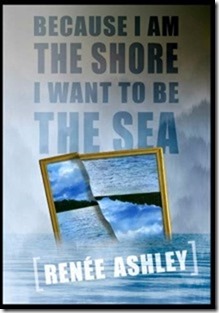
Because%20I%20am%20the%20shore

Renée Ashley is the author of five volumes of poetry and a novel. Her awards include a Great Lakes Colleges Association New Writers Award, a Pushcart Prize, a Kenyon Review Award for Literary Excellence, the Charles Angoff Award from The Literary Review, an American Literary Review Poetry Prize, The Robert Watson Literary Prize in Poetry from Greensboro Review, a Black Warrior Review Poetry Award, the Chelsea Poetry Award, The Open Voice Award in Poetry from the Writers Voice, West Side Y, NY, NY, and the Robert H. Winner Award and the Ruth Lake Memorial Award from the Poetry Society of America. She has been a fellow at the MacDowell Colony, Yaddo, the Vermont Studio Center, and the Virginia Center for the Creative Arts, and has received fellowships in both poetry and prose from New Jersey State Council on the Arts as well as a fellowship in poetry from the National Endowment of the Arts. She teaches in Fairleigh Dickinson University’s MFA in Creative Writing and the MA in Creative Writing and Literature for Educators.

The poems reprinted below are from Because I am the Short I Want to Be the Sea, published by Subito Press.

***

Okla Elliott: The poems in Because I Am the Shore I Want to Be the Sea are largely prose poems, with a few pieces that break into lineation of a sort. The syntax and punctuation for the poems are idiosyncratic to this project as well. How did you happen upon or decide on these formal aspects of the book?
Renée Ashley: I’d been wanting to write prose poems for a couple of years and couldn’t make a go of it. It took me a long time to figure out what worked for me. Conventional punctuation gave the poems too many stops, too much air, too many moments for the reader to think and/or react. I wanted a feeling of claustrophobia, of speed trapped inside a sealed vessel—as though the reader were locked inside my head with me. So, over time, terminal punctuation, except for question marks and exclamation points, was done away with, and I imposed an extreme sort of compression on the poems. I needed pressure on both the breath and the meting out of sound and content to achieve a sense of profluence, but also one of embeddedness, density, and restraint, all of those at the same time—meaning I wanted the sound and content to press outwardly against the rigid margins but then be visually forced back again at the point at which each poem’s real estate abruptly ended. Whether or not I achieved what I was after, I don’t know. But that was the ideal I had in mind.

OE: The vast majority of the poems have a similar structure and the same titling tactic, along with several other similarities, yet the book remains fresh throughout. What little tricks or tactics did you use to create variation between the poems?
RA: I’m so glad you think the pieces remain fresh–what a disaster if they hadn’t! It wasn’t something I consciously considered—well, no more than I would for any other gathering of my poems. Each poem or poem section has its own engine (an image, a rhythm) that drives it forward and conjures association and consequence. I’m very aware that my thematic issues are few, so I try to let image and angle of approach propel the flow of the articulation. I did fiddle with title tactics a lot and titles-as-titles didn’t work; they were too loud, too directive. Too there. The combination of the brackets and lower case seemed to hush them, make them seem tacked-on rather than an integral part of the working bodies of the poems; that’s what I wanted, a sort of whisper, a suggestion softly heard.

OE: Okay, I’m going to go lofty and abstract here. If there were one thing you could change about the current literary landscape, what would it be? Imagine you have total power and no limitations for this wish.
RA: Ah, bigger than a breadbox! You must understand that a big issue for me is deciding whether or not to use a semicolon… or whether or not to get out of bed on any given day.
But the first thing that comes to mind is that all really great writing could find a suitable venue for publication. (And, selfishly, that I would have time to read it—but, I know: that’s two wishes.) It’s a good wish, huge, really, though also small, I admit, in the face of the power you’ve offered me. But as I said, I’m not a thinker-in-grand-scales. I’m a punctuation-sized-thinker or open-my-eyes-sized-thinker. I’d make a terrible politician. Wait … wait … Maybe my wish should be that great writers aren’t beaten down by circumstances that discourage them so that they would keep writing and reach some ultimate work they might not have otherwise achieved … but then again that difficulty and/or discouragement that I relieve them of may have turned out to be the exact source of push-back that would have powered their definitive articulation. Never mind. I probably shouldn’t dabble in others’ affairs anyway; I can barely manage my own. We’ll all do what we do. I’m going to have to go with door number one.

***

[once quickly (quietly)]

The rough black sky then the lid of morning opens There’s a pure yellow light buried in the toad’s eye and the mute swan’s plodding through shallow water The snake is dangling from his myrtle tree and the sun rests—curled like a gilded cat—on the ledge of the sky The wild collation begins again Moon and the syntax of stars The turning on their silver pivots But the blades overhead are dividing the air And the light remains whole despite that There can be nothing ordinary about the ordinary Monstrous when the dark thing takes its place Then approaching that one grain of joy on the tongue: that place of beginning of all things able to climb the ladder named Assumption And all that was dead is dead again The horrible dreams return We are the restless unlovliest animal Hours of penitence Hours of rain like a beating Two instants of holy permutation Things come to you and you use them

***

[café des quatres vents]

It’s only a postcard Nothing about the wind knocking debris to the curb No hint about the heart We are the act of consequence – figure and profile Every thing is fatal and we suffer the world and its waters Somebody will always object and we grieve for those living hard amidst these shifting miracles Right now is when I love you That world is only darkness Our place is in those small lights It’s best to be clear

***

[I run to the sad man in the white car and]

This is a different gun reader than you have heard about before From me This is a different tragedy The man in the white car is weary of sorrow weary the way a woman becomes weary of a man Or of her life (Or of a satchel which might contain the whole history a whole of sorrow’s vestige) This man is learning the gun: singed wing orphan rare bird Sorrow can fly and a gun can fly and a shot And time. But time is simply metaphor here & hardly a metaphor at all Not flying Dragging a busted wing dragging its bitter (Like a satchel) Dragging its stark and dragging its bleak dragging its heavy its carcass its blasted-out carrion heart

SATURDAY POETRY SERIES PRESENTS: JACKIE TREIBER

Jackie Trieber


from ‘A DANCER’
By Jackie Treiber


And from eternal life found in the eyes came the truth: she was one witch. She was from Atzlan. Of Avar, wore the bridal relic, sat at the heels of mother fire. Mary A. of Massachusetts, little unclear Mary. Celine of Normandy, sick on milk. Joan of Arc. Strega. Lost in the woods in her red shoes. Caught in the rain at the base of a mountain. No survivor of death, survivor of transcendence. Torched, entombed, excised. Acrid climate, cupidity, war, drought. In lieu of an oral lineage, in lieu of explanations, there came the gift of death to her. When death was collective, she was anonymous. When death became individual, she died with little handfuls of dirt on her chest, thrown with purpose and care. Her conclusion was more than physical death now, and her body nothing more than a reed carved to sing its masterful song. This is why she stood resolute—she had known a thousand floods of death. This, out of all of them, was nothing.


Today’s excerpt appears here with permission from the author.


Jackie Treiber writes, reads and edits in Portland, Oregon. She is drawn to conflicted and damaged characters. Dualities such as profane/magical, masculine/feminine and stability/chaos thrill and inspire her. Her poems will be published in an anthology of Kansas City poets in Spring 2015 (UnHoly Day Press). Her most recent work was featured in Smalldoggies Reading Series Chapbook (2011).

Editor’s Note: Today’s excerpt is part of a larger work of fiction, though it stands on its own as a poem, blurring the line between prose and prose poetry. From within its almost choral narration (despite its third person narrative perspective) emerges one woman who is also every woman. She is a witch, a bride, Joan of Arc. She is our collective suffering, our recurring death. And yet her story is epiphanous. Because she has suffered, she knows that she can rise above. She has lived—and died—often enough to know that death is nothing more than metamorphosis.

Want to read more by Jackie Treiber?
Work poems
How Do We Look?
#23
#11 Socially Acceptable Cannibalism
We burned John Wayne’s favorite yacht

SATURDAY POETRY SERIES PRESENTS: KAITLIN DYER

2011-12-09 15.02.19

By Kaitlin Dyer:


LEAVING JERUSALEM

Screen Shot 2014-08-15 at 3.11.36 PM


ON THE FOURTH OF JULY, I HEAR THE NEIGHBOR’S MUSIC

Screen Shot 2014-08-15 at 3.12.48 PM


Today’s poems were originally published in the Hawai’i Pacific Review, and appear here today with permission from the poet.


Kaitlin Dyer is a founding editor of Harlot: A Revealing Look at the Arts of Persuasion. Her work has appeared in PANK, Potomac Review, Hawaii Pacific Review, and The New Welsh Review among others. These poems will be included in her chapbook Alter Lives of Alter Egos which is forthcoming from Dancing Girl Press in Feb/March of 2015. She loves dogs, hates caramel, and contains multitudes.

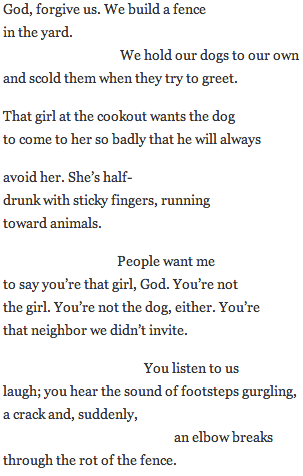
Editor’s Note: Today’s poems take on big issues. Politics and God. Ownership, land rights, and humanity. “God, forgive us. We build a fence / in the yard.” Who are we to lay claim to the earth, to carve out our little sections and plant our flags? And what god are we living with after we have staked our claims? These are the questions today’s poems pose. Questions that at once seem to take a stance and yet feel rhetorical. We don’t know where our birds have gone: “Perhaps / to the desert. / Perhaps, the morgue.” And instead of a God who is reflected in children and animals, we are left with an image of a biblical God who breaks through man-made fences.

Want to read more by Kaitlin Dyer?
Kaitlin Dyer Official Website
Kaitlin Dyer on Twitter
Harlot Magazine

THE ETIQUETTE OF POLICE BRUTALITY: AN AUTOPSY

THE ETIQUETTE OF POLICE BRUTALITY[1]

(AN AUTOPSY[2])

By Rion Amilcar Scott


Go ahead. Smack him one. He expects it so it would be rude not to. Besides, look at him giving you a dehumanizing stare[3]. How dare he look at you in that manner? He thinks he’s better than you. Approach in such a way that makes you look huge, immense—a living blue wall of silence[4]. But be loud. Put this guy down before he even starts. Grab him from behind. Maybe use the baton. Don’t be swayed by his screams and pleas of innocence. As a matter of fact, don’t hear them at all. Be deaf to his cries. Innocence doesn’t really matter here, anyway[5]. Sort it out later. Don’t be inhibited with the violence—punches, kicks, strangulation holds[6], baton blows, Tasers[7], and so on. Don’t worry, the state has your back. Make up any excuse you want. It doesn’t need to sound good. As a matter of fact, it would be insulting to make it sound too plausible. Say something like: “He was looking at us all leery and then he raised his hands. We had to throw him on the ground, smash his face to the concrete, knock his teeth out, and put him in a chokehold[8]. It’s important to neutralize the threat.” Toss it off without thinking. Fuck it, say: “He was dancing funny and I found that threatening so I was forced to jab him in the ribs.” The state has your back. No matter what you say, your superiors, the courts, everybody will nod and mumble: “Seems legit.” Yell racial epithets[9]. Shoot wildly[10]. At least 40 shots if unarmed[11]. More might be better[12]. It’s only polite to flex your authority every once in a while[13]. Let the world know how tough you are. The standard charge is resisting arrest. Assaulting an officer. Pile up any ol’ charge. What does it matter? To make the people feel safe and whole you have to break[14] one or two every once in a while so they know your power is both awesome[15] and nearly completely unchecked[16].


[1] Inspiration for this piece came from a short story collection called Modern Manners For Your Inner Demons by Tara Laskowski. The work is structured like an etiquette book except each piece of advice covers how to properly comport yourself while doing something wicked such as homicide, adultery, or arson.

[2] I go back and forth with this satirical piece—or “mockery” as I call it (“humor piece,” “satirical piece,” such clunky terms)—wondering if it’s at all successful. It was written from a place of pretty raw anger and frankly, terror, after reading about a succession of police harassment and brutality cases, mostly involving black and brown “suspects.”

Many of these incidents featured graphic and disturbing video of the assaults taking place. Sometimes I was brave enough to watch.

The public has been filming and broadcasting egregious acts of police violence since the 1990s when a motorist filmed Los Angeles police brutalizing Rodney King. Now that most of us carry video cameras in our pockets, such footage is nearly a weekly occurrence. This has done much to inspire the outrage of the public but has seemed to do little to stem the tide of police abuse or even to ensure the type of decisive and swift punishment that would make police think twice about physically assaulting citizens.

One possible thin silver lining is a study done by Rialto, Calif. police that ran from February 2012 to July 2013. A group of officers wore tiny video cameras while interacting with citizens. According to the New York Times, the video cameras resulted in a 60 percent drop in the use of force and an 88 percent drop in complaints against officers.

[3] According to CBS Miami, Miami-Dade Police choked a 14-year-old boy on Memorial Day 2013 because he watched them with what police termed, “dehumanizing stares.”

[4] It’s often said that a universal and morally bankrupt admonishment against “snitching” in poor black communities enables crime in these neighborhoods, but when was the last time you heard of police informing on one another? As the rapper Immortal Technique said, “They never snitch on themselves, but they want you to snitch on you.” An important question that’s rarely asked in these debates is why would anyone want to report crimes to people who have a reputation for brutalizing them?

[5] In Sept. 2000 in Prince Georges County, MD—the county I currently live in with my wife and son (in fact, this occurred in the very neighborhood I once lived)—Prince Jones, a man who had committed no crime, began his last stand. Undercover Prince Georges County narcotics officer, Cpl. Carlton B. Jones (no relation) followed Prince roughly 30 miles to Fairfax, Va. (coincidentally, the county where I went to school in the mid to late aughts) in an unmarked SUV and shot his car 16 times, killing him in the process. Police say they were trailing a suspect in the theft of an officer’s gun and Prince’s car resembled a car driven by the suspect.

Prince, a Howard University student (the university from which I hold an undergraduate degree—as a matter of fact, I too was a Howard student at this time) nearing graduation, was unarmed.

Cpl. Jones claims Prince rammed his car and refused to stand down when he announced he was an officer (though he admitted to showing no badge); witnesses dispute this claim, however, saying that Prince’s car was not moving when Cpl. Jones fired his weapon. As a result of killing Prince Jones, Cpl. Carlton Jones faced no criminal charges (sources: Washington Post; Washington Monthly).

[6] On Thursday July 17, 2014, police in Staten Island approached 43-year-old Eric Garner, a 400 pound asthmatic, purportedly to arrest him for selling loose cigarettes. Garner had reportedly just broken up a fight. Video recorded by a bystander shows Garner protesting frequent harassment: “Every time you see me you want to mess with me. It stops today… I’m minding my business officer. Why don’t you just leave me alone?” Four officers surround Garner and wrestle him to the ground. One deploys a chokehold, a use of force specifically banned by NYPD regulations. Despite video evidence, police claim a chokehold was not used on Garner. While an officer shoves Garner’s head to the sidewalk, he repeatedly cries, “I can’t breathe. I can’t breathe.” And those are his final words.

[7] When Oakland transit officer Johannes Mehserle pulled his revolver, shooting and killing Oscar Grant while he lay handcuffed and face down, he claimed to have been reaching for his Taser. For killing Grant, Mehserle served less than a year in prison.

In 2007, after a video of a University of Florida student being tasered by campus police made the rounds on the internet, “Don’t tase me, bro!” became a late-aughts punchline, but the incident that inspired it, a young man being tasered by police for aggressively asking a politician a question during an open forum, is a chilling, abusive, and reckless display of police power.

[8] From the New York Daily News: “The NYPD prohibited the use of chokeholds in 1993. The city’s independent police watchdog has substantiated 10 chokehold cases filed against cops since 2009, but little has happened to the officers involved, records show.

“In one of the cases, the cop accused of putting a person in a chokehold lost up to 10 vacation days, records from the Civilian Complaint Review Board show.

“In two cases, the department declined to discipline the officers, and in three cases, cops received ‘instructions,’ or retraining. In another case, the cop retired before he could be disciplined, and the three remaining cases are pending, the records show.”

[9] According to the New York Times, in 2011 the government intercepted a phone call in which NYPD officer Michael Daragjati bragged about falsely arresting a suspect. In regards to the young man, Daragiati said: “Fried another nigger.” Even more horrifying: Also in 2011, retired Marine, Kenneth Chamberlain, Sr., 68, inadvertently called police to his White Plains home when he accidentally activated his medical alert bracelet. The response of police—this is not in dispute—was to ignore Chamberlain’s request that they leave, call him a nigger, and fatally shoot him (sources: New York Times; New York Daily News).

[10] In 2013, the NYPD shot a disturbed and unarmed man and two innocent bystanders. The man, Glenn Broadnax, caused a commotion by jumping into traffic. The wounded Broadnax was then charged with assault for the bullet wounds suffered by the bystanders under the theory that his actions caused the police shooting to occur. An attorney for one of the wounded bystanders speaking to the New York Times: “It’s an incredibly unfortunate use of prosecutorial discretion to be prosecuting a man who didn’t even injure my client. It’s the police who injured my client.”

The NYPD (again) in 2012 shot nine innocent bystanders during a confrontation with a gunman in Times Square. All nine bystanders were struck by bullets from police weapons. NYPD Commissioner Raymond Kelly on the shooting: “I believe it was handled well” (Source: FoxNews.com).

While searching for alleged cop killer Christopher Dorner in February 2013, the LAPD shot at trucks that were said to resemble Dorner’s on two separate occasions. In the first incident, police fired on two Hispanic women—a mother and her 47-year-old daughter as they delivered newspapers early in the morning. A bullet ripped through the back of 71-year-old Emma Hernandez. Somehow this incident resulted in no fatalities despite the fact that police fired more than 100 rounds.

Later that day, police opened fire on a truck driven by a white male, David Perdue, a surfer on his way to the beach. In that instance, police rammed Purdue’s truck before shooting at it. Perdue was not hit and prosecutors determined the use of force was reasonable. Dorner, who died in a cabin fire police claimed not to have intentionally set, was a black male (Source: Christian Science Monitor).

Richard Pryor on California police in 1973: “They accidentally shoot more niggas out here than any place in the world. Every time you pick up the paper: nigga accidentally shot in the ass. How do you accidentally shoot a nigga six times in the chest? ‘Well, my gun fell and just went crazy.’”

[11] 41 police shots took the life of Amadou Diallo in the infamous 1999 shooting in the Bronx. He was armed only with a wallet.

[12] In 2006, 50 police shots took the life of Sean Bell in Queens, NY the morning he was to marry. He too was unarmed.

[13] The examples of police brutality used in this piece are all relatively current, which implies that this is a recent problem. That is certainly not the case. Worldwide, police and excessive police force have historically been tools of the state used against the disenfranchised and dispossessed to make sure they don’t get too loud in their cries against their disenfranchisement and dispossession. As the rapper Boots Riley notes: “You never seen a police break up a strike by hitting the boss with his baton pipe.”

It was police, for example, who held the fire hoses that mowed down civil rights protesters in the 1960s.

Huey P. Newton and Bobby Seale formed the Black Panther Party for Self-Defense in Oakland as a response to police harassment in 1966. Even then it was a long-standing community problem. The group’s initial program was an armed patrol to evaluate the behavior of the police. Government suppression of the Party was codified in the COINTELPRO program (see FBI documents here), a wave of law enforcement intimidation and force unprecedented in its cruelty, lawlessness, and violence. Chicago police murdered the Deputy Chairman of the Illinois Black Panther Party, Fred Hampton, in a police raid while he slept (drugged by infiltrators) on December 4, 1968. Police fired nearly 100 rounds at the Illinois Panthers while the Panthers fired only one.

[14] Richard Pryor on the police from Wanted/Richard Pryor Live in Concert (1978): “Two grab your legs, one grab your head—they go, snap! ‘Oh, shit he broke. Can you break ‘em? Does it say so in the manual? Let’s check. Yep, page 8, you can break a nigger.’”

[15] A 2014 American Civil Liberties Union report (War Comes Home: The Excessive Militarization of American Policing) details the increased militarization of police departments around the United States. SWAT teams armed with military weaponry, vehicles, and equipment handed down from our decade long Middle East (mis)adventures are being deployed in American cities for fairly routine operations. Just outside of Atlanta in 2014, police raided a house in search of a small stash of drugs. They carried M16s and upon entering tossed a flashbang grenade that landed in a crib next to a sleeping toddler. The child suffered a hole in his chest and possible permanent brain damage. The suspect police were looking for was not in the home at the time and did not even live there, according to the toddler’s mother, who wrote about the incident for Salon.com.

The family moved to Atlanta, a town that is no stranger to police raids gone astray. In 2006, police invaded the home of 92-year-old Kathryn Johnston, shooting her dead in the process. After police found no drugs in her house, they planted three bags of marijuana. The paperwork that served as the basis for the “no knock warrant”—which alleged that an informant purchased drugs at Johnston’s home—turned out to be based on falsified evidence (source: CNN.com).

[16] In many of the above cases, such as the Chamberlain case, police were cleared of any wrongdoing or faced relatively light or unspecified punishments, a situation that I imagine leaves police feeling comfortable in deploying any act of violence in their toolbox, no matter how reckless, if it leaves them standing when all the smoke from the gunfire has cleared. However, for much of the populace, that knot in their chests when a squad car sidles up next to them in traffic is the twinge of sheer terror.

***

Rion Amilcar Scott has contributed to PANK, Fiction International, The Rumpus, and Confrontation, among others. Raised in Silver Spring, Maryland, he earned an MFA at George Mason University and presently teaches English at Bowie State University. He can also be found at forgottentunneltv.tumblr.com and @ReeAmilcarScott.

SATURDAY POETRY SERIES PRESENTS: ALLIE MORENO

photo (1)

TOO MUCH OF A GOOD THING
By Allie Moreno

I have been stretched like
skin to dry in the sun
I am a blanket
I’m a tightrope
a staircase
a palace of forgotten
photographs
a sandcastle exposed in the wind
I love and
cover you

I have filled all the glasses
on the table
I have eaten what is
left on every plate
to be free of it

I have swallowed your
skeletons on cue
I should probably apologize
for complaining
but I’m the parade and the rain


“Too Much of a Good Thing” appears here today with permission from the poet.


Allie Moreno spends her daytime hours writing for a large tech company in the San Diego area. She received an MFA in Writing from UC San Diego and sometimes writes poetry from the confines of her cubicle. Allie tends to write about identity, belonging, and her experience as a trans-racial adoptee.

Editor’s Note: Simple, straightforward, and full of evocative imagery, today’s poem takes us inside the world of one who has lived for another. Stretched tight, walked upon, now disappearing grain by grain, “a sandcastle exposed in the wind.” To give love is not enough, when in so doing we give too much of ourselves. In end end we are almost left with a woman’s tendency to apologize for herself, but instead we are left with a counterweight. A provocative image slightly obscured. What is a woman when she is “the parade and the rain”?

Want to read more by Allie Moreno?
Allie Moreno’s Blog
Interview: Allie Moreno’s Adoption Experience

Feminism, Culture, and Poetry: An Interview with Lisa Marie Basile

Lisa Marie Basile

Feminism, Culture, and Poetry:

An Interview with Luna Luna Magazine Editor Lisa Marie Basile

by Sarah Marcus

This interview originally appeared as part of Gazing Grain Press’s feminist-author interview series by co-editor Sarah Marcus and is reprinted here with permission.

Sarah MarcusYou are the editor-in-chief at Luna Luna Magazine, which is self described as “a diary of ideas and a place for dialogue.” From your website, it seems as though this publication encourages a wide range of views and opinions. Although you “do not tolerate sexism, misandry, homophobia, ageism, racism, sizeism, religism, classism or transphobia in comments or in our published work,” you do allow articles from authors and comments from people who openly disagree and may have controversial stances on a variety of issues. How was Luna Luna Magazine founded, and how do you view its role and importance within the greater feminist and literary community?

Lisa Marie Basile: When I started Luna Luna I wanted to create a conversation. We are almost entirely run by women, and that is something I’m very proud of and want to continue. We of course allow voices from everyone, but I have never published anything I consider problematic or hateful.

I allow a very specific level of autonomy with regard to our contributors and staff writers; our disclaimer very clearly says that while we may not all agree with one another, we allow conversation and opinion. I want people to be able to discuss race, society, gender, sexuality and lifestyle in an open way. I will say, though, that I’ve never, ever published anyone who I felt was harmful to the public dialogue. We do publish comments to our articles that may be in opposition to our ideas (unless they’re blatantly rude or disgusting) and even then, sometimes (rarely), comment moderation slips through the cracks.

We do this because it gives our readers a chance to discuss the issue and it gives our writers the opportunity to provide a teaching moment. If I feel that there is ever a exploitative comment or if a commenter gets out of hand I’ll certainly discuss with the author and editors. I firmly believe in the discussion of differing opinions for the health of all – to an extent. We want to provide a platform for idea, and even confession of flawed idea, but I would not allow hate speech. We haven’t even come close, and if we had, our editorial staff would have had a very detailed discussion about it.

As far as feminism is concerned, our feminism is innate. We provide feminism in action. We are written by (mostly) women. We feature, spotlight and promote women. We actively seek diverse opinions on feminist issues, and we actively take a stance against everyday sexism. No opinion or delivery will be perfect for everyone, but we certainly try to at least get people talking about issues that affect them. We’ve had a lot of interaction with (either through content share or cross-promotion) other feminist organizations and magazines, and we’re really proud of that.

I’m not comfortable with labels but I will say our writers are gay, straight, bisexual, transgender, asexual, religious, atheist, parents, soon-to-be parents, and those who don’t want children. We have writers of almost every race, socioeconomic background, and size, and we’re determined to welcome people from every path of life.

In the end, we want to offer opinion of lifestyle, culture and the arts – and we welcome writing in those areas through a variety of lenses.

SM: You are also a co-editor & co-curator at DIORAMA: Poetry/Shape/Sound, the NYC editor of The Doctor T.J. Eckleburg Review, and the editor at Patasola Press. Can you please tell us a little bit about each of these projects and about the experience of being an editor for so many different, interesting projects?

LMB: I am inundated, but luckily these projects don’t all come to life at once. Patasola is a small press. I publish a handful of chapbooks or books per year and have found it very difficult to do any more than a few.  My goal here is to publish beautiful words, because I love the authors I work with.

I curate content from writers in the NY area for The Doctor T.J. Eckleburg Review, which is on break right now. I also teach a class for their workshops. DIORAMA is a poetry and performance event that incorporates the idea of musicality in poetry and live music into one intimate, vulnerable event where the reader and the audience isn’t separated by podium and harsh light. We’re very interested evocation and reading style and sound – how sound affects the listener’s experience. We host this event (myself and co-curate Alyssa Morhart-Goldstein, who runs SOUND Lit Mag, the associated journal of contemporary musico-poetics) every few months. We’re like a live action lit-journal; we select poets and their poems for the event. We also pair them with musicians who set their poems to music. It’s amazing.

I love to support writers and do beautiful things. I’m probably stretched too thin (no, I am), but I work best when busy. I am just lucky to be around the best people.

SM: I am so excited that your first full-length book, APOCRYPHAL, is due out this summer from Noctuary Press. Can you give us a synopsis of this work and tell us what inspired you to write these poems?

LMB: Thank you!!! I am so excited, too. It’s a weird, almost anti-climactic feeling; sort of like a death and a birth at once. I am already well-past the experience of those poems and I moved through a lot when writing it. Now it feels like a world I vaguely remember in a dream, but it’s still a world I know as home.

APOCRYPHAL is sort of set in three parts: a genesis, a world of secrets (apocrypha) and a paradise. For me, these “parts” are fluid; they’re from dreams and realities and half-remembered memories and secrets. Sometimes I don’t know which are which, but I use form and lineation to explore this. The book examines the woman’s relationship to sex and desire and being desired, but I think I try to subvert what we’ve been taught to “be” and “perform” and “look like.” I wanted to create a world that was as superficial and dramatic and broken as I felt and was taught when I was younger, insecure, and frightened. A lot of it deals with my father, who left when I was young and has always been a figure of relative mythology to me: how we talk about fathers, how we let them influence us, how we let them “define” men  – these are all topics I encounter. It’s written from not only my perspective but a sort of omnipotent camera. It pulls from my life as an Italian-American in a religious family, and from life on the beach and in cars and from the younger me who connected sex with validation. It’s my way of consoling my younger, more sunless self.

SM: What are you working on next?

LMB: I’m working on a book of fiction-it details the extreme side of friendship: obsession, co-dependence, ownership, lust and manipulation. I’m frightened of how natural it feels. But I’m excited for it to exist.

***

Lisa Marie Basile in a NYC-based poet. She is also the author of the chapbooks Andalucia (The Poetry Society of NY) and triste (Dancing Girl Press) and the forthcoming full-length APOCRYPHAL. She is the founding editor of Luna Luna, a diary of art, sex and culture, curator for the musicopoetics performance salon, Diorama, and the NY editor and a writing instructor for The Doctor T. J. Eckleburg Review. A graduate of The New School’s MFA program, she has been named a top contemporary NYC poet to read by several publications. She tweets at @lisamariebasile and works as a writer.

Sarah Marcus is the author of BACKCOUNTRY (2013, Finishing Line Press) and Every Bird, To You (2013, Crisis Chronicles Press). Her other work has appeared or is forthcoming in McSweeney’s, Cimarron Review, CALYX Journal, Spork, Nashville Review, Slipstream, Tidal Basin Review, and Bodega, among others. She is an editor at Gazing Grain Press and a spirited Count Coordinator for VIDA: Women in Literary Arts. She holds an MFA in poetry from George Mason University and currently teaches and writes in Cleveland, OH. sarahannmarcus.com

SATURDAY POETRY SERIES PRESENTS: SHARON SUZUKI-MARTINEZ

ssm author pic

By Sharon Suzuki-Martinez:


ONE HUNDRED BRIDGES

1.

One day
I gave myself a gift certificate
because who knows what I want?

One night
without thinking
I traded it for one hundred bridges.

2.

We turn the house upside-down
in search of our passports.

A century passes
before we find them in the pages
of our children.

3.

Too many bridges to cross.

Paths like rotting smiles, rat-kissed
tatters swinging loose
in the maw of some river god.

4.

It has always been this way–only
your voice carries me to the other side.


GOODBYE ISLAND

Then Marie said, “I’m in love with a man
who is an island.” Of course,

many of us had our doubts.
This did sound familiar.

We said, “Which of our legs
are you trying to pull?”

She stared at us like we were insects
from the future.

Our metaphysical existence
(vis-à-vis Marie)

grew negligible: tenuous, at best.
Further on down the road, we saw the man

for ourselves. We couldn’t help but
admire his thick vegetation,

his long languid beaches, his centuries
of blue-eyed solitude.

We desperately wanted to bear his young,
even the males among us.

Thus we engulfed
his shores with sweet lingering visits.

Soon, Marie saw the man
was no longer her own.

Sadly thereafter, she realized he never was.


“One Hundred Bridges” originally appeared in CURA and “Goodbye Island” originally appeared in Spooky Boyfriend. These poems appear here today with permission from the poet.


Sharon Suzuki-Martinez is the author of The Way of All Flux (New Rivers Press, 2012). She grew up in Hawaii and now lives in Tempe, Arizona where she created/curates the music/poetry website, The Poet’s Playlist and blogs about strange animals and the even stranger poet’s life at Sharon Planet.

Editor’s Note: Today’s poems are thinking poems. We are asked to slow down, to be present, and to really consider the ideas and imaginings the poet has carefully crafted for our contemplation. “One day / I gave myself a gift certificate / because who knows what I want?” “We turn the house upside-down / in search of our passports. // A century passes / before we find them in the pages / of our children.” I could read these lines again and again and meditate on the depths of their meaning.

In “Goodbye Island,” the poet pushes the boundaries of metaphor, painting us a picture of what a man might look like if he really were an island: “We couldn’t help but / admire his thick vegetation, // his long languid beaches, his centuries / of blue-eyed solitude.” As if this is not enough, she takes us a step further, deep into reflecting upon what it is to love a man who is an island: “Marie saw the man / was no longer her own. // Sadly thereafter, she realized he never was.”

Want to read more by Sharon Suzuki-Martinez?
The Poet’s Playlist
Sharon Planet

A Review of Simi Linton’s My Body Politic

A Review of Simi Linton’s My Body Politic

by Kate Grisim


Simi Linton’s My Body Politic takes readers through the aftermath of a road trip as a young adult to join a protest demonstration against the then-current war in Vietnam. The setting is a spring day in 1971; three youngsters (the protagonist, her husband, and her best friend) innocently stick their thumbs out to hitch a ride. They were en route to support a cause all three of them believed in, but by the end of the day, Linton’s life was derailed in a way she hadn’t conceived possible. Her story, however, only starts here.

The deaths of John (Linton’s first husband) and Carol (her best friend), seemingly the most traumatic situation that a person could imagine, take a back seat in Linton’s story to the trauma she endured in becoming a woman disabled by society and circumstance. This transition from loss to gain is the essential arc of Linton’s story. She does not soften her situation with flowery epithets of hope but instead mourns the life she once had as she “reconstructs […] the life I grew into.” Linton does not do this arrogantly, portraying herself as a rather naive, passive shell of a person in the first half of her memoir. For example, Linton is forced to take on the role of the “good patient” in the hospital, where ironically “[i]t wasn’t until the third or fourth week that a doctor came to tell me that my legs were paralyzed [….] I must have known it on some level, but kept the thought at bay.” Her further encounters with both medical professionals and friends and family members only add to this affect, even to the extent of having her sister travel to Linton’s late husband’s funeral to absorb the shock for her.

This is not merely circumstantial; it is clear that Linton sets up her dependency on people within the pages of her memoir in order to achieve a harsh portrayal of herself and the state of her body both before and after the accident. Perhaps the most harrowing image, one that has stayed with me well after finishing Linton’s story, is the description of a flashback to a photo shoot for a New York underground newspaper, in which Linton is posed under the headline “SLUM GODDESS:”

…had it been just a couple of years before [the accident] that I had stood tall on the roof of my apartment building in the East Village, with the New York City skyline rising up behind me? [I was] dressed in John’s black v-neck sweater and tattered jeans, [….] costumed as an ethereal symbol of the counterculture. I stood in profile, my face tilted upward, my long wavy hair blowing out behind me.

Although Linton describes instances in which she attempts to distance herself from the passivity her condition seems to require by demanding her newly disabled body be taken seriously (especially by an “unassuming” salesman trying to take advantage of fitting her for a prosthesis), it is not until one hundred pages in that readers might begin to get the feeling Linton is finally approaching the real crux of her story. This is not to say that the text before this point is trite or inconsequential; on the contrary, as after her hospital stay she writes about exposing herself to a new world where she is a curious entity, moving to California to attend college only to find they have already discovered “the disability movement” and she does not quite fit into their image of it just yet, and situating the disabled body against “normative” notions such as travel, dance, sex, intimacy, and celebrity. It is precisely in this section’s substantiality that Linton is at last able to reach a crucial narrative point, revealing a poignant and pivotal moment in her life’s bumpy journey.

At the beginning of chapter nine, Linton writes, “I have become a disabled woman over time.” In that one sentence, she recognizes the importance of not being “made invisible by the label [of disability]” but instead by embracing it not only as an individual but also through forcing herself to recognize her position within a community. This is where the title of her memoir, My Body Politic, really hits the mark, as readers are let into the realization that her story is not just a personal one but is also a political one as well. Linton describes this argument in a circumstance where she relates her experiences to someone who “doesn’t seem so much rude as misinformed [….] the man will nod and commiserate and act as if now he knows what is important about disability – its genesis.” She continues, describing how she found the act of writing a political “release” as well:

I did not have the precise language to describe the other parts of the disability experience – the kinds of obstacles or the intrusive people I encountered every day – nor had I found a way to talk about my new situation as a natural state, my wheelchair as a convenience, or my experiences in ways that would be interesting to anyone besides myself and a few like-minded people.

Linton uses her memoir’s final pages to further describe situations in which she and others take a political stance by using their personal lives as impetus for change or response. For example, there is little room to argue with a political statement describing how friends of Linton’s were denied the ability to get married because it would drastically decrease their allowances for life-saving medical equipment, only to then have a mere two years together once their request was finally approved. Writes Linton of this tragedy: “That this nation made it so hard for them to marry and live comfortably in the time they had is the shame of this nation.” At this point, readers should truly appreciate how Linton’s narrative and personal stance have changed and evolved in order to use such circumstances to point out damning political paradigms that prevent disabled persons from living the lives they clearly deserve.

However, such a reading within a disability framework is not necessary for Linton’s story to effectively reach her audience, and perhaps this is where the true beauty of her story lies. Linton’s talent on the page enables her to have written a compelling narrative evoking important questions about humanity, including whether and why one deserves to undergo such emotional turmoil at the same time they must experience intense physical turmoil as well.


Simi Linton, My Body Politic. The University of Michigan Press, 2006: $30.95 (hardcover), $21.95 (paperback)

***

Kate Grisim is currently a second-year Master’s student in the interdisciplinary field of disability studies at the University of Manitoba in Winnipeg, Canada. She is a recent convert to the blogosphere at mylittlecrippledheart.wordpress.com and is currently halfway through a writer-in-residency position at a not-for-profit arts organization.