Laura Grace Weldon: My Father’s Battle

My Father’s Battle
By Laura Grace Weldon

“Life as a whole expresses itself as a force that is not to be contained within any one part. . . . The things we call the parts in every living being are so inseparable from the whole that they may be understood only in and with the whole.”  

-Goethe

My 83-year-old father and I meet regularly at a quiet small-town eatery. Large windows light up the whole place. He remarried after my mother’s long illness and death, now able to relax back into bird watching and church choir.

For years he made lists of things to talk about on the phone or in-person, an eccentric way to handle his shyness, but now we talk easily. While he eats a cherry pastry, I tell him about a biography of Johann Wolfgang von Goethe I’m reading. Goethe believed personal observation was more vital than conventional knowledge. “Colors,” he said, “are light’s suffering and joy.” He scoffed at critics who insisted he didn’t understand scientific theories about color. Instead, he asserted that color required both darkness and light.

My dad, a retired teacher, disagrees. He says theories must be mastered before making advancements. Goethe would have enjoyed debating that point. As we talk, beveled glass decorations at the windows break light into rainbows that bounce from my father’s face to the walls around him.

I’m grateful things have become close-friend comfortable between us. We talk and laugh companionably, happy to be sitting together rather than separated by the miles of our daily phone call. My father had been ratcheted tight by early adversity but something loosened in him recently.

Continue reading “Laura Grace Weldon: My Father’s Battle”

Ace Boggess: “Religion”

Religion

Raining hard, mist steaming off roof &
pavement, wind aswirl, thunder a series

of car wrecks in tunnels. I’m watching
disruptions of summer through a window,

thinking in an hour I’ll be out in that,
driving you thirty miles to the cupcake festival,

plying you with sweets: devil’s food,
red velvet, tiramisu, whatever attracts you.

Smiles will break like skyward flashes,
not erasing smudges on our lives right now,

but covering them with paint.
Pumpkin writes your name in icing.

There might be cinnamon coffee cake,
coconut, & the infrequent orange.

I’ll stick with vanilla, assuming weather
doesn’t cancel the party or leave us stranded.

We’ll find out soon after I collect you,
a soggy rat swimming for its life

or pleasure it senses ahead, dropped
like a crumb from the hand of a child god.

About the Author: Ace Boggess is author of six books of poetry, most recently Escape Envy. His writing has appeared in Indiana Review, Michigan Quarterly Review, Notre Dame Review, Harvard Review, and other journals. An ex-con, he lives in Charleston, West Virginia, where he writes and tries to stay out of trouble. His seventh collection, Tell Us How to Live, is forthcoming in 2024 from Fernwood Press.

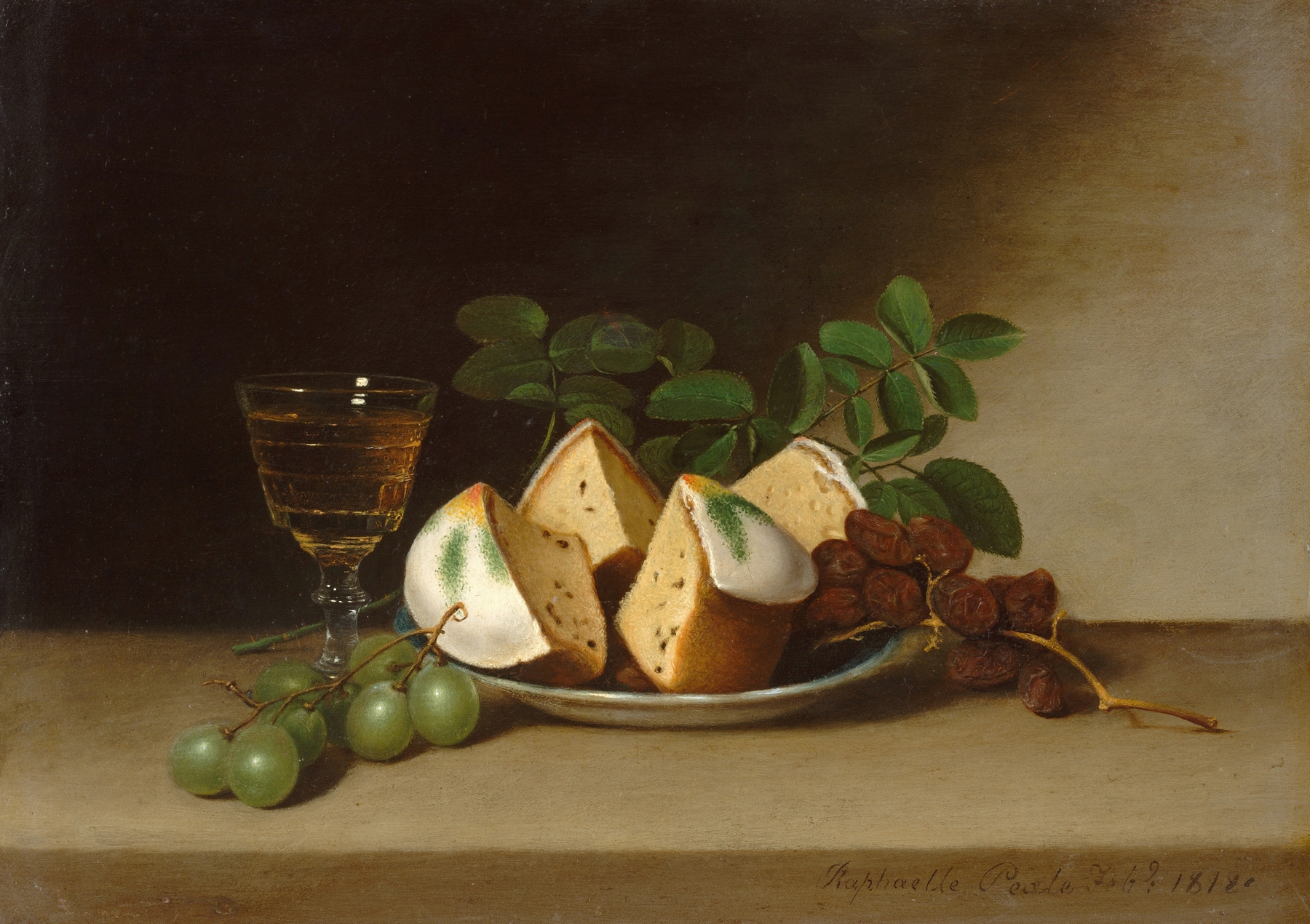
Image Credit: Raphaelle Peale “Sill Life with Cake” (1818) Public domain image courtesy of Artvee

Paul Ilechko: “Sonnet for Redecorating Plato’s Cave”

Sonnet for Redecorating Plato’s Cave

Plato in his allegory invented a cavern
a tight  cramped  dark place
with only a flickering fire to provide light

a miserable place for limited people
who ignore the real world  engrossed in
the sad mindless flickering of their television

but now there are plans to expand the cave
divided into sections of foreground
middle ground and background
whitewash the walls and renovate each area

appropriately  flooding the space
with reflected natural light  decorated
in earth tones and neutrals   an expensive look
that can be adapted to an upscale eatery.

About the Author: Paul Ilechko is a British American poet and occasional songwriter who lives with his partner in Lambertville, NJ. His work has appeared in many journals, including The Bennington Review, The Night Heron Barks, deLuge, Stirring, and The Inflectionist Review. He has also published several chapbooks. 

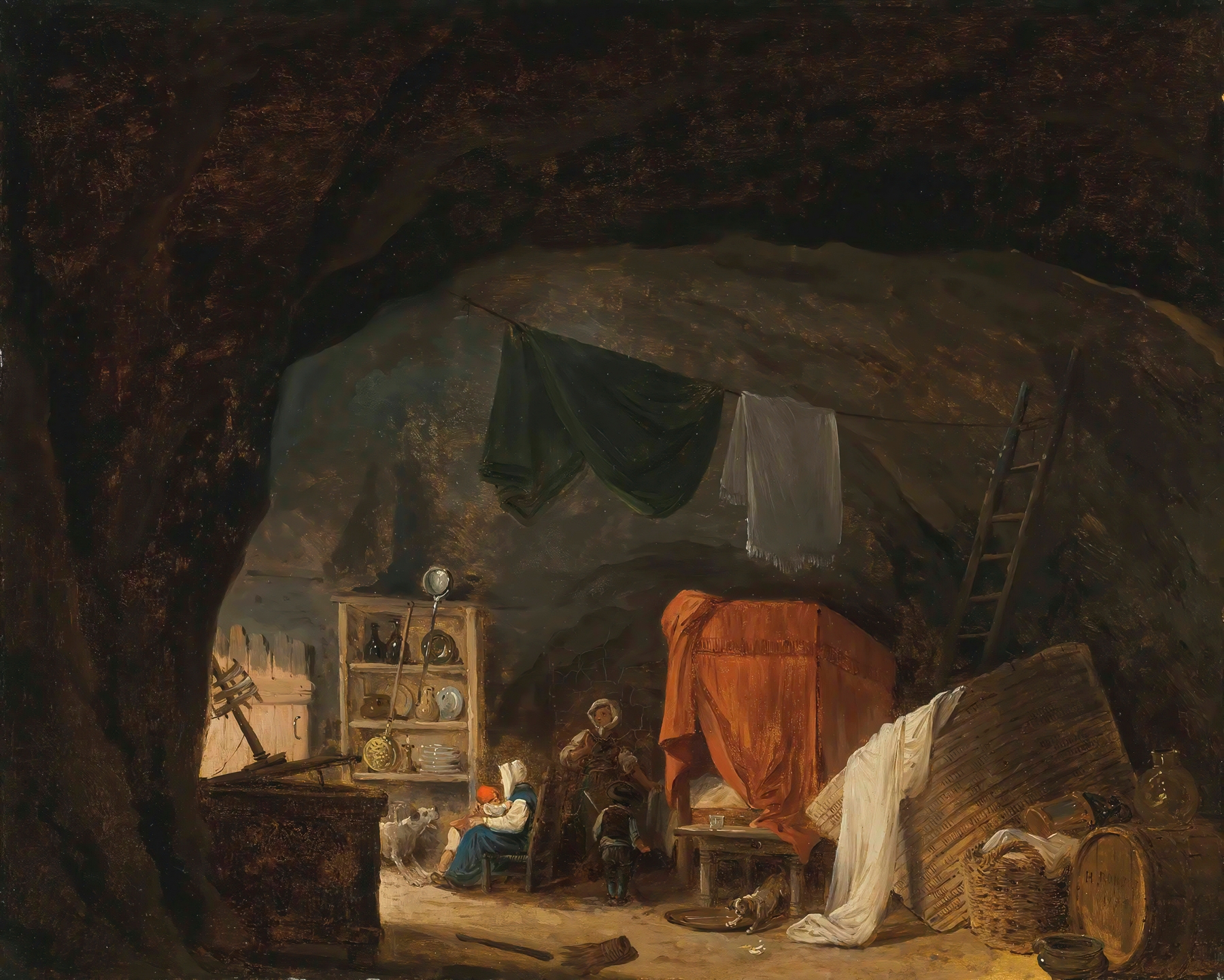
Image Credit: Hubert Robert A Family In A Cave Interior (1784) Public domain image courtesy of Artvee

Michael Layne Heath: “MY FAVORITE POET IN TOWN”

MY FAVORITE POET IN TOWN

My favorite poet in town
is a candy apple red '67 Pontiac GTO
on a slow motion careen
through the Mission at Sunday sunrise.

I hear that it once ran
on nitro and Jim Beam;
now overhauled, burning cleaner

Flames pluming off its rear wheels
dissolve into Yakuza ink and air,
all lost on those who only await
the parting of iron bodega gates.

About the Author: Michael Layne Heath is a writer and poet, with a number of chapbooks published, primarily by Kendra Steiner Editions, San Antonio. He is also a veteran freelance music writer, and the compiler of My Week Beats Your Year: Encounters With Lou Reed, published by Hat & Beard Press, Los Angeles.  Michael lives a stone’s throw from the Fillmore Auditorium in San Francisco.

Image Credit: Carol M. Highsmith “Untitled mural located in Balmy Alley, Mission District, San Francisco, California” (2012) Public domain image courtesy of the Library of Congress

S Stephanie: “Pissant”

Pissant

A formation of Canada Geese above
this morning, so low their shadow
grazed me, pointed me
straight to a phrase my mother
used when seeing shady politicians
on the news: Piss Ant
she’d pronounce, both syllables separately.
Piss Ant she would hiss beneath her breath
watching her second husband negotiate
our alcohol, shifting stairs most nights.
I couldn’t tell you exactly
what that phrase meant, but
the poet in me even then
appreciated her meaning.
Her cigarette dangling while
lifting another laundry basket.
Piss Ants, all of them
was the only direction her language
could take. It was the ‘50s.
Marriage was where the woman
in my mother had migrated. This
was supposed to be her South.

About the Author: S Stephanie’s poetry, fiction and book reviews and fiction have appeared in many anthologies and literary magazines such as: Birmingham Poetry Review, Café Review, Cease, Cows, Clover & Bee, Hole in the Head Review, Iowa Review, One, Rattle, St. Petersburg Review, Southern Indiana Review, The Southern Review, The Sun, Third Coast, and Turtle Island Review, She has three collections of poetry out. She holds an MFA from Vermont College of Fine Art and teaches poetry and writing on both the community and college level, works at a local hardware store, lives in Rollinsford, NH and respects cats.

You can learn more about her at her website which she rarely keeps up (apologies in advance). http://sstephanie.com/

Image Credit: Public domain image courtesy of the Biodiversity Heritage Library

Revisiting 2023: AIOTB’s 50 Most Popular Posts of the Year

As the Managing Editor of As It Ought To Be, I want to thank all of our contributors and readers for an amazing 2023. I’m proud of the work we’ve featured over the year and grateful to everyone who chose AIOTB to showcase their writing. It was a great honor to work with over a hundred writers from around the world this year. As 2023 comes to a close, I invite you to revisit some of our most popular posts of the year collected below.

Here’s to another bumper crop of poetry, reviews, and nonfiction in 2024!

Chase Dimock
Managing Editor
As It Ought To Be
Poetry

M.J. Arcangelini
- Your Gift of Stars

Jason Baldinger
- the only other thing is nothing
- this poem was written for john dorsey in the el bronco bar, richmond indiana
- when pigs fly

Marlena Maduro Baraf
- Memoir

Rusty Barnes
-Homage to Jim Harrison

Ruth Bavetta
- The Moon Illusion

Jon Bennett
- Purple Cabbage

Jean Biegun
-Olives

Sue Blaustein
- Who Wrote the Book of Love?

CL Bledsoe
- A Lightness of Feathers

Rose Mary Boehm
- Another Ordinary Story
- Discontent
- On Reflection

Ace Boggess
- Why I Can't Play Poker

R.T. Castleberry
Items from the Wreckage

Rick Christiansen
- Dragging His Beast Around

Susan Cossette
- Waiting for Cremation
- Magdalen with the Smoking Flame

John Dorsey
- Cancer Song #9
- Eating Gus’s World Famous Fried Chicken with Larry Gawel
- On the Prospect of Dying in December
- Poem After Listening to Philip Levine
- Poem for Tohm Bakelas
- What to Do After You Don't Die on the Table

Justin Hamm
- The Floor

Jeanette Hutzell
- Wasting Disease

Ted Jackins
- After Wayne Shorter

Mike James
- Andy Says...

Savannah Lauren
- If I Ever Have a Daughter

Madeira Miller
- On Ownership

Cord Moreski
- Night Swimming

Dave Newman
- Lilly Works the Late Shift

Michael G. O'Connell
- On the Loss of a Daughter

Dan Overgaard
-The Crack of the Bat

Royal Rhodes
-The Other Genesis

Sandra Rivers-Gill
- A Distant Hymn

Jason Ryberg
-Scarecrow Standing at a Crossroads

Alexandria Tannenbaum
-The Strip Mall

Richard Vargas
- when i was a UPS man

Agnes Vojta
- The Pope Coffin
- The Topography of Grief

Alexander Lazarus Wolff
-Self Portrait as Ariel from the Tempest

Robin Wright
- Boarding House Bedroom
- From This Height, Six Days before 9/11
- On the Ledge


Nonfiction

Sue Blaustein
- It’s 2023, and We Still Need to Read Sally Carrighar

Chase Dimock
- In Memory of Mike James

Howie Good
- In Defense of Prose Poetry

Mike James
- Tim Peeler and the Life of the Poem

The Cat that Wears the Night Sky for Skin: Charles Bowden and the Northern Jaguar

The Cat that Wears the Night Sky for Skin:
Charles Bowden and the Northern Jaguar

By John Macker

I’ve never seen a northern jaguar in the flesh, across from me or crossing the border or anywhere else, but then, I’ve never witnessed the birth of the blues or border author Chuck Bowden’s feral ghost. But I believe in them both. Just as I believe in the hot dry ground that sings under its breath for rain; that fantasizes with all of its stoic forbearance: one day it’ll ride the storm out once again.

It still gathers itself at the horizon for the redundant miracles of twilight. The cooling, the operatic softening. Perhaps, for the jaguar’s silent tracks as well: south of the border but close, so close, slowed on its journey by drought, or human predation, the wall. Maybe a sordid combination of all three.

The Mayans believed if you spread out the skin of the jaguar, you’d see a map of the celestial heavens.

In a perfect world, their range would include the American Southwest all the way down into Argentina as it did a thousand years ago. They’re considered endangered in Mexico and in the U.S. if they ever make it that far north. There are rumors. Some legitimate sightings over the years. In northern Mexico, in the Sierra Madre Occidental, his home territory, the Northern Jaguar Reserve⸺ the wildest, most isolated place, where between 8 and 20 of them roam, mate, raise their young and survive⸺ is located about 125 miles south of the U.S./Mexico border and is a protected space. It is 56,000 remote acres of canyons, perennial streams, sheer cliffs, jagged mountains and forests. It is managed by the non-profit Northern Jaguar Project, headquartered in Tucson.

Continue reading “The Cat that Wears the Night Sky for Skin: Charles Bowden and the Northern Jaguar”

Dan Overgaard: “The crack of the bat”

The crack of the bat

met my forehead, is what I remember,
and I went down, strange red tears running
across my left eye, and I got six stitches,
after, somehow, reaching a doctor in white.
I was about six, in Pennsylvania then,
and didn’t know anything about baseball
or the Fourth of July, but we had gone
to a parade in the neighboring town
and there were all these cars parked in thick grass,
and teams of horses following flags
and bugles, wagons and drums. I have no
idea now, what all I saw or what I’m
remembering, except for the deep grass
and the sunlight, then finding this broken bat
by the empty field, and taking it home,
how my friend Benny was thrilled by
a free bat, even if it was split, and wanted
to hit some rocks, pretending to be big leagues.
But I didn’t know about them, or batting—
how a marvelous swing could come around
full circle, with such power, after a rock.
I know I can say, for sure, that I saw the light.

About the Author: Dan Overgaard was born and raised in Thailand. He attended Westmont College, dropped out, moved to Seattle, became a transit operator, then managed transit technology projects and programs. He’s now retired, and probably gardening or catching up on reading. His poems have appeared in Mobius, Santa Clara Review, Across The Margin, The Galway Review, pioneertown, Poets Reading the News, Sweet Lit, The High Window and elsewhere. Read more at: danovergaard.com.

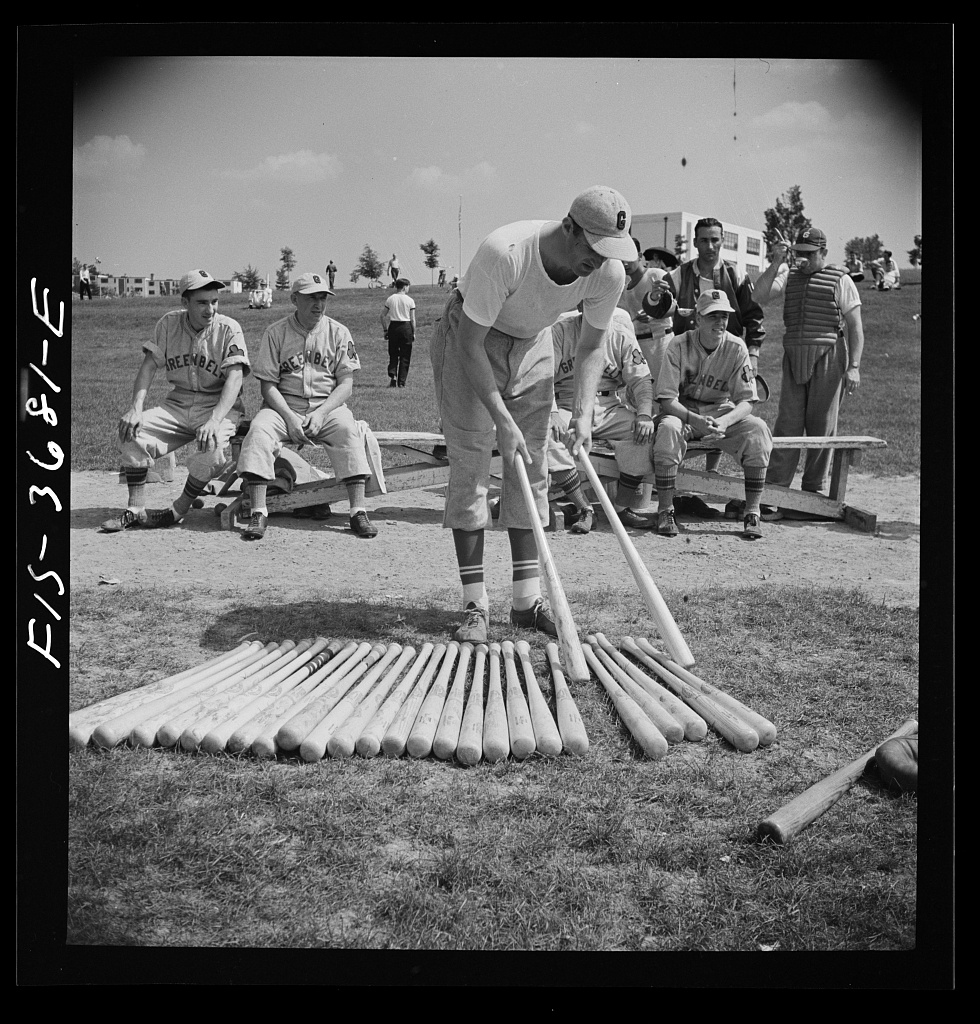
Image Credit: Marjory Collins “Greenbelt, Maryland. Member of the Greenbelt baseball team picking out a bat. On Sunday the team plays that of a neighboring town” (1942) Public domain image courtesy of the Library of Congress

Meg Freer: “Every Day Is a Bleak Day in the Towing Yard”

Every Day Is a Bleak Day in the Towing Yard


Stuffed animals crowd the dashboard
of a crumpled minivan at the towing yard,
not the usual assortment of tiny ones,
but large bears and dogs doomed to fade
in the sun under the watchful eyes
of the hawk who cruises the area.
No one cared enough, or didn’t get a chance
to remove them after the accident.
One day a new car shows up
whose vanity plate reads GR33NDAY,
not exactly an experience of itself
in this gravel field of smashed hopes.

About the Author: Meg Freer grew up in Montana and lives in Ontario, where she writes and teaches piano. Her work has appeared in RuminateArc Poetry, Rat’s Ass ReviewEastern Iowa Review, and many other journals. She is co-author of a chapbook, Serve the Sorrowing World with Joy (Woodpecker Lane Press, 2020) as well as author of A Man of Integrity (Alien Buddha Press, 2022). She holds a Graduate Certificate in Creative Writing with Distinction from Humber School of Writers.

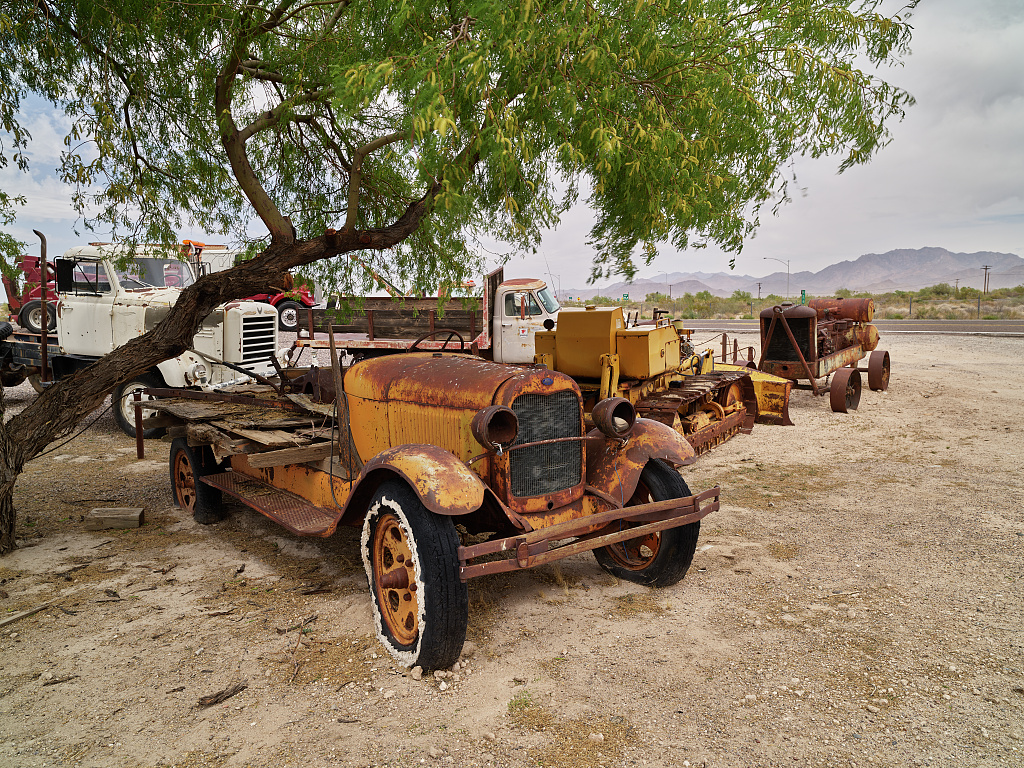
Image Credit: Carol M. Highsmith “Rusted relics in an “automobile graveyard” near Kingman, Arizona” (2018) Public domain image courtesy of the Library of Congress

In Memory of Mike James

As It Ought Be is mourning the loss of a great writer and friend, Mike James. When I took over as Managing Editor six years ago after the passing of AIOTB founder Okla Elliott, Mike reached out and contributed both his own work and his connections in the literary world to generate submissions. This gave the new AIOTB instant credibility, and it gave me the confidence and encouragement I needed to step into this new role. I’ve had the honor of working with and publishing countless brilliant writers because of Mike’s support. His talent as a poet is surpassed only by his talent for using poetry to build community and bring people together.

When Mike complimented publishers, editors, and other writers who used their platforms to showcase the works of others, he often liked to call them “a force for good.” It’s one of the highest compliments AIOTB has ever received.

Mike James, you were a force for good.

.

Below is a catalog of Mike James’ work on AIOTB from the past six years. It was always an honor to feature his work. In addition to poetry, Mike wrote many book reviews and essays that championed the work of the poets he admired. He was a model citizen of the literary world.

.

Poems

“Andy Says…”

“Questions and Answers”

“Code Names”

“Quotations”

“Consequences of Elections” 

“Supporting Characters” 

“Almost Autumn and Time to Go”

“Saint Jayne Mansfield” 

“Two Prose Poems”

“Gutter Angels”

“Moving Again” 

“Grace”

“Two Ghazals” 

“Paul Lynde”

“That One Singer”

“Beyond the Land of Misfit Toys”

“Oh Daddy, Give Me a Quarter for the Time Machine”

“Rebel, Rebel” 

.

Book Reviews and Poet Appreciations

Tim Peeler and the Life of the Poem

Howie Good’s Path of Most Resistance: An Appreciation

James Dickey: A Literary Life

Erotic by Alexis Rhone Fancher

Wave If You Can See Me by Susan Ludvigson

Once Upon a Twin by Raymond Luczak and New York Diary by Tim Dlugos

Beautiful Aliens: A Steve Abbott Reader and Have You Seen This Man? The Castro Poems of Karl Tierney

My Mother’s Red Ford: New & Selected Poems, 1986-2020 by Roy Bentley

Mingo Town & Memories by Larry Smith

“Dead Letter Office: Selected Poems” By Marko Pogacar

I love you and miss you, Mike.

Chase Dimock
Managing Editor
As It Ought To Be