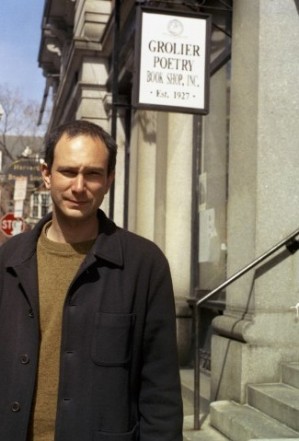
SATURDAY POETRY SERIES PRESENTS: KRISTIN GEORGE BAGDANOV

Kristin-George-Bagdanov

WE DISSOLVE SEPARATELY
By Kristin George Bagdanov

In the beginning was the word, was the
breath that shaped it, the mouth
that cupped the breath and the body
that made it. I am merely flesh, remaking

myself every seven years. I breathe to escape
my origin, caressing the unseen
with syllable like rings of smoke
that open to dissolve. Trust me, you will

always be alone. We will always be separate in time,
the distance between our bodies in bed
the distance between your death and mine.

We come together at night to pretend
that loneliness is an animal we can cull. But
I watch you sleep, hair splayed across your pillow,
slack mouth breathing for your singular life.


(Today’s poem originally appeared in Thrush Poetry Journal and appears here today with permission from the poet.)


Kristin George Bagdanov is an M.F.A. candidate in poetry at Colorado State University, where she is a Lilly Graduate Fellow. Poems of hers have recently appeared in or are forthcoming from The Los Angeles Review, 32 Poems, CutBank, Redivider, and Rattle. Her chapbook We Are Mostly Water was published by Finishing Line Press in 2012 as part of the New Women’s Voices series.

Editor’s Note: If I had to sum up today’s poem in one word it would be “powerful.” With this piece Kristin George Bagdanov takes on the heavy and the deep; without fear, without apprehension. “Trust me,” she tells us bluntly, “you will / always be alone.” We can love, but “We will always be separate in time, / the distance between our bodies in bed / the distance between your death and mine.” From its biblical entry—as captivating as the origin story it evokes—to its repeated waves of brutal honesty, today’s entry is as well-wrought as the human body in all its striking, singular existence.

Want to read more by and about Kristin George Bagdanov?
Kristin George Bagdanov’s Official Website
32poems
Flyway Journal
Rattle
Buy We Are Mostly Water from Finishing Line Press

SATURDAY POETRY SERIES PRESENTS: JOAN PRUSKY GLASS

Front Camera

THE BATHING SCENE FROM MARGUERITE DURAS’S THE LOVER
By Joan Prusky Glass

“Very early in my life it was too late.”
                          – M. Duras, The Lover

I read The Lover when I was fifteen.
The girl’s red doll lips became my own.
The power she had over
the Chinese man mine too.
His weakness became fuel
for a journey I was preparing for.
I needed him and despised him
before I knew why.

There is a scene in which
the man, on his knees,
bathes the girl’s slender body,
barely pubescent.
She looks down at him coolly,
braids hanging over her shoulders.
Immodest on purpose.

The lover draws a washcloth
across her hips tenderly,
with grief in his eyes.
Perhaps he is trying to wash
away the power he gave her.

She notices him loving her
the way you might notice
a penny tossed into the well
when your pockets
are filled to the brim.

(Today’s poem originally appeared in TRIVIA: Voices of Feminism and appears here today with permission from the poet.)

Joan Prusky Glass lives with her husband and three children in Derby, Connecticut. She is an educator and child advocate by profession. Her poetry has been published or is upcoming in Decades Review, TRIVIA: Voices of Feminism, Bone Parade, Milk Sugar, Harpweaver, Pyrokinection, Literary Mama, University of Albany’s Offcourse, The Rampallian, Visceral Uterus, Up the River, Haggard & Halloo, vis a tergo and Smith College Alumnae Quarterly among others.

Editor’s Note: What draws us into today’s piece, and what makes us resist against it? Where does the reader’s experience end and the poet’s begin? Where does the poet dissolve into the girl; where does the girl begin and her author end? Is today’s feature about power? Scandal? Sex? Love?

Today Joan Prusky Glass blurs the lines between perception and art, between experience and literature, between revulsion and beauty. The poet paints a watercolor of words, one vivid pigment bleeding into the next, so that we are both moved and unsteady. We are left not knowing where we stand; unsure of the medium, of the players, of ourselves.

Want to read more by and about Joan Prusky Glass?
“Inanimate Objects,” Bone Parade
Three poems, Offcourse
“Boredom Never Killed Anyone,” Visceral Uterus
“On the Death of a Neighbor,” Haggard and Halloo
“The Poet as a Young Girl,” Decades Review

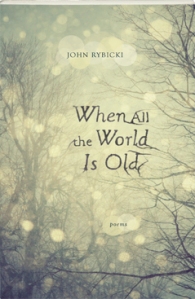
A Review of John Rybicki’s When All the World is Old

Rybicki3dforweb

A Review of John Rybicki’s When All the World is Old

By Kirsten Clodfelter

John Rybicki opens each section of When All the World is Old, his third poetry collection, with excerpts from journal entries written by his late wife, the poet Julia Moulds. Her voice echoes in brief flickers so that as we move forward into Rybicki’s own language, we hear her still: “I worry again and again about him losing me.” The weight of that loss—of knowing what trauma is coming before it’s yet arrived, and then, when it finally has, of learning how to navigate a way through it—is explored with candor and power in his stunning writing. Rybicki honors Moulds by building this book not just to her or for her or about her but also, in using her voice in the pages, literally of her—ensuring that his devastation becomes ours as well, a burden that weighs us down as we read, but maybe, in the tiniest way, is also one that we can help shoulder.

My mother was 41 when she died, just a handful of years younger than Rybicki’s wife, but they prepared differently. For my sisters and I, there was no tender last love note, no post-bath, steam-written secret message, no treasure to decode across the mirror or window or anywhere, later, no matter how willing we would have been to “place our mouths close to the glass” and “fog it with our breath / after she is gone.”

Rybicki writes about the kind of day-to-day living shaped by the long-shadowed awareness that the minutes we have left are diminishing; he admits, “It has been too much for too long and we know it / is time to take hold of the lightening and let it kill her…” and it’s cruel, the way we are tasked with somehow being our best, or happiest, or most loving selves in that final interim before the goodbye—if we are lucky or unlucky enough to have that kind of warning—while at the same time facing down the very worst things we can imagine. Rybicki asks, “Why can’t I say yes to the laughter in my chest?” But of course we already know why. It’s because we understand, as Rybicki understands, that his “wife is the center of it all. Everything grows / from her.”

So Rybicki does not laugh, but he does put on his bravest face. At her request: “Keep me safe,” he “is on his watch,” is “trying to smuggle her / out of a burning city,” careful to offer his reminder gently, “…Whatever you do, / love, don’t look back,” the way we might pull a blanket over the folded body of a person in our care when we find that they’ve fallen asleep on the couch. But Rybicki cannot shelter us from the truth—even the most impressive love we are capable of giving is not always enough to keep someone from leaving, and in the pages of this book we are asked to stand shoulder to shoulder with Rybicki and look back with him as the city smolders, to bear witness to the depth of his adoration and anguish, watching for the moment when he finally feels ready to “stand in defiance / of our parting and go to war to make you live again.”

In the months after her diagnosis, I used to catch my mother sneaking cigarettes in the bathroom. Smoke would leak through the door when, after wandering through the entire house, I’d finally think to crack it open and look for her there, interrupting—in the sudden and unceremonious way that children are always doing—her meager attempt at disappearance. She would fan her hand in front of her face frantically—the worst fucking magician you’ve seen in your life—and after the pinched, “Shit, shit,” and the tell-tale flush, she’d study me slyly and say, “Don’t tell your father.” Maybe in those moments she was thinking of our history, of the innocuous secrets we already shared and also of all the ones we wouldn’t, the things that at some point she must have realized she’d now never get to know—the first time I kissed a boy, had my heart broken, screwed up a friendship, found my footing and felt sure of the way forward, fell in love. Her voice was always very serious when she’d say this, or maybe it only appeared that way because of how easy it was by then to see the bones of her face—but those words weren’t a warning, they were a plea.

At ten, I was too young to understand why I should have been outraged to find my mother layering this extra poison into her body—cigarettes on top of radiation on top of chemo on top of cancer on top of cigarettes, but then, by the time I was old enough to reason that this action was selfish or ignorant, I was too young to understand that sometimes these little rebellions are a small pleasure, an anchor. When you’re dying, there are still things that need doing. There’s milk that needs to be bought, litter in the cat box that needs changed, lunches to pack before school, math homework that needs checking. So from time to time she snuck a cigarette—one of only a few choices she could still control, a type of ownership of her body’s betrayal. Who cares?

It’s the smallest things that we gather into our pockets and carry with us as daily reminders. In “On a Piece of Paper You Were About to Burn,” Rybicki recounts his desperate missing in glimpses and asks us not to look away: “You rock on the kitchen floor hugging your own legs, / weeping and kissing a face so tiny / you could cover it with a penny.” He’s seeking an answer, “How do you hold the dead,” and we don’t know either, so we keep reading to figure it out with him.

My daughter, 20 months old, loves to stand beneath a certain picture collage in our living room and hold her hands above her head, calling, “Up, up,” so that she can be lifted to honk the nose of each subject in the photographs, proudly naming us as she points, “Momma, Dada, Bebe.” When I am the one doing the holding, she is the most interested in pictures of her father, and I offer tiny, sing-song consolations, “Daddy’s at work,” “… at the store,” “…will be home right after nap.” But I am capable of imagining, in a different circumstance, the exact way it would break me right open to hear the squeal of this question each morning as we looked at those photographs and not have a single way to explain that Dad won’t be home at 4:30 or with hugs or groceries or ever again, and to think of it always leaves me in tears, the pain of that loss—just the idea of it—fresh and immediate and real even when my partner is in the next room watching television or asleep beside me in our bed.

In a collection that easily calls to mind other aching and beautiful homages to the way we survive after loss, like Mary Jo Bang’s Elegy and Donald Hall’s Without, John Rybicki’s poems in When the World is Old force us toward these moments of consideration with urgency—a reminder, perhaps, to keep our perspective or practice gratitude for the collection of small, warm moments we are gifted to share with others, because eventually the people we love are going to leave us—and no matter when that is, no matter how long we’ve had to prepare—it’s going to be too soon.

John Rybicki, When All the World is Old, Lookout Books, 2012: $13.50 (direct)/$16.95.

***

Kirsten Clodfelter holds an MFA from George Mason University. Her writing has been previously published in The Iowa ReviewBrevity, and Narrative Magazine, among others. A Glimmer Train Honorable Mention and winner of the Dan Rudy Prize, her chapbook of war-impact stories, Casualties, was published this October by RopeWalk Press. Clodfelter teaches in Southern Indiana, where she lives with her partner and their awesome, hilarious daughter. KirstenClodfelter.com, @MommaofMimo

SATURDAY POETRY SERIES PRESENTS: KAREN CRAIGO

1481411_10101596793016000_248693651_n

DEATH BY WATER
By Karen Craigo

You imagine the ark
from the outside, the way
most people saw it—shuttered,
huge, already starting to stink.
And there you are beside it,
treading water, reaching out
to touch the unsanded hull,
throat raw from pleading.
Most of us lead dry lives
with a few moist moments
we live for. Which is why
this death is the one
we were born to. Inside
we’re water and bones,
and so we bob on the waves
like a bag of sticks. Once,
all humanity was a forest, felled.
You can put your head under
and remember: didn’t you surge
into this world on a wave, crying,
your mouth full of salt?

(Today’s poem originally appeared in Prairie Schooner and appears here today with permission from the poet.)

Karen Craigo teaches English to international students at Drury University in Springfield, Missouri. A chapbook, Someone Could Build Something Here, was just published by Winged City Chapbook Press, and her previous chapbook, Stone for an Eye, is part of the Wick Poetry Series. Her work has appeared in the journals Atticus Review, Poetry, Indiana Review, Prairie Schooner, Puerto del Sol, The MacGuffin, and others.

Editor’s Note: Against a backdrop of biblical associations, Karen Craigo uses startling, hauntingly beautiful, idiosyncratic imagery to offer incredible insight into the human experience. As readers we are enveloped in that which is at once as old as time and as present as the moment at hand. With Craigo’s words, we are flooded. We, as individuals and as a people, are drowning. But so, too, are we called upon to confront the memory that we surged “into this world on a wave, crying,” our mouths “full of salt.”

Want to read more by and about Karen Craigo?
Buy Someone Could Build Something Here from Winged City Chapbook Press
Atticus Review
Blue Lyra Review
Hobart

SATURDAY POETRY SERIES PRESENTS: SABINE HUYNH

Sabine-HUYNH-fiche Photo by Anne Collongues.


FAREWELL CHILDHOOD
By Sabine Huynh

It’s hard not to think
of a place where dogs met
their fate on railway tracks
or in unkempt backyards
where a father with chapped lips planted
tulips around a dying cherry tree
where a mother’s screams scared
dust and kids into dark corners
where children watched T.V.
in the garage – why in the garage? –
where they played with a wheelbarrow
inside, and paper cut-outs
outside, yet they lived in town
it’s hard to ignore
a fact like that

I can only think of it here
facing the sunny Golan heights
with hummingbirds punctuating
my glum memories with gaiety
and cows’ mooing filling up
the deep valley of the past
a flying ant above my head
a white falcon perched on my thumb

if I thought of it there
where it all happened
I’d turn into that
silent child again
and never come back
but I’m here now
I have opened the windows
to let the landscape in
and the childhood out.

(Today’s poem originally appeared in Cyclamens and Swords and appears here today with permission from the poet.)

Sabine Huynh is a Vietnamese-born poet, novelist and translator. Raised in France, she has lived in England, The United States, Canada, and Israel. She writes in both French and English. Her poetry and her poetic translations have appeared in various literary journals and anthologies. She is the author of a poetry anthology, a novel, a collection of short stories, five poetry collections (four in French: two were published, two await pending publication; and one in English, not published yet), and she has translated four poetry collections (from Israel, Canada, and England).

Editor’s Note: In today’s post Sabine Huynh manipulates everyday language to transport us to a vivid past. There is a darkness beneath the light of the poem, and questions remain unanswered—buried—as the poet wants them to. But readers and the poet alike are given permission to let go of haunted memories, to make the life we want for ourselves when Huynh opens the windows for us all, “to let the landscape in / and the childhood out.”

Want to read more by and about Sabine Huynh?
Sabine Huynh’s Official Website
The Ilanot Review
Reiter’s Block
Additional poems in Cyclamens and Swords
Sabine Huynh’s English-to-French translations of an SPS favorite, Dara Barnat

What Would Stephanie Say?

"Microcosm 12" by Stephanie Goehring
“Microcosm 12” by Stephanie Goehring

Editor’s Note: The What Would I Say app is turning all of us into weird, self-involved robot poets. Stephanie Goehring shares some thoughts on this social media phenomenon and an in-progress poem composed entirely of her own What Would I Say results:

What Would Stephanie Say?

Probably That I’m a Narcissist (But That’s OK)

By Stephanie Goehring

A friend of mine, a fiction writer, keeps joking on Facebook about how obsessed poets are with the What Would I Say app. And it’s true: Just about all of the What Would I Say posts in my news feed have come from writers, and the poets are the ones who seem to be totally losing their minds over it.

When I first used this website, my thought process went something like this: Oh, this is hilarious. This is really interesting. This is beautiful. This is nonsense. But then I started thinking about how many people were posting results from the website that only seemed to fall into the latter category. So why were they flooding all of their friends’ news feeds with this garbage? And of course the answer is because they think their bot-self statuses are hilarious or interesting or beautiful. Even when the reality is that the particular post is bullshit. But we post it because it’s our own bullshit. In fact, it’s bullshit made of our own bullshit. It’s something we posted on Facebook (so, really, what’s the value of the initial language the bot is working with?) and then we repost it, garbled, as if that means anything.

But it does mean something. It says something about our collective narcissism. It says something about how we are constantly recording our own lives rather than and in addition to living them, how we all repeatedly throw ourselves against the wall of the Internet so that we can hear the echo. And that’s disgusting, but it’s also amazing. Because we aren’t the only ones who hear the echo.

And for poets in particular, I think that’s part of what makes What Would I Say so enticing: It’s replicating the experience of writing a poem. Language comes from you (meaning from everywhere else, too), is ordered (or disordered) and then thrown against the wall of the world so that it can become a sound that made another sound.

I wanted to do something with that: take the Facebook Stephanie that the Internet threw against the wall of itself and try to get that Facebook Stephanie to make a sound of her own—one that might matter to someone else. And I wanted to avoid using this bot-generated language to write a poem about poetry itself because that would just be an example of this kind of narcissism: A poem that gazes at its own navel to me seems far worse than a person who does (even if that person does so while taking a selfie and then posts it on Facebook).

Narcissism

In the parking lot when photographing your own intense feelings
only you should be disgusting like the march of the national anthem.
I don’t have a state dance. We need more than my empty living.
I had a lengthy conversation with the whole world
in a sequined dress and eating cold south winds gusting to go.
I like to recognize me, squeeze the tornado threat,
watch crowds of my blood, the dancing girl who tells me
I hear someone who intimidates people like a swimsuit model.
I’ve decided to be able to be italicized.
We need to reach me. You can do it
if you are the time, all of the supermoon.
Oh I still feel like four hours ago
except that I keep rereading my phone.
I’ve decided to be the word.
Fun fact for sale:
You can make a disciple. They lay eggs
in the box, looking for creative writing like you.
I hear you, and mentally, so hot tub connected.
I’m saying a word is cheap and get the stomach flu.
You can love YouTube.
Did you know it’s a fucking universe?
A blind contour drawing of drunk girls
losing someone else’s virginity?
When I rotate my arm, everything will take forever.
I will trigger scattered thunderstorms,
break his neck in his elementary school,
eat the playground and then venture out.
Even music wouldn’t do this listening to the rest of its life.
So am I. So if you
get punched in the universe,
try to write a cute photograph
thinking about the seasons as if we need you.

*The language in this poem is bot-generated in its entirety, with only capitalization and punctuation changed.

***

Stephanie Goehring is co-author, with Jeff Griffin, of the chapbook I Miss You Very Much (Slim Princess Holdings, 2011/13) and author of the chapbook This Room Has a Ghost (dancing girl press, 2010). She is also a visual artist. Find her online here.

SATURDAY POETRY SERIES PRESENTS: LINDA STERN ZISQUIT

DSC_0396 (2)
POSIT
By Linda Stern Zisquit

“Ten measures of beauty came down into the world;

Nine were taken by Jerusalem, one by the rest of the world.”

                                                                         Tractate Kiddushin


“Ten parts of suffering came down into the world; nine

were taken by Jerusalem, one by the rest of the world.”

                                                                         Avot d’Rabbi Natan


Had Rachel not looked up

Jacob would not have seen her.

There would have been no water,

no winding dream,


no tribe or unrelenting

portion of sadness

dispersed on his land, his Jerusalem,

and I would not have promised


to gather then home. But Rachel

saw him and he loved her.

She was barren and she suffered

and she followed him.


So I have this heaviness

to bear. Her life before him

had also the dailiness of lives,

an hour at which she would rise and go


to the well. Then out of the blue

her future came crashing against her lids

when she looked up, those hours changed,

and I was moved to his, another well.


(Today’s poem originally appeared in the collection Ritual Bath (Broken Moon Press, 1993), was recently published in The Ilanot Review, and appears here today with permission from the poet.)


Linda Stern Zisquit has published four full-length collections of poetry, most recently Havoc: New & Selected Poems (Sheep Meadow Press, 2013). Return from Elsewhere, her fifth volume of poetry, will be published in Spring 2014. Her other books are The Face in the Window (2004), Unopened Letters (1996), and Ritual Bath (1993). Ghazal-Mazal, a chapbook, appeared in 2011. Her translations from Hebrew poetry include These Mountains: Selected Poems of Rivka Miriam (2010), a finalist for the National Jewish Book Award, Let the Words: Selected Poems of Yona Wallach (2006), Wild Light: Selected Poems of Yona Wallach (1997), for which she received an NEA Translation Grant and was shortlisted for the PEN Translation Award, and Desert Poems of Yehuda Amichai (1991). Her work has appeared in journals including The Denver Quarterly, Harvard Review, Paris Review, Ploughshares, The Southern Review, Salmagundi and the Virginia Quarterly Review. Born in Buffalo, NY, Zisquit has lived in Jerusalem with her husband and five children since 1978; she is Associate Professor and Poetry Coordinator for the MA in Creative Writing Program at Bar Ilan University, and runs ARTSPACE, an art gallery in Jerusalem representing contemporary artists.

The Ilanot Review, where today’s poem recently appeared, is a biannual journal of creative writing which publishes a stellar selection of poetry, fiction, non-fiction, and literary interviews. The journal publishes two themed issues a year, inviting submissions from English-language poets and writers from anywhere in the world. The Ilanot Review is currently seeking submissions for its winter 2014 edition, through November 30th. The theme of the winter 2014 issue is sacred words.

Editor’s Note: Today’s selection contemplates the question so many of us are wont to ask: “What if?” In today’s piece the poet straddles two worlds; her own life and the biblical tales that shape so much of our modern lives. Within the poet’s words her own life is inextricably linked with the biblical love story of Rachel and Jacob. “Had Rachel not looked up / Jacob would not have seen her,” the poet posits, “But Rachel / saw him and he loved her,” and “So I have this heaviness / to bear.” Had the stories of our people unfolded differently, the poet seems to say, so, too, would our own lives now be different. Time, place, religion, literature, and the poet’s own path are conflated as the poem considers the universal themes of belonging, suffering, love, home, and self.

Want to read more by and about Linda Stern Zisquit?
Buy Havoc from Sheep Meadow Press
Sheep Meadow Press Author Page
Buy Unopened Letters from Amazon
ARTSPACE Gallery

SATURDAY POETRY SERIES PRESENTS: KEVIN VARRONE

1384718_678840042150824_1069769642_n
POEM I WROTE SITTING ACROSS THE TABLE FROM YOU
By Kevin Varrone

if I had two nickels to rub together
I would rub them together

like a kid rubs sticks together
until friction made combustion

and they burned

a hole in my pocket

into which I would put my hand
and then my arm

and eventually my whole self––
I would fold myself

into the hole in my pocket and disappear

into the pocket of myself, or at least my pants

but before I did

like some ancient star

I’d grab your hand


(Today’s poem originally appeared on Poets.org from the Academy of American Poets and appears here today with permission from the poet.)


Kevin Varrone’s most recent project is box score: an autobiography, recently published as a free, interactive app for iPhone and iPad (available at the iTunes/app store or at boxscoreapp.com). His other publications include Eephus, Passyunk Lost, The Philadelphia Improvements, Id Est, and g-point Almanac: 6.21-9.21. He is a 2012 Pew Fellow in the Arts, teaches at Temple University, and lives outside Philadelphia.

Editor’s Note: Today’s poem was a recent Poem-A-Day via the Academy of American Poets. As such, it was forwarded to me by doctor poet Jenny Stella, because she thought I would like it. Because of this, I dedicate today’s poem to Dr. Stella.

When I read today’s poem for the first time I was immediately reminded of the poet Nicolas Destino, whose work has been featured here on As It Ought To Be many times. If I were sitting across the table from Nicolas Destino, this is the kind of poem I would like to write for him. Because of this, I dedicate today’s poem to Nicolas Destino.

Today’s piece rides a wave of imagination until it finds a landing pad deep within the heart. First, the day-to-day is imbued with magic when the poet invents a world in which he can burn a hole in his pocket and, through it, disappear into himself. Then love and friendship smile from between the lines when the poet promises the one sitting across the table that, “before I did [disappear] / like some ancient star // I’d grab your hand.”

Want to read more by and about Kevin Varrone?
Box Score: An Autiobiography
Eephus (from Box Score)
Elective Affinities
Books from Ugly Duckling Presse
g-point Almanac from SPD Books

Partita & Sea Ridge

Erik Noonan

Partita & Sea Ridge

by Erik Noonan

honest devices – John Donne

Effulgent canopies of cornflower and aquamarine
overhang this fixed landscape where memory stands
watch over our earliest walks and drives as one
where by and large I dreamt up an eirenical piece
written out of a humble and afflicted heart
long on resilience short on dark cheer
and resolved to unlearn deceit beside her although in a little thin house
forego preferment along with los negocios and skinny love
and instead compare pleasantries savor household tasks
and so attend to the Umgangssprache as to lonely young friends near and far
rather than be outmaneuvered by an insolent and leonine demimonde
sharpening its recriminations for corner pocket Machtpolitik after hours.
From here we could just make out certain agents of the kairos now and then
when they alighted upon a bare twig midway from table to basin.

***

Erik Noonan is originally from Los Angeles. He was educated at Hampshire College and the New College of California. His poems, stories, reviews, articles and critical writings have appeared in various print and web periodicals, as well as the collections Stances (Bird & Beckett, 2012) and Haiku d’Etat (Omerta, 2013). His working experience in schools includes program and curriculum development, administration, accreditation compliance, internal liaison, community outreach, event planning, test preparation, deanship and counseling. As a classroom instructor trained in the historical study of literary texts and the communicative approach to language learning, he teaches both Literature and English as a Foreign Language. Erik lives in San Francisco with his wife Mireille.

SATURDAY POETRY SERIES PRESENTS: NADAV LINIAL

3111359842Left to right: Translator Joanna Chen and poet Nadav Linial. Photo courtesy of Joanna Chen.


PRECISION
By Nadav Linial
Translated by Joanna Chen

At the edge of the garden dew hovers on the iron fence
leaving traces of rust like remembrance

And in the house someone strips artichoke spikes
down to the sweet white heart like layers of forgetfulness.

In the orchard the cells of honeycomb spill over
the hollow body of the tree like tears

And at the edge of the field rain pierces the rock
like yearning.

How can an image capture a name
or speech describe the voice that
broke out when the grain of the soul was
separated from the chaff of the flesh?

I loved you like I loved you.


(Today’s poem originally appeared in the collection Tikrat Haadama [Earth Ceiling] (Keshev Publishing House, 2010) and in Haaretz, and appears here today with permission from the translator.)


Nadav Linial was born in Jerusalem in 1983 and lives in Tel Aviv, teaching in the literature department at Tel Aviv University. His first book, “Tikrat Haadama” (Earth Ceiling), in which this poem appears, was published in 2010 by Keshev Publishing House and was awarded two major prizes for young poets.

Joanna Chen is a British-born poet, journalist and translator. She has written extensively for Newsweek, The Daily Beast, Marie Claire and the BBC World Service. Her poetry and poetic translations were most recently published with Poet Lore, The Bakery, and The Moon Magazine, among others. The translator of today’s poem, Joanna Chen was last week’s featured poet here on the SPS.

Editor’s Note: How can we write about love? Have words ever failed so completely as they do in this? Can a simile adequately describe love? Can a picture painted with words even begin to portray that which is inscribed upon the heart? These are the questions percolating beneath the surface of today’s poem.

For me, as a reader, today’s piece elicits a new kind of love. A love of words themselves, whether or not those words are able to capture that which they seek to describe. How heartbreaking the lyric, how lovely the images. How breathtaking to think of love as physical things, that remembrance can be left like rust, stripped away like forgetfulness. What connection I feel to the powers that be when I imagine the grain of the soul separated from the chaff of the flesh.

In the end, the poet abandons metaphor, admits there are no words that will suffice for love. “I loved you like I loved you.” This, he posits, is the best that words can do. A sparse phrase that tells us nothing and everything at once. I know what it is to have “loved you like I loved you.” Don’t we all?

Want to see more by and about Nadav Linial?
Video: Israeli Center for Libraries (in Hebrew)