SATURDAY POETRY SERIES PRESENTS: SPRING!

photo 3Spring’s first flowers spotted this week in New York’s Jefferson Market Garden.


WITH A BUNCH OF SPRING FLOWERS
By Kate Seymour Maclean

In the spring-time, out of the dew,
      From my garden, sweet friend, I gather,
      A garland of verses, or rather
A poem of blossoms for you.

There are pansies, purple and white,
      That hold in their velvet splendour,
      Sweet thoughts as fragrant and tender,
And rarer than poets can write.

The Iris her pennon unfurls,
      My unspoken message to carry,
      A flower-poem writ by a fairy,
And Buttercups rounder than pearls.

And Snowdrops starry and sweet,
      Turn toward thee their pale pure faces
      And Crocus, and Cowslips, and Daisies
The song of the spring-time repeat.

So merry and full of cheer,
      With the warble of birds overflowing,
      The wind through the fresh grass blowing
And the blackbirds whistle so dear.

These songs without words are true,
      All sung in the April weather–
      Music and blossoms together–
I gather and weave them for you.


(Today’s poem is in the public domain, belongs to the masses, and appears here today accordingly.)


Kate Seymour Maclean (1829-1916): Born in Fulton, New York, seemingly as “Chloe Ann Seymour” and educated at the Falley Seminary, Kate Seymour moved to Canada a few years after her 1857 marriage to Allan MacLean of Ingersoll, Ontario. She was well known as a poet in her day, producing three volumes of verse and publishing frequently in Canadian and American magazines. Her first book, The Coming of the Princess, And Other Poems (1881), is prefaced by Graeme Mercer Adam, then editor of the Canadian Monthly. Loyal to her adopted country, MacLean became a strong advocate of the “Canada First” movement. She died in Toronto at the age of 86. (Biography courtesy of The Simon Fraser University Library.)

Editor’s Note: If you are an avid reader of this series, you have faithfully read along as I lamented this year’s winter and dared Mother Nature to bring on the spring. This week, spring has finally arrived. The cherry blossoms are bursting in all their glory in Washington D.C., and here in New York City there is warm weather and sunshine, the first cherry blossoms have been spotted on the trees, and spring flowers can finally be seen lining the streets and blooming in the parks.

If you read this series, you know how we on the East Coast have suffered this long winter, and you know how anxiously your faithful Editor has awaited spring. Today I am happy to report that SPRING IS HERE, and in its honor I offer you “A flower-poem writ by a fairy,” “sung in the April weather,” “Music and blossoms together.” To celebrate spring’s arrival, here is a poem in the form of a bouquet, “gather[ed] and weave[d] … for you.”

Want to see more by Kate Seymour Maclean?
All Poetry
Public Domain Poetry

A Review of Catherine Pierce’s The Girls of Peculiar

Pierce Girls of Peculiar

A Review of Catherine Pierce’s The Girls of Peculiar

By Jennifer Dane Clements

Catherine Pierce’s second poetry collection, The Girls of Peculiar, resurrects the gangly and awkward ghosts of adolescence, in turns honoring and questioning those young spectres. Indeed, it is impossible to read The Girls of Peculiar and not consider one’s own unglamorous coming-of-age, from the sensation of “a globe welling up inside” to “that red ache that came from lying/to our mothers.”

For me, The Girls of Peculiar harkened back to the brick school buildings and blue carpeted halls where my own teenage years were spent. But Pierce’s words ring universal:

Last year you weighed more. This year you’re as tall
as you’ll get, and there’s a boy whose eyes are poisoned
marbles. You’ve photographed him again and again
but you can’t get the poison right. You’re sixteen.
You say this again and again but you can’t believe it.
(Fire Blight)

I went to a high school built by women, for women. There were the things we were told, that we were strong and intelligent and the leaders of tomorrow, and would not be stifled by gender inequity. We were taught by incredible women and introduced to women who defied the expectations of the world. We were bound to the women who had walked those carpeted halls before us, phantoms of girls past that we, like our predecessors, were destined to become.

We never cooled
with twilight. We were busy prowling
by the river; sending our lit eyes into tree hollows,
beneath parked cars.
(The Delinquent Girls)

And there were the things we knew that we didn’t have to say, that perhaps our parents and teachers didn’t wish to acknowledge. Some of us had eating disorders, or inflicted self-harm, or saw shrinks for diagnoses we didn’t have to secure medications we didn’t need. We identified as adults in ways that ranged from noble to naive. We had sex with older men. We pulled all-nighters on school grounds with the strange and forbidden blessing of our teachers. We hung out in rough parts of town, oblivious to how our uniforms marked us as young and entitled and unattainable in ways we couldn’t know. We wielded our small rations of power in a dozen micro-rebellions a day, then tucked in our shirttails and learned algebra.

We were all flavors of adolescent girl kept in one place, and nothing has quite captured that dynamic as accurately as The Girls of Peculiar.

But I’m so tired of the small steps–
the pentatonic scale, the frequent flyer
hoarding, the one exquisite sentence
in a forest of exquisite sentences.
There is a globe welling up inside of me.
Mountain ranges ridging my skin,
oceans filling my mouth. If I stay still
long enough, I could become my own world.
(Because I’ll Never Swim in Every Ocean)

Poems like “Dear Self I Might Have Been,” “Before the Reunion (Her Lament),” and “Postcards from her Alternate Lives,” look backward, from a vantage point informed by several decades. Resisting the nostalgic, they instead acknowledge the difficulties of youth, moving into the “long highway days of your twenties” and beyond. Each of these poems serves as a postscript to old yearbooks, answering the question of what we’ll become: One girl writes speeches for the First Lady. One girl married the bus driver. One works for the CIA. One remains a virgin at 30.

For some of us, the school-age moments feel lifetimes old; for some of us, as close as this morning’s latte. But The Girls of Peculiar has nothing to do with wanting to return to those days–its poems are elegies, truthful monuments to the myths, the expectations, and the anxieties we carried in youth.

This is every house on your block
lit from within, each bedroom window
shining with safety and you outside
in the icing dusk, knowing nothing
will ever warm you….
The Future? This is The Future
If you were here, you’d know that.
(The Girls We Were)

Twelve years past high school, I am tempted to wrap a copy of The Girls of Peculiar and send it to my school’s newly appointed headmaster, the first woman to oversee the school in decades. Pierce’s collection seems the briefest and most comprehensive reminder of how burgeoning adulthood feels to “the delinquent girls,” and “the quiet girls,” and “the drama girls,” and then all of them together–a manual of understanding and a call to empathy.

Let these strangenesses be like the impossible lizard’s
tail: gone forever, because how could it be otherwise,

and then reappearing, iridescent and blood-warmed,
because how could it be otherwise?
(For This You Have No Reason)

And what could be more vital to someone newly charged with overseeing all of those girls, and all of the peculiars in which they–for the moment–reside.


Catherine Pierce, The Girls of Peculiar. Saturnalia Books, 2012: $14.00.

***

Jennifer Dane Clements received her MFA in creative writing from George Mason University, where she served as Editor-in-Chief of So to Speak: A Feminist Journal of Language & Art. A writer of prose and plays, she has been published in WordRiot, Nerve, and Psychopomp and has had plays produced by Capital Repertory Theatre (Albany, NY), Creative Cauldron (Falls Church, VA), and elsewhere. Clements currently works at a theatre-service organization and serves as a prose editor for ink&coda. More at jennifer-dane-clements.com.

SATURDAY POETRY SERIES PRESENTS: ONLY RIDE

OnlyRide-Front

from ONLY RIDE
By Megan Volpert:


Screen Shot 2014-04-04 at 3.16.20 PM

Screen Shot 2014-04-04 at 3.18.58 PM


Screen Shot 2014-04-04 at 3.20.28 PM

Screen Shot 2014-04-04 at 3.29.11 PM


Picture 1

Picture 3


Today’s poems are from Only Ride, published by Sibling Rivalry Press, copyright © 2014 by Megan Volpert. “You are suspended” was first published in This assignment is so gay, edited by Megan Volpert and published by Sibling Rivalry Press. These poems appear here today with permission from the poet.


Only Ride: If Denis Johnson had written Tuesdays with Morrie, it’d feel like Megan Volpert’s book of prose poems. Clawing its way out through this minimalist checklist of suburban malaise is an emphatically optimistic approach to growing up. These tiny essays carefully detail how to avoid becoming one’s parents, how to manage a body addled by disease, and how to keep having the best possible time in life. After all: this is the only ride there is, and we can only ride it. Volpert’s is a story of Springsteenian proportions, a gentleman’s guide to rebellion complete with iron horses and the church of rock & roll.

Megan Volpert is the author of five books on communication and popular culture, most notably about Andy Warhol. She has been teaching high school English in Atlanta for the better part of a decade, and is currently serving as her school’s Teacher of the Year. She edited the American Library Association-honored anthology This assignment is so gay: LGBTIQ Poets on the Art of Teaching, which is currently a Lambda Literary Award finalist. Predictably, www.meganvolpert.com is her website.

Editor’s Note: Megan Volpert’s Only Ride is a no-holds-barred journey through personal history, with sage wisdom bursting from its rough-and-tumble seams. The book is less Zen and the Art of Motorcycle Maintenance and more Get a Grip and Ride Like it’s Your Only Ride. This is a book about how to live life. Suck it up and move past the childhood issues that scarred you. Don’t just cope with illness, thrive in the face of it. Live life full throttle no matter what it throws at you, because life is short and living demands fierce courage.

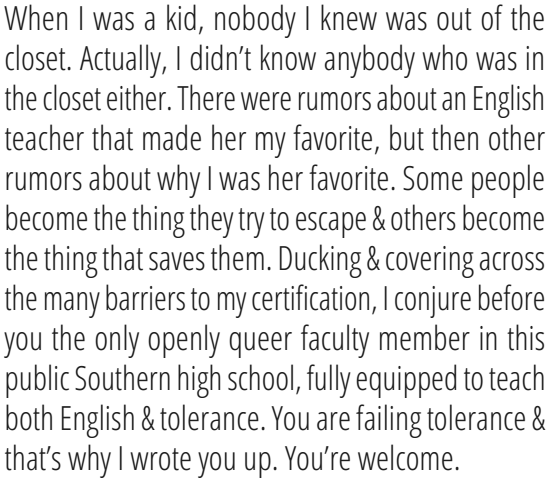
Throughout her journey Volpert takes personal and political stands, inspiring her readers to do the same. Sometimes you’ve just gotta smash things, because “a deep frustration that hurls pottery against the concrete floor… is not the thing to bottle up in shame.” Sometimes a teacher has a responsibility to teach more than just standard curriculum. As “the only openly queer faculty member in [a] public Southern high school,” Volpert is “fully equipped to teach both English & tolerance,” and she’ll write a student up for failing the latter.

Brimming with humor and hubris and wicked wit, the greatest gift of this book is the life lessons it relays. Stand up for what you believe in. Move past life’s bullshit and face adversity with a battle cry. Let go of the small stuff. “Many things annoy me,” Volpert confides, “but I seldom get really angry because now I just feel so lucky to be alive.” And we all should, the implication echoes. In a world where “[d]eath knocks twice: once for introductions & once to take you away,” why waste your precious life letting things get your goat? Having faced death, the poet gave her goat away; she has no goat to give. And we would all be well served to follow her example. “After all: this is the only ride there is, and we can only ride it.”

Want to see more from Megan Volpert?
Official Website
This assignment is so gay
Sibling Rivalry Press
FRONTIER PSYCHIATRIST

SATURDAY POETRY SERIES PRESENTS: LAURA YES YES

1970703_10152671596109251_151820833_n
By Laura Yes Yes:

SALEM 1994
(With touring partner Kim Johnson)

Courtesy of Jason Flynn’s youtube channel.


COLLEGE TRANSCRIPT

Courtesy of West Side School for the Desperate’s youtube channel.


Laura Swearingen-Steadwell (AKA Laura Yes Yes) has competed in slams nationwide, notably as a finalist in 2010’s Women of the World Poetry Slam. She tours and leads workshops as part of the queer female duo Shadowboxers Anonymous. Laura’s first book, How to Seduce a White Boy in Ten Easy Steps, was nominated for a National Book Award. She is currently an MFA candidate at Warren Wilson College.

Editor’s Note: I had the pleasure of seeing Laura Swearingen-Steadwell perform at louderARTS this week. louderARTS is home to a longstanding open mic, reading series, slam forum, and workshop series. Monday nights in Manhattan’s Bar 13 have been turning out the likes of Roger Bonair-Agard, Ocean Vuong, Elana Bell, Sabrina Hayeem-Ladani, John Paul Davis, Regie Cabico, and countless other rising stars and champions of the written and spoken word for years. The tradition continues every week. Show up at 6:00, like I did, and be treated to a FREE writing workshop with louderARTS members and visiting workshop leaders. I was lucky enough to kick off my evening with a workshop lead by today’s featured poet.

When Laura Swearingen-Steadwell opened up “Salem 1994” by inviting us all to join in a Kumbaya-esque rendition of Alanis Morissette’s “You Oughta Know,” I was all in. When the performance morphed into a feminist celebration of the songstresses who have been writing and performing the soundtrack of my life since I was fourteen years old, the poet officially had a new fan. When she performed “College Transcript” we were all invited to call out “brain,” “cunt,” “liver,” “fist” to accompany each of the poet’s hand gestures. It was fun. It was interactive. It was engaging. And it was truth, spoken from the poet’s own honest experience to resonate with our own. This is a poet who speaks her mind, who speaks her heart, who tells it like it is, unafraid, claiming the world for herself and for us all.

Want to see more by Laura Yes Yes?
“Habitat”
“Octopussy: The Playboy Interview”

SATURDAY POETRY SERIES PRESENTS: LIZZIE LAWSON ON SPRING

1185601_827625185839_902627425_nPhoto by Lydia Polimeni.


SPRING
By Lizzie Lawson

The tiny crocus is so bold
           It peeps its head above the mould,
           Before the flowers awaken,
To say that spring is coming, dear,
With sunshine and that winter drear
           Will soon be overtaken.


(Today’s poem is in the public domain, belongs to the masses, and appears here today accordingly.)


Lizzie Lawson (circa 1867–1902 OR 1858-1905) appears to have been a poet and children’s visual artist. This is a rare instance in which I was able to find many poems by the poet, but almost no biographical information whatsoever. The woman appears to have been lost to us, while her artistic creations remain. If anyone knows about the biography of this enigmatic artist, please share with us in the comments below!

Editor’s Note: Crocuses have been spotted on the east coast, “To say that spring is coming.” (See photographic evidence from photographer Lydia Polimeni above.) In fact, the first day of spring has come and gone. But… we here in the northeast expect snow next week, and are facing record lows for the beginning of spring. So, today’s entry is a kind of a rain dance, or, rather, a spring dance. A call to the powers that be: Bring on the spring! Bring on the sunshine! Bring on the—dare I say it?—warmth!!! Let the crocuses be the sign “that winter drear / Will soon be overtaken.” For we have had our fill of winter drear, thank you very much.

Want to see more by Lizzie Lawson?
Public Domain Poetry
Visual Art

SATURDAY POETRY SERIES PRESENTS: THE ARROW

Picture 9


from THE ARROW
By Lauren Ireland


Picture 4


Picture 8


Picture 7


Today’s poems are from The Arrow, published by Coconut Books, copyright © 2014 by Lauren Ireland, and appear here today with permission from the poet.


The Arrow: “It took almost a lifetime’s worth of emotions to read Lauren Ireland’s THE ARROW. She says Time eats at the edges of things so we hear her say other things, too, I am hating you from very far away and I am a grownup/flying right into the mouth of fear. This book is fraught with emotional emergencies, sometimes reckless, almost a little demented as one has to be when one faces who and what and where and how we are. Lucky for Ireland there are friends to whom many of these poems are dedicated who accompany her as she’s permanently lost in this very very mysterious flight we all share.” —Dara Wier


Lauren Ireland grew up in southern Maryland and coastal Virginia. She is a graduate of the MFA program for Poets and Writers at the University of Massachusetts-Amherst and an editor at Lungfull! Magazine. Lauren is the author of Dear Lil Wayne (Magic Helicopter Press, 2014) and two chapbooks, Sorry It’s So Small (Factory Hollow Press, 2011) and Olga & Fritz (Mondo Bummer Press, 2011). She co-curated The Reading at Chrystie Street in New York. Currently, she lives in Seattle with her husband and her husband’s cat.


Editor’s Note: As I read Lauren Ireland’s The Arrow I pushed against the book’s air of flippancy, its self-preservation in the guise of farce and self-deprecation, its false oaths of apathy. These are, as Naomi Shihab Nye would say, “the armor [the book] put[s] on to pretend [it has] a purpose in the world.” But this book does not need to pretend. It wears its armor as a tricked out husk around its fervent vulnerability. The poems within its pages are the bloodlettings of a twisted, tortured, and exceedingly human mind.

The Arrow is full of moments of lyric beauty and stunning, brutal clarity interwoven with equal portions of heaviness and frivolity that make for quite the witches’ brew. There is something unsettling about this book. Something that does not sit well. A wound or scab that begs to be healed yet must be picked at. I was often uncomfortable reading it, yet I could not put it down. I was drawn to the beauty and put off by the grotesque, and I believe this was meant to be the author’s poetic commentary on life. Life—like this book—is full of debauchery and death, fear and imagination, the mundane and the absurd. Love is inextricably linked with hate. There is a thin line between reality, waking dreams, and nightmares. This book is labyrinthine, in both the literal sense and the David Bowie sense of the word.

While it is easier to take some poems in the book more seriously than others, this, too, is an artistic reflection of the human life. As a work of art, however, I felt myself anchored throughout my journey by very deliberate artistic choices. Wickedly smart and poignant titles. Moments of lyric clarity that took my breath away. And a healthy dose of killer end-lines, which I am always a sucker for. “Now I am a grownup flying right into the mouth of fear,” “Now… I am running / from the nighttime wolves / in the forest that never was,” and that crushing Orphic echo, “Oh / I am exiled / my friend / this once / don’t turn.”


Want to see more from Lauren Ireland?
Official Author Website
Buy The Arrow from Coconut Books
Buy Dear Lil Wayne from Magic Helicopter Press
Small Press Distribution

SATURDAY POETRY SERIES PRESENTS: GUILLERMO FILICE CASTRO

download


RITUAL
By Guillermo Filice Castro

into a hole
something      of the self

always
disappears

light    mother

tongue

into
mouths

and this morning

that
bunch
of hairs

peeled off
the drain

and dropped into the toilet

almost
as mournful      a gesture

as a wreath
laid

in the ocean


(Today’s poem was originally published in Fogged Clarity and appears here today with permission from the poet.)


Guillermo Filice Castro is a recipient of the 2013 “Emerge-Surface-Be” fellowship from the Poetry Project. His work appears in Assaracus, Barrow Street, The Bellevue Literary Review, The Brooklyn Rail, Court Green, Ducts.org, Fogged Clarity, LaFovea.org, Quarterly West, among others, as well as the anthologies Rabbit Ears, Flicker and Spark, Divining Divas, Saints of Hysteria, and more. His translations of Olga Orozco, in collaboration with Ron Drummond, are featured in Guernica, Terra Incognita, U.S. Latino Review, and Visions. In 2012 he was a finalist for the Andrés Montoya prize. He lives in New York City.

Editor’s Note: Into the abyss of grief, of loss, something always disappears. And in the absence that follows it is the little things that remain, reminding us that one day they too will disappear. Those little bits left behind, as they too depart, become “almost / as mournful a gesture // as a wreath / laid // in the ocean.” Death is universal, yet it is the specificity with which today’s poet mourns and pays homage that allows us to feel his unique loss as if it were our own.

Want to read more by and about Guillermo Filice Castro?
“Ritual” in Fogged Clarity (with audio)
“Jones Beach” in Fogged Clarity (with audio)
LaFovea.org
Assaracus
The Bellevue Literary Review

Elie Faure in a Declining Empire

Elie Faure in a Declining Empire

by

Michael T. Young

When I read a book, I don’t want to simply be entertained, I want to be fed. For years I had a copy of Faure’s Art History: Renaissance Art on my shelf and I finally took it down and feasted on it. I was nourished by its depth and insight. But what struck me as peculiar is that as I read Faure—a French writer born in the 19th century and writing about Renaissance art—what struck me is that I was constantly reminded of and thought about contemporary America.

Faure writes in his introduction, “The acquiring of riches destroys a people by raising up around it organs of isolation and defense which end by crushing it. The only real wealth of mankind is action.” I thought of America, devouring most of the earth’s resources though housing less than five percent of its people. We have exported our manufacturing to other places that will do it far cheaper than here: to Mexico and China, so we can live off the labor of others. Later Faure writes of the decline of Venice and states, “After having lived by her work, she lived from her income—that is to say, from the work of others. No society, no civilization can endure that.” Think of those workers in China or Mexico, or our prison culture (with more people in prison per capita than any other developed country in the world), which has worked on assembly lines for everything from cruise missiles to Hot Pockets.

Our isolation is writ large. Our cultural activities are colossal and fragmented at the same time. Two people on opposite sides of the continent might watch the same television show with thirteen million other viewers and chat about it on Facebook while probably not knowing the name of their respective neighbors. This is a deep cultural fragmentation. I might have more in common with someone in a different time zone than my neighbor who shares with me the same air and sunlight on any given day. This kind of colossal fragmentation can be traced in nearly every cultural outlet. For example, in poetry there are so many factions it’s impossible to keep up with them. Poets don’t speak for the community in which they live, they only speak for themselves and the few remote readers scattered throughout the continent. This state reminds me of Faure averring of France at a certain period that “The voice is weak because it is isolated, but it is pure.” Or another context in which Faure writes of a period in Venetian art, “It is an art of poverty, thin and threadbare like themselves, but it is alive and that is the essential thing.” This is what we need. We are in a declining empire and only our small fires will matter as the darkness comes on.

In 2004, New York Times reporter Ronald Suskind was interviewing a top advisor to President Bush and that advisor said, “We’re an empire now.” George Kennan, a political advisor and diplomat wrote in a post-World War II State Department policy planning document: “We have about 50 percent of the world’s wealth, but only 6.3 percent of its population … In this situation, we cannot fail to be the object of envy and resentment. Our real task in the coming period is to devise a pattern of relationships which will permit us to maintain this position of disparity … To do so, we will have to dispense with all sentimentality and day-dreaming; and our attention will have to be concentrated everywhere on our immediate national objectives … We should cease to talk about vague and … unreal objectives such as human rights, the raising of the living standards, and democratization. The day is not far off when we are going to have to deal in straight power concepts. The less we are then hampered by idealistic slogans, the better.” This is the language and motive of empire. And what role is there for a poet in a declining empire but to keep the small fires alive secretly away from the halls of power that Kennan talked about?

The parallels of our culture with the decline of Rome are a commonplace. Yet, it is sobering to outline them as Morris Berman did in his book Dark Ages America where he points out (and here I quote reviewer George Scialabba summing it up), “By the end of the empire . . . economic inequality was drastic and increasing, the legitimacy and efficacy of the state was waning, popular culture was debased, civic virtue among elites was practically nonexistent, and imperial military commitments were hopelessly unsustainable. As these volumes [Berman’s 3 books] abundantly illustrate, this is 21st century America in a nutshell.”

A friend in an online conversation asked if the isolation I mentioned could be broken using social media like Facebook. Some felt optimistic about this possibility. However, another peculiar thing to empires is they confuse spectacle and art. Art takes us into ourselves and refreshes the bonds between reality and the inner recesses “where the meanings are,” but spectacle takes us out of ourselves so we can forget for a little while the reality that pains us. Art is clarifying even if in only a rarefied way, spectacle is nebulous, at best, in its relationship to reality. Rome, in its decline had the gladiators to distract the populace from the immense economic disparities and scarce food supplies. America has Hollywood. What the Roman poet Juvenal wrote of the Roman people in his 10th Satire could be said of contemporary Americans,

Ever since the time their votes were a drug on the market,
The people don’t give a damn any more. Once they bestowed
Legions, the symbols of power, all things, but now they are cautious,
Playing it safe, and now there are only two things that they ask for,
Bread and the games
(Lines 78 – 82, translated by Rolfe Humphries)

The prelude to these days is the days in which art is understood as a luxury and is subject to the powers of wealth. Faure spoke to this as well, pointing out elsewhere that “In reality, the relationship which certainly exists between luxury and art has given to wealth the advantage of a role that it has never possessed. The intellectual forces of a people are born of the effort from which spring, with these forces, the wealth of individuals, the power of radiation, and expansion of the collectivity.” Going on, he writes, “If the aristocracies of wealth avail themselves of the flowering of literature and more especially of painting, it is also they who bring the arts into contempt.”

Thus we have in America, as our highest art, the Hollywood spectacle, and, at the same time an almost superabundant flowering of poetry, a legion of poets but a legion that is fragmented and isolated. We are rich and poor at the same time, our voice “is weak because it is isolated, but it is pure.” Berman suggests our only hope as we walk into a new dark age is in “creating ‘zones of intelligence’ in a private, local way, and then deliberately keeping them out of the public eye.” That is really how all meaning is ever created. It is always local. Perhaps forgetting this truth is what creates empires and their inevitable deterioration in the first place. The desire to dominate the world is antithetical to a meaningful life. Or as the economist E.F. Schumacher put it in the 70’s, “people can be themselves only in small comprehensible groups.”

That quote is from his 1973 book, Small is Beautiful: Economics As If People Mattered. The title says it all but Schumacher sets out in the book to show the dangers of endless growth and the necessity of reshaping our economic thinking to a smaller scale. He gives the lie to thinking in purely quantitative terms and shows the necessity in thinking in qualitative terms. As he puts it “Nothing makes economic sense unless its continuance for a long time can be projected without running into absurdities. There can be ‘growth’ toward a limited objective, but there cannot be unlimited, generalized growth. . . Permanence is incompatible with a predatory attitude.” The idea is true in all areas of life: culture, society, business, government. Uncontrolled growth is not healthy in anything, an organism or an organization. At some point the sheer size of the thing causes it to implode. That is, in many ways, what happened to the Roman Empire. In such times, what we need in all areas of our culture, our society, are small groups devoted to meaningful things. What Schumacher proposes is that we “learn to think in terms of an articulated structure that can cope with a multiplicity of small-scale units.” Or again he asserts, “The fundamental task is to achieve smallness within large organization.” Current thinkers in economics do realize this. They simply don’t get the press. For instance, in his article, “America’s Deficit Attention Disorder,” published on August 13th, 2012 at Common Dreams, Dr. David Korten asserts that one of the things we must do to stop the destruction of the planet to benefit the few wealthiest people is “restructure the global economy into a planetary system of networked bioregional economies that share information and technology and organize to live within their respective environmental means.” It is what is needed: an outlook that would solve small and large problems alike, a framework for local living within a context of national organization and international cooperation.

But I’m not hopeful. Our government is more obviously in the pocket of corporate money than it ever has been. Some people have marked the ever deeper reach of corporate money into politics from the 70’s, back when Schumacher was writing. Of course, that’s debatable. Others, like Berman, trace it back much further. Either way, economic prosperity is still calculated in terms of endless growth. That said, we can still—and must—organize the small units that will weather the storms that come from government and corporate follies. We need the poets, painters, carpenters, plumbers, farmers in their areas to work as small, meaningful communities. Schumacher also states that “man is destroyed by the inner conviction of uselessness. No amount of economic growth can compensate for such losses.” This harkens back to the Faure quote I started with, “the acquiring of riches destroys a people by raising up around it organs of isolation and defense which end by crushing it. The only real wealth of mankind is action.” Surprisingly, or maybe not so surprisingly, Faure’s insights chime with a late 20th century economist’s. But Faure was a man of profound insight. And from him I realized, the kind of poetry and art we need is a small light to illuminate just the portion of the path before us, and knowing we don’t need it to illuminate any more than that. We need an art like Elie Faure’s, one that nourishes us in small, meaningful ways.

***

Michael T. Young’s fourth collection of poems, The Beautiful Moment of Being Lost, will be published in 2014 by Poets Wear Prada Press.  He received a Fellowship from the New Jersey State Council on the Arts and the Chaffin Poetry Award.  His work has appeared in numerous journals including Fogged Clarity, The Louisville Review, The Potomac Review, RATTLE, and The Same.  His essays, reviews and interviews can be found on his blog, The Inner Music: http://inermusic.blogspot.com/.

SATURDAY POETRY SERIES PRESENTS: KATHERINE MANSFIELD

Katherinemansfield


WINTER SONG
By Katherine Mansfield

Rain and wind, and wind and rain.
Will the Summer come again?
Rain on houses, on the street,
Wetting all the people’s feet,
Though they run with might and main.
Rain and wind, and wind and rain.

Snow and sleet, and sleet and snow.
Will the Winter never go?
What do beggar children do
With no fire to cuddle to,
P’raps with nowhere warm to go?
Snow and sleet, and sleet and snow.

Hail and ice, and ice and hail,
Water frozen in the pail.
See the robins, brown and red,
They are waiting to be fed.
Poor dears, battling in the gale!
Hail and ice, and ice and hail.


(Today’s poem is in the public domain, belongs to the masses, and appears here today accordingly.)


Katherine Mansfield Beauchamp (1888–1923) was a New Zealand poet and short story writer who began publishing work at the age of ten. While her personal life was tumultuous, her literary achievements were stellar; Katherine is today considered New Zealand’s most famous author and one of the most significant influences on twentieth century short story writers. She published three books before her death from tuberculosis at the age of 34; two additional books were published posthumously. (Annotated biography courtesy of Your Daily Poem.)

Editor’s Note: With apologies to those readers in California who are suffering a terrible drought, today’s poem is for my fellow Northeasterners, Midwesterners, and all of us across the country who are suffering this seemingly endless winter. Every time I go outside I think of our fearless editor here at As It Ought To Be, and a comic he shared recently which posits, “The air hurts my face / Why am I living where the air hurts my face.” It is cold out there, as we only just round the bend into March and dream of the warmth that must be coming. But for now it is “Rain and wind, and wind and rain,” “Snow and sleet, and sleet and snow, “Hail and ice, and ice and hail;” it is freezing temperatures and brutal winds, and every day I feel Katherine Mansfield’s pain when she pleads, “Will the Summer come again?” “Will the Winter never go?”

Want to read more about Katherine Mansfield?
KatherineMansfield.net
New Zealand Book Council
Katherine Mansfield Society

SATURDAY POETRY SERIES PRESENTS: THE MOONS OF AUGUST

Lameris Cover-1


FROM THE MOONS OF AUGUST
By Danusha Laméris


EVE, AFTER

Did she know
there was more to life
than lions licking the furred
ears of lambs,
fruit trees dropping
their fat bounty,
the years droning on
without argument?

Too much quiet
is never a good sign.
Isn’t there always
something itching
beneath the surface?

But what could she say?
The larder was full
and they were beautiful,
their bodies new
as the day they were made.

Each morning the same
flowers broke through
the rich soil, the birds sang,
again, in perfect pitch.

It was only at night
when they lay together in the dark
that it was almost palpable—
the vague sadness, unnamed.

Foolishness, betrayal,
—call it what you will. What a relief
to feel the weight
fall into her palm. And after,
not to pretend anymore
that the terrible calm
was Paradise.


LONE WOLF

On December 8, 2011, the first wolf in nearly a hundred years was seen
crossing the border of the Sierra Nevada from Oregon to California.

A male, probably looking for a mate
in this high wilderness
along the cusp of Mount Shasta.
Already there are ranchers waiting, armed.
True, it’s only one wolf.
Except that a wolf is never just a wolf.
We say “wolf” but mean our own hunger,
walking around outside our bodies.
The thief desire is. the part of wanting
we want to forget but can’t. Not
with the wolf loose in the woods
carrying the thick fur
of our longing. Not with it taking
in its mouth the flocks we keep
penned behind barbed wire.
If only we didn’t have to hear it
out in the dark, howling.


THE BALANCE

She was at a friend’s apartment,
my mother, a third floor walk-up.
It was summer. Why she slipped
into the back room, she can’t recall.
Was there something she wanted
fro her purse…lipstick?
a phone number?
Fumbling through the pile
on the bed she looked up and saw—
was this possible?—outside,
on the thin concrete ledge
a child, a girl, no more than two or three.
She was crouched down
eyeing an object with great interest.
A pebble, or a bright coin.
What happened next
must have happened very slowly.
My mother, who was young then,
leaned out the window, smiled.
Would you like to see
what’s in my purse?
she asked.
Below, traffic rushed
down the wide street, horns blaring.
Students ambled home
under the weight of their backpacks.
From the next room,
strains of laughter.
The child smiled back, toddled along
the ledge. What do we know
of fate or chance, the threads
that hold us in the balance?
My mother did not imagine
one day she would
lose her own son, helpless
to stop the bullet
he aimed at his heart.
She reached out to the girl,
grabbed her in both arms,
held her to her chest.


Today’s poems are from The Moons of August, published by Autumn House Press, copyright © 2014 by Danusha Laméris, and appear here today with permission from the poet.


The Moons of August: “Danusha Laméris writes with definitive, savoring power—in perfectly well-weighted lines and scenes. Her poems strike deeply, balancing profound loss and new finding, employing a clear eye, a way of being richly alive with appetite and gusto, and a gift of distilling experience to find its shining core. Don’t miss this stunning first book.” —Naomi Shihab Nye

“This book of motherhood, memory, and elegiac urgency crosses borders, cultures, and languages to bring us the good news of being alive. With language clear as water and rich as blood, The Moons of August offers a human communion we can all believe in. Reckoning with and grieving for the past as they claim the future, these poems are wise, direct, and fearless. “What’s gone / is not quite gone, but lingers,” Laméris reminds us. “Not the language, but the bones / of the language. Not the beloved, / but the dark bed the beloved makes / inside our bodies.” —Dorianne Laux


Danusha Laméris’s work has been published in Alaska Quarterly Review, Poetry Northwest, Rattle, The Sun and Crab Orchard Review as well as in a variety of other journals. Her poems have also appeared in the anthologies In a Fine Frenzy: Poets Respond to Shakespeare, A Bird Black as the Sun: California Poets on Crows and Ravens, and Intimate Kisses. She was a finalist for the 2010 and 2012 New Letters Prize in poetry and has been nominated for a Pushcart Prize. Her poem, “Riding Bareback,” won the 2013 Morton Marcus Memorial prize in poetry, selected by Gary Young and her first book, The Moons of August, was chosen by Naomi Shihab Nye as the winner of the Autumn House Press poetry contest. She lives in Santa Cruz, California and teaches an ongoing poetry workshop.


Editor’s Note: I first discovered Danusha Laméris when I featured her stunning poem “Arabic” in the fall of 2013. When I read that her first book was forthcoming this year—and chosen by Naomi Shihab Nye as the winner of the Autumn House Press poetry contest, no less—I begged the poet remember me when the book was released. When it arrived I read, devoured, re-read, explored, breathed, bled, and grew whole once more within the boundless confines of its pages.

Through Laméris’ words I was the first woman born; I knew the burden—and relief—of being Eve. I was as old as time and as all-encompassing as nature. I was as helpless and as grieved as a mother, and as powerful. The Moons of August is small and light and fits effortlessly in my hands. Yet it reaches far back to human origins and delves deep into the human experience and the complex soul of (wo)man. “With,” as Dorianne Laux so aptly states, “language clear as water and rich as blood,” this is a book to read when you want to feel alive, from the very atoms that comprise you to the farthest reaches of your white light.


Want to see more by Danusha Laméris?
Author’s Official Website