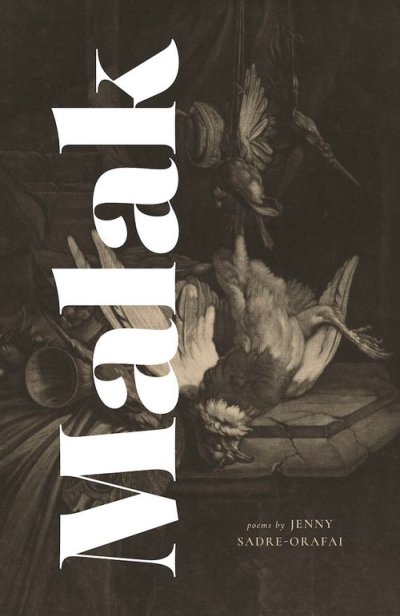
SATURDAY POETRY SERIES PRESENTS: MALAK


From MALAK
By Jenny Sadre-Orafai:


LAST READING

There is a pregnant bird in the cup.
Malak looks at me like she has never looked

at that in a cup before. My father looks at me
like there are things I’m not telling him.

She crochets baby caps, square blankets,
booties in Neapolitan ice cream colors.

If I ever have these babies, if I’m the bird
in the cup, I’ll want to devour them.

After the last reading she leaves the cup turned up,
daring the bird to forget I was pregnant.


MOTHER SPELL

I felt for mountain
and ocean, my first globe.

Mouth or beak. Arm or wing.
Skin or feather. Feet or feet.

Who brought these to me
to dress in booties and caps.

I didn’t ask to know a belly
so tight.

I didn’t ask if it was girl
or boy or bird.


LANGUAGE OF SIGNS

I slept the whole day
without remembering, Malak.

I dreamt I had a son
growing so fast,

a tomato plant sprawled
everywhere, unstoppable.

I held him at my hipline.
And I fed his hunger.

Now he’s a pitcher
of water.


Today’s poems are from Malak (Playtpus Press, 2017), copyright © 2017 by Jenny Sadre-Orafai, and appear here today with permission from the poet.


Malak is an invocation of past and future. With familial lament and childish wonder, the words lay tribute to the infinite—to the beauty in descent and the heartache that binds us to place. To our smallness in death and the importance of conjuring anew.

Jenny Sadre-Orafai is the author of Paper, Cotton, Leather and five chapbooks. Her poetry has appeared in Cream City Review, Ninth Letter, The Cortland Review, Hotel Amerika, The Pinch, and other journals. Her prose has appeared in Los Angeles Review, The Rumpus, South Loop Review, Fourteen Hills, The Collagist, and other journals. She is co-founding editor of Josephine Quarterly and an Associate Professor of English at Kennesaw State University.

Editor’s Note: Birds, tea leaves, foxes. If there are talismans that illuminate the path Jenny Sadre-Orafai’s Malak lays out for the reader, these may be those divining objects. There is magic within these pages — the kind that is conjured up in Gypsy tents and over old world kitchen tables, magic from a time and place when women were believed. But the future is always uncertain, and the tales that unfurl within Malak‘s pages curve and splinter like the lines on a palm.

What is inheritance, this collection asks. What is lived? What is lost? Do we inherit even that which cannot be passed down? Are predictions only as good as their fruition?

Malak is a book that pairs loss with beauty, future with past, the certainty of fate with the unknown and the unknowable. Throughout its pages, a sense of familiarity is established that both grounds and destabilizes. Its stories are told in the dark of night, but under the light of a full and generous moon. When Malak‘s truths reveal themselves, you bask in their luminosity and marvel at the careful magic of their making. You do not ask if they are boy or girl or bird.

Want more from Jenny Sadre-Orafai?
Buy Malak in paperback from Platypus Press
Buy Malak on Kindle from Amazon
Jenny Sadre-Orafai’s Official Website

“On the Farm, Before You Leave for Afghanistan” By Lynn Houston

.


In August 2016, while at a writing residency, I met a man who was already supposed to have deployed with his National Guard unit. We were given the gift of three weeks before he left, time we used to get to know each other, as we helped out on a friend’s farm, had long conversations on a porch swing, and rode his motorcycle up into the mountains. The night before he left the country, as he was driving to the base, we talked on the phone for over three hours. For six months while he was gone, I sent him near-daily poems in the mail. When he returned, after an initial successful reunion, it became clear that he was plagued with anger issues and other problems associated with a difficult re-entry into his civilian life. He began seeing someone else, and we broke up. In my grief, I revised the poems I’d sent him and began submitting them to poetry contests. Unguarded won the inaugural chapbook contest of the Heartland Review Press and is due to be released in December 2017, with a series of readings and book signings in the Elizabethtown, KY, area scheduled for early 2018.

.

On the Farm, Before You Leave for Afghanistan

Henry was the first to know I was your woman.
Henry, the goat. The one who hates you.

Since then I’ve been surprised by how often
clouds take the shape of curled horns
and remind me of that Tennessee morning

we left a shared bed to feed the herd
and took the smell of love-making with us.

Like any hard-headed man, when Henry knew
I was yours, he wanted me for a goat wife,
butted my thigh and bit my boot top,

rubbed his face against its orange leather.
Aware of Henry’s macho display and the force

of his horns, you turned your back on me
and walked toward the house, knowing that
to keep me safe you had to leave.

.

About the Author:Lynn Marie Houston holds a PhD from Arizona State University and an MFA from Southern Connecticut State University. Her poetry appears in numerous literary journals–such as O-Dark-ThirtyGravelPainted Bride QuarterlyOcean State ReviewHeavy Feather Review–and in her three collections: The Clever Dream of Man (Aldrich Press), Chatterbox (Word Poetry Books), and Unguarded (Heartland Review Press). For more information, visit lynnmhouston.com


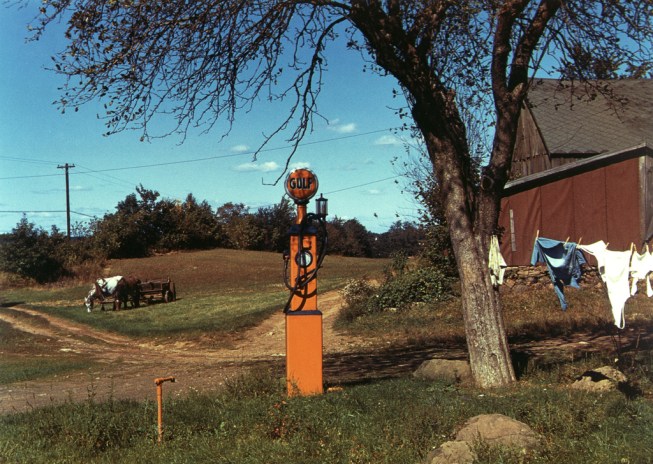
Image Credit: Jack Delano: “Rural Scene, Near Andover, Maine” courtesy of the Getty’s Open Content Program.

A Review of Daniel Crocker’s Shit House Rat

.

A Review of Daniel Crocker’s Shit House Rat

By Stephen Furlong

.

In a blurb for Daniel Crocker’s Everyday People and Other Poems (Green Bean Press, 1998), A.D. Winans writes “Daniel Crocker is one of a lively band of modern poets who write…from the heartland of the people, and I stress HEART, because Crocker’s poetry comes from deep inside him.” Daniel Crocker is a poet who lays it on the line, the poetic line, to provide his readers with impassioned honesty and the rawness of an exposed nerve. In Shit House Rat (Spartan Press, 2017), Crocker explores belonging, popular culture references, and sexuality.

In one of the first poems of the book, “Growing Up”, Crocker investigates youth and belonging. Channeling the 1990 documentary Silence=Death written and produced by Rosa von Praunheim, the speaker of the poem writes: “I saw Silence/equal death/and stayed silent/anyway.” The documentary focuses on the AIDS epidemic and includes appearances by Allen Ginsberg and David Wojanarowicz. This poem hints at a recurring theme in Crocker’s book which is, to borrow from Patricia Hampl: carry[ing] our wounds forward with us. Crocker’s poetry carries wounds forward in order to bring light to them and his poetry is remarkably admirable given today’s tumultuous climate of trying to hide, even deny, one’s misdeeds of the past. Crocker doesn’t hold back and doesn’t hide making his poetry powerful, even with its vulnerability.  Returning back to “Growing Up”, the popular culture references continue with the early 1980s Midwestern-driven sitcom “The Day After” and late 1970s “Roots”. The poem, itself, is honing in on these popular culture phenomena in an attempt to understand the Reagan administration and growing up during that timeframe.

In addition to these popular culture references, Crocker’s poems channel snuffleupagas, Wolverine, Reed Richards and writers who have influenced him throughout the years like Adrienne Rich and Lord Byron. In the last portion of the book, Crocker writes the poem “I Wish” for his wife, and longs to be Whitmanesque. The poem is gentle, heartfelt, and sincere which reveals growth and maturity throughout the course of the book. Throughout the course of the poet’s life. These references are entrances into Crocker’s livelihood, they are sometimes dark corners of the brain, but channeling back to A.D. Winans—they reveal Crocker’s heart. That makes all the difference in this collection.

There’s a devastating piece in this collection titled “Brutal,” which reminds me of Bruce Weigl’s “The Impossible”—a poem which talks about physical, namely sexual, abuse. The last line has stayed with me ever since I first read the poem: “Say it clearly and you make it beautiful, no matter what.”  Of trauma, Weigl says in an interview “to understand that this (trauma) was not something that I was going to get over, but instead something that I needed to find a way to live with.”

In writing “Brutal” Crocker tries to live with this memory instead of trying to get over it because, frankly, overcoming abuse is just not done, or for certain, easily done. Crocker’s speaker in this poem is young and, under peer pressure, has what is called a gay night. The individuals of the poem, Crocker and cousin Terry, reveal themselves and fall prey to an older cousin named Larry. Crocker confesses around halfway through:

…if I ever have the guts to write about it, it’s going to be brutal. It’s going to be honest and detailed. The details, however, are like an impressionist painting. Parts of it, like the monster, are painfully vivid. Larry’s white, white teeth. His beautiful body. The rest is images, textures, feelings. Feelings of guilt and desire are all mixed up in one.

The form of this piece, set in prose, reveals the blurring of everything coming together, of the pieces of this pain being fused with feelings of guilt and desire. Crocker has written extensively about his bisexuality and alludes to it in this piece as well, which makes the piece even more dizzying, even more crushing when this memory sticks out in his history. The poem later reveals Larry, the perpetrator, has died in a motorcycle accident, a fact which used to bring Crocker happiness; “I’m not sure I am anymore,” he then confesses immediately afterward. This poem reflects the confusion and anger abuse leaves in its wake. It also discusses the wretchedness it can have years after as both Crocker and Terry, both drunk mind you, discuss it. And the pain comes back. The frankness of this poem’s language haunts me because the poem doesn’t try to hide in veiled language or metaphor; it just speaks to the horrors of abuse and it does it directly and does not hold back.

To me, the success of Daniel Crocker’s poetry is exactly that: He does it directly and does not hold back. It’s admirable, it’s damn hard work, but it’s healing. Daniel Crocker’s poetry and writing helps my writing because of their frankness and honesty. Those qualities push me to do the same; they push me to be honest and detailed. I am convinced Crocker can’t write any other way. And I don’t think he would choose that.

.

About the Author: Stephen Furlong is a recent graduate of Southeast Missouri State University located on the Mississippi. His poems, reviews, and interviews have appeared or are forthcoming in Yes Poetry, Glass: A Journal of Poetry, and Pine Hills Review, among others. He also had a poem in A Shadow Map: An Anthology by Survivors of Sexual Assault published by Civil Coping Mechanisms and edited by Joanna C. Valente.

Two Prose Poems

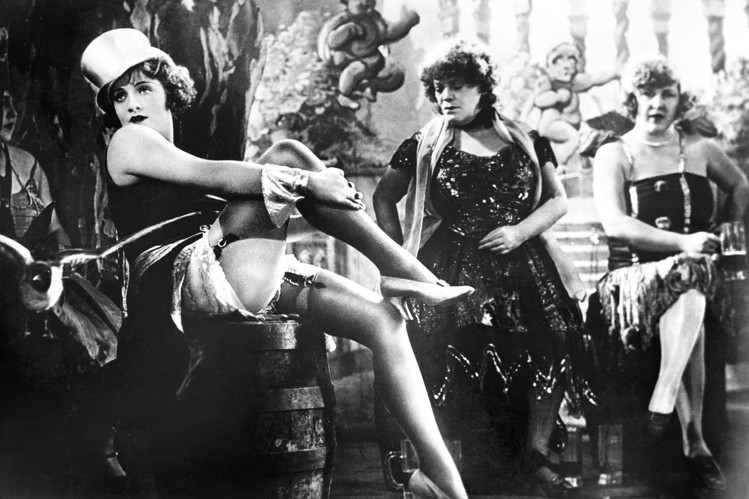
Marlene Dietrich in Der Blaue Engel (1930)

Two Prose Poems

By Mike James

.

Oh Daddy, Give Me A Quarter For The Time Machine

I want to go to Berlin! Back before reunifications or walled up divisions, back before that
screaming little man with his silly mustache.Yes, I want to go to the Weimar Republic
and catch, just one, cabaret. See Marlene sulk sexy onto the stage in black top hat, tux
(with white gloves, of course.) I want to see the scribblers making napkin notes for later.
Hello, Walter Benjamin with your weak tea and indigestion. Good evening to you, Mr.
Brecht, with your new girlfriend and old, out of tune guitar. Kurt Weill at the piano
smoking his black, extra-long filter. Some unknown Sally at a barstool listening to other
people’s dreams.

.

Rebel, Rebel

for David Bowie

Once he took off his dress, he didn’t know what to wear. He tried walking around, naked
as sunlight. Despite summer days, that became quite drafty. And nothing held in place.
Appendages sagged, this way and that. So he put on a blue suit, same color blue Candy
Darling used for lipstick. The color looked more natural romantic on her. He wore the
suit to walk the dog, shop for scarves, take out the trash, order delivery cheese pizza.
Despite adjustments from a sensible tailor, the suit was never a perfect fit. In stilettos he
no longer liked the click heels made for his ears.


About the Author: Mike James is the author of eleven poetry collections. His most recent books include: Crows in the Jukebox (Bottom Dog), My Favorite Houseguest (FutureCycle), and Peddler’s Blues (Main Street Rag.) He has previously served as associate editor for both The Kentucky Review and Autumn House Press. After years spent in South Carolina, Missouri, Pennsylvania, and Georgia, he now makes his home in Chapel Hill, North Carolina with his large family and a large assortment of cats.

“Mental Health Portraits” By Margaret Crocker

.


MENTAL HEALTH-PORTRAIT 1

Offices are silent
and locked at night.

And bland doors upon doors
and myself,
white and nervous against the glass
broken with chickenwire.

The pads of my shoes are quiet.
The elevator’s shaky hum is quiet.
The shadows of the dining hall are quiet and long.
The dust on the carcass of a water beetle,
the saw that does not move,
the razor behind the lock,
the fingers,
stained with marker,
the fingers clenched in state blankets.

The voices
are silent
while a reflection of me
smokes in the yard.

.

MENTAL HEALTH-PORTRAIT 2

Cee Cee
smiling in the hall.
She rubs her forehead back and forth,
her fingers back and forth,
the air twisting
her knuckles back and forth,
flies rubbing.

Cee Cee
taking a shower.
Her tshirt is hung
empty on the door.

Cee Cee in line
waiting for that Red Cross tshirt,
a souvenir of another life
of outside
and pursuits she sleeps away here,
of a time she had something to give.

Cee Cee in line
with a Dixie cup of orange juice
and that crazy, crazy blood
pumping a hole through the universe,
her head
bumping softly at the wall
again
again
as she stares past the door.
A sticker, a lollipop and a smiley-face on the board,
this is what she has now.

Cee Cee
carrying a cheap comb in a paper bag.
Cee Cee watches the bored nurse
and today’s discussion
“To Cope or Not To Cope.”

That is the question.

.
About the Author: Margaret Crocker is an artist, writer, wife, mother, daughter, sister and thief. She collects stray animals and has this weird fantasy of being on The Great British Baking Show, despite the fact she uses a bread machine. She knows little but proclaims much. There is much we don’t know about her.


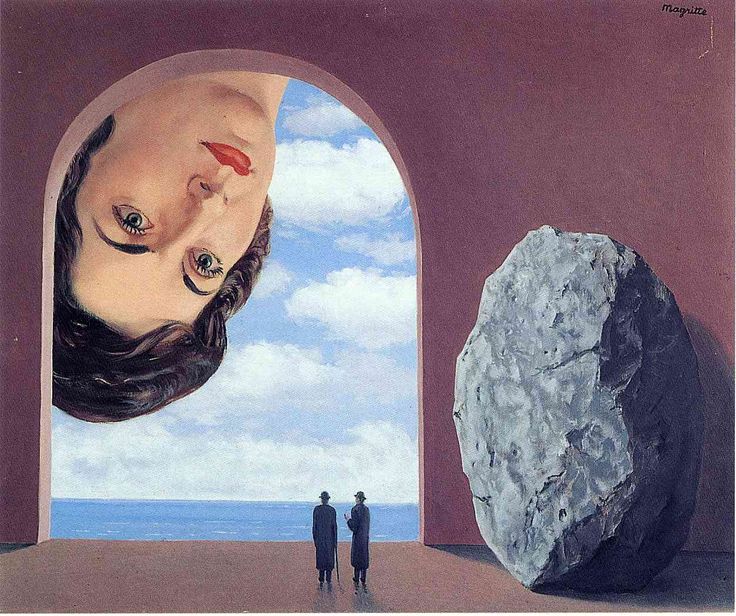
Image Credit: Portrait of Stephy Langui By Rene Magritte (1961)

High School Poetry Series: Gender, Identity, & Race — Robert Garrett

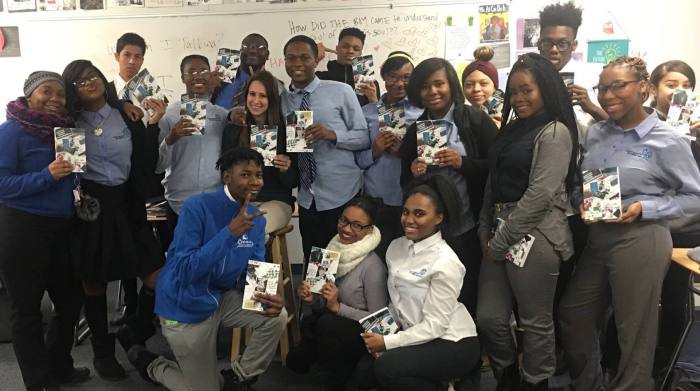
16403407_10103555321683718_111071533205757261_oA note from Series Editor Sarah Marcus-Donnelly: Born from a powerful in-class discussion that we had about gender, race, and the role of masculinity in rape culture, many of these poems are an analysis of gendered, racial personal experience and a study of our intersectionality. This poetry series was inspired by a HuffPost essay I wrote called, “Why I Teach Feminism at an Urban High School.” The poets featured here are all current students whose work I found to be brave and progressive. Please help me support their crucial and influential voices.

I chose this poem for its insistent rhyme that is both grounding and unsettling. The devastation is palpable, and the vision of a violence-free future is essential.


Shell

Life is an empty shell
because of a shell.
I wonder if you fly in the sky
or cry in hell?

I hope your killer rot in jail
in an uncomfortable cell.
As I sit back and reminisce
the memories bliss–

I remember the near miss that almost kissed
My skull instead
it leaked your lung
then the blood
ran down as your eyes hung.
Still, in that moment, it never seemed real.

Till I heard the sirens squill.
I still remember the feel I caught
the chills but didn’t cry, and I can’t
remember why, but I had this feeling
that day I should’ve died.

Time moved fast; it was your funeral now.
Tears dropped, hearts stopped
The room froze,
you could hear a penny drop
The preacher walked
to the stage, cleared his throat
and flipped the page.

Said a prayer to start
then read off your obituary–
your age,
the whole crowd sighed in dismay.

They said, “He was a good kid,”
“He had bright future,”
But all I thought about was the weapon
that took your life was a Ruger.

And as I sat I had a dream
like Martin Luther King Jr.
of a world filled with peace.
Man it was nice, you could walk down street
without looking twice.
You could walk at night
when the lights wasn’t bright
without hearing gunshots left and right.

Then reality set in, and I was back
in the war zone
where guns are easy to get in.
And at least once a day
somebody becomes “a dead man”.

A place where hope is destroyed
and the whole country wants to fit in.
With the depiction of weapons
that Hollywood is setting.

But they’re not showing the truth,
because the truth don’t sell.
We watch as it fails the youth
and floods the cells.

It’s time to break through the shell
of ignorance.
You can no longer
claim your innocence.

You just need to open your eyes;
they say it’s a beautiful world, but it’s a disguise.
Cause every other day, a child’s mother cries,
as their precious one floats to the sky.

At the hands of the “necessary evil,” the picture deceitful,
because if they get one, you get one, we all get one.

We need to change the soil
that is growing the seeds doing the bad deeds.
Like cutting the dead roots from sick trees.
Cause now we just watching the leaves
turn brown as the sun goes down
nobody looks around to notice that world
is a continuous run from danger.

The feeling when a stranger can rearrange
your life, wonder where we made a left
cause this world ain’t right.

IMG_1068

Robert Garrett is a high school senior who enjoys reading, social activism, and volunteering. He loves playing baseball and is a 4-year starting centerfielder. He is currently very busy applying to colleges.


SATURDAY POETRY SERIES PRESENTS: #METOO POETRY


Editor’s Note: As the #metoo movement that originated ten years ago with Tarana Burke reached a critical mass this week, together we bore witness to innumerable traumas. Perhaps, like me, you felt far more than you were able to articulate. In times like these I turn to poetry to find the words there are no words for. To that end, today I turn to poetry of witness and testimony. To poems that are unafraid to call out sexual assault and its aftereffects. To poetry that says: me, too.


“Seized” by Rachel Heimowitz

“I Should Quit Teaching” by Lois Roma-Deeley

Rupi Kaur’s #metoo poem

“bone” by Yrsa Daley-Ward

Nayyirah Waheed

SATURDAY POETRY SERIES PRESENTS: THE TREASURES THAT PREVAIL


From THE TREASURES THAT PREVAIL
By Jen Karetnick:


ADVISE AND CONSENT

It seems to fall to men to create
disasters and women to mop up after.

The first thing people have to forget

is their sense of the senatorial

desk, the deep leather armchair.

There’s always
somebody screaming

off stage or window-shopping for the ridiculous,
arm in arm. Sooner or later these moments come.

We have seen this happen and cannot refrain.


UNDER MANGO CAMOUFLAGE

They bloomed too soon, pistils coral,
hung green like left-behind seawater
well into the sodden fall, ripened
into a bilirubinous yellow.

Falling, they broke themselves
open into Cyrillic letters on the unearthed
limestone as if they were envelopes
stuffed too full of possibilities.

Now marked only with a flag of memory,
this is where we buried the bits
of flesh snipped as easily as a stem
from an eight-day-old son, disguising

the dreams that in the wrong hands
could have been so readily rewritten.


THE OPPOSITE OF MECCA

Oh, the darkness of it all—black cat, black dog,
black monkey on the black-eyed woman’s shoulder,

rocking on a boat dock over water so absent of light
even our dreams have lost their shadows. In this house

made of books and planks, under the art of thatch
and weave, we are birds nesting together who have closed

our throats to song. This is where, without definition, we pin
the horizon as the center on a map of our always new world.


Today’s poems are from The Treasures That Prevail (Whitepoint Press, 2016), copyright © 2016 by Jen Karetnick, and appear here today with permission from the poet.


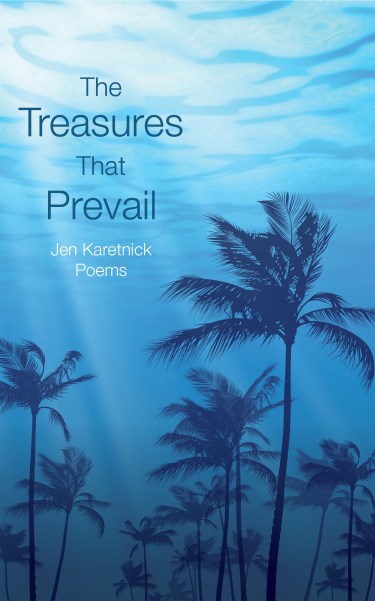
The Treasures That Prevail is about climate change and its effects on Miami; the poems in this collection confront the ills of modern society in general, mourn both public and personal losses, and predict the difficulties of a post-modern life in a flooded, Atlantis-like lost city. The narrators are two unnamed women, married with a teenage daughter and a teenage son, who live in a part of Miami that will be underwater unless action is taken. The Treasures That Prevail is a parable about what could happen to any of our low-lying coastal cities if we don’t start to make changes now.

Jen Karetnick is the author of seven poetry collections, including American Sentencing (Winter Goose Publishing, May 2016)–which was a long-list finalist for the Julie Suk Award from Jacar Press–and The Treasures That Prevail (Whitepoint Press, September 2016). She received an MFA in poetry from University of California, Irvine and an MFA in fiction from University of Miami. Her poetry, prose, playwriting and interviews have appeared recently or are forthcoming in TheAtlantic.com, The Evansville Review, Foreword Reviews, Guernica, The McNeese Review, Negative Capability, One, Painted Bride Quarterly, Prairie Schooner, Spillway, Valparaiso Poetry Review, Waxwing and Verse Daily. She is co-director for the reading series, SWWIM (Supporting Women Writers in Miami). Jen works as the Creative Writing Director for Miami Arts Charter School and as a freelance writer, dining critic and cookbook author. She lives in Miami Shores on the remaining acre of a historic mango plantation with her husband, two teenagers, three dogs, three cats and fourteen mango trees.

Editor’s Note: How fearfully prescient this collection has proven to be as California is burning, as large swathes of the world are recovering from hurricanes and earthquakes, as Harvey Weinstein has been outed as a sexual predator, as man after man shows us what it really mean to be “senatorial” in his “deep leather armchair,” as the world is melting and our future threatens to emerge underwater.

With The Treasures That Prevail Jen Karetnick has penned a collection that is beautiful and terrifying, that is lyric and devastating, that rings of Cassandra in the ways its truths fall upon deaf, ignorant, or apathetic ears. The language within these pages is thick and malleable, painting with words a picture that you might cut back with a machete in a valiant effort to combat the vengeful wrath of a raped and battered Mother Earth. For even the best among us — in the age of capitalism and consumerism and selfish, self-destructive climate change — are but “birds nesting together who have closed // our throats to song.”

Want more from Jen Karetnick?
Buy The Treasures That Prevail from Amazon
Jen Karetnick’s Writing Portfolio
Buy American Sentencing from Amazon

Snuffleupagus as Depression: A Conversation with Poet Daniel Crocker

Snuffleupagus as Depression:

A Conversation with Poet Daniel Crocker

By Chase Dimock


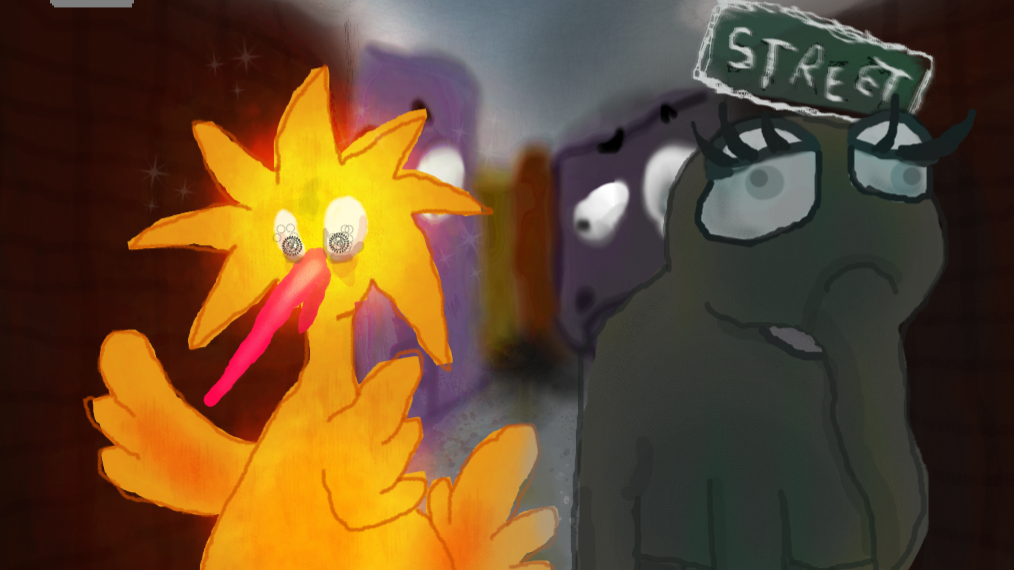
If you ask Daniel Crocker how to get to Sesame Street, he’d point you toward a twisting road of manic depression, frustrated desires, and existential malaise. In his latest book, Shit House Rat, Crocker’s poetry reimagines the furry childhood icons of Sesame Street embodying torments and foibles as adult and human as the people whose hands are lodged up their muppet behinds. Cookie Monster is an addict, Big Bird has mania, Snuffy is the haunting specter of depression, and Grover’s anxiety led to a hell of a divorce. But, Sesame Street is only the starting point. Shit House Rat takes the reader to Leadwood, Missouri, Crocker’s rural, predictably lead polluted hometown, where he engages themes from his childhood to his adulthood, including mental illness, queer sexuality, poverty, and small town conservativism. I got a chance to ask Crocker about the appeal of dark humor in poetry, the struggle of growing up bipolar and bisexual in rural America, and most importantly, what exactly a “shit house rat” is.  


Chase Dimock: The first thing your readers will notice about your new book will obviously be the title, Shit House Rat. I know that as you were working on this collection, you had some trepidations about how the title might be perceived by your audience. Where did you get the idea for this title and why did you ultimately decide to use it?


Daniel Crocker: I have trepidation when it comes to just about anything, so I try not to let it worry me too much as a writer. I really put myself out there, especially in this new book, and there’s always a lot of anxiety that comes with that. I did have some specific concerns about the title though. I got the idea from the old saying, “Crazy as a shithouse rat.’ I don’t know if it’s a Midwestern or southern thing, but I’ve heard it a lot growing up and even now. It’s a nice turn of phrase, really. So, I just took the last half of  the saying (kind of like I did with Like a Fish) and used it. My worry is that it’s a real putdown to people, like me, with a mental illness. I don’t want anyone with a mental illness to think I’m making fun of them at all. My hope is to take the phrase and subvert it. Own it.


Chase Dimock: I think it will be clear to anyone who reads your poetry that your goal isn’t to make fun of the mentally ill, but to use humor to explore the experience of mental illness. A lot of your poems are funny, and I mean literally laugh out loud funny, which is pretty rare for modern poetry. (Robert Lowell wasn’t much of a yuckster) Why are you drawn to using humor in your work? What does using humor reveal about the experience of mental illness?


Daniel Crocker: A lot of my early work is pretty dark and without a lot of humor. I don’t like a lot of that early work either (some of it still holds up). But, I always like humor. I thought I was funny. Eventually, I wrote a short story or two for Do Not Look Directly Into Me that were funny, and I quickly found that I loved doing it. I haven’t written fiction in a while, and it’s pretty clear to me now that I’m mainly a poet. However, once humor started seeping its way into my poems it was like a creative flood. I guess it was me finally finding a voice that was all my own. As Steve Barthelme one said to me, it has to be more than just funny though. I think that’s true. For me, the perfect poem of mine is something that makes people laugh when they first read or hear it, but then they find they are still thinking about it later because there was something deeper and darker in it as well. Which I guess if you think about it, it’s the two extremes of bipolar disorder mixed together.

I can’t say what dealing with mental health issues with humor means for anyone else, but for me humor is just a way I deal with a lot of things. When you have mental health issues, every day can be a struggle. With my own particular diagnoses–bipolar, anxiety, OCD, probably PTSD, I worry about a lot of things. I’m doing well on medication right now, but when I wasn’t little things like planning an extra ten minutes before work just to get out of the house just in case there was something you needed to check over and over. You never really know what kind of mood you’re going to wake up in, what your anxiety level for the day is going to be, etc. If you’re going to be successful in any way, you have to plan ahead for just about anything. It’s tough to commit to anything in the future because you don’t know where you’re head space is going to be on that day. Or, before medication for me, I might commit to a ton of stuff while manic and then regret it while depressed. I guess this is a long way of saying if you don’t have a sense of humor about things they can become overwhelming. At least that’s my go to stress relief. Jokes.

The good thing about writing funny poems is everyone usually likes them. The worry is if they are going to take them seriously or not. In Shit House Rat I’m using Big Bird as a symbol for mania and Snuffleupagus as depression. Will people buy it? I dunno.

Continue reading “Snuffleupagus as Depression: A Conversation with Poet Daniel Crocker”

SATURDAY POETRY SERIES PRESENTS: THEY WERE BEARS


From THEY WERE BEARS
By Sarah Marcus:


PEOPLE HAVE ALWAYS KNOWN BEARS

You said you were afraid of bears—

we weren’t safe until there was ice
along the shoreline. I said we all need trauma,

and my heart breaks every Autumn, so we broke
ourselves against those rocks until the cave mouth opened:

a womb for blind crayfish,
a passageway harboring beetles.

I want you to reach into the depths of your backwoods
and remember our Winters. We need the bears, ourselves

ursine sleeping in dens—the caverns drip-stoned and stunning.
I was and still am in search of a great bear

because people have always known bears—
we will always be shelter for each other.

When we first met, I told you that a long time ago,
grizzlies came down from the Rockies—

they were poisoned on the range, trapped,
hounded, shot out—we found cranial fragments.

We still listen to those legends of bounties paid
to mountain men, harboring that ancient fear of

the bears that made meat of us, boar and sow,
mauled and gnawed away. Our bones resting in caves,

because you were born to hunt, and I was
born of hunting: a witness of great fires.


LOVE POEM

First snow of the season—
your eyes say
there’s not much oxygen
                  in the mountain air
.

I have never wanted someone
                  as much as I want you.

I devalued the damage:
you won’t belong—stay gone longer—

                  let it melt.


I’ve been thinking about you
                  because we cannot be separate.
The gravitational pull defies
                  the thousands of miles between us.

Even in the deepest woods,
                  we kneel beside the rill,
the river’s riffle,
the spruce’s mantle of rime,

                  until the point of rock
                                  swells tightly around us.

There’s a chant building in the forest: I won’t be your secret.

Everyone knows how to leave,
but I don’t know how to be
in this city
without you.


MYTHOLOGY FOR DESERT LOVERS II

These things are real:
you are a desert moon rising a hundred mornings away.
My horses paw a cracked Earth.
The air threatening Winter.
The solitude of sand.
We can smell the danger

of you and her
in that house.
In every house.

When you are so strongly connected
to another person, what did you call it? Rare?
It’s like the sunset.
No one can hold that kind of beauty
for more than a moment.

Our small ribs are thick
enough to take on a prairie panic.
The fear of too much open space.
So many acres;
we can never catch up.

You say I’m always on your side
and this will always mean more
to a woman.

I try to explain that love is a violence,
even when it’s beautiful.
When you enter someone,
you must also leave them.

And there’s always that moment of relief
when I realize that I’ve always known—
I am a hundred deserts.

I will wait for you or some version of you
to become sky.


Today’s poems are from They Were Bears (Sundress Publications, 2017), copyright © 2017 by Sarah Marcus, and appear here today with permission from the poet.


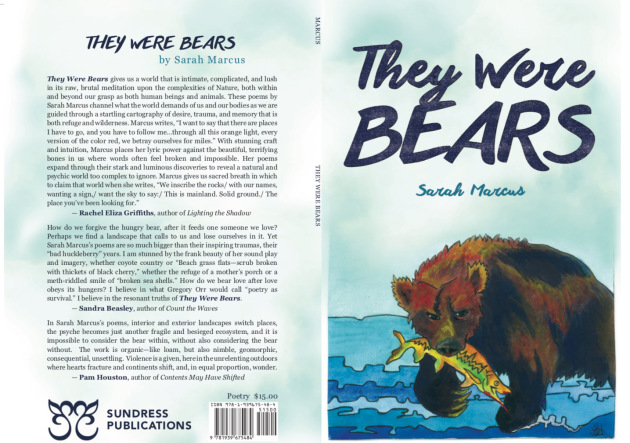
They Were Bears gives us a world that is intimate, complicated, and lush in its raw, brutal meditation upon the complexities of Nature, both within and beyond our grasp as both human beings and animals. These poems by Sarah Marcus channel what the world demands of us, and our bodies as we are guided through a startling cartography of desire, trauma, and memory that is both refuge and wilderness. Marcus writes, ‘I want to say that there are places I have to go, and you have to follow me…through all this orange light, every version of the color red, we betray ourselves for miles.’ With stunning craft and intuition, Marcus places her lyric power against the beautiful, terrifying bones in us where words often feel broken and impossible. Her poems expand through their stark and luminous discoveries to reveal a natural and psychic world too complex to ignore. Marcus gives us sacred breath in which to claim that world when she writes, ‘We inscribe the rocks/with our names, wanting a sign,/want the sky to say:/This is mainland. Solid ground./The place you’ve been looking for.’” -Rachel Eliza Griffiths, author of Lighting the Shadow


Sarah Marcus is the author of They Were Bears (2017, Sundress Publications), Nothing Good Ever Happens After Midnight (2016, GTK Press), and the chapbooks BACKCOUNTRY (2013) and Every Bird, To You (2013). Her other work can be found at NPR’s Prosody, The Huffington Post, McSweeney’s, Cimarron Review, Spork, The Establishment, Cosmopolitan.com, and Marie Claire.com SA, among others. She is an editor at Gazing Grain Press and the Series Editor for As It Ought To Be’s High School Poetry Series: Gender, Identity, & Race. She holds an MFA in poetry from George Mason University and currently teaches and writes in Cleveland, OH.


Editor’s Note: In the Jewish calendar, the days between Rosh Hashanah and Yom Kippur are a surreal and reflective time of reckoning. During these days we are introspective, coming to terms with our true selves before turning outward and asking forgiveness from those who we have wronged. It is in these Days of Awe that I come back to a collection I have been meaning to review for quite some time. It is in this magical time of brutal honesty that I dive deeply into a carefully-wrought world that is far beyond my comfort zone, with eyes and heart wide open to its savage and beautiful truths.

They Were Bears is one of the most thoughtful–if not the most thought-provoking–poetry collections to be released in recent memory. Rife with hunger and blood and animal instinct, this work pulsates at the intersection of nature and violence, family, sex, and love. They Were Bears drags us mercilessly back to our animal nature, honoring vulnerability and calling out sexual violence. This book pulls no punches, spares us little. What is reflected in its waters is our truest selves, as beautiful and terrifying as they are wont to be.

The tender, ravenous, brutal honesty of the book’s thematic spectrum is brought to life by the true craftsmanship of the poet. This is an absolutely stunning collection on every level–its words and images thrash and breathe, fly and tether. The poems are lush in their soundscape, and on the page they mark their territory distinctly. And the moments. The breathtaking moments. How true their revelation, declarations, and admissions: “because you were born to hunt, and I was / born of hunting: a witness of great fires;” “I try to explain that love is a violence, / even when it’s beautiful. / When you enter someone, / you must also leave them.”

Mazal tov to Sarah Marcus on this incredible work, and may we all start anew together in these Days of Awe.


Want more from Sarah Marcus?
Sarah Marcus’ Official Website