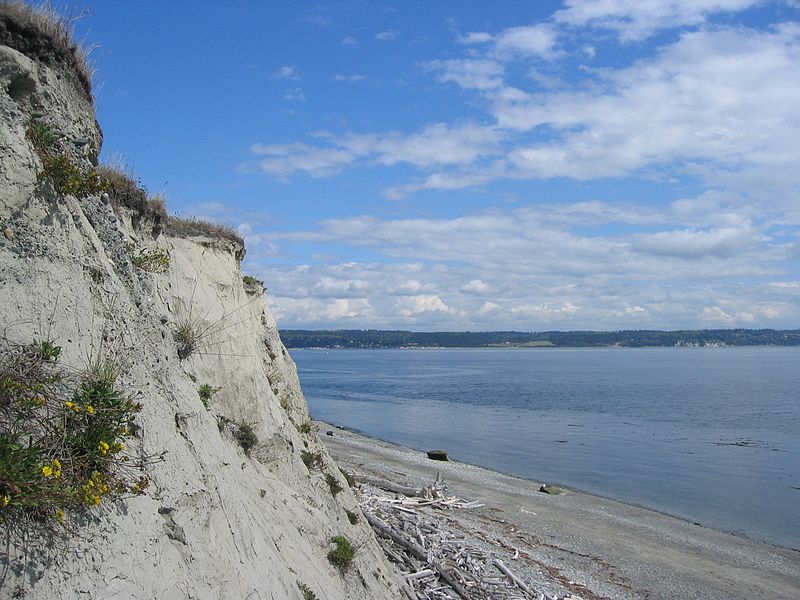
The canyon water ran black, the driftwood ran gray on a day when sky blended into sea a seamless bone.
Slivered ancient trees. Lines around the eyes of wizened faces of locals nearly worn away. Old timber,
sharp to the touch, piled at random discovered at the end of an uneven spider-webbed path.
The lapping of tiny waves announces a boat. A fisherman, a net all the same soft icy hue.
Memory of an air-mail letter, an atlas traced with music softly playing behind in pale yellow rooms. Light candles,
listen to the drone of seaplanes, shorebirds hopping with schedules we do not know. Send books
to houses covered with ancient vines, the purpleness of ground reflected in rot and neglected beams.
You don’t have to tell
her you love her. All
this gray quiet splintered
silence tells her as if the sea
could spell
and you made this place just for her.
.
(This poem original was published in the book Surface Effects in Winter Wind)
.
About the Author: Tobi Alfier (Cogswell) is a multiple Pushcart nominee and multiple Best of the Net nominee. Her chapbook “Down Anstruther Way” (Scotland poems) was published by FutureCycle Press. Her full-length collection “Somewhere, Anywhere, Doesn’t Matter Where” is recently out from Kelsay Books. She is co-editor of San Pedro River Review (www.bluehorsepress.com).
So he puts X=6 on the board, says I’m gonna show you how to figure out this problem and then starts drawing all this other number stuff; then pretty soon he’s back to X=6 at the bottom. So math is like this I think; you remember when the kids all went cruising, into the downtown, around the courthouse, you know, back before the mall. Now when they stopped at a light, they would all get out, run around the car screaming and laughing, get back in when the light turned green. They would of course be in different seats, but it would be the same damn kids in the car; that’s how math works.
.
About the Author: A past winner of the Jim Harrison Award for contributions to baseball literature,Tim Peelerhas also twice been a Casey Award Finalist (baseball book of the year) and a finalist for the SIBA Award. He lives with his wife, Penny in Hickory, North Carolina, where he directs the academic assistance programs at Catawba Valley Community College. He has published close to a thousand poems, stories, essays, and reviews in magazines, journals, and anthologies and has written sixteen books and three chapbooks. He has five books in the permanent collection at the Baseball Hall of Fame Library in Cooperstown, NY. His recent books include Rough Beast, an Appalachian verse novel about a southern gangster named Larry Ledbetter, Henry River: An American Ruin, poems about an abandoned mill town and film site for The Hunger Games, and Wild in the Strike Zone: Baseball Poems, his third volume of baseball-related poems.
pollock paints reflection of the big dipper the sun too bright on saturday afternoon and nothing i say worth believing listen i love you i’m afraid all of these ideas that become empty shells the air cold where it touches my fingers shadows curved sharply up the sides of houses and down all of the meaningless streets i’ve ever lived on and what happens when every country has been carefully defined? why do we care if certain babies are left to die in windowless rooms? i’ve got fences to build
holes to dig and nails to hammer entire days to waste holding objects in my scraped and bleeding hands and does it matter if the war is lost when it’s fought 5000 miles away?
there are those who claim it does there are instances when i’m mistaken for my father when all i can taste are his ashes
the phone ringing in another part of the house while i stumble drunkenly across the bedroom my friends dead or disappeared my letters returned unopened notebook after notebook filled with words scribbled down and then crossed out not poems but prayers not god but religion small moments of illumination that mean nothing in the end
.
About the Author: john sweet, b 1968, still numbered among the living. A believer in writing as catharsis. Opposed to all organized religion and political parties. His latest collections include APPROXIMATE WILDERNESS (2016 Flutter Press), BASTARD FAITH (2017 Scars Publications) and the limited edition HEATHEN TONGUE (2018 Kendra Steiner Editions). All pertinent facts about his life are buried somewhere in his writing.
If I try eyes-shut hard;
recall the misty likeness of a stretcher
and air mask, a trailer lined with
ice-fangs in Napanoch, a red ball
I worshipped at three years old.
How your legacy sits in two boxes.
Poor math, crayoned stick-people,
tidy poems you wrote in the 80’s
That are all
formatted
like this.
Pour upon the wording, to have
known you. I scrounge your experiences
to exonerate my own.
The exactness of your malady, father’s
a How-To guide on being in one’s cups.
You get dry in centers and rooms,
found something God-like,
pressed petals between pages,
all piecemealed at my fingertips.
I’m faint praise as a pushing thirty
dry spell. Oh how our quenching throats beg,
didn’t and don’t they?
Pour upon the wording, to
know how. Yet, I’ll remain séance-less.
I’ve found something myself.
How to speak.
TURNCOAT
I put my head on pillow
and wake up with the birds.
When I dream:
I’m adrift in a flowing sea
of rainbow-flavored liquor,
in a boat made from cheap cigarette
cartons, next to a whopper of an impression
of her, who loved my wrong,
who reminds me it’s 2007,
and promises I don’t have
to work tomorrow
or do anything else
ever again.
Today’s poems appear here today with permission from the poet.
Erric Emersony is a poet residing in South Philly, PA. He is a founding member of Duende literary journal for which he also served as poetry editor for the inaugural issue. He’s currently guest editor at Aji literary journal. Erric is a graduate of Goddard College’s Bachelor of Fine Arts Creative Writing program. His first collection, Counting Days, was published in December of 2017. He has published 40+ poems in 20+ magazines including: TL;DR, Crab Fat, The Black Napkin, The Disconnect, FIVE:2:ONE, Beautiful Losers, Prairie Margins, Neon, The Hungry Chimera, Control, Mead: Literature & Libations, Angry Old Man, Rat’s Ass Review, Gingerbread House, Willawaw, and Visitant.
Guest Editor’s Note: Erric Emerson’s poems build mood, feeling, and context by selecting precise details that tell deeply personal and emotional stories. In “Motherless,” Emerson combines distant memories–“the misty likeness of a stretcher / an air mask, a trailer with / ice fangs in Napanoch, a red ball”–with immediate sensations–“how our quenching throats beg”–to link a mother and son. Fragmented recollections from a harsh past and present connect mother and son without resorting to blame or sentimentality, creating a portrait of the two and their relationship both decades ago and today. “Turncoat” recreates a moment of waking when dream and reality combine in a guided wish for unconditional love from “her, who loves my wrong” with the need to escape–“promises I don’t have to / work tomorrow / or do anything else / ever again.” These poems and others in Counting Days are filled with fresh language and harsh realities that create moments and stories filled with deep emotion and angst.
Guest Editor Alan Toltzis is the author of The Last Commandment. Recent work has appeared in print and online publications including Hummingbird, Right Hand Pointing, IthacaLit, r.k.v.r.y. Quarterly, and Cold Noon. Find him online at alantoltzis.com.
A NOTE FROM THE MANAGING EDITOR:
After nearly ten years as Contributing Editor of this series, it is an honor and a unique opportunity to share this space with a number of guest editors, including the editor featured here today. I am thrilled to usher in an era of new voices in poetry as the Managing Editor of this series.
Viva la poesia!
Sivan, Managing Editor
Saturday Poetry Series, AIOTB
The highway to work was longer than usual the first Monday after turning back the clocks.
My watch suggested I slow down. You are not late enough, it said. Daydream some more.
Hood up, hands in his pockets, a boy waited at the end of a driveway by a mailbox.
His jowly fawn boxer sat in charge of watching the other direction for the school
bus, its muzzle and underbelly white as a fence post.
My super vision cut a hole, like a glass on biscuit dough, in the boy’s bag sagging at his feet.
His math homework wore a corsage of purple jelly
thumb prints above the first story problem. If you are traveling fifty miles per hour,
my watch said, and work is fourteen miles away racing toward you a hundred kilometers per hour,
when and where will the train derail? How long does it take the bullet to exit the barrel?
My eyes met the boy’s through the windshield as I passed. He yawned contagiously.
The boxer’s little docked tail bustled up leaves that matched its coat.
.
About the Author: Stephen Roger Powers started writing poetry almost twenty years ago to pass time in the middle of the night when he was too energized to sleep after coming off the stage in comedy clubs around the Midwest. He is the author of The Follower’s Tale and Hello, Stephen, both published by Salmon Poetry. Other work has appeared in 32 Poems, Shenandoah, The Southern Poetry Anthology Volume V: Georgia, Rabbit Ears: TV Poems,and Stone, River, Sky: An Anthology of Georgia Poems. He hasn’t done stand-up in a long time, but every once in a while he finds avenues for the performer he was born to be. He was an extra in Joyful Noise with Queen Latifah and Dolly Parton, and he can be seen if you know justwhere to look.
Crescendo of crows, sinister as black umbrellaspreening
around an open grave, conclave of shadows, damascene of dark.
Where gilded flickers filled the air, there is only this enormous darkness.
Trees no longer brimmed with tanagers or thrashers.
The hills have burned. Quail and mockingbirds
have not returned. Soon night will be the only color.
.
About the Author: Ruth Bavetta writes at a messy desk overlooking the Pacific Ocean.Her poems have appeared in Rattle, Nimrod, Tar River Review, North American Review and many other journals and anthologies. Her books are Fugitive Pigments (FutureCycle Press, 2013) Embers on the Stairs (Moontide Press, 2014,) Flour Water Salt (FutureCycle Press, 2016.) and No Longer at This Address (Aldritch Books 2017.) She likes the light on November afternoons, the music of Stravinsky, the smell of the ocean. She hates pretense, fundamentalism and sauerkraut.
Image Credit: close up from “Fish Crow” by John James Audubon
“Did You Know? You can swim through the aorta
of a blue whale.” I watched as two children
swam, their soft hands like fins pushing themselves
out of the open chamber of the imagined whale’s
red ventricle and back into the museum showcase.
The heavy plastic held on to the throb of their laughter.
I could fit, I thought. I could be held in this heart
like blood. I could be pumped through the veins
and organs of the whale, let it take me, flowing,
my arms at my sides gliding head first
through the enormous animal’s body.
Your heart, just the size of your soft infant fist
which fits twofold into my own, holds a small
whispering defect. The pediatrician presses air
between his teeth – tsst tsst – to mimic the sound
he hears on the stethoscope. “It’s nothing,”
he says, “Just relax.” Tsst tsst. Just a leak,
a little mist pressed through a tiny spout,
a space as tight as teeth.
You are supposed to outgrow the hole,
supposed to grow muscle around the flaw,
supposed to be as strong as hard plastic,
the murmur shrinking so that you never
have to think about the way your body
is whispering its defects. I am supposed to relax.
I could fit. Inside your body, remembering how you
once fit into me. I could repair you
with my own body, the way my body prepared you
in the first place, with all your flaws.
The pediatrician says it gets louder – tsst tsst –
as it shrinks. He says your heart is much louder.
I’ll take you someday to see the whale’s heart
and watch as you swim through its ventricles
and out of the oversized aorta like a fish, unaware
of your heart moving blood through your body
like waves, little echoes, like the plastic heart
holding onto your laughter.
Today’s poem previously appeared in Whale Road Review and appears here today with permission from the poet.
Rhiannon Conley is a poet and writing instructor living in North Dakota. She was nominated for a Pushcart Prize in 2016. Her first chapbook, Less Precious, was published by Semiperfect Press in 2017. She currently has work forthcoming in Literary Mama and Longleaf Review. She writes an irregular newsletter of short poetic essays called Smol Talks and more regularly Tweets @RhiannonAdmidas.
Guest Editor’s Note: The echoes throughout this poem are its heart beating, whispering the emotions of the speaker told to relax when listening to a diagnosis of a leak in her daughter’s heart. Like so many mothers, she wants to fix the problem and also shoulder some of the burden. The following lines repeat words and sounds and serve as a mantra that comes from the deepest and most profound feelings of helplessness: “I could fit. Inside your body, remembering how you / once fit into me. I could repair you / with my own body, the way my body prepared you / in the first place, with all your flaws.” The repetition of “body” and “you” is natural, seamless, barely above a whisper. The second appearance of “I could fit” is a rhythmic reminder of the speaker’s profound wish.
The model whale heart is the perfect opening for this poem, set in a familiar place to observe children perhaps on a field trip or visit to the museum. The imagery of swimming through “the imagined whale’s red ventricle” in the first stanza begins a narrative that circulates through thought and lands back on hope for future visits in spite of a mother’s fear. The well-crafted stanzas and lines serve the poem and its theme and create a circular effect that emanates from the narrative, its imagery and metaphors.
Guewst Editor Anne Graue is the author of Fig Tree in Winter (Dancing Girl Press), and has published poems in literary journals and anthologies, including The Book of Donuts (Terrapin Books), Blood and Roses: A Devotional for Aphrodite and Venus (Bibliotheca Alexandrina), Gluttony (Pure Slush Books), The Plath Poetry Project, One Sentence Poems, Random Sample Review, Into the Void Magazine, Allegro Poetry Magazine, and Rivet Journal.
A NOTE FROM THE MANAGING EDITOR:
After nearly ten years as Contributing Editor of this series, it is an honor and a unique opportunity to share this space with a number of guest editors, including the editor featured here today. I am thrilled to usher in an era of new voices in poetry as the Managing Editor of this series.
Viva la poesia!
Sivan, Managing Editor
Saturday Poetry Series, AIOTB
I paced up and down the front porch on a rare, cool Missouri night.
“The government wants me to take pills,” I told my wife. She asked why, but I didn’t have an answer. Part of me knew it wasn’t true. Part of me wasn’t convinced. My thoughts shifted rapidly.
“Do you ever wonder about that guy from the Oak Ridge Boys? You know, the one with the big beard?” I had also suddenly become obsessed by William Lee Golden. I was worried about him.
“Do you think he feels trapped? Like, he wishes he could shave off that scraggly damned beard and be free of if.”
I wondered if he’d ever regretted growing that beard, probably sometime in his early twenties, and regretted it.
“He has to think his fans just won’t get the real Oak Ridge Boys experience without it? And what about John Berryman? Did he have the same problem? Is that why he jumped off that bridge?”
This was just a few days before I broke down, went to a clinic, and got help for bipolar 1 disorder. The symptoms had been ramping up for months—compulsive intrusive thoughts and rituals—I’m going to kill myself tomorrow was a favorite of mine, running on a loop in my mind. I was trucking along on little to no sleep or food. My speech was pressured. The mania had started out fun. I was creative. I felt unstoppable. I had the energy to do some work. In the end it always gets scary. It devolves into anxiety, paranoia and the occasional mild delusion. In the end, however, I got a hell of a poem about William Lee Golden out of it.
The truth is, mania makes me a better poet, although it’s taboo to say so. Not among other bipolar people. We’ll readily admit to each other that we love parts of our mania. We usually just don’t tell the sane people in our lives. They look at us shocked, or sad, or worse. Sometimes they look at us with anger. Our loved ones have seen the wake of destruction left behind by mania. I’ve hurt plenty of people myself while manic, including my significant other. I swear by my medications now. They keep me stable, if not fully content. Sometimes something is missing.
Unless you’ve been through it, you just can’t understand how mania feels. It’s like being on speed and booze at the same time—except better. Your mind, at least for a while, is laser-focused. You actually have the desire and energy to want to create—or do whatever it is that you do. Depression, on the other hand, is a creativity killer. It can be hard to get out of bed, much less write a poem. Mania, when it hits just right, calls for hours of steady work. Continue reading ““Mania Makes Me A Better Poet” By Daniel Crocker”→
I’m waiting for the apocalypse or the rapture. In the meantime, I’m reading Stein. Also, growing cabbages, Watching John Wayne movies, while I paint my nails.
Some people pretend to live without shadows. Are always perfectly shaved. Ignore salsa stains, flatulence. Expect worry to be, at least, three houses away.
The best we hope for are angels grown tired of heaven’s many perfections. Who miss beer, sex, mascara. Who miss a world happy to wake from dreams.
On slow days, I work in the garden. The squirrels seem to like what I produce. In good years I harvest peppers, cucumbers. Bad years, profanity and (yep) dust.
Art News tells us, second chances are no harder than the first. We just write Songs about the second. We romanticize failure since we all have practice.
.
Ghazal
A garden doesn’t make you a farmer any more than boots make you a Cowboy. Go on and play your make-believe. Go to your fashion show.
Appropriation is the least appreciated art. Going forward, we should Only speak in quotes from Collete, Betty Boop, and her doe-eyed ilk.
If thievery was legal, where would the fun be? Cat burglars no more Romantic than postman. Duchamp another man with an extra urinal.
Listen, the whole world practices make-believe. Have you ever seen A President give an oath with fingers not crossed? That’s was a dream.
Matthew Broderick, once parroted the line, There’s akind of freedom in Being completely screwed. Let me an offer an agreement. Give anamen.
.
About the Author: Mike James is the author of eleven poetry collections. His most recent books include: Crows in the Jukebox (Bottom Dog), My Favorite Houseguest (FutureCycle), and Peddler’s Blues (Main Street Rag.) He has previously served as associate editor for both The Kentucky Review and Autumn House Press. After years spent in South Carolina, Missouri, Pennsylvania, and Georgia, he now makes his home in Chapel Hill, North Carolina with his large family and a large assortment of cats.
Today’s poems previously appeared in cream city review (vol. 41.1) and Indiana Review (vol. 39, no.1) and appear here today with permission from the poet.
Emily Blair’s poetry has appeared in Gulf Coast, Sixth Finch, Juked, Indiana Review, New Ohio Review, cream city review, Gettysburg Review and the Brooklyn Poets Anthology, among other places. She received a New York Foundation of the Arts Fellowship in Poetry in 2014 and in Fiction in 2006, and is the author of the illustrated chapbook Idaville (Booklyn Artists’ Alliance, 2010). Also a visual artist, she creates multimedia books and collaborates with social practice artist Michelle Illuminato under the name Next Question.
Guest Editor’s Note: To begin reading a poem by Emily Blair is to step onto a sturdy roadway only to find halfway along that you are swaying wildly on a rickety rope bridge, your foot’s about to fall through the rotting jute, and there’s no going back. All you can do is rush forward and hope you make it to the other side before it collapses behind you. She pulls you along with brilliant wordplay: “—were the heavens ablaze—was there a topiary maze—” and half-recognized allusions to the plot points of movies you probably slept through while you were babysitting those demon kids across the street. Toward the end of the poem you realize that the poet is cleverly yet subtly addressing some of your most mundane and commonly shared fears and despite all signs to the contrary–is every single sentence a question?–the poet gives us a temporary reprieve from that anxiety in the form of a quirky answer: “Are you going to haunt me forever? I’m free every night this week.”
Originally from MN, Guest Editor Julie Hart has lived in London, Zurich and Tokyo and now in Brooklyn Heights. Her work can be found in PANK Magazine, The Rumpus, Vol. 1 Brooklyn, the Brooklyn Poets Anthology and at juliehartwrites.com. She is a founder with Mirielle Clifford and Emily Blair of the poetry collective Sweet Action.
A NOTE FROM THE MANAGING EDITOR:
After nearly ten years as Contributing Editor of this series, it is an honor and a unique opportunity to share this space with a number of guest editors, including the editor featured here today. I am thrilled to usher in an era of new voices in poetry as the Managing Editor of this series.
Viva la poesia!
Sivan, Managing Editor
Saturday Poetry Series, AIOTB







 As It Ought To Be