SATURDAY POETRY SERIES PRESENTS: MALAK


From MALAK
By Jenny Sadre-Orafai:


LAST READING

There is a pregnant bird in the cup.
Malak looks at me like she has never looked

at that in a cup before. My father looks at me
like there are things I’m not telling him.

She crochets baby caps, square blankets,
booties in Neapolitan ice cream colors.

If I ever have these babies, if I’m the bird
in the cup, I’ll want to devour them.

After the last reading she leaves the cup turned up,
daring the bird to forget I was pregnant.


MOTHER SPELL

I felt for mountain
and ocean, my first globe.

Mouth or beak. Arm or wing.
Skin or feather. Feet or feet.

Who brought these to me
to dress in booties and caps.

I didn’t ask to know a belly
so tight.

I didn’t ask if it was girl
or boy or bird.


LANGUAGE OF SIGNS

I slept the whole day
without remembering, Malak.

I dreamt I had a son
growing so fast,

a tomato plant sprawled
everywhere, unstoppable.

I held him at my hipline.
And I fed his hunger.

Now he’s a pitcher
of water.


Today’s poems are from Malak (Playtpus Press, 2017), copyright © 2017 by Jenny Sadre-Orafai, and appear here today with permission from the poet.


Malak is an invocation of past and future. With familial lament and childish wonder, the words lay tribute to the infinite—to the beauty in descent and the heartache that binds us to place. To our smallness in death and the importance of conjuring anew.

Jenny Sadre-Orafai is the author of Paper, Cotton, Leather and five chapbooks. Her poetry has appeared in Cream City Review, Ninth Letter, The Cortland Review, Hotel Amerika, The Pinch, and other journals. Her prose has appeared in Los Angeles Review, The Rumpus, South Loop Review, Fourteen Hills, The Collagist, and other journals. She is co-founding editor of Josephine Quarterly and an Associate Professor of English at Kennesaw State University.

Editor’s Note: Birds, tea leaves, foxes. If there are talismans that illuminate the path Jenny Sadre-Orafai’s Malak lays out for the reader, these may be those divining objects. There is magic within these pages — the kind that is conjured up in Gypsy tents and over old world kitchen tables, magic from a time and place when women were believed. But the future is always uncertain, and the tales that unfurl within Malak‘s pages curve and splinter like the lines on a palm.

What is inheritance, this collection asks. What is lived? What is lost? Do we inherit even that which cannot be passed down? Are predictions only as good as their fruition?

Malak is a book that pairs loss with beauty, future with past, the certainty of fate with the unknown and the unknowable. Throughout its pages, a sense of familiarity is established that both grounds and destabilizes. Its stories are told in the dark of night, but under the light of a full and generous moon. When Malak‘s truths reveal themselves, you bask in their luminosity and marvel at the careful magic of their making. You do not ask if they are boy or girl or bird.

Want more from Jenny Sadre-Orafai?
Buy Malak in paperback from Platypus Press
Buy Malak on Kindle from Amazon
Jenny Sadre-Orafai’s Official Website

SATURDAY POETRY SERIES PRESENTS: #METOO POETRY


Editor’s Note: As the #metoo movement that originated ten years ago with Tarana Burke reached a critical mass this week, together we bore witness to innumerable traumas. Perhaps, like me, you felt far more than you were able to articulate. In times like these I turn to poetry to find the words there are no words for. To that end, today I turn to poetry of witness and testimony. To poems that are unafraid to call out sexual assault and its aftereffects. To poetry that says: me, too.


“Seized” by Rachel Heimowitz

“I Should Quit Teaching” by Lois Roma-Deeley

Rupi Kaur’s #metoo poem

“bone” by Yrsa Daley-Ward

Nayyirah Waheed

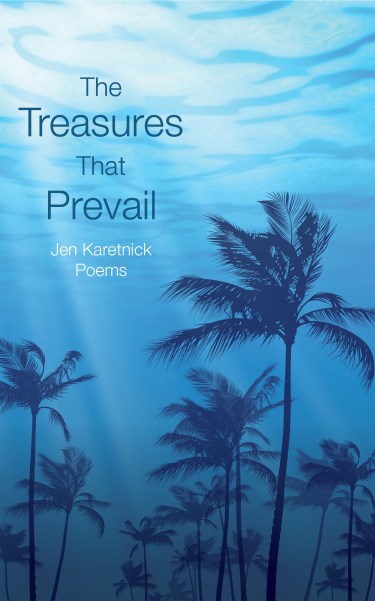
SATURDAY POETRY SERIES PRESENTS: THE TREASURES THAT PREVAIL


From THE TREASURES THAT PREVAIL
By Jen Karetnick:


ADVISE AND CONSENT

It seems to fall to men to create
disasters and women to mop up after.

The first thing people have to forget

is their sense of the senatorial

desk, the deep leather armchair.

There’s always
somebody screaming

off stage or window-shopping for the ridiculous,
arm in arm. Sooner or later these moments come.

We have seen this happen and cannot refrain.


UNDER MANGO CAMOUFLAGE

They bloomed too soon, pistils coral,
hung green like left-behind seawater
well into the sodden fall, ripened
into a bilirubinous yellow.

Falling, they broke themselves
open into Cyrillic letters on the unearthed
limestone as if they were envelopes
stuffed too full of possibilities.

Now marked only with a flag of memory,
this is where we buried the bits
of flesh snipped as easily as a stem
from an eight-day-old son, disguising

the dreams that in the wrong hands
could have been so readily rewritten.


THE OPPOSITE OF MECCA

Oh, the darkness of it all—black cat, black dog,
black monkey on the black-eyed woman’s shoulder,

rocking on a boat dock over water so absent of light
even our dreams have lost their shadows. In this house

made of books and planks, under the art of thatch
and weave, we are birds nesting together who have closed

our throats to song. This is where, without definition, we pin
the horizon as the center on a map of our always new world.


Today’s poems are from The Treasures That Prevail (Whitepoint Press, 2016), copyright © 2016 by Jen Karetnick, and appear here today with permission from the poet.


The Treasures That Prevail is about climate change and its effects on Miami; the poems in this collection confront the ills of modern society in general, mourn both public and personal losses, and predict the difficulties of a post-modern life in a flooded, Atlantis-like lost city. The narrators are two unnamed women, married with a teenage daughter and a teenage son, who live in a part of Miami that will be underwater unless action is taken. The Treasures That Prevail is a parable about what could happen to any of our low-lying coastal cities if we don’t start to make changes now.

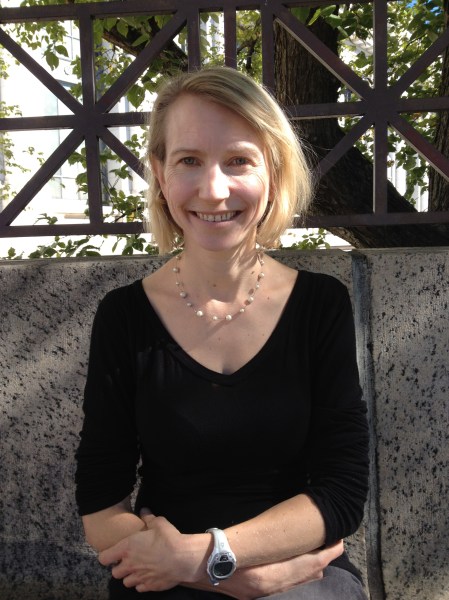
Jen Karetnick is the author of seven poetry collections, including American Sentencing (Winter Goose Publishing, May 2016)–which was a long-list finalist for the Julie Suk Award from Jacar Press–and The Treasures That Prevail (Whitepoint Press, September 2016). She received an MFA in poetry from University of California, Irvine and an MFA in fiction from University of Miami. Her poetry, prose, playwriting and interviews have appeared recently or are forthcoming in TheAtlantic.com, The Evansville Review, Foreword Reviews, Guernica, The McNeese Review, Negative Capability, One, Painted Bride Quarterly, Prairie Schooner, Spillway, Valparaiso Poetry Review, Waxwing and Verse Daily. She is co-director for the reading series, SWWIM (Supporting Women Writers in Miami). Jen works as the Creative Writing Director for Miami Arts Charter School and as a freelance writer, dining critic and cookbook author. She lives in Miami Shores on the remaining acre of a historic mango plantation with her husband, two teenagers, three dogs, three cats and fourteen mango trees.

Editor’s Note: How fearfully prescient this collection has proven to be as California is burning, as large swathes of the world are recovering from hurricanes and earthquakes, as Harvey Weinstein has been outed as a sexual predator, as man after man shows us what it really mean to be “senatorial” in his “deep leather armchair,” as the world is melting and our future threatens to emerge underwater.

With The Treasures That Prevail Jen Karetnick has penned a collection that is beautiful and terrifying, that is lyric and devastating, that rings of Cassandra in the ways its truths fall upon deaf, ignorant, or apathetic ears. The language within these pages is thick and malleable, painting with words a picture that you might cut back with a machete in a valiant effort to combat the vengeful wrath of a raped and battered Mother Earth. For even the best among us — in the age of capitalism and consumerism and selfish, self-destructive climate change — are but “birds nesting together who have closed // our throats to song.”

Want more from Jen Karetnick?
Buy The Treasures That Prevail from Amazon
Jen Karetnick’s Writing Portfolio
Buy American Sentencing from Amazon

SATURDAY POETRY SERIES PRESENTS: THEY WERE BEARS


From THEY WERE BEARS
By Sarah Marcus:


PEOPLE HAVE ALWAYS KNOWN BEARS

You said you were afraid of bears—

we weren’t safe until there was ice
along the shoreline. I said we all need trauma,

and my heart breaks every Autumn, so we broke
ourselves against those rocks until the cave mouth opened:

a womb for blind crayfish,
a passageway harboring beetles.

I want you to reach into the depths of your backwoods
and remember our Winters. We need the bears, ourselves

ursine sleeping in dens—the caverns drip-stoned and stunning.
I was and still am in search of a great bear

because people have always known bears—
we will always be shelter for each other.

When we first met, I told you that a long time ago,
grizzlies came down from the Rockies—

they were poisoned on the range, trapped,
hounded, shot out—we found cranial fragments.

We still listen to those legends of bounties paid
to mountain men, harboring that ancient fear of

the bears that made meat of us, boar and sow,
mauled and gnawed away. Our bones resting in caves,

because you were born to hunt, and I was
born of hunting: a witness of great fires.


LOVE POEM

First snow of the season—
your eyes say
there’s not much oxygen
                  in the mountain air
.

I have never wanted someone
                  as much as I want you.

I devalued the damage:
you won’t belong—stay gone longer—

                  let it melt.


I’ve been thinking about you
                  because we cannot be separate.
The gravitational pull defies
                  the thousands of miles between us.

Even in the deepest woods,
                  we kneel beside the rill,
the river’s riffle,
the spruce’s mantle of rime,

                  until the point of rock
                                  swells tightly around us.

There’s a chant building in the forest: I won’t be your secret.

Everyone knows how to leave,
but I don’t know how to be
in this city
without you.


MYTHOLOGY FOR DESERT LOVERS II

These things are real:
you are a desert moon rising a hundred mornings away.
My horses paw a cracked Earth.
The air threatening Winter.
The solitude of sand.
We can smell the danger

of you and her
in that house.
In every house.

When you are so strongly connected
to another person, what did you call it? Rare?
It’s like the sunset.
No one can hold that kind of beauty
for more than a moment.

Our small ribs are thick
enough to take on a prairie panic.
The fear of too much open space.
So many acres;
we can never catch up.

You say I’m always on your side
and this will always mean more
to a woman.

I try to explain that love is a violence,
even when it’s beautiful.
When you enter someone,
you must also leave them.

And there’s always that moment of relief
when I realize that I’ve always known—
I am a hundred deserts.

I will wait for you or some version of you
to become sky.


Today’s poems are from They Were Bears (Sundress Publications, 2017), copyright © 2017 by Sarah Marcus, and appear here today with permission from the poet.


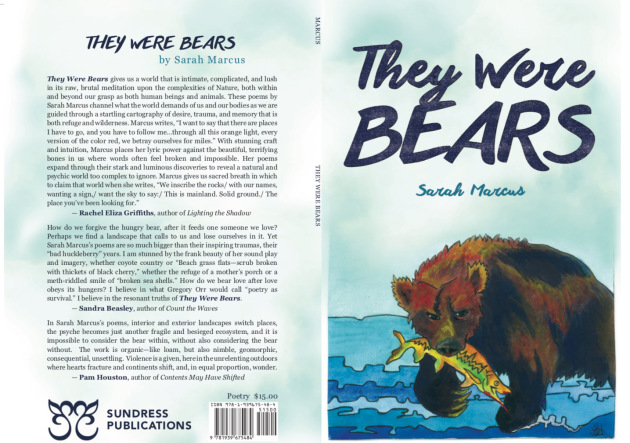
They Were Bears gives us a world that is intimate, complicated, and lush in its raw, brutal meditation upon the complexities of Nature, both within and beyond our grasp as both human beings and animals. These poems by Sarah Marcus channel what the world demands of us, and our bodies as we are guided through a startling cartography of desire, trauma, and memory that is both refuge and wilderness. Marcus writes, ‘I want to say that there are places I have to go, and you have to follow me…through all this orange light, every version of the color red, we betray ourselves for miles.’ With stunning craft and intuition, Marcus places her lyric power against the beautiful, terrifying bones in us where words often feel broken and impossible. Her poems expand through their stark and luminous discoveries to reveal a natural and psychic world too complex to ignore. Marcus gives us sacred breath in which to claim that world when she writes, ‘We inscribe the rocks/with our names, wanting a sign,/want the sky to say:/This is mainland. Solid ground./The place you’ve been looking for.’” -Rachel Eliza Griffiths, author of Lighting the Shadow


Sarah Marcus is the author of They Were Bears (2017, Sundress Publications), Nothing Good Ever Happens After Midnight (2016, GTK Press), and the chapbooks BACKCOUNTRY (2013) and Every Bird, To You (2013). Her other work can be found at NPR’s Prosody, The Huffington Post, McSweeney’s, Cimarron Review, Spork, The Establishment, Cosmopolitan.com, and Marie Claire.com SA, among others. She is an editor at Gazing Grain Press and the Series Editor for As It Ought To Be’s High School Poetry Series: Gender, Identity, & Race. She holds an MFA in poetry from George Mason University and currently teaches and writes in Cleveland, OH.


Editor’s Note: In the Jewish calendar, the days between Rosh Hashanah and Yom Kippur are a surreal and reflective time of reckoning. During these days we are introspective, coming to terms with our true selves before turning outward and asking forgiveness from those who we have wronged. It is in these Days of Awe that I come back to a collection I have been meaning to review for quite some time. It is in this magical time of brutal honesty that I dive deeply into a carefully-wrought world that is far beyond my comfort zone, with eyes and heart wide open to its savage and beautiful truths.

They Were Bears is one of the most thoughtful–if not the most thought-provoking–poetry collections to be released in recent memory. Rife with hunger and blood and animal instinct, this work pulsates at the intersection of nature and violence, family, sex, and love. They Were Bears drags us mercilessly back to our animal nature, honoring vulnerability and calling out sexual violence. This book pulls no punches, spares us little. What is reflected in its waters is our truest selves, as beautiful and terrifying as they are wont to be.

The tender, ravenous, brutal honesty of the book’s thematic spectrum is brought to life by the true craftsmanship of the poet. This is an absolutely stunning collection on every level–its words and images thrash and breathe, fly and tether. The poems are lush in their soundscape, and on the page they mark their territory distinctly. And the moments. The breathtaking moments. How true their revelation, declarations, and admissions: “because you were born to hunt, and I was / born of hunting: a witness of great fires;” “I try to explain that love is a violence, / even when it’s beautiful. / When you enter someone, / you must also leave them.”

Mazal tov to Sarah Marcus on this incredible work, and may we all start anew together in these Days of Awe.


Want more from Sarah Marcus?
Sarah Marcus’ Official Website
SATURDAY POETRY SERIES PRESENTS: NEW YEAR’S MORNING


NEW YEAR’S MORNING
By Helen Hunt Jackson

Only a night from old to new!
Only a night, and so much wrought!
The Old Year’s heart all weary grew,
But said: “The New Year rest has brought.”
The Old Year’s hopes its heart laid down,
As in a grave; but, trusting, said:
“The blossoms of the New Year’s crown
Bloom from the ashes of the dead.”
The Old Year’s heart was full of greed;
With selfishness it longed and ached,
And cried: “I have not half I need.
My thirst is bitter and unslaked.
But to the New Year’s generous hand
All gifts in plenty shall return;
True love it shall understand;
By all my failures it shall learn.
I have been reckless; it shall be
Quiet and calm and pure of life.
I was a slave; it shall go free,
And find sweet peace where I leave strife.”
Only a night from old to new!
Never a night such changes brought.
The Old Year had its work to do;
No New Year miracles are wrought.

Always a night from old to new!
Night and the healing balm of sleep!
Each morn is New Year’s morn come true,
Morn of a festival to keep.
All nights are sacred nights to make
Confession and resolve and prayer;
All days are sacred days to wake
New gladness in the sunny air.
Only a night from old to new;
Only a sleep from night to morn.
The new is but the old come true;
Each sunrise sees a new year born.


(Today’s poem is in the public domain, belongs to the masses, and appears here today accordingly.)


Helen Maria Hunt Jackson (1830 – 1885) was an American poet and writer who became an activist on behalf of improved treatment of Native Americans by the United States government. (Bio courtesy of Wikipedia, with edits.)

Editor’s Note: Wishing all who celebrate Rosh Hashanah this week a shanah tovah umetukah, a good and sweet new year. May today’s poem remind us that now is an opportunity for change, but that we must be the change we want to see in the world.

SATURDAY POETRY SERIES PRESENTS: WASN’T THAT A MIGHTY STORM

WASN’T THAT A MIGHTY STORM
Performed by Rolf Cahn and Eric Von Schmidt

Editor’s Note: I have been reading Isaac’s Storm by Erik Larson, which tells of the Great Storm of 1900. That Category 4 hurricane decimated the town of Galveston, Texas, killing between six and twelve thousand people, making it the deadliest natural disaster in U.S. history. I was reading this book as Hurricane Harvey ravaged Houston and beyond. I am reading it now, still, as Hurricane Irma sweeps over the Caribbean and heads for the U.S. mainland. I am thinking of those who are fleeing and those who are staying put to weather the storm. Of those who have lost everything. Of those who have lost their lives. I am thinking of global warming and our current regime of climate change deniers. I am thinking of the fires that are burning in the west. I am thinking of friends and their families, and of those who are my kin because of our shared humanity. I am thinking of how history repeats itself and of the lessons we fail to learn from the before time.

Today’s poem is a folk song that remembers the Great Storm of 1900, and dedicated to those who are now suffering, who have suffered, who will suffer still.

SATURDAY POETRY SERIES PRESENTS: JANET R. KIRCHHEIMER

Wonder Beans
By Janet Kirchheimer

My father went each morning to his garden.
He taught me to smell the soil to see if it was good,
to feel the dirt slide across my hands, to never
wear gloves, to stay in the middle of the row when planting seeds.
We’d look for work to do in the garden,
and sometimes there was nothing more to do
than watch the garden grow, wait for the harvest.
He thought that haricot vert were the dumbest thing he’d ever seen–
he liked his Kentucky Wonder beans, big and bursting with seeds, leaving
them to grow in the summer sun as long as possible.
Last winter he told me we couldn’t save
the parsley from the snow and ice, even though
we put blankets over it.
He got pneumonia in February.
In April, he asked me if I thought he’d get to his garden, and I told him yes.
By the end of May I brought him
cherry tomato plants to keep on the deck.
He no longer had the strength to pick
the first tomatoes that ripened in June.
August: I bring dirt from the garden
to his grave and scatter grass seed.


“Wonder Beans” previously appeared on String Poet and appears here today with permission from the poet.

Janet R. Kirchheimer is the author of How to Spot One of Us, (Clal, 2007). A Pushcart Prize nominee, her work has appeared in several journals including Young Ravens Literary Review, Atlanta Review, String Poet, Connecticut Review, Kalliope, Common Ground Review, and several anthologies and online journals. Currently, she is producing a poetry performance documentary, After, exploring poetry written about the Holocaust.

Editor’s Note: Today’s poem is a celebration of life and a poignant reminder that one day we may be remembered by what we love. Through a daughter’s eyes we see a father, watch him plant and grow, watch him love and tend the earth. Through the poet we know what it is for this daughter to love her father, and what it is to lose him. How touching her remembrance, how bittersweet the sting at poem’s end when father is returned to earth.

Want to read more by and about Janet Kirchheimer?
After – A Poetry Film
Young Ravens Literary Review
Collegeville Institute
Podium Literary Journal
Forward’s Schmooze

SATURDAY POETRY SERIES PRESENTS: HOLLY KARAPETKOVA

Song of the Exiles
By Holly Karapetkova

There never was a garden
only a leaving:
miles and miles
of footprints in the dirt.

In the beginning–
the shattered sun, the wind,
and nothing left but our shadows
sifting through the dust behind us.

When we turned
we did not turn to salt.
When we turned
there was nothing behind us to burn,

nothing to return to,
though who could blame us for turning
with only the long days ahead,
tongues tripping in the dirt.

They said we didn’t belong.
They blamed us
for leaving the garden
which never was or would be.

Where could we go,
we who had come from nowhere
and hence could not
return?


“Song of the Exiles” previously appeared via Split This Rock and appears here today with permission from the poet.

Holly Karapetkova’s poetry, prose, and translations from the Bulgarian have appeared recently in Alaska Quarterly Review, Prairie Schooner, North American Review, Drunken Boat, and many other places. Her second book, Towline, won the Vern Rutsala Poetry Contest and is just out from Cloudbank Books.

Editor’s Note: After a moment of silence following the loss of AIOTB’s Managing Editor, the Saturday Poetry Series returns this week with a poem worth breaking silence for. Holly Karapetkova’s “Song of the Exiles” begins in Eden. At once biblical and real, this Eden is a “garden / which never was or would be.” In this world we are storyteller and reader, mythological figure and landless refugee. This is world news, this is human interest story, this is myth in the truest sense of the word. And this, above all, is poetry. Expertly crafted, delicately wrought, brilliant poetry. “When we turned / we did not turn to salt. / When we turned / there was nothing behind us to burn.”

Want to read more by and about Holly Karapetkova?
Holly Karapetkova’s Official Website

SATURDAY POETRY SERIES REMEMBERS OKLA ELLIOTT

A version of this post was featured on this series in December of 2010. It is being shared here today as As It Ought To Be mourns the loss of our founder.


By Okla Elliott:

THE IDIOT’S FAITH

Three lanterns floated in the dream she told him, but he didn’t want to hear about lanterns. He wanted factories unbuilt, windows smashed open. He wanted libertine wailings. She denied being a builder of factories, but he knew her reputation. A wind blew in from Montreal, or she said it was from Montreal, said she could smell the bars of Rue St Laurent. He was skeptical but didn’t want to argue. What good are arguments on a Saturday night? What good are arguments at all? She told him again about her love of the French language, and he thought maybe they were getting somewhere. The modern sunset outside her window was spilled wine tinged with pollution. They went down the mountain to town, found the trouble she had decided they wanted. She called a homeless man a fallen Chinese god, and they mourned his sad descent, forgetting (almost) their own. That is the power of generosity, one use of our idiot faith in human love.


THE LIGHT HERE

It sets a mood
of clownish tragedy,
of ecstatic failure waiting to happen.

It is not a static blue light
nor the throb of a strobe.

It is not a light to read by
nor to be naked in,
unless you are desperate
or barbarously horny.

I would use it to look for you
in a cave or catacomb
or an ossuary crowded by the famous dead–
that is, if you were in such a place,
I would use this light to find you.

It is a light that yellows the periphery.
It is not a light that brightens the center.

It is mixed from an overcast morning
and the electric urban dusk.

It is a light I could live in
if I came to terms with certain failings
in my character
and the character of others.

I know you have light where you are,
better light even,
but I wanted you to know
about the light here.

 
Okla Elliott (1977 – 2017) passed away in his sleep last weekend. The Misicordia University professor, a prolific novelist, poet, short fiction writer, and translator, would have turned 40 this year. Those of us who knew him – and his circle of acquaintance and friendship was very wide indeed – are in shock from this wholly unanticipated death. He was kind, generous with his time, and indefatigable in his writing. He was much loved.

His work appeared in Harvard Review, The Literary Review, New Ohio Review, Prairie Schooner, A Public Space, Cincinnati Review, Indiana Review, Subtropics, and elsewhere, as well as being included as a “notable essay” in Best American Essays 2015. His books included From the Crooked Timber (short fiction), The Cartographer’s Ink (poetry), The Doors You Mark Are Your Own (a novel), Blackbirds in September: Selected Shorter Poems of Jürgen Becker (translation), Pope Francis: The Essential Guide (nonfiction), and Pope Francis: The Essential Guide (nonfiction, forthcoming). — David Bowen, The Book Haven (with edits)


Editor’s Note: Today I am honored to present to you the work of As It Ought To Be‘s managing editor. His work speaks for itself, as does the significant body of publications in which his work has appeared. Okla is an impressive scholar, a fearless leader, and a wonderful person to know in the writing world. He believes strongly in the idea of building and sustaining a community of writers, and I am honored to be a member of that community. Regarding today’s pieces I will say that Mr. Elliott effortlessly combines vignettes of straightforward narrative with crisp images and moments of simple yet brilliant language such as “What good are arguments on a Saturday night? What good are arguments at all,” “if you were in such a place, I would use this light to find you,” and this kicker of an ending, “It is a light I could live in / if I came to terms with certain failings / in my character / and the character of others. / I know you have light where you are, / better light even, / but I wanted you to know / about the light here.” Simple. Elegant. Stunning.

UPDATE: “The Light Here” appeared on the back cover of Okla’s memorial liturgy booklet at his funeral held at Misicordia University on Friday March 24, 2017.


ONLINE MEMORIALS AND TRIBUTES
As It Ought To Be Mourns the Loss of Our Founder
“Some testimonies to Okla Elliott, 1 May 1977 – 19 March 2017” – Days and Memory
“Requiescat in pace: poet, novelist, translator Okla Elliott, 1977-2017” – Book Haven
“Go Read Okla Elliott’s Stuff, Please. (A Remembrance)” – Great Writers Steal
“Remembering Okla Elliott” – Mildred Barya’s House of Life

SATURDAY POETRY SERIES PRESENTS: STACY R. NIGLIAZZO


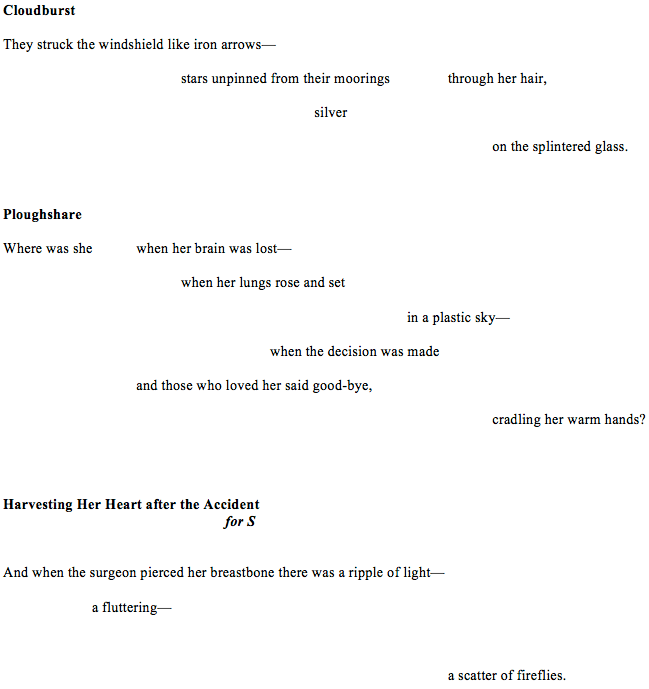
By Stacy R. Nigliazzo:


“Harvesting Her Heart after the Accident” first appeared in The Journal of Compressed Creative Arts/Matter Press. All other pieces are previously unpublished. Today’s poems appear here today with permission from the poet.

Stacy R. Nigliazzo‘s debut poetry collection Scissored Moon was published in 2013 by Press 53. It was named Book of the Year by the American Journal of Nursing. It was also short-listed as a finalist for the Julie Suk Poetry Prize (Jacar Press) and the Texas Institute of Letters First Book Award for Poetry/Bob Bush Award. She is co-editor of Red Sky, an anthology addressing the global epidemic of violence against women.

Editor’s Note: Stacy R. Nigliazzo imagines the unimaginable, writes those words which cannot be spoken. An emergency room nurse, it is when her personal losses make their way to the page that her experience becomes poetry, and that poetry becomes an act of healing for poet and reader alike. How visual her imagery, how visceral her grief. And yet her poems leave us not in darkness, but with the necessary reminder that even in our darkest hour there is a “ripple of light.”

Want to read more by and about Stacy R. Nigliazzo?
Stacy Nigliazzo’s Official Website