SATURDAY POETRY SERIES PRESENTS: JENNA LE

Jenna Le photo

By Jenna Le:


MOM’S COCKS

Mom grew up beside the Perfume River in Vietnam,
in a brick house overrun by chickens.
Those horny-footed fowl were always
rubbing their feather-padded genitals
against sofa legs and children’s shoes
as if they were fit to burst. Mom laughs

as she tells me how they ground
their pelvises against her leather sandal,
stuporous with misdirected lust—
How strange that she
is talking to me about sex
in this casual way. She’s returning to her roots

as a child who lived among
unmannered beasts. And I, through hearing her words,
am returning there with her: I
am the aggressive rooster; I’m the hens
cowering behind the outhouse; I’m the much-abased,
much-abraded, Size Four shoe.


THREE SHORT POEMS ON A COMMON THEME

1.

Staring at you across the room, my body seemed composed
of nothing but eyes.

Even my mouth
watered, like an eye.

2.

I couldn’t sleep a wink all night: my brain agitated its solitude
like a washing machine

filled with copies
of your immaculate white shirt.

3.

In the morning, I went out and bought a book of your poems.
It’s a poor substitute for a straightedge, it’s true,

but you won’t
sell me your curves for any price.


Today’s poems are from Six Rivers, published by NYQ Books, copyright © 2011 by Jenna Le, and appear here today with permission from the poet.


Jenna Le was born in Minneapolis, Minnesota, a daughter of two Vietnam War refugees. She received a B.A. in mathematics from Harvard University and an M.D. from Columbia University. She has worked as a physician in Flushing, New York, and the Bronx, New York. Her full-length poetry collection, Six Rivers (NYQ Books, 2011), was a Small Press Distribution Poetry Bestseller. Her poetry, fiction, essays, book criticism, and translations of French poetry have appeared or are forthcoming in journals such as AGNI Online, Barrow Street, Bellevue Literary Review, Massachusetts Review, Measure, Pleiades, and 32 Poems.

Editor’s Note: Lyric, narrative, accessible, and unafraid, Jenna Le’s Six Rivers opens along the banks of the Perfume River, in a scene that pairs mother with sex and “horny-footed fowl.” The relationships—between mother and daughter, between ‘here’ and ‘there’—are rich and complex, with the poet embodying her mother’s past, her roots, and the “much-abased, much-abraded, Size Four shoe.” Throughout the book love and sex, personal, familial, and cultural history, healing and death are all explored as we travel with the poet along the six rivers of her life. Le allows herself to be vulnerable and imperfect, and so we relate to her, root for her, are drawn into her vivid world. A keen seer and a captivating reporter, it is no wonder that, at times, the poet feels she is “composed of nothing but eyes.” Hungry for life, hungry for love, it is no wonder that “Even [her] mouth watered, like an eye.”

Want to read more by and about Jenna Le?
NYQ Poets
Mascara Literary Review
The Nervous Breakdown
The Toronto Quarterly
Sycamore Review
SATURDAY POETRY SERIES PRESENTS: NO

no


from NO
By Ocean Vuong


TORSO OF AIR

Suppose you do change your life.
& the body is more than

a portion of night—sealed
with bruises. Suppose you woke

& found your shadow replaced
by a black wolf. The boy, beautiful

and gone. So you take the knife to the wall
instead. You carve & carve.

Until a coin of light appears
& you get to look in, for once,

on happiness. The eye
staring back from the other side—

waiting.


HOME WRECKER

And this is how we danced: with our mothers’
white dresses spilling from our feet, late August

turning our hands dark red. And this is how we loved:
a fifth of vodka and an afternoon in the attic, your fingers

sweeping though my hair—my hair a wildfire.
We covered our ears and your father’s tantrum turned

into heartbeats. When our lips touched the day closed
into a coffin. In the museum of the heart

there are two headless people building a burning house.
There was always the shotgun above the fireplace.

Always another hour to kill—only to beg some god
to give it back. If not the attic, the car. If not the car,

the dream. If not the boy, his clothes. If not alive,
put down the phone. Because the year is a distance

we’ve traveled in circles. Which is to say: this is how
we danced: alone in sleeping bodies. Which is to say:

This is how we loved: a knife on the tongue turning
into a tongue.


Today’s poems are from NO, published by Yes Yes Books, copyright © 2013 by Ocean Vuong. “Torso of Air” previously appeared in BODY Literature, and “Home Wrecker” previously appeared in Linebreak. These poems appear here today with permission from the poet.


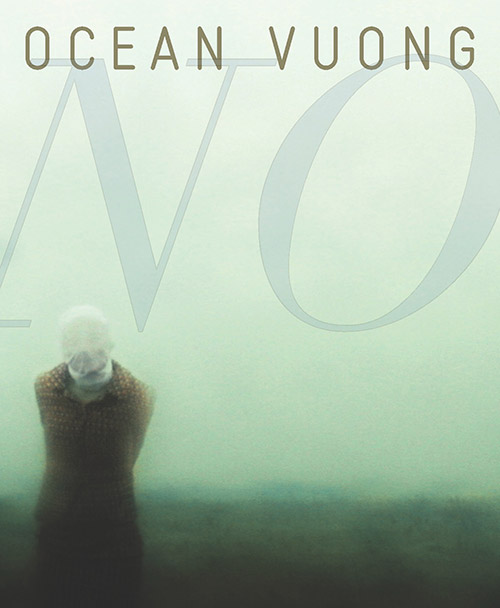
NO: Anyone who has already sensed that “hope is a feathered thing that dies in the Lord’s mouth,” should get their hands on NO. Honest, intimate, and brimming with lyric intensity, these stunning poems come of age with a fifth of vodka and an afternoon in an attic, with a record stuck on please, with starlight on a falling bomb. Even as Vuong leads you through every pleasure a body deserves and all the ensuing grief, these poems restore you with hope, that godforsaken thing—alive, singing along to the radio, suddenly sufficient. —Traci Brimhall, Our Lady of the Ruins


Ocean Vuong is a recipient of a 2013 Pushcart Prize as well as fellowships from Kundiman, Poets House, and The Saltonstall Foundation for the Arts. Poems appear in Poetry, The Nation, Beloit Poetry Journal, Passages North, Quarterly West, Denver Quarterly, and American Poetry Review, which awarded him the 2012 Stanley Kunitz Prize for Younger Poets. He lives in Queens, NY.


Editor’s Note: I’m just going to come right out and say this: Ocean Vuong is one of the best and most important poets writing in America today. I have not been so moved as I am by Vuong’s words since I first read Li-Young Lee. This poet has changed my life. He has renewed my belief in American poetry. That it can be emotional and heartbreaking. That is can be beautiful and full of hope. That modern American poetry can—and does—matter. In my humble opinion your poetry collection is simply not complete unless it houses both Vuong’s groundbreaking chapbook, Burnings, and his newest release from Yes Yes Books, NO.

NO is a surprisingly experimental collection, yet Vuong remains dedicated to the lyric and the narrative, guiding us through its formal twists and turns through emotive language and evocative imagery. Throughout its pages the poet intimately explores themes of love, sexuality, and belonging against a backdrop of devastating loss. It is a brilliant and beautiful collection, a true heartbreaking work of staggering genius. As the book’s publisher did when reading through the manuscript for the first time, when Ocean Vuong says NO to you, be prepared to say “Yes Yes!”


Want to see more from Ocean Vuong?
Buy NO from Yes Yes
The Poetry Foundation
Interview in The Well & Often Reader
Ben Lerner on mentoring Ocean Vuong, Brooklyn College

SATURDAY POETRY SERIES PRESENTS: ONLY RIDE

OnlyRide-Front

from ONLY RIDE
By Megan Volpert:


Screen Shot 2014-04-04 at 3.16.20 PM

Screen Shot 2014-04-04 at 3.18.58 PM


Screen Shot 2014-04-04 at 3.20.28 PM

Screen Shot 2014-04-04 at 3.29.11 PM


Picture 1

Picture 3


Today’s poems are from Only Ride, published by Sibling Rivalry Press, copyright © 2014 by Megan Volpert. “You are suspended” was first published in This assignment is so gay, edited by Megan Volpert and published by Sibling Rivalry Press. These poems appear here today with permission from the poet.


Only Ride: If Denis Johnson had written Tuesdays with Morrie, it’d feel like Megan Volpert’s book of prose poems. Clawing its way out through this minimalist checklist of suburban malaise is an emphatically optimistic approach to growing up. These tiny essays carefully detail how to avoid becoming one’s parents, how to manage a body addled by disease, and how to keep having the best possible time in life. After all: this is the only ride there is, and we can only ride it. Volpert’s is a story of Springsteenian proportions, a gentleman’s guide to rebellion complete with iron horses and the church of rock & roll.

Megan Volpert is the author of five books on communication and popular culture, most notably about Andy Warhol. She has been teaching high school English in Atlanta for the better part of a decade, and is currently serving as her school’s Teacher of the Year. She edited the American Library Association-honored anthology This assignment is so gay: LGBTIQ Poets on the Art of Teaching, which is currently a Lambda Literary Award finalist. Predictably, www.meganvolpert.com is her website.

Editor’s Note: Megan Volpert’s Only Ride is a no-holds-barred journey through personal history, with sage wisdom bursting from its rough-and-tumble seams. The book is less Zen and the Art of Motorcycle Maintenance and more Get a Grip and Ride Like it’s Your Only Ride. This is a book about how to live life. Suck it up and move past the childhood issues that scarred you. Don’t just cope with illness, thrive in the face of it. Live life full throttle no matter what it throws at you, because life is short and living demands fierce courage.

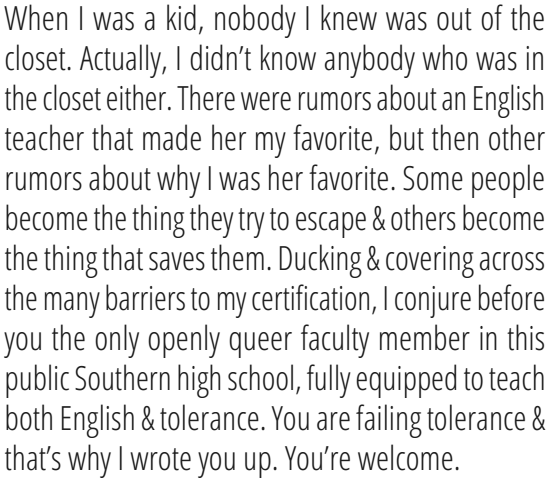
Throughout her journey Volpert takes personal and political stands, inspiring her readers to do the same. Sometimes you’ve just gotta smash things, because “a deep frustration that hurls pottery against the concrete floor… is not the thing to bottle up in shame.” Sometimes a teacher has a responsibility to teach more than just standard curriculum. As “the only openly queer faculty member in [a] public Southern high school,” Volpert is “fully equipped to teach both English & tolerance,” and she’ll write a student up for failing the latter.

Brimming with humor and hubris and wicked wit, the greatest gift of this book is the life lessons it relays. Stand up for what you believe in. Move past life’s bullshit and face adversity with a battle cry. Let go of the small stuff. “Many things annoy me,” Volpert confides, “but I seldom get really angry because now I just feel so lucky to be alive.” And we all should, the implication echoes. In a world where “[d]eath knocks twice: once for introductions & once to take you away,” why waste your precious life letting things get your goat? Having faced death, the poet gave her goat away; she has no goat to give. And we would all be well served to follow her example. “After all: this is the only ride there is, and we can only ride it.”

Want to see more from Megan Volpert?
Official Website
This assignment is so gay
Sibling Rivalry Press
FRONTIER PSYCHIATRIST

SATURDAY POETRY SERIES PRESENTS: THE ARROW

Picture 9


from THE ARROW
By Lauren Ireland


Picture 4


Picture 8


Picture 7


Today’s poems are from The Arrow, published by Coconut Books, copyright © 2014 by Lauren Ireland, and appear here today with permission from the poet.


The Arrow: “It took almost a lifetime’s worth of emotions to read Lauren Ireland’s THE ARROW. She says Time eats at the edges of things so we hear her say other things, too, I am hating you from very far away and I am a grownup/flying right into the mouth of fear. This book is fraught with emotional emergencies, sometimes reckless, almost a little demented as one has to be when one faces who and what and where and how we are. Lucky for Ireland there are friends to whom many of these poems are dedicated who accompany her as she’s permanently lost in this very very mysterious flight we all share.” —Dara Wier


Lauren Ireland grew up in southern Maryland and coastal Virginia. She is a graduate of the MFA program for Poets and Writers at the University of Massachusetts-Amherst and an editor at Lungfull! Magazine. Lauren is the author of Dear Lil Wayne (Magic Helicopter Press, 2014) and two chapbooks, Sorry It’s So Small (Factory Hollow Press, 2011) and Olga & Fritz (Mondo Bummer Press, 2011). She co-curated The Reading at Chrystie Street in New York. Currently, she lives in Seattle with her husband and her husband’s cat.


Editor’s Note: As I read Lauren Ireland’s The Arrow I pushed against the book’s air of flippancy, its self-preservation in the guise of farce and self-deprecation, its false oaths of apathy. These are, as Naomi Shihab Nye would say, “the armor [the book] put[s] on to pretend [it has] a purpose in the world.” But this book does not need to pretend. It wears its armor as a tricked out husk around its fervent vulnerability. The poems within its pages are the bloodlettings of a twisted, tortured, and exceedingly human mind.

The Arrow is full of moments of lyric beauty and stunning, brutal clarity interwoven with equal portions of heaviness and frivolity that make for quite the witches’ brew. There is something unsettling about this book. Something that does not sit well. A wound or scab that begs to be healed yet must be picked at. I was often uncomfortable reading it, yet I could not put it down. I was drawn to the beauty and put off by the grotesque, and I believe this was meant to be the author’s poetic commentary on life. Life—like this book—is full of debauchery and death, fear and imagination, the mundane and the absurd. Love is inextricably linked with hate. There is a thin line between reality, waking dreams, and nightmares. This book is labyrinthine, in both the literal sense and the David Bowie sense of the word.

While it is easier to take some poems in the book more seriously than others, this, too, is an artistic reflection of the human life. As a work of art, however, I felt myself anchored throughout my journey by very deliberate artistic choices. Wickedly smart and poignant titles. Moments of lyric clarity that took my breath away. And a healthy dose of killer end-lines, which I am always a sucker for. “Now I am a grownup flying right into the mouth of fear,” “Now… I am running / from the nighttime wolves / in the forest that never was,” and that crushing Orphic echo, “Oh / I am exiled / my friend / this once / don’t turn.”


Want to see more from Lauren Ireland?
Official Author Website
Buy The Arrow from Coconut Books
Buy Dear Lil Wayne from Magic Helicopter Press
Small Press Distribution

SATURDAY POETRY SERIES PRESENTS: THE MOONS OF AUGUST

Lameris Cover-1


FROM THE MOONS OF AUGUST
By Danusha Laméris


EVE, AFTER

Did she know
there was more to life
than lions licking the furred
ears of lambs,
fruit trees dropping
their fat bounty,
the years droning on
without argument?

Too much quiet
is never a good sign.
Isn’t there always
something itching
beneath the surface?

But what could she say?
The larder was full
and they were beautiful,
their bodies new
as the day they were made.

Each morning the same
flowers broke through
the rich soil, the birds sang,
again, in perfect pitch.

It was only at night
when they lay together in the dark
that it was almost palpable—
the vague sadness, unnamed.

Foolishness, betrayal,
—call it what you will. What a relief
to feel the weight
fall into her palm. And after,
not to pretend anymore
that the terrible calm
was Paradise.


LONE WOLF

On December 8, 2011, the first wolf in nearly a hundred years was seen
crossing the border of the Sierra Nevada from Oregon to California.

A male, probably looking for a mate
in this high wilderness
along the cusp of Mount Shasta.
Already there are ranchers waiting, armed.
True, it’s only one wolf.
Except that a wolf is never just a wolf.
We say “wolf” but mean our own hunger,
walking around outside our bodies.
The thief desire is. the part of wanting
we want to forget but can’t. Not
with the wolf loose in the woods
carrying the thick fur
of our longing. Not with it taking
in its mouth the flocks we keep
penned behind barbed wire.
If only we didn’t have to hear it
out in the dark, howling.


THE BALANCE

She was at a friend’s apartment,
my mother, a third floor walk-up.
It was summer. Why she slipped
into the back room, she can’t recall.
Was there something she wanted
fro her purse…lipstick?
a phone number?
Fumbling through the pile
on the bed she looked up and saw—
was this possible?—outside,
on the thin concrete ledge
a child, a girl, no more than two or three.
She was crouched down
eyeing an object with great interest.
A pebble, or a bright coin.
What happened next
must have happened very slowly.
My mother, who was young then,
leaned out the window, smiled.
Would you like to see
what’s in my purse?
she asked.
Below, traffic rushed
down the wide street, horns blaring.
Students ambled home
under the weight of their backpacks.
From the next room,
strains of laughter.
The child smiled back, toddled along
the ledge. What do we know
of fate or chance, the threads
that hold us in the balance?
My mother did not imagine
one day she would
lose her own son, helpless
to stop the bullet
he aimed at his heart.
She reached out to the girl,
grabbed her in both arms,
held her to her chest.


Today’s poems are from The Moons of August, published by Autumn House Press, copyright © 2014 by Danusha Laméris, and appear here today with permission from the poet.


The Moons of August: “Danusha Laméris writes with definitive, savoring power—in perfectly well-weighted lines and scenes. Her poems strike deeply, balancing profound loss and new finding, employing a clear eye, a way of being richly alive with appetite and gusto, and a gift of distilling experience to find its shining core. Don’t miss this stunning first book.” —Naomi Shihab Nye

“This book of motherhood, memory, and elegiac urgency crosses borders, cultures, and languages to bring us the good news of being alive. With language clear as water and rich as blood, The Moons of August offers a human communion we can all believe in. Reckoning with and grieving for the past as they claim the future, these poems are wise, direct, and fearless. “What’s gone / is not quite gone, but lingers,” Laméris reminds us. “Not the language, but the bones / of the language. Not the beloved, / but the dark bed the beloved makes / inside our bodies.” —Dorianne Laux


Danusha Laméris’s work has been published in Alaska Quarterly Review, Poetry Northwest, Rattle, The Sun and Crab Orchard Review as well as in a variety of other journals. Her poems have also appeared in the anthologies In a Fine Frenzy: Poets Respond to Shakespeare, A Bird Black as the Sun: California Poets on Crows and Ravens, and Intimate Kisses. She was a finalist for the 2010 and 2012 New Letters Prize in poetry and has been nominated for a Pushcart Prize. Her poem, “Riding Bareback,” won the 2013 Morton Marcus Memorial prize in poetry, selected by Gary Young and her first book, The Moons of August, was chosen by Naomi Shihab Nye as the winner of the Autumn House Press poetry contest. She lives in Santa Cruz, California and teaches an ongoing poetry workshop.


Editor’s Note: I first discovered Danusha Laméris when I featured her stunning poem “Arabic” in the fall of 2013. When I read that her first book was forthcoming this year—and chosen by Naomi Shihab Nye as the winner of the Autumn House Press poetry contest, no less—I begged the poet remember me when the book was released. When it arrived I read, devoured, re-read, explored, breathed, bled, and grew whole once more within the boundless confines of its pages.

Through Laméris’ words I was the first woman born; I knew the burden—and relief—of being Eve. I was as old as time and as all-encompassing as nature. I was as helpless and as grieved as a mother, and as powerful. The Moons of August is small and light and fits effortlessly in my hands. Yet it reaches far back to human origins and delves deep into the human experience and the complex soul of (wo)man. “With,” as Dorianne Laux so aptly states, “language clear as water and rich as blood,” this is a book to read when you want to feel alive, from the very atoms that comprise you to the farthest reaches of your white light.


Want to see more by Danusha Laméris?
Author’s Official Website

A Review of Seth Brady Tucker’s Mormon Boy

Seth Brady Tucker Mormon Boy Cover

.

A Review of Seth Brady Tucker’s Mormon Boy

By Karen Craigo


I’ve always felt drawn to work of poets from the Great War. Writers like Wilfred Owen and Siegfried Sassoon brought home to their readers the terrors of war, and while it is difficult to take their words in, it is essential to consider their powerful poems of witness.

A fragment from Sassoon’s “Aftermath” demonstrates how poetry can be a deterrent to war:

Do you remember the rats; and the stench
Of corpses rotting in front of the front-line
trench—
And dawn coming, dirty-white, and chill with a hopeless rain?
Do you ever stop and ask, “Is it all going to happen again?”

Nearly all of Sassoon’s poems capture a glimpse of the hell we call war, and for me, they hold more of the feeling of armed conflict than any history book could attempt to depict.

For years, I have been looking for the Wilfred Owen of our wars in Iraq or Afghanistan, and I have come up empty. I have found something far superior, though, in the poetry of combat veteran Seth Brady Tucker—superior because he is not a copy of those war poets who have come before him, but instead is an utterly unique and powerful voice in his own right, and a bold and unflinching witness to the wars we own today.

Mormon Boy, Brady’s debut poetry collection, covers a lot of ground—love, coming of age, even the perfection of his wife’s hiney in soccer shorts—but for me, war eclipses everything else in the book, and this is exactly as it should be.

Tucker’s first section, “Falling in Love During Wartime,” introduces the topic of his service, and the placement of these poems—coming before some poems that deal with Tucker’s pre-service life, so that the book is not chronologically ordered—has a profound effect on the way a reader receives the other work in the book. I actually suspect that I will read all of Tucker’s subsequent releases with the tinge of his military service shading my understanding of them. It’s unavoidable. War, after all, changes a person.

Tucker’s poetry is informed by plenty of sensory imagery—more, I think, than I see in the work of the Great War poets I mentioned. Tucker’s poem “Whirligig,” for instance, talks frankly about the mingling smells of his friend Erik’s blood and his own overheated weapon. It also presents a grisly picture of Erik’s severed foot, which “existed still tied / into its boot—how it felt to pick up that foot and place it in a pile of other things that /were Erik’s.” The understatement makes the idea of that pile all the more ghastly.

This section of “Whirligig” about Erik introduces the idea of getting past the war, and it concludes, “[S]omehow, one night, he will know five minutes / of peace—just five minutes of life, as it should have been.” But the title of the second section, “Those Stains Will Never Come Out,” seems tragically to reveal the futility of such thinking.

Still, it is intriguing to imagine other parts of Tucker’s life that are even more rarified than combat service. We have about 1.3 million active-duty troops in all branches of the military, but Tucker’s home state of Wyoming has only half a million souls. One of my favorite poems in his collection was “Where to Find Work in Natrona, Wyoming,” which the poem announces has a population of five. “This / should say it all,” Tucker writes. He continues:

Natrona mocks you,

with a population exactly
one thousandth its elevation.
Here, dust floats like a fog
over everything, but ultimately
obscures only the fact that there

is nothing to see but horizon.

The poem concludes with the incredibly bored speaker studying a veterinary guide and imagining he can probably handle some of the procedures described inside. That boredom is probably as far from your boredom as the Earth is from the sun.

One is thankful that Tucker the soldier went to Afghanistan armed not only with a rifle but also with some of the distracting memories from a time before his service that this book recalls. I think the poem “Making Out in Cars with Bucket Seats and Other Tales of Woe” resonates with every small-town person (although my own Gallipolis, Ohio may as well have been Beijing in comparison to Natrona). Imagine being approached while parking (in the sexy sense of the term) by an “incredible blue dick of a cop,” who asks probing questions about last night’s escapades while you are attempting to enjoy your night with a whole different date, whom Tucker identifies as “Red”:

Red, being no dope,
opens my car door and starts sprinting away into the night, her silhouette

flashing purple and black in the swirl of ruby and sapphire lights, long hair swinging like a middle finger, and then I am running too, my dark
silhouette
a bull’s-eye, a giant target, a free pass for a cop busting his first-kill cherry
[…].

The poem ends with Tucker berating himself for not buying American and lamenting bucket seats instead of the “wide / bench seats of a Nova.”

Tucker’s collection covers a lot of ground, the way it seems first collections used to do before everyone entered programs and started writing books instead of poems. I like the variety in theme and form, and I found Mormon Boy to be a promising introduction to a talented poet.

Seth Brady Tucker, Mormon Boy, Elixir Press, 2012: $17.

***

Karen Craigo teaches English to international students at Drury University in Springfield, Missouri. Her chapbook, Someone Could Build Something Here, was just published by Winged City Chapbook Press, and her previous chapbook, Stone for an Eye, is part of the Wick Poetry Series. Her work has appeared in the journals Atticus Review, Poetry, Indiana Review, Prairie Schooner, Puerto del Sol, The MacGuffin, and others.

Read her poem “Death by Water,” included in our Saturday Poetry Series, here.