SATURDAY POETRY SERIES PRESENTS: MY FRIEND KEN HARVEY

khcover

From MY FRIEND KEN HARVEY
By Barrett Warner:


MY FRIEND DAVID BOMBA

Screen Shot 2015-08-21 at 11.44.40 PM


MY FRIEND KEITH MARTIN

My friend Keith Martin is dead. He died in early April.
It’s kind of a busy month to die. The ground is softening—
rows raked and sown—jealous hues emerging like rye.

It’s weird that he died the same month I was born.
Now the ghost would be forever Aries, the passionate one,
the one who gets things almost right, who gets in his own way.

A friend is a brick against the sweet hereafter. Lose a friend
and you lose a brick. Lose Keith and you lose a wall.
It’s just a matter of time until the roof falls down.

Marsha his wife sat cold on offers coming quickly on his land.
I don’t blame her holding out for more, but suffered lifetimes
are always cheap. I gave away anything I ever tried to sell.

No one ever wants to buy what you don’t love.

Their house is a quarter mile away, through dense spite trees
planted by our neighbor so he wouldn’t have to look at Keith getting out of his car.

I can’t imagine hating someone so much I’d plant trees.

One dog’s not enough, and two dogs are too many.
That’s how Keith would talk, like Ben Franklin.

He wanted me to feel better, but I never did.


MY FRIEND LARRY MCKEE

My friend Larry McKee notices each leaf in an oak forest.
I see firewood, fence boards, squirrels, squirrel stew.

I hustle through life’s minor beauty to make myself sweat,
wearing work on my face like khol.

I am trying to say I don’t belong here, don’t deserve
this world. I need to earn every second of it.

If I stop sweating I’ll stop earning.
It’s why I’ll always have a job, and Larry, a passion.

Someone ate this, he says.
He holds a 175-year-old raccoon femur.

Someone knelt here in 1841 and prayed for something.
Maybe, yes, there was singing. Listen! Sobs and singing.

I have been sweating all day and all night and all year.
It’s only a matter of time before I exile myself.

It would be nice if Larry could learn from me too
but I have nothing to teach, even about drinking.

Larry grows the mint, makes ice from spring water
collected in caves, smokes the bourbon over apple wood.

He has a special black basalt rock that fits his hand
to crush the beautiful ice into manageable debris.

He takes so long to make a two minute drink
that I’m drunk on beer and hung over before his first sip.

Still, it’s the best I ever tasted.
And of course, the next day, I steal the rock.

The things I’ve bashed. The cars. The lives. The dogs.
The sweat that flew off my brow. The wasted muscle.

One night I pound some lamb into burgers, smother it
with sheep cheese, and I think, Larry would have admired this.

I call him up to brag about the recipe. His wife Hannah
passes over the phone. Sounds delicious, he says.

We haven’t spoken in thirty years. Leftover enchiladas for us,
Always better the second night, filled with grilled chicken cut up

Small mixed with salsa and corn cut off the cob. On the patio,
Watching fireflies and hummingbirds until dark.

Couple extra chairs at the table if you’re ever in the neighborhood.
The things I learned from Larry. The things I never learned.


Today’s poems are from My Friend Ken Harvey, published by PubGen, copyright © 2014 by Barrett Warner, and appear here today with permission from the poet.


My Friend Ken Harvey: “Nostalgia and sentiment were dirty words in poetry until Barrett Warner’s My Friend Ken Harvey came on the scene. Here we have a chapbook that shows us the many forms of love, how relationships can be measured as ‘not enough war or too much war in someone’s life,’ and how the simplest moments can be transcendent, all while dipping in and out of the sepia tint of memory.” —Dakota Garilli, Book Review: MY FRIEND KEN HARVEY by Barrett Warner


Barrett Warner’s poems, stories, and essays have appeared in newsprint, paper and online since 1982, and most recently in Entropy, Revolution John, and Four Chambers. In 2014 he won the Salamander fiction prize and the Cloudbank poetry prize. He has a website where he blogs about bathing, medication, gardening, Proust, and Kalamazoo.


Editor’s Note: Struck by the unique nature of this collection, I asked the author if he would share a few words on his vision and process. “To me,” he replied, “the biographical poem is an ekphrastic poem, but instead of writing about a Hopper painting or a Grecian urn, I’m writing about everyday people with whom I’ve had some moment of fantastic empathy.” What is “fantastic empathy,” and how does it translate from lived experience to poem to reader, I wonder. I find my answer in my own experience in reading these poems. “I’ll have the starfish, Bomba says,” because “Everyone should be allowed to order what they want / even if it’s not on the menu.”

This collection is at times hilarious, at times touching, at times lyric, simple, and stunning. “A friend is a brick against the sweet hereafter. Lose a friend / and you lose a brick. Lose Keith and you lose a wall,” Warner writes of the death of his friend Keith Martin. “I am trying to say I don’t belong here, don’t deserve / this world. I need to earn every second of it,” he writes, from some honest place between existentialism and a search for meaning. In a way, these poems are–as the poet says–ekphrastic, biographical, minute in their reports of human interactions. Yet in another way they are meta, like staring up at the night sky and trying to truly grasp what you are seeing. From the minutiae to the horizon, I suggest reading and rereading these poems and seeing where the experience leads you.


Want to see more from Barrett Warner?
Entropy
Cultural Weekly
Lines + Stars
Quarter After Eight
drafthorse

SATURDAY POETRY SERIES PRESENTS: PATRICK PHILLIPS

Photo by Marion Ettlinger


HEAVEN
By Patrick Phillips

It will be the past
and we’ll live there together.

Not as it was to live
but as it is remembered.

It will be the past.
We’ll all go back together.

Everyone we ever loved,
and lost, and must remember.

It will be the past.
And it will last forever.


Today’s poem is from the collection Boy (The University of Georgia Press, 2008, © Patrick Phillips), and appears here today with permission from the poet.


Patrick PhillipsElegy for a Broken Machine was published in 2015 by Alfred A. Knopf. A recent Guggenheim and National Endowment for the Arts fellow in poetry, he is the author of two earlier collections, Boy and Chattahoochee, and translator of When We Leave Each Other: Selected Poems of Henrik Nordbrandt. His work has appeared in many magazines, including Poetry, Ploughshares, and The Nation, and his honors include the Kate Tufts Discovery Award, a Pushcart Prize, and the Lyric Poetry Award from the Poetry Society of America. He lives in Brooklyn and teaches at Drew University.

Editor’s Note: I came across today’s poem on the New York subway as part of the MTA/Poetry Society of America collaboration, “Poetry in Motion.” Whenever I see a poem on the subway I read it. Of course I do. How often does one come across poetry in public spaces in America these days? But not since I came across Reznikoff’s “If There is a Scheme” on the PATH train has a poem in a public space so moved me.

What is so wonderful about today’s poem? Is it the way it plays with time, making the future of the past? “It will be the past / and we’ll live there together.” Is it the subtle way the poet uses rhyme and repetition, as if the poem were a lullaby — “together / remembered / together / remember / forever”? Or is it the promise of the poem? That within our future lies our past, that heaven is where we might relive our memories over and over, that we will be reunited there with everyone we ever loved, “And it will last forever.”

Want more from Patrick Phillips?
Buy Elegy for a Broken Machine from Amazon
Patrick Phillips’ Official Website

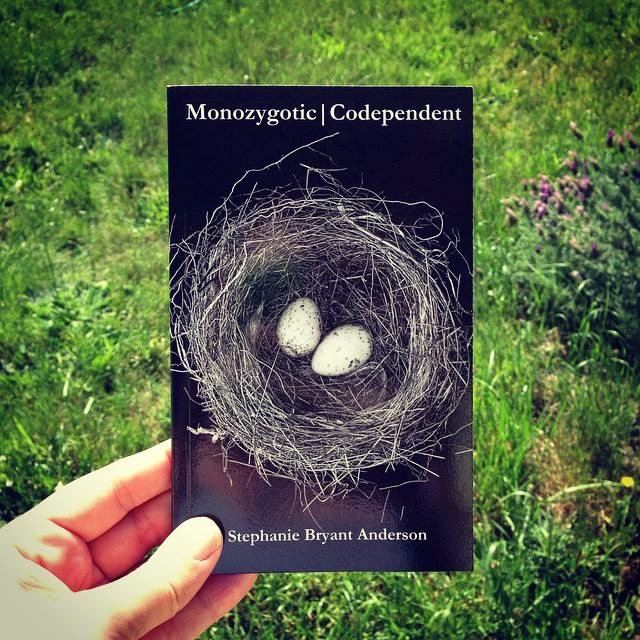
SATURDAY POETRY SERIES PRESENTS: MONOZYGOTIC | CODEPENDENT

monocofinal


From MONOZYGOTIC | CODEPENDENT
By Stephanie Bryant Anderson:


LONELINESS CAME INSIDE MY HOME, UNPACKED ITS
THINGS

I sat on the floor
in a blue room choking

on emotions, confessing
sadness to the cake falling

down my throat, wondering
how I have come to hate winter

when it snows
such beautiful white flowers.

But—

it’s the way I’ve neatly folded the laundry
over and over.

It’s the way fear visits me twice,
and courage once.

It’s the way I move alone at night
from the couch to the door

to the curtains,
back to the couch.

It’s how you catch me dreaming
and step over my body.


LIKE THE BLACK HOLE CARTOGRAPHER WHO WENT
HUNTING FOR WALNUTS

When the door closed this time, she knew it
       would be different. She saw his eyes—
emotionless ticks that had grown into the plural

patterns of empty walnut shells. Someone once
       star-mapped Aries the Ram, and generously
gave him horns. I am strong as an Ox

he reminded her as she stood to leave. Reminded
       her that she was the Year of the Rabbit with closed
curtains.

Safety over risk, she recalled looking at the door,
       but her body lied, it could not carry her there.
You cry too easily— he said, after the first hit

into her eye-bone crunched, sounding the way
       the nutcracker sounded when breaking open
walnuts. He stood over her

using the same angle God used to look down from.
       But, here, for her,
there was no longer a down—


ANXIETY WHILE CROSSING THE TENNESSEE-ARKANSAS
BRIDGE

Last November my sister got married.
My heart cropped, carried

for months in my handkerchief. At night
it would cry out from extinction.

This amputation being no small ache, I left
Tennessee, my heartbeat slow.

Memphis with her strange spell
filled my piano-ribs

with a slow blues loaded
with heavy bees and suicide ghosts.

The road tasted like salt. I drove until
I couldn’t see the shape of us,

until my heart could again beat
on its own.


Today’s poems are from Monozygotic | Codependent, published by The Blue Hour Press, copyright © 2015 by Stephanie Bryant Anderson, and appear here today with permission from the poet.


In Monozygotic | Codependent, Stephanie Bryant Anderson’s poems are concerned with splitting the self and uncovering the woman beneath the familial myths. Yet the essential paradox for Bryant Anderson: when the self has a twin—a ‘shadow,’ a ‘dark-haired mirror girl’—what then of the split? These poems ache; in the style of Southern gothic, these poems are ‘filled [with] piano ribs, a slow blues loaded with heavy bees and suicide ghosts.’ Bryant Anderson’s are poems of survival, built in fragile and beautiful shell casings, stanzas deceptively elegant and delicate, for what pinions each graceful couplet is a fierceness of spirit, a deep-seated desire for life, always life, even in the midst of pain and memory, ‘shaped as an open field plagued by black irises.’ I am broken and remade by these poems. —Jennifer Givhan, 2015 Winner National Endowment for the Arts fellowship


Stephanie Bryant Anderson is author of Monozygotic | Codependent (The Blue Hour Press 2015). Recent or forthcoming publications include Vinyl, burntdistrict, Rogue Agent and The Blueshift Journal. Besides poetry she enjoys kickboxing and math. Stephanie is founder of Red Paint Hill Publishing.


Editor’s Note: Monozygotic | Codependent opens with a quote from Sylvia Plath: “I do not know who I am, where I am going – and I am the one who has to decide the answers to these hideous questions.” And so Stephanie Bryant Anderson sets the stage for this brave, vulnerable collection. The journey the poet takes us on is deeply confessional, beginning in loneliness and ending in leaving, with panic, regret, abuse, anxiety, divorce, codependence, death, and God doggedly pursuing the I in-between. This is not the story of a light at the end of the tunnel; it is a story of survival. But there is so much beauty in the words, in their brutal honesty, in the intimacy of what is revealed, in the shared experience that arises when one speaks up about that which is too-seldom talked about. In this way, this book is Plathian, reflecting the intersection between lived suffering and staggering art.

Following the Plath quote, Monozygotic | Codependent welcomes us into its world with “Loneliness Came Inside My Home, Unpacked Its Things.” Here we sit on the floor. Here we are choking. Here we are eating our feelings. Here we are “wondering / how I have come to hate winter // when it snows / such beautiful white flowers.” A line so beautiful, it hurts to confront it. Like the idea of stepping over a woman dreaming.

From stepped over to stepped on, “Like the Black Hole Cartographer Who Went Hunting for Walnuts” takes us deep into the reality of a woman abused. She is not safe. She cannot leave. She is looked down on by man and God alike, only “here, for her, / there [is] no longer a down.”

In “Anxiety While Crossing the Tennessee-Arkansas Bridge” we encounter one of the major themes of the book: twin-ness. What it means to be a twin, to have been born into that level of codependence and to have to survive that conjunction into the individuality of adulthood. The result is a heart that must be “cropped, carried,” that has to learn to beat again on its own.


Want to see more from Stephanie Bryant Anderson?
Stephanie Bryant Anderson’s Website
Buy Monozygotic | Codependent from The Blue Hill Press
Follow Stephanie Bryant Anderson on Twitter

SATURDAY POETRY SERIES PRESENTS: JOANNA CHEN


Joanna head shot


A STRANGE VITALITY
By Joanna Chen

I saw a body fly through the air
last night on the highway—
a tiny Chagall figure, arms
belonging to a diver, legs
to an astronaut, his helmet a halo
of blue, catapulted into a swirling
sky edged in thunder. Before he landed
I thought of my father-in-law
born in Belarus, a gentle wisp
of a man whose eyes, pale
gray on his death bed, tore
through the frame of life.


Today’s poem was previously published in Radar Poetry and appears here today with permission from the poet.


Joanna Chen is a British writer currently living in Israel. Her essays, poems, and literary translations have been published in The Los Angeles Review of Books, Poet Lore, Asymptote, Guernica, Newsweek, and The Daily Beast, among others.

Editor’s Note: A brilliant, devastating little poem. A poem that contains the human body, sky and thunder, memory and death within its twelve short lines. And those lines! Their movement, their lyricism, their power. How epic the body, “catapulted into a swirling / sky edged in thunder,” how soft the repose, the “gentle wisp / of a man [with] eyes, pale.” And from that softness, the final throe–of the poem and of the life it recalls–the man who “tore / through the frame of life.”

This poem is an impactful experience on the page, and it is another experience to hear it read aloud by the poet. I suggest you hop over to Radar, click the play button, and read along as Joanna Chen adds another dimension to this work.

Want more from Joanna Chen?
The View From Here – Los Angeles Review of Books
JoannaChen.com
“Betrayal” by Agi Mishol, Translated by Joanna Chen
“All is Forgiven Between Us” – Narratively
“What the Trees Reveal” – Guernica

SATURDAY POETRY SERIES PRESENTS: SARA JUNE WOODS

FullSizeRender (1)
& SOMEWHERE THE SUN
By Sara June Woods

Somewhere there is a clearing
in a forest where the world is
not a lonely place.

Somewhere there is a mountain
I have written on in forest fires
that says I am sorry I am not

the one you were looking for.
I wanted to be so badly.
But I am just this one person.

& it says all this
spiraling across
below the tree line.

& somewhere the sun
looks the same coming up
as it does going down.


Today’s poem was previously published in jellyfish magazine and appears here today with permission from the poet.


Sara June Woods is author of three books, Sara or the Existence of Fire (Horse Less Press, 2014), Wolf Doctors (Artifice Books, 2014) and the forthcoming Careful Mountain (Civil Coping Mechanisms, 2016). Her poetry is published widely in journals such as Guernica, Columbia Poetry Review, Diagram, Gulf Coast, Denver Quarterly and Salt Hill. She is a trans woman and a Scorpio and she lives in Portland, OR with her girlfriend she is married to.

Editor’s Note: What do you do when a poem is heartbreaking? When its simple, honest revelations break your heart? When its line breaks break you? What do you do with a poem that devastates you with its simple, brutal truth? With a poem that’s so good, it hurts to read it? Why, you share it, of course. Here, you say to the world. You’re welcome.

Want more from Sara June Woods?
Healthy Dog Poem – Writing by Sara June Woods
P(r)o(bl)em – saramountain tumblr

SATURDAY POETRY SERIES PRESENTS: MARIANNE KUNKEL

Kunkel photo
By Marianne Kunkel:

A SLOTH FIRST HEARS ITS NAME

But why should it care? It munches
a cecropia leaf. It probes the air
with its blunt snout, detecting
a waft of sour coconut. It lumbers to a branch,
grabs hold with its claws, drops,
dangling upside down like a knapsack.
It doesn’t know to feel ashamed
that its name means lazy and sinful.
Like my little sister
after her abortion, when our father
changed her name from Molly to Molly.


Today’s poem originally appeared in Rattle and appears here today with permission from the poet.


Marianne Kunkel is the author of the chapbook The Laughing Game (Finishing Line Press), as well as many poems that have appeared in Hayden’s Ferry Review, Notre Dame Review, Columbia Poetry Review, Poet Lore, and elsewhere. A former managing editor of Prairie Schooner, she is an assistant professor of creative writing and publishing at Missouri Western State University, where she edits the undergraduate literary journal The Mochila Review. Follow her on Twitter @mariannekunkel.

Editor’s Note: Today’s poem is awesome for a myriad of reasons. Because it is about sloths (sort of). Because it is about words, about labels, about judgment and ignorant bliss. Because it vibrant both with images and with sound. Because it houses epic proportions in eleven short lines. Because its advocacy relies on neither a soap box nor a sense of superiority. But what is most striking about today’s poem, perhaps, is its volta. The way it turns the world of the poem on its head. The way it leaves the reader staggering, contemplative, changed.

Want more from Marianne Kunkel?
Verse Daily
“To Pee or not to Pee,” Portland Review
“Keep Away,” Portland Review
Phoebe
Rattle

SATURDAY POETRY SERIES PRESENTS: PATTY PAINE

10259779_10152027363561933_7567284404520260511_n copy

ANTIPHONY
By Patty Paine

Go back to that stream, touch
your lips to the cold, clear quivering,
draw into yourself a time when it was simple
as this to be quenched, to draw in what was
needed. Walk back over the dewed grass
of your past, past the water tower you filled
with dark imaginings, feel
the air crisp & clean on your skin, call
this hope, and carry it
to these moments when a photograph
can send you spiraling, your husband
now six months gone, waiting at the bottom
of an escalator in some airport
or another, everyone hurrying to be somewhere
else, except for this one man, waiting
for you to descend. How a face can be
indelible, yet fade so quickly, is an alchemy
best left unknowable. Hold that sting
of hope, and call out
the name of one who ministered
to you, over & over, until from the dark
you hear your own name return
to you, wild, and rising and clear.


Today’s poem originally appeared in Thrush and appears here today with permission from the poet.


Patty Paine is the author of Grief & Other Animals (Accents Publishing), The Sounding Machine (Accents Publishing), Feral (Imaginary Friend Press), Elegy & Collapse (Finishing Line Press), and co-editor of Gathering the Tide: An Anthology of Contemporary Arabian Gulf Poetry (Garnet Publishing & Ithaca Press) and The Donkey Lady and Other Tales from the Gulf (Berkshire Academic Press). Her poems, reviews, and interviews have appeared in Blackbird, Verse Daily, The Atlanta Review, Gulf Stream, The Journal and many other publications. She is the founding editor of diode poetry journal and Diode Editions. She is an Assistant Professor of English at Virginia Commonwealth University in Qatar where she teaches writing and literature, and is Interim Director of Liberal Arts & Sciences.

Editor’s Note: Today’s poem is one I encourage you to read over and over. For each reading is like opening the next layer of a Russian doll, and there is always more waiting to be discovered within. While one reading simply does not do the poem justice, you honor yourself, dear reader, each time you slip deeper into these words.

Start in media res. Start in motion. Begin not at the beginning, but by turning back. The world of the poem is visceral. Go on, touch the stream, feel the “cold, clear quivering.” Go deeper now. “[D]raw into yourself a time when it was simple / as this to be quenched, to draw in what was / needed.” Move backwards; a poem—a life—in rewind. Let the story unfold in this way—cinematic, emotive, devastating. Let the reverse motion be what propels you forward. You are Lot’s Wife. You are Orpheus. There is only looking back, but looking back leaves you alone in the dark, “hear[ing] your own name return / to you, wild, and rising and clear.”

What a fraught landscape, yes, but what a gift to have been taken on such a journey by such a guide.

Want more from Patty Paine?
Buy The Sounding Machine from Amazon
Buy Feral from Imaginary Friend Press
diode poetry journal
Diode Editions
Interview on The Best American Poetry blog

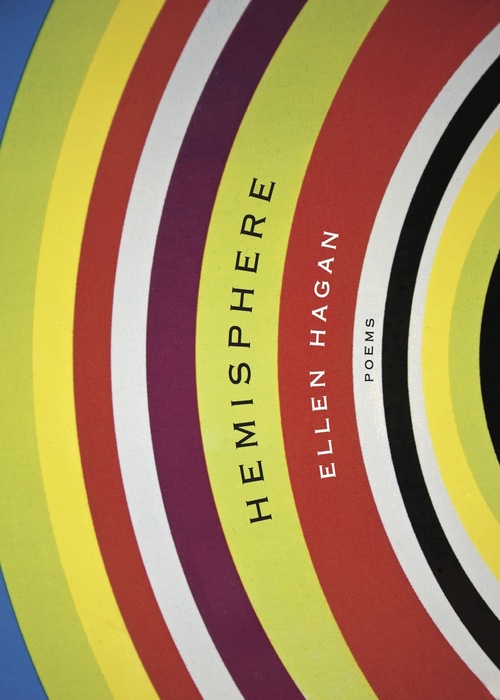
SATURDAY POETRY SERIES PRESENTS: HEMISPHERE

hemisphere


From HEMISPHERE
By Ellen Hagan:


RIVER. WOMAN.

I.
Downriver is always long
& always flailing, finding

where our lives begin,
intersect?  You, your bones

the humped slope of nose
browned skin of home.

You, sand. You, ocean.
You, bending & me.

How many nights we sleep
alone, our bodies rising—

what it means to miss you.
What it means to expand.
What it means to be birthed.
What it means to be sacred.
What it means to go home.

Place of birth, birthing
ground. Ground that is sacred.
You that is sacred.

Bones that hold together.  Bind.
Bound to you.  My mother.

II.
Me
I am bound to you.  My mother.
You stitch me from inside.  Hollowed.
your split sheath of self, your letters
the slow cursive of your language,
can’t I hear your voice, always?

Her
Lock the doors.  Latch the locks.
Shut the windows.  Close the blinds.
Cover up.  Clean your room.  Do
the dishes.  Wash the clothes.  Behind
your ears, yourself.  Clean the floor.  
Scrub.  Mop the remains every day
is one that you can use to erase all
the mistakes.  Blemish free.
Shine the doorknobs, pine, every
crease of space.  Cabinets.  Don’t leave
food out.  Food brings mice.  Mice
bring disease.  You will die.  You could 
die.  Don’t die.  Don’t ever die.  You 
stitch me from inside.  I am bound
to you.  Can’t you always hear
my voice?


LESSONS ON SPELLING

Bring the snakes in their skins, sly
& surrender. Simple bodies of grass
& clover, their slithering and sleuth-ness.
& the earth & the dusty fisherman
in from their boats, bobbing. Bring
piano, bring pain. That yellow skirt
pocked w/ fuchsia & the halter
of your mother’s pixie 60’s ways.
Let out the hems from your dresses,
the vertebrae in your back, body
forget skeleton—be loose, let it be dirty.
Get there. Call the black cat promenade,
lazy through the streets. Let your hair
down. Let it crawl, crowd the length
of your back. Bring soca & fiddle,
that record player your father bought
your mother in 1974. Bring all the days
from 1974 & on because time is a revolver.
A bag of limes on your back porch
squeezed & bitter & neon & orbiting
over you. Is your neighbor calling.
Is satsumas bursting on your tongue.
Bring your shiny shoes & arched soles
for the flapping pageant of second line
parade, the 100 parades from now until.
Autumnal. Hymns. Prayers.
Ways to say yes. Bring with you
your rope of hide, your many rings
of muscle & the washcloth
for your stomach, your feet
for the laying nape of your neck.
Bring danger & ways to hold your lips,
your lips, bring them too.
Spanning the whole of you.
You become.


WATER SIGN

Already a lullaby inside.
Your palms to belly, breath
on hip.  You are changing,
beginning. Too.  And you,
baby girl, or boy. Or two.
Are just gills. Still. Heart in
mouth. Red burst of newness.
Fins.  Fish or fowl. Shrimp
are larger than you.

Still, you are breaking me
apart. Him too. Our hearts
and lungs, and gills. Bursting 
You are stretching all,
all of us. Open.


Today’s poems are from Hemisphere, published by TriQuarterly Press/Northwestern University Press, copyright © 2015 by Ellen Hagan, and appear here today with permission from the poet.


Hemisphere: The poems in Hemisphere explore what it means to be a daughter and what it means to bear new life. Ellen Hagan investigates the world historical hemispheres of a family legacy from around the globe and moves down to the most intimate hemisphere of impending motherhood. Her poems reclaim the female body from the violence, both literal and literary, done to it over the years. Hagan acknowledges the changing body of a mother from the strains of birth from the growing body of a child, to the scars left most visibly by a C-section €”as well as the changes wrought by age and, too often, abuse. The existence of a hemisphere implies a part seeking a whole, and as a collection, Hemisphere is a coherent and cogent journey toward reclamation and wholeness. —TriQuarterly Press/Northwestern University Press


Ellen Hagan is a writer, performer, and educator. Her latest collection of poetry, Hemisphere, was released by Northwestern University Press in Spring 2015. Ellen’s poems and essays can be found in the pages of Creative Nonfiction, Underwired Magazine, She Walks in Beauty (edited by Caroline Kennedy), Huizache, Small Batch, and Southern Sin. Her first collection of poetry, Crowned, was published by Sawyer House Press in 2010. Ellen’s performance work has been showcased at The New York International Fringe and Los Angeles Women’s Theater Festival. She is the recipient of the 2013 NoMAA Creative Arts Grant and received grants from the Kentucky Foundation for Women and the Kentucky Governor’s School for the Arts. National arts residencies include The Hopscotch House and Louisiana Arts Works. Ellen recently joined the po­etry faculty at West Virginia Wesleyan in their low-residency MFA program. She teaches Memoir, Poetry & Nature, and co-leads the Alice Hoffman Young Writer’s Retreat at Adelphi University. She is Poetry Chair of the DreamYard Project and a regular guest artist at the Kentucky Governor’s School for the Arts.


Editor’s Note: I fell in love with the poems in Ellen Hagan’s Hemisphere for their language: earthy, sensual, gritty. Unafraid of blood and birth, of mud and heat, of nature, of relationship, of what is real and lush and vivid, of what is primal and complex. I am reminded of the swamp, of the first creatures that dragged themselves forth from the murky depths, crawling forward, always, evolving for the sake of life. I am reminded, also, of witchcraft, of alchemy, of drawing down the moon. Of things my mother taught me, of that which has been handed down from woman to woman through the ages.

Today’s poems were meant to be, here, today. Because they are about the twin experience of birth—both as child and mother. Because much of this book is about the relationship between mother and daughter, the circle of life as only mother and daughter experience it: “where our lives begin, / intersect;” “what it means to miss you. / What it means to expand. / What it means to be birthed. / What it means to be sacred. / What it means to go home.”

In honor of Mother’s Day, and of the magic that grows from the rich soil of today’s poems, today’s feature is dedicated to my mother, the water sign, from your daughter, the water sign. “You that is sacred… I am bound to you. My mother.”


Want to see more from Ellen Hagan?
Ellen Hagan’s Official Website
Ellen Hagan’s Blog
Duende
Drunken Boat
Buy Hemisphere from Indie Bound

SATURDAY POETRY SERIES PRESENTS: RICHARD D’ABATE

photo (5)

By Richard D’Abate:


THE SADNESS OF YOUNG MOTHERS

Because we’re at the beach today our sadness
knows itself,

Between the sinking sand and slowly measured
falling waves.

Not long ago time was arrow-tipped and
ravenous.

It found its mark before the god of love had
even stirred.

It filled our bones to bursting, era of the second
self begun.

Now every gesture mirrors gestures of a
smaller one.

They raise their arms, we raise our arms, they wobble
toward the sea

Like turtle hatchlings, thoughtless prey, and
so do we.

We match the steps of half-formed beings—
tender, new—

Ourselves, our future selves, alive but always
cut in two.

We are afraid. The burning sun devours
little bones.

Their little mouths will gulp the tangled weed, the
sliding foam.

We run, we start to run, but time has a thickness
all its own,

And half of half of half is motion’s rule or
none at all,

As when the cresting tops of glittering breakers
do not fall,

Or when in dreams we hear, but do not hear, our
children call.


Today’s poem was originally published by AGNI and appears here today with permission from the poet.


Richard D’Abate is the author of a poetry collection, To Keep the House From Falling In (Ithaca House Press), as well as stories and poems in Epoch, Apple and other magazines. His most recent work appears in Agni Online. A native of New York City, his professional life has been focused in Maine: as a professor of English literature, an advocate for the public humanities, and director of the Maine Historical Society, a statewide cultural agency and research center. His scholarly essays have appeared in various publications, including American Beginnings (University of Nebraska Press), on New World exploration, encounter, and cartography. He now lives and writes in Wells, Maine.

Editor’s Note: As a reader and a card-carrying feminist, I was as taken aback by today’s poem for its stunning lyric as I was by the (male) poet’s ability to capture the way mothers worry for their children. (Fathers do as well, of course, but today’s poem is about the experience of young mothers, specifically.) How audacious to take on this persona! And how effortlessly and accurately the poet has captured this unique viewpoint that is not his own. Haters gonna hate, and there are those who feel that a male writing from a female perspective is a patriarchal act of establishing dominion over a realm that is not theirs to control. But the other half of that debate is that of being empathetic, of trying to understand the other from within the other’s shoes, of being sensitive to those from outside our own gender, and Richard D’Abate has done this with today’s honest and heartbreaking work.

The poet has given breathtaking form to the parental experience, naming it the “era of the second self,” calling children “our future selves,” who, through a mother’s eyes, are “alive but always / cut in two.” Even more palpable is the mother’s fear for her children: “they wobble / toward the sea // Like turtle hatchlings, thoughtless prey, and / so do we,” “We are afraid. The burning sun devours / little bones. // Their little mouths will gulp the tangled weed, the / sliding foam. // We run, we start to run, but time has a thickness / all its own … [as] when in dreams we hear, but do not hear, our / children call.” By the skilled hand of the poet the fear and helplessness mothers feel for their children is brought to life through a vivid imagery and lyric beauty so chilling we feel it as if it were our own.

Want more from Richard D’Abate?
Buy To Keep the House from Falling In on Amazon
The Richard D’Abate Lectures: Conversations About History, Art, and Literature
Maine Historical Society: Richard D’Abate Endowment Fund for Scholarship & Special Programs

SATURDAY POETRY SERIES PRESENTS: ELANA BELL

authorphoto.2

By Elana Bell:


ELEGY FOR A MOTHER, STILL LIVING

         The Lord gives everything and charges by taking it back. —Jack Gilbert

I was formed inside the body
of a woman who wanted me
as she wanted her own life,
allowed to drink the milk
made only for me.
I was given mother-love,
its bounty and its cocoon
of those first years without language.
It is right to mourn the rocky hills
of Crete where we walked, my small
hand in hers for hours. The hidden
beach where we swam naked
then baked on the fine sand. Lazy
afternoons in her lap, thick
hand stroking my curls.
Her fingers have stiffened.
In her eyes, the eyes of an animal in pain.
I hold the memory of my mother
against the woman she is.


Today’s poem was originally published by AGNI and appears here today with permission from the poet.


Elana Bell’s first collection of poetry, Eyes, Stones (LSU Press 2012) was selected by Fanny Howe as the winner of the Walt Whitman Award from the Academy of American Poets. She is the recipient of grants and fellowships from the Jerome Foundation, the Edward Albee Foundation, and the Brooklyn Arts Council. Her work has recently appeared in AGNI, Harvard Review, and the Massachusetts Review. Elana leads creative writing workshops for women in prison, for educators, for high school students in Israel-Palestine and throughout the five boroughs of New York City, as well as for the pioneering peace building and leadership organization, Seeds of Peace. She was a recent finalist for Split This Rock’s inaugural Freedom Plow Award for Poetry & Activism, an award which recognizes and honors a poet who is doing innovative and transformative work at the intersection of poetry and social change. Elana also teaches literature and creative writing at CUNY College of Staten Island and curates public art installations with Poets in Unexpected Places.

Editor’s Note: If I have learned anything from reading Li-Young Lee and Ocean Vuong, it is that great poetry changes the reader. Whenever I read Elana Bell, I am deeply moved in the moment. Many poems do this, and many make it into the pages of this series. But today’s poet has always moved me far beyond the moment of reading. Her words stay with me. Weeks, months, years later, her poems are still a part of me, as if they are my own memories. Once I have read an Elana Bell poem, I have been forever changed.

I first heard the poet read “Elegy for a Mother, Still Living” at NYC’s Bluestockings nearly four years ago, and the poem has never left me. A year later, I wrote “Elegy for the Still Living: Father Cannot Stand Still”, a mourning poem for my father’s illness, named in homage to today’s poem. Years have passed. My father has passed. No elegy I write for him will ever again be “for the still living.” But “Elegy for a Mother, Still Living” remains with me, a memory of a different time, a different kind of mourning.

When I came across today’s poem in AGNI, it was like coming across an old photograph. A commemoration of my own past. A memory like an artifact, layer upon layer of personal significance buried between the lines of someone else’s words, someone else’s experience, someone else’s life. And yet, by the gifted hand of the poet, someone else’s experience has become my own. I am reminded of a line from the musical Wicked: “Who can say if I’ve been changed for the better? (I do believe I have been changed for the better.) But, because I knew you, I have been changed for good.”

Want more from Elana Bell?
Elana Bells’ Official Website
Academy of American Poets
P.O.P. (Poets on Poetry) Shot and edited by poet and photographer Rachel Eliza Griffiths, P.O.P is a video series featuring contemporary American poets who read both an original poem and a poem by another poet, after which they reflect on their choice.
Poets in Unexpected Places
Buy Eyes, Stones
Reading on PBS