Three Poems by Russel Swensen

swensenc_w

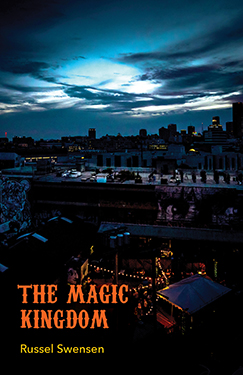
[Editor’s note: The following poems appear in The Magic Kingdom, which is available through Amazon.com and directly from the publisher, Black Lawrence Press.They are reprinted here with permission of the author.]

Elegy for my Twenties

They were spent, despite my best efforts
in the city of Los Angeles
where the palm trees never seemed real to me
floating in front of the hair salons & nail parlors
in their wooden dresses that shone slick
as taffeta or

the trees were
beauticians talking amongst themselves

knowing something about loss
that escaped me then (as it escapes me now)
about how it can be dressed up

or concealed or made to shine with a hard
cake-like light

that both dazzles & sedates. Like youth itself,
once you have passed it by as I passed derelict cars
on the 405

old carapaces leaking old & silent families onto the shoulder
or into the rearview mirror

where they hardened & turned red with distance.
But this isn’t about them.

& if I claimed to care about them,
perhaps that would be worse than simply not caring,
perhaps some things you can’t make beautiful, perhaps one
solitary thing

which you do not own, but hold, helplessly in your hands, this
self you’ve invested so much in. This self you’ve surrounded
with swaying

trees & abandoned cars & sentient perfume (that clings to you
because it loves you) does it even sound

familiar? Do you remember instead do you prefer
to regret

those condemned houses you used
to wake in those decaying recliners with bad cocaine on tv
trays your little parade

of women you drove mad with worry the needle you found
in your car the black rubber staff that had been inside someone
& left behind—

is this better, is this worse. It has to matter,
but it doesn’t.

There is this notion we have that
to write a good poem you have to be a good person
or seem like one—

which means you can’t trust anyone. This is a problem,
a real one.

You’ve never had any other.

***

Missives from the Emerald City

Blown by a storm of mild disinterest—or too many
acquaintances—

into that bar, the one I always hated,

La Poubelle, I find myself watching a girl in a white fringe dress
stumble through the exits, only to

spit out Texas across

the sides of her borrowed Lexus. She catches my eye; smiles

look mom, no hope, vomits on the other

side; drives.

***

Customer Satisfaction

Do you live for the weekend do you polish
your body like bone
…………………..does it put the lotion on its skin
when you’re down

do you get up again? Do you love the blue plastic angel
or just the unstable?

Do you remember
………………….would you prefer to forget?
…………….(your hand red
from her summer dress)

Is that, said the Lion, what you mean by regret? Is it hard to answer
with your heart in its teeth?

……………………………………(if on distant shores, we should ever meet
………………………..again…)

Why were you there standing in line? Why you were there

at that particular time? Is there someone we should call? &
were your injuries sustained

in the fall? (a singular accident—children dangling
from rides

like singular black tassels—did you

get there in time?

***

Russel Swensen is the author of Santa Ana (2012) and The Magic Kingdom (2016). His fiction and poetry have appeared in Black Clock, Quarterly West, Pank, Third Coast, Devil’s Lake, The Collagist, and elsewhere.

This Train Is Bound for Glory by Okla Elliott

This Train Is Bound for Glory

by

Okla Elliott


1.

The concrete platform vibrated subtly as the train entered Philadelphia’s 30th Street Station. I gathered my luggage, checked my ticket, and prepared to board the southbound train to North Carolina to visit my family, like I do every Christmas. As the train approached, I felt a childlike and quasi-transcendent excitement. My heart always responds with joy and eagerness to trains approaching. My sense of self is expanded beyond personal limits, spread out across the distances I might travel and the people I might meet.

I first fell in love with trains and public transit more broadly speaking when I studied abroad in Germany during my junior year of college. Everything was suffused with Romantic bluster—me on a train heading to Berlin or Prague or Krakow with my journal and some classic of European literature—and I felt the weight of history everywhere around me. I watched the countrysides and cityscapes flash by as I wrote naively self-important entries in my journal and scribbled notes for novels that would never reach completion.

But there is more to trains than the Romantic fantasies of a blissfully ignorant boy from Kentucky seeing the world for the first time. Public transit can be instrumental in solving many of our economic, environmental, and even cultural problems.

2.

The first thing to consider when looking at the economics of public transit is that it creates jobs that cannot be outsourced. The ticket inspector, the train conductor or bus driver, the repair crews for the railways, the mechanics who perform regular repairs and safety checks, and the staff at train stations and bus depots are all employees that must be physically located in the United States and, more specifically, in their home regions and cities. But it is not just that these are stable jobs with government benefits that will improve the lives of these workers directly. A recent study shows that investing in local public transit has a noticeably positive effect on the local economy overall. According to the American Public Transportation Association, every tax dollar invested in passenger trains yields nearly four dollars in local economic growth.

And the economic gains don’t stop there. In terms of alleviating the disadvantages that come with income inequality, public transit can be helpful as well. Champaign-Urbana, IL, offers a year-long pass with unlimited rides on the city buses for only $70, an amount a worker might pay in a single week if dependent on taxis or Uber. Chapel Hill, NC, offers bus service for free, thus eliminating any financial burden for poor workers needing to get to work. This means that workers who can’t afford a car or can’t drive a car due to a disability or illness can still hold a job and earn an income.

And it’s not just the poor who can benefit here. According to The Transit Savings Report, a monthly analysis produced by the American Public Transportation Association, public transit can save users an average of $764 per month, or about $9,167 a year. With the middle class getting hit right, left, and center with increasing college tuition, decreasing or stagnating wages, and ever-increasing economic precariousness, these savings are not merely nominal but necessary.

Congestion alone costs us billions of dollars per year. According to a recent US News & World Report article: “The cost of congestion to the average auto commuter was $960 in lost time and fuel in 2014, compared to an inflation-adjusted $400 in 1982.” And overall costs nationwide are expected to balloon: “In the next five years, the annual delay per commuter would grow from 42 to 47 hours, the total delay nationwide would grow from 6.9 billion hours to 8.3 billion hours, and the total cost of congestion would jump from $160 billion to $192 billion, researchers estimated.”

Even if we ignore the predictions for growth in cost, we’re still looking at $160 billion dollars a year wasted nationwide due to traffic congestion. By using trains and high-speed rails, not only can we vastly reduce fuel waste, passengers can complete minor work tasks during the time spent on the train, if they so choose, thus reducing wasted time. I know that personally some of my most productive hours have been spent in trains. During various train trips over the past handful of years, I wrote nearly a third of my doctoral dissertation, read hundreds of pages for pleasure or for work, and graded dozens of student papers. None of this could have occurred had I been driving a car, an activity that precludes nearly all other productive efforts.

3.

But we have to think about more than economics when determining public policy. In many ways, the most pressing matter facing us as a species is the environment, since if we don’t reverse our policies that are destroying the planet we rely on for nourishment and breathable air, we won’t have the opportunity to solve any of the other problems that face us. Here again, public transit can help. Trains are 17% more efficient as a means of travel than airplanes and 34% more efficient than cars—and that’s in the current state American trains are in. If we were to modernize all of our passenger trains and invest in new technologies to improve fuel efficiency, while also increasing the number of people who rely on trains as their primary mode of commuter and long-distance travel, the positive impact on our environment could be colossal.

Inter-city travel is not the only area where public transit is more efficient. Bus travel within cities is considerably more environmentally friendly than car travel. What’s more, there have been great strides made in biodiesel and hybrid buses that are even more fuel efficient than regular buses. A recent study shows that there is no decline in performance of biodiesel buses, yet literally every pollutant is reduced in quantity when the switch to biodiesel is made.

It should also be mentioned that both liberals and conservatives in this country regularly use the catch-phrase “energy independence.” I by no means believe that public transit, including electric trains and biodiesel buses, can allow us to achieve complete energy independence, but by reducing our need for petroleum energy sources, we can make great strides not only in protecting our environment but also in reducing our need to purchase oil from countries in the Middle East. And since liberals, moderates, and conservatives alike agree that energy independence is desirable, this could be a major selling point for increased public transit.

4.

On a less idealized note, I have noticed interesting differences region to region in regard to the race and economic status of those who make use of public transit. In the Northeast and Midwest, you will find people of all races and socioeconomic strata riding city buses and regional trains. In the South, where there are much fewer public transit options, the customers for public transit are almost entirely poor and largely people of color. The view of public transit as something only poor people use, and something even to be ashamed of using, can be found everywhere in the country, but it is certainly more pronounced in the South. (Having never used public transit in the Southwest or the West, I can’t speak to those regions, but we need to battle this perception everywhere, if we’re going to change out nation’s policies vis-à-vis public transit.)

In effect, public transit could prove to be a place of commingling among various sectors of society—a laboratory of desegregation, a mobile melting pot of the sort our country often speaks of and rarely works to promote.

5.

I don’t expect everyone to fall in love with trains the way I have or to share my perhaps ridiculously Romanticized notions about them. I do, however, believe we can change Americans’ attitudes toward public transit in terms of general associations with trains and buses, as well as in terms of practical decision-making.

And the popularity of Amtrak has increased notably since the 2008 economic crisis. Take Alabama for example. In 2008, the National Association of Railroad Passengers reported 47,399 passengers in the state. In 2010 that number had grown to 62,737, and in 2014 the number was 62,426. This represents a 32% increase in passengers that has remained steady, and this number is even more striking given that Alabama is generally ranked rather poorly in terms of its public transportation. And we saw similar increases across the nation. In Ohio the increase from 2008 to 2014 was 119,000 to 152,000. In Illinois the number increased from 4,295,300 to 4,883,900—meaning that over half a million more passengers rode Amtrak in 2014 than in 2008. In Pennsylvania a quarter million more passengers used Amtrak in 2014 than in 2008. I won’t enumerate each state’s increases, but suffice to say that these increases have occurred across the United States and have remained steady over the past half-decade. It is therefore irrefutable that we are seeing greater demand for public transportation in this country; all that remains is to muster the political willpower to make it more widely available and more affordable.

But while the facts and statistics are overwhelming in favor of public transit, numerical data can often feel bloodless and alienating. I began this essay by relating my personal introduction to trains and my emotional responses to them. Cognitive psychology teaches us that we most often have an emotional response to something and then devise rational arguments to support that more immediate emotional response. When I first fell in love with trains and travel in general, I didn’t know any of the statistics I’ve listed here. I looked those up later.

I am not suggesting that we never make rational decisions based on data. We certainly do, and our policy-makers certainly should. Educating people about the advantages of public transit will have a positive impact on our nation’s policies in this regard, and simply creating a wider debate about public transit will serve to raise awareness on the issues surrounding it. But we can’t stop there. We have to show the joys of crossing the country by train, the personal pleasures of being able to sit back and read that great novel you’ve been meaning to get to instead of having your attention take up by driving for several hours, and so forth.

6.

Here are five suggestions for programs that could increase the popularity and efficiency of public transit:

1) We need to instate a lottery-style program that gives away a dozen free month-long passes on Amtrak each month. Anyone signed up for Amtrak’s Rewards Program would be instantly eligible and randomly chosen. This would offer incentive to sign up for the Rewards program and it would increase train travel as well as create the opportunity for people to explore the possibilities of extended train travel.

2) Even though Amtrak’s writer-in-residence program has had its issues, this sort of program is precisely what we need. We must clarify and correct the issues that occurred with the inaugural group of writers, but that should be easy enough, and all programs have issues early on. What if we included other programs as well? Student scholarships for educational trips over spring break or tickets for law students wanting to participate in a presidential primary of their choice (tickets split equally between registered Democrats, Independents/third-parties, and Republicans) are two ideas that come immediately to mind, but tickets supporting education and professionalization of many varieties could be easily devised.

3) A family vacation discount program could not only increase the number of current passengers but also go a long way toward creating those sorts of lifelong memories in younger generations of Americans that might change the culture’s overall view of public transit as a whole. And given its focus on families, we might even be able to get Republicans on board (pun sort of intended) for the program.

4) For local buses, we can create programs that link into welfare. Republicans and Democrats alike talk about welfare-to-work programs. What if we guaranteed that welfare unemployment recipients had free transportation to make it to job interviews and then to make it to their new jobs after receiving them? I would suggest free passes during the entire time on these programs and then for two years after receiving gainful employment, thus allowing time for workers to get on their feet and either purchase regular bus passes or a car, if that is what they prefer.

5) Commuter trains reduce traffic congestion, improve inter-municipal economies, and help families where perhaps the parents have to work in different cities—to name just a few of their benefits. I would propose that we do bulk-rate buying by businesses and public institutions to reduce the cost of long-term commuter passes. And this is a case where we have precedent to use municipal, state, and federal funds to build such lines.

7.

We have to change not only our policies about public transit but also our attitudes toward it, our sense of how it can enrich our personal lives. There is no question that increased public transit offers myriad advantages for our society in terms of economic and environmental concerns, but it can also offer us many hours more leisure, more cultural opportunities, and better relations between the various demographics that make up our population. There is a host of concerns facing the United States today, and at first glance public transit might not make it near the top of that list, but resting as it does at a nexus point among several major issues, it must become a central focus of progressive and non-partisan activism.
“The Mummy Returns: A Film by Kanley Stubrick” a Book Review by Christopher Nelms

cover2x1

The Mummy Returns: A Film by Kanley Stubrick

 by

Christopher Nelms

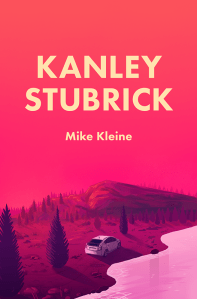
Fresh off the success of I Hate the Internet, Jarrett Kobek’s press, We Heard You Like Books, has released Kanley Stubrick by Mike Kleine, a novella written in a resemblance of verse which slightly resembles prose without cons but mostly resembles resembling. I’ll give it to you straight, like a sparkling glass of dry pear cider: Kanley Stubrick is one of the kinkiest pieces of “weird fiction” I’ve read in the years I’ve felt were years, and I’m not talking about the curl of its hair like sneers, though it is profoundly pubic in the way it has been made, thankfully, public, like an uncanny valley, fuel to fossil-fools.

On the surface, Kanley Stubrick (hereafter, KS) is a dyslexic ode to Paxil-flatlined channelsurfing, Waterworld-waterboarding, Ambien-ambient affect, & the banal catechisms of mildly curious cohabiting partners, but look closer: you will see it is, in wacktuality, an ultimate species of revenge tragedy, in the Grand Guignol-tradition of The Duchess of Malfi, Freudian psychoanalysis, Golden Girls, and the Bill Kill diptych of legendary American film-cosmetologist. Tintin Quarantino.

Caution: there are spoilers ahead, but only in the plot which imbricates, imprecates, and eventually bowdlerizes all human life onto the cutting-room floor of soiled Macguffins, the compost from which all plots flower into parasites for their parasites.

Playing with popular YA-dystopian tropes, KS gets the plot rolling with a pair of stolen (?) shoes, about which inquiries must be made via a device which enables disembodied communication on a global scale. Soon, it becomes quite clear how we must think of “shoes” in this world. Shoes have soles and you put them on your feet to protect them from harm, and also to make walking easier, faster, to increase the productivity of this slowest and, sadly, most common of all human forms of locomotion (excepting crawling, a form of locomotion whose inefficiency, neoliberal capitalism, with its ravenous emphasis on the bottom-line, has shamed, made undignified for humans of age to not participate in the myth of standing on their own two feet, proud & upright, pulled up by their own bootstraps).

Now, Stanley Kubrick, unlike Halfred Aitchcock, is not commonly known for his use of Macguffins to get the plot rolling, like dung beetles, in his films, but, I would argue, Kubrick is an even greater practitioner of the Macguffin than Aitchcock or Quarantino. Dispensing with Macguffins in his films, Stanley Kubrick created a single overarching Macguffin to drive the plot of his career, legacy & critical reception: namely, that he was a genius. Armed with this insight, we can return to KS’s rather disarming Macguffin: the allegedly stolen shoes which belong to the narrator’s cohabiting partner. It has been established shoes are for feet, feet are on legs, legs are for walking under a regime of global capitalism which only allows global, disembodied verbal communication via device as a way to improve the efficiency of biopoliticized bodies ashamed to crawl, etc. We also say an “argument has legs,” when it seems to get somewhere, and legs are obviously the argument a legacy makes; legs move through an argument with space as legacy moves through an argument with time. As a man walks to the other side of town to testify of his presence by being present on the other side of town, the pyramids of Egypt walk to the other end of history, even their ruins testimony to their presence.  Only the profit-motive of prophet-motives didn’t let them crawl to nowhere.

With airtight logic, Kleine spins his plot from out of WW1 aeroplane documentaries and missing shoes until somehow we get to volcanoes & Stanley Kubrick. It is an airtight plot that ends like the moon, like all plots, with nothing left alive to sense. Just as volcanoes burn all oxygen away from them, just as Kubrick faked the moonlanding in an airtight plot to mask the moonlanding didn’t occur because the moon was airtight, the plot of KS burns with scrupulous logic, creating an airtight vacuum which nonsense like vampires or tardigrades can live swimmingly in.

Fuck a vampire though, this ain’t that kind of YA junk. Like the Beatles, Trix, and crushing trauma, vampires are for kids. The literary monster which best figures the contemporary world is quite obviously the mummy, a dead aristocrat woken by a meddling, Orientalizing, white-chocolate-Academia-nut cookie-cutter colonialist, come to shuffling, stumbling half-life amid halls of useless wealth, where the writing is literally on the wall. Like a newborn baby, the mummy’s mission, once brought to half-life, is simple: take revenge upon those who disturbed its ancient sleep of nothingness so it may return to the nothingness from whence it came, and in the meantime, “magical means” shall empirically provide a reason for that nonsensical mission to occur.

There are no mummies in KS, at least that I remember. I read it twice, both times a few months ago and each time I was amazed at how much the book wanted you to forget it, eating itself out of house and home into the desert of the spill, dyslexhurt of the Spleeven Stillberg. KS is a book which is a mummy which uses its own wrapping for toilet paper, capturing what it feels like to be on social media, watching an endless scrollwork of hieroglyphs hook up to each other human-centipede-style, an eternal feast of previously embalmed and digested thoughts being passed down a butt-stuff chain of command like wisdom, from mummymaw to mummyhole to mummymaw to mummyhole, intestinally diluted, liked, and shared. Kanley Stubrick, much like the misprisioned film director referenced in its title, is a mistake only in a magical world that thinks something as supernatural as a mistake could exist.

Kleine creates a utopia in KS where you don’t have to slouch with the indignity of enforced dignity, where the alimony of innocents pisses clowns, and the second cumming crawls, ouching towards Bethlehem’s please-bittered bitte, l’chaim. Stanley Kubrick sphinxes Oedipus with riddles of His Emperor’s New Shoelessness & Freud goes beyond the pleasure principle wearing Stanley’s borrowed, battered genius-macguffin-shoes, a pair of plastic knockoff Crocs melting into the Bedouin sands of human history as if they were Madame Tussaud’s wax Walter White impersonating Shelley’s impersonation of history’s impersonation of Ozymandias. Aeroplanes invented by ancient aliens buzz and strafe all founding fathers, even Cary Grant, and Mt Rushmore gets stoned to death for adultery, it’s burial shroud a gigantic Kaepernick jersey made of gold, arsenic, and old lace, a pledgeless negligee of star-mangled banter to a new world order of an airy B&B-world without boarders. Onward history channels, impotable but surfable.

The moral lesson of Kanley Stubrick would be unimpeachable if it held office: That revenge is a wish best heard tolled. Let the pyramid of the contemporary world shake with the #woke death-rattle of embalmed culture. Let the bells of your phone’s alarm clock warn you into the danger of another dawn, the orange clockwork of a dying sun. Be like the scarab, producer & eater of dung, a holy-roller of eyes-wide shit, sacred as perennial floods and divine bovinity. The world is a wax museum and the hopes of its inhabitants guttering wicks. Let Earth melt into a hot puddle, tilt on its axis, and pour its molten smelt in a last gasp of trite kink upon the obsidian silk skin of necrophiled space. Be the nothing you want to be in the world.

In short, I liked this book from We Heard You Like Books like I like my moss-piglets, mummified but woke, extremophilic, and ready to take meaningless, gleeful revenge on the Empire’s archaeologists. But like Levar Burton used to get paid to say: you don’t have to take my word for it.

***

Christopher Nelms is a scribbler living in Athens, GA. His forthcoming self-help book, Take Yourself Out and Someone Else With You: A Terrorist’s Guide To Dating, will be coming to a dustbin near you in June 2017.

SATURDAY POETRY SERIES PRESENTS: KELLY CRESSIO-MOELLER


Profile b/w scarf – aroho – Version 3


ON WHY I NO LONGER SIT AT THE WINDOW SEAT ON A TRAIN
By Kelly Cressio-Moeller


Germany was like a step-mother: utterly familiar, utterly despised. ~ Erica Jong


It’s a good day for a lie-down, overcast and
wet-wooled – even the rain wants to be horizontal.
I am day-dreaming of goose down when I
enter the train, scoot into an open seat,
press my cheek against the streaked window.
The station’s soothing voice announces,
Zurückbleiben bitte, someone runs in just before
the doors close, slams me against the side
of the compartment, takes a lungful of my air.
In an accent foreign as my own, he asks
my name, if I “want some fun” back
at his room. I buy time before the next stop,
tell him I’m “Whitney from America”
(anything but my real name in his mouth).
Now he locks his arm through mine and thick
fingers jab my ribs. His leg, an anchor –
his pocked face smirks like he’s already
notched his belt.

I imagine the defence move my brother
taught me where I smash my palm heel into
some asshole’s nose, shifting bone into brain.
(Where is my Siegfried in this country of the
“Nibelungenlied”. What would Kriemhild do?)
My eyes ransack the forest of businessmen,
cutpurses, hausfraus, the heroin chic: rows of
enameled faces, cow-dumb, indifferent as teeth.
Let the Ausländer fight it out!

Thigh-grab, elbow-jab, hand-slap – his broken
English splinters the air. Whitney Houston
in my head singing “I Will Always Love You” on
some godforsaken loop as I mentally run through
my list of German imperatives: Hilfe! Polizei!
Vergewaltigung! (a word that takes longer to say
than the act it defines). I backhand him across
the mouth, escape before the doors slam.
He’s waving (waving!) through the glass,
a blurry fat-lipped sneer retreating – the air
staccatoed with rasps of my breath. It begins
to hail marbles (even the gods are throwing stones),
feathers or lightening bolts would feel just the same.

Only later with candlelight und Butterkuchen,
do I re-surface to Vivaldi’s soaring strings on the radio.
I mention my morning combat-commute.
My host shrugs his shoulders before loading
the Meissen with another helping of Schadenfreude.
He says, Da muβ man durch : ‘one must go through it’ –
as if it were a tunnel, something to be run through.


** The line What shall I wish for myself? is a reworking Mary Oliver’s line What shall I wish for, for myself?

Today’s poem originally appeared online in Tinderbox Poetry Journal, Issue 1 and appears here today with permission from the poet.


Kelly Cressio-Moeller has new work forthcoming in Radar Poetry and has been previously published at Boxcar Poetry Review, burntdistrict, Crab Orchard Review, Gargoyle, Poet Lore, Southern Humanities Review, THRUSH Poetry Journal, Tinderbox Poetry Journal, Valparaiso Poetry Review, and ZYZZYVA among others. Her poems have been nominated for three Pushcart Prizes, Best New Poets, and Best of the Net. She is an Associate Editor at Glass Lyre Press. Visit her website at www.kellycressiomoeller.com.

Editor’s Note: During the dark days this November I delved into poetry as a kind of antidote, and in this way I arrived at today’s poem. Incredibly timely, it speaks to an experience that is all too common and far too marginalized. “I moved on her like a bitch,” America’s President-elect said, “I did try and fuck her,” he said, “Grab them by the pussy,” he said; “You can do anything.” And I thought, “anything but my real name in his mouth.” I thought, “even the gods are throwing stones.” I thought this poem. And those who have no idea what this poem is about, those who do not have to regularly question their safety, those who are unsympathetic to this experience– “one must go through it,” those people say. “[A]s if it were a tunnel, something to be run through.”

Want more from Kelly Cressio-Moeller?
Cha: An Asian Literary Journal
Escape into Life
THRUSH Poetry Journal
Tinderbox Poetry Journal
Valparaiso Poetry Review

Three Poems by Matthew Nickel

the_route_to_cachare_cover

A Good Clean Village—War Monument

Gorge du Tarn, France

To have gone off and left the gorge
Deeply cut with river flowing,
To have gone off and watched them die
One by one, into the trenches

Friends, cousins, the man who gave you
A wooden cross for Noël, the cousin
Who taught you to swim, Uncle Jacques
Who held stained hands around yours,

Holding the taut line jerked by trout
Fighting in the green swollen river
Icy around shivering thighs,
Satisfactory holding in the current,

To have gone off to watch your brother
Bleed to death in the mud beside you
Your father caught by Germans, witness to
His execution, one pistol to the head

One shot you did not hear for the screaming
Breath dry in your mouth as you ran
Toward them caught by your mother’s brother
Thrown down to save you from yourself,

To have gone off and to walk back, alone
To the gorge wind and moving stream, to the
High pass and cliff clutch, to the nothing
That crumbles from the limestone edges

To have gone off and to come back
Arched shoulders burdened
All for a German tourist loud with camera
Taking your picture unaware

As you wash your lettuce in the branch
That cuts the village, where you used to
Wash your feet before dinner so that
Mother would be happy,

Mother, now dead who had gray tears
When you came home alone, lines
Around the mouth darkened when she knew
No one else was coming back.

But you let him take your picture
Because your lettuce is clean now
It has come from a good walled garden
On the edge of the cliff in a good clean village

You shake your lettuce cage dry in the sun
Wave to the men playing boules by the stream
And you think of leeks fat for dinner, potatoes
Dirt groveled chthonic and waiting,

And trout caught in early dawn,
All for your family coming soon, where
Laughter loud from grandchildren will
Surround your table, satisfy a deep longing

In the day’s last light, while the sun drops
Behind the wall of gorge, where you can hear
The stream from the village
Fall down into the river endlessly flowing.

***

Coda—Le Pèlerinage: Les Saintes-Maries-de-la-Mer

I hold her hand as waves wash over our feet
singing loud Salut, salut, O Saintes Maries
her eyes sing aloud the depths of the sea

dark gypsy hands reach up the boat is high
gray eyes chant—Vive Les Saintes Maries
Vive La Sainte Sara—waves lift us to sky

she dances in water weaving light
we reach for the boat and touch fingers
her voice edges the sky around the saints

we look at each other say nothing waves
lap our bodies and sand is in our hair away
bishop robes over dunes gardians trot out the day

procession vanishes into carnival a man ratchets
a hurdy gurdy you picked a fine time to leave me
suddenly we are not alone we see familiar faces

though we do not name them gliding beside
compound of sea and sand eyes like a friend
or some long lost mother for whom we cried

we step infinite and slow until a fish leaps
into the chaos of sun windless over a wide sea;
we sing harmony on forgotten beaches

with voices out of the irredeemable past present
only in hymns over water and the steady vibration
of hearts together mounting wind over sand.

***

Not Just La Patria—For RPW

For West is where we all plan to go some day. It is where you go when the land gives out and the old-field pines encroach. –Robert Penn Warren

Walking out of Notre Dame there beyond
The pigeons Charlemagne, Roland, and Olivier
Face the west lingering like ghosts brackened
Green on the edge above that aged bronzed river:
This will be my final night in Paris alone
Before I move south for the winter.

I look across to the Left Bank, Shakespeare & Co.
Remembering the nights reading Warren’s
A Place to Come To upstairs on a sagging bed
Dusty beside a window facing Notre Dame;
Warren brought the earth, la terra, into focus
Made the past edge fiercely over tomorrow;

I had fled to France, to escape the maelstrom
The vision-curse of American western solitude
“Go west, my son,” and lose yourself into sublime
Emptiness, a delight in mere survival, selfhood,
Thinking this, I was startled when overhead
I heard cathedral bells rolling time into clouds;

Charlemagne, that legend of the Western World,
Hovered with staff ready to strike down
The enemies of the West: where was Roland’s
Horn, where were the pine trees and the breath
That long blew our past into forgetfulness
Ah que ce cor, he said long ago, but the battle

Is never won and the soul contends for amnesty
In the epic of our ancestry: do we return to
Roncevaux and find, as if for the first time,
The immutability of stone rising from earth
Do we sing lost songs in crowded brasseries
Over a mug of Mutzig and cassoulet because

We are unable to resign ourselves to the end
Of what we love, because we, like the stone,
Will not fall down to the terror of the times—
We inherit from the dead more than a history:
The direction of a hand gesture dripping water,
The discovery of self in the gloom of landscape

In the doom of a strange land; we inherit voices
The dead speak if we listen, but how do we hear
Them in the cackling of the modern world—
At dawn, the train departs Paris, land unfolds southward
The sea shimmers soon beyond Avignon, ruins
Thinking, nothing is lost, nothing is ever lost.

***

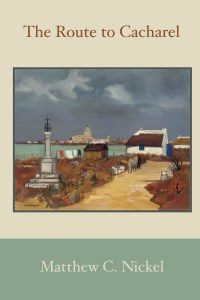
A Mid-Hudson Valley native, Matthew Nickel is the author of the poetry collections The Route to Cacharel (Five Oaks Press, 2016) and The Leek Soup Songbook (Des Hymnagistes Press, 2015), and he is the editor of numerous anthologies of poetry, including Kentucky Writers: The Deus Loci and the Lyrical Landscape, Des Hymnagistes: An Anthology, and many others. He has written critical essays on American and British writers such as T. S. Eliot, Ezra Pound, Robert Penn Warren, Elizabeth Madox Roberts, Ernest Hemingway, Richard Aldington, and his book, Hemingway’s Dark Night: Catholic Influences and Intertextualities in the Work of Ernest Hemingway, was published by New Street Communications in 2013. He is currently an assistant professor at Misericordia University in Northeastern Pennsylvania.

Marc Vincenz: Three Translations & an Interview

fig-2-secret-letter-cover

Thousandfurs

for R. and C.

Unstitching, tacking, fastening,
losing the needle, the red thread;
snapped the blue long ago.

I find oddments of old clothes,
memory carriers,
witnesses of suffering, happiness too—
cut to size, measure up, adjust to fit,
consider the patchwork in daylight.
Mending is a metaphor.
Has one lived too long?

Once I wove wreaths of wildflowers
for children
and studded plastic crowns
with glass jewels.
There was a boy, and I, his girlfriend;
children accumulate time
not out of years—
children played mostly until 6
up in the old country, where no timepieces
chop life up
into you-have-to, you-are-permitted-to, and being.
I gave them the names
of mountains, birds and flowers,
signposts to the Creation Lab,
where a thousand years are an instant.

I must, having gotten older and old,
adjust, attempt to cope with Thousandfur-stuff,
search within sleep
for hiding places and nooks—freeze—
burn one day with hair and skin
while herein the mythical hope,
the invisible one is collected
from the cryptic, smiling messenger,
God with the winged shoes.

***

Aftershine

I’m standing here alone
in the early autumnal sun,
frilled dahlia petals and rotten wood
hole-punched by rays of sunlight.

Over fading hazelnut leaves,
cloud-towers deconstruct,
and a yellow and distant light
swarms upward behind the mountain, as if
a new earth were sending
golden birds ahead.
It’s only a deceptive luminance,
a glittering afterglow,
like lost joy she paints,
paints over,
in a picture
never to be completed.

***

The Word

for Corinna Jäger

The word is sealed shut,
you must dig for the word;
the word cuts through
so it may carry on.

The word
comes to pass;
catch it in flight,
don’t tie it down,
just hold it as you would a bird: free,
because the word wants to fly,
wants to be grounded and rooted, to seed and to
bud,
who knows where, when—
no one knows the legend of the word,
and one who might know it,
would be one
who spoke with God.
Both poets and children
seek the right word,
but the right word
mostly arrives too late.

***

Thomas Bradly: Congratulations, Marc, on your new translation of the great Erika Burkart’s Secret Letter (Cervena Barva). To what extent can your cosmopolitanness be attributed to your “peripatetically linguistic renderings of foreign verse?

Marc Vincenz: When you live as I have done, through extremely diverse cultural landscapes—say for example, from the gagging metropolis of Shanghai one day to the expansive volcanic plains of Iceland the next—you develop a broad view of the world, of language. You become an observer, an accumulator of culture; ideally, absorbing the most illuminating sounds and visions from each of the places you set your bag down. There is a moment, after all this wandering, when something coalesces in that vast array of voices and images. They come together in your mind as one, and somehow the world becomes easier to listen to, to silently observe. Language itself becomes easier to absorb. At least, that is my experience of it.

Does my international upbringing have something to do with my affinity of/for other languages and cultures? Most certainly—it’s a passion, Tom. Do I feel comfortable in a wide array of places and sounds? Yes, absolutely. It was entirely the way I grew up—slipping in and out peripatetically from place to place, from tongue to tongue.

TB: And what of your own poetry? How has your international exposure influenced your work?

MV: Naturally each locale has its own fragrances, its own cultural quirks, mythology, architecture, landscape, customs, politics—and yet, all of these are mirrors of another culture: different ways of expressing (symbolizing) the same things. Humanity, after all, is human—desires and needs are much the same the world over. Imagination and innovation is a constant. It is my firm belief that inference and foresight are at the heart of human language. Likely this is the reason why poetry has such an important role in my life.

Something from everywhere I have laid down tracks has wormed its way into my writing. And, in that sense, I suppose you might say that much of my writing is about place—or to put it more succinctly, about defining space. Becoming the Sound of Bees and my newer work are set in mythical lands—or lands of the wandering mind, if you will. These mythical lands are assemblages of many cultures. Spaces that appear to be specific are not obviously contextualized; allusions to figures out of history or entirely out of the realm of the subconscious (forests, mountains and oceans) materialize from out of the possible past or potential future. These are reflections of many eyes and tongues, many senses—real or imagined. They are attempts at the discovery of a common thread or vibration that carries through most known and imagined worlds. It seems to me that by stepping outside the every day or very familiar and placing it somewhere new—an assemblage or clustering (as if around a cell or an atom)—that the most captivating thoughts become less obscured.

TB: So how does this continual up-rooting, this constant changing of locale, effect your own work?

MV:  Traces of diverse mythologies or cultural symbols creep into your every day, into your sense-field; smatterings of music and snatches of landscapes too. A poem may arise with a visualization or it may make itself known sonically through an opening line, a mental image or a melody that leads the rest of the poem musically or imagistically. So, sound, cadence and tone (the singsong resonance of a particular tongue) finds its way through the tiniest of crevices. And the most vibrant visuals too: from the street stalls of Asia to the jungles of South America to the mountain landscapes of the Alps.

Quite often, while working on a poem, I’ll find myself transported to one of these distant locales. When there in your mind’s eye, you can’t help by become enchanted with the feast of senses. More often than not, I allow these senses to come through and reflect themselves in the poem. Occasionally they lead down dead end roads, but mostly they are loyal companions on my literary journey. Over time, I find it easier to tap into these other worlds—even sitting in a café in the middle of New York City. And strangely, at least for me, it is probably the most effective to dream up a world at the polar-end of the place you find yourself in that particular moment.

As you know, I was brought up a wanderer. It is in my blood, no matter where I find myself, and so, in the course of my writings, I drift and delve—from the embalmed history to the embedded memory to the unleashed imagination, which is, of course, a reflection of memory too.

You seem, lately, to be bringing these hugely far-flung worlds, traditions and idioms together into a composite poesy and mythos, planetary rather than regional. Is this a conscious project? I would think, if you set explicitly out to do such a Herculean labor, it might be daunting, to say the least. But, reading your books in succession, it feels more like a—to use the devalued term—organic process.

The actual outpouring comes organically, as you say, however it can and may be induced by train journeys, earthquakes, mountain paths and or encounters of a circumspect kind. No, seriously, I would say it is a natural other-dimensional state of awareness, no more than slipping into or shedding of a second skin. It hovers there all the time: a parallel state of reality—a would-be-could-be-probably-will-be. There’s that foresight in the firelight again, that sense of reaching into the primordial fire: the realms of mythology and magick, the realm of “sacred” symbolism.

From time to time, there are themes or images that arise in those semi-conscious moments that drive the narrative along its axis mundi (or axiom). These may arise in the moment or come much later. It doesn’t really strike me as a Herculean labor, rather more of a natural wandering, almost as if I were walking though a familiar landscape: a forest, a cove, a plain, a valley (there you see that sense of filling in space along a stream of words). Ernst Halter rather aptly explained his own process as one of traversing a great body of water and somehow having a second sense as to where he might encounter the next atoll or islet. The journey itself then becomes the network or web that links these islets into a Oneness. It is a kind of working in reverse: knowing the goals, but not quite knowing their precise location. Only after the journey can the map be drawn and charted. (Interesting to note that my mother’s father was a surveyor and cartographer. I still have his fifty-year-old brass theodolite in the bottom of a trunk somewhere.)

Jon Chopan and Thomas Cotsonas: A Conversation

pjimage

Jon Chopan: The first thing I am thinking to ask is about essays. What I mean is, you said this was a collection of short stories and I see that, but I read some of these pieces as essays. Do you see yourself at all as an essayist?

Thomas Cotsonas: I don’t see myself as an essayist.  I’m not sure why, exactly.  I think maybe it has something to do with the word itself.  “Essayist” makes me think of someone like Emerson or Montaigne.  I think of Susan Sontag or the Joan Didion of “The White Album.”  I love all those writers, but I think the pieces in the book that are essayish or that have essayish moments are up to something else.  I guess I’m talking about personas here.  It doesn’t occur to me to wonder whether the “I” on the page in “The White Album” is any different from the real life Joan Didion, you know?  But I hope it does occur to readers to wonder whether the “I” in things like “René Renée,” “Quartet (4),” and “Zeno’s Parachute” is different from me, the author.  Something happens when you’re reading something you think is fiction and you come across a passage that makes you question that label.  There’s a dissonance there, like the wrong chord has been struck.  I’ve always liked that dissonance as a reader, and I guess I like that dissonance as a writer too.  Maybe it boils down to this: “essayist” feels too restrictive.  If I think of myself as a writer of fiction—and I do—pretty much anything goes.

Speaking of labels: Pulled from the River has a few.  The blurb on the cover calls it a “memoir,” but the other blurbs call it “fiction” or “a novel.”  Black Lawrence’s website files it under “fiction,” but if I’m looking for the book on Amazon it’s “literary nonfiction.”  What do you think of the book as?

JC: I mean, it’s fiction if only because it breaks the one rule that would otherwise make it nonfiction, which is to say that I play fast and loose with the facts, at times. Otherwise, I think it is a collection of things, stories, essays, fragments, that add up to a book length kind of lyric essay that reflects on and distills and wrestles with a specific moment in my life, with a specific set of mostly real people and mostly real events. I think it is very much a persona of me, but I think even Didion, for instance, is creating a persona. The Joan Didion in “The White Album” isn’t Joan Didion the writer at the desk, right? I mean, it is a version of her. I think the beauty of fiction is that you can steal any form you want, an essay, an index, a contributors note and use that form as you see fit, so long as you understand the conventions of the form. I don’t think, by dictionary definition, that the essay belongs to nonfiction. It might by convention, but that is exactly why fiction writers should be writing essays. Conventions, to my mind, are made to be broken, upset as it were.

To that end, a lot of the work in Nominal Cases uses a kind of frame around its stories. You mentioned “René Renée.” To my mind this story uses the essay as a frame around the story. So, we get the “I” who is weighing something (the essay), the story of “René Renée,” and then the “I” again, who sort of weds the two, the story and the essay together. When you’re working on a piece like this, do you think on that essay part (the part we might call meta) or the story part first? How does your process unravel in regards to where an idea like this comes from?

TC: Absolutely Didion’s creating a persona or a version, I agree.  I didn’t mean to suggest that someone writing an essay is not engaging in some kind of persona-creating, but rather that someone reading “The White Album” (or something like it)—the average reader, let’s say—probably doesn’t ever pause and go, “I wonder to what extent the Didion”—or whomever—“on the page is different from the Didion in real life?”  I think it’s fair to say that most writing involves some element of persona-creating, whether it’s “The White Album,” “Borges and I,” something by Maggie Nelson, or John D’Agata’s About a Mountain—or either of our books, for that matter.  I just think it’s a different experience for readers to encounter explicitly autobiographical elements in something that’s called fiction than it is in something that’s called nonfiction.  Generally speaking, I’d say the autobiographical is more or less assumed in nonfiction that uses an “I,” but somewhat unexpected in fiction.  So: I agree with you overall, but I prefer the fiction label because I don’t want the kind of reader expectations that come with the label of nonfiction or essay.  I mean, in a perfect world maybe we wouldn’t need genre labels.  Bookstores and websites could just file everything alphabetically according to author or something.

As for the process in “René Renée,” I think the story part came first, and that what happened was I didn’t really like where it was going but liked it enough to try to give it something else, to make it turn in on itself in a way that felt engaging and true—not just like “Let’s be meta for meta’s sake, you know?”  In a lot of these stories in the book, the characters are confused or stuck in some way—they’re paralyzed by something.  They hedge.  So it occurred to me at some point to try to make some of the stories themselves confused/stuck/paralyzed.  That part wasn’t too difficult: I have way more false starts and unfinished things laying around than I do finished things, and I’ve always been fascinated by fragments of stories and unfinished projects in any medium.  What was difficult was trying to get a story’s paralysis to feel necessary, to get the reader to go along with stories that hedge or deliberately ask the reader to remember that they’re reading a story, which a lot of readers probably don’t want to do and for which I don’t blame them.  Texts that make use of metafictional devices can be a real slog to get through, especially if you’ve come to that text for escape.  I hope the stories that use metafictional devices aren’t a slog.  I hope they feel rooted in something that’s true.  I hope that’s something like an answer.  That was a tough question, but a good one.

I’d like to shift gears a little bit now, if that’s all right.  As you’ve just said, you think of Pulled from the River as a collection of things that add up to a kind of book-length lyric essay—I like that description of it.  One of the things I really enjoy about the book is the variety of forms on display.  You give us fairly straightforward, traditional short stories, letters, flash fictiony things, and a kind of coroner’s report, to name just a few.  How did you go about putting the book together?  I mean, what was your process for arranging the stories in the order they ended up in?

JC: That’s a tough question. I like it. I guess that, looking at the opening few pieces, the strategy was to get all the balls in the air right away. The title story goes a long way toward doing that, but then I think I needed to get individual pieces focused on those parts right away so that the reader would see early what was going on, which pieces of the mosaic to really focus on. After that, I think the goal was to return to those major story lines, the narrative chunks, before the ball had been in the air too long, before the reader could forget about it. In that way, I think I was trying to juggle everything so that the reader would have an easier go at juggling.

I think, even though this strikes me as a bit lazy on my part, I am really interested in bouncing that question back at you. One could read this as a “traditional” collection, where everything is meant to stand alone, but I really started to see overlap and a kind of dialogue across pieces, across the space of the book. Were you focused on that when you put Nominal Cases together? Were you very consciously thinking about the order?

TC: I know what you mean about the juggling.  Narratively speaking, we have several storylines to hold in our head, several characters to keep straight across an ambiguous timeline and through a variety of styles and forms.  But you definitely pull it off, and you’re right: the title story—for me at least—really helps out with that.  I actually went back to it a couple times as I read.

I wasn’t focused on order at all when I was writing the stories that ended up in the book.  Five of the stories—four and one-third, actually—the ones that deal with Walter Eccles and the Eccles family—were part of a novel I was writing that didn’t really work out.  (Note: I’m not done writing about them.)  All the other stories were written as standalones during a period when I wrote an incredible number of stories—most of which will probably never see the light of day.  At some point, I gathered everything together to see how much I had.  It was only then that I started to see the overlap or dialogue that you’re talking about in your question.  I was completely unaware of it when I was writing.  After I was aware of it though, the process was similar to what you said about your book.  I organized the stories into units: there were the Eccles stories; the first-person monologues; the four “Quartets”; the all-questions story; the baseball things; and the city stories.  I knew I wanted the Robert Moses story to be at the book’s center, and I knew I wanted “The City’s Father” to come right before it.  Everything after that was like a balancing act, you know?  Making sure I rotated between the units in a way that felt coherent if someone was reading the book front-to-back.  I have to give some credit here to Michael Martone: it was his idea to break up the four “Quartets.”  It was one story when I first put the book together, and it wasn’t working like that at all.  We met one day to talk about how things were going, and I think I said that something didn’t feel right about it.  That was when he mentioned breaking up that story.  I went home, gave it a shot, and really liked what it did for the collection.  Everything fell into place after that.

Here’s something a little bit more general: I’m fascinated by what I guess I’ll call underappreciated books or authors.  I’m thinking of things that have meant a lot to me as a reader or a writer, but that for some reason or other haven’t gotten a whole lot of attention.  I’m always interested to hear what other people—other writers, especially—say in response.  Are there any books or authors you’re really into that you think are underappreciated?

JC: I think, maybe, John Haskell’s I am not Jackson Pollock is one of those books. I really love what Haskell is doing there. It reads like an essay collection but it is fiction, the cover says stories. I also really love Bernard Cooper’s Maps to Anywhere. I think something similar is going on. The work lives in that space between fiction and nonfiction, between essay and story. I like that. I enjoy that experience. As narrative goes, I really love Richard Brautigan’s last novella So the Wind Won’t Blow It All Away. I read it once a year. There is something really wonderful happening there. It is not, if I am remembering right, one of those works people talk about when they talk about Brautigan, but I think it is one of his best.  What about you?

TC: The first thing that comes to mind for me is Sarah Orne Jewett’s Country of the Pointed Firs.  It came out in 1896 and is an absolutely killer short story cycle set on the coast of Maine.  It’s short, but the prose is gorgeous.  I’m not sure why no one reads her anymore.  I love Bohumil Hrbal’s Dancing Lessons for the Advanced in Age too.  People talk about his later novel, I Served the King of England, I think, but not Dancing Lessons for some reason.  NYRB put out an edition a few years ago.  It’s a hilarious, wise, beautiful drunken rant written as one continuous sentence for 117 pages.  Also: J. Robert Lennon’s Pieces for the Left Hand.  It’s a book of 100 little anecdotes that’ll take the wind out of you.  Oh, and thanks for the Brautigan tip: I love In Watermelon Sugar but haven’t read So the Wind.  I’ll have to check it out.

JC: What are you working on now?

TC: A couple things.  A novel that takes place over the course of one winter day in Rochester, New York.  The book’s protagonist is a man who works at a packaging company.  On this particular day he decides he’s not going to go into work, and the book’s about what happens that day.  I’m also kind of always writing these very, very short stories that I call “contortions.”  I’ll write them on the train or during office hours or if I’m stuck with the novel.  Someday I’ll probably have enough good ones to put them together for a book.

“World History” by Erika Burkart

fig-2-secret-letter-cover

World History

In time, history crumbles
into stories,
each ending so tragically that the reader,
though he be
no statistician,
turns the page,
pausing at length,
before he closes the book
on secular misunderstandings.
Elbows propped upon the cover,
he stares into the future,
a sphinx on the graves
over the hollow groves
of a past—
dark as always,
infiltrating into the present.

(translated from the German by Marc Vincenz)

***

[The above translation appears in Secret Letter (Cervena Barva Press, 2015) and is reprinted here with permission from the translator.]

SATURDAY POETRY SERIES PRESENTS: THE NEEDS OF THE MANY BY BRENDAN CONSTANTINE

Photo Credit: Michelle Felix


THE NEEDS OF THE MANY
by Brendan Constantine

On the days when we wept—
and they were many—we did it
over the sound of a television
or radio, or the many engines
of the sky. It was rarely so quiet
we could hear just our sadness,
the smallness of it
that is merely the sound of wind
and water between the many pages
of the lungs. Many afternoons
we left the house still crying
and drove to a café or the movies,
or back to the hospital where we sat
dumb under the many eyes
of Paul Klee. There were many
umbrellas, days when it refused
to rain, cups of tea ignored. We
washed them all in the sink,
dry eyed. It’s been a while,
we’re cried out. We collect pauses
and have taken to reading actual
books again. We go through them
like yellow lights, like tunnels
or reunions, we forget which;
the older you are the more similes,
the more pangs per hour. Indeed,
this is how we break one hour into
many, how healing wounds time
in return. And though we know
there will always be crying to do,
just as there’s always that song,
always a leaf somewhere in the car,
this may be the only sweetness left,
to have a few griefs we cherish
against the others, which are many.


Today’s poem first appeared via The Academy of American Poets’ ‘Poem A Day’ series, was then published in the collection Dementia, My Darling (2016 Red Hen Press), and appears here today with permission from the poet.


Brendan Constantine‘s work has appeared in Prairie Schooner, FIELD, Ploughshares, Virginia Quarterly, and Hotel Amerika, among other journals. His most recent collection is Dementia, My Darling (2016 Red Hen Press). He has received grants and commissions from the Getty Museum, James Irvine Foundation, and the National Endowment for the Arts. He currently teaches poetry at the Windward School and regularly offers classes to hospitals, foster homes, veterans, and the elderly.

Editor’s Note: I’m just going to come out and say it: You need this poem. Right now. At this moment. In the wake of tragedies too hard to hold and too heavy to bear. You have watched the sky fall. You have been broken by the debris of what you thought to be true, of what has and has not been shattered. All that you know in your heart about what is right and what is wrong, about human kindness and decency, about the kind of country you want to live and raise your children and grow old in, the kind of world you want this to be. It’s all fallen apart. And that sadness you feel? That resistance to getting out of bed in the morning? Those spontaneous tears you find yourself bursting into? You are not alone. You. Are. Not. Alone.

But this poem. This poem! This poem knows our suffering. This poem knows our shared grief. This poem knows that “On the days when we wept— / and they were many—we did it / over the sound of a television.” This poem knows that “Many afternoons / we left the house still crying.” And this poem knows, too, that there is a time beyond this time — for better or worse — that the day will come when we are cried out, when we will read books again and reach milestones, and yet. And yet this poem knows that some griefs we will carry with us. Held fast by markers like where you were when Kennedy was shot or when 9/11 happened. This poem knows that there are “a few griefs we cherish / against the others, which are many.” And we know that this moment in American history is one of those griefs we will cherish against the others, which will be many.

Want to see more from Brendan Constantine?
The LA Review of Books on Dementia, My Darling
Muzzle Magazine
The BlueShift Journal
Betty Sargent for Publisher’s Weekly
Video by Sarah Jensen, winner of Write Bloody’s Best Poetry Video award, 2013

Keep Loving. Keep Fighting.

brett1

Keep Loving. Keep Fighting.

Meditations on what has been happening on the University of Illinois at Urbana-Champaign campus after the Trump election win was declared

by

Brett Ashley Kaplan

I’d wager that for all of you November 9, 2016 was a day of shock, revulsion, horror, disbelief, tears, confusion and a huge amount of fury. Like most of you, I had a very hard time focusing on anything but the terrifying prospect of TRUMP. I don’t think it is possible to say that this isn’t a racist choice. Even if individual Trump voters may not claim the word “racist” to describe themselves…this is “white nostalgia” (thank you Naomi Taub—Van Jones calls it “white lash”) to hark back to an imagined, fantastical, never happened Eden of whiteness before there was a smart articulate black president who threatened the ascendancy of whiteness. Before all these meddling professors with their diversity muddied the pure white American idyll. This is a return of White Supremacy. It doesn’t matter that the bald fact is that this country, after the genocide or displacement of its original inhabitants, was founded on and built by voluntary and involuntary immigrants and is now enriched by Latino/a/x, black, brown, Muslim, European, Chinese, Korean, Indian, multiracial, white, biracial, Jewish,  and many other immigrants. Facts, in fact, no longer matter because Trump unleashes the masculinist id and allows for trespasses of power and abuses against women’s right to decide when, where, and by whom we get groped and kissed. As Chris Benson rightly pointed out in conversation with Masha Gessen, Trump’s self-proclaimed abuses of power over women augur his abusive of power writ large. It has been part an amazing joy and also profoundly frightening to be part of what’s happening on this campus as we move from shock to action.

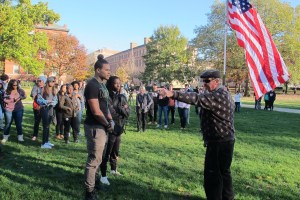
On Wednesday, two men, one with a large American flag and the other with a bible, were spewing supposedly Christian but actually anti-immigrant, pro-Trump, racist rhetoric. A large group of us formed around them—some students were arguing with them and some brett1were just watching the spectacle. I was trying to take the floor away from these two hate-mongers and focus energy in a positive way—finally a brave student took the floor and reminded them that their version of “Christian” actually has nothing to do with what Christ would have espoused.

Right next to all this screaming there were students writing love-filled messages in chalk on the quad: “Spread love, the world needs it;” “Your skin your sex your gender your beliefs ARE VALID;” “Love is the answer.” Unfortunately, another chalking, that I did not brett5see but a student sent me an image of proclaimed: “White Privilege, I (heart) Trump”

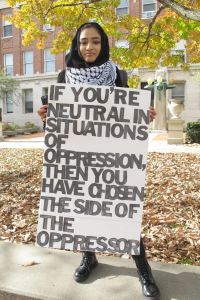
Later in the day I saw students forming a chain in front of Lincoln Hall and chanting, “keep loving, keep fighting.” These students were contributing a wonderful energy to the quad, they were joining together to do it. The next day, I saw a student sitting alone, and completely silent in front of the Alma Mater with a sign that read:  “Vow of silence. No voice. No comment. No hate. No tyrant. #Not My President.” I gestured to him (I didn’t want to use words and disrupt his peaceful protest) to ask if I could photograph him, and he nodded yes. Then I wrote him a note: Thank you for your protest. It is very beautiful. Andbrett8 very needed.

Writing on a huge “What are you Thankful For” sign I encountered a Latina student who was chalking that she was thankful for all the solidarity and coalition building opportunities on campus. I asked specifically which resources she was grateful for and she described both La Casa and to the Gender and Women’s Studies center as offering spaces for dialogue and unloading after the election. I was relieved that far from feeling isolated she felt held by these communities.

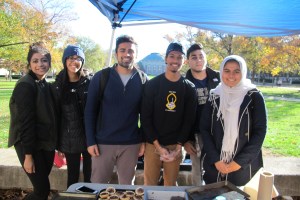
Then I talked with the Muslim Student’s association, out on the quad for a bake sale. They were so happy to have someone approach them and offer solidarity that I wondered if this was rare. The group of students I spoke to had different feelings about the election: one woman said that she did feel safe on this campus but then her friends started chiming in about Islamophobic acts that had happened here since November 8: a Muslim woman had a knife wielded at her on a bus, another woman’s hijab was pulled off, and another student suffered a man shouting brett10“go back to your country” as he walked by. When I asked them how they were feeling about Trump and about all of these revolting acts they said they were shocked but they were ready for action and to fight for what they believe in.
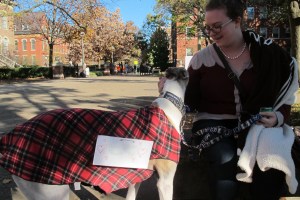
Another solitary protester sat alone in a chair on the quad holding up the sign “Love trumps hate.” I asked him if he knew of other protests happening and how he felt protesting alone and he said yes, there would be soon mass protests and it was just fine for him to protest alone. Yet another lone protester had affixed a sign on her dog that offered him as something like “post-election therapy.” I have to own up to the fact that the solitary protesters made be feel melancholic and protective. But they were all mourning andbrett12 fighting in ways that had an impact, even though they chose to do it alone.
In my graduate seminar I opened class by asking if anyone had anything that he/she/they would like to share about the election. One white student said that she had been crying about it (I’ve seen many, many people crying) and was talking with a black student who “asked if [she] needed a hug and then told her, ‘it’ll be ok, we’ll get through this!’ This sweet gesture brought [her] to tears and made [her] think maybe this terrible outcome will unite us in some important ways.”

Among the incredibly moving and thoughtful and insightful and informative things people have posted on Facebook, I found these words from one of the many Comparative Literature graduate students who make our department so stellar, particularly moving: “I have seen instructors break into tears because they suddenly feel inadequate to protect their most vulnerable students, even in their own classrooms. I have seen new communities forming around the desire to extend compassion, protection and comfort to people who feel threatened and devalued…” (Meagan Smith).

This morning, Friday 11 November, I went to the 31st annual Diversity Breakfast. Chancellor Jones offered there an impassioned, clear rebuke against the disgusting rise in racism we are experiencing now. It was a strong, unequivocal statement and it earned him a standing ovation. After all the awards were given and the speeches made I bee-lined over to the new Chancellor, congratulated him on his moving and wonderful speech, and asked him to send such a strong statement to all the students—several of whom had already told me they needed that from him.

From the diversity breakfast my daughter and I picked up my father from the airport and went straight to a protest at the Alma Mater. Three generations of Kaplans were chanting “hey hey, ho ho Donald Trump has got to go!” “We welcome immigrants!” “Tell us what power looks like! This is what POWER looks like!” My Jewish-American father was part of the Civil Rights movement and always fought for racial justice; my younger daughter is finding her way in the world but already knows that racism is painful and wrong and that Trump and his supporters are spreading racism!

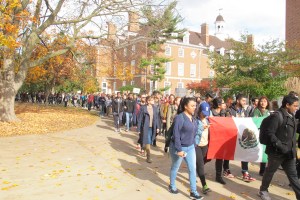
The protest moved from the Alma Mater all the way around the quad and then down Green Street. We stopped traffic and took over the road—there were probably 300 or so peoplebrett13—black, brown, white, gay, straight, trans, young, old—an actually diverse group of people yelling at the top our lungs “THIS IS NOT MY PRESIDENT!”

As I write, the KKK has endorsed Trump and plans an enthusiastic welcome rally; a Saudi man has been murdered in Wisconsin; swastikas and other hate symbols proliferate around the nation. My partner, a black physicist from Tobago on his way home from a conference has just texted me the cover of USA Today bearing the headline: “Rise in racist acts follows election.” I cannot predict what sort of fissures the racism Trump and his followers propagate will forge into our family and through our love.

If the see-saw between love and hate as represented in this small sampling from this small college town in the Midwest were to be weighed, love would definitely, certainly, trump hate. But I am not sure I could possibly hazard which one will ascend in the long run.

It is time now for all of us to write to the electoral college delegates and ask them not to vote for hate on December 19. This may be our only chance for peace.

***

Brett Ashley Kaplan is a professor of comparative literature at the University of Illinois at Urbana-Champaign. She is also the author of  Unwanted Beauty, Landscapes of Holocaust Postmemory, and Jewish Anxiety and the Novels of Philip Roth.