
Portrait of André Breton by Victor Brauner, 1934.
WHAT IS SURREALISM?
by André Breton
This was first presented as a lecture in Brussels on June 1, 1934 at a public meeting organized by the Belgian Surrealists, and thereafter issued as a pamphlet.
Comrades:
The activity of our surrealist comrades in Belgium is closely allied with our own activity, and I am happy to be in their company this evening. Magritte, Mesens, Nougé, Scutenaire and Souris are among those whose revolutionary will—outside of all consideration of their agreement or disagreement with us on particular points—has been for us in Paris a constant reason for thinking that the surrealist project, beyond the limitations of space and time, can contribute to the efficacious reunification of all those who do not despair of the transformation of the world and who wish this transformation to be as radical as possible.
***
At the beginning of the war of 1870 (he was to die four months later, aged twenty-four), the author of the Chants de Maldoror and of Poésies, Isidore Ducasse, better known by the name of Comte de Lautréamont, whose thought has been of the very greatest help and encouragement to myself and my friends throughout the fifteen years during which we have succeeded in carrying a common activity, made the following remark, among many others which were to electrify us fifty years later: “At the hour in which I write, new tremors are running through the intellectual atmosphere; it is only a matter of having the courage to face them.”
1868-75: it is impossible, looking back upon the past, to perceive an epoch so poetically rich, so victorious, so revolutionary and so charged with distant meaning as that which stretches from the separate publication of the Premier Chant de Maldoror to the insertion in a letter to Ernest Delahaye of Rimbaud’s last poem, Rêve, which has not so far been included in his Complete Works. It is not an idle hope to wish to see the works of Lautréamont and Rimbaud restored to their correct historical background: the coming and the immediate results of the war of 1870. Other and analogous cataclysms could not have failed to rise out of that military and social cataclysm whose final episode was to be the atrocious crushing of the Paris Commune; the last in date caught many of us at the very age when Lautréamont and Rimbaud found themselves thrown into the preceding one, and by way of revenge has had as its consequence—and this is the new and important fact—the triumph of the Bolshevik Revolution.
I should say that to people socially and politically uneducated as we then were—we who, on one hand, came for the most part from the petite-bourgeoisie, and on the other, were all by vocation possessed with the desire to intervene upon the artistic plane—the days of October, which only the passing of the years and the subsequent appearance of a large number of works within the reach of all were fully to illumine, could not there and then have appeared to turn so decisive a page in history. We were, I repeat, ill-prepared and ill-informed.

André Breton, René Hilsum, Louis Aragon and Paul Eluard posing with a copy of Dada 3, 1919.
Above all, we were exclusively preoccupied with a campaign of systematic refusal, exasperated by the conditions under which, in such an age, we were forced to live. But our refusal did not stop there; it was insatiable and knew no bounds. Apart from the incredible stupidity of the arguments which attempted to legitimize our participation in an enterprise such as the war, whose issue left us completely indifferent, this refusal was directed—and having been brought up in such a school, we are not capable of changing so much that is no longer so directed—against the whole series of intellectual, moral and social obligations that continually and from all sides weigh down upon man and crush him. Intellectually, it was vulgar rationalism and chop logic that more than anything else formed the causes of our horror and our destructive impulse; morally, it was all duties: religious, civic and of the family; socially, it was work (did not Rimbaud say: “Jamais je ne travaillerai, ô flots de feu!” and also: “La main à plume vaut la main à charrue. Quel siècle à mains! Je n’aurai jamais ma main!” [Never will I work, O torrents of flame! The hand that writes is worth the hand that ploughs! What a century of hands! I will never lift my hand!]).
The more I think about it, the more certain I become that nothing was to our minds worth saving, unless it was… unless it was, at last “l’amour la poésie,” to take the bright and trembling title of one of Paul Eluard’s books, “l’amour la poésie,” considered as inseparable in their essence and as the sole good. Between the negation of this good, a negation brought to its climax by the war, and its full and total affirmation (“Poetry should be made by all, not one”), the field was not, to our minds, open to anything but a Revolution truly extended into all domains, improbably radical, to the highest degree impractical and tragically destroying within itself the whole time the feeling that it brought with it both of desirability and of absurdity.
Many of you, no doubt, would put this down to a certain youthful exaltation and to the general savagery of the time; I must, however, insist on this attitude, common to particular men and manifesting itself at periods nearly half a century distant from one another. I should affirm that in ignorance of this attitude one can form no idea of what surrealism really stands for. This attitude alone can account, and very sufficiently at that, for all the excesses that may be attributed to us but which cannot be deplored unless one gratuitously supposes that we could have started from any other point. The ill-sounding remarks, that are imputed to us, the so-called inconsiderate attacks, the insults, the quarrels, the scandals—all things that we are so much reproached with—turned up on the same road as the surrealist poems. From the very beginning, the surrealist attitude has had that in common with Lautréamont and Rimbaud which once and for all binds our lot to theirs, and that is wartime defeatism.
I am not afraid to say that this defeatism seems to be more relevant than ever. “New tremors are running through the intellectual atmosphere; it is only a matter of having the courage to face them.” They are, in fact, always running through the intellectual atmosphere: the problem of their propagation and interpretation remains the same and, as far as we are concerned, remains to be solved. But, paraphrasing Lautréamont, I cannot refrain from adding that at the hour in which I speak, old and mortal shivers are trying to substitute themselves for those which are the very shivers of knowledge and of life. They come to announce a frightful disease, a disease followed by the deprivation of all rights; it is only a matter of having the courage to face them also. This disease is called fascism.

André Breton photograph by Man Ray, c. 1930.
Let us be careful today not to underestimate the peril: the shadow has greatly advanced over Europe recently. Hitler, Dolfuss and Mussolini have either drowned in blood or subjected to corporal humiliation everything that formed the effort of generations straining towards a more tolerable and more worthy form of existence. The other day I noticed on the front page of a Paris newspaper a photograph of the surroundings of the Lambrechies mine on the day after the catastrophe. This photograph illustrated an article titled, in quotation marks, ‘Only Our Chagrin Remains’. On the same page was another photograph—this one of the unemployed of your country standing in front of a hovel in the Parisian ‘poor zone’—with the caption Poverty is not a crime. “How delightful!” I said to myself, glancing from one picture to the other. Thus the bourgeois public in France is able to console itself with the knowledge that the miners of your country were not necessarily criminals just because they got themselves killed for 35 francs a day. And doubtless the miners, our comrades, will be happy to learn that the committee of the Belgian Coal Association intends to postpone till the day after tomorrow the application of the wage cut set for 20 May. In capitalist society, hypocrisy and cynicism have now lost all sense of proportion and are becoming more outrageous every day. Without making exaggerated sacrifices to humanitarianism, which always involves impossible reconciliations and truces to the advantage of the stronger, I should say that in this atmosphere, thought cannot consider the exterior world without an immediate shudder. Everything we know about fascism shows that it is precisely the confirmation of this state of affairs, aggravated to its furthest point by the lasting resignation that it seeks to obtain from those who suffer. Is not the evident role of fascism to re-establish for the time being the tottering supremacy of finance-capital? Such a role is of itself sufficient to make it worthy of all our hatred; we continue to consider this feigned resignation as one of the greatest evils that can possibly be inflicted upon beings of our kind, and those who would inflict it deserve, in our opinion, to be beaten like dogs. Yet it is impossible to conceal the fact that this immense danger is there, lurking at our doors, that it has made its appearance within our walls, and that it would be pure byzantinism to dispute too long, as in Germany, over the choice of the barrier to be set up against it, when all the while, under several aspects, it is creeping nearer and nearer to us.
During the course of taking various steps with a view to contributing, in so far as I am capable, to the organization in Paris of the anti-fascist struggle, I have noticed that already a certain doubt has crept into the intellectual circles of the left as to the possibility of successfully combating fascism, a doubt which has unfortunately infected even those elements whom one might have thought it possible to rely on and who had come to the fore in this struggle. Some of them have even begun to make excuses for the loss of the battle already. Such dispositions seem to me to be so dismaying that I should not care to be speaking here without first having made clear my position in relation to them, or without anticipating a whole series of remarks that are to follow, affirming that today, more than ever before, the liberation of the mind, demands as primary condition, in the opinion of the surrealists, the express aim of surrealism, the liberation of man, which implies that we must struggle with our fetters with all the energy of despair; that today more than ever before the surrealists entirely rely for the bringing about of the liberation of man upon the proletarian Revolution.

An automatic writing session. Simone Collinet-Breton, Robert Desnos and Jacques Baron are in the foreground. Max Morise, Roger Vitrac, Jacques Boiffard, Andre Breton, Paul Eluard, Pierre Naville, Giorgio de Chirico and Phillipe Soupault are left to right. Photograph by Man Ray, c. 1923.
I now feel free to turn to the object of this pamphlet, which is to attempt to explain what surrealism is. A certain immediate ambiguity contained in the word surrealism, is, in fact, capable of leading one to suppose that it designates I know not what transcendental attitude, while, on the contrary it expresses—and always has expressed for us—a desire to deepen the foundations of the real, to bring about an even clearer and at the same time ever more passionate consciousness of the world perceived by the senses. The whole evolution of surrealism, from its origins to the present day, which I am about to retrace, shows that our unceasing wish, growing more and more urgent from day to day, has been at all costs to avoid considering a system of thought as a refuge, to pursue our investigations with eyes wide open to their outside consequences, and to assure ourselves that the results of these investigations would be capable of facing the breath of the street. At the limits, for many years past—or more exactly, since the conclusion of what one may term the purely intuitive epoch of surrealism (1919-25)—at the limits, I say, we have attempted to present interior reality and exterior reality as two elements in process of unification, or finally becoming one. This final unification is the supreme aim of surrealism: interior reality and exterior reality being, in the present form of society, in contradiction (and in this contradiction we see the very cause of man’s unhappiness, but also the source of his movement), we have assigned to ourselves the task of confronting these two realities with one another on every possible occasion, of refusing to allow the preeminence of the one over the other, yet not of acting on the one and on the other both at once, for that would be to suppose that they are less apart from one another than they are (and I believe that those who pretend that they are acting on both simultaneously are either deceiving us or are a prey to a disquieting illusion); of acting on these two realities not both at once, then, but one after the other, in a systematic manner, allowing us to observe their reciprocal attraction and interpenetration and to give to this interplay of forces all the extension necessary for the trend of these two adjoining realities to become one and the same thing.
As I have just mentioned in passing, I consider that one can distinguish two epochs in the surrealist movement, of equal duration, from its origins (1919, year of the publication of Champs Magnétiques) until today; a purely intuitive epoch, and a reasoning epoch. The first can summarily be characterized by the belief expressed during this time in the all-powerfulness of thought, considered capable of freeing itself by means of its own resources. This belief witnesses to a prevailing view that I look upon today as being extremely mistaken, the view that thought is supreme over matter. The definition of surrealism that has passed into the dictionary, a definition taken from the Manifesto of 1924, takes account only of this entirely idealist disposition and (for voluntary reasons of simplification and amplification destined to influence in my mind the future of this definition) does so in terms that suggest that I deceived myself at the time in advocating the use of an automatic thought not only removed from all control exercised by the reason but also disengaged from “all aesthetic or moral preoccupations.” It should at least have been said: conscious aesthetic or moral preoccupations.
During the period under review, in the absence, of course, of all seriously discouraging exterior events, surrealist activity remained strictly confined to its first theoretical premise, continuing all the while to be the vehicle of that total “non-conformism” which, as we have seen, was the binding feature in the coming together of those who took part in it, and the cause, during the first few years after the war, of an uninterrupted series of adhesions. No coherent political or social attitude, however, made its appearance until 1925, that is to say (and it is important to stress this), until the outbreak of the Moroccan war, which, re-arousing in us our particular hostility to the way armed conflicts affect man, abruptly placed before us the necessity of making a public protest. This protest, which, under the title La Révolution d’Abord et Toujours (October 1925 [Revolution Now and Forever]), joined the name of the surrealists proper to those of thirty other intellectuals, was undoubtedly rather confused ideologically; it none the less marked the breaking away from a whole way of thinking; it none the less created a precedent that was to determine the whole future direction of the movement. Surrealist activity, faced with a brutal, revolting, unthinkable fact, was forced to ask itself what were its proper resources and to determine their limits; it was forced to adopt a precise attitude, exterior to itself, in order to continue to face whatever exceeded these limits.

André Breton, Robert Desnos, Joseph Delteil, Simone Breton, Paul & Gala Eluard, Jaques Baron and Max Ernst.
Surrealist activity at this moment entered into its reasoning phase. It suddenly experienced the necessity of crossing over the gap that separates absolute idealism from dialectical materialism. This necessity made its appearance in so urgent a manner that we had to consider the problem in the clearest possible light, with the result that for some months we devoted our entire attention to the means of bringing about this change of front once and for all. If I do not today feel any retrospective embarrassment in explaining this change, that is because it seems to me quite natural that surrealist thought, before coming to rest in dialectical materialism and insisting, as today, on the supremacy of matter over mind, should have been condemned to pass, in a few years, through the whole historic development of modern thought. It came normally to Marx through Hegel, just as it came normally to Hegel through Berkeley and Hume. These latter influences offer a certain particularity in that, contrary to certain poetic influences undergone in the same way, and accommodated to those of the French materialists of the eighteenth century, they yielded a residuum of practical action. To try and hide these influences would be contrary to my desire to show that surrealism has not been drawn up as an abstract system, that is to say, safeguarded against all contradictions. It is also my desire to show how surrealist activity, driven, as I have said, to ask itself what were its proper resources, had in some way or another to reflect upon itself its realization, in 1925, of its relative insufficiency; how surrealist activity had to cease being content with the results (automatic texts, the recital of dreams, improvised speeches, spontaneous poems, drawings and actions) which it had originally planned; and how it came to consider these first results as being simply so much material, starting from which the problem of knowledge inevitably arose again under quite a new form.
As a living movement, that is to say a movement undergoing a constant process of becoming and, what is more, solidly relying on concrete facts, surrealism has brought together and is still bringing together diverse temperaments individually obeying or resisting a variety of bents.
The determinant of their enduring or short-lived adherence is not to be considered as a blind concession to an inert stock of ideas held in common, but as a continuous sequence of acts which, propelling the doer to more or less distant points, forces him for each fresh start to return to the same starting-line. These exercises not being without peril, one man may break a limb or—for which there is no precedent—his head, another may peaceably submerge himself in a quagmire or report himself dying of fatigue. Unable as yet to treat itself to an ambulance, surrealism simply leaves these individuals by the wayside. Those who continue in the ranks are aware of course of the casualties left behind them. But what of it? The essential is always to look ahead, to remain sure that one has not forfeited the burning desire for beauty, truth and justice, toilingly to go onwards towards the discovery, one by one, of fresh landscapes, and to continue doing so indefinitely and without coercion to the end, that others may afterwards travel the same spiritual road, unhindered and in all security. Penetration, to be sure, has not been as deep as one would have wished. Poetically speaking, a few wild, or shall we say charming, beasts whose cries fill the air and bar access to a domain as yet only surmised, are still far from being exorcized. But for all that, the piercing of the thicket would have proceeded less tortuously, and those who are doing the pioneering would have acquitted themselves with unabating tenacity in the service of the cause, if, between the beginning and the end of the spectacle which they provide for themselves and would be glad to provide for others, a change had not taken place.

Photo booth photograph of André Breton, c. 1929
In 1934, more than ever before, surrealism owes it to itself to defend the postulate of the necessity of change. It is amusing, indeed, to see how the more spiteful and silly of our adversaries affect to triumph whenever they stumble on some old statement we may have made and which now sounds more or less discordantly in the midst of others intended to render comprehensible our present conduct. This insidious manoeuvre, which is calculated to cast a doubt on our good faith, or at least on the genuineness of our principles, can easily be defeated.
The development of surrealism throughout the decade of its existence is, we take it, a function of the unrolling of historical realities as these may be speeded up between the period of relief which follows the conclusion of a peace and the fresh outbreak of war. It is also a function of the process of seeking after new values in order to confirm or invalidate existing ones. The fact that certain of the first participants in surrealist activity have thrown in the sponge and have been discarded has brought about the retiring from circulation of some ways of thinking and the putting into circulation of others in which there were implicit certain general dissents on the one hand and certain general assents on the other. Hence it is that this activity has been fashioned by the events. At the present moment, contrary to current biased rumour according to which surrealism itself is supposed, in its cruelty of disposition, to have sacrificed nearly all the blood first vivifying it, it is heartening to be able to point out that it has never ceased to avail itself of the perfect teamwork of René Crevel, Paul Eluard, Max Ernst, Benjamin Péret, Man Ray, Tristan Tzara, and the present writer, all of whom can attest that from the inception of the movement—which is also the date of our enlistment in it—until now, the initial principle of their covenant has never been violated. If there have occurred differences on some points, it was essentially within the rhythmic scope of the integral whole, in itself a least disputable element of objective value.
The others, they whom we no longer meet, can they say as much? They cannot, for the simple reason that since they separated from us they have been incapable of achieving a single concerted action that had any definite form of its own, and they have confined themselves, instead, to a reaction against surrealism with the greatest wastage to themselves—a fate always overtaking those who go back on their past. The history of their apostasy and denials will ultimately be read into the great limbo of human failings, without profit to any observer—ideal yesterday, but real today—who, called upon to make a pronouncement, will decide whether they or ourselves have brought the more appreciable efforts to bear upon a rational solution of the many problems surrealism has propounded.
Although there can be no question here of going through the history of the surrealist movement—its history has been told many a time and sometimes told fairly well; moreover, I prefer to pass on as quickly as possible to the exposition of its present attitude—I think I ought briefly to recall, for the benefit of those of you who were unaware of the fact, that there is no doubt that before the surrealist movement properly so called, there existed among the promoters of the movement and others who later rallied round it, very active, not merely dissenting but also antagonistic dispositions which, between 1915 and 1920, were willing to align themselves under the signboard of Dada.

André Breton at a Dada festival in Paris, March 27, 1920, wearing a slogan “In order to love something you need to have seen and heard it for a long time bunch of idiots” by Francis Picabia.
Post-war disorder, a state of mind essentially anarchic that guided that cycle’s many manifestations, a deliberate refusal to judge—for lack, it was said, of criteria—the actual qualifications of individuals, and, perhaps, in the last analysis, a certain spirit of negation which was making itself conspicuous, had brought about a dissolution of the group as yet inchoate, one might say, by reason of its dispersed and heterogeneous character, a group whose germinating force has nevertheless been decisive and, by the general consent of present-day critics, has greatly influenced the course of ideas. It may be proper before passing rapidly—as I must—over this period, to apportion by far the handsomest share to Marcel Duchamp (canvases and glass objects still to be seen in New York), to Francis Picabia (reviews “291” and “391”), Jacques Vaché (Lettres de Guerre) and Tristan Tzara (Twenty-five Poems, Dada Manifesto 1918).
Strangely enough, it was round a discovery of language that there was seeking to organize itself in 1920 what—as yet on a basis of confidential exchange—assumed the name of surrealism, a word fallen from the lips of Apollinaire, which we had diverted from the rather general and very confusing connotation he had given it. What was at first no more than a new method of poetic writing broke away after several years from the much too general theses which had come to be expounded in the Surrealist Manifesto—Soluble Fish, 1924, the Second Manifesto adding others to them, whereby the whole was raised to a vaster ideological plane; and so there had to be revision.
In an article, “Enter the Mediums,” published in Littérature, 1922, reprinted in Les Pas Perdus, 1924, and subsequently in the Surrealist Manifesto, I explained the circumstance that had originally put us, my friends and myself, on the track of the surrealist activity we still follow and for which we are hopeful of gaining ever more numerous new adherents in order to extend it further than we have so far succeeded in doing. It reads:
It was in 1919, in complete solitude and at the approach of sleep, that my attention was arrested by sentences more or less complete, which became perceptible to my mind without my being able to discover (even by very meticulous analysis) any possible previous volitional effort. One evening in particular, as I was about to fall asleep, I became aware of a sentence articulated clearly to a point excluding all possibility of alteration and stripped of all quality of vocal sound; a curious sort of sentence which came to me bearing—in sober truth—not a trace of any relation whatever to any incidents I may at that time have been involved in; an insistent sentence, it seemed to me, a sentence I might say, that knocked at the window.
I was prepared to pay no further attention to it when the organic character of the sentence detained me. I was really bewildered. Unfortunately, I am unable to remember the exact sentence at this distance, but it ran approximately like this: “A man is cut in half by the window.” What made it plainer was the fact that it was accompanied by a feeble visual representation of a man in the process of walking, but cloven, at half his height, by a window perpendicular to the axis of his body. Definitely, there was the form, re-erected against space, of a man leaning out of a window. But the window following the man’s locomotion, I understood that I was dealing with an image of great rarity. Instantly the idea came to me to use it as material for poetic construction. I had no sooner invested it with that quality, than it had given place to a succession of all but intermittent sentences which left me no less astonished, but in a state, I would say, of extreme detachment.

André Breton and Paul Eluard at a fair. Attributed to André Kertesz, c. 1930.
Preoccupied as I still was at that time with Freud, and familiar with his methods of investigation, which I had practised occasionally upon the sick during the War, I resolved to obtain from myself what one seeks to obtain from patients, namely a
monologue poured out as rapidly as possible, over which the subject’s critical faculty has no control—the subject himself throwing reticence to the winds—and which as much as possible represents spoken thought. It seemed and still seems to me that the speed of thought is no greater than that of words, and hence does not exceed the flow of either tongue or pen.
It was in such circumstances that, together with Philippe Soupault, whom I had told about my first ideas on the subject, I began to cover sheets of paper with writing, feeling a praiseworthy contempt for whatever the literary result might be. Ease of achievement brought about the rest. By the end of the first day of the experiment we were able to read to one another about fifty pages obtained in this manner and to compare the results we had achieved. The likeness was on the whole striking. There were similar faults of construction, the same hesitant manner, and also, in both cases, an illusion of extraordinary verve, much emotion, a considerable assortment of images of a quality such as we should never have been able to obtain in the normal way of writing, a very special sense of the picturesque, and, here and there, a few pieces of out and out buffoonery.
The only differences which our two texts presented appeared to me to be due essentially to our respective temperaments, Soupault’s being less static than mine, and, if he will allow me to make this slight criticism, to his having scattered about at the top of certain pages—doubtlessly in a spirit of mystification—various words under the guise of titles. I must give him credit, on the other hand, for having always forcibly opposed the least correction of any passage that did not seem to me to be quite the thing. In that he was most certainly right.
It is of course difficult in these cases to appreciate at their just value the various elements in the result obtained; one may even say that it is entirely impossible to appreciate them at a first reading. To you who may be writing them, these elements are, in appearance, as strange as to anyone else, and you are yourself naturally distrustful of them. Poetically speaking, they are distinguished chiefly by a very high degree of immediate absurdity, the peculiar quality of that absurdity being, on close examination, their yielding to whatever is most admissible and legitimate in the world: divulgation of a given number of facts and properties on the whole not less objectionable than the others.
The word “surrealism” having thereupon become descriptive of the generalizable undertaking to which we had devoted ourselves, I thought indispensable, in 1924, to define this word once and for all:
SURREALISM, n. Pure psychic automatism, by which it is intended to express, verbally, in writing, or by other means, the real process of thought. Thought’s dictation, in the absence of all control exercised by the reason and outside all aesthetic or moral preoccupations.
ENCYCL. Philos. Surrealism rests in the belief in the superior reality of certain forms of association neglected heretofore; in the omnipotence of the dream and in the disinterested play of thought. It tends definitely to do away with all other psychic mechanisms and to substitute itself for them in the solution of the principal problems of life. Have professed absolute surrealism: Messrs. Aragon, Baron, Boiffard, Breton, Carrive, Crevel, Delteil, Desnos, Eluard, Gérard, Limbour, Malkine, Morise, Naville, Noll, Péret, Picon, Soupault, Vitrac.
These till now appear to be the only ones…. Were one to consider their output only superficially, a goodly number of poets might well have passed for surrealists, beginning with Dante and Shakespeare at his best. In the course of many attempts I have made towards an analysis of what, under false pretences, is called genius, I have found nothing that could in the end be attributed to any other process than this.
There followed an enumeration that will gain, I think, by being clearly set out thus:
Young’s Night Thoughts are surrealist from cover to cover. Unfortunately, it is a priest who speaks; a bad priest, to be sure, yet a priest.
Heraclitus is surrealist in dialectic.
Lully is surrealist in definition.
Flamel is surrealist in the night of gold.
Swift is surrealist in malice.
Sade is surrealist in sadism.
Carrier is surrealist in drowning.
Monk Lewis is surrealist in the beauty of evil.
Achim von Arnim is surrealist absolutely, in space and time
Rabbe is surrealist in death.
Baudelaire is surrealist in morals.
Rimbaud is surrealist in life and elsewhere.
Hervey Saint-Denys is surrealist in the directed dream.
Carroll is surrealist in nonsense.
Huysmans is surrealist in pessimism.
Seurat is surrealist in design.
Picasso is surrealist in cubism.
Vaché is surrealist in me.
Roussel is surrealist in anecdote. Etc.
They were not always surrealists—on this I insist—in the sense that one can disentangle in each of them a number of preconceived notions to which—very naively!—they clung. And they clung to them so because they had not heard the surrealist voice, the voice that exhorts on the eve of death and in the roaring storm, and because they were unwilling to dedicate themselves to the task of no
more than orchestrating the score replete with marvellous things. They were proud instruments; hence the sounds they produced were not always harmonious sounds.

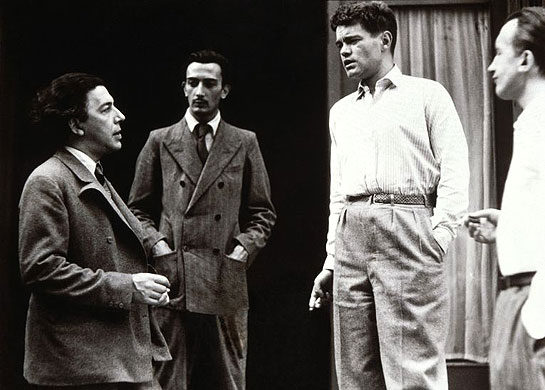
André Breton, Salvador Dali, René Crevel and Paul Eluard, 1930.
We, on the contrary, who have not given ourselves to processes of filtering, who through the medium of our work have been content to be the silent receptacles of so many echoes, modest registering machines that are not hypnotized by the pattern that they trace, we are perhaps serving a yet much nobler cause. So we honestly give back the talent lent to us. You may talk of the “talent” of this yard of platinum, of this mirror, of this door and of this sky, if you wish.
We have no talent…
The Manifesto also contained a certain number of practical recipes, entitled: “Secrets of the Magic Surrealist Art,” such as the following:
Written Surrealist Composition or First and Last Draft
Having settled down in some spot most conducive to the mind’s concentration upon itself, order writing material to be brought to you. Let your state of mind be as passive and receptive as possible. Forget your genius, talents, as well as the genius and talents of others. Repeat to yourself that literature is pretty well the sorriest road that leads to everywhere. Write quickly without any previously chosen subject, quickly enough not to dwell on, and not to be tempted to read over, what you have written. The first sentence will come of itself; and this is self-evidently true, because there is never a moment but some sentence alien to our conscious thought clamours for outward expression. It is rather difficult to speak of the sentence to follow, since it doubtless comes in for a share of our conscious activity and so the other sentences, if it is conceded that the writing of the first sentence must have involved even a minimum of consciousness. But that should in the long run matter little, because therein precisely lies the greatest interest in the surrealist exercise. Punctuation of course necessarily hinders the stream of absolute continuity which preoccupies us. But you should particularly distrust the prompting whisper. If through a fault ever so trifling there is a forewarning of silence to come, a fault let us say, of inattention, break off unhesitatingly the line that has become too lucid. After the word whose origin seems suspect you should place a letter, any letter, l for example, always the letter l, and restore the arbitrary flux by making that letter the initial of the word to follow.
I shall pass over the more or less correlated considerations which the Manifesto discussed in their bearing on the possibilities of plastic expression in surrealism. These considerations did not assume a relatively dogmatic turn with me till afterwards in Surrealism and Painting (1928).
I believe that the real interest of the Manifesto—there was no lack of people who were good enough to concede interest, for which no particular credit is due to me because I have no more than given expression to sentiments shared with friends, present and former—rests only subordinately on the formula above given. It is rather confirmatory of a turn of thought which, for good or ill, is peculiarly distinctive of our time. The defense originally attempted of that turn of thought still seems valid to me in what follows:
We still live under the reign of logic… But the methods of logic are applied nowadays only to the resolution of problems of secondary interest. The absolute rationalism which is still the fashion does not permit consideration of any facts but those strictly relevant to our experience. Logical ends, on the other hand, escape us. Needless to say that even experience has had limits assigned to it. It revolves in a cage from which it becomes more and more difficult to release it. Even experience is dependent on immediate utility, and common sense is its keeper. Under color of civilization, under pretext of progress, all that rightly or wrongly may be regarded as fantasy or superstition has been banished from the mind, all uncustomary searching after truth has been proscribed. It is only by what must seem sheer luck that there has recently been brought to light an aspect of mental life—to my belief by far the most important—with which it was supposed that we no longer had any concern. All credit for these discoveries must go to Freud. Based on these discoveries a current of opinion is forming that will enable the explorer of the human mind to continue his investigations, justified as he will be in taking into account more than mere summary realities. The imagination is perhaps on the point of reclaiming its rights. If the depths of our minds harbor strange forces capable of increasing those on the surface, or of successfully contending with them, then it is all in our interest to canalize them, to canalize them first in order to submit them later, if necessary, to the control of the reason. The analysts themselves have nothing to lose by such a proceeding. But it should be observed that there are no means designed a priori for the bringing about of such an enterprise, that until the coming of the new order it might just as well be considered the affair of poets and scientists, and that its success will not depend on the more or less capricious means that will be employed. I am resolved to deal severely with that hatred of the marvellous which is so rampant among certain people, that ridicule to which they are so eager to expose it. Let us speak plainly: The marvelous is always beautiful, anything marvellous is beautiful; indeed, nothing but the marvelous is beautiful.
What is admirable about the fantastic is that there is no longer a fantastic; there is only the real.

Benjamin Péret, André Breton and two friends, 1935.
Interesting in a different way from the future of surrealist technics (theatrical, philosophical, scientific, critical) appears to me the application of surrealism to action. Whatever reservations I might be inclined to make with regard to responsibility in general, I should quite particularly like to know how the first misdemeanors whose surrealist character is indubitable will be judged. When surrealist methods extend from writing to action, there will certainly arise the need of a new morality to take the place of the current one, the cause of all our woes.
The Manifesto of Surrealism has improved on the Rimbaud principle that the poet must turn seer. Man in general is going to be summoned to manifest through life those new sentiments which the gift of vision will so suddenly have placed within his reach:
Surrealism, as I envisage it, asserts our absolute nonconformism so clearly that there can be no question of claiming it as witness when the real world comes up for trial. On the contrary, it can but testify to the complete state of distraction which we hope to attain here below… Surrealism is the “invisible ray” that shall enable us one day to triumph over our enemies. “You tremble no more, carcass.” This summer the roses are blue; the wood is made of glass. The earth wrapped in its foliage has as little effect on me as a ghost. Living and ceasing to live are imaginary solutions. Existence lies elsewhere.
Surrealism then was securing expression in all its purity and force. The freedom it possesses is a perfect freedom in the sense that it recognizes no limitations exterior to itself. As it was said on the cover of the first issue of La Révolution Surréaliste, “it will be necessary to draw up a new declaration of the Rights of Man.” The concept of surreality, concerning which quarrels have been sought with us repeatedly and which it was attempted to turn into a metaphysical or mystic rope to be placed afterwards round our necks, lends itself no longer to misconstruction, nowhere does it declare itself opposed to the need of transforming the world which henceforth will more and more definitely yield to it.
As I said in the Manifesto I believe in the future transmutation of those two seemingly contradictory states, dream and reality, into a sort of absolute reality, of surreality, so to speak. I am looking forward to its consummation, certain that I shall never share in it, but death would matter little to me could I but taste the joy it will yield ultimately.
Aragon expressed himself in very much the same way in Une Vague de rêves (1924):
It should be understood that the real is a relation like any other; the essence of things is by no means linked to their reality, there are other relations besides reality, which the mind is capable of grasping and which also are primary, like chance, illusion, the fantastic, the dream. These various groups are united and brought into harmony in one single order, surreality… This surreality—a relation in which all notions are merged together—is the common horizon of religions, magic, poetry, intoxications, and of all life that is lowly—that trembling honeysuckle you deem sufficient to populate the sky with for us.
And René Creval, in L’Esprit contre la raison (1928):
The poet does not put the wild animals to sleep in order to play the tamer, but, the cages wide open, the keys thrown to the winds, he journeys forth, a traveller who thinks not of himself but of the voyage, of dream beaches, forests of hands, soul-endowed animals, all undeniable surreality.
I was to sum up the idea in Surrealism and Painting (1928):
All that I love, all that I think and feel inclines me towards a particular philosophy of immanence according to which surreality will reside in reality itself and will be neither superior nor exterior to it. And conversely, because the container shall be also the contained. One might almost say that it will be a communicating vessel placed between the container and the contained. That is to say, I resist with all my strength temptations which, in painting and literature, might have the immediate tendency to withdraw thought from life as well as place life under the aegis of thought.
After years of endeavor and perplexities, when a variety of opinions had disputed amongst themselves the direction of the craft in which a number of persons of unequal ability and varying powers of resistance had originally embarked together, the surrealist idea recovered in the Second Manifesto all the brilliancy of which events had vainly conspired to despoil it. It should be emphasized that the First Manifesto of 1924 did no more than sum up the conclusions we had drawn during what one may call the heroic epoch of surrealism, which stretches from 1919 to 1923. The concerted elaboration of the first automatic texts and our excited reading of them, the first results obtained by Max Ernst in the domain of “collage” and of painting, the practice of surrealist “speaking” during the hypnotic experiments introduced among us by René Crevel and repeated every evening for over a year, incontrovertibly mark the decisive stages of surrealist exploration during this first phase. After that, up till the taking into account of the social aspect of the problem round about 1925 (though not formally sanctioned until 1930), surrealism began to find itself a prey to characteristic wranglings. These wranglings account very clearly for the expulsion orders and tickets-of-leave which, as we went along, we had to deal out to certain of our companions of the first and second hour. Some people have quite gratuitously concluded from this that we are apt to overestimate personal questions. During the last ten years, surrealism has almost unceasingly been obliged to defend itself against deviations to the right and to the left. On the one hand we have had to struggle against the will of those who would maintain surrealism on a purely speculative level and treasonably transfer it on to an artistic and literary plane (Artaud, Desnos, Ribemont-Dessaignes, Vitrac) at the cost of all the hope for subversion we have placed in it; on the other, against the will of those who would place it on a purely practical basis, available at any moment to be sacrificed to an ill-conceived political militancy (Naville, Aragon)—at the cost, this time, of what constitutes the originality and reality of its researches, at the cost of the autonomous risk that it has to run. Agitated though it was, the epoch that separates the two Manifestos was none the less a rich one, since it saw the publication of so many works in which the vital principles of surrealism were amply accounted for. It
suffices to recall particularly Le Paysan de Paris and Traité du style by Aragon, L’Esprit contre la raison and Etes-vous fous by René Creval, Deuil pour deuil by Desnos, Capitale de la douleur and L’Amour la poésie by Eluard, La Femme 100 têtes by Ernst, La Révolution et les intellectuels by Naville, Le Grand Jeu by Péret, and my own Nadja. The poetic activity of Tzara, although claiming until 1930 no
connection with surrealism, is in perfect accord with ours.
We were forced to agree with Pierre Naville when he wrote:
Surrealism is at the crossroads of several thought movements. We assume that it affirms the possibility of a certain steady downward readjustment of the mind’s rational (and not simply conscious) activity towards more absolutely coherent thought, irrespective of what direction that thought may take; that is to say, that it proposes, or would at least like to propose, a new solution of all problems but chiefly moral. In that sense, indeed, it is epoch-making. That is why one may express the essential characteristic of surrealism by saying that it seeks to calculate the quotient of the unconscious by the conscious.

Paul Eluard, André Breton and Robert Desnos at a fair in Montmartre.
It should be pointed out that in a number of declarations in La Révolution et les Intellectuals. Que peuvent faire les surréalistes? (1926), [Pierre Naville] demonstrated the utter vanity of intellectual bickerings in the face of the human exploitation which results from the wage-earning system. These declarations gave rise amongst us to considerable anxiety and, at tempting for the first time to justify surrealism’s social implications, I desired to put an end to it in Légitime Défense. This pamphlet set out to demonstrate that there is no fundamental antinomy in the basis of surrealist thought.
In reality, we are faced with two problems, one of which is the problem raised, at the beginning of the twentieth century, by the discovery of the relations between the conscious and the unconscious. That was how the problem chose to present itself to us. We were the first to apply to its resolution a particular method, which we have not ceased to consider both the most suitable and the most likely to be brought to perfection; there is no reason why we should renounce it. The other problem we are faced with is that of the social action we should pursue.
We consider that this action has its own method in dialectical materialism, and we can all the less afford to ignore this action since, I repeat, we hold the liberation of man to be the sine qua non condition of the liberation of the mind, and we can expect this liberation of man to result only from the proletarian revolution.
These two problems are essentially distinct and we deplore their becoming confused by not remaining so. There is good reason, then, to take up a stand against all attempts to weld them together and, more especially, against the urge to abandon all such researches as ours in order to devote ourselves to the poetry and art of propaganda. Surrealism, which has been the object of brutal and repeated summonses in this respect, now feels the need of making some kind of counter-attack. Let me recall the fact that its very definition holds that it must escape, in its written manifestations, or any others, from all control exercised by the reason. Apart from the puerility of wishing to bring a supposedly Marxist control to bear on the immediate aspect of such manifestations, this control cannot be envisaged in principle. And how ill-boding does this distrust seem, coming as it does from men who declare themselves Marxists, that is to say possessed not only of a strict line in revolutionary matters, but also of a marvelously open mind and an insatiable curiosity! This brings us to the eve of the Second Manifesto. These objections had to be put an end to, and for that purpose it was indispensable that we should proceed to liquidate certain individualist elements amongst us, more or less openly hostile to one another, whose intentions did not, in the final analysis, appear as irreproachable, nor their motives as disinterested, as might have been desired. An important part of the work was devoted to a statement of the reasons which moved surrealism to dispense for the future with certain collaborators. It was attempted, on the same occasion, to complete the specific method of creation proposed six years earlier, and, as thoroughly as possible, to set surrealist ideas in order.
In spite of the particular courses followed by former or present adherents of surrealism, everyone must admit that the drift of surrealism has always and chiefly been towards a general and emphatic crisis in consciousness and that only to the extent to which this is or is not accomplished can decide the historical success or failure of the movement. From the intellectual point of view, it was and still is a question of exposing by every available means, and to learn at all costs to identify, the facticious character of the old antinomies hypocritically calculated to hinder any unusual agitation on the part of man, were it only a faint understanding of the means at his dispocal and to inspire him to free himself somewhat from the universal fetters. The horror of death, the pantomime of the beyond, the shipwreck of the most beautiful reason in sleep, the overpowering curtain of the future, the towers of Babel, the mirrors of inconstancy, the insuperable silver wall splashed with brains, all these startling images of human catastrophe are perhaps, after all, no more than images.

Marcel Duchamp cover of André Breton’s Young Cherry Trees Secured Against Hares, published by View in New York, 1946.
Everything leads to the belief that there exists a certain point of the mind at which life and death, the real and the imaginary, the past and the future, the communicable and the incommunicable, the high and the low, are not perceived as contradictions. It would be vain to attribute to surrealism any other motive than the hope of determining this point. It is clear, moreover, that it would be absurd to ascribe to surrealism either a purely destructive or a purely constructive character—the point at issue being precisely this: that construction and destruction can no longer be brandished against each other. It becomes clear also that surrealism is not at all interested in taking into account what passes alongside it under the guise of art or even antiart; of philosophy or anti-philosophy; of anything, in a word, that has not for its ultimate end the conversion of being into a jewel, internal and unseeing, with a soul that is neither of ice nor of fire. What, indeed, could they expect of surrealism, who are still anxious about the position they may occupy? On this mental plane from which one may for oneself alone embark on the perilous, but, we think, supreme reconnaissance—on this plane the footsteps of those who come or go are no longer of any importance, because these steps occur in a region where, by definition, surrealism possesses no listening ear. It is not desirable that surrealism should be dependent on the whim of this or that group of persons. If it declares itself capable of uprooting thought from an increasingly cruel serfdom, of bringing it back to the path of total comprehension, of restoring to its original purity, it is indeed no more than right that it should be judged only by what it has done and by what it has still to do in the fulfillment of its promise…
From 1930 until today the history of surrealism is that of successful efforts to restore to it its proper becoming by gradually removing from it every trace both of political opportunism and of artistic opportunism. The review La Révolution Surréaliste, (12 issues) has been succeeded by another, Le Surréalisme au Service de la Révolution (6 issues). Owing particularly to influences brought to bear by new elements, surrealist experimenting. which had for too long been erratic, has been unreservedly resumed; its perspectives and its aims have been made perfectly clear; I may say that it has not ceased to be carried on in a continuous and enthusiastic manner. This experimenting has regained momentum under the master-impulse given to it by Salvador Dali, whose exceptional interior “boiling” has been for surrealism, during the whole of this period, an invaluable ferment. As Guy Mangeot has very rightly pointed out in his History of Surrealism, published recently by René Henriquez, Dali has endowed surrealism with an instrument of primary importance, in particular the paranoiac-critical method, which has immediately shown itself capable of being applied with equal success to painting, poetry, the cinema, to the construction of typical surrealist objects, to fashions, to sculpture and even, if necessary, to all manner of exegesis.

Leon Trotsky, Diego Rivera and André Breton, 1938. Photo by Fritz Bach.
He first announced his convictions to us in La Femme Visible (1930):
I believe the moment is at hand when, by a paranoiac and active advance of the mind, it will be possible (simultaneously with automatism and other passive states) to systematize confusion and thus to help to discredit completely the world of reality.
In order to cut short all possible misunderstandings, it should perhaps be said: “immediate” reality.
Paranoia uses the external world in order to assert its dominating idea and has the disturbing characteristic of making others accept this idea’s reality. The reality of the external world is used for illustration and proof, and so comes to serve the reality of one’s mind.
In the special ‘Surrealist Intervention’ number of Documents 34, under the title ‘Philosophic Provocations’, Dali undertakes today to give his thought a didactic turn. All uncertainty as to his real intentions seems to me to be swept away by these definitions:
Paranoia: Delirium of interpretation bearing a systematic structure.
Paranoiac-critical activity: Spontaneous method of “irrational knowledge” based on the critical and systematic objectification of delirious associations and interpretations.
Painting: Handmade color “photography” of “concrete irrationality” and of the imaginative world in general.
Sculpture: Modeling by hand of “concrete irrationality” and of the imaginative world in general.
Etc…
In order to form a concise idea of Dali’s undertaking, one must take into account the property of uninterrupted becoming of any object of paranoiac activity, in other words of the ultra-confusing activity rising out of the obsessing idea. This uninterrupted becoming allows the paranoiac who is the witness to consider the images of the external world unstable and transitory, or suspect; and what is so disturbing is that he is able to make other people believe in the reality of his impressions. One aspect, for instance, of the multiple image occupying our attention being a putrefied donkey, the ‘cruel’ putrefaction of the donkey can be considered as ‘the hard and blinding flash of new gems’. Here we find ourselves confronted by a new affirmation, accompanied by formal proofs, of the omnipotence of desire, which has remained, since the beginning, surrealism’s sole act of faith. At the point where surrealism has taken up the problem, its only guide has been Rimbaud’s sibylline pronouncement: “I say that one must be a seer, one must make oneself a seer”. As you know, this was Rimbaud’s only means of reaching the unknown. Surrealism can flatter itself today that it has discovered and rendered practicable many other ways leading to the unknown. The abandonment to verbal or graphic impulses and the resort to paranoiac-critical activity are not the only ones, and one may say that, during the last four years of surrealist activity, the many others that have made their appearance allow us to affirm that the automatism from which we started and to which we have unfailingly returned does in fact constitute the crossroads where these various paths meet. Among those we have partly explored, and on which we are only just beginning to see ahead, I should single out simulation of mental diseases (acute mania, general paralysis, dementia praecox), which Paul Eluard and I practiced in The Immaculate Conception (1930), undertaking to prove that the normal man can have access to the provisorily condemned places of the human mind; the manufacture of objects functioning symbolically, started in 1931 by the very particular and quite new emotion aroused by Giocometti’s object ‘The Hour of Traces’; the analysis of the interpenetration of the states of sleep and waking, tending to make them depend entirely on one another and even condition one another in certain affective states, which I undertook in The Communicating Vessels; and finally, the taking into consideration of the recent researches of the Marburg school (to which I drew attention in an article published in Minotaure, ‘The Automatic Message’) whose aim is to cultivate the remarkable sensorial dispositions of children, enabling them to change any object whatever, into no matter what, simply by looking at it fixedly.
Nothing could be more coherent, more systematic or more richly yielding of results, than this last phase of surrealist activity, which has seen the production of two films by Luis Bunuel and Salvador Dali, Un Chien Andalou and L’Age d’or; the poems of René Char; L’Homme approximatif, où boivent les loups and L’Antitête by Tristan Tzara; Le Clavecin de Diderot and Les Pieds dans le plat by René Crevel; La
Vie immédiate by Eluard; the very precious visual commentaries by Valentine Hugo on the works of Arnim and Rimbaud; the most intense part of the work of Yves Tanguy; the inspired sculpture of Alberto Giocometti; the coming together of Georges Hugnet, Gui Rosey, Pierre Yoyotte, Roger Caillois, Victor Brauner and Balthus. Never has so precise a common will united us. I think I can most clearly express this will by saying that today it applies itself to “bring about the state where the distinction between the subjective and the objective loses its necessity and its value”.

Hopi Kachina doll from André Breton’s collection.
Surrealism, starting fifteen years ago with a discovery that seemed only to involve poetic language, has spread like wildfire, on pursuing its course, not only in art but in life. It has provoked new states of consciousness and overthrown the walls beyond which it was immemorially supposed to be impossible to see; it has—as is being more and more generally recognized—modified the sensibility, and taken a decisive step towards the unification of the personality, which it found threatened by an ever more profound dissociation. Without attempting to judge what direction it will ultimately take, for the lands it fertilizes as it flows are those of surprise itself, I should like to draw your attention to the fact that its most recent advance is producing a fundamental crisis of the “object.” It is essentially upon the object that surrealism has thrown most light in recent years. Only the very close examination of the many recent speculations to which the object has publicly given rise (the oneiric object, the object functioning symbolically, the real and virtual object, the moving but silent object, the phantom object, the discovered object, etc.), can give one a proper grasp of the experiments that surrealism is engaged in now. In order to continue to understand the movement, it is indispensable to focus one’s attention on this point.
***
I must crave your indulgence for speaking so technically, from the inside. But there could be no question of concealing any aspect of the persuasions to which surrealism has been and is still exposed. I say that there exists a lyrical element that conditions for one part the psychological and moral structure of human society, that has conditioned it at all times and that will continue to condition it. This lyrical element has until now, even though in spite of them, remained the fact and the sole fact of specialists. In the state of extreme tension to which class antagonisms have led the society to which we belong and which we tend with all our strength to reject, it is natural and it is fated that this solicitation should continue, that it should assume for us a thousand faces, imploring, tempting and eager by turns. It is not within our power, it would be unworthy of our historic role to give way to this solicitation. By surrealism we intend to account for nothing less than the manner in which it is possible today to make use of the magnificent and overwhelming spiritual legacy that has been handed down to us. We have accepted this legacy from the past, and surrealism can well say that the use to which it has been put has been to turn it to the routing of capitalist society. I consider that for that purpose it was and is still necessary for us to stand where we are, to beware against breaking the thread of our researches and to continue these researches, not as literary men and artists, certainly, but rather as chemists and the various other kinds of technicians.
To pass on to the poetry and art called (doubtless in anticipation) proletarian: No. The forces we have been able to bring together and which for fifteen years we have never found lacking, have arrived at a particular point of application: the question is not to know whether this point of application is the best, but simply to point out that the application of our forces at this point has given us up to an activity that has proved itself valuable and fruitful on the plane on which it was undertaken and has also been of a kind to engage us more and more on the revolutionary plane. What it is essential to realize is that no other activity could have produced such rich results, nor could any other similar activity have been so effective in combating the present form of society. On that point we have history on our side.
A comrade, Claude Cahun, in a striking pamphlet published recently: Les Paris Sont Ouverts, a pamphlet that attempts to predict the future of poetry by taking account both of its own laws and of the social bases of its existence, takes Aragon to task for the lack of rigor in his present position (I do not think anyone can contest the fact that Aragon’s poetry has perceptibly weakened since he abandoned surrealism and undertook to place him self directly at the service of the proletarian cause, which leads one to suppose that such an undertaking has defeated him and is proportionately more or less unfavorable to the Revolution)…. It is of particular interest that the author of Les Paris Sont Ouverts has taken the opportunity of expressing himself from the “historic” point of view. His appreciation is as follows:
The most revolutionary experiment in poetry under the capitalist regime having been incontestably, for France and perhaps for Europe the Dadaist-surrealist experiment, in that it has tended to destroy all the myths about art that for centuries have permitted the ideologic as well as economic exploitation of painting, sculpture, literature, etc. (e.g. the frottages of Max Ernst, which, among other things, have been able to upset the scale of values of art-critics and experts, values based chiefly on technical perfection, personal touch and the lastingness of the materials employed), this experiment can and should serve the cause of the liberation of the proletariat. It is only when the proletariat has become aware of the myths on which capitalist culture depends, when they have become aware of what these myths and this culture mean for them and have destroyed them, that they will be able to pass on to their own proper development. The positive lesson of this negating experiment, that is to say its transfusion among the proletariat, constitutes the only valid revolutionary poetic propaganda.

André Breton photograph by Manuel Álvarez Bravo.
Surrealism could not ask for anything better. Once the cause of the movement is understood, there is perhaps some hope that, on the plane of revolutionary militantism proper, our turbulence, our small capacity for adaptation, until now, to the necessary rules of a party (which certain people have thought proper to call our “blanquism”), may be excused us. It is only too certain that an activity such as ours, owing to its particularization, cannot be pursued within the limits of any one of the existing revolutionary organizations: it would be forced to come to a halt on the very threshold of that organization. If we are agreed that such an activity has above all tended to detach the intellectual creator from the illusions with which bourgeois society has sought to surround him, I for my part can only see in that tendency a further reason for continuing our activity.
None the less, the right that we demand and our desire to make use of it depend, as I said at the beginning, on our remaining able to continue our investigations without having to reckon, as for the last few months we have had to do, with a sudden attack from the forces of criminal imbecility. Let it be clearly understood that for us, surrealists, the interests of thought can not cease to go hand in hand with the interests of the working class, and that all attacks on liberty, all fetters on the emancipation of the working class and all armed attacks on it cannot fail to be considered by us as attacks on thought likewise.
I repeat, the danger is far from having been removed. The surrealists cannot be accused of having been slow to recognize the fact, since, on the very next day after the first fascist coup in France, it was they amongst the intellectual circles who had the honor of taking the initiative in sending out an Appel à la lutte [a call to struggle], which appeared on February 10th, 1934, furnished with twenty-four signatures. You may rest assured, comrades, that they will not confine themselves, that already they have not confined themselves, to this single act.
–André Breton





 As It Ought To Be