
Okla Elliott: In Lightning and Ashes, you make use of what seems like direct family sources (such as the poem “A Letter to my Mother from Poland, October 4, 1952”). What portion of these source materials is rooted in actual familial documents, what part from family lore, and what part poetic creation?
John Guzlowski: It’s a central question. When I started writing my poems about my parents back in the late 1970s, I was in grad school and very conscious of the ways memory can be manipulated and tricked out for various literary effects. My wife was working on rhetoric and the art of memory, and I was doing a dissertation on the postmodern sense of the self and how it plays out in fiction. One of the books I was writing about was Pynchon’s V., and one of my favorite quotes in that book came from what Pynchon said about Fausto Majistral and this character’s autobiographical writing. Here’s the quote:
“Now memory is a traitor: gilding, altering. The word is, in sad fact, meaningless, based as it is on the false assumption that identity is single, soul continuous. A man has no more right to set forth any self-memory as truth than to say ‘Maratt is a sour-mouthed University cynic’ or ‘Dnubietna is a liberal and madman.’”
The first poem I wrote about my parents is called “Dreams of Warsaw,” and it deals with their memories of the war and my own oldest childhood memories of my father’s telling me about the war. Right there, as the literary analyst I was training to be, I could see a lot of potential for complexity, layering, and manipulation of memory. There’s my parents’ years in the camps, my father’s retelling of that story, my mother’s retelling of that story, my childhood memories of their retellings, and then my adult attempt to place all of that within the context of my life and of course in the context of a poem.
Over the next 25 years, as I worked up the poems that went into Lightning and Ashes, I’ve had to deal with this nexus of memories, and it’s hard to say that there is a certain definite portion that is from actual family history, family lore, or my poetic creation. All three come together to varying degrees in various poems. There are some poems like “My Mother Reads My Poem “Cattle Train to Magdeburg’” that come almost completely from my mother’s telling in her own words about what actually happened. And the poem takes issue with my earlier poem “Cattle Train to Magdeburg” (based on my childhood memories of what my dad said about how she was taken to Germany by the Nazis) so that she in large part in “My Mother Reads” is trying to get at her own truth of what happened. When my mother read “Cattle Train to Magdeburg,” she told me what was wrong with my earlier poem, and I wrote it down. 90% of the poem is her words in English about her experience.
There’s very little that I did to the poem beyond breaking her statements into lines and stanzas and cutting out one significant detail from her telling that I thought would cause the reader to ask unnecessary questions about what happened to her.
That’s one extreme. The other is the poem that is essentially fiction. The prose poem you ask about—“A Letter to my Mother from Poland, October 4, 1952”—is not based on an actual letter. In fact, I never read any of the many letters written to my mother by her sister Sophie about what it was like in Poland for my Polish relatives after the war, after the Soviet takeover of Poland. I knew about these letters, of course.
As a child, I remember my mother receiving them. She was a private woman, and she could not share her grief with anyone. She would get these letters and take them into the bedroom and read them there, after closing the door. I would stand on the other side of the door sometimes and listen to her weeping as she read the letters about it was like in Poland after the war. I would beg her not to cry through the closed door. Toward the end of my mother’s life, when I would visit her to get her papers and things in order, I asked her where the letters were. I knew she had kept them and added new letters as they still occasionally came from Poland. I was shocked by her response to my question. She had destroyed them, all of the letters that came from her family in Poland.
The “Letter to My Mother from Poland” poem is my attempt to recreate one of these destroyed letters. The description of the hunger and poverty in the first stanza, the dreams of my grandmother who was raped and killed by the Nazis, the wish for reunion—all of that was invented for the letter, but the invention of course was never complete invention. My father would sometimes reference the letters when I was a child. He’d mention the poverty or the hunger or the loneliness of being separated from the family that my mother read about in these letters. These things were part of the truth of these letters, and I tried to get this truth into this poem and into the other poems I wrote about my parents.
There was a Polish writer named Jozef Mackiewicz who said that “Only the truth is interesting.” And I believe that, but the truth is sometimes hard to convey. Sometimes the truth has to get heated up (embellished, transformed, jazzed up).
For me, Tim O’Brien’s essay “How To Tell A True War Story” gets at something important about telling a war story. Sometimes the facts themselves just don’t convey the horror that you would hope they convey. Here’s an example: 50,000,000 people died in WWII. I can tell that fact to a hundred people, one after another, and they probably won’t react much, not emotionally at least, maybe not even intellectually. I need to tell them something more. I need to tell them about these dead people in a way that will carry the weight of 50,000,000. I need to tell about my mother and the letters she used to get from her sister and what they talked about, the death of their mother, the guilt they felt for being alive, the sense of emotional and physical hunger they were left with after the war, the yearning for some kind of spring that would give them peace from their memories.
I don’t know if this was what was actually in the letters my mother received, but it is the truth that they carried for her.
OE: Which sorts of historical or official documents have you used in your poetic exploration of the Holocaust, and how have you made use of them?
JG: Most of my poems are based on my parents’ stories of their experiences, but I’ve always been interested in history, especially the piece of history my parents experienced from the inside, and I’ve read a lot of histories of that period.
I can’t even begin to make a list of what I’ve read. Last month, I read Timothy Snyder’s Bloodlands: Europe between Hitler and Stalin. Currently, I’m reading David Stafford’s Endgame, 1945: The Missing Final Chapter of World War II. It’s a book about the last months of the war and the period just after that. It captures something my dad talked about, the political, military, and social chaos that existed at the end of the war. On my desk, I’ve also got a copy of Hedgepeth and Saidel’s Sexual Violence Against Jewish Women During the Holocaust. It’s the next book I’ll read.
I’ve also read memoirs written by slave laborers, Holocaust survivors, soldiers, civilians caught up in the war, UN directors of refugee camps, and refugees. One of the great things that has happened since Language of Mules, my first book about my parents, came out is that I’m hearing from people who were also, like my parents, Polish Catholic slave laborers in the concentration camps. These survivors write me to tell me about their experiences, and some have sent me pieces of their unpublished memoirs. I also hear  from their children.
You ask how do I make use of these documents. I think primarily I use them to get a sense of the zeitgeist, the world my parents entered when they were taken to the camps, the world they entered after liberation. My parents at different times in my life told me a lot about their experiences in the war, but they couldn’t tell me everything. To understand their experiences, I need to know about the context of those experiences, what was going on around my mother and my father when they were young people in the camps. Histories and memoirs provide that some extent. Does this context get into the poems? I think not directly for the most part.
Where I see it play out is when I do a poetry reading. When I read a poem like my “Hunger in the Labor Camps,” for example, for an audience, I find myself using information from histories and memoirs to flesh out the poem. It’s a poem about what my dad ate in the camps and what living in the camps was like. The poem tries to stay pretty close to his experience, but I try to give my audience a sense of what was going in the larger camp around my father. I talk about how many calories a day a prisoner was given, the kind of work they were required to do, how many prisoners were in the camp, how many died each year from malnutrition or abuse, what it was like in the camps when the war ended.
I guess it’s like the poem tells one person’s story and the lead in to the poem provides the larger view of that story. Sometimes, however, things from my reading get into the poems. The memoirs, the published and the unpublished ones, are rich in detail, and the details occasionally find their way into the poems. In the “Hunger in the Labor Camps” poem, for instance, I have a list of things my dad tried to eat in the camp. Here’s the first part of the poem.
WHAT MY FATHER ATE
He ate what he couldn’t eat,
what his mother taught him not to:
brown grass, small chips of wood, the dirt
beneath his gray dark fingernails.
He ate the leaves off trees. He ate bark.
He ate the flies that tormented
the mules working in the fields.
He ate what would kill a man
in the normal course of his life:
leather buttons, cloth caps, anything
small enough to get into his mouth.
He ate roots. He ate newspaper.
In his slow clumsy hunger
he did what the birds did, picked
for oats or corn or any kind of seed
in the dry dung left by the cows.
And when there was nothing to eat
he’d search the ground for pebbles
and they would loosen his saliva
and he would swallow that.
And the other men did the same.
My father told me about some of these things, the seed, the bark, leather buttons; but some of the other things come from the memoirs. At the time, I was writing this poem, I was also reading an unpublished memoir of a woman who lived in Poland during the war and suffered tremendous hunger. She told of giving her children pebbles to suck on while she left them alone at home to search for food in the neighboring villages. Those pebbles got into the poem.
OE: I am almost embarrassed to ask this, since it seems such a cliche now, but it is also one of the central questions we ask in regard to Holocaust poetry. Adorno famously said to write poetry after Auschwitz is barbaric. To what extent is he right or wrong? And, perhaps more broadly, what are the difficulties of representation unique to Holocaust representation? How do they differ from, for example, representations of other human catastrophes?
JG: I’ve spent a long time thinking about what Adorno said, reading his words, reading the people who have read his words and decided to explain them, and I hope he forgives me for saying this, but I think that what he said was correct and yet foolish.
Yes, we should all accept that poetry and all art is barbaric after Auschwitz. Poetry and art cannot tell us what happened at Auschwitz. No poem I ever wrote can tell us what my parents’ experience were like. As my mother used to say, “You weren’t there.” But still I feel a need to write these poems and people tell me they need to hear them. And my mother recognized this. Even though she knew that there were things that I wouldn’t know about her experiences and that I could never capture what had happened, she felt that that little that I could tell was better than the nothing people would know if I didn’t write what I could. Before one poetry reading, she told me, “Tell them we weren’t the only ones.”
That’s my first response to Adorno’s dictum. My second is that poetry and art are necessary. If we look to history, all it can give us finally are the numbers, the facts. It’s poetry and art that bring the human voice into what happened in the past.
Finally, I hate to be a smart ass but Adorno himself didn’t stop writing after the Holocaust. Admittedly, he wasn’t a poet. He was something that many would consider even more marginal, a philosopher, and he wrote about subjects like aesthetic theory, composing for movies, the history of music.
About the second part of your question, about what is unique to the representation of the Holocaust, let me first say that what I write about is not the Holocaust. My parents were Polish Catholics. Terrible things happened to them during the war, but they were not Jews. Having said that, I think that those who write about the Holocaust have a responsibility to tell the truth. This may sound obvious, but I don’t think it is. There have been memoirists who have lied about their experiences (Jerzy Kosinski, WIlkominski, and Rosenblat come to mind). And there have been poets and novelists and film-makers that have misrepresented the Holocaust. What they’ve done is to try to find some positive message in the obscenity, madness, and death that is the Holocaust. Roberto Benigni’s Life is Beautiful is an example of this. Wanting to take something good out of the Holocaust, he creates a cartoon version that seems about six days long. I think doing so he commits a sin, and Adorno would probably see it that way. Benigni turns the Holocaust into entertainment.
OE: In recent scholarly efforts in Holocaust studies, there has been much discussion of “postmemory” (a term coined by Marianne Hirsch at Columbia University) — that is, attention is being given to the generation who came after Holocaust survivors (and in the larger field of trauma studies, the children of any trauma victim). Obviously, your work bears the mark of your parents’ traumatic experiences, but how would you say you have processed their experiences? To what degree and in what sense has trauma been transferred across generations? In what ways has it not been transferred (aside from the obvious non-transferal of their direct physical suffering)?
JG: Has trauma been transferred across generations? Absolutely. I grew up in a Chicago neighborhood of Poles and Jews and Ukrainians and Germans who had survived the war, men and women. They were the parents of the children I played with. Those parents like my parents had been damaged. Some showed the damage clearly, others not so much. But we as children saw and felt that damage.
 Let me give you one example. There were two little girls who lived two doors away from me, There father had been in the concentration camps in Germany. He worked the 4 pm to midnight shift at a nearby factory. When he came home, he expected his children and his mother not to be there, not to be home. The mother would roust the kids up as it got closer to midnight and get them dressed and out the door before he got home. He didn’t want anybody in the house sleeping when he got home. He had some kind of fear that made him crazy about this. If he would find his kids and his wife at home when he got there, he would curse, beat them all, chase them out of the house. They could only return when he had fallen asleep. This was one family. There were many such families. There were fathers who stripped their kids naked and whipped them through the streets and mothers who smashed coffee pots across their kids’ faces.
There was violence and drunkness and madness in my neighborhood and in my house. My father was an alcoholic; my mother physically abused my sister. Not every day, but often enough. And all of this was somehow connected to the fact that they had gone through the camps and seen terrible things done. That old trauma and this new trauma were tied together, and all of it pressed against me.
How did I process this? That’s the story of my life. For years, I didn’t want to have anything to do with my parents and their memories and how all of that “camp shit” made a mess of their lives. I ran away from them and the world I grew up in. I didn’t want to know where I came from, what had happened to my parents or my friends, and I was pretty successful. Recently, on Facebook, I got back in touch with a college friend. When he looked at my info and my notes on FB, he was surprised by the poems I had about my parents and their experiences. He said he never knew they had been in the camps.
I didn’t start writing about my parents and their experiences until I was in my early 30s. That’s when I wrote my first poem about my parents, “Dreams of Warsaw, September 1939.” Before that, I wanted nothing to do with their trauma or what their trauma was doing to me. After that poem, I gradually started returning to those memories of my parents and their experiences. I started reading about Poland and the war too, and about the Poles who came to America. Maybe I couldn’t process what had happened to them before that. I don’t know. But I do know that for the last few years, all my writing and much of my energy has gone into thinking about my parents and writing about them and their experiences, and maybe what I’m trying to do is understand why my parents were the people they were when I knew them, understand too where all that drunkenness and abuse and weakness and confusion and sorrow and suffering my parents showed came from. I sometimes think that writing about my parents in the war is a way redeeming them, of making all that horrible stuff seem somehow heroic or at least explainable.
OE: Everyone is asked about their influences, but I wonder if you might talk about how different poets have influenced your work that deals with the Holocaust as opposed to those poets who have influenced your work on other subjects. What distinctions are their between these two groups of poetic influences? What overlaps and interplays?
JG: Let me start by saying that we don’t know who influences us until we start writing. Looking for influences is always an afterthought. I write a poem and then I look at it, and I ask myself, where did that shape and content come from, why does it look that way and why do I say the things I do. Before that the influences of course are there, but we don’t know who or what they are.
When I first started writing in college, I hadn’t read much poetry, or literature for that matter. Of course, I had taken some survey courses in British and American lit and was just starting to look around and think about the kinds of English courses I wanted to take. But I was writing already, and the writing I was doing was strongly influenced by the writers I was reading on my own, writers who weren’t being taught in anybody’s classes, the beat writers, Kerouac, Ginsberg, Ferlinghetti, Gregory Corso, and William Burroughs. I believed in what Kerouac called “Spontaneous Bop Prosody,” a free-flowing, improvisational style of writing that tries to take the writer to the essence of his experience, to the center of himself.
The poetry that came out of this was surreal, endless, obscure, and druggy. Let me give you a short example. This is a stanza from my long poem “38 Easy Steps to Carlyle’s Everlasting Yeah”:
And be a blue angelic tricycle
And be any martyr’s unused coffin
And be you or me – it doesn’t matter which
And write poems like Pablo Neruda does
And throw them into the street/into the wind
I wrote like this all through college, poems about submarines crashing into lidless suns, airplanes unzipping the sky, Christ coming back to earth and burning up people with his laser eyes. You get the picture.
Then I started grad school in 1973, and I stopped writing poetry for years. I was too busy reading everything I should have read as an undergrad and writing all those papers we had to write about things like “Time in the Novels of Robert Penn Warren,” “Shakespeare’s Use of the Contraction ‘T’is’ in Hamlet,” The Image of the Hill in William Faulkner’s Novels,” and “The Post-Modern Sense of Self in Pynchon’s V.”
In 1979, when I first started writing about my parents and their experiences in the war, I had pretty much forgotten the beats. The surreal, flowing inwardness I found in them wasn’t what I now found myself writing. My first poems about my parents (“Dreams of Warsaw,” “My Father’s Teeth,” “Cross of Polish Wood”) had the feel, for me, of fragmented sonnets. In grad school, one of the great revelations was the British metaphysical poets, especially Donne. Those early poems about my parents had some of that compressed, image-haunted sense that I loved in Donne.
As I wrote more poems about my parents, what I found in my writing was several of the writers I really grew to love in grad school were finding themselves into my poems. Robert Frost was there. Some of the longer poems (“Among Sleeping Strangers” and “Pieta in a Bombed Church”) use the long iambic pentameter lines Frost used in “Mending Wall” and “Birch Trees.” I liked the natural rhythm of his cadences and their ability to move a narrative along. I wanted to write poems that had a story-like quality to them and Frost really helped.
What also helped with the narrative drive of the poems was the folk songs I had listened to in college. Woody Guthrie especially. He can tell a terrific story in a very short space in an everyday language that I was also interested in. A lot of my poems were based on stories my parents told me, and I was always looking to capture their voices. My mother and father didn’t have much education. They weren’t educated people, and I wanted to use language that suggested a natural, unaffected quality. I think Marianne Moore said that she wanted to write poems that dogs and cats could understand. I was the same way, and I think it was the influence of Frost and Guthrie that showed me a way to do that.
And where were the beats in all of this? I think they gave me freedom. For me, the final essential lesson of the beats is about freedom. I don’t see Kerouac and Ferlinghetti and Ginsberg in my writing, in my lines and images, but I do feel them in the freedom that they gave me to write about my parents. I grew up thinking that my parents and all of their experiences were something to be avoided, stepped away from, that it was just “that camp shit” and “that alien shit” that I as an American shouldn’t concern myself with. Kerouac and Ferlinghetti and Ginsberg with their ethnic roots and outsider perspective gave me the freedom I needed to think and write about a foreign past that a lot of people don’t want to think and write about. And did I mention comic books as an influence?
OE: There are constant debates over how best to become a writer or improve oneself as a writer. I’m thinking of the neverending squabble over MFAs and PhDs in creative writing, but also of such ideas as the ones I have propagated among my students that they should all study abroad somewhere for a year in undergrad and take a wide range of courses such as anthropology, philosophy, and foreign literatures. What advice would you give to young writers today?
JG: I didn’t go through an MFA program in creative writing. In fact, I didn’t know that such programs existed when I was an undergrad in the late 1960s. I always assumed that the way to be a writer was the way I was doing it: by learning as much as possible about literature and books and by writing all the time. My friends who wrote felt the same. They read and wrote. Most of them didn’t even take the creative writing classes that were offered at the school I attended, the University of Illinois, Chicago. I read and wrote, and I also took those courses.
I had three very good and very different poets teaching those courses: Paul Carroll, John Frederick Nims, and Michael Anania. But their methods were much the same. On the first day of class, for example, Paul Carroll said, “Next time you come to class, bring 3-4 of your poems, and I’ll make copies of them, and we’ll talk about them.” That’s pretty much what happened. We didn’t get prompts, we didn’t revise. We workshopped for the whole semester. The grade was based on those poems we turned in that first week. It didn’t matter if those poems were good, bad, or indifferent. There was no revising!
What did I learn in those classes? I learned what Carroll, Nims, and Anania liked in the way of poetry, and I learned to listen to what other young writers were thinking about and writing about. I learned to like the company of writers. I learned that pretty well and wrote accordingly.
During my teaching career, a lot of the teaching I did was creative writing. I taught it for about 25 years, and I taught it in real-time classes and virtual, online classes. We had prompts and textbooks and workshops and revision, revision, revision. We talked about how to find subjects and how to be personal and how to shape a poem and how to bring music into a poem and how to revise, revise, revise. We also did a lot of conferencing. I met with each student about once every other week for a half hour to review his work.
So was my method a good method for getting young writers to write or was Carroll’s method a better method? I think it finally doesn’t matter. The important thing is to be reading and writing. Over the years, the best students I had were the ones who came into class with a lot of reading behind them. It didn’t matter if they were reading Dostoevsky or Dean Koontz or Donald Duck. In fact, the best writers were always the ones who were reading Dostoevsky And Dean Koontz And Donald Duck. The reading itself was important, and the writing was important as well, writing all the time, writing about everything, writing like writer’s block was just some hooey that no real writer ever believed in or thought about.
And you could always tell which students were reading and writing like that. They were the ones who were on fire. My advice then for young writers? Be on fire!
OE: There are lots of paths to becoming a writer, finding one’s materials, and so on. What educational or experiential endeavors would you advise young writers today to pursue? What sorts of attitudes toward their work or habits of mind ought they to develop?
JG: We all have our own stories, and a lot of becoming a writer involves discovering what our stories are. I came to writing my own story fairly late. I went to grad school and studied contemporary American fiction and got a PhD and spent years working on the sort of academic criticism and research that path requires. Looking back on all of that now, I can’t help but think that maybe an MFA program in creative writing would have served me well. Maybe it would have had me focusing on my own writing, my story, sooner.
But having said that, I start wondering what I would have missed by going into an MFA program instead of the sort of traditional program in English studies that did go into, the one that led me to a PhD. And what I would have missed is considerable. I may never have read Chaucer and Spenser and Dryden and Henry Vaughan and Samuel Johnson and the Bronte sisters and Emerson and Thoreau and Proust and Dostoevsky and Pushkin and Yeats and Henryk Sienkiewicz and Camus and Faulkner and Graham Greene and Toni Morrison and Isaac Bashevis Singer and Tim O’Brien.
I’m not saying that all of these writers make an appearance in every line and syllable of what I write, but they are there in some way because they and so many other writers have touched me and spoken to me and stuck with me in ways I can’t begin to describe or understand. But I do know this: Who I am as a writer in fact is a dialogue between me and all of the writers I’ve read. If I had gone into a program that emphasized writing over reading, I might not have read the writers I read, and the conversation that my writing represents might not have been what it is.
When I was still teaching creative writing, I could tell the difference between the students who wrote and read and the ones who were mainly focused on writing.
The students who were writers and not readers tended to have a single voice in their writing. Their own. That’s not to say they couldn’t write with another voice. They could and did. As their creative writing teacher, I would sometimes say, “Do a poem or a story in such and such a voice.” And they would, but there would be something mechanical about this. It would be an exercise, something external, not something internal.
You also asked about what kinds of experiential endeavors I would recommend. I honestly don’t think it matters. My first creative writing teacher, the poet Paul Carroll, said that you didn’t have to live in the gutter to write about it. And Henry James suggested something similar in his essay “The Art of Fiction.” He said a writer should be the kind of person “on whom nothing is lost.”And by this I think he meant that being a writer entailed cultivating certain habits of mind. Here’s how he described these habits: “The power to guess the unseen from the seen, to trace the implication of things, to judge the whole piece by the pattern, the condition of feeling life, in general, so completely that you are well on your way to knowing any particular corner of it–this cluster of gifts may almost be said to constitute experience, and they occur in country and in town, and in the most differing stages of education. If experience consists of impressions, it may be said that impressions are experience, just as (have we not seen it?) they are the very air we breathe.”
And how do you cultivate these habits? I think it finally comes down to writing. It’s the act that teaches us how to write.
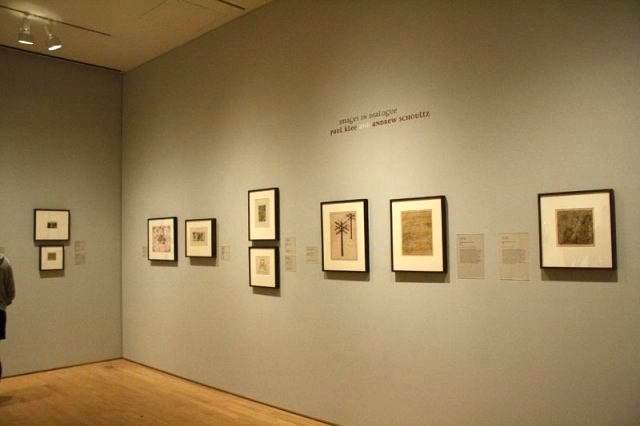 Partial installation of Images in Dialogue: Andrew Schoultz and Paul Klee. Flickr photograph by My Love For You.
 Three Crying Horses (acrylic and ink on paper) by Andrew Schoultz, 2011. Photograph by Marx & Zavattero.
 Untitled (Telephone Poles) (acrylic and ink on paper) by Andrew Schoultz, 2011.
 Detail of Dark Horse Apocalypse by Andrew Schoultz, 2011. Flickr photograph by My Love For You.
 Installation photo of works by Paul Klee and Andrew Schoultz. Flickr photograph by My Love For You.
 Juggler in April by Paul Klee, 1928. Flickr photograph by My Love For You.
 Detail of Broken Bridge by Andrew Schoutz, 2011. Flickr photograph by My Love For You.
 Large Beast by Paul Klee, 1928 and Three Caged Beasts by Andrew Schoultz, 2011.
 Three Caged Beasts (acrylic and ink on paper) by Andrew Schoultz, 2011.
 Detail of Cloud City (acrylic and ink on paper) by Andrew Schoultz, 2011. Flickr photograph by My Love For You.


