Franki Elliot

Miss in Polish

by Franki Elliot

My grandma can’t tell you my name
but she knows I live in Chicago.

She knows I have a brother,
and he lives in Chicago too.

She adjusts her hospital gown and says,
“You tell them I’m not ready.
I’ll show them.
I’m gonna live another couple years.”

You drove me all the way there,
through washed up towns and stretches of oil refineries.
Wore a nice sweater and shiny shoes even though my family
isn’t the kind you have to impress.

I liked that.
It made me feel safe.
It made me feel like I meant something to someone.

Sitting in the waiting room reading
as strangers whispered grimly into telephones,
you said, “This is the perfect book but man,
is it miserable in here.”

When I go back, the hospital room is freezing and
the doctor stands with a clipboard,
asks her what day is her birthday.

She said she knows there is a four in there somewhere.
I know it because it’s the same birthday as Hitler.
I don’t think she knows that. I hope she doesn’t know that.

And my grandpa has never held my hand
before until today. He has tears quietly running down his
cheeks when he says, “How’s the violin, ponnie?
Still playing?”

***

Franki Elliot is a twenty-something author from Chicago. Originally self published, Piano Rats sold out of it’s first printing quickly and was soon picked up by Curbside Splendor for an October 2011 release. This is her first book. Franki’s favorite artist Shawn Stucky provided the cover art and book design.

http://curbsidesplendor.com/index.php?id=206

www.pianorats.com

Andreas Economakis

Athens Street (©2012 Andreas Economakis)

“Ela Re Malaka”

by Andreas Economakis


I awake suddenly from a deep and catatonic sleep. In a dream that quickly flutters away, I am pinned underneath a bulky red Lancia, desperately trying to lift it off of me. At the wheel is a gel-haired dude, smiling and oblivious to my predicament. Every time I manage to lift the car a bit, Gel-dude honks and the Lancia gets heavier. To make matters worse, the car horn sounds like a new age Vangelis ditty. Panic seizes me. That’s when the ground starts shaking, like there’s an earthquake.

Trumpets are blaring in my head and a tremendous pressure is weighing me down. It feels as if someone is sitting on me, blasting air-horns and juggling anvils. What the…? I open my eyes and notice that my cat Rufus is busy cleaning himself on my chest. That explains the juggling anvil earthquake. With his wet paw smoothing his forehead, he looks a little like the Gel-dude.

The horns continue blasting outside. What in tarnation is going on? Has Panathinaikos just won a match against Olympiakos? I live so close to Panathinaikos’ football stadium that riot-police often park their blue steel-cage buses on my side street when there’s a game. Bewildered, I look at the clock. 7:45AM. It can’t be a soccer match. Besides, I don’t hear any tear-gas canisters clanking against the pavement or bricks thumping on riot policemen’s plastic shields.

The honking continues. I shoo the cat off, ready to tackle the day like a bona fide Athenian. First on my list of things to do is find the cretin who’s honking the car horn and give him five fingers. No, ten! I peel the covers away, ready for battle. Bad mistake. I am greeted by an unbelievable blast of cold air, the kind of polar cold that frostbites all your extremities and freezes your lips together into a pucker. I gasp for breath, the wind literally knocked out of me. A notorious bareback sleeper, I quickly scurry into my clothes, layering them on like an attack-dog dummy. The horns outside keep sounding like there’s an air raid at hand. I cringe and waddle over to the radiator. Ice cold. Just then I remember that my apartment doesn’t have autonomous heating. This is true of most pre-‘90’s apartments in Athens. There is one boiler for everyone in the building and it is turned on whenever the building manager sees fit, which is generally for a couple of hours in the evening. Mornings are radiator free, the philosophy here that people will either sleep in late or bolt for work fast. It doesn’t matter if it is colder than Minsk outside, rules are rules. My apartment building is no different, with one slight exception. Strangely, the heat also goes on between 1 and 2 PM. I soon find out that this is the magical hour in my building when the young folk wake up and the old folk take their afternoon nap.

I pull my ski cap over my bedhead and turn on the thermosifonas (hot-water heater) to take a shower. At my dad’s place I learned that you must turn it on only when you intend to use it. The thermosifonas consumes egregious amounts of electricity and electricity does not come cheap in Greece. I’ll always remember my dad’s expression of horror when he got the electric bill after I’d spent a month at his place a couple of years back. I had left the thermosifonas running the whole time, accustomed like a good American to taking a hot shower whenever I damn well pleased. Only after seeing this bill did it finally make sense why the power switch to the hot water heater is clearly labeled in every Athenian apartment. And I thought it was because the pansies were worried about getting electrocuted while showering.

Highly irked by the honking, I step out onto my balcony and peer over the edge to the tiny street below. A middle-aged man in a suit looks up at me. He’s standing next to his blocked Nissan Micra, his right hand jabbing the horn trough an open window. His face is a portrait of anger, frustration and righteousness. It’s the car-honking cretin.

“Ela re malaka! Vgale to aftokinito sou apo edo gia na figo. Kornaro 10 lepta, gamo ton Christo mou!” (“Come on you masturbator! (sic. asshole). Move your car so I can get out. I’ve been honking for 10 minutes, fuck my Christ!”) he yells up at me, waving a hand that’s holding a cigarette. (A note to the readers: calling someone a masturbator or asshole in Greece isn’t necessarily an insult. It falls in the same category as “dude” if properly intoned. This guy however definitely just called me an asshole. And it isn’t even 8AM.)

“Who are you calling a masturbator, you masturbator! It’s not mine, that stupid Lancia!” I yell back, hand poised, ready to flip him five fingers. This guy is really frazzling my geraniums.

“Ah, signomi re file! Mipos xeris pianou ine?” he responds with a goofy smile, his tone noticeably friendlier. I look around for a bucket of water.

“No, I have no idea whose it is. But Jesus, can you honk a little louder, please? They can’t hear you in Kabul.” I respond, blood boiling.

“What do you want me to do, buddy? It’s not my fault!” he yells back, leaning on his horn once more and exhaling a stream of curses and smoke into the air.

Steamed, I reenter my frozen apartment. I feel hot. Getting into a shouting match first thing in the morning does the trick. Maybe this is how the locals keep themselves warm in the winter.

While brewing coffee, I get to thinking about the Lancia incident and the chaotic car scene in Athens in general. It’s a classic Greek problem, with deep roots. See, most of modern Athens was built without an urban plan. That is to say, after the dark ages of Turkish and colonial occupation and the mass repatriation of Greek refugees fleeing the Asia Minor Catastrophe in the 1920’s, everyone and their cousin built their apartment buildings wherever they could, generally leaving nothing more than a donkey-cart path below. The government just wasn’t strong enough to control the rabidly anti-authoritarian Greeks who wanted to build wherever a shovel could strike dirt. This was particularly true in the populist second half of the 1900’s. Needless to say, throughout this crazy building boom in Athens, donkey parking spaces, garages and wide streets were never considered. No one could afford donkeys or cars anyway and living space was far more important. Besides, the small village footpath was all most people knew. Not unlike the rest of medieval Europe really. The only difference is that the Middle Ages were long gone elsewhere in Europe, replaced by the Renaissance and the 20th Century. Not so in Greece. You would think that this free-for all building mentality would change once Greeks started getting more affluent and could afford cars and garages. Wrong. Renaissance, or rebirth, is just a word in the Greek vocabulary, not an action or period of time.

Every Greek I know subscribes to the philosophy that you can fit one more straw on the camel’s back, no matter how loaded up the poor beast is. If you can’t find a parking space on the road, park it on the sidewalk. If you can’t find a spot on the sidewalk, double or triple park. Many people go a step further, illegally saving a space on the street in front of their store or house with whatever object they can find (chairs, garbage bins, flower pots or the merchandise from their store). No one worries that the cops will do anything about this, because they don’t. Even fools know that cops don’t enforce the law in Greece. And when -on the rare odd occasion- they do, then everyone has a “friend” or “relative” in public service who will make the ticket or fine “go away.” Finally, because the streets are so small, many people buy a smaller second or third car or a motorcycle just for the city. Greece has the smallest cars and greatest number of motorcycles in the world because it has the smallest streets in the world.

To confound matters -and spurred no doubt by the government’s own megalomania, corruption and mind-boggling nepotism- upwardly mobile nouveaux riche Greeks have run out in droves and bought enormous cars. Desperate to show their newfound wealth, these Armani-Exchange small penis types are content to spend hours in bumper-to-bumper traffic, polluting the air and clogging the lanes. They are also fine with squeezing their Abrams-sized vehicles down medieval alleyways, destroying all side-mirrors in their path. After all, a Land Rover is a Land Rover, even if it is scratched and has no side-mirrors. Stand back and admire my size, you poor sods!

Embarrassed by the government-toppling extent of traffic in central Athens, the authorities have tried repeatedly to solve the problem. They have done this in four ways, all without success. First, they have levied huge taxes on automobiles, especially on big, luxury cars. Instead of scaring people away, this taxation has had the opposite effect on the nouveaux riche. Almost as if excited by this rise in prices, these perfumed materialists have run out and unloaded every last penny on these overpriced cars in order to parade the fact that they have the clout. Many are the stories of families with 2 Porsches and a SUV that live in hovels and sleep on blow-up mattresses. In Greece the automobile is the undisputed heavyweight status symbol of choice, followed closely by the Rolex watch, the ring-side table at a posh night club, the summer vacation to Mykonos and the ubiquitous powerboat, moored as close to Athens as possible for everyone to see.

In its second attempt to deal with the crisis, the government has passed strict odds-evens regulations in Athens, in a ring around the center of town otherwise known as the “Daktylios.” In the Daktylios, cars ending in odd numbers can only circulate on odd days and so forth. If you are caught, get set for a hefty 200 Euro fine. Leave it to the Greeks to figure out a way around this restriction too! In fact, the government’s crafty plan has backfired horribly. What the bureaucrats didn’t count on was that everyone would rush out and buy a second car, with a different ending license plate number, of course. Now more cars than ever clog the streets of Athens and finding a parking spot is like hitting the lottery. And so the double and triple-parked cars on the streets. As if by universal accord, if a blocked car needs to get out, it honks incessantly until the occupant of the offending car hears him from whatever neighboring apartment building he is in. This can take a long time and grate one’s nerves to pulp, but people don’t seem to mind.

In its third attempt at solving the traffic and parking crisis, the government has excavated the streets and built bunches of new parking lots all over Athens. To a foreigner, this seems like a pretty darn good solution to the parking problem. Does it work? No. The reason for this is multifold. Firstly, no matter how clueless a Greek person might be, he’s definitely no sucker when it comes to money. Even the richest Greek will be a penny-pincher when it comes to certain types of spending. I’m not sure if this is a left over from the Dark Ages when my Greek forefathers had to eat fried dirt and pickled thistles to survive, but your average Greek will not drop a cent into something he thinks he can get for free. Paying for parking falls into this category. Paying for parking is for losers. (An exception to this rule is when your nouveau riche Greek goes out clubbing in his fancy car, paying dearly for parking directly in front of the club). There is simply no way in hell Dimitrakis and Fofi will park their new Yaris in a pay parking lot when they can circle the block 30 times and eventually park on the sidewalk. Even if it is illegal, it is far better to risk a possible (albeit unlikely) fine than to pay a certain parking fee. Let the pedestrians use the streets if they need to walk. They don’t matter anyway, they’re pedestrians for crying out loud!

And for those of you who suggest that law enforcement of parking regulations would help curb the sidewalk parkers, think again. The very last people in Greece who enforce the laws are the cops. They are the most visible and ironic part of the anti-authoritarian culture that keeps Greece running like a rusty Citroen 2-CV. Cops in Athens rarely ticket illegally parked vehicles. They only target specific high-profile blocks downtown, where rich politicians and well-connected ship-owners live and work.

One more thing. It is every Greek’s god-given right to park directly in front of his destination. Heaven-forbid if Efthimakis has to walk more than a few meters to where he is going. Aside from risking a certain heart attack on account of the nonstop cigarette smoking, he might throw an atrophied muscle and wear down his new Gucci loafers. And if he parks in the parking lot no one will see and admire his brand new Kompressor. I saw this happen a couple of months ago on Skoufa Street, in the posh downtown shopping district of Kolonaki. A fat man smoking a cigar and looking like he had one foot in the grave (health wise) held up traffic for 20 minutes as he tried to maneuver his big, shiny silver-blue X-5 4×4 onto a bus-loading zone sidewalk, in front of a church where a wedding was taking place. Not only did all the waiting bus passengers have to step into the street to accommodate the fat bastard, the bus itself couldn’t fit down the street when it finally arrived. Only after the bus honked incessantly did cigar-man finally exit the church, cursing and annoyed as hell at the bus driver for wrecking his cool. A 10-minute chest-pounding argument ensued between the bus driver and the fat bastard, cut short only by the symphony of car horns behind the bus and an embarrassed groom intervening. I’ve come to believe that illegal parking is as much a part of the Greek psyche as is night clubbing and chain smoking.

In its fourth and final attempt to curb the traffic problem in Athens, the government has set about creating new highways and extending the metro line. These seem like smart solutions, but they too have backfired. On the short-term, these public works have grievously exacerbated the traffic problem in the city as countless trucks and piles of dirt impede virtually everything that moves. On the long term, the beneficial effects of the metro are cancelled out, paradoxically, by the new roads. Now that Dimitrakis and Fofi can take their Yaris on the super-duper new German roads into town, they wouldn’t be caught dead in the metro. After all, the metro is for the unfortunate who cannot afford cars.

Almost as if they intended to add salt to their wounds, the incompetent government bureaucrats have encouraged the banks to provide low-interest car loans to virtually every mammal with an opposable thumb in Greece. Even more paradoxical, the government always lowers the automobile taxes right before elections, in a criminally obvious attempt to sway voters. Greece has to withstand a car-buying explosion every 4 years, further clogging the already suffocating streets. They call this progress. Truth is, the guy in the Kompressor does feel 100% more important and better off today, even if he’s spending 17 hours a day trapped in heart-stopping traffic. The paradox.

The situation is pretty hopeless. There isn’t a single Athenian who doesn’t list traffic congestion as the greatest problem afflicting Athens today. Nary a day goes by that the traffic problem isn’t the focus of every single TV channel in the evening news. My favorite is ALTER TV, a fun, yellow press station on the verge of bankruptcy that plays anthemic music over its broadcasts and has a hilarious muckraking mono-brow anchorman. Mono-brow loves to incite people, especially those trapped in their cars when they are stuck in bottleneck traffic.

Scene: Split-screen. Monobrow in the studio stares at us from one of the screens. On the other, an ALTER-TV reporter walks up to a shiny Jeep Wrangler stuck in traffic. Cameras are rolling live, with Mahler blaring in the background. The driver rolls down his window, angrily, and stares at the reporter.

Reporter: “Sir, how long have you been stuck in your car?”

Driver: “An hour and 15 minutes!”

Reporter: “And how far have you traveled in this time?”

Driver: “Three blocks!!”

Reporter: “Really? What does it feel like?”

Driver: “Grrrrrrr!!! What do you think?”

Mono-brow: “Excuse me Sotiris, allow me to intervene. Sir, Mono-brow from the studio. The question at hand, is this: Is the government to blame?”

Driver: “Of course it’s the government’s fault, the good for nothing bureaucrats in their traffic-clogging Nazi limousines!”

Mono-brow: “Does this justify the boys of November 17 or The Cells of Fire?” (homegrown terrorist groups)

Driver: “You damn right it does! After all, it’s all the Americans’ fault. Why if I had a rocket propelled grenade, I’d…”

Ahem.

–Andreas Economakis

This story is a segment from the author’s book: The Greek Paradox.

Copyright © 2012, Andreas Economakis. All rights reserved.

For more stories by Andreas Economakis click on the author’s name below.

Andrew Schoultz and Paul Klee at SFMOMA

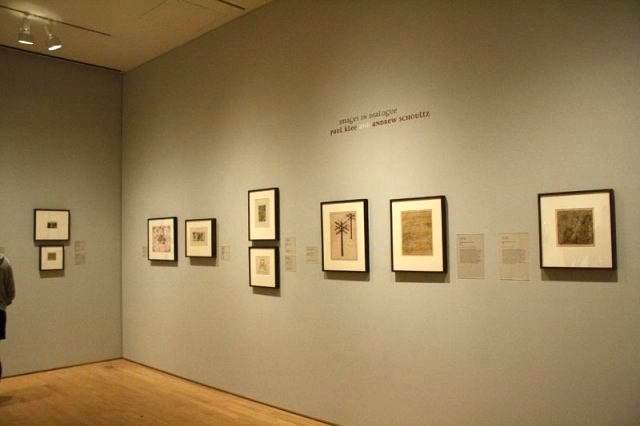
Partial installation of Images in Dialogue: Andrew Schoultz and Paul Klee. Flickr photograph by My Love For You.

ANDREW SCHOULTZ AND PAUL KLEE AT SFMOMA

by Matt Gonzalez

Today closes an important exhibition at the San Francisco Museum of Modern Art (SFMOMA) pairing two artists, born roughly one hundred years apart. Artists Andrew Schoultz and Paul Klee exhibit side-by-side in the second floor gallery normally reserved exclusively for works by Klee from the Carl Djerassi Collection, in the exhibition Images in Dialogue: Andrew Schoultz and Paul Klee.

Three Crying Horses (acrylic and ink on paper) by Andrew Schoultz, 2011. Photograph by Marx & Zavattero.

Curated by John Zarobell, who until recently was an assistant curator of collections, exhibitions, and commissions at SFMOMA, the exhibition has been an opportunity to reengage with Klee works on view by the San Francisco public over the years, with the intent to present them in a new light, through the juxtaposition with contemporary artist Andrew Schoultz. Both artists’ works contain strong narrative elements, though nondescript to the extent that they invite viewers to imagine their own storylines; so the pairing offers a chance to see the effect each has on the other.

Swiss-German Paul Klee (1879-1940) is a renowned artist within the early 20th century expressionist group The Blue Rider. Painter, draughtsman, and printmaker (working with etching, drypoint, and lithography), Klee taught at the Bauhaus, lecturing on ideas about color and abstraction.

Old Man Reckoning by Paul Klee, 1929. Photograph SFMOMA.

Andrew Schoultz (1975-) is a native of Milwaukee, Wisconsin, who has resided in San Francisco, California, for over a decade. He is an internationally-known artist, well-known in contemporary circles, whose work is rooted in political concerns. Lauded for its versatility, his work ranges from large murals (most recently at Art Basel Miami) to smaller pieces, highlighting Schoultz’s tendency toward fine detail and adroit use of ink, acrylic, and collage.

Untitled (Telephone Poles) (acrylic and ink on paper) by Andrew Schoultz, 2011.

John Zarobell, Assistant Professor and Department Chair of European Studies at the University of San Francisco, conceptualized the show. Under Zarobell’s direction, Schoultz viewed the entire Klee collection in the SFMOMA’s holdings, approximately 100 pieces, and selected twenty that particularly moved him and which he felt could inspire new works. Zarobell subsequently selected nine of the new Schoultz drawings he believed worked best in concert between the two artists, and presents them in conjunction with Schoultz’s gallery, Marx & Zavaretto, in the Djerassi Gallery.

It should first be noted that the comparisons are not literal. Schoultz did not attempt to render what Klee had already done. Rather he uses Klee’s pieces to explore his own oeuvre of images and allows them to be obliquely informed or influenced by Klee.

To be sure, the exhibit is not a conversation between artists either, as Klee cannot respond to Schoultz’s work, but it does present a re-invigoration of the Klee collection and encourages Schoultz to go in directions he might not have otherwise. Zarobell stands in for Klee, as an editor having selected nine of the fifteen works Schoultz made during this project, and in that way, while it’s not Klee himself, the artist does have an indirect say in the pairings. Ultimately, the works themselves must be the focal point.

Detail of Dark Horse Apocalypse by Andrew Schoultz, 2011. Flickr photograph by My Love For You.

Klee is primarily known for the pictorial symbolism he used in his small, idiosyncratic, and playful works. He lived during one of the most tumultuous periods in Germany, yet always seemed somewhat distanced from and aloof to surrounding political circumstances. He did participate briefly in a revolutionary art council during the fleeting German communist government of 1918, but otherwise his political activism is not generally highlighted. Even his inclusion in the famed Nazi degenerate art show of 1937, while he lived in exile, seems more a product of his adherence to modernist aesthetics than it did to any narratives professing political allegiances or ideals.

In parallel, Klee’s work reads more political standing next to Schoultz. Rather than just the playful little drawing of marionettes we are accustomed to expect, one sees an artist informed by an apocalyptic image of the world and its future. Schoultz’s adjacency enlivens Klee’s political statement, by contextualizing it among Schoultz’s more visually powerful artworks which project turmoil and chaos. Now the subtle unfinished structure with ladders seems a remnant of battle or destruction of some kind. What would have otherwise simply been a device in which to place figures, even a whimsical one, is understood by the clear messages of upheaval that Schoutz’s own work more directly conveys.

Installation photo of works by Paul Klee and Andrew Schoultz. Flickr photograph by My Love For You.

Juggler in April by Paul Klee, 1928. Flickr photograph by My Love For You.

Detail of Broken Bridge by Andrew Schoutz, 2011. Flickr photograph by My Love For You.

Andrew Schoultz’s work, on the other hand, paints a world nearly always devoid of people. Riderless war horses, carrying banners, run amidst flying arrows. Tornados and whirlwinds throw bits of money around as if it were confetti. An all-seeing eye, the Eye of Providence, is now rendered as a seer ominously letting you know that your actions are chronicled, and become historic. Broken bridges and barren telephone poles suggest an environment that is desolate and wasted, setting the stage for a post-apocalyptic moment.

Unlike Klee, Schoultz has always been seriously engaged politically, living the life of someone who comes from and chronicles the challenges of the American experience in the last quarter of the 20th century and the beginning of the 21st century. From the recent economic collapse to the death of industrial cities and the loss of jobs, Schoultz’s adult life has witnessed a nearly constant presence of undeclared American wars on various continents and growing corporate greed that has endangered human beings and the environment. His work, often masked by bright festive colors, warns of, if not directly predicts, the coming desolation.

Large Beast by Paul Klee, 1928 and Three Caged Beasts by Andrew Schoultz, 2011.

Detail of Large Beast by Paul Klee, 1928. Flickr photograph by My Love For You.

Three Caged Beasts (acrylic and ink on paper) by Andrew Schoultz, 2011.

As a result of the pairing with Klee, Schoultz’s work takes on a clearer narrative quality and broadens the historic prospective of his work. Schoultz often cites the Nuremburg Chronicle (1493) as an influence. The Chronicle was an early book that paired typography with hundreds of images retelling the story of the world, contextualized in part by the Bible. Schoultz’s canvas generally seems to be a chronicle of the future. Part warning, part prediction, that globalization will render the world people-less, although also hinting toward some future existence where Nature may persevere.

Mostly, Klee’s work has the effect of emphasizing the cyclical nature of Schoultz’s historical chronicle. Rather than give off solely a future impression, standing next to the older images, particularly the yellowing of Klee’s paper, reveals that Schoultz’s work is not just one forecasting our future, but one that has been repeated throughout history. Embedded in these images is a narrative opposed to war and Wall Street greed. But now it isn’t limited to late 20th century globalization. With Klee along-side his work, Schultz’s chronicle now begins at a much earlier moment in history and is as much about the past as it is the future.

Detail of Cloud City (acrylic and ink on paper) by Andrew Schoultz, 2011. Flickr photograph by My Love For You.

Klee, whose playful images abound, also strengthens an alternative reading of Schoultz’s work, allowing it to convey less desolation. There is a “look here” quality, as the viewer enjoys finding some occurrence: dancing tigers, or even horses in a kind of funnel of energy that might otherwise intuit more ominous. Something about sharing space with Klee allows war horses to be reinterpreted as horses on a carousel; the broken bridge to be an invitation to work or build something anew without necessarily revealing what caused the devastation. Also, the absence of humans depicted in Schoultz’s work is now populated by Klee’s people, who can easily walk, in this small gallery, from one canvas to another. Klee, it can be said, emphasizes Schoultz’s playfulness, which is doubtless already present in the work.

Ultimately, this pairing works, not because of a conversation between artists or because of commentary by one artist, but because the viewer sees each artist anew. The show is a way for Schoultz to showcase his vision, and when juxtaposed against Klee’s, the world he paints comes into focus and the breadth of his chronicle becomes apparent.

Just as the SFMOMA show reaches its end, Schoultz has embarked on his next public project “the Boneyard Project” organized by Eric Firestone in Tucson, Arizona. A select number of artists, Schoultz included, are currently painting air planes and exploring their cultural significance while applying their graffiti and mural practice to this uncommon canvas. The show opens at the Pima Air & Space Museum on January 28, 2012. Specifically, Schoultz’s assignment is to paint an old spy plane. Coincidentally, Klee too once painted war planes during World War I. He camouflaged them.

Images in Dialogue: Andrew Schoultz and Paul Klee, curated by John Zarobell. Exhibition runs: August 13, 2011 to January 8, 2012. SFMOMA, 151 Third Street, San Francisco, CA.

NOTE: Curator John Zarobell says that the idea to pair Klee’s work with a contemporary artist is not an original idea: “Six years ago, then-Curatorial Associate Tara McDowell worked with Simon Evans, who selected a show of Klee works from our holdings and added a piece of his own. In 2007 Apsara DiQuinzio paired drawings by Klee with those of Devendra Banhart, who had a long-standing fascination with the modern artist.”

SATURDAY POETRY SERIES PRESENTS: NICOLE STEINBERG

Nicole Steinberg’s collection of sonnets, Getting Lucky, was created using editorial copy from Lucky, a women’s style magazine. Each poem contains original text from an issue of Lucky and is named for a woman featured in that issue.

By Nicole Steinberg:

GETTING LUCKY WITH JAMIE

If you want to go a tiny bit hipster, here’s how:
Grab a romper and go to town on the all-natural train
from Jackson Heights to lower Manhattan; mask
any contempt for the matchy-matchy girls under
your straw fedora and un-meltable hair. Always
have Kate Moss’s precise address and phone
number at the ready; indulge in vanilla soft-serve
and run wild through dressing rooms, completely
guilt-free. Hide your arbitrary fears and Connecticut
weakness; call forth your tough, punk rock shine.
Stay pretty in the heat of the New York chill
you’ve dreamed of since you were a teenager, even
after you’re no longer new. Lick your black pearl lips,
telegraph a dose of danger. Let it come, dripping wet.


GETTING LUCKY WITH BECKI

Chances are you’re like me, a midsummer night’s
cowgirl. You smoldering petal, the sweetest
corsage, juicy bloom on the branch—I clutch
the cling of your loungewear, extract the spectrum
from your wafer heart. My preference is the pink
fruit of your cheek: its fancy stitch and classic
mascara smears; the scar, a striking solitaire.
The angelic décor of your hand seems simple,
ideal for rings and glinty bangles—I let it
make me happy. Cat-like nails: perfect, perfect.
For you I’m Michelle Pfeiffer cinched in a belt;
crazy stacked receptionist hung on a hook.
I’m an old-fashioned girl, all over your brow
and under your gown, constantly tied and tasting.


GETTING LUCKY WITH GEORGIA

Beneath the V-neck shirt, it’s all about a schoolgirl
spin; peer closely. The surface is gamine, library-ish—
you couldn’t find a sweeter-looking chanteuse,
preppy Marie Antoinette fresh out of the gardens
of Versailles. Slim cuffed khakis and studded
ballet slippers; thick, translucent frames over pale
quartz eyes; brass bullet hanging from a wispy chain:
officially the most fun thing in an long, long time.
Sumptuous, stormy, ultra-malleable—I didn’t know this
icy puppy could be so subversive. My vanilla rosette,
coquettish lightweight who never learned how to drive:
Skip the country club for bedhead and heavy metal;
flash an arresting stretch of shoulder. Get twisted and
wild in full-throttle red: the gleam of your lips, just-bitten.


(Today’s poems originally appeared in H_NGM_N and Lyre Lyre, and appear here today with the permission of the poet.)


Nicole Steinberg is the editor of the literary anthology Forgotten Borough: Writers Come to Terms with Queens, as well as an editor at large at LIT magazine. Her poetry has appeared in H_NGM_N, No Tell Motel, BOMB, Gulf Coast, and other publications. She is the author of Birds of Tokyo (Dancing Girl Press, 2011) and founder of Earshot, a NYC reading series. She currently lives in Philadelphia.

Editor’s Note: I recently saw Nicole Steinberg read at the Moonshot Magazine Holiday Party at Brooklyn’s own The Home Of. After the reading, when I asked my fellow audience members what they liked best, each and every one of them gave the same response. Nicole Steinberg was the clear audience favorite, and the words on everyone’s lips were Getting Lucky.

Steinberg’s reappropriated text functions as a telling commentary on modern American society and the gendered molds it imposes on women and girls. The counterculture revolution urged from within the controlled, sonnet form gives tongue-in-cheek nods to the norm while flipping the bird with glittery fingernails.

Want to see more by Nicole Steinberg?
H_NGM_N
Lyre Lyre
Wicked Alice
Gulf Coast
The Nepotist
Buy Birds of Tokyo
Buy Forgotten Borough: Writers Come to Terms with Queens

ECONOMIC STIMULUS FOR WHOM?

GOVERNMENT SPENDING TODAY IS DIFFERENT THAN IT WAS DURING THE 1930s and 1940s.


Paul Krugman wrote in his New Year’s Day column in the NY Times that “Nobody understands debt.”  He complained about the “wrong-headed, ill-informed obsession with debt” that characterizes the current Republican-controlled Congress and is a key element in contemporary conservative thought.

Krugman makes a number of arguments about why the debt is not as pressing a problem as Republicans assert, all of which are valid. Among these arguments are that interest rates have not increased with deficit spending during the Obama administration as conservative experts predicted, and debt is only likely to cause economic troubles when it grows more quickly than revenue from taxes. Krugman does concede that taxes impose some cost on the economy, though this cost is over-exaggerated by today’s “rapidly anti-tax” conservative movement.

At least for the U.S., the increase in sovereign debt is also not a particularly pressing issue:

It’s true that foreigners now hold large claims on the United States, including a fair amount of government debt. But every dollar’s worth of foreign claims on America is matched by 89 cents’ worth of U.S. claims on foreigners. And because foreigners tend to put their U.S. investments into safe, low-yield assets, America actually earns more from its assets abroad than it pays to foreign investors. If your image is of a nation that’s already deep in hock to the Chinese, you’ve been misinformed. Nor are we heading rapidly in that direction.

Contrary to the received wisdom that dominates today’s discussions about debt in both the U.S. and in Europe, Krugman gives us the example of Great Britain, which has historically been able to carry much higher debt-to-GDP ratios than in those countries that are today said to be in fiscal crisis because of their debts:

Britain, in particular, has had debt exceeding 100 percent of G.D.P. for 81 of the last 170 years. When Keynes was writing about the need to spend your way out of a depression, Britain was deeper in debt than any advanced nation today, with the exception of Japan.

Krugman’s argument in this column is meant to lend support to a fairly standard liberal Democratic/Keynesian line about what needs to be done to adequately address the current crisis. Stimulate the economy by increasing effective demand through increased government spending on goods and services. Additional debt incurred could be partially offset with tax increases, especially on the highest income earners; but more importantly, the economic stimulus created by government spending will create economic growth that, in the long run, will cause a sufficient rise in GDP to compensate for the growth in the debt.

There are good historical reasons to think that Krugman’s analysis makes more sense than Republican counter-arguments. In his Socialist Register 2011 article “The First Great Depression of the 21st Century,” Anwar Shaikh describes the American experience of the Great Depression of the 1930s as follows:

The Great Depression triggered by the stock market crash in 1929 led to a sharp fall in output and a sharp rise in unemployment from 1929 – 32. But over the next four years output grew by almost 50 per cent, the unemployment rate fell by a third and government spending grew by almost 40 per cent. Indeed, by 1936 output was growing at a phenomenal 13 per cent. The rub was that the federal budget went into deficits of almost 5 per cent over the same four years. So in 1937 the Roosevelt administration increased taxes and sharply cut back government spending. Real GDP promptly dropped, and unemployment rose once again. Recognizing its mistake, the government quickly reversed itself and substantially raised government spending and government deficits in 1938. By 1939 output was growing at 8 per cent. (pg. 55-56)

This cycle of phenomenal growth rates sparked by very high rates of government spending continued to escalate considerably over the next several years as the U.S. began its build-up for WWII in 1939, and entered the war in December of 1941.

But here Shaikh’s account of events begins to make some distinctions that are not to be found in the traditional Keynesian analysis. Shaikh emphasizes that during the New Deal and WWII:

the government spending involved did not just go towards the purchase of goods and services. It also went toward direct employment in the performance of public service. For instance, the Works Progress Administration (WPA) alone employed millions of people in public construction, in the arts, in teaching, and in support of the poor.

Shaikh highlights the importance of distinguishing between government spending on goods and services (thereby profiting business with the hope that this stimulus will “trickle down” to employment), and spending directly on employment (with workers’ wages then stimulating business by creating more effective demand from consumers).

The first scenario, the one which Keynes advocated, will only help to reduce unemployment and spur economic growth if businesses re-invest their profits in productive investments that create new jobs. The second scenario, however, is a direct and more certain way to reduce unemployment. And as workers necessarily spend most of their income on living expenses, their wages are less likely to be hoarded (or invested in ways that do not create jobs) than are business profits.

Let’s now return to an examination of the present crisis, and think about the situation not only from the point of view of government spending a la Keynes and Krugman, but also in light of the distinctions that Shaikh makes regarding the character of government debt.

http://en.wikipedia.org/wiki/File:USDebt.pngAs we can see from the charts above, the absolute size of the debt in inflation adjusted dollars slightly declined from its peak in the 1940s until the 1970s. After 1980 the Federal debt very dramatically increased from 1980 until the present day.

If we look at debt as a % of GDP, however, what we find is that relative size of debt dramatically decreased from the late 1940s until the 1970s, and has just as dramatically increased since 1980. During the last few years of economic crisis, the relative size of the debt is once again approaching the levels that it had attained during the peak years of spending during and immediately after WWII.

One thing that we must note is the astonishing fact that debt-to-GDP ratios consistently declined during the years that are often described as having been “Keynesian”, while those ratios increased during the years that we have been calling “neo-liberal.” In other words, government debt dramatically increased after the “Reagan Revolution” that claimed to be against Big Government.

http://en.wikipedia.org/wiki/File:US_Unemployment_measures.svg

If we look at the above chart based on Bureau of Labor Statistics data, what we will also see is that the new era of increased Federal debt has not, by any means, ushered in a new era of full employment. Since 2007 unemployment rates have been among the highest since the Great Depression. By way of contrast, during the era of high levels of government debt immediately after WWII, the U.S. had achieved near full employment.

One lesson that can be drawn from this is that it is not simply a matter of increasing government spending in order to create effective demand, as in the Keynesian model. Rather, government spending can have very different kinds of effects on the economy depending on the nature of the spending. For instance, as Shaikh indicates, there is a major difference between spending that simply makes the government a consumer of goods and services, and spending that directly creates employment.

In 1945 the Executive branch of the Federal Government directly employed 3.4 million civilians (employment by the Judicial and Legislative branches is negligible by comparison). By the early 2000s, that number stood at 1.8 million. During this same time frame, the population of the United States more than doubled. This is one of the key differences between government spending then and now. High levels of government spending today may indeed stimulate the economy, but a much higher ratio of this spending today winds up as a stimulus to corporate profits, rather than as the wages and salaries of the 99%.

At the end of the last Great Depression, it took a major World War in order for the Federal Government to unambiguously commit to policies that would generate economic growth that would benefit all classes in American society. It would not take a World War in order to achieve similar effects, what it would take is the re-orientation of government “toward direct employment in the performance of public service” (Shaikh). Let us hope that it does not take another World War to bring the First Great Depression of the 21st Century to an end.

The prospects for this kind of progressive change do not appear good given the current state of affairs within the American political system. If anything, the exact opposite trends seem to be in motion. President Obama announced plans earlier this week for a leaner military, increasing the Federal government’s focus on creating ever more efficient killing machines that require an ever decreasing amount of human labor to unleash their destructive potential.

It is high time for Americans to refuse to be a part of this upside-down system, and begin building one that is based on that satisfaction of human needs rather than on the pursuit of corporate profits.


SATURDAY POETRY SERIES PRESENTS: J. P. DANCING BEAR

NOT PERSEPHONE
By J. P. Dancing Bear

tonight you’re feeling a little vulturish: in your tuxedo: it’s not a pomegranate on your silver tray: and she’s not Persephone: but you offer it to her anyway: she is weary of the way the paring knife slides out of the wall: or how peeling painting of your ancestors: framed as they are: revert to feathers: the curtains cascade to a pool: ripple and sway: a staircase next to them: that has no beginning: play Miles Davis: cool and sublime: dancing her closer to a painting of steps: spiraling up and away: you ask if it’s okay: to call her by a mythical name: she hunches her shoulders: stares at the currents below: she got that look in her eye: the one that says I could make this work

                                                                                                                             for Seth Abramson


(Today’s poem originally appeared in The Medulla Review, and appears here today with permission from the poet.)


J. P. Dancing Bear is the author of nine collections of poetry, most recently, Inner Cities of Gulls (2010, Salmon Poetry), winner of a PEN Oakland-Josephine Miles National Literary Award. His forthcoming Family of Marsupial Centaurs will be released by Iris Press, and Fish Singing Foxes will be released by Salmon Poetry. His poems have been published in Mississippi Review, Natural Bridge, Poetry Kanto, Verse Daily and many other publications. He is editor for the American Poetry Journal and Dream Horse Press. Bear also hosts the weekly hour-long poetry show, Out of Our Minds, on the public station KKUP, also available as podcasts.

Editor’s Note: Today’s poem invites us to enter a scene where modernity and mythology dance in the light of cinematic prose. Phrase directs phrase and image forwards image so that we are audience to the intimacy between man and woman, tinted with seduction, danger, and promise.

Want to see more by and about J. P. Dancing Bear?
Buy Inner Cities of Gulls
Buy Conflicted Light
J. P. Dancing Bear’s Official Website (click on “poems” to see more work on line)
The American Poetry Journal
Dream Horse Press

From the Ashes: An Interview with John Guzlowski

Okla Elliott: In Lightning and Ashes, you make use of what seems like direct family sources (such as the poem “A Letter to my Mother from Poland, October 4, 1952”). What portion of these source materials is rooted in actual familial documents, what part from family lore, and what part poetic creation?

John Guzlowski: It’s a central question. When I started writing my poems about my parents back in the late 1970s, I was in grad school and very conscious of the ways memory can be manipulated and tricked out for various literary effects. My wife was working on rhetoric and the art of memory, and I was doing a dissertation on the postmodern sense of the self and how it plays out in fiction. One of the books I was writing about was Pynchon’s V., and one of my favorite quotes in that book came from what Pynchon said about Fausto Majistral and this character’s autobiographical writing. Here’s the quote:

“Now memory is a traitor: gilding, altering. The word is, in sad fact, meaningless, based as it is on the false assumption that identity is single, soul continuous. A man has no more right to set forth any self-memory as truth than to say ‘Maratt is a sour-mouthed University cynic’ or ‘Dnubietna is a liberal and madman.’”

The first poem I wrote about my parents is called “Dreams of Warsaw,” and it deals with their memories of the war and my own oldest childhood memories of my father’s telling me about the war. Right there, as the literary analyst I was training to be, I could see a lot of potential for complexity, layering, and manipulation of memory. There’s my parents’ years in the camps, my father’s retelling of that story, my mother’s retelling of that story, my childhood memories of their retellings, and then my adult attempt to place all of that within the context of my life and of course in the context of a poem.

Over the next 25 years, as I worked up the poems that went into Lightning and Ashes, I’ve had to deal with this nexus of memories, and it’s hard to say that there is a certain definite portion that is from actual family history, family lore, or my poetic creation. All three come together to varying degrees in various poems. There are some poems like “My Mother Reads My Poem “Cattle Train to Magdeburg’” that come almost completely from my mother’s telling in her own words about what actually happened. And the poem takes issue with my earlier poem “Cattle Train to Magdeburg” (based on my childhood memories of what my dad said about how she was taken to Germany by the Nazis) so that she in large part in “My Mother Reads” is trying to get at her own truth of what happened. When my mother read “Cattle Train to Magdeburg,” she told me what was wrong with my earlier poem, and I wrote it down. 90% of the poem is her words in English about her experience.

There’s very little that I did to the poem beyond breaking her statements into lines and stanzas and cutting out one significant detail from her telling that I thought would cause the reader to ask unnecessary questions about what happened to her.

That’s one extreme. The other is the poem that is essentially fiction. The prose poem you ask about—“A Letter to my Mother from Poland, October 4, 1952”—is not based on an actual letter. In fact, I never read any of the many letters written to my mother by her sister Sophie about what it was like in Poland for my Polish relatives after the war, after the Soviet takeover of Poland. I knew about these letters, of course.

As a child, I remember my mother receiving them. She was a private woman, and she could not share her grief with anyone. She would get these letters and take them into the bedroom and read them there, after closing the door. I would stand on the other side of the door sometimes and listen to her weeping as she read the letters about it was like in Poland after the war. I would beg her not to cry through the closed door. Toward the end of my mother’s life, when I would visit her to get her papers and things in order, I asked her where the letters were. I knew she had kept them and added new letters as they still occasionally came from Poland. I was shocked by her response to my question. She had destroyed them, all of the letters that came from her family in Poland.

The “Letter to My Mother from Poland” poem is my attempt to recreate one of these destroyed letters. The description of the hunger and poverty in the first stanza, the dreams of my grandmother who was raped and killed by the Nazis, the wish for reunion—all of that was invented for the letter, but the invention of course was never complete invention. My father would sometimes reference the letters when I was a child. He’d mention the poverty or the hunger or the loneliness of being separated from the family that my mother read about in these letters. These things were part of the truth of these letters, and I tried to get this truth into this poem and into the other poems I wrote about my parents.

There was a Polish writer named Jozef Mackiewicz who said that “Only the truth is interesting.” And I believe that, but the truth is sometimes hard to convey. Sometimes the truth has to get heated up (embellished, transformed, jazzed up).

For me, Tim O’Brien’s essay “How To Tell A True War Story” gets at something important about telling a war story. Sometimes the facts themselves just don’t convey the horror that you would hope they convey. Here’s an example: 50,000,000 people died in WWII. I can tell that fact to a hundred people, one after another, and they probably won’t react much, not emotionally at least, maybe not even intellectually. I need to tell them something more. I need to tell them about these dead people in a way that will carry the weight of 50,000,000. I need to tell about my mother and the letters she used to get from her sister and what they talked about, the death of their mother, the guilt they felt for being alive, the sense of emotional and physical hunger they were left with after the war, the yearning for some kind of spring that would give them peace from their memories.

I don’t know if this was what was actually in the letters my mother received, but it is the truth that they carried for her.

OE: Which sorts of historical or official documents have you used in your poetic exploration of the Holocaust, and how have you made use of them?

JG: Most of my poems are based on my parents’ stories of their experiences, but I’ve always been interested in history, especially the piece of history my parents experienced from the inside, and I’ve read a lot of histories of that period.

I can’t even begin to make a list of what I’ve read. Last month, I read Timothy Snyder’s Bloodlands: Europe between Hitler and Stalin. Currently, I’m reading David Stafford’s Endgame, 1945: The Missing Final Chapter of World War II. It’s a book about the last months of the war and the period just after that. It captures something my dad talked about, the political, military, and social chaos that existed at the end of the war. On my desk, I’ve also got a copy of Hedgepeth and Saidel’s Sexual Violence Against Jewish Women During the Holocaust. It’s the next book I’ll read.

I’ve also read memoirs written by slave laborers, Holocaust survivors, soldiers, civilians caught up in the war, UN directors of refugee camps, and refugees. One of the great things that has happened since Language of Mules, my first book about my parents, came out is that I’m hearing from people who were also, like my parents, Polish Catholic slave laborers in the concentration camps. These survivors write me to tell me about their experiences, and some have sent me pieces of their unpublished memoirs. I also hear from their children.

You ask how do I make use of these documents. I think primarily I use them to get a sense of the zeitgeist, the world my parents entered when they were taken to the camps, the world they entered after liberation. My parents at different times in my life told me a lot about their experiences in the war, but they couldn’t tell me everything. To understand their experiences, I need to know about the context of those experiences, what was going on around my mother and my father when they were young people in the camps. Histories and memoirs provide that some extent. Does this context get into the poems? I think not directly for the most part.

Where I see it play out is when I do a poetry reading. When I read a poem like my “Hunger in the Labor Camps,” for example, for an audience, I find myself using information from histories and memoirs to flesh out the poem. It’s a poem about what my dad ate in the camps and what living in the camps was like. The poem tries to stay pretty close to his experience, but I try to give my audience a sense of what was going in the larger camp around my father. I talk about how many calories a day a prisoner was given, the kind of work they were required to do, how many prisoners were in the camp, how many died each year from malnutrition or abuse, what it was like in the camps when the war ended.

I guess it’s like the poem tells one person’s story and the lead in to the poem provides the larger view of that story. Sometimes, however, things from my reading get into the poems. The memoirs, the published and the unpublished ones, are rich in detail, and the details occasionally find their way into the poems. In the “Hunger in the Labor Camps” poem, for instance, I have a list of things my dad tried to eat in the camp. Here’s the first part of the poem.

WHAT MY FATHER ATE

He ate what he couldn’t eat,
what his mother taught him not to:
brown grass, small chips of wood, the dirt
beneath his gray dark fingernails.
He ate the leaves off trees. He ate bark.
He ate the flies that tormented
the mules working in the fields.
He ate what would kill a man
in the normal course of his life:
leather buttons, cloth caps, anything
small enough to get into his mouth.
He ate roots. He ate newspaper.
In his slow clumsy hunger
he did what the birds did, picked
for oats or corn or any kind of seed
in the dry dung left by the cows.
And when there was nothing to eat
he’d search the ground for pebbles
and they would loosen his saliva
and he would swallow that.
And the other men did the same.

My father told me about some of these things, the seed, the bark, leather buttons; but some of the other things come from the memoirs. At the time, I was writing this poem, I was also reading an unpublished memoir of a woman who lived in Poland during the war and suffered tremendous hunger. She told of giving her children pebbles to suck on while she left them alone at home to search for food in the neighboring villages. Those pebbles got into the poem.

OE: I am almost embarrassed to ask this, since it seems such a cliche now, but it is also one of the central questions we ask in regard to Holocaust poetry. Adorno famously said to write poetry after Auschwitz is barbaric. To what extent is he right or wrong? And, perhaps more broadly, what are the difficulties of representation unique to Holocaust representation? How do they differ from, for example, representations of other human catastrophes?

JG: I’ve spent a long time thinking about what Adorno said, reading his words, reading the people who have read his words and decided to explain them, and I hope he forgives me for saying this, but I think that what he said was correct and yet foolish.

Yes, we should all accept that poetry and all art is barbaric after Auschwitz. Poetry and art cannot tell us what happened at Auschwitz. No poem I ever wrote can tell us what my parents’ experience were like. As my mother used to say, “You weren’t there.” But still I feel a need to write these poems and people tell me they need to hear them. And my mother recognized this. Even though she knew that there were things that I wouldn’t know about her experiences and that I could never capture what had happened, she felt that that little that I could tell was better than the nothing people would know if I didn’t write what I could. Before one poetry reading, she told me, “Tell them we weren’t the only ones.”
That’s my first response to Adorno’s dictum. My second is that poetry and art are necessary. If we look to history, all it can give us finally are the numbers, the facts. It’s poetry and art that bring the human voice into what happened in the past.

Finally, I hate to be a smart ass but Adorno himself didn’t stop writing after the Holocaust. Admittedly, he wasn’t a poet. He was something that many would consider even more marginal, a philosopher, and he wrote about subjects like aesthetic theory, composing for movies, the history of music.

About the second part of your question, about what is unique to the representation of the Holocaust, let me first say that what I write about is not the Holocaust. My parents were Polish Catholics. Terrible things happened to them during the war, but they were not Jews. Having said that, I think that those who write about the Holocaust have a responsibility to tell the truth. This may sound obvious, but I don’t think it is. There have been memoirists who have lied about their experiences (Jerzy Kosinski, WIlkominski, and Rosenblat come to mind). And there have been poets and novelists and film-makers that have misrepresented the Holocaust. What they’ve done is to try to find some positive message in the obscenity, madness, and death that is the Holocaust. Roberto Benigni’s Life is Beautiful is an example of this. Wanting to take something good out of the Holocaust, he creates a cartoon version that seems about six days long. I think doing so he commits a sin, and Adorno would probably see it that way. Benigni turns the Holocaust into entertainment.

OE: In recent scholarly efforts in Holocaust studies, there has been much discussion of “postmemory” (a term coined by Marianne Hirsch at Columbia University) — that is, attention is being given to the generation who came after Holocaust survivors (and in the larger field of trauma studies, the children of any trauma victim). Obviously, your work bears the mark of your parents’ traumatic experiences, but how would you say you have processed their experiences? To what degree and in what sense has trauma been transferred across generations? In what ways has it not been transferred (aside from the obvious non-transferal of their direct physical suffering)?

JG: Has trauma been transferred across generations? Absolutely. I grew up in a Chicago neighborhood of Poles and Jews and Ukrainians and Germans who had survived the war, men and women. They were the parents of the children I played with. Those parents like my parents had been damaged. Some showed the damage clearly, others not so much. But we as children saw and felt that damage.

Let me give you one example. There were two little girls who lived two doors away from me, There father had been in the concentration camps in Germany. He worked the 4 pm to midnight shift at a nearby factory. When he came home, he expected his children and his mother not to be there, not to be home. The mother would roust the kids up as it got closer to midnight and get them dressed and out the door before he got home. He didn’t want anybody in the house sleeping when he got home. He had some kind of fear that made him crazy about this. If he would find his kids and his wife at home when he got there, he would curse, beat them all, chase them out of the house. They could only return when he had fallen asleep. This was one family. There were many such families. There were fathers who stripped their kids naked and whipped them through the streets and mothers who smashed coffee pots across their kids’ faces.

There was violence and drunkness and madness in my neighborhood and in my house. My father was an alcoholic; my mother physically abused my sister. Not every day, but often enough. And all of this was somehow connected to the fact that they had gone through the camps and seen terrible things done. That old trauma and this new trauma were tied together, and all of it pressed against me.

How did I process this? That’s the story of my life. For years, I didn’t want to have anything to do with my parents and their memories and how all of that “camp shit” made a mess of their lives. I ran away from them and the world I grew up in. I didn’t want to know where I came from, what had happened to my parents or my friends, and I was pretty successful. Recently, on Facebook, I got back in touch with a college friend. When he looked at my info and my notes on FB, he was surprised by the poems I had about my parents and their experiences. He said he never knew they had been in the camps.

I didn’t start writing about my parents and their experiences until I was in my early 30s. That’s when I wrote my first poem about my parents, “Dreams of Warsaw, September 1939.” Before that, I wanted nothing to do with their trauma or what their trauma was doing to me. After that poem, I gradually started returning to those memories of my parents and their experiences. I started reading about Poland and the war too, and about the Poles who came to America. Maybe I couldn’t process what had happened to them before that. I don’t know. But I do know that for the last few years, all my writing and much of my energy has gone into thinking about my parents and writing about them and their experiences, and maybe what I’m trying to do is understand why my parents were the people they were when I knew them, understand too where all that drunkenness and abuse and weakness and confusion and sorrow and suffering my parents showed came from. I sometimes think that writing about my parents in the war is a way redeeming them, of making all that horrible stuff seem somehow heroic or at least explainable.

OE: Everyone is asked about their influences, but I wonder if you might talk about how different poets have influenced your work that deals with the Holocaust as opposed to those poets who have influenced your work on other subjects. What distinctions are their between these two groups of poetic influences? What overlaps and interplays?

JG: Let me start by saying that we don’t know who influences us until we start writing. Looking for influences is always an afterthought. I write a poem and then I look at it, and I ask myself, where did that shape and content come from, why does it look that way and why do I say the things I do. Before that the influences of course are there, but we don’t know who or what they are.

When I first started writing in college, I hadn’t read much poetry, or literature for that matter. Of course, I had taken some survey courses in British and American lit and was just starting to look around and think about the kinds of English courses I wanted to take. But I was writing already, and the writing I was doing was strongly influenced by the writers I was reading on my own, writers who weren’t being taught in anybody’s classes, the beat writers, Kerouac, Ginsberg, Ferlinghetti, Gregory Corso, and William Burroughs. I believed in what Kerouac called “Spontaneous Bop Prosody,” a free-flowing, improvisational style of writing that tries to take the writer to the essence of his experience, to the center of himself.

The poetry that came out of this was surreal, endless, obscure, and druggy. Let me give you a short example. This is a stanza from my long poem “38 Easy Steps to Carlyle’s Everlasting Yeah”:

And be a blue angelic tricycle
And be any martyr’s unused coffin
And be you or me – it doesn’t matter which
And write poems like Pablo Neruda does
And throw them into the street/into the wind

I wrote like this all through college, poems about submarines crashing into lidless suns, airplanes unzipping the sky, Christ coming back to earth and burning up people with his laser eyes. You get the picture.

Then I started grad school in 1973, and I stopped writing poetry for years. I was too busy reading everything I should have read as an undergrad and writing all those papers we had to write about things like “Time in the Novels of Robert Penn Warren,” “Shakespeare’s Use of the Contraction ‘T’is’ in Hamlet,” The Image of the Hill in William Faulkner’s Novels,” and “The Post-Modern Sense of Self in Pynchon’s V.”

In 1979, when I first started writing about my parents and their experiences in the war, I had pretty much forgotten the beats. The surreal, flowing inwardness I found in them wasn’t what I now found myself writing. My first poems about my parents (“Dreams of Warsaw,” “My Father’s Teeth,” “Cross of Polish Wood”) had the feel, for me, of fragmented sonnets. In grad school, one of the great revelations was the British metaphysical poets, especially Donne. Those early poems about my parents had some of that compressed, image-haunted sense that I loved in Donne.

As I wrote more poems about my parents, what I found in my writing was several of the writers I really grew to love in grad school were finding themselves into my poems. Robert Frost was there. Some of the longer poems (“Among Sleeping Strangers” and “Pieta in a Bombed Church”) use the long iambic pentameter lines Frost used in “Mending Wall” and “Birch Trees.” I liked the natural rhythm of his cadences and their ability to move a narrative along. I wanted to write poems that had a story-like quality to them and Frost really helped.

What also helped with the narrative drive of the poems was the folk songs I had listened to in college. Woody Guthrie especially. He can tell a terrific story in a very short space in an everyday language that I was also interested in. A lot of my poems were based on stories my parents told me, and I was always looking to capture their voices. My mother and father didn’t have much education. They weren’t educated people, and I wanted to use language that suggested a natural, unaffected quality. I think Marianne Moore said that she wanted to write poems that dogs and cats could understand. I was the same way, and I think it was the influence of Frost and Guthrie that showed me a way to do that.

And where were the beats in all of this? I think they gave me freedom. For me, the final essential lesson of the beats is about freedom. I don’t see Kerouac and Ferlinghetti and Ginsberg in my writing, in my lines and images, but I do feel them in the freedom that they gave me to write about my parents. I grew up thinking that my parents and all of their experiences were something to be avoided, stepped away from, that it was just “that camp shit” and “that alien shit” that I as an American shouldn’t concern myself with. Kerouac and Ferlinghetti and Ginsberg with their ethnic roots and outsider perspective gave me the freedom I needed to think and write about a foreign past that a lot of people don’t want to think and write about. And did I mention comic books as an influence?

OE: There are constant debates over how best to become a writer or improve oneself as a writer. I’m thinking of the neverending squabble over MFAs and PhDs in creative writing, but also of such ideas as the ones I have propagated among my students that they should all study abroad somewhere for a year in undergrad and take a wide range of courses such as anthropology, philosophy, and foreign literatures. What advice would you give to young writers today?

JG: I didn’t go through an MFA program in creative writing. In fact, I didn’t know that such programs existed when I was an undergrad in the late 1960s. I always assumed that the way to be a writer was the way I was doing it: by learning as much as possible about literature and books and by writing all the time. My friends who wrote felt the same. They read and wrote. Most of them didn’t even take the creative writing classes that were offered at the school I attended, the University of Illinois, Chicago. I read and wrote, and I also took those courses.

I had three very good and very different poets teaching those courses: Paul Carroll, John Frederick Nims, and Michael Anania. But their methods were much the same. On the first day of class, for example, Paul Carroll said, “Next time you come to class, bring 3-4 of your poems, and I’ll make copies of them, and we’ll talk about them.” That’s pretty much what happened. We didn’t get prompts, we didn’t revise. We workshopped for the whole semester. The grade was based on those poems we turned in that first week. It didn’t matter if those poems were good, bad, or indifferent. There was no revising!

What did I learn in those classes? I learned what Carroll, Nims, and Anania liked in the way of poetry, and I learned to listen to what other young writers were thinking about and writing about. I learned to like the company of writers. I learned that pretty well and wrote accordingly.

During my teaching career, a lot of the teaching I did was creative writing. I taught it for about 25 years, and I taught it in real-time classes and virtual, online classes. We had prompts and textbooks and workshops and revision, revision, revision. We talked about how to find subjects and how to be personal and how to shape a poem and how to bring music into a poem and how to revise, revise, revise. We also did a lot of conferencing. I met with each student about once every other week for a half hour to review his work.

So was my method a good method for getting young writers to write or was Carroll’s method a better method? I think it finally doesn’t matter. The important thing is to be reading and writing. Over the years, the best students I had were the ones who came into class with a lot of reading behind them. It didn’t matter if they were reading Dostoevsky or Dean Koontz or Donald Duck. In fact, the best writers were always the ones who were reading Dostoevsky And Dean Koontz And Donald Duck. The reading itself was important, and the writing was important as well, writing all the time, writing about everything, writing like writer’s block was just some hooey that no real writer ever believed in or thought about.

And you could always tell which students were reading and writing like that. They were the ones who were on fire. My advice then for young writers? Be on fire!

OE: There are lots of paths to becoming a writer, finding one’s materials, and so on. What educational or experiential endeavors would you advise young writers today to pursue? What sorts of attitudes toward their work or habits of mind ought they to develop?

JG: We all have our own stories, and a lot of becoming a writer involves discovering what our stories are. I came to writing my own story fairly late. I went to grad school and studied contemporary American fiction and got a PhD and spent years working on the sort of academic criticism and research that path requires. Looking back on all of that now, I can’t help but think that maybe an MFA program in creative writing would have served me well. Maybe it would have had me focusing on my own writing, my story, sooner.

But having said that, I start wondering what I would have missed by going into an MFA program instead of the sort of traditional program in English studies that did go into, the one that led me to a PhD. And what I would have missed is considerable. I may never have read Chaucer and Spenser and Dryden and Henry Vaughan and Samuel Johnson and the Bronte sisters and Emerson and Thoreau and Proust and Dostoevsky and Pushkin and Yeats and Henryk Sienkiewicz and Camus and Faulkner and Graham Greene and Toni Morrison and Isaac Bashevis Singer and Tim O’Brien.

I’m not saying that all of these writers make an appearance in every line and syllable of what I write, but they are there in some way because they and so many other writers have touched me and spoken to me and stuck with me in ways I can’t begin to describe or understand. But I do know this: Who I am as a writer in fact is a dialogue between me and all of the writers I’ve read. If I had gone into a program that emphasized writing over reading, I might not have read the writers I read, and the conversation that my writing represents might not have been what it is.

When I was still teaching creative writing, I could tell the difference between the students who wrote and read and the ones who were mainly focused on writing.

The students who were writers and not readers tended to have a single voice in their writing. Their own. That’s not to say they couldn’t write with another voice. They could and did. As their creative writing teacher, I would sometimes say, “Do a poem or a story in such and such a voice.” And they would, but there would be something mechanical about this. It would be an exercise, something external, not something internal.

You also asked about what kinds of experiential endeavors I would recommend. I honestly don’t think it matters. My first creative writing teacher, the poet Paul Carroll, said that you didn’t have to live in the gutter to write about it. And Henry James suggested something similar in his essay “The Art of Fiction.” He said a writer should be the kind of person “on whom nothing is lost.”And by this I think he meant that being a writer entailed cultivating certain habits of mind. Here’s how he described these habits: “The power to guess the unseen from the seen, to trace the implication of things, to judge the whole piece by the pattern, the condition of feeling life, in general, so completely that you are well on your way to knowing any particular corner of it–this cluster of gifts may almost be said to constitute experience, and they occur in country and in town, and in the most differing stages of education. If experience consists of impressions, it may be said that impressions are experience, just as (have we not seen it?) they are the very air we breathe.”

And how do you cultivate these habits? I think it finally comes down to writing. It’s the act that teaches us how to write.

SATURDAY POETRY SERIES PRESENTS: ERIN LYNDAL MARTIN

BECAUSE THERE WERE PINK PETALS ON THE FIRST OF MAY
By Erin Lyndal Martin

somewhere sometime I’ll say the last thing that I’ll ever say to you.

it makes me feel lonely now.     if I see your light on when I drive

home I’ll knock on your door with a box of pizza and a bottle of wine.

it’s the least I can do. that and staying silent during the game

shows, letting you whisper the answers to yourself like a liturgy. I

would like that. it would remind me why I love you.          and maybe I

would mention again how someone you didn’t know dreamed of you

dressing that way that you never dressed, not way back then, but how

you have stitched yourself to me now like pages in a book made from

yarn and cardboard where the letters are the height of knuckles


and I am reading this to you again over the din of classic rock and

law students comparing notes on esculpatory evidence and a little girl

in a striped shirt who is picking up littered cigarette boxes and I

think her father is going to tell her to stay away from them but

instead she rips off the proof of purchase so he can send it in to get

some reward or another, and then she is putting the box top under the

ashtray to keep the wind from blowing it away


and I am thinking that someone somewhere would be sad to see the way

you talk to me, jealous even, and how this line crooks like an

interstate is wiggling through whatever strange messiness we’re bound

for, awkward and jagged, the way the roads look on that old trucker’s

atlas you have where we spread it out on the whole sofa and point at

places we used to live and places we’ll go once we leave alabama and

the hackberry trees and the exoskeletons of palmetto bugs that litter

our floors


and I think you’ll still say beautiful things about me

not because I was beautiful, not all the time at least

but because that’s in your nature
and I will love you for it


the past few days while you’ve been away, I’ve thought about watering

your plants.

when you are really gone, I will take advantage of vertical space and

stack things up high in my inevitably small apartments because of you

and I will know that you are getting drunk and napping in stairwells,

or you are writing painful stories about old men who make their own

artifacts and swim out beyond the shore to leave them in a lake.


at night the am radio will toss and turn between collegiate sports and

conspiracy theories and scraps of donna summer will rain in like

confetti.        I didn’t think I could miss you. I didn’t think I

could not.


(Today’s poem previously appeared in The Offending Adam, and appears here today with permission from the poet.)

Erin Lyndal Martin is a poet, fiction writer, and music journalist. Her work has recently appeared in Guernica, InDigest, and Crowd. She is associate fiction editor for H_ngm_n and runs the music website Euterpe’s Notebook.

Editor’s Note: Today’s poem knows a future wound. Picks at said wound; will not let it settle. Today’s poem knows the heartache is in the details, that memory and foresight exist on one plane, that it is not time, but inevitability, that will get the better of exposed organs.

Want to see more by and about Erin Lyndal Martin?
SOFTBLOW
PANK
The Offending Adam

Gustavo Ramos Rivera

Gustavo Ramos Rivera, Sin titulo, oil on canvas, 48″ x 48″, 2011.

GUSTAVO RAMOS RIVERA AT ELINS/EAGLES-SMITH

by Matt Gonzalez

Since the early 1900s when Xavier Martinez settled in San Francisco, there have been many Mexican-born artists working in the region. Today the list includes Enrique Chagoya, Jet Martinez, Calixto Robles, Juvenal Acosta and Gustavo Ramos Rivera. Rivera (known as Ramos Rivera in Spanish) has been working in San Francisco the longest — over four decades — and is internationally known.

A native of Ciudad Acuña, Coahuila, Rivera has shown in many Bay Area venues, including Charles Campbell Gallery, John Berggruen, Smith Andersen Editions, Hackett-Freedman, and the San Jose Institute of Contemporary Art.

His second solo show at Elins/Eagles-Smith, “Gustavo Ramos Rivera: Paintings and Works on Paper,” runs through Saturday, Dec. 31. The show features eight large paintings, one a diptych measuring 7 by 7 feet, and a number of gum prints (a form of monotype) made while working at Atelier Tom Blaess in Bern, Switzerland, earlier this year.

Most art critics have noted Rivera’s Mexican or Latin American palette and place him in a lineage of painters whose work tries to  approximate the Mexican landscape, meaning, it is dominated with bright primary colors, particularly reds and yellows. But Rivera’s abstract work also belongs to a tradition of Bay Area painting among artists such as John Grillo, Richard Diebenkorn and Frank Lobdell.

The paintings at Elin/Eagles-Smith are composed over areas of compartmentalized color fields, with spontaneous brushwork and palette knife application that relies heavily on under-painting seeping through the top-coat of paint. It is coupled with a wandering line of paint as if Rivera is drawing with it, rendered straight out of the tube or with the pointed back end of a brush. This drawing work doesn’t seem confident or premeditated, rather it recalls the Surrealist efforts at automatic writing. In many places the resulting canvas looks as if Rivera is just scribbling, reminiscent of child’s play, suggesting further connections to the accident and scramble so critical in Dada and Surrealist aesthetics.

Nevertheless, Rivera’s finished canvases reveal a formalism that indicates a mature artist who both juxtaposes and combines intention with spontaneity.

Gustavo Ramos Rivera, Portal de Luz, oil on canvas, 60″ x 60″, 2005.

Rivera outlines forms on the canvas with black or other colors. The results are hardly recognizable. Sometimes you can see part of a cross, a wheel with spokes, a crescent moon shape on its side, or a desolate tree. But these symbols, which some have called a “personal hieroglyphics,” are so obliterated by the process of abstraction that the work can just as easily stand as non-objective. Yet some kind of landscape is strongly suggested in these works and the partial signage Rivera uses offers a glimpse into his subconscious.

The finished paintings look as if Joan Miró, Mark Rothko, and Cy Twombly collaboratively painted over Richard Diebenkorn’s Ocean Park series, with Rothko and Twombly taking turns with the final pass.

Installation photograph of Bulerías and Sin titulo at Elins/Eagles-Smith Gallery by Alan Bamberger, November 3, 2011.

Gustavo Ramos Rivera, detail of Bulerías, oil on canvas, 84″ x 85″, 2009.

The most impressive painting in the show is the diptych that measures 7 by 7 feet, titled Bulerías, which refers to the well-known rapid flamenco rhythm. Rivera sustains the composition despite a central vertical line separating the two canvases. The painting is comprised of separated color fields joined with lines and the collision of vibrant primary colors over black under-painting. Although non-objective, the work suggests the patterns of a dance movement or even a contraption of some kind, fully equipped with mechanized levers and extension cords.

It is worth noting that Rivera’s art-making of the 1960s was in a more traditional, figurative style of painting that depicted the human condition, in the manner of Jose Luis Cuevas and Francisco de Goya. Later, Rivera passed through a period where his palette was often darker, and merged his figurative work with abstraction. During this time he was preoccupied with texture and color experimentation. In those mid-career works, landscape emerged as a predominant element in the painting.

The work at Elins/Eagles-Smith features elements of obliterated symbols which hint at the earlier, transitionary period of Rivera’s work, where the fragmentary language now present took a more direct and recognizable form. These transitional paintings feature figurative elements and signage that directly reflect the landscape of Rivera’s birthplace. They include representations of the sun and moon, trees, festival banners, rivers, church steeples, crickets and dirt paths. These forms are often combined with a visionary poetic context, made up of dark and brooding images that emphasize the mythologist in him. Comparisons to the Surrealist work of Manolo Millares, Joan Ponç and Modest Cuixart, of the post-World War II Catalonia group, the Dau al Set, come to mind.

Gustavo Ramos Rivera, Arrecife, oil on canvas mounted on wood, 48″ x 48″, 2011.

In time, Rivera evolved into full abstraction in the tradition of Antoni Tàpies, also a founding member of the Dau al Set. Gestural, eschewing figuration, yet retaining formal elements in the work. These are the paintings on exhibit at Elins/Eagles-Smith.

By burying nearly indecipherable signs throughout the work, Rivera unconsciously references events and places in his life which ultimately withstand the artist’s turn to abstraction. The explicit figurative element have disappeared, but shapes remain: crosses, trees, and organic forms such as one might find in a Miró.

Like the Russian Futurist who believed zaum poetry had meaning because it used syllables of words to suggest them, Rivera is implying meaning through the obliteration of the image. Or like Franz Kline, who used a Bell-Opticon in the late 1940s to magnify drawings and thus understand how a part of a drawing could stand alone as a painting, Rivera’s painting gives little hint of its origin.

Regrettably, the current show does not include any of Rivera’s wood sculpture, which the gallery previously exhibited in 2009, and Ben Bamsey has referred to as “abstract totem poles.” Made from discarded wood scraps, tree limbs, broom handles, and milk cartons, they are fastened with nails and wire and painted in bright colors and sometimes even equipped with wheels.

But otherwise this is a perfect show.

As a boy Rivera fondly recalls being asked to paint a chair. His father presented him with brush and paint and let him go. There he discovered a love of covering something in paint. The walls of the family home became his next canvas. This current show presents decades of what is at its root a childish impulse to play. But it also conveys the artist’s very personal and individual relationship to the world. Rivera succeeds every time because he is pure of mind as he faces off with the canvas. He isn’t trying to paint something any more than he did when he painted his first chair. The painting is all self-expression.

SATURDAY POETRY SERIES PRESENTS: OMNIDAWN POETS: CYRUS CONSOLE

FROM THE ODICY
By Cyrus Console

What is it with you Tony you describe
Everything precisely as it was
Even the way you are nodding now
On your hands and knees, sort of touching
Your forehead to the floor. “Another’s back
Is one man’s element.” “Another’s heart

Is like a horse’s legs.” There is no quick
Way to another’s heart but through his back.
There were some things missing from my room
When I came in just now your pupils seemed
Vanishingly, as it were, large.
The elephant’s innumerable scars

Were all we ever talked about outdoors.
And when I broke my mind I shot myself
Mercifully permanent epistles
On temporary problems. Kind of sad.
And how is your internet ladyfriend, one of us asked
But Tony only shook his head


(Today’s selection is from The Odicy (Omnidawn, 2011), and appears here today with permission from the poet.)


Cyrus Console is author of The Odicy (Omnidawn 2011) and Brief Under Water (Burning Deck 2008). He teaches at the Kansas City Art Institute.

Editor’s Note: Read Cyrus Console’s The Odicy and you will be lead by Tony, the antihero of Console’s modern epic, on a journey in strict pentameters. On the other side you will emerge crusted over in sugar, modified by chemicals, in a world where color is not to be trusted. Akin to the aha moment at the conclusion of Planet of the Apes, you will at some point realize that this ineffectual hero is one of your own kind, that this world in which chemicals of warfare and chemicals of food are one and the same is the very real world in which you live.

A Note About the Omnidawn Series: Not long ago I attended a reading of Omnidawn-published poets at New York’s Poets House. The evening was filled with incredible talent and a palpable dedication to the craft of poetry that I wanted to share with you. I am honored that Omnidawn was willing to partner with me for this series, and am thankful to the poets who have agreed to share their work here so that I may help spread the word both about Omnidawn Publishing and about the talented writers they support. The Omnidawn Series here on As It Ought To Be has been extended one final week to include Cyrus Console, a poet that the series would not be complete without.

Want to read more by and about Cyrus Console?
Buy The Odicy from Omnidawn
Boston Review
pax americana
Octopus Magazine