“The New Era of Engaged Literature” By Okla Elliott

heartre

The New Era of Engaged Literature

by  Okla Elliott

When I was fourteen years old, I naively and ignorantly and perhaps over-seriously declared myself a Marxist. It was around this time that I also began considering myself a writer, though most of what I wrote sounded like quasi-plagiarized Bad Religion and Pixies lyrics. When I think back on that younger me whose main goals in life were to become a professional skateboarder and to save the world with his bad poetry, I feel a kind of wistful nostalgia; I also want to ruffle his hair and tell him to chill out a bit. That said, I can’t deny that in many ways those formative years are still with me and shape much of how I view literature today. Sure, I am no longer a Marxist (if in fact in my youthful ignorance I ever was), but rather a democratic socialist of the Bernie Sanders variety, but I sport a Black Flag tattoo that the fourteen-year-old me would be proud of, and I likewise have Simone de Beauvoir and Slavoj Žižek tattoos that the fourteen-year-old me would appreciate if he knew their work.

To be honest, my ignorance has likely been the guiding star for my literary development. Neither of my parents graduated high school, so when I made it to college, I had no idea how one went about becoming a writer. I ended up double-majoring in philosophy and German, double-minoring in French and religious studies, because I had somehow gotten it into my head that this was the way to become a writer. I also studied abroad to Germany and Poland in undergrad, another weird idea I had gotten into my ahead about how one becomes a writer. I remained highly political, preferring writers such as Gore Vidal over the aesthetes of the literary world. It wasn’t until I began my MFA in creative writing at Ohio State University that I learned politics and literature are frequently seen as opposing activities.

I have often half-joked that just as the rich don’t talk about money, American authors have tended not to talk about politics, since we’re members of the most powerful nation on Earth. The rich don’t talk about money, and the powerful don’t talk about politics. Authors in virtually every other nation are expected to incorporate politics into their work, however openly or obliquely. But I have seen this state of affairs in American literature change dramatically in the past handful of years (and of course there were notable exceptions beforehand). American writers are producing more of what Jean-Paul Sartre called “engaged literature,” and I couldn’t be more pleased to see this happening. As citizens of the most powerful nation on Earth, it’s about time we realized the rest of the world is out there and that our government’s decisions affect the lives of billions of people.

Putting aside my half-joke (which I don’t think is entirely empty) why else might American authors have had this tendency to avoid politics? There is one other key reason I see: rampant anti-intellectualism among Americans that reaches even into the corridors of universities, where our programs in creative writing are housed. One of my favorite professors during my own MFA referring to the scholars in the English department as “those pointy heads on the fourth floor” (the fourth floor being where their offices were). He said this several times in the years I was there, yet I never sensed an ounce of animosity in his words; it was merely a casual dismissal, and one that always got a chuckle of agreement from most of the students in the workshop. I have heard dozens of similar reports from other programs, with some even describing real dislike/distrust between the creative and scholarly factions within English departments. But I and many writers I’ve talked to feel this distaste for political thought and intellectual engagement in cultural issues is changing, at least among a sizable subset of us. The causes for this change are numerous, but having 9/11, the Iraq War, the 2008 collapse, and the unprecedented wealth inequality all hit us over the course of a decade or so are foremost among them.

Director of Ohio State University’s MFA program Michelle Herman said the following when I asked her about this trend:

In 28 years of teaching at Ohio State—and teaching through some pretty contentious election cycles, too—I cannot recall my graduate students (or the alumni of our graduate program, for that matter) injecting themselves quite so intensely into the whirl of political discourse.

Herman also has a theory as to why this might be happening at this point in history. She points out that “the ease of disseminating ideas, of moving from thought to ‘print’ (electronica) quickly enough for those thoughts to matter—or anyway to be heard” might have as much or more to do with this increase in political activity than some sweeping cultural change. I certainly agree that social media has played a huge and incalculably important role in such movements as Occupy Wall Street and the Bernie Sanders campaign, and I think Herman has accurately hit on that importance. This moment in history is saturated with the effects of online activity in ways we likely won’t understand for many years, if ever.

There are three main causes, to my mind, for the shift to more political engagement in American literature in the past decade or so. 1) Institutional changes at the level of grant-giving entities and universities. 2) A general awakening to political and international problems across the culture. 3) An increase in literary inclusion of marginalized people.
I’ll begin with and focus largely on the institutional changes, because they are so pervasive and more easily quantified.

Interestingly, just as the advent of MFA programs and therefore the age of craft in American literature aided in reducing the amount of politically oriented literature in this country, I argue that the advent of the PhD in creative writing is aiding in ushering in a new age of engaged literature—though without totally jettisoning what we learned from our decades in the craft trenches. How so? Well, as part of their course load, PhD candidates in creative writing also have to take scholarly courses that expose them to thinkers such as Walter Benjamin, Judith Butler, Fredric Jameson, Gayatri Spivak, and many others. They likewise receive introductions to the larger fields of disability studies, gender studies, trauma studies, and postcolonial studies. All of this means PhD candidates in creative writing receive at least a cursory knowledge—and in some cases an in-depth understanding—of major political and philosophical thinkers from around the world. This new hybrid degree is, in effect, creating a new hybrid category of creative writer, one that is interested in craft and social engagement in equal measure.

The other major institutional change that has helped bring about this new era of engaged literature in the United States is at the level of grant-funding entities. Obviously the events on 9/11 themselves were horrendous, as were the majority of the Bush administration’s reactions, but one interesting accidental byproduct of those events is that Americans were woken up and were forced to recognize that an outside world beyond the United States exists. There was a time when scholars were heavily funded to learn Russian and German, since those were languages of Soviet Russia and East Germany. In the years after 9/11, the US government pumped millions of dollars into the learning of Arabic, Korean, and Farsi—while still funding the study of Russian and Chinese at high levels. And in a kind of cultural trickle-down, universities have begun offering more courses in these languages and cultures.

Likewise, programs in translation were created, often connected to varying degrees with the MFA in creative writing program at the home university. Here are just some examples of recent translation programs added to major universities: University of Illinois added an MA and various certificate programs in translation in 2008; University of Maryland started an MA in translation in 2013; and University of Iowa, which already had an MFA in translation before this recent boom in such programs, has added an undergraduate certificate in global engagement via translation. This last one is especially salient for my point, since it overtly names engagement as part of its goal. And the list of new programs and journals focused on translation from around the world goes on and on. In 2015, even Amazon announced an investment of $10 million over the next five years in AmazonCrossing, its translation program founded in 2010. Since politics is heavily global in nature now, it is impossible to overestimate the importance of all these new programs and investments in terms of its effects on literature.

The gifts of translation for English-language literature are myriad: blank verse as a solution for translating unrhymed Latin verse, the sonnet and sestina forms from Italian, couplets from French, and, some have claimed, free verse from Chinese. I argue that the 21st-century gift translation can give is an understanding of how political and literary discourses may most profitably mix.

I also believe that the adjunct crisis has created increased awareness among writers. With nearly 70% of our courses now being taught by adjuncts, emerging writers are often working for criminally low wages and no benefits or job security. This newfound economic precariousness among many writers has forced the issue of economics and institutional policy into the lives of writers in a way that was not as pronounced in previous decades.
The change at the institutional level therefore originates from several sources, ranging from government funding to greater global awareness to the increasing need for more higher education in the form of PhDs in creative writing if one wants to pursue a career as a creative writer in academia. The causal lines here are sometimes direct and sometimes roundabout or even totally accidental.

As I mentioned earlier there have of course been numerous exceptions throughout American literary history: Erica Jong, Norman Mailer, W.S. Merwin, Joyce Carol Oates, Upton Sinclair, John Steinbeck, Gore Vidal, and Richard Wright, among others, and there were of course excellent organizations like Cave Canem before the time period I am discussing. I am therefore emphatically not claiming that this is an entirely new phenomenon, just that there is a notable increase in it. Interestingly, we find that the least powerful among us—minorities, women, and the impoverished—are often more likely to inject politics into their literary production. Here is where my third main reason for this change comes in. A more open acknowledgment of racist, sexist, and anti-LGBTQ practices in the literary industry, as well as the founding of groups such as VIDA to highlight and combat such practices, have brought more marginalized writers to the forefront of American literary culture, thus bringing a more politically engaged literature to the forefront as well.

Given the limited space I have here, I have focused largely on changes institutions and organizations and how those have caused a shift in the literary culture in the United States, but as mentioned earlier, there is a broader and more nebulous increase in interest caused by recent historical events, a topic worthy of an entire essay unto itself. But that, as they say, is a project for another time.

As so many great authors from here in the United States and around the world have proven, literature does not have to choose between being aesthetically pleasing or politically engaged, between being of the moment or achieving timelessness. Aristotle famously defined humanity in two ways: 1) Humans are political animals. 2) Humans are linguistic animals. I would argue that engaged literature which still keeps its eye on craft brings these two definitions into enjoyable and productive harmony.

SATURDAY POETRY SERIES PRESENTS: NAN COHEN

nan cohen

A NEWBORN GIRL AT PASSOVER
By Nan Cohen


Consider one apricot in a basket of them.
It is very much like all the other apricots–
an individual already, skin and seed.

Now think of this day. One you will probably forget.
The next breath you take, a long drink of air.
Holiday or not, it doesn’t matter.

A child is born and doesn’t know what day it is.
The particular joy in my heart she cannot imagine.
The taste of apricots is in store for her.


Today’s poem was was first published on the Academy of American Poets website and appears here today with permission from the poet and publisher.


Nan Cohen is the author of Rope Bridge, a collection of poems. Her work has appeared in Gulf Coast, The New Republic, Ploughshares, Poetry International, and Tikkun, among other magazines and anthologies. She is the recipient of a Wallace Stegner Fellowship, a Rona Jaffe Writer’s Award, and a Literature Fellowship from the National Endowment for the Arts. A high school teacher and English department chair in Los Angeles, she is also the Poetry Director of the Napa Valley Writers’ Conference.

Editor’s Note: Simple, yet revelatory. A personal experience that belongs to one and to many. The day you will likely not remember. The apricot that is like all the others–unique. “The particular joy in my heart she cannot imagine.” The way that line bowls you over. How unadorned it is, yet how stunning. This poem. This poem. This poem.

Want to read more by and about Nan Cohen?
Rope Bridge
Nan Cohen’s Blog
“The Fear of the Dark” (with audio) at Slate
“Storm” at The New Republic
“Girder” at Verse Daily

High School Poetry Series: Gender, Identity, & Race – Bianca Capeles


IMG_1635

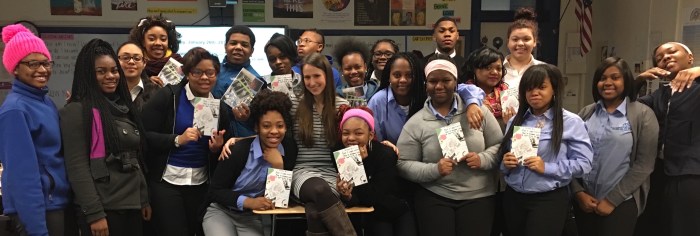
A note from Series Editor Sarah Marcus: Born from a powerful in-class discussion we had about gender, race, and the role of masculinity in rape culture, these poems are an analysis of gendered personal experience and a study of our intersectionality. This poetry series was inspired by a HuffPost essay I wrote called, “Why I Teach Feminism at an Urban High School.” The poets featured here are students from my 12th Grade Creative Writing class whose work I found to be brave, fearless, and progressive. Please help me support their crucial and influential voices.

*

Bianca Capeles is a 17-year-old senior poet in my Creative Writing class. Her future aspirations include a United States Presidency and many, many book publications. She is a member of the Poetry Club and the Drama Club. She enjoys writing and engaging in heated political debates on Facebook. She continues her fight for equality because she “doesn’t understand how someone could advocate for one life over another.”

Capeles’s poem is a re-imagination of biblical lore. Her second person point of view and her steady and engaging rhythm reveals and insists on a historical pattern on repeat.

I chose this poem because of its clear message: a woman’s value is incalculable and should not be determined by men. The moment I heard this poem performed, I knew it needed a larger audience. Please join me in enjoying this untamed, bold new voice!

Elysha

Jezebel,
Explain the glances in your direction.
I guess it doesn’t help to stand beside Elijah,
newly turned prophet,
felt called to bring you to church.

Jezebel,
It must be the skirt you chose to wear,
just tight enough to curve around your legs,
evoking lust, causing Christian men to sin:
Mesmerizing beyond faith to break a commandment,
to devalue the worth of wedding rings…

Jezebel,
It must be the leather you chose to wear,
zipped up to your neckline,
covering what you thought would label you temptation.
Instead, you become rebellious in the eyes of the priest:
He sees your eyeliner and deems you troubled,
criminalizes your modesty,
sends women to patronize:

They say, “God changed me,”
and shows you a picture of a happier woman.

Jezebel,
Explain the whispers in your direction:
Pastor mentions his lovely wife –
You only notice the shrinkage of a woman under constant scrutinization.
You notice her limbs are completely covered in the same church Jezebel is shamed.
She looks as if making up for Eve.

Jezebel,
You remain unconvinced.
Elijah looks over for affirmation,
mentions later that his congregation asked about you:
But you hear the intentions behind every invitation to go out.
They want to discern your spirituality through the clothes that you wear,
if your inherent reflex is to smile if a man is caught staring.
They want to compare your faith to your fashion sense,
despite never having sex, Jezebel.

Elijah,
You are committed to God first, and then wife 1, 2, and 3.
She stands beside you with her child,
the offspring of another man,
and you bask in the reverence that is your position right now:
What a respectable man of God you are
for taking over the responsibilities
of used goods.

Elijah,
You feel above reproach.
You will raise your daughter to shun women like her mother,
wear clothes that attract men like you,
and associate her worth with her virginity,
even while having sex with drunk women,
conceiving a child out of wedlock,
and denying her.

Elijah,
You enjoy the air that Jezebel gives you:
Men glare and envy you,
all unhappy in marriages you have been able to avoid up until now,
with children not claimed to be yours as of yet.

Elijah,
You convince yourself that your interest is her salvation:
That the conversations you have could never find themselves materializing into something more than seeking God,
positioned beside the riskiest threat introduced to church since implemented dress code,
because you’ve brought her to church.

Elijah,
Explain the thought process that makes you innocent beside her:
Your tightened tie and shaved face would not exclude you from rebellious titles,
the tattoo on your arm is similar to the criminalization of eyeliner in Pentecostal churches,
And yet you remain a higher stature than assumed Jezebel,
Because you are assumed to be Elijah, Elysha.

SATURDAY POETRY SERIES PRESENTS: GEORGE MOSES HORTON ON LIBERTY AND SLAVERY

George-moses-horton_at_aalbc
ON LIBERTY AND SLAVERY
By George Moses Horton

Alas! and am I born for this,
To wear this slavish chain?
Deprived of all created bliss,
Through hardship, toil, and pain!

How long have I in bondage lain,
And languished to be free!
Alas! and must I still complain–
Deprived of liberty.

Oh, Heaven! and is there no relief
This side the silent grave–
To soothe the pain–to quell the grief
And anguish of a slave?

Come, Liberty, thou cheerful sound,
Roll through my ravished ears!
Come, let my grief in joys be drowned,
And drive away my fears.

Say unto foul oppression, Cease:
Ye tyrants rage no more,
And let the joyful trump of peace,
Now bid the vassal soar.

Soar on the pinions of that dove
Which long has cooed for thee,
And breathed her notes from Afric’s grove,
The sound of Liberty.

Oh, Liberty! thou golden prize,
So often sought by blood–
We crave thy sacred sun to rise,
The gift of nature’s God!

Bid Slavery hide her haggard face,
And barbarism fly:
I scorn to see the sad disgrace
In which enslaved I lie.

Dear Liberty! upon thy breast,
I languish to respire;
And like the Swan upon her nest,
I’d to thy smiles retire.

Oh, blest asylum–heavenly balm!
Unto thy boughs I flee–
And in thy shades the storm shall calm,
With songs of Liberty!


(Today’s poem is in the public domain, belongs to the masses, and appears here today accordingly.)


George Moses Horton: (1798–1883) Born a slave on William Horton’s tobacco plantation, George Moses Horton taught himself to read. Around 1815 he began composing poems in his head, saying them aloud and “selling” them to an increasingly large crowd of buyers at the weekly Chapel Hill farmers market. Students at the nearby University of North Carolina bought his love poems and lent him books. As his fame spread, he gained the attention of Caroline Lee Whiting Hentz, a novelist and professor’s wife who transcribed his poetry and helped publish it in her hometown newspaper. With her assistance, Horton published his first collection of poetry, The Hope of Liberty (1829), becoming the first African American man to publish a book in the South—and one of the first to publicly protest his slavery in poetry. (Annotated biography of George Moses Horton courtesy of The Poetry Foundation.)

Editor’s Note: As Passover is coming up this week, I have been thinking about slavery and freedom. About histories of bondage and those who are still wandering in search of sustainable freedom today. As we remember our own slavery this Passover and celebrate our own redemption, may these words from another Moses help us to also remember the experiences of those who have likewise suffered, and to advocate for those who are wandering the world today in search of life and liberty.

Want to read more by and about George Moses Horton?
The Poetry Foundation
UNC Documenting the American South
Academy of American Poets

SATURDAY POETRY SERIES PRESENTS: D.H. LAWRENCE ON SPRING

DH_Lawrence_1906
THE ENKINDLED SPRING
By D.H. Lawrence

This spring as it comes bursts up in bonfires green,
Wild puffing of emerald trees, and flame-filled bushes,
Thorn-blossom lifting in wreaths of smoke between
Where the wood fumes up and the watery, flickering rushes.

I am amazed at this spring, this conflagration
Of green fires lit on the soil of the earth, this blaze
Of growing, and sparks that puff in wild gyration,
Faces of people streaming across my gaze.

And I, what fountain of fire am I among
This leaping combustion of spring? My spirit is tossed
About like a shadow buffeted in the throng
Of flames, a shadow that’s gone astray, and is lost.


(Today’s poem is in the public domain, belongs to the masses, and appears here today accordingly.)


David Herbert Richards Lawrence (1885 – 1930) was an English novelist, poet, playwright, essayist, literary critic and painter who published as D. H. Lawrence. His collected works, among other things, represent an extended reflection upon the dehumanising effects of modernity and industrialisation. Although best known for his novels, Lawrence wrote almost 800 poems, most of them relatively short. His first poems were written in 1904 and two of his poems, “Dreams Old” and “Dreams Nascent,” were among his earliest published works in The English Review. His early works clearly place him in the school of Georgian poets, a group not only named after the reigning monarch but also to the romantic poets of the previous Georgian period whose work they were trying to emulate. (Annotated biography of Yehuda Amichai courtesy of Wikipedia, with edits.)

Editor’s Note: Lyric gyrations, thick alliteration, words and images like blossoms and wildfire. D.H. Lawrence helps us welcome spring while questioning the I amidst such a season.

Want to read more by and about D.H. Lawrence?
The world of DH Lawrence
Biography.com
Academy of American Poets

21st Century Politics and The “F” Word

mary

21st Century Politics and The “F” Word

by

M.E. “Spike” Allen

The big noise over Gloria Steinem’s view of certain adult millennials —  that they go for Bernie because that’s “where the boys are,” also the title of a #1 hit by ‘50s icon Connie Francis – has faded now.

And former secretary of state Madeleine Albright’s smiling threat at a Clinton rally, delivered with a Macheath-ish mirth — that hellfire awaits females who choose to vote for a non-Hillary candidate — has also lost its luster, but the rhetoric goes on. As is the millennial feminists’ wont.

Albright, however, did speak the truth when she said “It’s not done,” apparently referring to that feminist thing, the one involving men and women and all generations. And although it might be Hillary’s turn – given the history that black men were accorded the vote soon after the Civil War and that women won it some 50 years later–millennials largely won’t vote on a gender-only basis; it gets their back up.

The “Will I be voting for Hillary” arguments range from stalwart essay writing to assistance of the ka-ching variety. Shiva Bayat’s Slate piece, headlined “A Vote for Bernie Is a Feminist Act,” says that “Feminism is a worldview that understands and critiques power.” She adds that “Female supporters of Hillary should be happy that the women’s movement laid the groundwork for feminists like me to engage critically in power and political life—and so I call on my fellow feminists not to let our bridges Bern.” Very young. On the other end, we have fundraising for Hillary C. by such younger-generation role models as Lena Dunham and Christina Aguilera. To them, She Is the One. Says Ms. Dunham: “I can’t talk about Hillary Clinton without also acknowledging that she has survived horrific, gendered attacks on nearly every single aspect of her character with tremendous grace and aplomb.” Interestingly, many millennials are unmoved by this. It’s their mind to make up, nobody else’s. Also, there’s the concern that the front-line suffragettes might have the stink of victim on them, an unkind position to say the least. This is not to say Bayat is wrong.

Still, as desperate as Clinton can seem after a loss, of any kind, really — no easy-come, easy go big dog like her husband – there’s something humorous re her unabating relentlessness, her cyborg-like ability to raise herself from the dead, time after time, and with the same patina of phoniness with each iteration. The funny part comes when she does something so madcap, so off the cuff, so antithetical to her habit of tightly-wound self-control, that it becomes ridiculous – and then, surprisingly, touching.

Like posing with the not-exactly-heavyweight Britney Spears this month, clearly a bid for the youth vote. Ms. Spears praised Ms. Clinton — “This woman had an intense presence and I felt very honored to meet her”— but offered no endorsement. Britney had tweeted the words along with a photo of the two in Vegas, but she included the hashtag ImWithHer – a clear show of support, leading Ms. Spears to quickly delete it. She reportedly then re-posted, leaving out the commitment-defining hashtag.

There is a generational divide re feminism, and it’s one that is marked by many insignia, including those of dress. First FoxNews made sure all its female news-readers/anchors looked like the 1960s femme-fatales gracing the covers of soft-cover detective stories, except that in FoxWorld, nearly all were brittle double-bottle blondes. The paperbacks were more egalitarian, at least re hair color.

At one point, a Fox news-reader (female) never appeared between camera and anchor chair without her cleavage preceding her. Yes, TV studios are  supposed to have icy temperatures, and in one respect, their mien, these frosty dames definitely brought the bleak to the fore.

It can be easy to dismiss Fox for its peculiar semiotics — what can be said or telegraphed about a land that intelligence forgot, one reigned over by a Wizard-of-Oz type, one whose recent news items include a discussion between him and The Donald over that mean, mean lady who’s “overrated and angry,” in The Donald’s estimation.

Dialing the magniloquence up, Trump finished her off, he thinks, by calling her a bimbo. Hey, it worked in high school. Megyn Kelly is the least extreme of the Fox Barbies, and her smarts and journalistic savvy often put anchors such as Wolf Blitzer to shame. But that’s FoxWorld.

So imagine a reader’s crankiness when noticing the garb on anchors from yet another news world, a younger news world, one that can be found 180 degrees from Fox, on something called The Young Turks, which brags that it’s “the largest online news show in the world.”

The panelists all seem millennial, with the male anchors guided by Casual Friday dicta. The female panelists’ threads, though, tell another story. Some of these women are very bright and both genders seem to represent a libertarian/agnostic strain of journalism that very entertainingly lays out both fact and fancy and is aimed at sating its viewers’ hunger for something more newsy than, say, Newsy.

It’s a thinking person’s live news program, lousy with op-ed, so near yet so far from the corporatized broadcast outlets that sell “news” as long as it doesn’t criticize or offend the parent company. Conservatives have a word for it: Lame-stream. Of course conservatives are the worst offenders, but they do get in a lick or two.

The Young Turks—who take the news seriously, but slather on the snark—could be throwing their cred away by presenting its female panelists with super-tight tops and décolletage. And what of the responsibility of the women themselves who show up on broadcasts in such work-wear? Fine when posting to a dating site, but not when presenting oneself or one’s staff as a font of ideas.

Is it possible the men and women on these newscasts are playing a weird game of Chicken, the women daring the men to look, the men trying hard not to. You see, the thinking must go, this is the way it’s supposed to be. No one notices the difference between the sexes.

On another front, a bizarre one in an abnormal group, there has been David Brock — he of “a little bit nutty, a little bit slutty” politics in the Anita Hill/Clarence Thomas case a quarter of a century ago – actually calling Bernie “a typical politician.” Politician, certainly. Typical? Thud. Brock’s changeling powers are well documented: going from remorseless priest of the Hard Right, and evil sexist, to, watch it now, Clinton honey-bunny. Brock heads a pro-Clinton super PAC, Correct the Record (irony alert), and earlier this year questioned both Bernie Sanders’ health at 74 (Hillary is 68, just six years younger) and his policies re people of color.

At one point, Hillary, or Hillary’s people, reportedly told Brock to calm down, and Sanders’ peeps soon lined up the self-described Democratic Socialist’s lifetime bona fides re civil rights. Sanders even quickly released his perfectly acceptable medical status (though it was nowhere near Trump physician Harold Bornstein’s odd “extraordinary” rating for his patient). Probably edited by Trump.

With Clinton’s drubbing in New Hampshire, she accelerated her flat-out lying about being a progressive, a label that has worked so well, and so accurately, for Sanders. Also, after siccing Bill on her problem, she went a bit gone herself as she labeled Sanders a “one issue” candidate. Here’s her line on that, to a mixed group of union members in Nevada: “If we broke up the big banks tomorrow, would that end racism? Would that end sexism? Would that end discrimination against the L.G.B.T. community? Would that make people feel more welcoming to immigrants overnight?” Oh, Sister, Sister. Lame. Quite lame.

SATURDAY POETRY SERIES PRESENTS: DIODE

Screen Shot 2016-04-02 at 11.12.42 AM
Editor’s Note: It has been my honor and privilege to write another omnibus review for Diode Poetry Journal, this time a review of four full-length poetry collections. Each of the poets that are the subject of this review have been featured here on the Saturday Poetry Series, and diode gave me the opportunity to expand my inquiries into these collections and to help share the gift of poetry with the world. Read selections from the review below, then hop on over to diode and read the full review and the incredible issue.


from SMALL PRESS FULL LENGTH COLLECTIONS OMNIBUS REVIEW
diode 9.1, by Sivan Butler-Rotholz

New from [Red Hen Press, Texas Tech University Press, Black Lawrence Press, and The (Great) Indian Poetry Collective] are four full-length poetry collections from four visionary writers. Whether crafted by award-winning artists or carefully curated, whether hand-selected or born of generous mentorship, these thoughtful and painstaking works gift the reader an exquisite unrest. Vivid, lyric, and evocative, the words and ideas proffered within these books enable the reader not only to question, but to reconsider, not only to reflect, but to be transformed.

Seemingly disparate, these collections grow from the fertile soil of common ground. Each one stems from the rich roots of questioning, and among their boughs are inquiries into science and religion, genesis, generations, and death, the infinite and the inevitable, history, humanity, and crossing over.

from Review | Histories of the Future Perfect, by Ellen Kombiyil
The (Great) Indian Poetry Collective, 2015

Imagine a world freed by the boundless realms of a child’s imagination. A child, that is, with a PhD and the resources of NASA at its fingertips. And a heart that has lived more than one lifetime. “Of the heart,” Kombiyil observes, “one might say that it slows,” and “love is / lava spilling out & cooling into rock.” From earth, she imagines the stars, and from space, she longs for earth. In “While Sipping Lemon Tea on Saturn’s Ice-Cloud Deck,” the poet experiences “Dizzy days and sleepless nights—elongated years,” wistful when admitting that “I’ve forgotten the outline of my body against you.”

from Review | The Glad Hand of God Points Backwards, by Rachel Mennies
Texas Tech University Press, 2014

The Glad Hand of God Points Backwards “cradle[s] a weight unasked of it.” This ambitious collection is laden with questions of religion and God, of Judaism as a uniquely weighted experience, of the tension between a lost matriarchy and a present patriarchy—“prayers as old as a thousand matriarchs;” “Sarah had Rebekah had Leah and Rachel had… no use for sarcasm but lived thick within God’s ironies…” Woven between the fibers of these themes are the intrinsic considerations of—and reflections upon—history and those relationships that are the genesis, generation, and continuation of life.

from Review | Decency, by Marcela Sulak
Black Lawrence Press, 2015

When the book considers history, that consideration is varied enough to encompass Cortés, the Holocaust, and the southern backyard of the poet’s own childhood. Sulak writes of La Malinche, a Nahau (Aztec) woman who was born noble, sold into slavery, and came into the possession of Cortés:

              They call me La Malinche,
              because I betrayed. Cortés called me
              Doña Marina. Our friends
              called us by the same name.
              You can call me mother,
              of course. But what I like most,
              is the unanswered calling in the sun
              and the corn and the coins, those luminous
              voices eternally seeking their gods

And of the poet’s own history:

              At the end of our marriage, I remember
              the raccoons of my childhood . . .
              how my brother set the spring-triggered steel jaw trap for the coons
              in the dim light of the barn floor; my cat stepped into it and caught her paw,
              and how she howled, her desperate twist, and when I bent to release her
              she bit my finger and it swelled ten times its normal size, how that’s what
                     happens,
              my father said, when you touch an animal in pain.

from Review | River Electric With Light, by Sarah Wetzel
Red Hen Press, 2015

The driving force and metaphor running through this work is water. Rivers carry words, ideas, people. “If I must choose a word for you, / let it be river,” the book opens, and in this way the poet conjures up a world in which water and the you of the collection become one. She then echoes these words with a shift that sets the stage for the ways in which water—and the you—shifts throughout the book, throughout life, and throughout both personal history and the history of the world: “If I must choose a word for you, / let it be the word / for what flows.”


Today’s selections are from diode 9.1. Read the full omnibus review here. Read the full issue here.


Diode: Diode publishes electropositive poetry. Poetry that excites and energizes. Poetry that uses language that crackles and sparks. The journal features poetry from all points on the arc, from formal to experimental.

Want to read more at the intersection of yours truly and diode?
Diode 9.1 – Small Press Full Length Collections Omnibus Review
Diode 8.3 – Accents Publishing Chapbook Omnibus Review

SATURDAY POETRY SERIES PRESENTS: THE BOOK OF ESTHER BY STACEY ZISOOK ROBINSON

me

By popular demand, in celebration of Purim we are re-featuring this stellar poem by Stacey Zisook Robinson, in conversation with your faithful editor at the crossroads of feminism and midrash.

By Stacey Zisook Robinson:


THE BOOK OF ESTHER

That blush on my cheek?
It’s paint,
And I have glittered my eyes
And robed myself in the finery
of silk and gossamer,
lapis and gold–
And whored myself for your salvation.

You asked for no thoughts.
You merely offered my body
to the king–
My life forfeit
If my beauty failed.

You asked for no ideas
And I gave you none,
Though I had a thousand,
And ten thousand more.

Diplomacy was played on the field of my body,
The battle won in the curve of my hip
And the satin of my skin,
Fevered dreams of lust
And redemption.

That blush on my cheeks?
It is the stain of victory
And of my shame.


Today’s poem was originally published on Stumbling Towards Meaning and appears here today with permission from the poet.


Stacey Zisook Robinson is a single mom. She sings whenever she can. She writes, even when she can’t. She worked in Corporate America for a long time. Now she works at her writing and looks for God and grace, meaning, connection, and a perfect cup of coffee, not necessarily in that order. Stacey has been published in the Summer 2013 issue of Lilith Magazine and in several anthologies including The Hope (Menachem Creditor, ed) and In Transit (BorderTown Press, Daniel MacFadyen, ed). Watch for her book, Dancing in the Palm of God’s Hand, forthcoming from Hadasah Word Press. Stacey has recently launched a Poet in Residence program designed to work with both adults and kids in a Jewish setting to explore the connection between poetry and prayer as a way to build a bridge to a deepened Jewish identity and faith.

Editor’s Note: This week we celebrated Purim, a Jewish holiday that commemorates Queen Esther (5th c. B.C.E.) saving Persian Jews from genocide. Esther’s rise to power, however, was problematic. Her predecessor, Queen Vashti, was summoned to appear in her crown, ordered to display her beauty before the king and his nobles. The implication, according to many scholars, is that Queen Vashti was ordered to appear wearing only her crown. She refused, and it was suggested that she should be de-throned and replaced by a “worthier woman” so that “all wives [would] henceforth bow to the authority of their husbands, high and low alike” (Esther 1:19-20).

And there’s your daily dose of female oppression, Bible style.

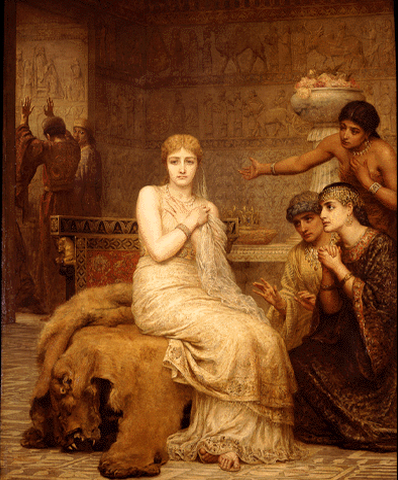
"Vashti Refuses the King's Summons" by Edwin Long (1879). Public Domain image.
“Vashti Refuses the King’s Summons” by Edwin Long (1879). Public Domain image.


A search began for beautiful young virgins. Those who made the cut were subjected to twelve months of beauty treatments before the king would even deign to lay eyes on them. The hopefuls then appeared before the king, who did not see any of them ever again “unless he was particularly pleased by her” (Esther 2:12-14). King Xerxes liked Esther best of all the young virgins displayed before him, and crowned her queen in Vashti’s stead. Plot twist: the king did not know that Esther was Jewish, for she had deliberately kept that fact from him. In the end Esther was able to use her beauty to bend the king to her will, and when one of his henchmen sought to have all the Jews in the kingdom annihilated, Esther stood up for her people and they were spared.

While it is this end-result that is remembered and celebrated each year at Purim, it is Esther’s degrading rise to the throne—and what it cost her to to save her people—that is the subject of today’s poem.

To come to power, Esther had to take the rightful queen’s place and become the poster child for the idea that “all wives [should] bow to the authority of their husbands.” To catch the king’s eye she had to strip away her personhood until nothing was left but her physical beauty. “That blush on my cheek? / It’s paint, / And I have glittered my eyes / And robed myself in the finery / of silk and gossamer, / lapis and gold.” It was not her devotion to her people that allowed her to save them, but that she “whored [her]self for [their] salvation.” Nor did her people care who she was beneath her beauty, or whether she survived her attempt to save them: “You asked for no thoughts. / You merely offered my body / to the king– / My life forfeit / If my beauty failed.”

"Queen Esther" by Edwin Long (1878). Public Domain image.
“Queen Esther” by Edwin Long (1878). Public Domain image.


Queen Esther was a pawn in men’s games, as women of history have too often been. “Diplomacy was played on the field of my body, / The battle won in the curve of my hip.” She used her beauty and her sexual allure because, as a woman of her time and place, they were the only instruments of power available to her. But if she were given a voice, she might speak of inner conflict. She might tell us what it feels like to lack the ability to either refuse or consent. Queen Esther was a hero, but what did it cost her to package and sell herself in the name of the greater good? “That blush on my cheeks? / It is the stain of victory / And of my shame.”

Today’s poem does what all great feminist biblical interpretation and midrashot do: it examines, deconstructs, and reconstructs androcentric assumptions, biases, and perspectives in biblical literature, placing women, gender, and sexuality at the center of reinterpretation.

In a time when the Bible is still being used to justify the oppression of women, we need much more of the important work Stacey Zisook Robinson is doing with “The Book of Esther.”

Want more from Stacey Zisook Robinson?
Stacey Zisook Robinson’s Blog
Stacey Zisook Robinson’s Official Website
Personal Essays and Opinion Pieces on iPinion
ReformJudaism.org

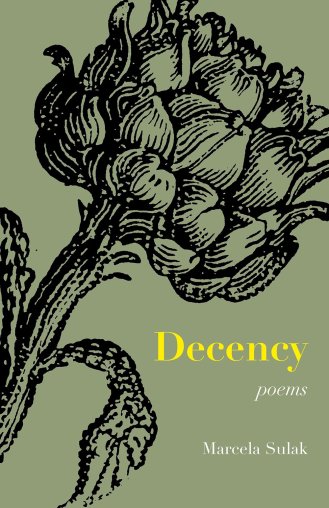
SATURDAY POETRY SERIES PRESENTS: DECENCY


Decency


From DECENCY
By Marcela Sulak:


selections from SOLIDARITY

vi. Virginity

It’s not that you get tired, it’s that it starts to be the only thing,
starts to disappear you.

Your parents phone you at college to ask: how is your virginity
doing? Did your virginity have a good day?

What does it want to be when it grows up? Your virginity sounds
a little sad this morning. What kind of cake does your virginity want

for its birthday? your girlfriends saw the most amazing shoes
that your virginity would look terrific in!

Want to go shopping? your boyfriends—would your virginity like to see
a movie? What about dinner?


ix. witches

My daughter is named for my grandmother, a midwife
who attended the births of 90 babies in rural Texas

before they had cars and after they finished having witches
but before there were doctors. Now you may understand

what I mean when I say another woman
gave my daughter a book called “The witches and the rabbi”

for her birthday. Here is the plot: a village is terrorized by a plague
of witches who fly from their cave when the moon is full,

on brooms through the sky except when it’s raining. I’m not sure
what the witches actually do to the village, since no one

actually goes outside on those nights. Gary, Indiana, could use
an infestation of witches—no stabbings

or gunshot wounds on evenings of full moons.
But one full moon when it is raining the rabbi shows up

with twenty townsmen. The witches
are so delighted they make them a feast of all the good things

they have. The rabbi tricks them into dancing with him and
the vigilante men, out into the rain,

which kills them. I knew her father’s mother was secretly
glad when I started to hemorrhage. She didn’t want me

to have a homebirth with a midwife.
“What kind of rabbis are these?”

Says my rabbi, stopped by for a quick hello. My daughter
wanted to show him that we had a book about rabbis. “They’re

engaging the poor witches
in mixed dancing and leading them astray,” he says.

This is the broom which sweeps the sky of the stars you have
to be too drunk to write about, as Daisy put it.

This is the housework the princesses do disguised
as village maidens. These are the constellations that form

in the shadow of the stars.
Silent are the women in the village

who took their cloth packets of herbs and were silent
when their husbands rushed off to kill the witches in that story.


CHOCOLATE

The day I won the custody case my lawyer gave me a bitter chocolate
in black and silver paper. Once I saw cacao pods
drying in a Venezuelan village square

during Easter week; through the open church doors, peeling saints sniffed
        and were carried
like colicky children through night streets. The local hot chocolate
was thickened with cornmeal and canella bark

somebody tore from the trees. To reach that village we found a fisherman,
        plowed
through rows of porpoises, then hiked five kilometers
inland through banana and cocoa trees,

which like shade. Once only men could drink
chocolate. Women were permitted cacao beans as currency,
to buy meat or slaves or pay tribute. It feels good to imagine a single seed,

hidden in the forbidden mouth, the tongue
curled, gathering the strength to push. The Aztec king discarded
each gold-hammered cup after its initial use; his chocolate was red as fresh
        blood.

He was a god to them. It was frothy,
poured from great heights. When we bathed in the village river, girls
gathered around me, whispering, why is your skin so pale? Why is your
        hair so straight?

Can we braid it? Dime, eres blanca?
The judge, our lawyers, her father, and I decided the fate
of my child. The dark liquid we poured was ink, initialing our little
        negotiations.

Who can know the heart of another, the blood
spiced with memory, poured from one generation to the next
over great distances? The Mayan word for chocolate means bitter. The
        village

used to be a plantation; now it is a co-operative, owned by descendants
of the former slaves. At Easter Vigil the women lined up
behind the most beautiful, in a long sky

-blue dress adorned with gold stars. Between the decades of the rosary she
        called out,
while we shuffled our feet in merengue beat, bearing the saints
through the streets, someone shot off a Roman

candle. The men’s procession paused for rum. I know I’ll be paying for it
        the rest
of my life. The Mayan word means bitter water. The cacao
tree was uprooted from paradise.


HOW TO USE A NAPKIN

Understand the napkin
has been unnecessary
for most of human history.

Understand the world is filled with people
eager to bend
things to their will.
We shall practice on the napkin.
When you have finished eating
place your napkin loosely
next to your plate
.

It should not be crumpled or twisted,
which would reveal untidiness or nervousness;
nor should it be folded,

which might be seen as an implication
that you think your hosts
might reuse it without washing
.
.
It is a delicate affair.
Don’t argue with me
said my husband

who had called for my advice
about the apartment he was renting
when he didn’t want to live with me.

It is largely
symbolic today
except for barbecues.
Lightly dab the lips.

I suspect the word
argue is the space
in the mouth for things
to come apart in.

The napkin must not be left
on the chair, it might seem
as if you have an inappropriately

dirty napkin to hide
or even that you are trying
to run off with the table linens.

It takes great trust
to use a napkin.
It takes an act
of faith to leave
the table.


Today’s poems are from Decency (Black Lawrence Press, 2015), copyright © 2015 by Marcela Sulak, and appear here today with permission from the poet.


Decency: Poetry. Jewish Studies. Women’s Studies. Decency celebrates the spunky wenches, the unfortunate queens, the complicated translators, the wistful wives who have been hustled off the spotlit stages of history. Through the lens of Victorian manuals of etiquette, through the unfolding of religion from the Middle East to the American Southwest, Decency thinks through the brutal things we do to one another, recording the ways the individual operates in relation to society’s mores and harms. From the Sumerian queen Puabi to contemporary female recruits to the Israeli intelligence’s “Honeytrap” operation, Decency is a mix of the documentary and the lyrical, the wrathful and the joyful.


Marcela Sulak‘s poetry collections include Decency (2015) and Immigrant (2010), both with Black Lawrence Press. She’s translated four collections of poetry from the Czech and French, and, most recently, the Hebrew: Orit Gidali’s Selected Poems: Twenty Girls to Envy Me (University of Texas Press, July 2016). She’s co-edited the 2015 Rose Metal Press title Family Resemblance: An Anthology and Exploration of 8 Hybrid Literary Genres. Sulak directs the Shaindy Rudoff Graduate Program in Creative Writing at Bar-Ilan University. ​​


Editor’s Note: If there is a question driving the poems in Marcela Sulak’s sophomore collection, it is a question of the ways in which we are and are not decent to one another. As individuals and as countries. As intimates and strangers. Both within and across the (real or artificial) divides of race, creed, culture, and nationality. Sulak pursues the answers to this question with the keen eye of an academic and a researcher, then relays her observations and discoveries with the skilled and deliberate abandon of an artist. These questions of decency are considered and depicted through the lenses of history, relationship, and etiquette. The result is a brave yet dainty collection. A powerful yet vulnerable collage. A work that charms the reader with its quaintness so that its harsh truths and difficult revelations go down like chocolate–bitter yet sweet, delicate yet bold.

Among the many long poems in this collection is one that stopped me in my tracks when I heard the poet read it aloud at the book’s New York launch last year. “Solidarity” is a stunning inquiry into rape–its ramifications and its afterlife and the endless experiences that collide with sexual violence in concentric circles. Today, for example, are Sulak’s reflections on misogyny and witch hunts, virginity and agency. Of virginity she writes, “It’s not that you get tired, it’s that it starts to be the only thing, / starts to disappear you.” Determined that her daughter know the truth about the history of hysteria, misogyny, and women healers, she considers witches through the skewed twin lenses of history and scaremongering: “Silent are the women in the village // who took their cloth packets of herbs and were silent / when their husbands rushed off to kill the witches in that story.” If I could have, I would have reprinted this long poem in its entirety. But then, you really ought to buy the book so that you can read this breathtaking work for yourself.

Throughout this masterful collection the poet’s own experiences are coupled with the larger lenses of the book–history and etiquette, for example–so that what is gleaned by the reader is at once deeply personal and delightfully educational. “The day I won the custody case my lawyer gave me a bitter chocolate,” Sulak writes of her unique experience, then later, in the same poem, writes of the history of chocolate: “Once only men could drink / chocolate. Women were permitted cacao beans as currency, / to buy meat or slaves or pay tribute.” Yet these ideas are not disparate; they are finely woven together by the poet’s skilled hand. The genius of this interrelation is beautifully evidenced by moments like this, in a poem that appears to be about the history of the napkin, but is equally about the poet’s leaving her husband: “It takes great trust / to use a napkin. / It takes an act / of faith to leave / the table.” The art of the poem–like the collection that houses it–is enriched beyond experience and information by a powerful lyric: “It feels good to imagine a single seed, // hidden in the forbidden mouth, the tongue / curled, gathering the strength to push.”


Want to see more from Marcela Sulak?
Marcela Sulak Official Website
“Jerusalem” in the Cortland Review
Decency” and “Raspberry” in Haaretz
Buy Decency from Black Lawrence Press, Book Depository, or Amazon

Sarah Freligh: Two Poems

9780913785645

A Letter to You About Myself

I still do bad things. Sometimes I bite my fingernails, not down
to the quick, but only to even out the rough spots. Last week my
thumb snagged a new pair of tights. All day the run laddered up
my thigh, displaying beige leg flesh in each little window. I’m always
in a hurry, an hour ahead of the here and now, a refugee from my own
life. I hope I didn’t give that to you. My teeth are bad, maybe yours
are too? My dentist says I’ll be lucky to keep the teeth I have as if he
knows what my future will be: me in a hospital bed cranked up high
enough to see outdoors: the birds fighting for the last bit of seed
in the feeder. The drone of a TV across the hall, a soap opera whose
characters I no longer recognize. The names are the same, the actors
different. Every day is like this. The girl who brings my tray is not
the one from yesterday though she says she is. Her hands are hard
and strong. Here’s your boiled egg, honey, she says. I don’t answer
to that name anymore.


***

Saudade

—From the Portuguese: A kind of intense nostalgia or a constant desire for something that does not and probably cannot exist

Like the time your train
tooted out of Utica
three hours late past

a grove of trees wrapped
in white lights, past
the neon signs of a bar

as the last car left
the parking lot,
a black sedan you see

yourself riding in, thigh
to thigh with the blue-jeaned guy
you hooked up with over

whiskey shots and shells of Pabst
at last call, the bass player
for the rock band whose

big hands you’d admired
all night plucking
at his stringed crotch, even

as the jukebox spins out
its last song, even as
a waitress wipes down

the sticky tables with a frayed rag
soaked in club soda, listens
to the train whistle

out of the station, wishing
she were where you are
moving away from her life.


***

Sarah Freligh is the author of Sad Math, winner of the 2014 Moon City Press Poetry Prize, A Brief Natural History of an American Girl, winner of the Editor’s Choice award from Accents Publishing, and Sort of Gone, a book of poems that follows the rise and fall of a fictional pitcher named Al Stepansky. Her work has appeared in The Sun Magazine, Brevity, Rattle, Barn Owl Review, on Writer’s Almanac, and anthologized in the 2011 anthology Good Poems: American Places. Among her awards are a 2009 poetry fellowship from the National Endowment for the Arts and a grant from the Constance Saltonstall Foundation in 2006.

[The above poems appear in Sad Math and are used here by permission of the author.]