SATURDAY POETRY SERIES PRESENTS: NEW YEAR’S MORNING


NEW YEAR’S MORNING
By Helen Hunt Jackson

Only a night from old to new!
Only a night, and so much wrought!
The Old Year’s heart all weary grew,
But said: “The New Year rest has brought.”
The Old Year’s hopes its heart laid down,
As in a grave; but, trusting, said:
“The blossoms of the New Year’s crown
Bloom from the ashes of the dead.”
The Old Year’s heart was full of greed;
With selfishness it longed and ached,
And cried: “I have not half I need.
My thirst is bitter and unslaked.
But to the New Year’s generous hand
All gifts in plenty shall return;
True love it shall understand;
By all my failures it shall learn.
I have been reckless; it shall be
Quiet and calm and pure of life.
I was a slave; it shall go free,
And find sweet peace where I leave strife.”
Only a night from old to new!
Never a night such changes brought.
The Old Year had its work to do;
No New Year miracles are wrought.

Always a night from old to new!
Night and the healing balm of sleep!
Each morn is New Year’s morn come true,
Morn of a festival to keep.
All nights are sacred nights to make
Confession and resolve and prayer;
All days are sacred days to wake
New gladness in the sunny air.
Only a night from old to new;
Only a sleep from night to morn.
The new is but the old come true;
Each sunrise sees a new year born.


(Today’s poem is in the public domain, belongs to the masses, and appears here today accordingly.)


Helen Maria Hunt Jackson (1830 – 1885) was an American poet and writer who became an activist on behalf of improved treatment of Native Americans by the United States government. (Bio courtesy of Wikipedia, with edits.)

Editor’s Note: Wishing all who celebrate Rosh Hashanah this week a shanah tovah umetukah, a good and sweet new year. May today’s poem remind us that now is an opportunity for change, but that we must be the change we want to see in the world.

Learning from (Illinois) Nazis


Scene from The Blues Brothers

Learning From (Illinois) Nazis

By Ezra Claverie

In the weeks since a white supremacist in Charlottesville used a car to attack anti-fascists, a lot of people have been posting on Facebook the scene from The Blues Brothers (John Landis, 1980) where Jake and Elwood drive their car at Illinois Nazis. The Nazis jump off the bridge, humiliated but unhurt, then spend the rest of the film trying, but failing, to kill Jake and Elwood.

The bridge scene gets laughs in part because of the self-seriousness of the leader of the Nazis, played by steely-eyed but short and unimposing Henry Gibson, but also in part because Jake and Elwood transgress a liberal norm. They defy the limits of an American liberalism that says the law should protect the speech (and so on) even for groups who would, given control of the levers of state power, use that power not only to eliminate legal protections for dissenting speech, but also to expel or exterminate opponents.

If Jake and Elwood really believed in American-style liberalism–the old “I may disagree with you but I defend your right to speak”–we wouldn’t have the scene, as famous as any in the film. The brothers’ transgression allows audiences to experience vicariously the thrill of flouting this norm against a group that most people already love to hate. But the stakes for Jake and Elwood, white Catholics not affiliated with the left, began low. Had they just waited their turn in the traffic jam, they might have had no problems even if the Illinois Nazis had later captured the government. (The same does not hold for their Black band mates or the Black artists whose songs the Blues Brothers cover. And would Illinois Nazis even allow the performance of such entartete musik?)

Karl Schmitt–the German, coincidentally Catholic, and, after 1933, Nazi jurist–explicitly articulated a principle relevant here, which American liberalism rejects: the friend-enemy distinction, upon which (Schmitt argued) all political life operates.

According to Schmitt, you must define as “enemy” one who seeks to eliminate the circumstances that allow you and your group, collectively, to exist as political actors. The Enemy “intends to negate his opponent’s way of life and therefore must be repulsed or fought in order to preserve one’s own form of existence.” 

Rivals and opponent groups may bitterly debate and wrangle with your group, but provided they do not constitute an existential threat, you can count them as Friends. In contrast, an Enemy aims to remove your group from the field of political contestation. Schmitt therefore argued that only political parties not intent on neutralizing or dismantling the parliamentary system, as the Nazis did, should be allowed participation in the Reichstag. Nevertheless, when they came to power, he joined.

Alex James Fields, the white supremacist who drove the car that killed Heather D. Heyer and injured many others, identified his Enemies. He drove a car into a crowd that included members of Democratic Socialists of America and Industrial Workers of the World, leftist groups of the kind that fascists, whether in or out of state power, target for killing. Fields, who associated with the neo-Nazi group Vanguard America, sought to eliminate the fundamental circumstance that allowed his Enemies to exist as political actors: their lives. For observers and survivors, the attack functioned as terrorism, an implicit warning: if you come out against white supremacy, the same could happen to you. He clarified American white supremacy as an existential threat to anti-racists and the left.

And yet on the same grounds we could characterize Jake and Elwood’s rush at the Illinois Nazis as an act of political terrorism. We hear the car’s engine revving, but we never hear the brakes; nothing in the scene suggests that Elwood will stop if the Nazis stand their ground. Their leap into the river gives them and the movie a means of escape from the serious question of what to do about people who, if they came to power, would slaughter you, me, or our friends. The failure of Jake and Elwood’s act of terrorism, like the failure of the Nazis’ quest for vengeance, turns the scene into comedy.

Liberals, both in the classical European and American senses, tend to imagine a political world without Enemies, where political stakes never rise to life-and-death. Within their political horizon, liberals treat disagreements as temporary and tactical, with deliberations over details of policy or administrative practice taking the place of struggles over fundamental questions, which mythologized culture heroes settled long ago. The failure or betrayal of state-socialist alternatives to neoliberal capitalism, to which Thatcher famously claimed “There is no alternative,” has only exacerbated this tendency.

Schmitt and many on the left and right regard as wishful thinking the notion of a world without political Enemies. Charlottesville reminded us that the stakes of political life remain high, especially for those who confront America’s resurgent and racist far right.

.

About the Author: 

Ezra Claverie has a PhD from the University of Illinois, Urbana-Champaign. His essays have appeared in Intensities: The Journal of Cult Media, The Journal of American Culture, The Journal of Popular Culture, and Jump Cut: A Review of Contemporary Media. His primary research looks at Hollywood studios’ use of superheroes owned by the comics duopoly of DC and Marvel, reading these films as allegories of the corporate management of intellectual property. He teaches in the Writing Program at NYU Shanghai.

Continue reading “Learning from (Illinois) Nazis”

SATURDAY POETRY SERIES PRESENTS: WASN’T THAT A MIGHTY STORM

WASN’T THAT A MIGHTY STORM
Performed by Rolf Cahn and Eric Von Schmidt

Editor’s Note: I have been reading Isaac’s Storm by Erik Larson, which tells of the Great Storm of 1900. That Category 4 hurricane decimated the town of Galveston, Texas, killing between six and twelve thousand people, making it the deadliest natural disaster in U.S. history. I was reading this book as Hurricane Harvey ravaged Houston and beyond. I am reading it now, still, as Hurricane Irma sweeps over the Caribbean and heads for the U.S. mainland. I am thinking of those who are fleeing and those who are staying put to weather the storm. Of those who have lost everything. Of those who have lost their lives. I am thinking of global warming and our current regime of climate change deniers. I am thinking of the fires that are burning in the west. I am thinking of friends and their families, and of those who are my kin because of our shared humanity. I am thinking of how history repeats itself and of the lessons we fail to learn from the before time.

Today’s poem is a folk song that remembers the Great Storm of 1900, and dedicated to those who are now suffering, who have suffered, who will suffer still.

Albert Herter @ Koenig & Clinton

AHerter_CompoundGrowth2_2017_300DPI-700x573

Albert Herter, Compound Growth #2, acrylic ink, colored pencil, oil pastel, watercolor, marker on paper, Sheet: 16 x 20 in (40.6 x 50.8 cm), Frame: 19 3/4 x 23 5/8 in (48.3 x 60 cm), 2017.

Albert Herter @ Koenig & Clinton 

by Matt Gonzalez

Albert Herter, “The Quincux Aspect”
Koenig & Clinton, 1329 Willoughby Avenue, Brooklyn, NY
June 3 — September 1, 2017

Albert Herter’s show at Koenig & Clinton, “The Quincux Aspect”, presents a series of Lacanian drawings Herter has been working on for nearly a decade. They parallel his study of and experience undergoing Lacanian psychoanalysis. The exhibition at Koenig & Clinton is Herter’s first solo show in New York City. He first presented 23 similarly themed drawings in a solo show at Partisan Gallery in San Francisco’s Mission District in 2012. The current show includes 45 medium-sized color drawings made from acrylic ink, colored pencil, oil pastel, and marker on paper.

The basic subject of the work is the subconscious, and Herter, now a Lacanian analyst by day, pours out what are intricate scenes and rich drawings filled with Gargantuan and Rabelaisian themes of excess. The result is a series of narratives that sit suggestively beneath the ego layer, many revolving around sexuality and decadence. The drawings also offer a veiled commentary on the excesses of capitalism. Perhaps this says something about what lies latent in the ego of society itself.

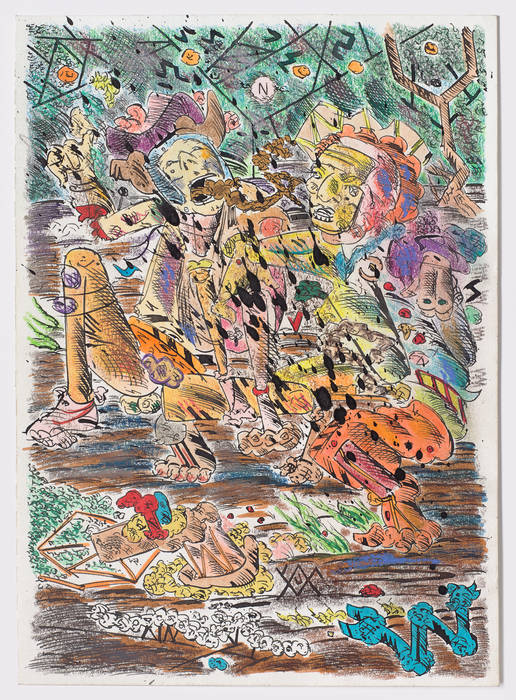
The drawings are set very theatrically, either in some kind of outdoor landscape or city square. The characters are elaborately costumed, articulated marionettes, although they lack any apparent strings or controls suggesting the absence of determinism. Usually paired in settings of two or three, the characters engage in, or act out, a drama filled with interpretive complexity.
AHerter_Pantagruelling3_2016_300DPI-516x700

Albert Herter, Pantagruelling #3, acrylic ink, colored pencil, oil pastel, marker on paper, Sheet: 11 3/4 x 8 1/2 in (29.8 x 21.6 cm), Frame: 15 3/4 x 12 3/8 in (40 x 34.4 cm), 2016.

More akin to the literary works of Apuleius and Petronius, the drawings do not themselves have obvious historical antecedents, although it can be said the work is influenced by 20th century comix tradition. But there are also more classical influences: the pre-Raphaelites whose reliance on abundant detail, rich colours and complex compositions comes to mind, as does German Expressionism, particularly George Grosz who presents luxury and the grotesque in coexistence. Herter’s portrayal of the body can also be viewed as unmistakable baroque, with ornate detail reminiscent of artists who favored the suggestion of lusciousness over the rendering of exact forms.

The Lacanian principle, jouissance, is invoked to show the dialectical interplay between enjoyment and suffering. By transgressing the limits of pleasure, Herter’s characters often exceed the boundaries of pleasure, thereby entering the realm of suffering and pain. The message here is that the very thing that one enjoys, and which the body gains pleasure from, can also be a destructive, consuming force. In this regard, Lacanians would posit that the sexual orgasm is self-annihilating and in that sense, these works seem to devour themselves with their overabundance. Herter invokes the intimate gaze of the voyeur with some characters who seem just out of the narrative. Yet a claustrophobia attends to the cramming of symbols into such small compositions.

The title The Quincux Aspect likely refers to quincunx, which denotes a geometric pattern of five points arranged in a cross-like formation. It can also refer to a bronze coin that was used in the Roman Republic and valued at 5/12ths. Herter may be referencing a grouping just under a majority, or a nod to religious iconography, suggesting in both cases a lack of the individual’s power. In many respects the economic narratives that pit the haves against the have-nots renders individual choice meaningless — and, in a sense, obscene.

AHerter_Aposematism6_2017_300DPI-692x700

Albert Herter, Aposematism #6, acrylic ink, colored pencil, oil pastel, watercolor, marker on paper, Sheet: 16 x 16 in (40.6 x 40.6 cm), Frame: 19 3/4 x 19 5/8 in (50.2 x 49.8 cm), 2017.

Herter has said that he does not think at all while drawing these scenes.  The narratives appear on their own, naturally hinged to his experience, yet outside of it, with many of the bodies rendered disjoined and fragmented in exceptional ways. The drawings present aspects of anamorphic portraiture with the corresponding emotional confusion and psychosis, presented in contrast to characters in reverie of the pleasurable and excessive.

Given this, these works act as powerful artifacts of Herter’s Lacanian explorations. What could have been left on the floor of a psychoanalytic session is rendered in beautifully provocative colored drawings. These works invite direct personal response. In fact, it can be said that they were made to be interpreted. One suspects that Herter wouldn’t want to have the last say on their meaning.

The show ends tomorrow, September 1, 2017.  Don’t miss it. It’s at Koenig & Clinton’s new location in Bushwick. The gallery is open 11am to 6pm.

By Matt Gonzalez

Albert Herter (b. 1980, San Francisco) holds a BFA in New Genres from the San Francisco Art Institute, where he studied abstract painting, video, installation, and performance. His drawing work with accompanying surrealist text was published by Comfortable on a Tightrope (Manchester) and Museums Press (Glasgow) as In the Curtyard: Orchestrated Reduction of the Fantasm. Herter lives and works in Brooklyn, New York.

Addendum: Dana Smith notes that The Quincux Aspect is an astrological term. From AstroWiki: “An aspect of 150 degrees between two planets. The quincunx is thought to be one of the most important minor aspects. It is valid with an orb of up to three degrees. Even astrologers who do not usually work with minor aspects often include quincunx aspects in their interpretations. The quincunx is classified neither as a harmonious nor as an aspect of tension. It indicates potential that is difficult to realise. In contrast to the square or opposition it doesn’t usually feel like a significant source of tension, demanding action.”


Two Poems By Sean Karns

Tina Modotti “Hands Resting on Tools”  from the Getty’s Open Content Program.

Two Poems

By Sean Karns


The Man of Dirt Toils in the Laughter of His Wayward World

A long way off, the Man of Dirt heard something.
He has been diluted by his design for years.

He took a moment to understand the commotion.
It has been a while. Once upon a time,

It is said, he walked away. Everything I have designed
Has been a disappointment, he contemplated.   

On all fours he placed his ear to his dirt.
Buried under his dirt, laughter.

Not that pat-your-back kind of laughter,
But the kind of laughter when all that is left

Is the sunken world. Work to be done.
A lot of dirt to dig through to bring light

To those laughs, he thought. He gazed at his dirty,
Chapped hands—brittle and old like a kid’s

Digging stick. He massaged his hands and remembered
When he was young and ambitious.

I had my whole world ahead of me, he somberly
Declared to no one particular.   

This is the last time, the last time, he bemoaned.
Those words, like words in an echo-chamber,

Caused laughter; so loud the laughter, the dirt
Murmured. He stumbled and cracked a rib

On an elbow protruded through dirt.
Ah, I get it. A little elbow ribbing, he snickered.

He began, again, as always, the digging.
He tunneled toward the laughter.

So sinister, so alive the dark laughter.
Blinded by the dark, he toiled in the laughter

.

The Son Witnesses

The son asks his father how the world works. The father looks at the car grease under his nails and cleans them with his front teeth. He pulls the globe out of the closet and selects a serrated knife, then sits. His knife feels familiar in his hand as he shows his son how to cut the globe. The son watches over his father’s shoulder, wanting to know. The father hands the knife to his fellow worker. But the son is nervous, like the first time he walked around his neighborhood block alone. The son cuts the globe; it feels like cutting into a tree branch. The plastic shards fall. The father stands; his hand is on his son’s back as pieces of the ocean and countries, unknown to both, fall.


“The Man of Dirt Toils in the Laughter of his Wayward World” originally appeared in the Birmingham Poetry Review.

“The Son Witnesses” originally appeared in Cold Mountain Review and is published in Jar of Pennies.

.

About the Author: 

Sean Karns has an MFA in creative writing from the University of Illinois and a BA from The Ohio State University. He is the author of a collection of poetry, Jar of Pennies, and his poetry has appeared in the Birmingham Poetry Review, Hobart, Rattle, Pleiades, Los Angeles Review, Cold Mountain Review, Folio, and elsewhere; and his poetry has been anthologized in New Poetry from the Midwest. He is currently the poetry editor at Mayday Magazine and teaches at Wittenberg University.

SATURDAY POETRY SERIES PRESENTS: A SOLAR ECLIPSE


A SOLAR ECLIPSE
By Ella Wheeler Wilcox

In that great journey of the stars through space
      About the mighty, all-directing Sun,
      The pallid, faithful Moon, has been the one
Companion of the Earth. Her tender face,
Pale with the swift, keen purpose of that race,
      Which at Time’s natal hour was first begun,
      Shines ever on her lover as they run
And lights his orbit with her silvery smile.

Sometimes such passionate love doth in her rise,
      Down from her beaten path she softly slips,
And with her mantle veils the Sun’s bold eyes,
      Then in the gloaming finds her lover’s lips.
While far and near the men our world call wise
      See only that the Sun is in eclipse.


(Today’s poem is in the public domain, belongs to the masses, and appears here today accordingly.)


Ella Wheeler Wilcox was born on in Johnstown, Wisconsin in 1850. She was a popular writer characterized mainly by her upbeat and optimistic poetry, though she was also an activist and a teacher of the occult. She died in Connecticut in 1919. (Bio courtesy of The Academy of American Poets.)

Editor’s Note: When the moon meets the sun in a lover’s embrace, what do men see? “only that the Sun is in eclipse,” according to today’s poet. A little sun-moon love, with a healthy dose of questioning perspective, in honor of this week’s solar eclipse.

A Growing Bibliography of Okla Elliott’s Work

Co-founder Okla Elliott served as the managing editor for As It Ought To Be from its inception until his unexpected passing in 2017. We remember Okla as a brilliant writer and an intellectually generous editor who delighted in providing platforms for others to shine. Collected below is a bibliography of his writings and remembrances of his extraordinary life. This bibliography will always be accessible under “contents” on the tool bar on the top of our pages. Because he was so prolific, it is nearly impossible to catalog all of his work. This page will continue to grow as we find more of his work online. If you have a favorite Okla Elliott piece that isn’t linked below, feel free to contact us at inquiries.asitoughttobe@gmail.com

Remembrances

AS IT OUGHT TO BE MOURNS THE LOSS OF OUR FOUNDER

SATURDAY POETRY SERIES REMEMBERS OKLA ELLIOT WITH JOHN GUZLOWSKI

REMEMBERING OKLA ELLIOT WITH MICHAEL YOUNG

SATURDAY POETRY SERIES REMEMBERS OKLA ELLIOT WITH PAUL CRENSHAW

SATURDAY POETRY SERIES REMEMBERS OKLA ELLIOTT

“Some testimonies to Okla Elliott, 1 May 1977 – 19 March 2017” – Days and Memory

“Requiescat in pace: poet, novelist, translator Okla Elliott, 1977-2017” – Book Haven

“Go Read Okla Elliott’s Stuff, Please. (A Remembrance)” – Great Writers Steal

“Remembering Okla Elliott” – Mildred Barya’s House of Life


Okla’s Articles on As It Ought To Be

The Social and Spiritual Possibilities of Lent

This Train Is Bound for Glory

The Storms in Philadelphia

The New Era of Engaged Literature

Five Thoughts on Cecil the Lion—Or: How the Internet Really Botched This One

Notes toward a Writerly Education—Or: Can We Please, Please, Please Have a Different Debate

Tilting Toward Winter

Simone de Beauvoir and Jean-Paul Sartre

Existential Echoes: Toward a Genealogy of Ideas in Albert Camus’s “The Myth of Sisyphus”

Incomplete Thoughts on Wisconsin and Political Enthusiasm

Sin’s Fatal Taint: the Felony Murder Rule and its Discontents

Living in the Dollar-Amount Democracy


Okla’s Books

The Doors You Mark Are Your Own (co-authored with Raul Clement)

The Cartographer’s Ink

From the Crooked Timber

Bernie Sanders: The Essential Guide

Blackbirds in September: Selected Shorter Poems of Jurgen Becker (translator)

A Vulgar Geography

Lucid Bodies

The Other Chekhov (with Kyle Minor)


Okla’s Editorial Work

MAYDAY MAGAZINE

New American Press


Okla’s Poetry Online

Three Poems: “Imaginings in the Garden,” “The Dead,” and ” The Entire City” (from Masque & Spectacle)

“That the Soul Discharges Her Passions Upon False Objects” (from The Literary Review)

“Where We Are” (from Swamp Ape Review)

“The Parable of the Worm in the Apple” and 
“Shibboleth, Beginning and Ending with Lines from Kim Ch’un-Su” (from The Del Sol Review)


Okla’s Fiction Online

“The Earth in Its Devotion” (from Tupelo Quarterly)

“Marine Life” (from Joyland)

“Lonely Tylenol” (from Contemporary World Literature)


Okla’s Essays Online

“Lent is About More than What You Give Up: It’s About the Wisdom You Acquire” (from Penn Live)

“The Unseen Jury: The Ideology and Psychology of Covert Racism” (from Stir Journal)

“Is It Time for Ranked Voting Choice in National Politics?” (from The Hill)

“Measured Chaos: Form in Anthony Hecht’s “More Light! More Light!” and “The Book of Yolek” (from Modern American Poetry)

SATURDAY POETRY SERIES PRESENTS: MARIANNE PEEL

In the Afternoon, She Smelled Like the Earth
By Marianne Peel

Her shoulders were always burned.
We had smeared ourselves with baby oil infused with iodine
painting our skin a burnt orange deeper than the marigolds
planted in a circle to protect
the lettuce from the woodchucks.

She taught me how to thread
a frenetic worm onto a crooked hook.
Digging around in that coffee can tin
wet with dirt and the roots of the soil
there was always humid mud under her nails.

Sometimes trails streaked her cheeks
after she pushed her hair off her face.
In the afternoon she smelled
like the earth after the sun
went way, way down.

She taught me to cast my line
flinging her whole arm back past her shoulder
all in one calculated, measured motion.
She said the splash on the water should be quiet soft
so we don’t scare the fish away.

And then we waited.
Just the creak of the dock bouncing
in time with the water
moving all afternoon
bobbing us up and down.

Sometimes our toes would touch
splayed off the dock
and I would recite this little piggy went to market
– but just in my head because
we had to be silent soft, waiting for the fish.

She taught me to reel in, quickly,
but with no panic, no surprise,
knowing there would be only sunfish suspended from the hook
little orange sunshines in our hands
on the dock every summer afternoon.

And she taught me to unhinge the mouth
to pull the mouth slowly from its worm feast
to toss it gently back into the water and watch it,
still hungry,
swim away.


“In the Afternoon, She Smelled Like the Earth” previously appeared via Silver Birch Press and appears here today with permission from the poet.

Marianne Peel is a poet who is raising four daughters. She shares her life with her partner Scott. She received Fulbright-Hays Awards to Nepal and Turkey. She taught English at middle and high school for 32 years. She is now retired, doing Field Instructor work at Michigan State University. She recently won 1st prize for poetry in the Spring 2016 Edition of the Gadfly Literary Magazine. In addition, Marianne has been published in Muddy River Review; Silver Birch Press; Persephone’s Daughters; Encodings: A Feminist Literary Journal; Write to Heal; Writing for Our Lives: Our Bodies—Hurts, Hungers, Healing; Mother Voices; Ophelia’s Mom; Jellyfish Whispers; Remembered Arts Journal, and Gravel, among others.

Editor’s Note: Today’s poem is vivid, vibrant, and rich with imagery. You can almost smell the earth, feel it crumble through your fingers, watch the worm wriggle. So alive are the moments of memory that we are swept up into them, unaware that we don’t know who the poem’s “she” is. We are willing to suspend our curiosity, because, “In the afternoon she smelled / like the earth after the sun / went way, way down.” Because the poem leaves us with a feeling, with an echo in the shape of knowledge, because “she taught me to unhinge the mouth / to pull the mouth slowly from its worm feast / to toss it gently back into the water and watch it, / still hungry, / swim away.”

Want to read more by and about Marianne Peel?
Persephone’s Daughters
Muddy River Poetry Review
Jellyfish Whispers

LEAD


From the journal Metallurgical and Chemical Engineering, Vol XVII, 1917

Lead

By Daniel Crocker

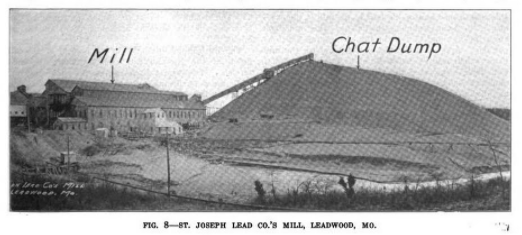
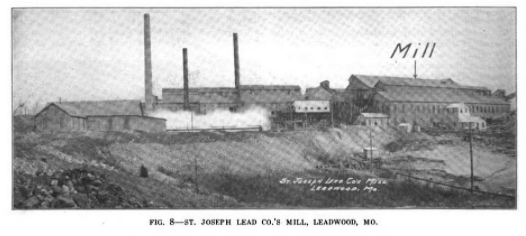
In a 2016 MSNBC opinion piece,  Hillary Clinton wrote, “Flint isn’t alone. There are a lot more Flints out there — overwhelmingly low-income communities of color where pollution, toxic chemicals and staggering neglect adds to families’ burdens.” She is right. There are too many Flints. I come from a town called Leadwood that resides in an area in Missouri commonly known as the Lead Belt. As you might guess from those names, we have a lead problem. Most of them have been knocked down and covered with rocks now, but until recently Leadwood (population about 1,000) and the small towns surrounding it had “chat dumps”–huge mounds of sand mixed with lead waste. The one in Bonne Terre, MO for example was about 160 feet high and 32 acres. I would guess the one in Leadwood was slightly bigger.

The giant mounds have been flattened, but the chat is still there. Miles of it. I’m in my 40s, and we’ve known since I was a kid that the water isn’t safe (though not the toxic levels Flint has at the moment). A few years ago, we got the attention of Erin Brockovich. She came to the area. Her team called it the worst thing they’d ever seen. Tests were run. The dirt in some people’s back yards had 10,000 times more lead than what is considered safe. Promises were made, but not a lot has gotten done.

The biggest detractors of Clinton’s article made two main points—that Clinton is only interested in Flint for political reasons and that her article is race-baiting. It would be naive to think that race doesn’t play a part in Flint and other areas, just as Clinton said. Facts are facts and anyone who says otherwise is just trying to detract from the actual problem. The economy plays a part as well. The Lead Belt is a mostly white,  poor area. I don’t think we talk enough about the similar problems the urban poor and the rural poor face. In fact, we too often separate the two for no other reason than political ideology. Environmental problems like the ones in Flint and Leadwood are not political. They are man-made disaster areas that overwhelmingly affect poorer communities. On this, we should be united.

There are, of course, different circumstances. The lead mining companies from where I live provided good jobs for people for a lot of years (my dad was a miner), but when it stopped being profitable they left a toxic mess and said they didn’t have the money to clean any of it up. This was decades ago, but a lot of people there still have fond memories of those good jobs. Some folks were actually upset that the chat dumps were knocked down. When I was a kid, we used to go play on them.  Finally, however, people there are starting to get it.

From the journal Metallurgical and Chemical Engineering, Vol XVII, 1917

When you come from a very poor community, it’s hard to get anyone with any power to listen, and the people who do have power think they can do what they want because of it. Luckily for Flint (if you can say there’s anything lucky about this disaster at all) is that Michael Moore was able to give them a national voice, and Rachel Maddow’s coverage had been fantastic, but quickly dropped off after Trump was elected. Continue reading “LEAD”

SATURDAY POETRY SERIES PRESENTS: JANET R. KIRCHHEIMER

Wonder Beans
By Janet Kirchheimer

My father went each morning to his garden.
He taught me to smell the soil to see if it was good,
to feel the dirt slide across my hands, to never
wear gloves, to stay in the middle of the row when planting seeds.
We’d look for work to do in the garden,
and sometimes there was nothing more to do
than watch the garden grow, wait for the harvest.
He thought that haricot vert were the dumbest thing he’d ever seen–
he liked his Kentucky Wonder beans, big and bursting with seeds, leaving
them to grow in the summer sun as long as possible.
Last winter he told me we couldn’t save
the parsley from the snow and ice, even though
we put blankets over it.
He got pneumonia in February.
In April, he asked me if I thought he’d get to his garden, and I told him yes.
By the end of May I brought him
cherry tomato plants to keep on the deck.
He no longer had the strength to pick
the first tomatoes that ripened in June.
August: I bring dirt from the garden
to his grave and scatter grass seed.


“Wonder Beans” previously appeared on String Poet and appears here today with permission from the poet.

Janet R. Kirchheimer is the author of How to Spot One of Us, (Clal, 2007). A Pushcart Prize nominee, her work has appeared in several journals including Young Ravens Literary Review, Atlanta Review, String Poet, Connecticut Review, Kalliope, Common Ground Review, and several anthologies and online journals. Currently, she is producing a poetry performance documentary, After, exploring poetry written about the Holocaust.

Editor’s Note: Today’s poem is a celebration of life and a poignant reminder that one day we may be remembered by what we love. Through a daughter’s eyes we see a father, watch him plant and grow, watch him love and tend the earth. Through the poet we know what it is for this daughter to love her father, and what it is to lose him. How touching her remembrance, how bittersweet the sting at poem’s end when father is returned to earth.

Want to read more by and about Janet Kirchheimer?
After – A Poetry Film
Young Ravens Literary Review
Collegeville Institute
Podium Literary Journal
Forward’s Schmooze