Cheryl A. Rice: “Remember the Goldfish Will Be Dead By Morning”

.

7506916742_3886ef474c_o

.

.

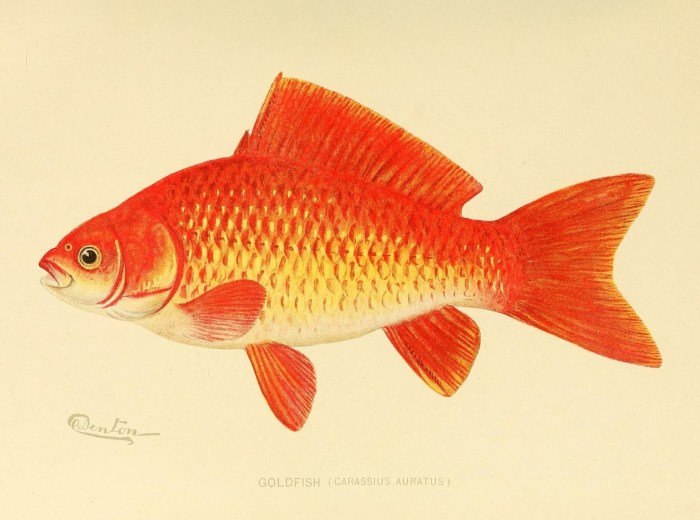
Remember the Goldfish Will Be Dead By Morning, 

as will the thready cobwebs of carnival light
strung above scraps of pavement
that’s seen better days, industrious employees
parking in a fresh lot, neatly painted
plots from end to end,
paint now faded, workers retired,
transferred or deceased.
In the morning, stars will have moved on
to other fairs, or the other side of the globe,
rides beyond not yet unplugged,
not yet spattered with vomit and sweat,
freshly hosed, engines revving.
In the morning, somewhere, there is popcorn
waiting to be heated, holding explosions
tight inside their vegetal chests.
Lemons are being sliced, water chilled,
hot dogs start their hours-long sauna.
But here in our town, all that remains
are tire tracks on the ballfield,
garbage drums full of discarded soda cups,
French fry boats anointed with catsup,
napkins cycling in the breeze.
The sun surveys the damage.
Crews pick debris from the ground,
recycling antics be damned.
And that goldfish you won
tossing rings at impossible pins?
The one you carefully slipped in an empty beer stein
when you got home late, so as to not wake him?
He’s been dead for hours, floating in
glass and baggie, back to tank, egg, essence,
gold all that remains by morning,
a sort of orange sunrise to remind the masses
of reflective vests, steel-toed boots,
the circle of days that we swim around,
in our own bags, without air,
with too much light.

.

.

About the Author: Cheryl A. Rice’s poems have appeared in Home Planet News, Baltimore Review, Up The River, and Misfit Magazine, among others. Recent books include Love’s Compass (Kung Fu Treachery Press), and Until the Words Came (Post Traumatic Press), coauthored with Guy Reed. Her blog is at: http://flyingmonkeyprods.blogspot.com/. Rice lives in New York’s Hudson Valley.

.

Image Credit: Image originally from Annual report 8th; 9th (New York State Forest, Fish and Game Commission) (1902-1903) Image courtesy of the Biodiversity Heritage Library
Jo Angela Edwins: “How It Feels to Be Bodiless”

.

20210803081311_IMG_2302

.

.

How It Feels to Be Bodiless

So often in the center of a street
a single shoe—frayed laces, fractured heel—
lies sad and inert as a dead bird,
as if he too fell from the sky and waits
like a fool for the other to drop,
but she doesn’t. Somewhere in the heavens
she dances her indie hop jauntily,
happy perhaps that her bumble-tongued mate
took at last that lonely flying leap,
lost himself in rubber-wheeled traffic,
the perfect place to bare his step-worn soul.
No one wants him now.
He will be battered by everything, elements,
Hondas, Harleys, harried pedestrians
who kick him from underfoot to save themselves
from falling in his place. He will discover
what it means to lie in the gutter.
He will, like all of us someday, understand
how it feels to be bodiless forever,
a vessel for nothing, a thing without use—
that freedom, that terrible freedom.

.

.

About the Author: Jo Angela Edwins has published poems in various venues, recently including Amethyst ReviewBreakwater ReviewFeral, and Thimble Literary Magazine. Her chapbook Play was published in 2016. She has received awards from Winning Writers, Poetry Super Highway, and the SC Academy of Authors and is a Pushcart Prize, Forward Prize, and Bettering American Poetry nominee. She lives in Florence, SC, where she serves as the poet laureate of the Pee Dee region of the state.

.

More by Jo Angela Edwins:

Housewarming Party

.

Image Credit: Chase Dimock “Albuquerque Light” (2021)

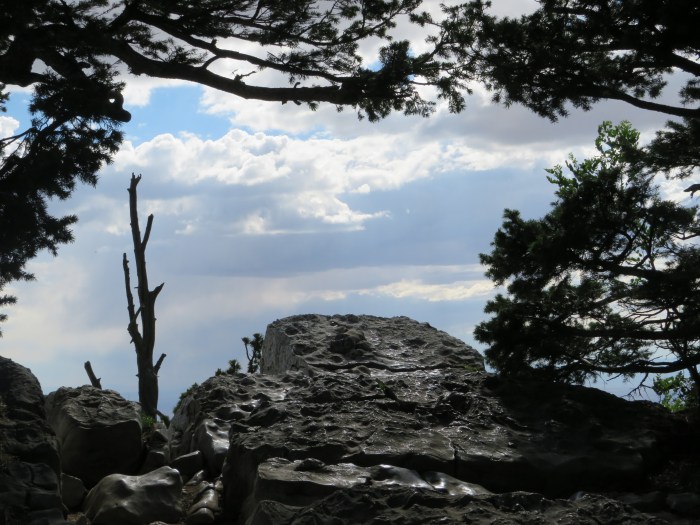
John Macker: “Epilogue”

.

20210626045458_IMG_1981

.

.

Epilogue

A pair of Cooper’s hawks
dive and explode the air
cleave the sky into uncharted territories
a frenzied cincture
a momentary communion that

admits the ground to the heavens
this first fresh autumn day has dissent
written all over it ⸺
wildflowers retreat defeated colors
fade into the middle of the earth again.

Looking up, grace is just myth rewired
silence broken into a million feathers
the practical hours and tamed
rivers lay beyond us just over
the Jemez mountains, I’m sure.

As swiftly and immodestly as they arrive
they vanish, their rhythms survive them
standing here in endangered open space
lone unknown interlocutor
their aromatic wind still in my face.

The words we say to each other now
are spirits in freefall, they search my
mind for place a holding pattern
how can the human heart remain sedentary?
Abandoned fabric of the sky they once

nuanced unravels      they won’t share the secrets
of being in the mystery      lizard bivouacked near
my boot, blinks away the sun’s engorged sparks
harvest moon rises like oblivious burning desire
an insatiable eye     a mute witness.

.

.

About the Author: John Macker grew up in Colorado and has lived in northern New Mexico for 25 years. He has published 13 full-length books and chapbooks of poetry, 2 audio recordings, an anthology of fiction and essays, and several broadsides over 30 years. His most recent are Atlas of Wolves, The Blues Drink Your Dreams Away, Selected Poems 1983-2018, (a 2019 Arizona/New Mexico Book Awards finalist), Desert Threnody, essays and short fiction (winner of the 2021 Arizona/New Mexico Book Awards fiction anthology prize), El Rialto, a short prose memoir and Chaco Sojourn, short stories, (both illustrated by Leon Loughridge and published in limited edition by Dry Creek Art Press.) In 2019, his poem “Happiness” won a Fischer Poetry Prize finalist citation, sponsored by the Telluride Institute.

.

More by John Macker:

Last Riff for Chet

Abundance

Nostalgia Poem

.

Image Credit: Chase Dimock “Sandia Peak, New Mexico” (2021)

Meg Pokrass: “Pilot”

.

service-pnp-fsa-8a15000-8a15100-8a15163v

.

.

Pilot

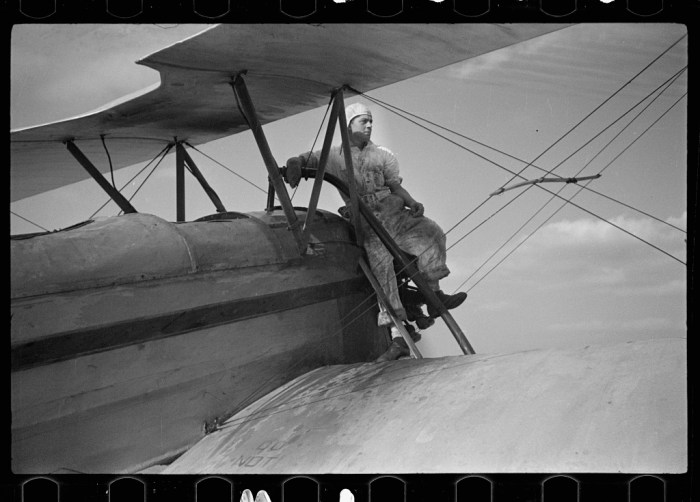
According to him he was a pilot, owned a few race cars, and chewed ice. Simple confessions. He was a “chewer” and it did not mean anything, just something to say.

Near Christmas, the cat was tired of her dating stories. She didn’t want to bore the cat anymore. So, she poured it on a bit, to get one of them to stop playing around and to take her somewhere. Why not the pilot? It was time to tell a few stories to a human, and relieve the cat. She’d do so in a restaurant, with or without ice.

“I prefer to live on the edge,” he said in a text. She almost said “most people are not given a choice”.

It seemed to her a moment of mental decline could happen when a pilot believes that he can fly over real people. Online dating is exactly this, she thought, staring up at the profile pictures of such sad, old children.

.

.

About the Author: Meg Pokrass writes stories she doesn’t know she is writing.

.

More by Meg Pokrass:

Blueberry Blue

Neurology

.

Image Credit: [Untitled photo, possibly related to: “Duster” plane spraying insecticide over a field of beans.] from The Library of Congress

Sue Blaustein: “Microscopy”

.

service-pnp-cph-3b10000-3b10000-3b10500-3b10544r

.

.

Microscopy

What’s under our skins?

                Show me –
through an illustrated cut-out,
                an incision
or window – what lies
                under soft
and folded flesh.

                What’s in there?
Zoom in, then in once more
                to see. Cell structures
revealed by swirls stained
                purple. Vacuoles,

membranes – pores
                endowed
with intelligence! Chemical
                locks, chemical
keys – receptors.
                Shapes.

What’s under our skins?

(My mother knew – from
autopsies and slides).

Away from the flaws
                and heat,
the embarrassments
                of flesh –

                attentive
and schooled
in the wonders
of magnification,

my mother
in her working days
spent hours
at the microscope.
What’s under our skins –
                our skulls?

The more you magnify,
                the closer in –
cellular, molecular,
atomic, sub-atomic ­-
everything starts
to look strangely the same.

Is that a womb, or a brain?

Fundamental
and fundamental.
                Shapes.
Coils of DNA, twitchy
                in a nucleus –

the secret codes and keys
accounting for the ways
                my mother and I
are alike and unalike.

                My mother –
who pored over
The Double Helix
when it first came out –
who could write lines
in a trip journal like:
our capable guide endlessly
                over-informed us.

                I stay informed.
I read about the frontiers of biology –

                Virus,
prion, shred
of protein.
Electron sharing and bonds
creeping along the boundaries
                between
living and non-living –
                things known,
and not yet known
                in her time,
                her prime.
                On that last trip
for which she kept a journal,
(she’d been a widow for more
than a decade by then)
she woke thinking she’d slept
all night and it was breakfast.

                It wasn’t.
It was dinner. Some other
travelers set her straight
                and she wrote:

I was informed that I was dis-oriented.

                Shapes and
chemicals create
                relationships.
Tastes and tics, a way
of making
                sentences.
A preferred way
to spend your days.
Until reaching a point
at which you,
                or yours (on
your behalf) say:
                This isn’t
what I’d call living…

.

.

About the Author: Sue Blaustein is the author of “In the Field, Autobiography of an Inspector”. Her information can be found at www.sueblaustein.com. Recently she contributed a poem to a “The Subtle Forces” podcast episode and was interviewed on the “Blue Collar Gospel Hour”. A retiree, she blogs for Milwaukee’s  Ex Fabula, serves as an interviewer/writer for the “My Life My Story” program at the Zablocki VA Medical Center, and chases insects at the Milwaukee Urban Ecology Center.

.

Image Credit: Frances Benjamin Johnston “Students in a science class using microscopes, Western High School, Washington, D.C.” (1899) The Library of Congress

Victor Clevenger: “Contemporary Tanka”

.

service-pnp-habshaer-nj-nj1300-nj1373-photos-038219pv

.

.


girl in yellow dress
looks like a bobblehead            
sings peaches by bieber
searching for canned chow mein            
half hour before closing time

        face painted like clown
        cute missouri girl dreaming
        she’s a red balloon
        being twisted tightly into hearts
        by a lover’s hands

out the madhouse
man with trucker hat desires
denver omelets
light on the onions
still enjoying a fresh breath of freedom

        st. joseph
        loud thunder & sex screams
        echo through hotel walls
        three episodes into golden girls
        i open my first seltzer

.

.

About the Author: Victor Clevenger spends his days in a Madhouse and his nights writing.  Selected pieces of his work have appeared in print magazines and journals around the world; it has also been nominated for the Best of the Net Anthology and the Pushcart Prize.  He is the author of several collections of poetry including Sandpaper Lovin’ (Crisis Chronicles Press, 2017), A Finger in the Hornets’ Nest (Red Flag Poetry, 2018), Corned Beef Hash By Candlelight (Luchador Press, 2019), A Wildflower In Blood (Roaring Junior Press, 2020), and Mourning Eyes (Between Shadows Press, 2021).  Together with American poet John Dorsey, they run River Dog. He can be reached at: crownofcrows@yahoo.com

.

More by Victor Clevenger:

$5.00 Wok

Milkman’s Mustache

Thursday Evening in September

.

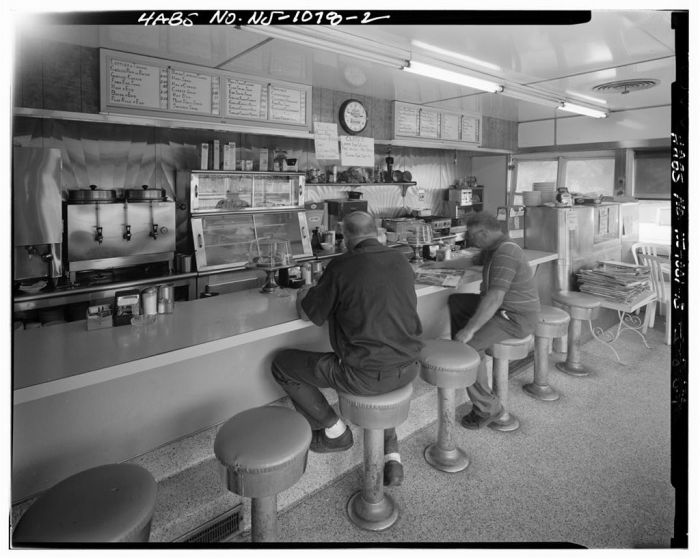
Image Credit: “INTERIOR VIEW LOOKING EAST – White Crystal Diner, 20 Center Avenue, Atlantic Highlands, Monmouth County, NJ ” The Library of Congress

Sarah Daly: “A Photograph of Two Women”

.

05733201

.

.

A Photograph of Two Women

Echoes persist,
even when the
photograph has faded.

Streets, once saturated,
are but a fine thread,
a trace of mourning.

Traffic, once an omnipresent rush,
is hushed and silent.

Skyscrapers are reduced to needles
stuck crookedly in a pincushion.

Days are lost,
others are embalmed,
if we listen closely,
can we hear their laughter?

.

.

About the Author: Sarah Daly is an American writer with work in The Round, Litbreak Magazine, and Cabinet of Heed.

.

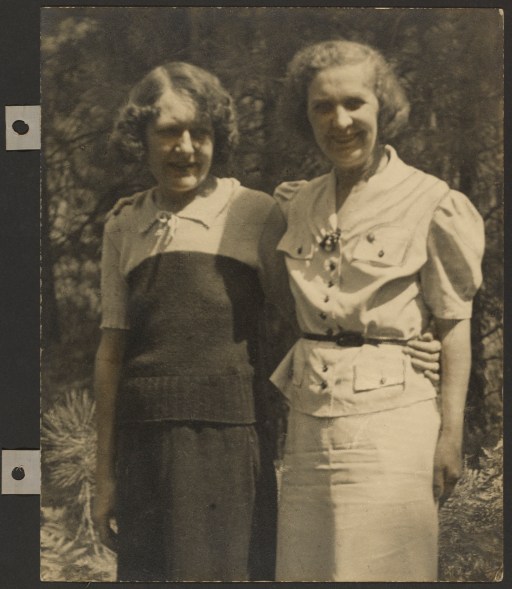
Image Credit: Louis Fleckenstein “Portrait of Two Women Standing Outside” Digital image courtesy of the Getty’s Open Content Program.

Lorraine Henrie Lins: “OST DOG”

 .

.

.

OST DOG

I admire the way they miss you,
those large neon-green posters stuck
sight-level on every light pole in town,
making sure we know your face–
that one floppy ear and roundish white
patch just under your eye.

You’ve been missing for so long,
that even I have begun to look for you,
feel that small whisper of despair on my daily drive
where I imagine the way you might sit by the door,
eye to eye with the doorknob, head cocked, ready
to bolt into the wide open yard.

I have started to miss the way you would have
slept by my feet as I worked at my desk,
the tip of your nose tucked under the smooth
curl of your whip tail, and smile to myself,
remembering how you must have done
that little dance with your feet when
it was dinnertime, the hard of your nails
ticking the kitchen floor as you moved.
You’ve been away so long that I have begun
to watch for you in the harvested corn fields
and down the sidewalks of the streets we pass,
as if you might be just around the next corner.

It’s been long enough for the faded posters
to lose their call, to wilt under snow and rain,
forgive the staples that held them to the creosote poles
and surrender the photocopy of your picture
so that all that remains is their weathered plea.

.

.

About the Author: Lorraine Henrie Lins is a Pennsylvania county Poet Laureate and author of four books of poetry: All the Stars Blown to One Side of The Sky, I Called It Swimming, Delaying Balance and most recently, 100 Tipton.  She serves as the Director of New and Emerging Poets with Tekpoet and is a founding member of the “No River Twice” improvisational poetry troupe.  Lins’ work appears in wide variety of familiar publications and collections, as well as on a small graffiti poster in New Zealand. Born and raised in the suburbs of Central New Jersey, the self-professed Jersey Girl now resides along the coast of North Carolina.  www.LorraineHenrieLins.com

.

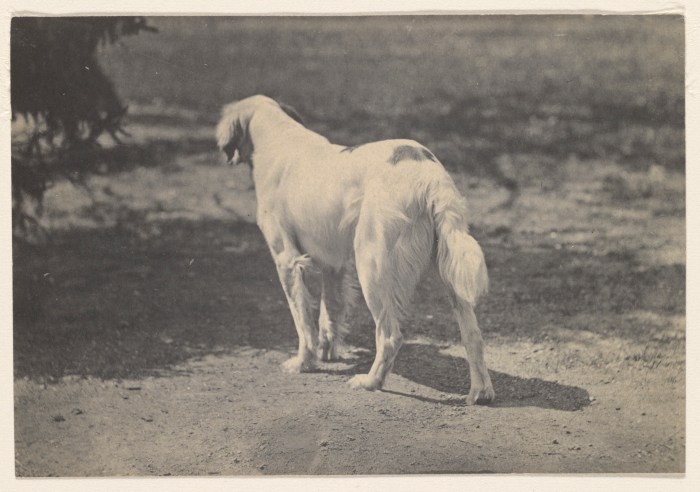
Image Credit: Thomas Eakins “Portrait of a Dog” (1880-1895) Digital image courtesy of the Getty’s Open Content Program.

Michael Catherwood: “Suffocating Lawns of Skylark”

.

service-pnp-fsa-8c16000-8c16700-8c16725v

.

.

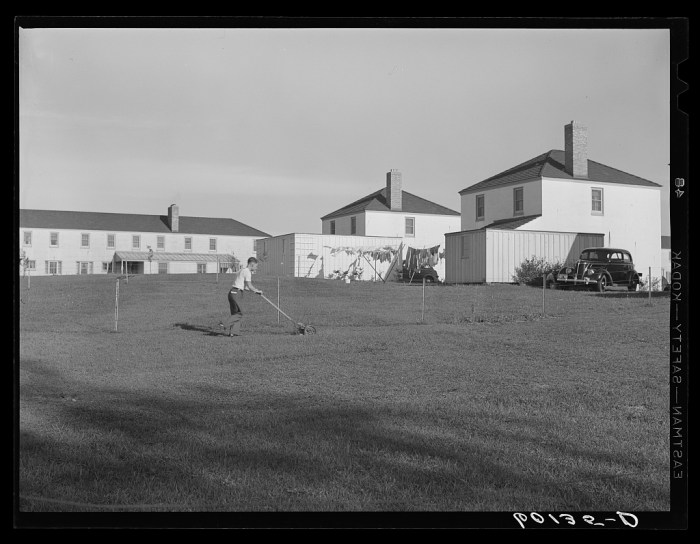
Suffocating Lawns of Skylark
          —After D. H. Lawrence’s “The Mystic Blue”

In its waking, fresh daylight wanders
as morning settles on the railed lawns
that reveal the empty toil. Alone,
our damp surgery of lawnmowers

ensure our ignorance while we trim
away time to a row’s end.
                                                    We’ve set up
this ruse to keep us masked, to hide the cuts
emptiness brings, where endless whims

stage our survival and sharpen
crumpled distances. Our blood disappears.
We have cut and aligned repetition

in these mechanical rows—are deadened
by the fatigue of senses, the grid here
a false infinity we have fashioned.

.

.

About the Author: Michael Catherwood’s latest book is Projector from Stephen F. Austin Press. Recent poems have appeared in The Common, I-70 Review, Pennsylvania English, and Common Ground Review. He’s the former editor at The Backwater Press and Associate Editor at Plainsongs since 1995. He’s a cancer survivor and lives with his wife Cindy in Omaha.

.

Image Credit: John Vachon “Resident of Greendale, Wisconsin, mowing lawn” (1939) Public domain image courtesy of the Library of Congress

AIOTB Magazine’s 2022 Pushcart Nominees

.

20211023031121_IMG_2374

.

.

As It Ought To Be Magazine is proud to announce our nominees for the Pushcart Prize.

.

Jason Baldinger: “Let Go of Atlantis”

Sam Barbee: “Hybrid”

Ruth Bavetta: “Signals”

Lisa Creech Bledsoe: “The Magician’s Handbook”

Susan Cossette: “She Waits Behind the Drapes”

Imran Boe Khan: “A Thousand Miles from Your Bedside”

.

Thank you to our nominees and all our contributors this year who have filled our site with their stunning poetry.