SATURDAY POETRY SERIES PRESENTS: MARTIN CAMPS


MOSQUITOES
By Martin Camps

Mosquitoes do not die of hunger.

There is always a leg for them

an arm or a deaf ear to their hungry voice.

You will never see the aged corpse of a gnat.

They only know about violent death:

of a body burst by a slap,

by a discharge of light or by air poisoning.

They will sink the day they find out they can

walk on the water.


(“Mosquitos” appears here today with permission from the poet.)


Martin Camps has published three books of poetry in Spanish: Desierto Sol (Desert Sun, 2003), La invencion del mundo (The Invention of the World, 2008), and La extincion de los atardeceres (The Extintion of Twilight, 2009). Has is the recipient of two poetry prizes from the Institute of Culture of Mexico and an Honorable Mention in the Bi-National Poetry Prize Pellicer-Frost in 1999. His poems have been published in The Bitter Oleander (Pemmican Press), Alforja, and Tierra Adentro, among others. He answers all email at markampz@hotmail.com.

Editor’s Note: Martin Camps is among my all-time favorite poets. His work never ceases to be breathtaking in its form, its function, and–especially–its sound. The way Camps plays with language appears, in some ways, to stem more from his Spanish-speaking roots than from an experimental poetry slant, and the effects simply blow me away. And then, of course, in all his poetic brilliance, he concludes with an epic end-line.

Want to see more by and about Martin Camps?
Email markampz@hotmail.com to buy his books directly from the poet for $6 each.
See an alternate version of today’s poem: Mosquitoes

Peticao a NASA
La Belleza de No Pensar

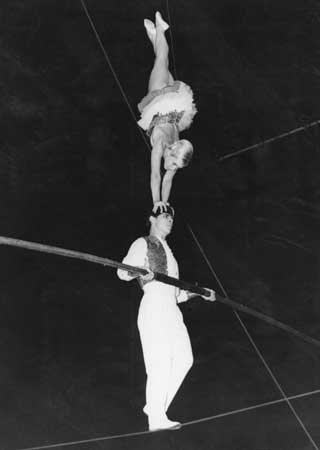
Pas de Deux on the High Wire

Photo credit: dadcentric.com

For Chelsea and Maz, whose wedding last weekend prompted me to dust this off.
And for Patti.

Pas de Deux on the High Wire
by John Unger Zussman

One Saturday, in our twenties,
We put up the tightrope.
Eyed it warily.  No sweat,
We reassured each other.
Piece of cake.

At first, we could barely manage
A few quick steps on the rope,
Stretched taut, inches off the floor.
We’d push out tentatively,
Teeter, recover, flail, step off.
Laugh nervously, try again.

No instructor, no mentor,
Just the trying, and ourselves.
Slowly we learned to center our balance,
Arms extended, touching lightly for support.
The posts grew higher, year by year,
And our moves more intricate.
We took tumbles, gathered bruises.
When one wavers, the rope jiggles,
Endangering the other.
Once I toppled from eight feet.
She came too. It took years
To recover.  The scars
Remind us how we learned.

Now we run, hand in hand, from peak to peak,
Skyscraper to skyscraper, triple pirouette,
Grand jeté, entrechat huit. I partner her
In a deep penché, the tip of her pointe shoes
Balanced on the narrow wire. It is exhilarating
And marvelous. We are confident until,
In middle age, we look down. Then we seem
Unbelievably, foolishly precarious.

Just us two. No children, families distant,
A few friends gazing up from below.
We are working without a net. It is glorious,
Yet there is always the premonition
Of the inevitable gust of wind.

SATURDAY POETRY SERIES PRESENTS: JUDITH NEWTON

LAST QUARTET
By Judith Newton

In the end,
you would no longer hear your music—
you, whose rooms had been alive with it,
whose life was Late Quartet.

I think of you and I remember Beethoven
in a Berkeley house,
the light from quiet windows
heightening the patina of well used surfaces,
ferns, like green swords,
piercing the heart of the afternoon,
and, through the swelling turbulence of the strings—
the counterpoint of intellect
serenely resonant at its labors.

To forgo your music was, for you, the worst farewell,
to live in silence, a dark prelude to what you knew would come.
I think of you in the end—a holy man despite yourself—
bearing your body’s discord with deliberate grace,
and with a tremolo of acquiescence
closing off the sweet vibratos of this world.

I think of you, in this after moment,
when the tone arm lifts, the record ends,
and Late Quartet
still dilates the impassioned air.
(“Last Quartet” appears here today with permission from the poet.)
Judith Newton lives in Kensington, CA. She is the author of several books of nonfiction and is completing a memoir: The Joys of Cooking: A Love Story. She is a food columnist for the iPinion Syndicate, and is completing a book of poetry entitled Poetry for the Immune Deficient.

Editor’s Note: Judith Newton’s poems go straight to the heart of what it is to deal with with loss as the one left behind. I was just talking about this with a dear friend of mine who suffered the loss of his partner, and, like Judith Newton, wrote his way through his struggle. I dedicate today’s post to my friend, who knows what it is to endure loss, and who is in tune with the music inherent in life and death.

Want more by and about Judith Newton?
The Joys of Cooking – A Love Story
iPinion
As It Ought To Be

SATURDAY POETRY SERIES PRESENTS: SEAN KARNS

CUTTING DOWN THE PROPERTY LINE
By Sean Karns

1. Tire Swing

He hacks at the thicket, grabs hold
of the blackberry canes,
bloodies his hands;
blackens them with juices.
He looks at his hands,
sees labor: a future in tearing
down. There are children swinging
on a swinging tire. He wants to join them.
He feels a stare; his father sits
on the porch; it’s mid-day and hot.
The yard is dry grass and dirt.
He feels the thorny sting
to take away
what is in the house
that keeps him hacking.
There’s a silk scarf
his mother left under his pillow.
The tire swing creaks.
A swing that creaks
like a deranged mosquito
singing in his ear.
They swing, seeing
how far the lake.
He rubs the blackness
from his hands,
looks at the house, its tilted porch
and chipped paint.
The dark tree-line
and forgetting the clink
of the doorknob.

2. Woods

He goes farther into the woods;
his father stares—
faces in the bark of every tree.
He wants to drop a match
on the everywhere leaves.
And then the twisting
of the bronze door knob.
He hides his face with the scarf
from the footsteps and the black
polished boots under the bed.
He gathers the sturdiest tree
limbs he can pull
with his thirteen years of strength.
With a hatchet, he cuts the limbs
into logs and hammers
them around a tree.
He stole rope
from his father’s work-shed.

3. Fortress

He peeks out of the hollow
of the oak tree.
He slips on the dewy ground.
His father’s dream-weight
pushes down on him. He swipes the mud
from his lips. The insects
sound like the twist
of a door knob. So do the branches
falling. He throws
the rope over the tree limb,
dollies up his scarf, hatchet and hammer.
There’s no higher place
for him to throw his rope.


(“Cutting Down the Property Line” previously appeared in Mayday Magazine and is reprinted here today with permission from the poet.)

Sean Karns’ work has appeared or is forthcoming in Cold Mountain Review, Folio, Los Angeles Review, Ninth Letter, Mayday Magazine, Pleiades, and elsewhere.

Editor’s Note: There is a weight to the aural nature of the words in today’s piece that alludes to a corresponding heaviness of subject matter. A narrative poem, the story is not neatly laid out for the reader, but instead consonants become palpable, and the story oozes from the language, thick like syrup forcibly drained from a tree deep in the woods.

Want more by and about Sean Karns?
Mayday Magazine (1)
Mayday Magazine (3)
Sean Karns reads his poem “A Rural Weekend”

SATURDAY POETRY SERIES PRESENTS: OKLA ELLIOTT

ON PERFECTION
By Okla Elliott

1.
My arrogance is perfect—
I want everything I say taken down
in italics. I want
footnotes longer than the original text.
Every woman and many men
will want to look into the green almond eye
of my perversion.
They will thank me
for the privilege of disinterested touch.

I claim to be made of starstuff
brought here across a million million miles.

I claim to be happy
in the inevitable loneliness.

2.
The sanctified blade is perfect.

The colossal slowness of dying is perfect.

Everything is exactly as it should be
here where a goat’s shit glistens with the water
of an idyllic river
he drank at hours ago,
hydrating his living (and dying) cells.

I have become a mystic
a perfect destiny
after all these years
of studied incredulity.

The unsanctified flesh is perfect,
I tell you,
because it always-already knew
every kind of love
our holy pornographers pretend
they invented.

3.
The slick tongue of metaphysics
flicks between stained teeth.

A tongue that could wet
dry lips or give a lecture
on Wittgenstein or lick the needy
flesh we hide (stupidly)
most of the enormous time we have.

4.
The spindle pricks the thumb wants
the needle.

A vest of goldthread
should be buried
with the dead.

Everything will rhyme
in the afterlife
as it does in the beforedeath.
It’s as I’ve
said: perfection permeates
the sound fundament
and the cracked firmament.

It’s as I’ve said, tsk tsk,
it’s perfect
just as it is.

The feast prepares itself.

***

(“On Perfection” previously appeared in Zone 3 and in the poet’s latest chapbook, A Vulgar Geography, and is reprinted here today with permission from the poet.)

Okla Elliott is currently the Illinois Distinguished Fellow at the University of Illinois, where he studies comparative literature and cultural theory. He also holds an MFA from Ohio State University. For the academic year 2008-09, he was a visiting assistant professor at Ohio Wesleyan University. His drama, non-fiction, poetry, short fiction, and translations have appeared or are forthcoming in Another Chicago Magazine, Indiana Review, The Literary Review, Natural Bridge, New Letters, North Dakota Quarterly, A Public Space, and The Southeast Review, among others. He is the author of three poetry chapbooks–The Mutable Wheel, Lucid Bodies and Other Poems, and A Vulgar Geography–and he co-edited (with Kyle Minor) The Other Chekhov.

Editor’s Note: Okla Elliot is the Co-Creator and Webmaster of As It Ought To Be. But today’s post is not about nepotism. Today’s post is about excellent poetry and the fact that you ought to be reading it. Recently Okla sent me a copy of his latest chapbook, A Vulgar Geography, at my behest. The first night I read it cover to cover, something I am almost never able to do with books of poetry. There were moments I literally had to put the book down and exclaim out loud to myself with amazement at the brilliance of a line, a moment, an idea. The second night I re-read the book, cover to cover, this time aloud. My mouth took to the words like a finely crafted dessert. The way one consonant rolled into another, the words were tangible morsels on my tongue.

I say this not because Okla is my Editor here at As It Ought To Be. Not because he is my friend, nor because he is an inspiration, though he is these things. I say this because it is true: A Vulgar Geography is a near-perfect book of poetry. From its outward appearance (a simple clean design with a lone, intricate image that reflects the book’s title) to the types of poems chosen (ranging from left-aligned to prose to experimental) to–most importantly–the poems themselves, which are finely crafted masterpieces of thought, idea, story, and word. I highly recommend you don’t take my word for it, but rather, read A Vulgar Geography and find out for yourself.

Want to read more by and about Okla Elliot?
Buy Okla Elliott’s new book, A Vulgar Geography.

Art in the Novel: Thomas Bernhard’s Old Masters through Don Delillo’s Point Omega

Art in the Novel: Thomas Bernhard’s Old Masters through Don Delillo’s Point Omega

by Jordan A. Rothacker

Last year saw the publication of Don Delillo’s fifteenth novel, Point Omega. It is his fourth book since Underworld, all four marking a new direction of his career away from sweeping doorstoppers. The slim, considerate minimalism intrigued me about this book. It begins with a description of a visual art installation, which sounds fun, and as I was just in Spain, sucking up so much great visual art at Reina Sofia, the Prado, the Picasso Museum in Malaga, and then saw this book in English on a shelf in a bookstore in Seville, it crossed my path at the right time. And also, in all honesty, I have never read a novel by Delillo and this seemed like a nice quick way to jump into the work of this author I have respected from afar. Delillo has always seemed more cosmopolitan, artistic, and thoughtful to me than most other American authors of his generation and maybe I have been saving up his books and putting off getting into him. I have owned Libra and White Noise for some time but looking at them I have always wished I owned Mao II and The Names instead as greater points of entry (for my interests) into his oeuvre.

When I returned from Spain, with many new books on my immediate list, I went straight to this small and hopefully quick read. It was just that, 117 pages and an enjoyable breeze to read. Point Omega is a slim little slip of a book full of big, big ideas. I don’t mean to sound patronizing. Don Delillo is a true artist and I prefer willfully thoughtful books to cynical, ironic ones (like so many of my generation), cute for their own sake that don’t try to say anything.

The set up and plot of the novel are just as slim as its tangible form. There is a lot of blank space in the layout that encourages form and function of the work. The first page after the title pages merely tells us when the whole novel is set “2006 Late Summer/Early Fall,” which is followed by a preface-type chapter called Anonymity, the action of which falls on September 3, we are told. The last chapter of the book, a conclusion-type chapter, is called Anonymity 2 and happens on September 4. The main action of the book occurs within four numbered chapters between these. Prefacing and concluding chapters take place in the Museum of Modern Art (MoMA), New York, and focus around a spectator of Douglas Gordon’s 2006 installation of 24 Hour Psycho, a videowork of Hitchcock’s film slowed down to span twenty-four hours. These chapters are in third person.

The meat of the work (lean meat), those four chapters tell in first-person the story of a struggling documentary filmmaker James (Jim) Finley from New York (Brooklyn) visiting Richard Elster in the California desert far east of San Diego. Finley wants to make a movie of Elster, a retired “defense intellectual,” a theoretical architect for the Bush Administration war machine. Finley envisions Elster standing against a wall in Brooklyn, he has the wall picked out, where he will just be free to talk on film, talk as a man who was in the most important rooms of the early 00s and help the public understand the invasion of Iraq. For days the men, generations apart in age, talk in Elster’s desert house; they also eat and drink Scotch. In chapter two, Elster’s daughter Jesse shows up, she brings more life to her father and enticement to Finley, and eventually she disappears, not a trace as to where. The extra life she brought to the men is gone and then some and as they search and then fall apart they leave the desert for New York. That is the whole narrative plot, but it is not what the book is about.

Point Omega is full of many ideas that are backlit by the sparse prose as much as the sparse landscape of the desert in which it is set. The titular concept is from Teilhard de Chardin. Elster tells Finley, when talking about the early influence of de Chardin on him as a thinker and what the war room was like, “‘The blur of technology, this is where the oracles plot their wars. Because now comes the introversion. Father Teilhard knew this, the omega point. A leap out of our biology. Ask yourself this question. Do we have to be human forever? Consciousness is exhausted. Back now to inorganic matter. This is what we want. We want to be stones in a field’” (52-53).

In the first chapter, before we see Elster, Finley tips us off to all of this. “The desert was outside my range, it was an alien being, it was science fiction, both saturating and remote, and I had to force myself to believe I was here. He [Elster] knew where he was, in his chair, alive to the protoworld, I thought, the seas and reefs of ten million years ago. He closed his eyes, silently diving the nature of later extinctions… Extinction was a current theme of his. The landscape inspired themes. Spaciousness and claustrophobia. This would become a theme” (20). This also leads to the constant connection between space and time in the work. The title words even resonate with this motif.

But where is the “art” (as in visual art) and why those two book end chapters? Ah, that is the brilliance of Delillo. It is all there in the text, the theme and the narrative scenes that illustrate the theme. At just another evening of Elster, Jesse, and Finley sitting on the porch looking out at the descent, the didactic patriarch speaks about the location, “‘There’s none of the usual terror. It is different here, time is enormous, that’s what I feel here, palpably. Time has preceded us and survives us’” (44). Jesse asks about “the usual terror” and he says it is from the way he feels time in a city. “Cities were built to measure time, to remove time from nature. There is an endless counting down, he said, When you strip away all the surfaces, when you see into it, what’s left is terror. This is the thing that literature was meant to cure. The epic poem, the bedtime story” (45). Finley then chimes adding film to this list and the conversation turns back to the film of Elster that he wants to make and probably never will.

However, for the reader there already is a film in mind, 24 Hour Psycho. It is planted there at the beginning and if you flip ahead in the book as you are reading, you know it is there to bring you out of the work. Actually, two pages after this conversation about the terror beneath reality that art was meant to cure, we find out that Finley has taken Elster, on their second meeting, to see 24 Hour Psycho at the MoMA. Elster never tells Finley what he thinks of the film/installation, but we (and Finley) find out through Jesse what he thought, “‘it was like watching the universe die over a period of about seven billion years… it was like the contraction of the universe… the heat death of the universe’” (47). These weighty lines fit the line of thought we already know about this man who goes to the desert soon after this, as well as adding something to our memory of the first Anonymity chapter.

The third-person narrator of Anonymity describes an unnamed man watching 24 Hour Psycho. The narrator describes the film/installation and what the man watching sees and thinks of what he sees. At one point two men walk into the room and the narrator watches them watch the film/installation and after page forty-seven we know who those two men are. It is the fifth day that the man has come to the museum to watch this and tomorrow, the last day of the installation, he is back, which we read in the final chapter Anonymity 2. What does the man get out of the experience of dedicatedly viewing this piece of art? “The less there was to see, the harder he looked, the more he saw. This was the point, to see what’s here, finally to look and know you are looking, to feel time passing, to be alive to what is happening in the smallest registers of motion” (5-6), the narrator tells us, and we are given wonderful art criticism of this piece. The whole chapter is full of wonderful art writing about this piece.

Reading Point Omega makes you wonder how it was written, where the germ began. Could it be as simple as Delillo viewing the film/installation, being profoundly affected by this piece of art and creating the unnamed man in the chapter out of himself? Maybe he even saw the two men described walk into the dark room and the back story (and forward story) he imagined for theme became the book? Either way, it all fits together perfectly and harmoniously.

After the body section set in the desert, when we return to the MoMA for Anonymity 2, we are given a possible crux of the work. Viewing on this last day, the man notices an error in the sequence where Detective Arbogast is stabbed and falls backwards down the stairs. He reflects on the error, “Maybe the error is not detectable at 24-frames per second. He’d read somewhere that this is the speed at which we perceived reality, at which the brain processes images. Alter the format and expose the flaws. This was a flaw that a person might tend to excuse unless he was a man of attenuated viewpoint. If that was him, then that was him” (103). For the reader, Elster seems to be just this attenuated person, and so does Delillo, the grand architect of all of this. The episodes in the desert, the thoughts of Elster, 24 Hour Psycho by Douglas Gordon, the description of experiencing 24 Hour Psycho, all feed and fold back into themselves, all one within this slim book, a skinny Ouroboros.

Point Omega is a beautiful and brilliant book (beautifully brilliant) and made me want to try more Delillo, but first it made me want to experience more thoughtful books that featured a piece of visual art in its thought process. How many books do this? Written art criticism is as old as writing itself. Directing my mind to the ancient world, I first flash upon Herodotus and his descriptions of Egyptian architecture. But how many novels make a piece of art that already exists out there in “the real world” the centerpiece of their narrative or theme?

Hugo does this for the Notre Dame Cathedral in Hunchback of Notre Dame, but of course that piece of architecture has served as more than a mere “piece of visual art” to millions of people over hundreds of years. That century gave us Wilde’s Portrait of Dorian Gray, James’ Portrait of a Lady, and Zola’s The Masterpiece, but again none of those involve visual art from “the real world.” Last century and this one so far have a slim selection of example—none really come to mind (in non-fiction, Miller’s Big Sur and The Oranges of Hieronymus Bosch and Hemingway’s A Moveable Feast are wonderful though)—except for the likes of The Da Vinci Code and The Girl with the Pearl Earring, and other thrillers or historical romances. There is actually a whole genre industry of art history mysteries, but I am trying to focus on literary fiction here.

A fun example I can draw from my shelf, though not quite a novel is Julian Barnes’ A History of the World in 10 ½ Chapters (1989). This very thematic collection of stories contains one called Shipwreck, that not only gives a narrative of the events leading up to the incident that inspired Gericault’s painting The Raft of the Medusa, an analysis of the painting, but also a fold out color print of the painting right there in the book. Barnes and his publisher go above and beyond to give us the painting, but his analysis does provide a detailed prose rendition of the painting. That is what I am looking for. The prose rendering of a work of visual art that exists already outside the narrative of a novel.

This literary phenomenon I liken to sampling in music or collage in visual art (or even the whole medium of photography or film, if you want to go further with the argument), the writer is trying to appropriate the aesthetic impact of another artist’s work into his own. The big difference from sampling and collage is that those involve pre-existing works incorporated into another work of the same medium. The prose rendering of a work of visual art that already exists is just that, a prose rendering. The writer is recreating the work in a new medium and must play upon to some degree the reader’s associations. This literary phenomenon requires and deserves an essay (maybe a book) or exploration unto itself and thankfully I have chosen another book to hold up next to Delillo’s.

Also on that same book shelf in that bookstore in Seville was Old Masters (1985) by Thomas Bernhard, an author I always wanted to read and a book by him that already sat in my amazon wishlist. I owned Correction, but as in the case of Point Omega, this one seemed a nice short book of subject matter that interested me to employ as a point of entry into Bernhard’s work. What I knew already, and was confirmed by the book’s back, was that Old Masters was about two men conversing at a museum in front of a painting, Tintoretto’s portrait, White-Beard Man. It was not a painting I particularly knew, but this book seemed to perfectly suit my purposes so I was off to reading.

With Old Masters, the experience of reading the book seems as necessary to describe as the work itself. Initially, it seems that this is an author who has strong ideas on form and function in aesthetics and a possibly deep contempt for the reader. Bernhard is certainly not one to baby a reader, that is sure enough, but reading the thoughts and words of his characters it is clear that this also corresponds to a greater intention in the work. What I am getting at, firstly, is the way the book is laid out. It is only 156 pages, not too long, a short novel really, just a bit longer than Point Omega. However, look more closely, it is a solid 156 pages, no chapters, so no chapter breaks, and not a single indention, not for a paragraph nor a quotation of dialogue. The book is a solid block of text from start to finish (I checked, and Correction is just like this too). That puts this novel in the 250 or maybe even 300 page range of conventional novel format.

That is not that long really, but there is a weight to the reading experience. The quick plot is that Atzbacher, a philosopher, is going to meet his older friend Reger, a musicologist and columnist, in the Kunsthistorisches Museum in Vienna on a Saturday in front of Tintoretto’s White-Bearded Man. Reger sits in front of this painting on the same bench every other day in the morning and has done so almost without fail for almost thirty years to think. Atzbacher saw him here yesterday and Reger asked him to meet him again the next day. This is rare, because Reger never goes two days in a row, never on Saturday’s and never asks Atzbacher to meet him. As far as action goes, that is the plot at its thickest point. There is also a museum guard named Irrsigler who is in the room and has kept that bench reserved for Reger these thirty years.

The actual process of reading this block of text and therefore the process by which Bernhard tells the story is quite crazy and brilliant in its own right. Here is the first sentence:

“Although I had arranged to meet Reger at the Kunsthistorische Museum [his italics] at half-past eleven, I arrived at the agreed spot at half-past ten in order, as I had for some time decided to do, to observe him, for once, from the most ideal angle possible and undisturbed, Atzbacher writes.” (1)

That “Atzbacher writes” is the only indication that this work is in third person, literally until the very end; seriously, the last half page gives us a couple “Atzbacher records,” but otherwise the whole work is told within what Atzbacher is writing or recording. His present tense narration is minimal since all he is doing is looking at Reger and eventually sits by him. Mostly he is thinking of Reger and flashing back to many things Reger has said or said someone else said. This leads to some amazingly beautiful and hysterically convoluted sentences. The perfect example I kept showing people while reading this to demonstrate the extreme of Bernhard’s style is on page nine:

“Discretion, that is your very strong suit, I said to Irrsigler, I reflected, while regarding Reger who was in turn regarding Tintoretto’s White-Bearded Man and who, for his part, was being regarded by Irrsigler.”

It is not wrong to find humor here, Bernhard indicates as a subtitle that this work is “A Comedy,” and it is this sentence where I draw my first comparison to Delillo. On page eight of Point Omega you have a moment in the MoMA where the narrator describes the moment where the unnamed man observes Elster and Finley in the installation room: “Everybody was watching something. He was watching the two men, they were watching the screen, Anthony Perkins at his peephole was watching Janet Leigh undress.”

Before more comparisons, there is more that needs to be understood about Old Masters. Delillo, with sparse and exacting language lets images fold back in on themselves, while Bernhard gives a process of language or thought folding back in on itself. It is through language that Ouroboros takes form in this novel. It is an angry, vicious, twisty, turny rant. Flipping through my copy of dense text I see so much of my own marginalia, like breadcrumbs in a forest, and many sentences I have even marked with my own little drawings of a snake about to eat its own tail. By page fifty the notes I was jotting about this book refer to it as “punk,” with a righteous anger always on the line of nihilistic-anarchism. Reger hates institutions; he also has a lot of anger towards Austria specifically (maybe this is where a lot of comedy lies, in self-parody, since Bernhard was notoriously critical of his own country).

On page twenty-four, mid-rant about art historians who tour groups through the museum he blurts out that, “The teachers are the henchman of the state, and seeing that this Austrian state today is a spiritually and morally totally crippled state, one that teaches nothing but brutalization and corruption and dangerous chaos, the teachers, quite naturally, are also spiritually and morally deformed and brutalized and corrupt and chaotic.” And on page twenty-eight, “Humanity today is only an inhumanity of the state, I reflect. Man today is only a state man, and in consequence he is today only a destroyed man and a state man as the only humanly possible man, it seems to me.” This punk political attitude continues through the whole book and relates to the title and the White-Bearded Man centerpiece. “State-commissioned art is what Reger calls the paintings hanging on these walls, including even the White Bearded Man [his italics]. The so-called old masters only ever served the state of the Church, which comes to the same thing… Just as so-called free man is a utopia, so the co-called free artist has always been a utopia” (29). Reger finds “the old masters most profoundly repulsive and again and again I continue to study them” (31) and warns to “beware of penetrating into a work of art… you will ruin each and every one for yourself, even those you love most” (32). The method he gives to handle all of this is to turn anything we observe for a long amount of time, a picture, “our parents, our superiors, if we have any, into caricatures, and the whole world into a caricature” (57) noting that “we only control what we find ridiculous” (59).

More personal than punk (but doesn’t the political always begin personally?) Reger gives us some explanation for his rage, for in his own twisted logic he blames the great institutions of society for his wife’s death (just a year before the book is set). In his words, “A crime has been committed against me, a municipal-governmental-Catholic-ecclesiastical atrocity that I can do nothing about” (126). It is here I should note that the last half of the book shows a strong rise of new dominant theme, the master/slave dialectic. It is subtly there all along, in the didactic relationship Reger has towards Irrsigler and Atzbacher, initially a master pupil relation, but by the end the reader is given constant examples of master/slave. On page one hundred and four Reger shows his place in the dialectic, “I have to go to the old masters to be able to exist, precisely to the so-called old masters, who have long, that is for decades, been abhorrent to me, because basically nothing is more abhorrent to me than these so-called old masters here at the Kunsthistorisches Museum and old masters generally, all old masters, no matter what their names are, no matter what they have painted… and yet it is they who keep me alive.” After this it is everywhere, Reger’s dependence on his wife for not only her love, but her economic support, and yet she was his pupil and he gave her daily lessons in poetry and philosophy (and then the pupil is teacher: “we must quite simply and quite ruthlessly brush aside… any philosopher whom our wife fails to understand… and move on” (131); and even with their own housekeeper: “surely the housekeeper is the mistress nowadays, not the other ways around. The so-called powerless are the powerful today” (149).

As I mentioned earlier, the Ouroboros of this work is in Reger’s tangents and his turning of each point back in on itself. It is a dialectic in itself and it begins early. On page sixteen Atzbacher relates that Reger has said, “Actually, I have never, ever since childhood, hated anything more than museums, he said, I am by nature a hater of museums, but it is probably just because of this that I have been coming here for over thirty years, I indulge in this doubtlessly mentally determined absurdity.” This six pages after it is mentioned that to Reger the Kunsthistorisches Museum is his “mental production shop.” One of the finest examples of this is towards the end where Reger states that “Anything kitschy is human… there can be no doubt about that. And so is high art and the highest art” (97).

At one point in all the mess of his ranting, Reger does lend some thoughts to my own side investigation as to what is happening when a writer does a prose rendition of a piece of visual art. For Reger it is an act of possession, and not only possession, but through literature assuming the role of an artist of another medium. He says, “ I certainly regard myself as an artist, that is as a critical artist, and as a critical artist I am also creative, that is obvious, hence a performing and creative artist… That is my greatest delight: to know that as the author of these works of art for The Times I am a painter and a musician and a writer in one” (52). This is also an indication of how Regers mind and rhetoric works. Positive or negative the thought, he always takes it as far into transformative abstraction as he can. Most of his thoughts are negative though and that leads to creating a general tone for the whole work.

What role does Tintoretto’s painting have to do with all the rest of this novel? There is constant mention of the painting, the presence of the painting, but not once is there the description or “prose rendering” of the painting. Though Reger identifies as a painter since he is able to make the arts he writes about in his criticism of them, Bernhard doesn’t see fit to perform this role. For Atzbacher we have a moment where he notes his thoughts on a Reger-inspired rant “while observing Reger and simultaneously, through Tintoretto’s White-Bearded Man, gazing into my childhood” (25). He is able to use the painting as a transformative tool, a trick he must have learned from Reger. And Reger has sat here for over thirty years, and this painting has changed his life, he met his wife here, on this bench in from of this painting. Grateful for that, he continued to return, even bringing his wife, to this “mental production shop.” Towards the close of the novel we can finally here Reger say, “Looking at the White-Bearded Man… I have always really loved the White-Bearded Man. I never loved Tintoretto, but I have loved Tintoretto’s White-Bearded Man. I have looked at this painting for over thirty years and I still find it possible to look at it, there is no other painting I could have looked at for over thirty years” (150-151).

The constant repetition in the way Reger speaks (or the way Atzbacher relates Reger’s speech) is ultimately very musical. By the end of the book I was suspecting that there is a grand form here of refrains on subjects and repetitions of not only words and phrasings but also ideas to the point of leitmotifs. I wished I could read more of it at one sitting, could experience the work at the speed and attention level that Bernhard must have intended and maybe deserves, but I got the idea. It reminded me of Faulkner’s Absolom, Absolom, in how there same story is told and retold and each time there is just a little more information and by the end of the book you have the whole story. Here at the end you have Reger’s whole life up to the present moment in the museum. The true comedy comes at the end of this crazy work, which I won’t give away in case anyone wants to read this book and have a difficult but fulfilling literary experience, but I will confirm, that a book that is constantly vicious and angry with many arguments towards suicide or nihilism does end humorously, and not even by way of black comedy.

It is mere coincidence that I chose to read and review both of these novels together. For me in my deciding, they both looked slim, both by authors I had never read before, and both contained a piece of visual art from the real world. After those obvious shared traits, coincidences mounted towards synchronicities. Both books are bookended by third person (the Anonymity chapters on Point Omega and the subtle indication of the third person state of the whole work in Old Masters). Elster is to Finley as Reger is to Atzbacher, and Atzbacher gives voice to Reger in the way Finley hopes to give voice to Elster. Both show an anger towards institutions that have failed us (the administration that led to the Iraq War, rendition sites, and torture in Point Omega and the every institution in Old Masters). In both there is a missing woman who once had a didactic relationship with the patriarchal figure (the daughter Jessie who disappears in Point Omega and the deceased wife of Old Masters).

And finally, in regards to these losses, these old men, masters in their own rights, have come to similar conclusions. Reger tells us that, “All our lives we rely on the great minds and on the so-called old masters… and then we are mortally disappointed by them because they do no fulfill their purpose at the crucial moment” (144) and then Finley reiterates this while observing Elster, “I thought of his remarks about matter and being, those long nights on the deck, half smashed, he and I, transcendence, paroxysm, the end of human consciousness. It seemed so much dead echo now. Point omega. A million years away. The omega point has narrowed, here and now, to the point of a knife as it enters a body. All man’s grand themes funneled down to local grief, one body, out there somewhere, or not” (98).

And notice how well, and in the same way, both of those quotes employ their respective titles? I believe that all those characters (by the ends of the books surely) and even their creators would scoff at my amplification of these coincidences to synchronicities, but I couldn’t relate them if they weren’t there.

***

Jordan A. Rothacker is a PhD student in the Department of Comparative Literature at the University of Georgia.

SATURDAY POETRY SERIES PRESENTS: W. TODD KANEKO

NORTHWEST POEM
by W. Todd Kaneko

You will find no herons perched
in this poem. No salmonberries or pine
cones on sodden paths through cedar.
But here is an old woman who slices
her calendar into weeks lost and weeks
to come—those piles sifting together
while she waits for the leaves to turn
into blankets full of moths and ravens.

Here is a girl who dwells in dollhouses
deep in this poem, porcelain boys hiding
fingers from whales’ teeth and butterfly
knives. There are no miles of shoreline
lapping at ends of days like wolves,
no fishladders swarming with sockeye,
only a skeleton where the ocean once was.

Extinction begins as absence, ends gaping
like a surgery, a hole in my chest
marking that mythology we call home.
Mount Rainier does not drift phantomlike
in this poem, but here is that old woman,
crooked under the weight of a century.
She waves off that flock of dark birds
thronging overhead, threatening to pluck
eyes from sockets, tongues from mouths,
until all we can discern is the tide washing
over bare feet, the sound of wings.


(“Northwest poem” previously appeared in Lantern Review and is reprinted here today with permission from the poet.)

W. Todd Kaneko lives and writes in Grand Rapids, Michigan. His stories and poems can be seen in Puerto Del Sol, Crab Creek Review, Fairy Tale Review, Portland Review, Southeast Review, Blackbird and elsewhere. He has received fellowships from Kundiman and the Kenyon Review Writer’s Workshop. He teaches at Grand Valley State University.

Editor’s Note: In response to today’s poem I say, “Thank God for stunning moments in poetry!” If not God, then The Universe, Creative Energy, The Muse. Here’s to W. Todd Kaneko’s muse, at the very least. She is a creature to be awed and honored.

Want to read more by and about W. Todd Kaneko?
Blackbird
Superstition Review
Word Riot

Is There a Gene for That?

PKU support wristbands. Photo credit: Mid-Atlantic Connection for PKU and Allied Disorders (MACPAD), http://www.macpad.org. Used with permission.

Is There a Gene for That?
By John Unger Zussman

In the eight years since the human genome was sequenced, the search has been on for genes that underlie various diseases and disorders. We seem to be obsessed with genetic explanations for human physiology and behavior.

And when we find them, we often assume that biology is inescapable destiny. For example, some women with no evidence of cancer, but with one of the breast cancer mutations (BRCA1 or BRCA2), choose to have preventive mastectomies rather accept the elevated risk of breast cancer they have inherited. In the race between nature and nurture, nature seems to be winning—at least in our minds.

I want to argue here that nature vs. nurture is the wrong way to think about this question. Not everyone with a BRCA mutation develops breast cancer. Something must be intervening between genetics and outcome. The problem with BRCA is we don’t know what.

There are other conditions, however, where we do know the intervening factors. So, to illustrate this new perspective, let’s examine a serious disease called phenylketonuria.

Never heard of it? Perhaps you’ve noticed the fine print on a can of diet soda that says Phenylketonurics: Contains phenylalanine. If you’ve wondered what those words mean and whether you should avoid diet soda—you should, but not because of the warning—read on.

Phenylketonuria (FEE-nil-KEE-tun-YUR-ia, but you can call it PKU) is a rare gene-linked condition that affects about 1 out of 10–15,000 people in the U.S. Phenylketonurics have trouble producing an enzyme that metabolizes the essential amino acid phenylalanine (one of the building blocks of proteins). Phenylalanine is found in most proteins in the human diet (including breast milk) and the artificial sweetener NutraSweet (aspartame), which is used in many “sugar-free” food products and over-the-counter medicines. If phenylalanine builds up in the blood, it can outcompete other amino acids in transport across the blood-brain barrier, starving the brain of other amino acids that are necessary for development. Serious cognitive impairment can result, including mental retardation, ADHD, brain damage, and seizures.

In developed countries, most newborns are screened for PKU soon after birth by testing blood for phenylketones. If PKU is diagnosed, parents are advised to start the child on a special diet low in phenylalanine. Some phenylalanine is necessary, but it must be strictly limited. This means severe restrictions on meat, chicken, fish, eggs, nuts, cheese, legumes, milk, and other dairy products, and no aspartame. Infants’ diets are often supplemented with special formula; as the child grows, pills or special protein foods can substitute. By following this diet, phenylketonurics can avoid phenylalanine buildup and its serious effects, and lead fully normal lives.

When I first lectured about PKU years ago, it was believed that phenylketonurics could go off the special diet by age 5-6 and no further damage would result. However, later research confirmed the benefits of extending the diet to age 18, and now, “for life.”

Since PKU is caused by an anomaly in a single gene that interferes with enzyme production, you might think of it as a textbook example of a completely genetic disorder. (Technically, it’s a recessive autosomal disorder, in which the child inherits one copy of the mutation from each parent.) And from the point of view of a child fed a “normal” diet, you’d be right. Whether she suffers the cognitive damage of PKU depends completely on whether she has two copies of the mutation. It’s 100% nature and 0% nurture, right?

Well, no. Because diet mediates the effect of the gene. So consider the situation from the point of view of a child with two copies of the mutation. Whether she suffers the cognitive damage of PKU depends completely on her diet. It’s 0% nature and 100% nurture!


Diet

Normal

Low-phenylalanine

Gene

Normal

Normal

Normal

PKU mutation

Cognitive impairment

Normal

Something is wrong here, and I would argue that it’s our way of considering nature and nurture in “either/or” opposition. Nature and nurture always work together in “both/and” collaboration. It’s the interaction of nature and nurture that determines our outcomes. In other words, it’s 100% nature and 100% nurture.

When you think about it, that’s true almost by definition. Genes are not directly apparent in our physiology and behavior; they are always expressed through the physical environment of our bodies, brains, and their surroundings. In a recent blog post, California geriatrician Walter Bortz talks about the Pima Indians of Arizona, who have one of the highest rates of type 2 diabetes in the world.

When these folks pursue their very physically active lives south of the border, in Mexico, they have no diabetes. But as soon as they cross north of the Rio Grande, they find McDonald’s and a far-more leisurely life.  They soon thereafter develop diabetes. Their genes certainly have not changed during their trip north, but their lifestyle did.

If the Pima have an underlying genetic predisposition for diabetes—and no such genes have yet been found—it is masked until they enter the world of fast food and couch surfing.

(Bortz is an octogenarian marathon runner who just published his seventh book, Next Medicine, a dire diagnosis and optimistic prescription for the American health care system that is well worth reading.)

When you start to look for the nature/nurture interaction, you see it everywhere. We generally think of physical height as highly heritable. But the genes for tallness can be undermined by poor diet. Bortz cites research by John Komlos of the University of Munich, who has studied population height over time. Two hundred years ago, the average Dutch man was 3 inches shorter than the average American. Now, he is 3 inches taller, at 6’1”. Genes don’t change this quickly—but diet and nutrition do. “America has gone from being the tallest nation in the world,” observes Komlos, “to the fattest.”

In the last few decades, we have learned a great deal about the factors that influence genetic expression. Everything goes into the mix, from the prenatal environment of your mother’s womb, to the viruses you happen to be exposed to, to the billions of microbes that live in your gut, to the air you breathe, the water you drink, and the food you eat. (Of course, these factors can also cause mutations in our genes, not part of our genetic inheritance, that can cause cancer and other disorders.)

In addition, the whole science of epigenetics has emerged—the study of what turns genes on and off—telling us that environmental factors like diet, behavior, and environmental toxins are key. I’ll leave epigenetics to a future post, but significantly, these epigenetic switch settings can be passed down to future generations. Not only does environment influence the way genes are expressed, it also directly influences those genes themselves.

So the next time you hear a claim that some characteristic or quality is 80% (or 50% or 20%) genetic, think twice. At best, it’s an oversimplification; at worst, it’s wrong. Many factors intervene between gene and outcome. Nature and nurture are invariably, inextricably intertwined. If we understand that, we can make wiser decisions about our health and our lives.

Sources:

To learn more about PKU, see Wikipedia, PubMed Health, or the National Society for Phenylketonuria. I also found good online explanations of PKU by Tracy Beck and Dr. Janet Starr Hull (who takes on aspartame as well).

Copyright © 2011, John Unger Zussman. All rights reserved.

SATURDAY POETRY SERIES PRESENTS: CATHERINE PIERCE

FIREFLY
by Catherine Pierce

Its six legs coated with disease, it’s vulgar
like the aphid, the earwig. Its eyes are nightmare

globes. It does not love you or thank you
for the glass jar with air holes. Still, you want it

in your hands. Not for its yellow light like the soft
glow in the wooded cabin. Not for the vibrating

wings against your palms like champagne
bubbles bursting. Not even for the perfect

metaphors that ride on its sunflower-seed back—
the catching of a gone childhood, the memory

of keeping something alive. You pursue it
because it’s a slow beast, easily captured. Because

it hovers and floats. Because you can win at this,
and because it will fly off when you unfold

your hands, single-minded, unmoved by its loss.

 
(“Firefly” previously appeared in AGNI and is reprinted here today with permission from the poet.)
Catherine Pierce is the author of Famous Last Words (Saturnalia, 2008) and The Girls of Peculiar (forthcoming from Saturnalia in 2012). Her poems have appeared or are forthcoming in Slate, Ploughshares, Boston Review, Best American Poetry 2011, and elsewhere. She lives in Starkville, Mississippi, where she teaches and co-directs the creative writing program at Mississippi State University.

Editor’s Note: I saw my first firefly this summer. I know, for those of you who grew up in the Midwest or on the East Coast this is a bit blasphemous, but we don’t have fireflies in San Francisco. I’ve dreamt of seeing one for as long as I can remember, and this summer, when conditions were right, someone who loves me very much and wanted to make my dream of fireflies a reality took me to an enchanted garden, and, lo and behold–magical creatures of my imagination! To me, today’s poem is as if looking at fireflies through Alice’s Looking Glass. I never understood why people would want to contain the creatures, how children could tear their glowing orbs from their bodies and wear them on the tips of their fingers.

Today’s poem is about the darker side of the allure of the firefly. Those human traits that make people want to capture them, to keep them in jars, to pursue only for the sake of the chase. Of course, as with so much poetry, today’s poem is also about human nature. “It does not love you or thank you / for the glass jar with air holes. Still, you want it / in your hands… Because you can win at this, / and because it will fly off when you unfold /your hands, single-minded, unmoved by its loss.”

Want to read more by and about Catherine Pierce?
Catherine Pierce Official Website
The Paris Review
Blackbird
Diode
Anti-Poetry

To Have Squeezed the Universe Into a Ball

To Have Squeezed the Universe Into a Ball:
German Expressionism at MoMA

by David Gibbs

The exhibit, German Expressionism: Works From the Collection, at the Museum of Modern Art takes the viewer through the transition of early twentieth century Europe, with its curiosity and reliance on the seedy undercurrent of society; its prostitution, drinking, and cajoling, to the trauma of World War I and its chaotic aftermath. Mood shifts sharply, in this mixed media show, from praise and adolescent sexual excitement to a resigned bareness as the dark, yet sprightly atmosphere, dims, revealing its underlying misery, portrayed by disfigurement, rage, and a hopeless sunken-ness of faces and figures. In paintings and illustrations, hair thins and crooks, cut short in its wildness, as optimism flinches so decisively, and dismissively, that it dissolves for the duration of the movement.

Franz Marc’s pre-war woodcut, Fantastic Creature, from the illustrated book, The Blue Rider, gently persuades the viewer of the vitality of daydreams. A lean animal, yellow with grey stripes poses, its features flat and mellow. In the background, a rock draws the viewer’s attention with its height and color. The tone of red, along with its three green spots resemble a strawberry turned upside-down, with two green leaves growing out if its peak. The terrain lumps, wrinkly, like knuckles with a strong shadow adorning the upper crest. Its shade even resembles a pale skin. If it were not for the creature, the landscape would echo an underwater setting with its soft edges that hint at a slow delicate tide. The tenderness implies a welcoming of the imagination and of the pleasures of creativity. The stokes are smooth and without tension. Color is emphasized for its enjoyment. The lack of details suggests a meditation with space, even an allowance for investigation. The character of the piece is hopeful, even juvenile, in its ease.

In Ernst Ludwig Kirchner’s painting Street, Berlin and Erich Heckel’s Franci, prostitutes take the foreground as models, but with hardly a distinction of their profession; it is the accompanying text from either museum or artist that clarifies the women’s social positions. This emphasis implies that a curiosity surrounding the taboo of their vocation still exists now as it did then, and that pointing it out will excite something forbidden in viewers, and will create an interest to see them as objects of beauty and desire.

While this elevation of infatuation stimulates viewers, the artists are cautious not to “prostitute” them. Eroticism is pushed aside to stress the tension between voyeurism and exhibitionism. Men look, and obviously the artists’ looked, and now we look at the intimate displays of sexual and social values. It is as if the artists want the viewers to ask themselves why they are attracted to the art; whether it is observational, lustful, empathetic, or out of disgust. They want the viewer to have to express something of themselves, something perhaps they did not realize. And this is the urge of Expressionism, a release (and perhaps relief) of unbearable emotions. It is mindfulness so tender, in its spectrum of enjoyment to melancholy, that it stings when kept silent.

No doubt a mind so sensitive could be crushed so brutally by war. The elongated eyes that restricted empathy and sadness, it seems, to a soft watery stare grow hard and alien in battle. The illustrations of Otto Dix depict shadowy heaps wearing gas masks, hands filled with grenades. Colorful swirls are substituted for dark ink blots, as if black blood forced out of arteries. Gestures are frozen in action. Slaughter rivets the viewer in this frightening series as bodies lose their vigor. Flesh becomes bone. Skin becomes uniforms and dirt, suggesting trenches running through each body. Things bloat. Eyes shrink. The images hardly encourage the viewer to think struggle, victory, or even a philosophy of death straying too far from a dull acceptance of its emptiness. All vibrations melt to slim shimmers.

George Grosz’s Explosion mixes the geometric slivers of Cubism with the bright hues of early Expressionism, as if straining for a balance between them. The affect is layered and overwhelming, mimicking the citizen’s scramble as all around them gleams fiery in a red brilliance the color of meat. Tall buildings and factories burst and topple. Bricks stop in mid-flight. Smokestacks billow like a canon’s fire. The source of light and darkness, cutting the cubist angles, come from the windows of burning buildings, drawing one’s fragmented focus from the people crammed into the canvas’s corner to the explosion itself, as if suggesting this mentality an outcome of war. What vibrant colors that were reserved for people pre-war, now enhance the dehumanization taking place. Detail is now allowed for industry and mayhem, while people are split and reduced to abstract.

The emphasis of business and economic interests intensifies as post-war art is used for rhetoric against both communists and capitalists. Often, capitalists are depicted as fat, dumb-witted, and sinister, while communism is portrayed as a vehicle of starvation and chaotic mob violence. Each side cries oppression, and each side shows skeletons and hangings as sad consequences for supporting the opposition. In one illustration, business men have picked up the guns of dead soldiers to continue the war in the streets. They huddle in a blown out bunker, like generals forced to fight alone at the end of a gruesome battle. The final mood is grim and satirical, as if each cruel joke had fought alongside each soldier, hardening to a near indifference on the front lines.

German Expression: Works From the Collection finishes its three month run at MoMA on July, 11. For more information and pictures of the work, go to http://www.moma.org/explore/collection/ge/index.

***

David Gibbs is a candidate for the MFA in Creative Writing at The New School. His poetry has been published, or is forthcoming, in the Columbia Poetry Review, CutBank, Nimrod, and other journals. He is an editor at The New York Quarterly and the Graduate Coordinator of the Prison Writing Program at the PEN American Center. Additionally, between July and October, he will perform, alongside other artists, Roman Ondak’s performance art piece, Good Feelings in Good Times, at The New Museum. He lives in Brooklyn, NY.