SATURDAY POETRY SERIES PRESENTS: LAURA E. DAVIS

LEDavis-2014

By Laura E. Davis:


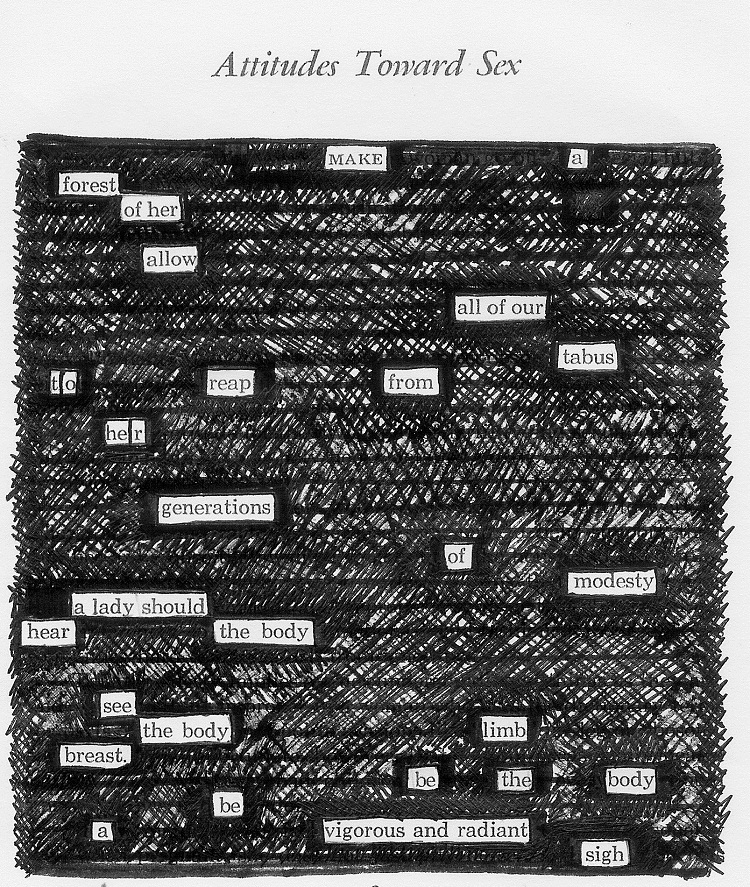
ATTITUDES TOWARD SEX

attitudestowardsex.small


THE BOYS ARE ALWAYS TALKING

about their cocks, naming
names—Rebecca, Elizabeth,
Ashley—we see these girls
all lined up, waiting to admire

the boys’ cocks. And the boys
talk about size of their cocks,
seven inches becomes ten, then
thirteen. They tell us how

they measured their cocks
after their first wet dream: they
woke up sweaty, quick-covered,
got their cocks hard again, pulled

out the ruler. Boys and cocks
everywhere. A boy shows his
cock to a girl on the playground.
Another boy watches girls from

a parked car while he touches
his cock. On the subway, boys
unzip their pants, put cocks
on display. Baby boys discover

their tiny cocks during every
diaper change. I didn’t see
my own clit was until I was
twenty-three. I had to hold

a mirror just to see it rise
like slow-motion stalagmite.
Had to hold back my own skin
just to show it to myself.


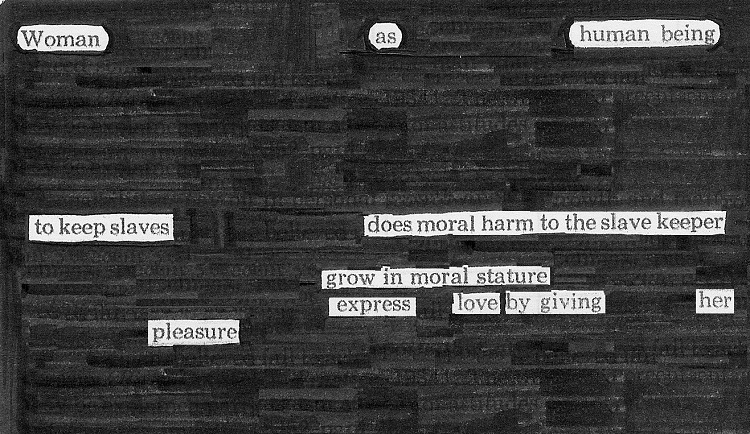
WOMAN AS HUMAN BEING

woman as human being.smaller


“Attitudes Toward Sex” was originally published in iARTistas. “The Boys Are Always Talking” was originally published in Muzzle. “Woman as Human Being” was originally published in Toad Journal. These poems appear here today with permission from the poet.


Laura E. Davis is the author of Braiding the Storm (Finishing Line, 2012), founding editor of Weave Magazine, and founder of Submission Bombers. Her poems are featured or forthcoming in Toad, Stirring, Corium Magazine, So to Speak, Muzzle, and others. Laura teaches for Poetry Inside Out, a K-12 a bilingual poetry program in San Francisco, where she lives with her partner, Sal.

Editor’s Note: This week I had the honor of working with an artist to create an artistic response to the Hobby Lobby Supreme Court decision. I have already written an editorial response to the ruling, but I wanted to speak out against this injustice in many ways, through many voices.

Today’s poems speak for womankind. They speak for our bodies, for our vantage point within a man’s world. When read together today, they are meant to be a shout from the rooftops. That no one exercises control over our bodies but ourselves. That we are human beings whose rights are superior to the rights of corporations. Yes, that we are human beings. Beautiful, complex, powerful human beings who are as capable of a battle cry as we are of “a vigorous and radiant sigh.”

Want to read more by Laura E. Davis?
Dear Outer Space – Laura E. Davis’ Blog
“Quiet Lightning” on Youtube
Buy Braiding the Storm from Finishing Line Press
“Relics” in Sundress
“Vessels” and “Red Storm” in The Doctor T. J. Eckleburg Review

Franz Douskey: A Micro-Interview and Three Poems

 westmidnight

Franz Douskey has published in Rolling Stone, the Nation, New York Quarterly, The New Yorker, and Las Vegas Life. His readings and travels with such notables as James Dickey, Allen Ginsberg, Ai, Charles Bukowski and F. D. Reeve are legendary. Some of his writing has been performed by Frederica Von Stade of the Metropolitan Opera Company, The Yale Glee Club and The Heaths. Along with writing, Franz Douskey produces radio shows for WQUN, Quinnipiac University, and hides out with the horses at Giant Valley Farm.

The following interview took place via email and the poems below are reprinted from West of Midnight: New and Selected Poems with permission of the author.

***

Okla Elliott: A thought that returns to me regularly is that in the table-of-contents of a journal, prose is broken up into fiction and nonfiction, and a lot of people are intensely serious about that distinction. Poetry, however, is not divided in such a way, so readers are left to assume whatever they prefer about a poem’s factual status. Of course, it’s the metaphor and joy of invention that finally carries all writing, no matter its genre or relationship to historical fact, but, that said, I think poems by war veterans or abuse victims or even highly paid lawyers that depict their lives as accurately as possible might gain something by being read as aesthetic depictions of real events. I bring all this up because I get the sense that many of your poems would be classified as creative-nonfiction-in-verse, if we bothered to make this sort of distinction for poetry. I am thinking particularly of your poems “Remembering James Dickey,” “Eric,” “Burning the Gypsies,” and others. Could you speak a bit about how your personal experience and travels or historical facts have informed the content (or even the form) of your poetry?

Franz Douskey: Personal experience and travel are strong forces of my writing. I like being there. About “Remembering James Dickey”… We got to know each other during the New York Quarterly annual Poetry Dinners at the Paris Hotel. We stumbled through that very dignified place often enough that the staff got to know us and would lead us safely away from their guests to preserve the hotel’s reputation. “Eric” was a student. One of those who came around to “take” my classes even when he hadn’t signed up. I still recall that phone call. “Burning the Gypsies” isn’t from direct experience, but the result of three separate forces that came together: my research of the Holocaust, my books of Gypsy life and lore, and Hell, I’m part Hungarian. Disturbing what we do to each other. Not every experience turns into poetry, but I find it difficult to be creative, inventive, etc. Enough extraordinary people and events have been part of my life that I seldom look inside. There is a Delphic maxim often ascribed to Socrates, “Know thyself.” I have no interest in knowing myself. What a dull book that would be.


OE: What got you started on poetry? And what do you think helped you develop most as a poet?

FD: Reading Kenneth Patchen, both prose and poetry, got me started writing. What came out was poetry. What helped develop my writing was travel. When I was excited by an author’s work, I sought out his and her books and, then sought them out. I visited Kenneth and Miriam Patchen often at 2340 Sierra Court. I was the only visitor allowed in the house, except for Kenneth’s dentist. Travel and reading caused me to visit Galway Kinnell, in Seattle, Henry Miller, at Big Sir, George Hitchcock, in Santa Cruz, and while living in Tucson I was strongly impressed by the poetry of Richard Shelton. I met a lot of writers there, including Raymond Carver, John Weston and Charles Bukowski. I traveled to several places, including New Orleans, with Bukowski, Gypsy Lou and Jon Webb, Bukowski’s first publishers (LouJon Press).

As I published more often, I traveled and did readings with Robert Penn Warren, James Dickey, William Packard, Allen Ginsberg and F. D. Reeve. Some of the Ginsberg-Douskey readings are in the Ginsberg Archive, at Stanford University, in Palo Alto. So I’d have to say, reading, traveling and getting to know the writers was a strong foundation.


OE: What advice might you give young poets today?

FD: Me give advice? First thing that comes to mind is: Why care what other people think? Self censorship is deadly for every human, and that goes triple for writers and especially poets. One time in a stop over at O’Hare, the plane attendant announced that our ground time would be brief Brilliant. How right she was and is. We don’t have forever. These bones are rented and we don’t know when the lease is up. Write, write, write, then revise, leave the work alone, go back and reread it, revise, revise and revise, knowing that revising is every bit a part of the creative process as writing down those original sparks. Go to readings, leave work early, travel, put yourself in weird experiences, even dangerous ones as long as you have an escape plan. Read a few writers, but make certain that you don’t fall in love with their style. Constantly become yourself. Leave the bough. Take on life and leave all blame behind. What you think and how you write are two elements uniquely you. And never take advice from anyone.


 ***

Beirut

things move quickly here
the roads are mined
they have trucks just to carry
human parts

I miss you a minute ago
I was smoking and out of the corner
of my eye I thought I saw your head
on my pillow I guess I’m losing
my mind

death scares me
I’ve never seen so much of it
bodies on the roads
blood seeps through shirts and blouses
heads leak and mouths eat dirt

and death could come now
while I smoke and listen to music
anyone might be the enemy
it is scary

you should see the faces of the living
worse than the dead

ten years ago it was different
now we are traveling
into something cold and dark

sometimes I think I’ll never see you–
if I get shot up
they’ll send what’s left in an empty glove
waving goodbye like a flag


***

Cat Dying of Cancer

too sick to do anything else
she twists in a chair to lick herself —
this is strange
because she has cancer
of the tongue

I guess it’s clean but I don’t let her lick me

one night I’ll turn around and see nothing in
her eyes
but me in my white robe leaning over her

her tongue will’ve fallen out and slid behind
the cushion

one day my sister will come over with her
kids
and the one who searches the furniture for
money
will pull out a piece of dried fruit
only it’ll be tongue of cat

as is his habit he’ll probably eat it

next time his granddaddy asks him
cat got your tongue? only you and I will know


***

Breton Speaking

First of all, there are the demented
fritillaries and raucous hummingbirds.
Yesterday Rimbaud came over to watch
Fantasy Island. His cough hasn’t improved,
still he won’t stop smoking.

It is difficult here. We hardly see
anyone. The night is lacerated by downpours
of shadows, a violent silence wings down
from the vertiginous, embroidered stars.

There are massive snails in the woods.
Trees are toothpicks in their jaws.
We lose old friends every day. Some of us,
especially Camus and Char, wonder if this
is heaven or hell. Celine says
it’s Paris, after the war.

Our wives are still on the other side,
wearing satins and sachets,
a minimal sign of virtue.

Did I tell you about the bats? Last year
only five people lived to tell about them.

Then there are the parties, equally deadly,
that one is expected to attend. Verlaine
threw up a week ago, and he still hasn’t
been able to eat anything but Wheatena.

Eluard hasn’t gotten over dying. He says
he wasn’t ready. He has something that
would clear his reputation. He has sent
a letter of protest to God,
the true originator of surrealism.

Meanwhile, any hope for hypogeous
restoration dwindles.

I once said, The future is never.
I didn’t know how right I’d be.

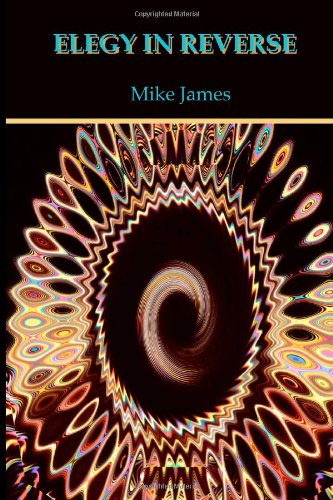
A Review of Mike James’s Elegy in Reverse

Mike James Elegy in Reverse

A Review of Mike James’s Elegy in Reverse

By J. Andrew Goodman

Elegy in Reverse is a tense poetry collection exploring how loss and absence manifest. Family, friends, lovers, talents, and faith are shadows made measurable by experience and reverence in Mike James’s eighth collection, released by Aldrich Press earlier this year. James’s verse reminds us that what we hold dear is perishable and that words are often not enough to hold these things accountable for leaving. His poetry is plainspoken but evocative, fully rendering the familiarity of longing and grief for that which has a propensity toward leaving. Amid such an exodus, James captivates readers with his rapturous voice.

The characters of James’s past are made tangible by his written memory. In the early pages of his collection, readers are introduced to his mother and his alcoholic father; the latter is deceased and the former presumably so. In “Jailbird,” his father invents a dance, “the prison shuffle,” that the son enjoys, but his mother refuses to join:

when i was with your father
i had enough dancing
to do me
until cows or jesus
came home

she always
laughed
when she said that
as if she were saying it
for the first time

In economic verse, James details the family situation of his childhood: His father goes or returns to prison. His mother hopes to prevent her son from making similar choices. She makes light of her husband’s antics, yet reveals in doses the continuity of the past, her worry refreshed.

His mother appears sparingly throughout the collection, despite James’s apparent fondness of her, while his father returns frequently. The collection contains a number of heartbreaking poems about his father’s alcoholism, which “cost him a sense of direction,” ultimately turning him away from his family. The son is left only with his memory, piecemeal and bitter. James seems to believe he has inherited such transience. Or, possibly, he recognizes this as a feature of human nature, the human condition. He expresses “a sad anger” toward most loss or abandonment, writing in a poem later in the collection that “an old friend says leaving is contagious.” This sets a precedent for the remainder of the book.

Despite his ability to make good use of them, James recognizes that words often escape or fail us as well. In “Message at Babel,” James alludes to the biblical account of God confounding the human language. As part of a short series of poems within the collection that questions the necessity of disparity in faith, James explores through a lens of mourning what it means that Eve was possibly judged “before she even chewed,” that Job’s wife was silenced by her children’s “faces / so stiff in death.”

Still, James shows us clearly that language and voice help diffuse the power of death and grief. Our memories become stories, become physical. “I don’t know what to make / of the language / of grace” James writes in a poem about refusing to offer a prayer before a meal with his wife. The litany and ritual of biblical language are not as significant or endearing to him as experience itself:

those words / don’t cling to me / the way a blanket does / on mid-winter / mornings / / or the way we cling / to one another / at night / as we swim / across the ocean of our bodies / past the edge of our wants / / the night sky full of stars / mariners used / for passage/ their breath filling sails / with a word / that can be a taunt / a promise / or something close to grace / / home

James’s refusal isn’t a rejection of faith, but of its language, poor in its appraisal of our desires and necessities. He suggests silence is its own grace in “However Bright the Sun” and “Wild Apples.” In labor, we work through our grief and unpleasantness. We forget our losses, even though their accumulation manifests into a shadow, “some days . . .  into a taste.”

The dichotomy of what is unreal as it exists in reality is essential to James’s collection. He is visited by his father’s ghost, and they converse. Eden’s inhabitants are capricious, envious of Eve’s taste. James even defines an elegy as “a love poem to an abstraction / once touched.” It seems, then, that with poetry James is enabled to seek the abstraction through language, to define absence by its bounty. The way the monk in “The Monk’s Dream” seeks God’s face during sleep or contemplation but can think only of hawk’s feathers and an empty bowl is how we, with James, seek the unreal through the limitations of the real.

More than a reconciliation of grief, Elegy in Reverse is a love poem to language and the surprising result of what happens when we’re able to say the right thing. Even when describing that which is fleeting, Mike James’s voice is nascent, emerging. He is never at a loss for words.

Mike James, Elegy in Reverse. Aldrich Press, 2014: $16.00

***

J. Andrew Goodman is a graduate of Murray State University’s MFA program and an intern for the independent literary publisher, White Pine Press. He currently lives and works in Louisville, Kentucky.

SATURDAY POETRY SERIES PRESENTS: JENNY SADRE-ORAFAI

Sadre-Orafai

KARAJ
By Jenny Sadre-Orafai

When I miss her, I open my popout map.
I spill my face into the streets of Tehran.
I hide in Laleh Park. I read street names
aloud, like I’m reporting to someone.
I pretend I see things no one else can─
who took the Peacock Throne, how the burnt
city fell. I say Karaj like I’m telling you your future.


Today’s poem was originally published in Thrush Poetry Journal and appears here today with permission from the poet.


Jenny Sadre-Orafai is the author of four chapbooks. Her first collection Paper, Cotton, Leather will be published this fall by Press 53. Recent poetry has appeared in Redivider, Thrush Poetry Journal, PANK, Rhino, Sixth Finch, ILK, iO: A Journal of New American Poetry, and Poemeleon. Recent prose has appeared in The Rumpus, The Toast, and Delirious Hem. She is co-founding editor of Josephine Quarterly and an Associate Professor of English at Kennesaw State University.

Editor’s Note: I fell in love with today’s poem because it so intimately and distinctly tells the poet’s story, and yet, this is not her story. I have my own Karaj, and anyone who has ever loved a city that lies on the other side of the world—anyone who has ever loved a city by way of memory and longing—speaks the language of this poem. I am reminded, too, of Danusha Laméris’ beautiful poem, “Arabic,” of the ways in which love—of a language, of a people, of a place—remain with us across the span of distance and time. When Jenny Sadre-Orafai leaves us with her (killer!) end-line, I know what my future holds. I know what city waits for me on distant shores.

Want to read more by Jenny Sadre-Orafai?
Official Website
Two poems with audio in PANK
Creative nonfiction essay with audio in The Rumpus

Lyn Lifshin: A Micro-Interview and Three Poems

lyn

Lyn Lifshin: A Micro-Interview and Three Poems

by

Okla Elliott and Lyn Lifshin

Okla Elliott: You organized A Girl Goes into the Woods by themed sections (autobiography, relationships, family, war poems, and so forth). How did you decide on these particular themes, and how did poems that might fit in more than one section end up where they did? Also, if poems were written years apart yet fit the same theme, what differences did you find in your own thinking on the theme?

lyn2Lyn Lifshin: Though I hadn’t thought of it until you asked the question, it seems many of my books (all three Black Sparrow books—Cold Comfort, Before It’s Light, and Another Woman Who Looks Like Me—as well as Persephone) are arranged in a similar way with similar themes. In contrast, are the many books that focus on one theme—all the equine books: my just published Secretariat: The Red Freak, The Miracle; The Licorice Daughter; My Year with Ruffian; and Barbaro: Beyond Broken. And many other books are one theme: Malala; Knife Edge & Absinthe: The Tango Poems; Tangled as the Alphabet; Blue Tattoo; Marilyn Monroe; The Doctor Poems; etc. Actually I had not realized until looking thru some titles how the one theme book is so prevalent!

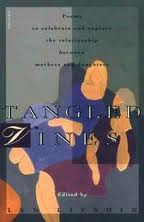
As for how I decided on these particular themes: when I first started writing, I wrote mostly political poems and was referred to as Mr. Lifshin. Later I wanted to show the variety of my work, not just political poems but erotica, family poems, nature poems, love poems, poems of place and of course, mother and daughter poems. (I had written no mother and daughter poems when I edited Tangled Vines, a mother and daughter anthology that stayed in print in various printings and versions for about 20 years—but from that time, it became an obsession for many years) Some poems were triggered by requests by editors doing anthologies: Richard Peabody ‘s Marilyn Monroe and Barbie anthology, got me going on poems that turned into my own books, as did the request for poems about Malala, Joni Mitchell, Dick for a Day, requests for poems about an earthly Jesus—a request for poems about Obama led to a series, as did requests for poems about September 11.

Sometimes I’ve wanted to do a collection of new poems but often the editor/publisher wants to do a best of. For A Girl Goes into the Woods I selected what I thought were the best and strongest poems whether they were new or old. It’s hard to say what difference I found in new and old poems on the same subject. I know sometimes when I read old poems, I change the language but it’s hard to make any generalizations. It’s true some poems could have fit in more than one section but mostly I think they are where they should be! I’m not sure I can give a true answer about how I may feel differently about a certain theme when I wrote it in the past and now am writing about it again. I think it would vary too much from poem to poem.

OE: Your poems “Barbie Wonders about Buying a Coffin” and “Thirty Miles West of Chicago” both touch on childhood and death in quite different ways—the former by playfully personifying a child’s dolls, the latter with a dark and heart-wrenching heaviness. Tell us a bit about these two poems, how you came to write them, and maybe discuss the wildly different styles employed.

LL: As I mentioned, when Richard Peabody asked for Barbie poems, I did intenselyn3 Barbie research not ever having a Barbie doll myself and just imagined her in a variety of situations— enough to do a whole book of Barbie poems. I don’t really remember when or what mood I was in when I wrote “Thirty Miles West of Chicago.” At different times of my life and in different places I seem to write at different times of the day. Somehow I remember when I first began, I stood at the kitchen counter. More recently, I write on the D.C. Metro going to ballet, an hour metro ride going and coming back, or in a cove in the living room in an apartment rented in DC with Janet Reno on one side, a drug dealer across the hall and the owners of the Fifth Column, a night club—they always came back about 3 am, loudly. Always thought they were selling drugs too—but it was income tax evasion or something like that. I wish I remembered the circumstances—I just don’t.

OE: What’s your current project? What can readers look forward to in the near future?

LL: After publishing 5 books this past year and having some of the most stressful experiences in and out of publishing, I planned to take a real break and just dance—Argentine Tango, ballroom. But some road blocks there. But I did get back and took a private class this week. In the shelf above my desk, I have about 60 spiral notebooks—I still write poems by hand and then am always way behind typing them up—now they are howling, waiting for me. Some of them go back to the early nineties…so that is a huge enormous undertaking and not a lot of fun since it’s hard to read my handwriting and the references. But forthcoming in July is Luminous Women: Enheduanna, Scheherazade and Nefertiti, a totally different kind of theme for me. It started off as a project with a painter—selecting women thru history who left an indelible stamp but the plan never materialized and I was left with poems about these three women (and also Pachamama—so I suppose that could be a book on its own) and another small book due in the fall, Moving Thru Stained Glass: The Maple Poems.

***

Thirty Miles West of Chicago

paint chips slowly.
It’s so still you
can almost hear it
pull from a porch.

Cold grass claws
like fingers in a
wolf moon. A man
stands in corn bristles

listening, watching
as if something
could grow from
putting a dead child

in the ground.

***

All Night the Night Has Been

lightening with moths

white behind the walnuts

If a woman couldn’t sleep
and came to this window
in this light her skin
would glow like bones

Clouds over the full moon
even with the wind

What would have been nuts
look like limes
on the white stones,

it sounds like some-
one tapping on a glass
coffin. It sounds

like someone tapping
from within the tree

***

Taking My Mother to the Bathroom

I lead her, a
child waking up
from a nightmare,
dazed by light.
She lags, hurries
then, half cranky,
half grateful.
She wants the
door shut, then
says open it,
wants my hands
the right way,
wash in between
my fingers. She
says the wash-
cloth is too
wet, too cold,
too soapy. The
towels are too
heavy. You don’t,
she spits, cover
your mouth. Go
home, you should
not be here to
see me like this.

***

Lyn Lifshin is the author of over 100 books, and her work has appeared in such journals as American Poetry Review, Another Chicago Magazine, Georgia Review, Iowa Review, The Literary Review, New York Quarterly, and Ploughshares, among many others. The above poems are included in A Girl Goes into the Woods: Selected Poems and are reprinted here by permission of the author.

A Review of Lena Divani’s Seven Lives and One Great Love: Memoirs of a Cat

Lena Divani Seven Lives

A Review of Lena Divani’s Seven Lives and One Great Love: Memoirs of a Cat
Translated from the Greek by Konstantinos Matsoukas

By Jennifer Dane Clements

Forget, for a moment, the ubiquitous internet cats. Put aside the grumpy one, the cross-eyed one, the dwarf one with extra toes, the one who slides through empty boxes. Let’s get the hard part out of the way: This is a novel from a cat’s perspective, offered up at a time when cats have gone strangely viral. But unlike so much hipster-cat culture, this work takes itself seriously.

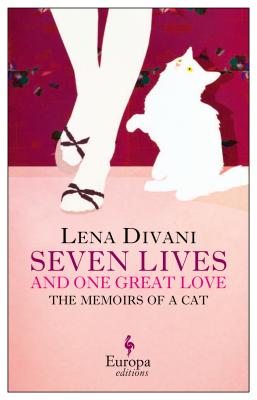
Indeed, Lena Divani’s Seven Lives and One Great Love: Memoirs of a Cat (translated by Konstantinos Matsoukas)—smart, earnest, and not without a healthy dollop of  whimsy—comes closer to anthrozoology than anything to do with a cheezburger.

Welcome to a world in which humans are given names like Madam Sweetie or The Damsel, and our protagonist—a stark white stray on the last of his lives—is called Zach. Cultured and articulate enough to merit entry into the feline intelligentsia, Zach leads the reader through his consciousness with the cadence and tone of a Liam Neeson or Jude Law, something deep, whisky-stained, and British. Perceptive, literate, and not so subtly arrogant, our narrator understands from the moment he’s born into a feral cat colony that he’s destined for greatness, and in his first breath decries his mother and his siblings as lesser-than.

Zach sees himself as a muse in the making, seeking to position himself as the newest entry into the canon of cat/writer relations: “According to all credible sources, all writers, great and small, talented and mediocre, have been good friends to us. Edgar Allan Poe, Colette, Balzac, Patricia Highsmith, Emmanuel Roides, even the demented Philip K. Dick, they all drew inspiration from us.” His literary aspirations lead Zach to accompany two well-to-do writers in their Athens flat, where he attempts to edge his way into their hearts and writings.

But humans are a challenging breed: We overcomplicate, we go against nature, we don’t open ourselves to others. “Your delusion that you are masters of this universe has become plain ridiculous, already,” Zach tells us. “You have made your life unlivable. You’ve become suspicious. You are scared to touch humans in case they bite your arm off. You are friendless. And thus, you have need of us. Whereas we once approached you for food, you now beg us for some sustenance for your deprived soul.”

Yet Zach has mythologized these complexities in such a way that he wants nothing more than to earn human love. He indicts mankind in one breath, then romanticises his particular human in the next.

And therein lies the heart of Seven Lives: That to love is to observe, often without understanding. To let those observations not interfere with affection but to strengthen it, to challenge its simplicity, to acknowledge imperfections as a part of the adored. That perhaps those we love most are always a foreign species, in one way or another, subject to study and examination through the curious act of loving.

The cat’s love in Seven Lives is pure and fearless, but never uninformed. We readers could take from this a lesson or two: how the smallest of encounters can mark others in profound ways; how we may judge in abstractions and love in specifics. In its quirky, unapologetic way, Divani’s novel is a lesson in considering the needs, the wants, and the perspectives of those utterly unlike ourselves, and how that consideration makes us yet more capable of empathy, more capable of becoming increasingly attuned to our own experience. And ultimately—if we may say so without insult to our feline friends—more human.

Lena Divani, Seven Lives and One Great Love: Memoirs of a Cat. Europa Editions, 2014: $15.95.

***

Jennifer Dane Clements received her MFA in creative writing from George Mason University, where she served as Editor-in-Chief of So to Speak: A Feminist Journal of Language & Art. A writer of prose and plays, she has been published in WordRiotNerve, and Psychopomp and has had plays produced by Capital Repertory Theatre (Albany, NY), Creative Cauldron (Falls Church, VA), and elsewhere. Clements currently serves as a prose editor for ink&coda. More at jennifer-dane-clements.com.

SATURDAY POETRY SERIES PRESENTS: SPLIT

30m0dbb


from SPLIT
By Cathy Linh Che:


THE FUTURE THERAPIST ASKS ABOUT RAPE

This morning, I watched a woman shatter
the thin ice on the pavement. I made the bed,
tucked in the sheets, and in the window,
I saw reflected my mother’s face.

Men in my life walked in and out of the rooms,
tramping snow. My mother shushed me,
and my father with his powder keg hands
pulled up a pair of clean black socks.

It isn’t what you think.
My father was a soldier.
He taught me nothing about men.

They are an empty barrel.
You’re not supposed to look into
a gun you dismantle

to try and see its parts.


HOME VIDEO

There are flowers on this bed, an elbow planted by an ear.
No, you cannot touch this breast. No darkness, no shatter,
and no, no pendulum. The past is a blood clot lodged inside
your lung.

                                                  *

In the living room, shapes move against the wall. You are
wearing a thin dress. You watch Beetlejuice while he moves
his fingers over your white underwear. You watch the screen
and see his fingers. Your brothers are in the room, but they
never seem to notice.

                                                  *

Behind the lens is the father. Mother offstage calls, Con gai
nay
. On the phone, Con gai thuoi, which means, This girl. This
girl’s rotten. This girl like swollen fruit. She cuts off the
bruises. She teaches me to cut.

                                                  *

He rises to the surf. It detonates with a sheering crash.
Inside each wave is a barrel. In each barrel is a vacuum that can suck
you in, spin you round, snap your bones if you tumble the
wrong way.

                                                  *

If I say, I have been touched. If I say, by my cousin, then, a
neighbor boy and then another. If I say no, I didn’t want it
from my first boyfriend. There was blood and membrane
and he didn’t believe me. If my body can be a box. If I can
close it up. If it has to be open. Who will touch me again?


POMEGRANATE

I open my chest and birds flock out.
In my mother’s garden, the roses flare
toward the sun, but I am an arrow

pointing back.
I am Persephone,
a virgin abducted.

In the Underworld,
I starve a season
while the world wilts

into the ghost
of a summer backyard.
My hunger open and raw.

I lay next to a man
who did not love me—
my body a performance,

his body a single eye,
a director watching an actress,
commanding her

to scintillate.

I was the clumsy acrobat.
When he came, I cracked open
like a pomegranate

and ate six ruddy seeds.

I was the whipping boy.
I was thorny, barbed wire
wound around a muscular heart.


Today’s poems are from Split, published by Alice James Books, copyright © 2014 by Cathy Linh Che, and appear here today with permission from the poet.


SPLIT: “Che effectively weaves the trauma of the Vietnam War into her own personal trauma, making herself a war victim—only her war is not against enemy combatants, but against her past.” —The Philadelphia Review of Books

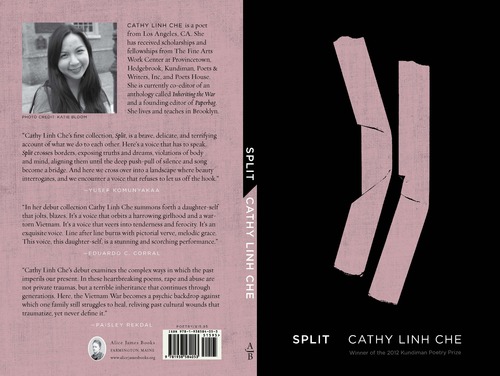
“Cathy Linh Che’s first collection, Split, is a brave, delicate, and terrifying account of what we do to each other. Here’s a voice that has to speak. Split crosses borders, exposing truths and dreams, violations of body and mind, aligning them until the deep push-pull of silence and song become a bridge. And here we cross over into a landscape where beauty interrogates, and we encounter a voice that refuses to let us off the hook.” —Yusef Komunyakaa


Cathy Linh Che is the author of Split (Alice James, 2014), winner of the 2012 Kundiman Poetry Prize. She has been awarded fellowships and residencies from Poets & Writers, Poets House, The Lower Manhattan Cultural Council’s Workspace Residency, and the Jerome Foundation.


Editor’s Note: Words—my words—seem ineffective here. But I was deeply moved by this poet, by this book, and so I will try. Split is a sacrifice; raw and unrelenting. It is blood and memory and gasoline. It is the truth no one wants to hear, that we all need to hear. But it is more than the phoenix choking on ash, thrashing to be free. It is lineage and heritage, truth offered up in the name of a history, a family, a self. This is a stunning book by a bold and dedicated poet, a book that dares us to look, listen, and speak up.


Want to see more from Cathy Linh Che?
Official Website
Buy Split from Alice James Books
Fireside: A Kundiman Blog
Hyphen
Poets.org

Finding Courage: My #YesAllWomen

amugigi

Finding Courage: My #YesAllWomen

by Amy Gigi Alexander

In the past few weeks many things happened which influenced my state of mind. Maya Angelou died, and popular media exploded with stories and quotes from her life. The New York Times ran an article about the dangers women face when they travel: an article that spoke a truth that is rarely spoken. A misogynistic, mentally unwell man went on a shooting spree in California. People responded to the shooting with #YesAllWomen: a platform of discussion and intention around the treatment of women worldwide, calling for change.

I felt depressed at Maya Angelou’s death. I never met her, I only read her books. But I was disappointed that I would not meet her, that her living voice was gone. Most of all, I was overwhelmed by the challenge of how to pay homage to such a woman. A woman who was so real, so true, so honest she deserved the same back from me, from the world…not just a list of top ten quotes. I thought I should share something here which required the same honesty I had learned from her. A thank you in the form of a story deep and wide.

The New York Times article on the world of difference women face traveling compared to men made me think about how I always read essays and blogs which are encouraging women to travel, but that don’t really spell out: here is what you will face when you are somewhere else. How we don’t really talk about those dark things, because we don’t want to live fearfully, we want to go.

My response to the misogynistic rants of the shooter were twofold: first, I was surprised at my acceptance of it, that I was not outraged, only saddened, for these kinds of events and points of view have become almost expected. It frightened me that I did not find it unusual, but instead fell into a state of uneasy grief. But then quite quickly there was a turnaround within me and within the outside world: #YesAllWomen, a movement of women’s voices sharing stories and calling for an end to the misogyny which runs rampant in our culture filled my social media feeds with opinions, essays, calls to action.

Somehow these four events blended, and I found myself writing a personal response to them, a collective one, a little essay that honors Angelou with truth and talks about travel as a way to bridge the gap between how I’m treated because I am a woman and how I respond to that challenge.

Here it is.

Women often ask me if I’m afraid of getting raped when I travel solo. The answer is yes. I am. I am terrified of being raped.

But it’s a more complicated answer than simply yes. I was raped in my late twenties by a man I barely knew. He broke into my apartment, raped and tortured me for days: I barely survived it. The rape was brutal, leaving me severely beaten and in shock. Afterwards, people, even those very close to me, asked me what I had been wearing, or what I done to encourage him. I had done nothing at all, but this seemed to make little difference in the minds of people.

Afterwards I shut down almost entirely: I stopped eating, I spent my days in bed sleeping, I watched as my body seemed to fall apart, disintegrate. Suffering from post-traumatic stress syndrome, I hallucinated my rapist constantly, lived in a state of half aliveness, just breathing.

The house where I was staying had a long bookcase in the hallway, and one day, wandering down the hall, I chose a book with a bright yellow cover. It was Maya Angelou’s I Know Why The Caged Bird Sings. I don’t remember why I chose it, but I think it may have been a simple reason: on the cover was a bird in cage, and I felt like that bird.

I took it back to bed and read it over and over: here was someone who understood. Understood raw, numb, closed. Understood that I was afraid to leave the house. Understood silence, chatter, madness.

Angelou had written more than a book: she had come to life, and now she sat on the edge of my bed, stroking my hair, and I did not mind she was there.

Slowly, over months, I began to feel better: I began showering, I cut my hair, I changed the bed sheets, I ate, I dreamed, and finally one day I left that house, and went out into the world again. I was still closed, still terrified, still hurting, but I knew I had to become someone more than I had been being.

“I can be changed by what happens to me, but I refuse to be reduced by it.” —Maya Angelou

It’s been more than sixteen years now, since that rape. I never talk about it, although I write about it. Sometimes people treat me differently when they find out I’ve been raped: they don’t know what to say, or they use it against me. A few men have treated me like I was dirty or tainted, or too troublesome to have a relationship with. Some people have told me I was being a victim when I have talked about it, other people have broken down in front of me and told me their stories of being raped. Some people feel sorry for me, other people get very uncomfortable. Talking about it often feels like an exercise in powerlessness: everyone has an opinion about it and strangely there does not often seem to be room for my own. But here I can share my opinion, and it is this: it was the worst thing that ever happened to me, and I wish sincerely that it had not happened at all. But since it did, I had to use it the best way that I could, I had to find something good to come out of it, otherwise I think I would have never left that bed, and just slowly starved to death.

“Stepping onto a brand new path is difficult, but not more difficult than remaining in a situation, which is not nurturing to the whole woman.” —Maya Angelou

It made me tougher. It forced me to think harder about who I was as a woman and what I wanted as a woman. My womanhood, my personhood, my life. It made me fight for myself in a way that reached deep. I had to do it, for there was no one else to do it for me.

It meant a daily practice of overcoming for years: nightmares, recoiling from touch, folded. Slowly it moved from overcoming into flying: soaring high above my old self, above the rape, above what society said I was. It made me draw on a courage that I had not known I had.

“Having courage doesn’t mean we are unafraid. Having courage means we face our fears.” —Maya Angelou

Traveling solo as a woman is an act of independence: it says, I can be here, despite whatever you may think. I am free to go where I want to go and experience more than what you may believe I should. One reason I prefer to travel alone is that it is a courage-building exercise: it is not for the faint-hearted, it is for the Joan of Arcs, the Warrior-goddesses, the Valkyries. It took me a long time to get to the place that I actually enjoyed it. When I first started intensively traveling solo, I was so afraid I could hardly sleep, scarcely able to enjoy the travel itself. But I’ve experienced firsthand how traveling can make me whole, and it is through travel that I found myself again.

Even though I travel alone much more comfortably now than I did ten years ago, I still have fear. I still have doubt. I still ache for the ease of a tour, a perfectly planned vacation with a guide, no decisions, and minimal risk. That ache is just a small ache, however. An impression, fading. For I am well aware that to have the kind of richly varied and adventurous experiences I seek, I need to travel alone. For its only in traveling alone that a strange partnership is forged within me: a balance of vulnerability and power.

It’s not all roses traveling alone. I’ve had my share—perhaps more—of danger, of close calls, of almosts.

The time I was locked in a Honduran border patrol office and the official took off his clothes, telling me that he was going to rape me. The time I was on a crowded Calcuttan street and a group of men groped me. The time a Columbian taxi driver refused to let me out of his cab and drove me around for hours, talking dirty to me. The time I discovered my hotel room in Bangladesh was full of peepholes and I had been being watched for months. The time an Englishman, the husband of a dear friend, offered to take me on a day tour of London and instead took me to a hotel, and I when I refused to go in with him, he held my wrists so tight he bruised them. The time in Spain, along the remote trail of the Camino, that a man forced himself on me, trying to kiss me, holding my arms down as two other men laughed. The time in Bihar that I couldn’t stand being cooped up anymore in the compound with the women, so I went on a walk and found myself surrounded by a crowd of angry men who wanted to teach me a lesson since I had wandered out without a headscarf. So many more stories I have: countless leers, jeers, stares, fondles, lingering touches I had not asked for.

When these things have happened to me, I have done whatever I needed to do to escape. Smiled. Prayed. Yelled. Pushed. Fought. When it was possible, I have tried to search for the humanity in each man, and in doing so, helped him to see mine. When I saw that the Honduran border patrol officer was actually going to rape me, I knelt on the ground in front of him and prayed the rosary in Spanish. When the Columbian taxi driver would not let me out of his cab, I asked to see pictures of his children, encouraged him to tell me his life story. Other times, I have left the scene running so fast I barely touched earth, shaking and angry, wondering if I should go home and stop going places.

Sometimes I have locked myself in my hotel room for days, too afraid to go out. But when the hurt passes, I open the door and go out again, into the city, the village. I am a fighter, I am doing battle. I refuse to miss out on what is extraordinary, what is beautiful, what is important, simply because in that place, there will be a handful of men there that have a different idea of who I am and what my identity is as a woman.

There have been so many articles written about what to do when you prepare for solo travel as a woman. How to dress, how to walk, how to wear your hair, how to ask for directions, how to take a train. Where to sit, where to eat, where to go and not go. I’m not going to write any of that here. It’s obvious to me that when I travel somewhere else, I’m going somewhere else. Therefore there are always a plethora of customs and beliefs which must be paid attention to, rules to break and rules to follow. I don’t like some of rules in other places, but I feel like I’m changing things for the better, for women everywhere, just by going.

“Hoping for the best, prepared for the worst, and unsurprised by anything in-between.” —Maya Angelou

Traveling solo can be a lot of different things. But it’s not limited to fears and challenges. It’s also this wonderful high, this sublime conversation with yourself: you are actually here, doing this, alone. This is, for me, the greatest achievement of my life: I can get on plane and go anywhere on Earth and have a marvelous time. Every time I do it, I’m terrified. Yet slowly the fear takes leave of me and I begin to take on the colors and patterns of a new place. I’m not limited by my fear of rape, of having been raped, of wondering if it will happen again and what I will do if it does. I’m trying to encourage other women to just go, to not plan, to take charge of their own experience of the world. I’m calling the world out, I’m calling that rapist out, I’m calling men out, I’m calling women out. I’m saying, I am here.

This is my tribute to Maya Angelou, a truth-teller, a sooth-sayer, a woman whose words got me out of bed and out the door into the world.

This is my answer to all the questions I get about traveling solo as a woman.

This is my #YesAllWomen.

***

Amy Gigi Alexander is a writer of memoir, fiction, and stories about place on her website,www.amygigialexander.com. She lives in California and is finishing her first novel. Follow her on Twitter: @amyggalexander

[The above piece originally appeared at World Hum and at Alternet in substantially shorter form. The full piece is printed here with permission of the author.]
Master of Disaster/Breaking in the Fold

sabra

Master of Disaster/Breaking in the Fold

by Sabra Embury

Passing a glass-walled room, Oscar waved to an orangutan trying on designer jeans. “Use the sandblaster, Tina,” he said into a mike. He pushed a button releasing a snow cone from a shaft onto a refrigerated plate. Tina tossed the jeans aside, and with her favorite hammer in hand moseyed to the snack bar located in the corner of her furnished studio.

Oscar made his way to the end of the hall. Swiping his badge on a scanner, a green light rolled a bolt in the door in front of him, letting the handle give to a pull. Inside, Oscar took a pair of Ray Bans out of his lab coat and shielded his eyes. He flipped a switch on the wall beside him. A giant dangling bulb beamed from dim to bright, bringing with it a mob of gargantuan moths fluttering from a box of botanicals bloomed by sunlamp: sunflowers, lilacs, snapdragons, zinnias. Oscar made a mental note to cut down on the steroids filtering through the water in the sprinkler system. He reached for his walkie talkie attached to his hip by a harness. “Two boxes of Rubbish in 220, please.”

Today Oscar was working on distressing cabled pullovers for a company called Rubbish in both taupe and black: a relaxed, cable-knit sweater, threadbare and patched for a trendy, rugged-looking style. “Last time we put the pigs on this we had to turn the sleeves into tube scarves,” he thought, massaging his temple.

As the creative engineer of a textile distressing factory, brainstorming strategies for wear & tear seemed simple enough, but the fact was: fabric disastering, or “the art of the perfect fray,” had as many (if not more) stresses as any office or retail job might. The Stinky Floor for instance, which Oscar had nicknamed, held menagerie of livestock and other more exotic creatures. Officially titled: The Coarse Organics lab, it was a holding cell to a plethora of pigs, print parched piranas, and a vicious murder of crows who had a taste for denim a la mode “aka” jeans carefully daubed at the knees with vanilla bean ice cream. The crows cawed with smiling eyes whenever Oscar entered their sanctuary. And nevermore would he forget to leave anything edible in his locker. 48 stitches and a glass eye swore no chewy-chunked granola bar would ever see the Stinky Floor again.

When the boxes of cable-knits arrived, Oscar pinned them to a string of white christmas lights suspended above the grey concrete floor like a clothesline. He spritzed the sweaters with a sweet-smelling spray and waited, dimming the moth-orbited light with a switch.

One-by-one the gargantuan moths made their way from the dimmed bulb to the string of shimmering christmas lights, landing on the sweaters beaded, glistening damp with man-made nectar. Fluttering their grey wings in gentle swooshes, the moths began to graze the 100% acrylic sweaters, fraying then gently at the cuffs and ribbing. Scribbling figures onto his clipboard, the master of disaster pondered textures strong, light and soft.

***

Sabra Embury is a book critic for Brooklyn’s L Magazine and is a regular contributor at TROP, an online literary magazine based in Los Angeles. Her writing can be found in the Los Angeles Review of Books, the Rumpus, Tottenville Review, NANO Fiction, and other places. Follow her antics on Twitter @yrubmEarbaS.

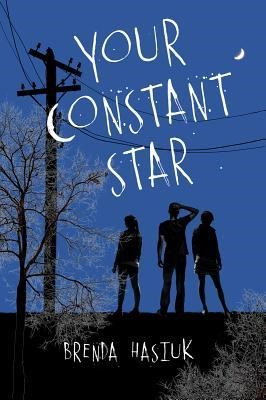
A Review of Brenda Hasiuk’s Your Constant Star

Constant Star_Hasiuk

A Review of Brenda Hasiuk’s Your Constant Star

by Will J Fawley

Brenda Hasiuk’s YA novel, Your Constant Star, opens the first of its three sections by introducing readers to Faye. Adopted from China by a Polish mother and a Scottish father, Faye is “pretty much happy ho-hum.” Still, she possesses a lingering feeling of displacement in light of being adopted, especially in regard to the frequency and state of child abandonment in China. Faye provides many lovely cultural details throughout her narration, such as the Chinese story of lovers being connected, however far apart they may be, by a red string. These details make Faye a believable and compelling character.

Next readers meet Bev, Faye’s self-proclaimed sort-of friend. Bev is pregnant and has decided to give her child up for adoption. She has recently returned to Winnipeg after living in Vancouver for many years, and is reconnecting with her childhood and with Faye. Much of the novel’s second section follows Bev in her attempts to choose the right adoptive parents for her baby, with Faye tagging along for the ride.

The third section is dedicated to Mannie, the father of Bev’s baby. He seems completely lost, though readers learn that he has given up carjacking and dealing to make pizzas in order to earn legitimate money that will help support his future baby. Bev doesn’t want him to know who the adoptive parents are, and part of Mannie’s quest concerns his efforts to contact Faye and learn of the whereabouts of his son after the adoption takes place.

There is a gravitas about the book that is still with me. I enjoyed the first two sections, but the third was a bittersweet sucker-punch that made it all meaningful and terrible and beautiful. We are left with the idea that “what’s most beautiful and what’s most brutal are just two halves of the same whole.”

Overall, this is a book caught in liminal spaces – between beautiful and brutal, between cultures, between times, and between genres.

As for the cultural divide, there is a clear focus on globalization. It seems like no two characters in the novel have the same background. They are Chinese, Polish, Scottish, Métis, Russian, Argentinean, Pilipino, and they are all, with one exception, Canadian. Characters are constantly being whisked around the country and around the world to China and Russia, Toronto, Calgary, Vancouver. Still, this is a very Canadian novel, a very Winnipeg novel. It is a novel about Canada and how the country, and Winnipeg itself, is a melting pot of cultures from around the world.

This is also a novel that spans not only distance, but also time. It is full of flashbacks and daydreams. Present events always seem to be fuelled by memories. Hasiuk weaves a web of time that pulls the reader through these characters’ lives, giving us an intimate look at their complexities. The flashbacks are so many and so smooth that the present becomes a bridge between memories, the reader scarcely realizing they’ve crossed it until they are on the other side, looking back. Though this could be confusing or slow the pacing, Hasiuk handles these instances beautifully, successfully adding layer upon layer of depth to these characters and their histories.

And as for the genre divide, Kirkus Reviews published a piece in which the book’s YA classification was questioned, because so much depends upon the teenagers’ parents and situation in life, leaving them little room to act. And while these characters may be affected by the past, they feel liking living, breathing teens in the present. Certainly it’s important to remember that people are a culmination of their pasts and their families, and therefore what Brenda Hasiuk provides in Your Constant Star is an honest look at young people’s lives.

The novel reads very clearly as one for young adults, a book about the struggle of young people finding their place in a complicated, globalized world in which they have been displaced since birth. Each character is halved by culture, by distance, by borders, and is searching for their true self at the other end of the red string.

Brenda Hasiuk, Your Constant Star. Orca Book Publishers, 2014: $12.95

***

Will J Fawley is a writer and blogger living in Canada. He blogs at The Wildest Edge.