“The Word with the Schwa that’s Really a Short U” By Ronnie Sirmans


THE WORD WITH THE SCHWA THAT’S REALLY A SHORT U

My new friend’s from Boise,
and I remember: as a boy
reading the word and mis-
pronouncing it as “Boys.”  
Some words seem to say
themselves to us. Like love.  
Has anyone moved lips
and tongue with a long o
to whisper to their true “loave”?  
Instincts may shape the syllable,
from inaudible caul, borne by
fluid breath like spoken words.
The pronunciation, its middle is u,
but not mouthed as “you,” but rather
the sound of our uncertainty, “uh”
— announcing our confusion over
how to grasp the word’s meanings,
a rainbowed fish still in the currents,
that we can’t catch with our bare hands
but need strong jaws like the bear
or a hook that snags the mouth
and lips, causing a bloody wound.


About the Author: Ronnie Sirmans is a digital editor for a print newspaper in Atlanta, and his poems have appeared in Gargoyle, The South Carolina Review, Tar River Poetry, BlazeVOX, The American Journal of Poetry, Deep South Magazine, and elsewhere.


More By Ronnie Sirmans:

“Remembering the Great Flood in the Frozen Food Aisle”


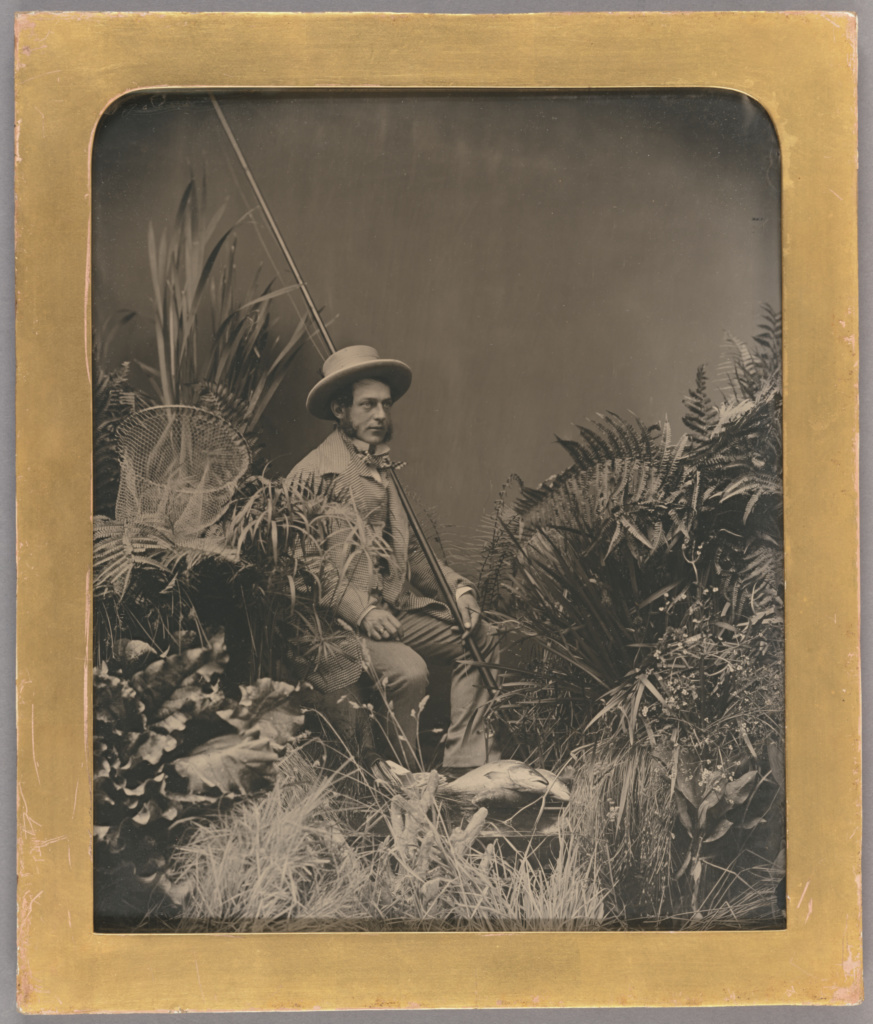
Image Credit: “Studio Portrait of a Man Posed with Fishing Gear / The Fisherman” Artist Unknown.  Digital image courtesy of the Getty’s Open Content Program

“The Misery of Fun” By Nathan Graziano


The Misery of Fun


I was holed up, purposefully, in my basement—the place where I hermit when I’m not obligated by work or another adult responsibility to leave and confront the outside world—when my wife came down the stairs, her heels clacking against the hardwood. She was holding her phone, staring at the screen. “So,” she said.

I knew that “so” and something was coming that I wasn’t going to enjoy hearing. “What is it?”

So my dad texted me, and they’re planning a trip for next April and inviting us and the kids,” she said.

“Tell me it’s not Disney World.”

“Disney World isn’t that bad,” she said with a lilt in her voice. “It’ll be fun.”

My head dropped into my hands. My wife was going to use the kids, who are now teenagers, to try to convince me into willfully entering the lost circle of Dante’s Hell.

And all of this would be done in the name of “prescribed fun.”    

At the risk of sounding like a curmudgeon—-which I probably am—-the idea of Disney World…hell, state of Florida alone, is enough to induce an anxiety attack. I’d rather be strung up by my toes and beaten with a broomstick than to stand in a 45 minute line next to a family of sunburned and overstuffed Midwesterners. There will be thousands of people with the same expectation: to have “fun” on the boat trip through It’s a Small World. Hop on, everybody, it will be a blast, everything you’ve waited to experience, so much fucking fun that you’ll pop like a fun-sucking tick.

“I’m not going,” I told my wife. “I don’t have enough Ativan to make it through a week there.” Continue reading ““The Misery of Fun” By Nathan Graziano”

SATURDAY POETRY SERIES PRESENTS: AMY WATKINS

MURMURATION
By Amy Watkins

An osprey beats the wind with bowed wings,
steady till it drops and shakes in flight.
The wind catches and it rises again.
I watch from the porch where I’ve come early
to stop avoiding our father’s call. Last night,
I turned the ringer off then on then off again,
swiped down to ignore but texted back.
There are two birds in the tree across the street
and a third circling and circling, rising and falling
in the wind from a distant hurricane.
The phone rings. He wants to talk about you.

They say each bird attends to just seven others, and,
in this way, a thousand starlings turn together
like one creature. I’ll try not to make this a metaphor.
Once, you and I climbed the hills outside
Florence, Italy. Our dearest ones climbed with us
and, because we were few and each one loved
by all the others, I thought we made a kind of net
that might hold the breaking world together.
A murmuration of starlings unfurled like the aurora
borealis, a sheer curtain caught in wind,
twisting, tracing a path through twilight.

A hawk swoops low over the osprey nest.
I think it might land, but it doesn’t. You ask to meet
for coffee. Our father calls, and I don’t answer.


Today’s poem previously appeared in SWWIM and appears here today with permission from the poet.


Amy Watkins grew up in central Florida surrounded by saw palmetto and sugar sand and a big, close-knit, religious family: the kind of upbringing that’s produced generations of southern writers. She married her high school sweetheart, had a baby girl, and earned her MFA in writing from Spalding University. She is the author of two chapbooks forthcoming in 2019: Wolf Daughter (Sundress Publications) and Lucky (Bottlecap Press). Follow her on Twitter @amykwatkins.

Contributing Editor’s Note: Amy Watkin’s poem, “Murmuration,” is a coming together of worlds. First, there’s the easy mixture of nature and the modern digital world. She closely watches ospreys, how one “drops and shakes in flight. / The wind catches and it rises again.” and then “two birds in a tree across the street / and a third circling, rising and falling.” These innate animal behaviors echo her own modern-day habits with her cell phone—“I turned the ringer on then off again, / swiped down to ignore but texted back.”

She also employs the world of the sacred and the secular, which she hints at through controlled and purposeful ambiguity in word choice. For instance, Watkins selects the homonym “bowed” for the angle of the osprey’s wings in flight. When she decides to finally take a phone call from her dad, it becomes a holy act when she arrives “early / to stop avoiding our father’s call.” Her level of her control and precision is astonishing when, for a moment, she takes herself out of the poem and cautions the reader “I’ll try not to make this a metaphor.” Of course, this line has just the opposite effect and we focus more intensely on the rich metaphors throughout the poem.

Watkins pays pays off the title of the poem in grand style describing “A murmuration of starlings unfurled like the aurura / borealis,”—a startling and beautiful image that ties everything gracefully together. “Murmuration” is an emotional and beautifully crafted poem that works on many levels. The poem rewards deeply upon close reading.

Want to read more by and about Amy Watkins?
Red Lion Sq.
Burrow Press
Glass: A Journal of Poetry
Drunk Monkeys
Emrys Journal


Contributing Editor Alan Toltzis is the author of The Last Commandment. Recent work has appeared in print and online publications including Hummingbird, Right Hand Pointing, IthacaLit, r.k.v.r.y. Quarterly, and Cold Noon. Find him online at alantoltzis.com.


A NOTE FROM THE MANAGING EDITOR:

After nearly ten years as Contributing Editor of this series, it is an honor and a unique opportunity to share this space with a number of contributing editors, including the one featured here today. I am thrilled to usher in an era of new voices in poetry as the Managing Editor of this series.

Viva la poesia!
Sivan Butler-Rotholz, Managing Editor
Saturday Poetry Series, AIOTB
 

“Plus Ten” By Jeremy Nathan Marks


Plus Ten

Tonight fish
perch, whitefish, bass
even smelts
occupy spacious shore houses
while children bed down below ground
in clay beds said to hatch prodigious numbers
of tadpoles.

It is February
and the coyotes take the old swimming hole
and pretend it is Christmas Day in Australia.

Our hemispheres are flipped.

The river fills with ice.
Then it thaws.
It goes and floods in ways farmers say
it never used to.
Rain. Snow. Rain again.
The coyotes now go hunting in packs with dogs
and give the bum’s rush to gun enthusiasts at a Valentine’s Day sale.

Here in town we all sing
‘The Good Old Hockey Game’
as though pucks survive the winter wet
and jive with industrial sized climate controllers.

They do. Digitally.

Out in the muck I haven’t met a single bear that didn’t share
my exasperation at the tartness of mushed berries
or the way some satellite ref keeps moving the goal line.

Robins dine on February worms.
Crocuses laugh at snowdrops come out to see what’s up
and go down broke backed.

Ice again. Wait a day. It will be plus 10.


About the Author: Jeremy Nathan Marks is a London, Ontario-based writer. Recent poetry appears/is appearing in Unlikely Stories, Writers Resist, Poets Reading The News, KYSO Flash, Poetry Pacific, Rat’s As Review, The Wire’s Dream, NRM Magazine, Cajun Mutt Press, Eunoia Review, The Conclusion Magazine, Bravearts, and Runcible Spoon. His short story, “Detroit 2099,” will appear in The Nature of Cities Anthology later this year.


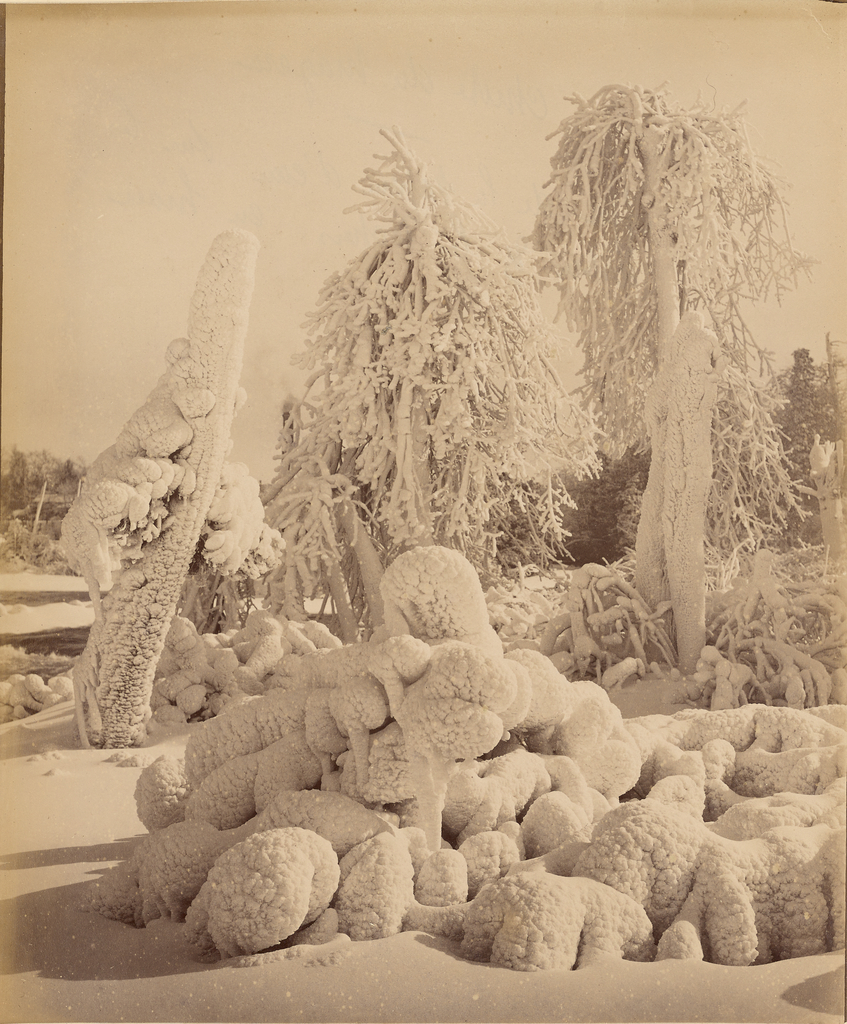
Image Credit: “Chûte du Niagara” Unknown Photographer (1860s-1880s) Digital image courtesy of the Getty’s Open Content Program

Bunkong Tuon: “Gender Danger”


This is the second in a series of poems from a forthcoming poetry collection about raising a biracial daughter in Contemporary America, during this polarizing time of political and cultural upheavals where sexual harassment allegations abound, where a wall, literal and figurative, threatens to keep out immigrants like the narrator, a former refugee and child survivor of the Cambodian Genocide. You can find the full series of poems below.


Gender Danger

Chanda goes down
the slide, then climbs
back on it, and laughs
when I shake my head,
“No, not that way.”
She flies on the zip-line,
yells, “Look at me, Daddy.”
Inside a giant plastic globe
she screeches as I spin
her world. Then she says,
“Potty, Daddy, Potty.”
We cross the lawn,
go through a corridor,
and find ourselves in
front of the bathroom.
I move us towards
the men’s room
but Chanda yanks me
to the women’s room.
She is aware of gender
but is not ready to use
the restroom on her own.
“Daddy can’t go in there,”
I explain. She cries, “No
boysroom. No boys!”
A woman walks by.
I want to ask for help
but reason prevails.
So I pull Chanda
into the men’s room.
She’s on the toilet,
tears streaming
down her face.
Someone comes in
right after us, whistling.
Chanda looks at me,
eyes squinting, screeches.
I hold one of her hands,
pat her shuddering
shoulders, and repeat,
“It’s okay, Honey.
Daddy’s right here.”


About the Author: Bunkong Tuon is the author of Gruel (2015) and And So I Was Blessed (2017), both poetry collections published by NYQ Books, and a regular contributor to Cultural Weekly  He is also an associate professor of English and Asian Studies at Union College, in Schenectady, NY.


Bunkong Tuon’s series of poems on raising a biracial daughter in contemporary America:

Ice Cream

Gender Danger

The Bite

Tightrope Dancer

Women’s March in Albany

My Mother on Her Deathbed


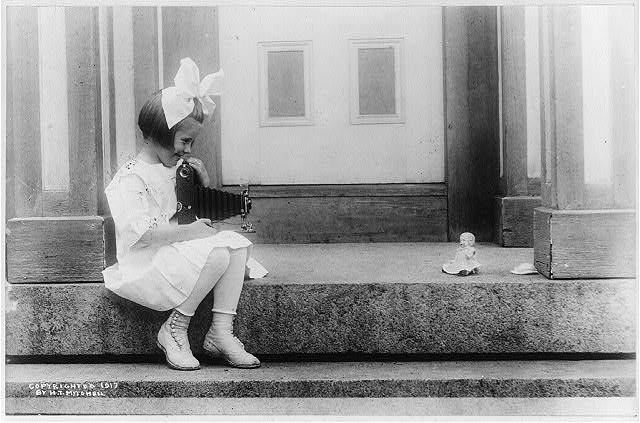
Image Credit: “Young girl taking a Kodak picture of her doll” (1917) Library of Congress

“Sent My Way” By Marc Frazier


Sent my Way

A white crow is at home in my front yard—
a symbol like everything is
I know when I see a cardinal’s red flit before me
It’s the spirit of my mother Agnes checking in
But I didn’t even know such an anomaly existed
I remember the white buffalo of Wisconsin
Many years back which drew crowds
But it died on everyone—a clear message I believe
Who likes crows to begin with
This one is loud like the rest and speaks to me
In its own inimitable bird language
A thing alone and so noticeable must be a treat
to predators—red in tooth and claw
though poets created a “murder” of crows
(scientists don’t use such a term)
some primal violence is associated with them
and I wonder how many baby robins
this glorious creature by my elm has devoured.
like me it must fit in with its peers where it can
It seems to feel safe and listened to with me near
When I hear a cardinal’s chirp I know God is real
When I hear this white crow, I wonder how we survive
When so much sets us apart from the flock
Our blessing, our curse


About the Author: Marc Frazier has widely published poetry in journals including The Spoon River Poetry Review, ACM, Good Men Project, f(r)iction, The Gay and Lesbian ReviewSlant, Permafrost, Plainsongs, and Poet Lore. Marc is the recipient of an Illinois Arts Council Award for poetry and has been nominated for a Pushcart Prize and a “best of the net.” His book The Way Here and his two chapbooks are available on Amazon as well as his second full-length collection Each Thing TouchesWillingly, his third poetry book, will be published by Adelaide Books New York in 2019. His website is http://www.marcfrazier.org.


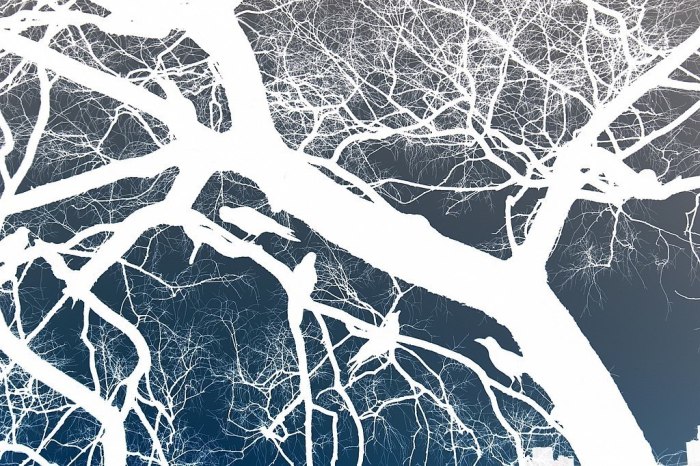
Image Credit: Emmanuel Bastien, “Crows” Remixed by the AIOTB Magazine staff Creative Commons.

“Ode to Dolores O’Riordan, The Spirit of Protest, & Zombie by The Cranberries” By J.B. Stone

cranberries


Ode to Dolores O’Riordan, The Spirit of Protest, & Zombie by The Cranberries
For Dolores O’Riordan, & the Battle Cries Gone Unheeded

you hear it emanate through your car radio
the overtones of a dying village

still the world is a war zone
& the crossfire continues to burn it all alive

your fists shake, rattle
& curl into a tightly bound ball

you know there are so many tracks
from their repertoire clutched closely to your heart like a child

soft                              yet not afraid to be                  heavy

tender                                                                                    honest

but of all of them,
                  this is the anthem of your thought process
and in this depleting plot

you are trying to punch a hole through this dashboard
screaming at a god you hope can sense your disdain

asking, “Why is this song still relevant?”

then the dawn approaches,
the scenery of 5 AM appears
in the shades of crimson magenta

you’ve driven for hours with this song on repeat
& the vibration of your erupting skin bubbles into a fleshy Vesuvius

and unlike many who grace these mornings
with peace and love, you confront it as a statue does

….before it collapses

as the children around you are devoured
and the bones that were once their homes
are hollowed out and spitooned into the dirt

you hold out hope,
that your stand will become beacon,

your voice will become earthquake
your feet will march in picket line formation

and in the end the revolution
starts & ends with hope


About the Author: J.B. Stone is a writer, slam poet, and book reviewer from Brooklyn, now residing in Buffalo, NY. He is the author of two digital chapbooks, A Place Between Expired Dreams And Renewed Nightmares (Ghost City Press 2018) and forthcoming, Fireflies & Hand Grenades (Stasia Press 2019). His reviews, stories, and poetry have appeared in and/or are forthcoming in journals such as BlazeVOX, Anti-Heroin Chic, Occulum, Bone & Ink, Crack the Spine, Mojave He[art] Review, Maudlin House, Peach MagGlass and elsewhere. His work has appeared in and/or is forthcoming in anthologies such as, Your Body Is Not A Temple: A Tribute to Anthony Bourdain (Iron Lung Press), Mansion (Dancing Girl Press), among others. You can check out his website jaredbenjaminstone.com, or his tweets @JB_StoneTruth.


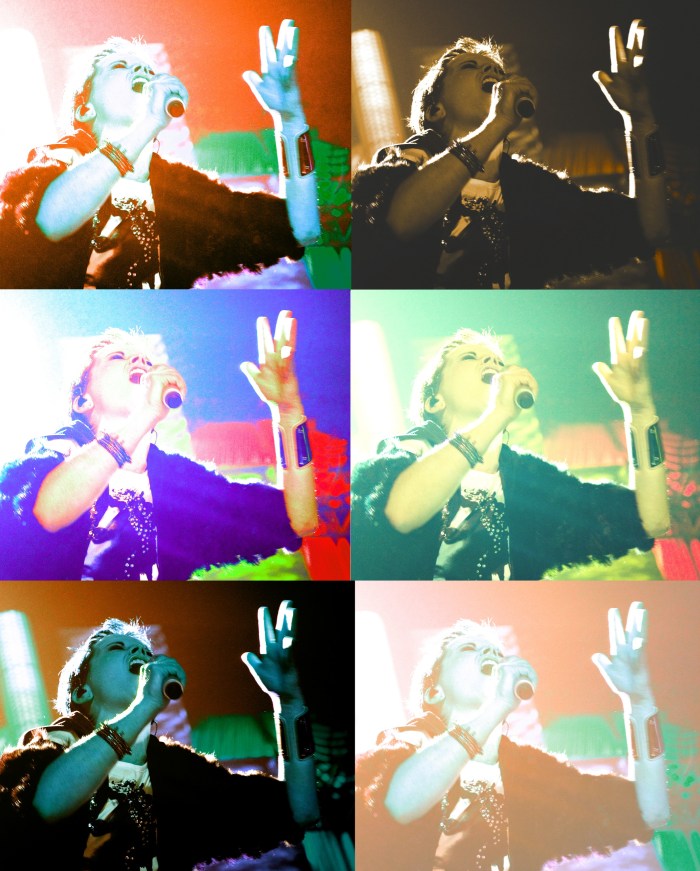
Image Credit: “The Cranberries en Barcelona” by Alterna2 Creative Commons 2.0, remixed by the AIOTB Magazine staff

Cranberries one


“Before Evening Med Pass” By Ryan Quinn Flanagan


Before Evening Med Pass

My wife has come to visit me.
On the unit at the Sudbury madhouse.
We are seated on the end of the bed.

Does he always play that horrible music?
The nurses give him one hour each day
with his guitar,
I tell her.
He plays the same thing all the time.

That’s awful, she says.
I shrug my shoulders.
Before she leaves, she meets my roommate Don
who thinks there are listening devices
everywhere.

After she leaves, I hear Don
through the yellow privacy curtain.
Your wife seems nice, do you trust her?

I tell him I do.
Then I hear him roll over in bed
and exhale once
loudly.


About the Author: Ryan Quinn Flanagan is a Canadian-born author residing in Elliot Lake, Ontario, Canada with his wife and many mounds of snow.  His work can be found both in print and online in such places as: Evergreen Review, The New York Quarterly, Cultural Weekly, In Between Hangovers, Red Fez, and The Oklahoma Review.


More By Ryan Quinn Flanagan:

“Robbie the Owl”

“He Brought His Canvases Over”


Image Credit: Arthur S. Siegel “Parke, Davis and Company, manufacturing chemists, Detroit, Michigan. Packaging pills in the finishing department” (1943) from The Library of Congress

“Hit and Run” By Steve Cushman


Hit and Run

My father had left us two days earlier
and my mother was driving the rusting
Torino to my sister’s softball practice.
Kim was in the front, and I was in the back.
Mom stopped at a red light when a man 
read-ended us. Shit, Mom said, enough already,
but we weren’t yet done with heartbreak because
five minutes later the hit and run driver, a tall
skinny drunk guy seemed to realize what sort
of trouble he was in, so he took off.  When the
police officer arrived and walked over, my mother
punched his chest, and my sister shook her head,
said Men.  The cop opened his arms when he could
have closed them.  Then he did what I couldn’t do,
held my mother, told her it was going to be alright
whether he believed this or not I’ll never know.


About the Author: Steve Cushman has published three novels, including the 2004 Novello-Award Winning Portisville.  His first poetry collection, How Birds Fly, is the winner of the 2018 Lena Shull Book Award.


More by Steve Cushman:

“Small Gifts”


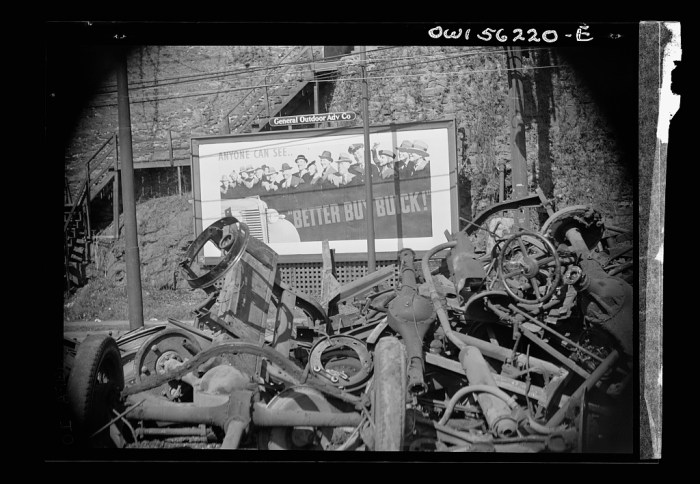
Image Credit: “Manayunk, Pennsylvania. Part of an automobile junk yard on Ridge Avenue” by Paul Vanderbilt (1938) from The Library of Congress

“Cards” by Jonathan K. Rice


Cards
           circa 1965

It’s time for the monthly bridge club
my parents host with couples
from other neighborhoods
and it’s our turn. My role is minimal.

I’m told to stay in my room,
but to first greet everyone and say goodnight,
just not be seen and not play my records.
Preferably not make any noise at all.

I decide to read The Island of Dr. Moreau
I bought at the school book fair that morning,
maybe play around with the crystal radio I built from a kit.

Before long I can hear people laughing,
ice clinking. I can smell the vermouth, gin,
the occasional cigarette.

I open the window, take off the screen
and climb out behind the tall hibiscus,
dodging palmetto bugs and lizards,

steal away into the night down the block
where older kids hang by the street light.
The newspaper boy has a zip gun he made
with some pipe from a nearby construction site.

He says it will shoot .22 bullets
and he has a pocketful. I can see the cars
in the driveway and along the street
in front of my house.

The kid shoots his zip gun. It sounds like a
firecracker, and we hear broken glass. He loads
it again. More fireworks. More broken glass.
And it’s all in front of my house.

We run in different directions.
I run toward a neighbor’s backyard
around to my window.

I hear the needle scratch vinyl, screeching
through my dad’s bossa nova record
while men cuss. This is not what Bridge
usually sounds like.

I hear poker chips being thrown and stacked,
the hardness of bottles and glasses on the table,
doors opening and closing, people coming and going.
footsteps down the hallway.

The screen and window back in place,
I pick up my book. Mom comes in,
finds me reading H.G.Wells.


About the Author: Jonathan K. Rice edited Iodine Poetry Journal for seventeen years. He is the author of two full-length poetry collections, Killing Time (2015), Ukulele and Other Poems (2006) and a chapbook, Shooting Pool with a Cellist (2003), all published by Main Street Rag Publishing. He is also a visual artist. His poetry and art have appeared in numerous publications, including Cold Mountain Review, Comstock Review, Diaphanous, Empty Mirror, Gargoyle, Inflectionist Review, Levure Litteraire, The Main Street Rag, Wild Goose Poetry Review and the anthologies, Hand in Hand: Poets Respond to Race and The Southern Poetry Anthology VII: North Carolina.


More by Jonathan K. Rice

“Springmaid Pier”


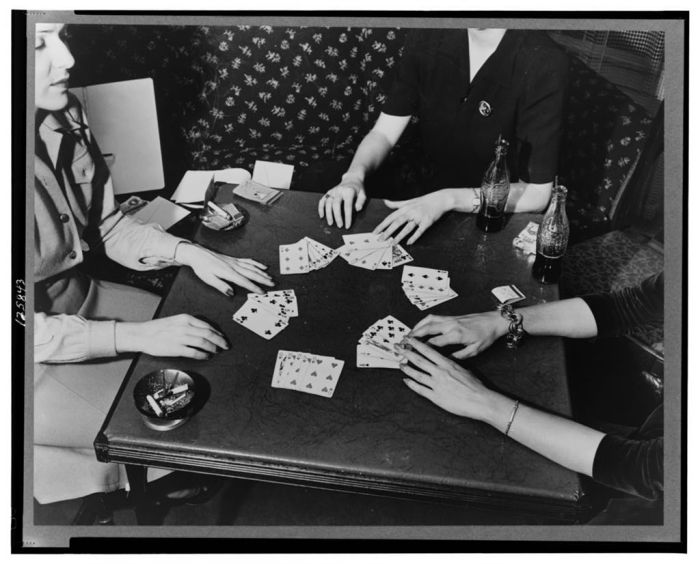
Image Credit: “Detroit, Michigan. Poker hand and hands of girl players” (1941) Arthur S. Siegel. from The Library of Congress