SATURDAY POETRY SERIES PRESENTS: OLAM, SHANA, NEFESH

Etching on chapbook cover by Andi Arnovitz

From OLAM SHANA NEFESH
By Jane Medved:


SIRENS

They think it is the young girls singing
you see, we pull them to us as smoothly

as oiled rope uncurls into golden braids.
It only takes a few minutes before everything

they see is woman. The pale skin of the sails
spreading like thighs, the thick knots

that tie the anchor turning to strands
of dampened hair held by a lover

before she shakes it free. The salt tastes
as sweet as sweat and soon the ship’s thrust

into the sea becomes unbearable.
This would be enough for galley slaves,

soldiers who tattoo fortunes on their scars,
the simple, parched sailors. But they are not

the ones we want. When we see the heroes
whose fierce deeds fall like hammers, we lay

aside our nocturne of desire. We sing instead
as a mother holds a dying child until

the horizon is the circle of our arms, the wind
a cloth wrapping them in its whisper, the waves

a gentle hush upon each creaking of the deck.
“Do not be afraid. You will be remembered and reborn.”


WHITE FIRE

There is a cable and it reaches
from the side of loving kindness

to the cold window across the room
taking over the function of your heart

which is tired of trying to make blood
out of air. Some days it’s just too hard

to keep on lifting, to appear in a robe
which keeps on falling, exposing

all sorts of intimate matters and the
little whispers beneath. Do not worry.

You are the hand, the page, the white fire
and you cannot be erased. The black letters

will burn and sing and declare themselves
but they are nothing without your silence;

which is not the absence of words, empty
as the howl of a bowl, but the promise made

between all words before they are spoken,
that they will reach across the black lines

and know each other again, even
if they no longer recognize themselves.


LEAVING A NOTE AT THE WESTERN WALL

There is a splintered door leading
nowhere and a lot of women crying
today I can’t even get near the wall.
Luckily I have my own tricks.
I place my arm over a young girl’s shoulder,
sigh sympathetically as she bends
her head in prayer, then edge myself
into her space. Everyone wants to touch
God’s face, to press their forehead
against his slippery cheek and brush
the pitted marks beneath, thank you
for my eyes, my legs, my arms, my breath
.
Herod did a good job, the ancient stones
hold solid. They outweigh the base
of the great pyramids and nothing moves
them, perhaps they are even held up
by pleading, since every crack is filled
with scraps of blue-lined paper, torn
index cards, a piece of yellow legal pad,
a folded napkin, sealed envelopes, airmail,
express, please, listen, thank you for my eyes,
my legs, my arms, my breath, excuse me
,
a woman pushes past me, excuse me please,
when she reaches for the wall a handful
of notes loosen and fall at our feet.
The chair behind me is piled with prayers
as morning, evening and darkness
make their requests, songs from the sons
of Korach even though their father moans
in the earth thank you for my arms,
my legs, my eyes, my breath
, women beg
the matriarchs and children press letters
into fists of stone while God sends back his answers
– No and no and no.


Today’s poems are from Olam, Shana, Nefesh (Finishing Line Press, 2014), copyright © 2014 by Jane Medved, and appear here today with permission from the poet.


Olam, Shana, Nefesh: “‘Olam, Shana, Nefesh’ is a Kabbalistic phrase used to describe the three dimensions of Place, Time and Person. Olam is most commonly translated as ‘world.’ But in Hebrew olam comes from the root of the word ‘hidden.’ This implies that place always has an unrevealed element to it; that we are surrounded by a reality beyond what is immediately visible. Shana literally means ‘year.’ It invokes an image of repetition, re-visiting, return, a never -ending cycle of months. In the Jewish calendar time is not a passive backdrop to human endeavor, but an active force whose windows of opportunity open and close, blossom and die just like the seasons. Nefesh can be translated as ‘person’ but it refers to the spirit as well as the body; the infusion of the divine into the physical. This is an inherently volatile combination, since a human being always contains a push and pull between the material and the spiritual, the body with its appetites and fears and the spirit. This is ‘person’ as the container of the animal and the divine.” – From Olam, Shana, Nefesh (Finishing Line Press, 2014)


Jane Medved is the poetry editor of the Ilanot Review, the on-line literary magazine of Bar Ilan University, Tel Aviv. Her chapbook, Olam, Shana, Nefesh, was released by Finishing Line Press in 2014. Her recent essays and poems have appeared or are forthcoming in Lilith Magazine, Mudlark, Tinderbox Poetry Journal, Cimarron Review, Spoon River Poetry Review, Tupelo Quarterly and New American Writing. A native of Chicago, Illinois, she has lived for the last 25 years in Jerusalem, Israel.


Editor’s Note: Olam, Shana, Nefesh is an absolutely stunning collection. A rare assortment of meditations on myth and history, religion, spirituality, sensuality, gender and place. The questions posed are epic, the answers as small and as critical as breath. The poems themselves are absolutely gorgeous in their own right; lyric delights that any reader would feel indulgent slipping into, with moments like “The salt tastes / as sweet as sweat and soon the ship’s thrust // into the sea becomes unbearable,” “The black letters // will burn and sing and declare themselves / but they are nothing without your silence,” and “Everyone wants to touch / God’s face.” But this book is even more rewarding for those readers familiar with the rich landscapes the poems call and respond to. How rewarding is “Sirens” for those well-versed in Greek mythology, how brilliant “White Fire” for those who know and love midrash, and how masterful “Leaving a Note at the Western Wall” for students of religion and history, for Jewish women, for those who have been to Jerusalem’s Wailing Wall, who have “press[ed] their forehead[s]/ against [God’s] slippery cheek and brush[ed] / the pitted marks beneath, [saying] thank you / for my eyes, my legs, my arms, my breath.”


Want to see more from Jane Medved?
Tinderbox Poetry Journal
Lilith Magazine
Buy Olam, Shana, Nefesh from Amazon
SATURDAY POETRY SERIES PRESENTS: VALERIE BACHARACH


Untitled


GENESIS
By Valerie Bacharach

I flew across the international
date line to yesterday.
Stayed on the plane,
circumnavigated the world,
arrived at time’s beginning.

A garden of wildness.

No need of that man
whose rib I stole,
no need of knowledge,
or apples,
or snakes,
or God…

Only this—
solitude
grace
pure air

before pain found me.


Today’s poem was originally published in Poetica‘s “Poem of the Week” series and appears here today with permission from the poet.


Valerie Bacharach is a poet and teacher in Pittsburgh, Pennsylvania. She is a member of Carlow University’s Madwomen in the Attic poetry workshops and has attended Chatham University’s Summer Community of Writers. In 2015, she participated in Chautauqua Institution’s Writers Festival, and worked with the poet, Tony Hoagland. She conducts weekly poetry workshops with the women of Power House, a halfway house for women in recovery from drug and alcohol addiction. Her poetry has appeared or is forthcoming in Voices from the Attic, Pittsburgh City Paper Chapter and Verse, Uppagus, U. S. 1 Worksheets, and Poetica.

Editor’s Note: Today’s poem is epic in its sparse simplicity. Rife with the unsaid, with what does not need to be written. At the same time, the poem is laden with intertextuality, the Bible doing the heavy lifting of connectivity and association, allowing what appears on the page to be ripe with the weight of ancient tales. Amid these rich layers, a lyric beauty emerges: “[I] circumnavigated the world, / arrived at time’s beginning,” “A garden of wildness,” “before pain found me.”

Want to read more from Valerie Bacharach?
Uppagus
Pittsburgh City Paper

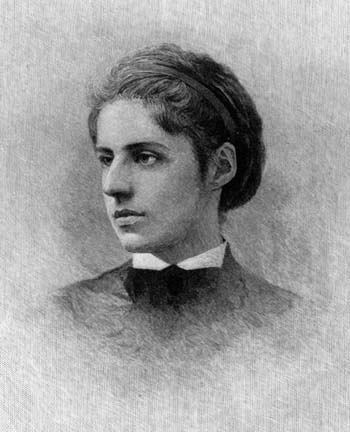
SATURDAY POETRY SERIES PRESENTS: EMMA LAZARUS


Emma_Lazarus


1492
By Emma Lazarus

Thou two-faced year, Mother of Change and Fate,
Didst weep when Spain cast forth with flaming sword,
The children of the prophets of the Lord,
Prince, priest, and people, spurned by zealot hate.
Hounded from sea to sea, from state to state,
The West refused them, and the East abhorred.
No anchorage the known world could afford,
Close-locked was every port, barred every gate.
Then smiling, thou unveil’dst, O two-faced year,
A virgin world where doors of sunset part,
Saying, “Ho, all who weary, enter here!
There falls each ancient barrier that the art
Of race or creed or rank devised, to rear
Grim bulwarked hatred between heart and heart!”


Today poem is in the public domain, belongs to the masses, and appears here accordingly.


Emma Lazarus (1849 – 1887): A descendant of Sephardic Jews who immigrated to the United States from Portugal around the time of the American Revolution, Emma Lazarus was born in New York City on July 22, 1849. Before Lazarus, the only Jewish poets published in the United States were humor and hymnal writers. Her book Songs of a Semite was the first collection of poetry to explore Jewish-American identity while struggling with the problems of modern poetics. (Annotated biography courtesy of The Academy of American Poets.)


Editor’s Note: I wanted to share with you today a poem for Rosh Hashanah, the Jewish New Year. Rosh Hashanah is a celebration of newness, ushered in by sweet wishes of the year to come. But we spend the days that follow in contemplation of those regrets we have from the year past, in asking for forgiveness, and in letting go. When I came across today’s poem I thought of the Syrian refugees, of how the plight of exile has plagued my own people in the past, and how others are suffering from it today.

5776, the Jewish year that begins at sundown on Sunday September 13th, will be a “two-faced year, Mother of Change and Fate” for countless Syrian refugees. That fate that my own people have suffered in the past is today their reality: “The West refused them, and the East abhorred. / No anchorage the known world could afford, / Close-locked was every port, barred every gate.”

Emma Lazarus is most famous for penning the words that appear at the base of the Statue of Liberty, wherein the “Mother of Exiles” declares, “Give me your tired, your poor, / Your huddled masses yearning to breathe free, / The wretched refuse of your teeming shore. / Send these, the homeless, tempest-tossed to me, / I lift my lamp beside the golden door!” As we celebrate a new year, may the words of the Mother of Exiles find their way into the hearts and minds of ports and borders across Europe and throughout the world, “Saying, ‘Ho, all who weary, enter here!'”


Want to read more by and about Emma Lazarus?
The Academy of American Poets
Jewish Women’s Archive
The Poetry Foundation

SATURDAY POETRY SERIES PRESENTS: PATRICK PHILLIPS

Photo by Marion Ettlinger


HEAVEN
By Patrick Phillips

It will be the past
and we’ll live there together.

Not as it was to live
but as it is remembered.

It will be the past.
We’ll all go back together.

Everyone we ever loved,
and lost, and must remember.

It will be the past.
And it will last forever.


Today’s poem is from the collection Boy (The University of Georgia Press, 2008, © Patrick Phillips), and appears here today with permission from the poet.


Patrick PhillipsElegy for a Broken Machine was published in 2015 by Alfred A. Knopf. A recent Guggenheim and National Endowment for the Arts fellow in poetry, he is the author of two earlier collections, Boy and Chattahoochee, and translator of When We Leave Each Other: Selected Poems of Henrik Nordbrandt. His work has appeared in many magazines, including Poetry, Ploughshares, and The Nation, and his honors include the Kate Tufts Discovery Award, a Pushcart Prize, and the Lyric Poetry Award from the Poetry Society of America. He lives in Brooklyn and teaches at Drew University.

Editor’s Note: I came across today’s poem on the New York subway as part of the MTA/Poetry Society of America collaboration, “Poetry in Motion.” Whenever I see a poem on the subway I read it. Of course I do. How often does one come across poetry in public spaces in America these days? But not since I came across Reznikoff’s “If There is a Scheme” on the PATH train has a poem in a public space so moved me.

What is so wonderful about today’s poem? Is it the way it plays with time, making the future of the past? “It will be the past / and we’ll live there together.” Is it the subtle way the poet uses rhyme and repetition, as if the poem were a lullaby — “together / remembered / together / remember / forever”? Or is it the promise of the poem? That within our future lies our past, that heaven is where we might relive our memories over and over, that we will be reunited there with everyone we ever loved, “And it will last forever.”

Want more from Patrick Phillips?
Buy Elegy for a Broken Machine from Amazon
Patrick Phillips’ Official Website

SATURDAY POETRY SERIES PRESENTS: DEVIN KELLY


DSC_0759


FEAR OF
By Devin Kelly

We are discussing the roots of things. How phobia
means fear of, and we make them up. Bookaphobia.
Classroomaphobia. Girlaphobia. I say there will be
a quiz. They laugh. It is evening in a small room
in Queens where the desks are miniatures
of the things they should be and the children
sitting in them too close to me and my coffee
so soon done. Then I ask them if they are afraid.
Then I ask them of what. The word penis. Spiders.
The people who hate me for my name. How a moment
turning stills to a moment stilled. How silence,
even in silence, breathes. Their pages of homework
loiter upon their desks. Fifteen words they had
never seen before, and fifteen meanings, written out
beside. Benevolent. Ailurophile. I spoke, upon the hearing,
of opposites, to think of words as people, rooted,
experimenting with different prefixes. To think of words
as lovers, hungry for what it might be they want.
What is her name? It lingers a moment before
it hassles its way out of my mouth. The shape it takes,
unfamiliar, awkward. A word I have never spoken before.
And her skin brown. How she taught me the way
to count to ten in Arabic. The people who hate me
for my name. The people who hate me. The people.
Across an ocean, a man kneeling does not see the hand
that holds the gun that fires the bullet that splits
his head in two. Across an ocean, someone laughs
at a fence of severed heads. I do not know
what to teach anymore. Graphophobia. Philophobia.
Fear of writing, fear of love. And all these children
who do not have a name for their sorrow. At night,
in bed, I turn her name for the hundredth time
and find its beauty. The soft grace of wanting
to be held. A child, scared, moving in dark
from room to room to find the mother who named her,
the father, too, and their reasons why.


Today’s poem originally appeared in Rattle and appears here today with permission from the poet.


Devin Kelly earned his MFA from Sarah Lawrence College. His collaborative chapbook with Melissa Smyth, This Cup of Absence, is forthcoming from Anchor & Plume Press. His poetry, fiction, and essays have appeared or are forthcoming in Gigantic Sequins, Armchair/Shotgun, Post Road, RATTLE, The Millions, Appalachian Heritage, Midwestern Gothic, The Adirondack Review, and more, and his essay “Love Innings” was recently nominated for a Pushcart Prize. He co-hosts the Dead Rabbits Reading Series in Manhattan, teaches Creative Writing and English classes to high schoolers in Queens, and lives in Harlem. You can find him on twitter @themoneyiowe.

Editor’s Note: June 26, 2015 was a day of imperative progress in American history. A day of change. A day when love triumphed. I celebrated this historic event in the most wonderful way I could have imagined, at the wedding of two women whose love is beshert. But when one of the brides gave her speech, she reminded us that there is still more to be done. “Today we celebrate,” she said, “but tomorrow, we keep fighting.” Even amidst a joy so great she shared it with the entire country, the blushing bride reminded us that we can—and should—always be working to make the world a better place.

Today’s poem was written in response to Islamophobia. A Muslim girl in a classroom. What is she afraid of? “The people who hate me for my name.” The families of the victims of a racist hate crime—a terrorist act—in Charleston, SC have what to teach us about love and forgiveness. But what are they truly the victims of? “The people who hate me. The people.” We speak words today that carry with them the chalk outlines of the hatred that flows from fear: Black Lives Matter; I can’t breathe. “I do not know / what to teach anymore,” writes the poet, but he knows “all these children / who do not have a name for their sorrow.”

Let us shout our joy from the rooftops and dance in the streets because yesterday love won. And today, tomorrow, and in the days to come, let us fight until love triumphs over fear and hatred, until there is justice and equality for all.

Want more from Devin Kelly?
The Adirondack Review
District Lit
Little Fiction
Warscapes
Devin Kelly – Published Work

SATURDAY POETRY SERIES PRESENTS: SARA BIGGS CHANEY

BiggsChaneyauthor

ST. EUGENIA DECLARES HER ALLEGIANCES
By Sara Biggs Chaney

The girl said: I am not skin,
but sackcloth.

She said: I am not spoke,
but symphony.

My rib bones, how they burn
for the Son.

For Him, I will suffer
this harmonic ache–

I will pin my maiden head,
a moth wing,

I will bear the shames
of a thousand men,

I will wear the hands
of a healer.


Today’s poem was originally published in Thrush and appears here today with permission from the poet.


Sara Biggs Chaney received her Ph.D. in English in 2008 and currently teaches first-year and upper-level writing in Dartmouth’s Institute for Writing and Rhetoric. Her most recent chapbook, Ann Coulter’s Letter to the Young Poets, was released from dancing girl press in November, 2014. Sara’s poems have recently appeared or are forthcoming in RHINO, Sugar House Review, [PANK], Juked, and elsewhere. You can catch up with Sara at sarabiggschaney.com.

Editor’s Note: Today’s poem, like the famous Walt Whitman quote, contains multitudes. Relaying an epic history in a few swift couplets, the interplay between referentiality and alliteration is as precise as it appears effortless. Discreet moments—brilliant vignettes—are carefully pieced together to reveal the story of a life: “The girl said: I am not skin, / but sackcloth;” “I will bear the shames / of a thousand men, // I will wear the hands / of a healer.” As readers, we are as transported by the world of the poem as we are transformed.

Want more from Sara Biggs Chaney?
“St. Barbara, Locked Away” in Atticus Review
“St. Theodora in the Brothel” in Tinderbox Poetry