The Incredible Bipolar Hulk: A Conversation with Poet Daniel Crocker

.

The Incredible Bipolar Hulk:

A Conversation with Poet Daniel Crocker

By Chase Dimock

.

The genius of The Incredible Hulk is that everyone can identify with him. All people have a reservoir of anger inside them, and we all know the painful discipline of managing anger, lest it erupt into senseless rage. The Hulk Smash is the fantasy of acting on our anger with a violent ferocity that mirrors the inner, emotional experience of pain.

In his latest chapbook, Gamma Rays, Daniel Crocker identifies with the Hulk as a metaphor for the experience of bipolar disorder. As It Ought To Be debuted Crocker’s Hulk poem “The Incredible Hulk Tries to Write a Poem” last January. For Crocker, the Hulk is more than just a momentary outburst; he is an enduring persona who embodies the manic energy of bipolar disorder. Crocker’s poems humanize the Hulk, and in turn, provide insight into the mind of the bipolar person as they navigate the impulses within them. I had a chance to ask Crocker about the Hulk and how he personifies the bipolar experience in his poetry.


Chase Dimock:  The first question on anyone’s mind when they first look at your cover is going to be “Why the Hulk?” In the past, you’ve written poems in which you take on the personas of Cookie Monster, Skeletor, and George Bailey from It’s a Wonderful Life among others. What is it about the Hulk that made him worthy of an entire collection of poetry? What does taking on his persona uniquely achieve among your pantheon of pop culture icons?


Daniel Crocker: The simple answer is, I love the Hulk. I wrote one Hulk poem, the one where he goes shopping after taking klonopin, and then I couldn’t stop for awhile. I was filtering everything through the Hulk. I originally thought I might end up with a full length, but after about 20 poems I realized I was kind of done with the story I wanted to tell. But, he’s a great metaphor. Any negative aspect of your personality, especially those that center around losing control, that’s basically the Hulk. He’s the things you bury deep. In a lot of ways this books is about coming to terms with that.

So I used it as a metaphor for my bipolar disorder because you never know when you’re going to have another episode. You just try to keep them at bay with medication. Then I started thinking about what it means to navigate love and a relationship when you have this hanging over your head–when you’re not always sure you’re going to wake up okay. Unlike Shit House Rat, however, this is more about coming to terms with it. It is, I think, a happy book with a happy ending.


Chase Dimock: The Hulk has been incarnated as a comic, a cartoon, a TV show, and several movies. I know the TV show version of the Hulk the best because I grew up watching reruns. In that version, he’s somewhat of a loner who tries to manage his rage alone and channel it toward productive ways to help the people he runs into. The show always ends with “The Lonely Man Theme.” It seems like your Hulk is more like the Hulk from the comics, which places him in a romantic relationship with Betty. Why was it important to focus so many of your poems on the Hulk in a relationship?


Daniel Crocker: In the end, it’s a book about navigating a relationship while having a mental illness. In my favorite runs of the Hulk, Bruce was always afraid of his anger coming out. He would do anything to keep the Hulk away–even though it’s a part of him. He was so obsessed with finding a cure that his relationship with Betty would be strained. When I was diagnosed with bipolar, I read up everything I could on it. So, I understand that level of obsession. I also, of course, worry that my symptoms could come back at any time—even while on medication.  So, I hope it shows the impact of bipolar disorder on one’s immediate family as well as just the person who has it. In the end, though, it’s just coming to terms with the monster inside of you–whatever that may be.

Continue reading “The Incredible Bipolar Hulk: A Conversation with Poet Daniel Crocker”

“Paul Lynde” By Mike James

.

Paul Lynde

Died on an early January Sunday in Beverly Hills. If he’d been born in early January, he’d be a Capricorn. He was a Gemini. During the 1970’s it was popular to tell people “your sign.” Like shag carpet, that’s less popular now. Paul trusted astrology. Call him a man of the times. Call him Liberace without a piano, add a scarf. Geminis love illusions and music. Prefer light blue and yellow. The great talents of Geminis “are in the social realm.” Does that include cooking? Paul Lynde liked to drink white wine while cooking. He loved to cook.

.


About the Author: Mike James has been widely published in magazines, large and small, throughout the country. His thirteen poetry collections include: Jumping Drawbridges in Technicolor (Blue Horse), First-Hand Accounts from Made-Up Places (Stubborn Mule), Crows in the Jukebox (Bottom Dog), My Favorite Houseguest (FutureCycle)and Peddler’s Blues (Main Street Rag.) He has served as an associate editor for the Kentucky Review and Autumn House Press, as well as the publisher of the now defunct Yellow Pepper Press. He makes his home outside Nashville, Tennessee.More information can be found on his website at mikejamespoetry.com.


More By Mike James:

Grace

Two Ghazals

Under the Tamarind Tree

Francisco Manuel Blanco: “Tamarindus Indica”
.

Under the Tamarind Tree

By Bunkong Tuon

.

Editor’s Note: This past week, the nation witnessed devastating images from detention centers and heard hateful rhetoric spewed about immigration. Now, more than ever, it is important to humanize immigration and emphasize empathy. It is in this spirit that we are proud to present the final post in a series of poems about the immigrant experience in America.

Our late Managing Editor, Okla Elliott, featured Bunkong Tuon’s work on As It Ought To Be back in January of 2017. Okla was particularly concerned about the anti-immigration rhetoric heating up in the country and he hoped to showcase the voices of immigrants on our site. In honor of Okla’s memory, Tuon has allowed us to feature more of his poetry about his experience as an immigrant from Cambodia in the United States. All of the poems from this series can be found linked at the end of this article.

.

Under the Tamarind Tree

The child sits on the lap
of his aunt, under the old tamarind tree
outside the family home.

The tree stands still, quiet,
indifferent. The house sways
on stilts.

Monks in saffron robes,
and nuns with shaved heads,
lips darkened with betel-nut stain,

sit chanting prayers
for the child’s mother.

Incense perfumes the hot dry air.

There emerges a strange familiar song
between the child and his aunt that day—
a distant one, melodic but harsh,
as if the strings are drawn too tight—

Each time the child hears prayers
coming from the house, he cries;
each time he cries, the aunt, a girl herself,
pinches the boy’s thigh.

.

Previous poems from Bunkong Tuon’s series on the immigrant experience in America:

Fragments

Our Neighborhood in Revere, MA

Snow Day

An Elegy for a Fellow Cambodian

Halloween, 1985

Dancing Fu Manchu Master

Fishing for Trey Platoo

Lies I Told About Father


.

About the Author: Bunkong Tuon is the author of Gruel (2015) and And So I Was Blessed (2017), both poetry collections published by NYQ Books, and a regular contributor to Cultural Weekly  He is also an associate professor of English and Asian Studies at Union College, in Schenectady, NY.

SATURDAY POETRY SERIES PRESENTS: LAURA READ


RIP, LAURA’S VAGINA
By Laura Read


Your vagina is beginning to devitalize,
the doctor explained, when I asked him why
I had had so many urinary tract infections lately.
The first thing I thought was that I should say
No, your vagina is devitalizing, because I have
two teenage sons, and that is what passes for wit
in our house. But then I got lost in the fact
that he didn’t, in fact, have a vagina,
and I thought I should point that out instead
because in some circles—say, mine—
that would be an insult. Then, in the little
room inside my mind where Dorothy Parker
was holding court at the Algonquin,
I thought maybe devitalize is just a medical term,
give the guy a break. But I didn’t even know
this man. Couldn’t he just give me a prescription
and say something vague about aging?
What about euphemism? I guess devitalize
was one because he went on to more vividly
explain that my tissues were, frankly, deteriorating.
At that point, I was thinking But you haven’t even
seen the area in question
and How did you get
this far without knowing how to talk to women?

Devitalize reminds me of de-ice which is what
I was doing just before this tricky moment
at the Urgent Care. My son was late to Algebra
because it’s really cold and it took a while
to clean the car. And at 8:00 the door
where he usually goes in automatically closes,
so I had to take him around to the front,
and he dropped his phone in the snow
and it got run over, so now there’s a crack
in the screen. He wants me to replace it,
but I said, No, it still works.


Today’s poem previously appeared in the Beloit Poetry Journal, Volume 68, No. 1. Winter 2018, and appears here today with permission from the poet.

Laura Read’s first collection of poems, Instructions for My Mother’s Funeral, was published in 2012 by the University of Pittsburgh Press. Her second collection, Dresses from the Old Country, will be published by BOA in fall of 2018. She teaches English at Spokane Falls Community College.

Guest Editor’s Note: This poem moves through thought and returns to previous memory in a deceptively effortless progression, as if listening to someone recount an experience in conversation. The speaker fixates on a word that informs the tone of the experience and the poem: devitalize. This word takes her down a linguistic path that leads to another path and another, but, unlike Robert Frost, she returns to the fork in the road at the end of the poem with her response to her son that is meant for the insensitive doctor: “No, it still works.”

The allusive dark humor of Dorothy Parker is conjured as a familiar satirical connection and an anchor for association or a metaphorical leap. The “little room” inside the speaker’s mind is where pithy retorts are stored for occasions such as the encounter at the Urgent Care clinic, but she doesn’t respond in the way that she wants to, keeping her thoughts to herself, as many women do in these situations when they are being told that their bodies have failed them in some way by doctors who make assumptions without being completely sure.

The significant linguistic turn the speaker takes to a new word: “Devitalize reminds me of de-ice” leads her to recent memory, and the experience of taking her son to school that morning evokes mournful anger and defiance in the face of a doctor’s proclamation that a vital part of her female-ness is deteriorating. The details are important in her reliving the moments with her son as she is sitting in the clinic, and seemingly mundane facts become the thematic crux, informing the reader how life and language connect to produce intense emotion when we least expect it.

Want to read more by and about Laura Read?
Laura Read’s Official Website


Guest Editor Anne Graue is the author of Fig Tree in Winter (Dancing Girl Press, 2017), and has published poems in literary journals and anthologies, including The Book of Donuts (Terrapin Books), the Plath Poetry Project, One Sentence Poems, and Rivet Journal.

A NOTE FROM THE MANAGING EDITOR:

After nearly ten years as Contributing Editor of this series, it is an honor and a unique opportunity to share this space with a number of guest editors, including the editor featured here today. I am thrilled to usher in an era of new voices in poetry as the Managing Editor of this series.

Viva la poesia!
Sivan, Managing Editor
Saturday Poetry Series, AIOTB


Visit Our Updated Author Interviews Page

Vanessa Bell “Conversation at Asheham House” (1912)

Over the years, we have had the privilege to interview a range of poets, novelists, and multimedia artists. Check out our updated archive of interviews and discover some new, contemporary literary voices.

Bunkong Tuon: “Lies I Told about Father”

From a Russian Anti-Alcohol Poster

.

Editor’s Note: This is the fifth post in a series of poems about the immigrant experience in America. Our late Managing Editor, Okla Elliott, featured Bunkong Tuon’s work on As It Ought To Be back in January of 2017. Okla was particularly concerned about the anti-immigration rhetoric heating up in America and he hoped to showcase the voices of immigrants on our site. In honor of Okla’s memory, Tuon has allowed us to feature more of his poetry about his experience as an immigrant from Cambodia in the United States. You can find the full series of poems at the end of this page.

.


Lies I Told about Father

I believed I had the power to revive you,
to sit you up in the family’s pigsty,
drunk off your ass, smiling at nothingness,
the late morning light shining on your face.
With a son’s quiet adoration, I chiseled you:
a gangster from the East, a Khmer Krom
whose blood cried out Khmer characters (not Vietnamese),
who, guided by fate, found himself in the West
and married mother for her virtue and beauty.

In these poems you drink because, well, real men
drink, curse, and sleep around (the cursing
and sleeping around, you didn’t do, of course,
because of your love and respect for Mother).
I was an aspiring writer then,
renting a tiny studio on Ocean Boulevard
in Long Beach, following in the drunken
bouts of Charles Bukowski, buying cheap wine,
imitating free verse,
waking up to the stench of sour vomit.
Of course, this life did not last long.
I can’t hold liquor, let alone women.
I have always been a reader,
safe behind words, punctuation, and sentences,
between the pages, where I can conquer
an entire nation or seduce women with my long dash—.

Now, I am engaged to a kind, generous person.
Mother would approve of her.
I am returning to you once again,
not for approval, just to talk,
son to father, but it dawns on me:
I am without you.

.


About the Author: Bunkong Tuon is the author of Gruel (2015) and And So I Was Blessed (2017), both poetry collections published by NYQ Books, and a regular contributor to Cultural Weekly. He is also an associate professor of English and Asian Studies at Union College, in Schenectady, NY.


Previous poems from Bunkong Tuon’s series on the immigrant experience in America:

Our Neighborhood in Revere, MA

Snow Day

An Elegy for a Fellow Cambodian

Halloween, 1985

Dancing Fu Manchu Master

Fishing for Trey Platoo

Lies I Told About Father

Bunkong Tuon: “Fishing for Trey Platoo”

Fishing for Trey Platoo

By Bunkong Tuon


Editor’s Note: This is the fourth post in a series of poems about the immigrant experience in America. Our late Managing Editor, Okla Elliott, featured Bunkong Tuon’s work on As It Ought To Be back in January of 2017. Okla was particularly concerned about the anti-immigration rhetoric heating up in America and he hoped to showcase the voices of immigrants on our site. In honor of Okla’s memory, Tuon has allowed us to feature more of his poetry about his experience as an immigrant from Cambodia in the United States. The full series of poems is available below.

.


Fishing for Trey Platoo 

You might have seen them 
fishing on the shores of the Cape Cod Canal: 

My uncle in his fisherman’s hat 
pulling in a one-foot scup, my aunt in her pajama-like 

pants walking backward up the bike path, 
snapping a line that’s got stuck between the rocks, 

my other aunt reeling in a sea bass 
her husband by her side directing. 

Bikers, joggers, teenagers and their dates, 
families with their children look curiously on. 

Or maybe you have seen them
lining up all three sides of a pier in Salem, 

their wrists jerking in a language 
that bewitches the squids below. 

They are not the only ones.
Other Cambodians and Vietnamese, once enemies, 

fish side by side on the same American pier. 
Other immigrants, Chinese, Spanish, Portuguese 

speaking languages that I can’t understand, come together 
on this spot: sacred rods in hands, beckoning the squid. 

Or maybe you have seen them
under a bridge fishing the Providence River, 

looking for trey platoo, a type of mackerel
like they used to eat in the refugee camps in Thailand. 

Sometimes, my aunts and uncles run into an old friend 
from those long ago days. They talk about the lack 

of food, of sneaking out at night to fish, and of running, 
always running, from the Thai police. 

They exchange phone numbers, share fishing secrets,
and set up a time and place where they’ll fish together again. 

When they get home, my aunts gut the fish,
clean them, fry them, and put them in boiling stew 

of galangal, lemongrass, and kaffir leaves.
My uncles and aunts sit in a circle on the floor, 

eat, and tell stories of how this fish got away
or how one of them got caught by the Thai police. 

No matter how hard they try, they can never understand 
why my cousin and I ever bother with fishing— 

Why we catch and release food, as if it’s some sport.

.


About the Author: Bunkong Tuon is the author of Gruel (2015) and And So I Was Blessed (2017), both poetry collections published by NYQ Books, and a regular contributor to Cultural Weekly  He is also an associate professor of English and Asian Studies at Union College, in Schenectady, NY.


Previous poems from Bunkong Tuon’s series on the immigrant experience in America:

Our Neighborhood in Revere, MA

Snow Day

An Elegy for a Fellow Cambodian

Halloween, 1985

Dancing Fu Manchu Master

Fishing for Trey Platoo

Lies I Told About Father


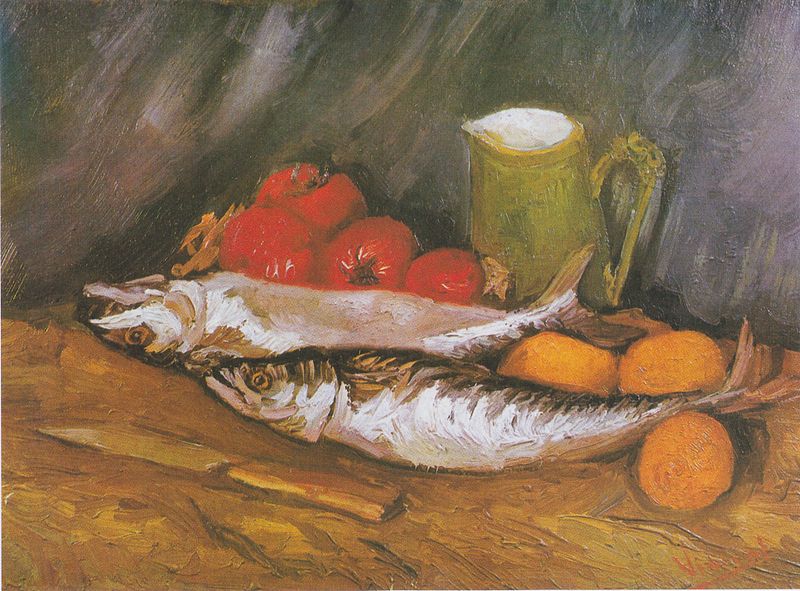
Image Credit: “Still Life with Mackerel, Lemon and Tomato” By Vincent Van Gogh (1886) Public Domain

SATURDAY POETRY SERIES PRESENTS: DEEP CALLS TO DEEP


From DEEP CALLS TO DEEP
By Jane Medved:


WINTER BURIAL

For the sky that reaches into its hushed pocket,
                                           for the bridle of winter waiting to be released.

For the ghost face which slips over everyone,
                                           for the tusk of the same white beginning.

For crystals that shape themselves while falling,
                                           for the storm’s icy laugh.

For the charred bars of the petting zoo,
                                           whose cages were made out of wood and went up fast.

For the twin goats trapped, for the small fire they turned their back on,
                                           the bread burning, the coffee.

For the one surviving goose housed in a Little Tikes kitchen,
                                           the black centers of his eyes and the string closing the door.

For the fenced-in storage area now zoned for a park,
                                           where there used to be patches of dried grass.

For the last time it snowed on the Jerusalem highway,
                                           and they wouldn’t let anyone in or out.

For the holiday makers who were stranded
                                           without fun.

For my niece’s baby who never woke up that day,
                                           she was an angel in her crib.

For they got her into the ground just before it froze,
                                           but no one knows where.

For the hidden ear of the tzaddik she is buried next to,
                                           for the cooing she drops into the ground where it melts.

For her small breaths, none of which are
                                           shaped the same.

For the soul, which cracks open the body,
                                           for the body, which is told what it must carry.

For when the ice let me back down the hill,
                                           I found my niece in her kitchen, forgiving everyone.


from THE LAST TIME I SAW HEROD

I. Women’s shelter, Miriam HaHashmonait St., Jerusalem

He was banging on the gate
even though there is no way
to know that we are in here.

He was looking for his wife,
aren’t they all, which is why
we make the children play

in the yard and of course
he knew her real name,
which makes me wonder

what’s the point of being
a princess if even that
can be taken away. I’m not

sorry he looked thin. I used
to feed my own husband
but I never watched him eat.

In my mind he was gulping
me down, tearing everything
apart so as not to miss a piece.


EVERYTHING WILL TELL ITS OWN STORY

sooner or later, coins, a copper lantern,
bits of colored glass, Napoleon’s diary
on loan from Harvard and the endless
lap of water at the world’s toothless edge.

These were found in the Phoenician port
where Napoleon threw his cannonballs
into the Mediterranean to lighten the load.
He wised up soon enough and tossed
his soldiers overboard instead.

The metal balls are shocked into rust
and stare like thick black eyeballs
from their shelf in the dusty museum.
History ignores the bodies though,
their bones turn to fine sand
that tricks the treasure hunters
with its unpredictable lapses. Never mind.

We are all one part ocean anyway,
which is why sex smells like fish, and waves
always come back to a dry river bed.

We are all one part earth, which is why
snow angels cannot fly but lose themselves
to the ground, only the children
leave a clue, a small piece of spine
that still remains even if they are forced into ashes.

We are all one part fire, angry
as a kidney stone, a fist, absolutely certain,
a blaze that hides for months in the smoking
roots of the rotem tree, waiting
to be lifted out, spoken into flame and taken.

We are all one part wind, did you notice
how birds spread out like notes
when they fly, faithful as radio beams
to their unseen connections.

I inhale the invisibility of it, using up
my appointed breaths, certain
that the air will always pass through me
cold and hot and justified.


WHICH IS TO SAY,

                               there is another way home.
                                                                                Just
yesterday, I saw the beating arc of starlings

who migrate to the Negev every year. It was late
and you have to take my word for this. They

became a single body that exhaled a melody
of startled scales made out of bones and feathers,

a flock of notes that scattered to swoop and play,
then reassemble in a different serenade, a fist of

sky squeezing its shape, or the curve of a swan’s
neck.
                   It was remarkable,
                                                      how soundless waves
could cart away the distance,
                                               and how I forgave,
in that moment, everyone.
                                                             Which is to say,

that the desert is a grave and lonely place,
where silence reappears as another kind of music.


Today’s poems are from Deep Calls to Deep (New Rivers Press, 2017), copyright © 2017 by Jane Medved, and appear here today with permission from the poet.


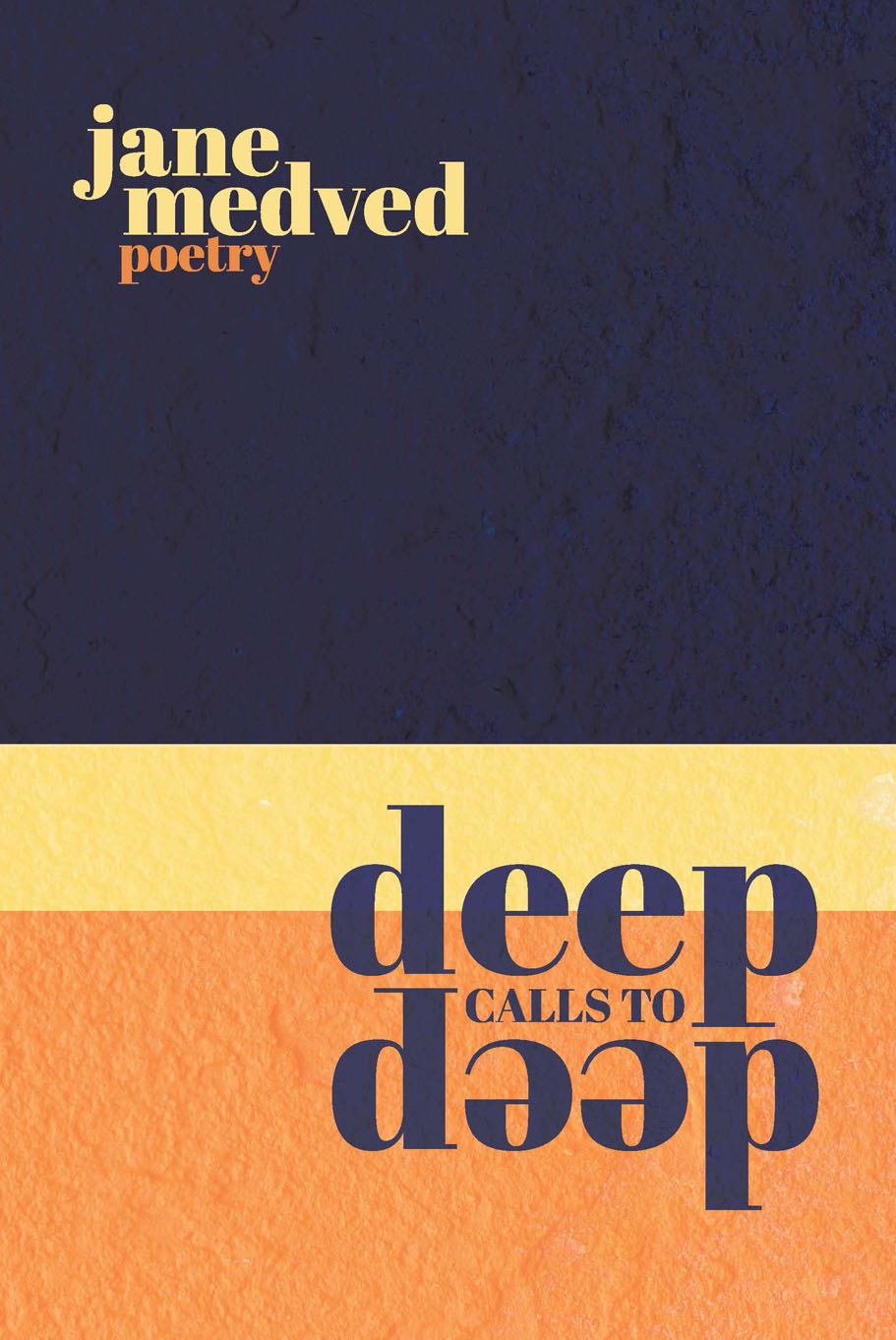
Deep Calls to Deep: “Taking its title from Psalm 42, Deep Calls to Deep explores the nexus between the depths of biblical history and the depths of the self, and the twin powers of faith and doubt that drive them both. Building from a masterful sequence exploring the legacies of Herod to a final richly lyrical sequence, Deep Calls to Deep becomes richer with multiple readings. With stunning formal variety and skill, it enacts not only the struggle to maintain faith, but to ground it equally in past and present, chaos and void, self and other.” — Leslie Adrienne Miller, author of Y and The Resurrection Trade

Jane Medved is the author of Deep Calls to Deep (winner of the Many Voices Project, New Rivers Press 2017) and the chapbook Olam, Shana, Nefesh (Finishing Line Press, 2014) Her recent essays and poems have appeared or are forthcoming in Queen Mob’s Teahouse, The Tampa Review, The Atticus Review, The Cortland Review, 2River View and Vinyl. She is the poetry editor of the Ilanot Review, the on-line literary magazine of Bar Ilan University, Tel Aviv. She lives and teaches creative writing in Jerusalem, Israel.

Editor’s Note: “History ignores the bodies,” but Jane Medved does not. It is through her own determined lens on history that the poet shapes this stunning new collection. The history she embraces is personal and familial, ancient and deeply entrenched, a history of people and place, of nature and land, of violence and loss. One might approach this work like an archaeologist, gentle and sifting, knowing that “coins, a copper lantern, bits of colored glass” are all precious, that every word and artifact you come across has a story to tell.

Deep Calls to Deep is ambitious, provocative, heart-wrenching and sacred. Within its pages the spiritual commingles with the archaeological, and words lay bare lost treasures like a desert wind revealing fact and fiction from beneath centuries of sand. The collection is divided into four sections, each so distinct and compelling that I could only begin to give you a taste of the whole by sharing a poem from each.

How visceral it is to read this collection. How engrossing. How evident on every page the capable hand of the poet who wrought the work, her knowledge and skill as writer and reader, how in tune she is with the human experience. Deep Calls to Deep is a masterpiece of the lyric, overflowing with stunning language and accessible imagery, at once startling in its beauty and reassuring in its familiarity. “Which is to say, // there is another way home… Which is to say, // that the desert is a grave and lonely place, / where silence reappears as another kind of music.”

Want more from Jane Medved?
Buy Deep Calls to Deep from Amazon
Queen Mob’s Teahouse
Cortland Review
2River View


A NOTE FROM THE MANAGING EDITOR:

After nearly ten years as Contributing Editor of this series, I am thrilled to expand my role to Managing Editor and provide the opportunity for fresh voices to contribute to this ongoing dialogue. It is an honor and a unique opportunity to now share this series with a number of guest editors, and we’ll be hearing more from them in the coming weeks. Today’s feature, however, is a labor of love from yours truly.

Viva la poesia!
Sivan, Managing Editor
Saturday Poetry Series, AIOTB


Bunkong Tuon: “Dancing Fu Manchu Master”

Dancing Fu Manchu Master

By Bunkong Tuon


Editor’s Note: This is the third post in a series of poems about the immigrant experience in America. Our late Managing Editor, Okla Elliott, featured Bunkong Tuon’s work on As It Ought To Be back in January of 2017. Okla was particularly concerned about the anti-immigration rhetoric heating up in America and he hoped to showcase the voices of immigrants on our site. In honor of Okla’s memory, Tuon has allowed us to feature more of his poetry about his experience as an immigrant from Cambodia in the United States. The full series of poems is available below.

.


Dancing Fu Manchu Master

One day, walking home

by myself, a blue plastic backpack slung

over my shoulders, a Christmas gift

from our sponsor, I noticed three boys

watching me from the convenience store

down the corner near an apartment complex.
The leader, a short, red-haired, chubby kid,
stepped out of the shadow, and called out,
“Ching Chong, are you from Hong Kong?”

I quickened my pace pretending

to hear my Grandmother calling me.

“Hey, can you help me with my math homework?”
They burst out laughing.

Seeing me walk firmly away, they slurred out

a slew of hurtful words.

“Why don’t you go back to China?”

“Do you eat dogs where you come from?”

“You use grass and leaves to wipe your ass, right?”
“Do you know Kung Fu?”

With this last question saliva,

warm and gooey, hit my neck.

I closed my eyes, counted my steps,
mindful of my breath, my heart slowed.
I jumped and turned,

thirty feet straight into the air,

took out my sword, with a flick

of the wrist, saw heads roll,

tumbling away down the sidewalk,
bodies slumped behind:

red blossoming concrete.

Trained in the mysterious arts

of Dr. Fu Manchu, I made myself
disappear before the police arrived.

.


About the Author: Bunkong Tuon is the author of Gruel (2015) and And So I Was Blessed (2017), both poetry collections published by NYQ Books, and a regular contributor to Cultural Weekly  He is also an associate professor of English and Asian Studies at Union College, in Schenectady, NY.


Previous poems from Bunkong Tuon’s series on the immigrant experience in America:

Our Neighborhood in Revere, MA

Snow Day

An Elegy for a Fellow Cambodian

Halloween, 1985

Dancing Fu Manchu Master

Fishing for Trey Platoo

Lies I Told About Father

SATURDAY POETRY SERIES PRESENTS: LYNN POWELL


By Lynn Powell:


THE MOON RISING

Sly old guru, Rorschach moon,
you’re calling me again with your round riddle,
your paradox of Ohm and moan.
All day the sun was up on its soapbox, a Pollyanna
casting out the darkness in everybody else.
Now we’re back at the window where we started—
me with my midnight weakness, and you
with your sleight-of-silver ministry
to anyone unguarded and alone.

Slow moon, you’ve lingered near the cloister and the dance hall,
laid your soft law down on wide and narrow beds.
You’ve faced yourself in ponds, thrown yourself
on the mercy of a moody sea. You’ve been the slick
Houdini of horizons, sliding out of each tight spot
the night has tried to trap you in.
What’s left for me to misconstrue?

I’m tired of my mind and its whitewash,
tired of your low-light revelations.
And how will I find the dark forest if you keep
murmuring silky nothings to the trees?

Cold moon, unmake me
in your image. Pare me down
to the bleak beatitude, the black sum
of all you know for sure.


AT THE EQUINOX

             Has the rain a father, or who has begotten the drops of dew?
                                                                         —Job 38:28

From the car window, after the fog lifts,
the autumn fields flash with sudden flowers—

              like filigrees of mirror, like alloys of lace and light.

A weird miracle? Some brilliant, manic manna?
Until, of course, it’s only spiders—ten thousand

              that have worked the dark with rigs of silk

to snag a fly and then, surprising themselves,
have step-fathered the dew.

              And so, for an odd hour, hunger

glistens in galaxies, sieved
from passing thoughts of lake and air.


Today’s poems are from the collection Season of the Second Thought (University of Wisconsin Press, 2017), copyright Lynn Powell, and appear here today with permission from the poet.

Lynn Powell has published three books of poetry: Season of the Second Thought (winner of the 2017 Felix Pollak Prize), The Zones of Paradise, and Old & New Testaments. Her nonfiction book Framing Innocence won the Studs & Ida Terkel Award from The New Press in 2010. A native of East Tennessee, Powell teaches in the Creative Writing Program of Oberlin College.

Guest Editor’s Note: Lynn Powell’s work is reminiscent of “The Parable of the Sunfish” in Ezra Pound’s ABC of Reading. Powell is a poet who gains deep understanding and insight into her subjects, examining them over and over from unique angles until she has observed their essence. In “The Moon Rising,” for instance, the moon is a “Sly, old guru” a “Rorschach,” a “slick/Houdini of the horizons.” It possesses a “slight of hand ministry” or can lay its “soft law down on wide and narrow beds.”

Throughout her collection Seasons of the Second Thought, line by line Powell examines, prods, and dissects until she has mastered her subject, rewarding her readers with an intimacy and understanding that is both profound and revealing. In “At the Equinox,” she observes the world with such intensity that she is able to see the creators of the miracle she is viewing not as their mundane selves — “only spiders—ten thousand” — but as creatures that “have step-fathered the dew.” Powell’s work is an enlightenment that allows the reader to see the world for what it can be when observed fully.

Want to read more by and about Lynn Powell?
Buy Seasons of the Second Thought from University of Wisconsin Press
POETRY Magazine
Bellingham Review
Shenandoah
American Literary Review


Guest Editor Alan Toltzis is the author of The Last Commandment. Recent work has appeared in print and online publications including Hummingbird, Right Hand Pointing, IthacaLit, r.k.v.r.y. Quarterly, and Cold Noon. Find him online at alantoltzis.com.

A NOTE FROM THE MANAGING EDITOR:

After nearly ten years as Contributing Editor of this series, it is an honor and a unique opportunity to share this space with a number of guest editors, including the editor featured here today. I am thrilled to usher in an era of new voices in poetry as the Managing Editor of this series.

Viva la poesia!
Sivan, Managing Editor
Saturday Poetry Series, AIOTB